CUET 2026 May 15 Shift 1 Economics Question Paper is available for download here. NTA is conducting the CUET 2026 exam from 11th May to 31st May.
- CUET 2026 Economics exam consists of 50 questions for 250 marks to be attempted in 60 minutes.
- As per the marking scheme, 5 marks are awarded for each correct answer, and 1 mark is deducted for incorrect answer.
Candidates can download CUET 2026 May 15 Shift 1 Economics Question Paper with Answer Key and Solution PDF from links provided below.
Related Links:
CUET 2026 Economics May 15 Shift 1 Question Paper with Solution PDF
| CUET May 15 Shift 1 Economics Question Paper 2026 | Download PDF | Check Solutions |
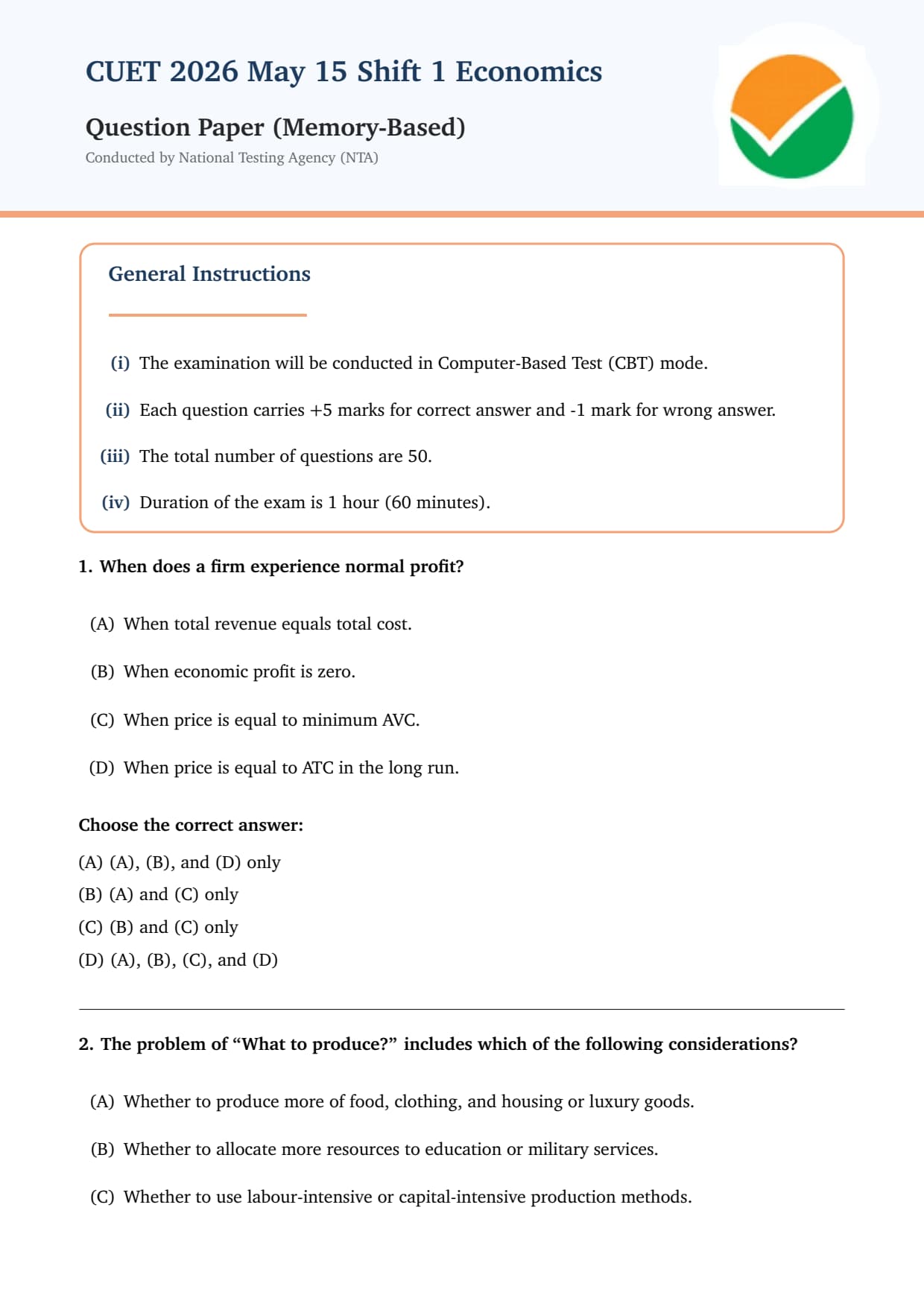
When does a firm experience normal profit?
(A) When total revenue equals total cost.
(B) When economic profit is zero.
(C) When price is equal to minimum AVC.
(D) When price is equal to ATC in the long run.
Choose the correct answer:
View Solution
Step 1: Understand normal profit.
Normal profit occurs when: \[ \mathrm{Total\ Revenue = Total\ Cost} \]
Thus: \[ \mathrm{Economic\ Profit = 0} \]
Hence statements (A) and (B) are correct.
Step 2: Analyze statement (C).
Price equal to minimum AVC represents shutdown point condition in short run.
It does not necessarily imply normal profit.
\[ \Rightarrow \mathrm{Incorrect} \]
Step 3: Analyze statement (D).
In long run equilibrium: \[ P=ATC \]
At this point firms earn: \[ \mathrm{Normal\ Profit} \]
Hence: \[ \Rightarrow \mathrm{Correct} \]
Step 4: Identify correct combination.
Correct statements are: \[ (A),\ (B),\ and\ (D) \]
Therefore, the correct answer is: \[ \boxed{\mathrm{(A)}} \] Quick Tip: Normal Profit: \[ TR=TC \] \[ \mathrm{Economic\ Profit}=0 \] Long run equilibrium: \[ P=ATC \]
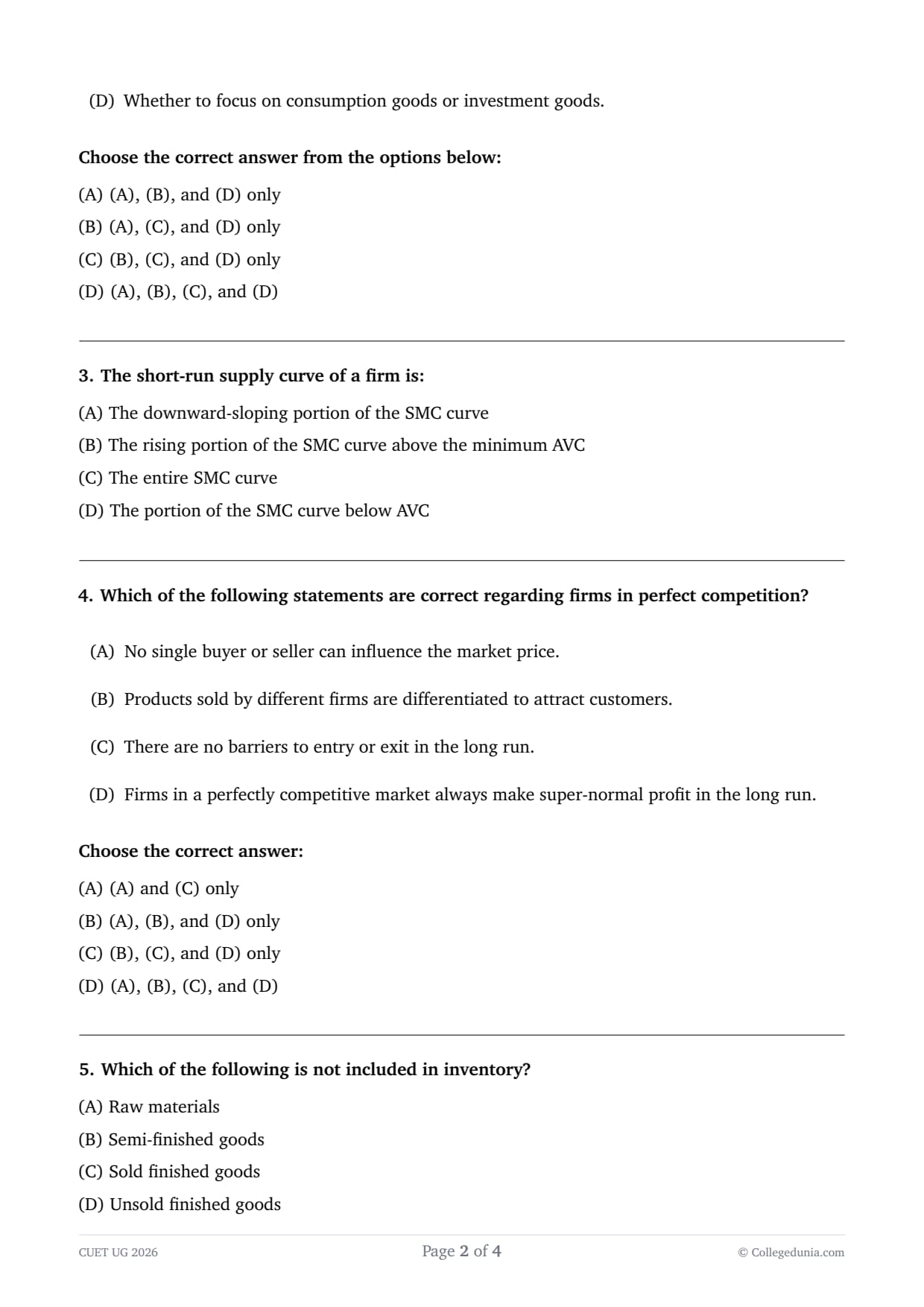
The problem of ``What to produce?'' includes which of the following considerations?
(A) Whether to produce more of food, clothing, and housing or luxury goods.
(B) Whether to allocate more resources to education or military services.
(C) Whether to use labour-intensive or capital-intensive production methods.
(D) Whether to focus on consumption goods or investment goods.
Choose the correct answer from the options below:
View Solution
Step 1: Understand the problem of ``What to produce?''
This central problem of an economy deals with:
Choice among different goods and services
Allocation of scarce resources
Priority of production
Step 2: Analyze statement (A).
Choosing between: \[ \mathrm{Necessities\ and\ Luxury\ Goods} \]
is part of deciding what goods should be produced.
\[ \Rightarrow \mathrm{Correct} \]
Step 3: Analyze statement (B).
Allocation of resources between: \[ \mathrm{Education\ and\ Military\ Services} \]
is also related to what society wants to produce.
\[ \Rightarrow \mathrm{Correct} \]
Step 4: Analyze statement (C).
Choice between: \[ \mathrm{Labour-Intensive\ and\ Capital-Intensive} \]
methods belongs to: \[ \mathrm{How\ to\ Produce} \]
not what to produce.
\[ \Rightarrow \mathrm{Incorrect} \]
Step 5: Analyze statement (D).
Choosing between: \[ \mathrm{Consumption\ Goods\ and\ Investment\ Goods} \]
is also a part of deciding what to produce.
\[ \Rightarrow \mathrm{Correct} \]
Step 6: Identify the correct combination.
Correct statements are: \[ (A),\ (B),\ and\ (D) \]
Hence, the correct answer is: \[ \boxed{\mathrm{(A)}} \] Quick Tip: Central problems of an economy: \[ \mathrm{What\ to\ Produce} \] \[ \mathrm{How\ to\ Produce} \] \[ \mathrm{For\ Whom\ to\ Produce} \]
The short-run supply curve of a firm is:
View Solution
Step 1: Understand short-run supply curve.
In the short run, a firm will continue production only if: \[ P \geq AVC \]
If price falls below AVC, the firm shuts down.
Step 2: Relation between SMC and supply curve.
The firm's short-run supply curve is: \[ \mathrm{That\ portion\ of\ SMC\ curve\ which\ lies\ above\ minimum\ AVC} \]
because:
SMC determines output level
AVC determines shutdown point
Step 3: Analyze the options.
Option (A)
Downward-sloping portion cannot be supply curve.
\[ \Rightarrow \mathrm{Incorrect} \]
Option (B)
Correct definition of short-run supply curve.
\[ \Rightarrow \mathrm{Correct} \]
Option (C)
Entire SMC curve includes portion below AVC.
\[ \Rightarrow \mathrm{Incorrect} \]
Option (D)
Below AVC firm shuts down.
\[ \Rightarrow \mathrm{Incorrect} \]
Step 4: Identify the correct option.
Therefore: \[ \boxed{\mathrm{The\ rising\ portion\ of\ SMC\ above\ minimum\ AVC}} \]
Hence, the correct answer is: \[ \boxed{\mathrm{(B)}} \] Quick Tip: Short-run supply curve: \[ \mathrm{SMC\ above\ minimum\ AVC} \] Shutdown condition: \[ P
Which of the following statements are correct regarding firms in perfect competition?
(A) No single buyer or seller can influence the market price.
(B) Products sold by different firms are differentiated to attract customers.
(C) There are no barriers to entry or exit in the long run.
(D) Firms in a perfectly competitive market always make super-normal profit in the long run.
Choose the correct answer:
View Solution
Step 1: Analyze statement (A).
In perfect competition: \[ \mathrm{No\ individual\ buyer\ or\ seller\ can\ influence\ market\ price} \]
Firms are: \[ \mathrm{Price\ Takers} \]
Hence: \[ \Rightarrow \mathrm{Correct} \]
Step 2: Analyze statement (B).
In perfect competition: \[ \mathrm{Products\ are\ homogeneous} \]
There is no product differentiation.
\[ \Rightarrow \mathrm{Incorrect} \]
Step 3: Analyze statement (C).
Perfect competition assumes: \[ \mathrm{Free\ Entry\ and\ Exit} \]
Thus: \[ \Rightarrow \mathrm{Correct} \]
Step 4: Analyze statement (D).
In long run equilibrium: \[ P=ATC \]
Firms earn only: \[ \mathrm{Normal\ Profit} \]
not super-normal profit.
\[ \Rightarrow \mathrm{Incorrect} \]
Step 5: Identify correct combination.
Correct statements are: \[ (A)\ and\ (C) \]
Hence, the correct answer is: \[ \boxed{\mathrm{(A)}} \] Quick Tip: Features of perfect competition: \[ \mathrm{Homogeneous\ Product} \] \[ \mathrm{Free\ Entry\ and\ Exit} \] \[ \mathrm{Price\ Taking\ Firms} \]
Which of the following is not included in inventory?
View Solution
Step 1: Understand the meaning of inventory.
Inventory refers to stock of goods held by a business for:
Production
Sale
Future use
Step 2: Identify items included in inventory.
Inventory generally includes:
Raw materials
Work-in-progress or semi-finished goods
Unsold finished goods
Step 3: Analyze the options.
Raw materials
Used for production.
\[ \Rightarrow \mathrm{Included} \]
Semi-finished goods
Partially completed goods.
\[ \Rightarrow \mathrm{Included} \]
Sold finished goods
Once sold, they are no longer part of stock.
\[ \Rightarrow \mathrm{Not\ Included} \]
Unsold finished goods
Available for sale and part of inventory.
\[ \Rightarrow \mathrm{Included} \]
Step 4: Identify the correct option.
Therefore: \[ \boxed{\mathrm{Sold\ Finished\ Goods}} \]
Hence, the correct answer is: \[ \boxed{\mathrm{(C)}} \] Quick Tip: Inventory includes: \[ \mathrm{Raw\ Materials} \] \[ \mathrm{Work-in-Progress} \] \[ \mathrm{Unsold\ Finished\ Goods} \]
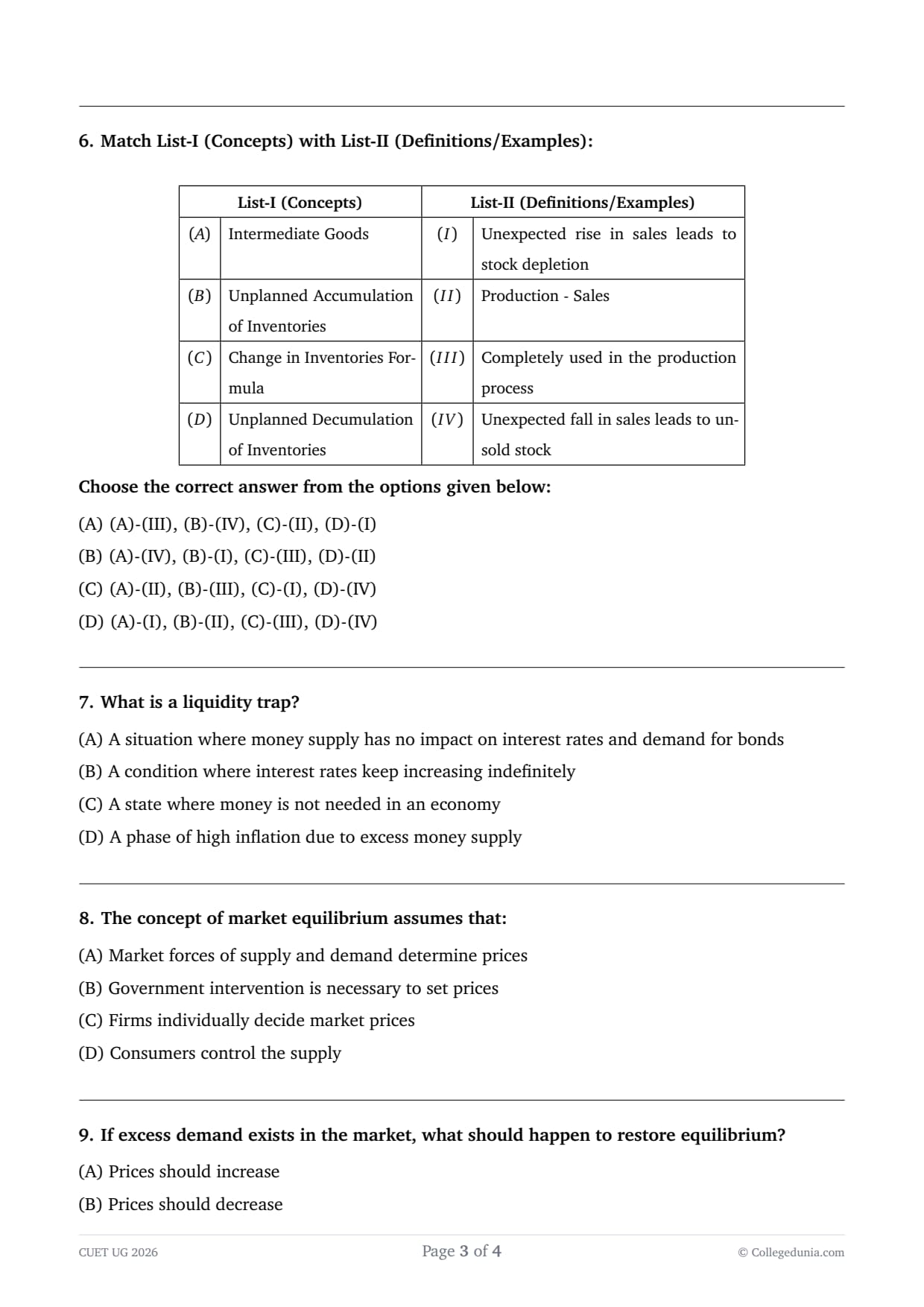
Match List-I (Concepts) with List-II (Definitions/Examples)
| List-I (Concepts) | List-II (Definitions/Examples) | ||
|---|---|---|---|
| (A) | Intermediate Goods | (I) | Unexpected rise in sales leads to stock depletion |
| (B) | Unplanned Accumulation of Inventories | (II) | Production - Sales |
| (C) | Change in Inventories Formula | (III) | Completely used in the production process |
| (D) | Unplanned Decumulation of Inventories | (IV) | Unexpected fall in sales leads to unsold stock |
Choose the correct answer from the options given below:
View Solution
Step 1: Match Intermediate Goods.
Intermediate goods are: \[ \mathrm{Goods\ completely\ used\ in\ production} \]
Thus: \[ (A)\rightarrow(III) \]
Step 2: Match Unplanned Accumulation of Inventories.
When sales unexpectedly fall: \[ \mathrm{Unsold\ stock\ increases} \]
This leads to: \[ \mathrm{Unplanned\ Accumulation} \]
Thus: \[ (B)\rightarrow(IV) \]
Step 3: Match Change in Inventories Formula.
Change in inventories is: \[ \mathrm{Production - Sales} \]
Thus: \[ (C)\rightarrow(II) \]
Step 4: Match Unplanned Decumulation of Inventories.
Unexpected rise in sales causes: \[ \mathrm{Stock\ depletion} \]
Thus: \[ (D)\rightarrow(I) \]
Step 5: Identify correct option.
Correct matching is: \[ (A)\rightarrow(III) \]
\[ (B)\rightarrow(IV) \]
\[ (C)\rightarrow(II) \]
\[ (D)\rightarrow(I) \]
Hence, the correct answer is: \[ \boxed{\mathrm{(A)}} \] Quick Tip: Inventory Change: \[ \mathrm{Production - Sales} \] Unplanned accumulation: \[ \mathrm{Sales < Production} \] Unplanned decumulation: \[ \mathrm{Sales > Production} \]
What is a liquidity trap?
View Solution
Step 1: Understand liquidity trap.
Liquidity trap is a situation where: \[ \mathrm{Interest\ rates\ become\ extremely\ low} \]
and people prefer holding cash instead of bonds.
Step 2: Effect of increasing money supply.
In liquidity trap: \[ \mathrm{Increase\ in\ money\ supply} \]
does not reduce interest rate further.
Thus monetary policy becomes ineffective.
\[ \Rightarrow \mathrm{Money\ supply\ has\ little\ or\ no\ impact} \]
on:
Interest rates
Demand for bonds
Step 3: Analyze remaining options.
Option (B)
Liquidity trap occurs at very low interest rates, not indefinitely increasing rates.
\[ \Rightarrow \mathrm{Incorrect} \]
Option (C)
Money continues to be important in the economy.
\[ \Rightarrow \mathrm{Incorrect} \]
Option (D)
Liquidity trap is related to recession and low interest rates, not high inflation.
\[ \Rightarrow \mathrm{Incorrect} \]
Step 4: Identify the correct option.
Therefore: \[ \boxed{\mathrm{Money\ supply\ has\ no\ significant\ impact\ on\ interest\ rates}} \]
Hence, the correct answer is: \[ \boxed{\mathrm{(A)}} \] Quick Tip: Liquidity trap occurs when: \[ \mathrm{Interest\ Rates\ are\ Extremely\ Low} \] People prefer: \[ \mathrm{Holding\ Cash\ instead\ of\ Bonds} \]
The concept of market equilibrium assumes that:
View Solution
Step 1: Understand market equilibrium.
Market equilibrium occurs when: \[ \mathrm{Quantity\ Demanded = Quantity\ Supplied} \]
At this point: \[ \mathrm{Market\ Price} \]
is determined through interaction of: \[ \mathrm{Demand\ and\ Supply} \]
Step 2: Analyze the options.
Option (A)
Prices are determined by: \[ \mathrm{Market\ Forces\ of\ Demand\ and\ Supply} \]
\[ \Rightarrow \mathrm{Correct} \]
Option (B)
Government intervention is not necessary in free market equilibrium.
\[ \Rightarrow \mathrm{Incorrect} \]
Option (C)
Individual firms are price takers in competitive markets.
\[ \Rightarrow \mathrm{Incorrect} \]
Option (D)
Consumers influence demand, not supply directly.
\[ \Rightarrow \mathrm{Incorrect} \]
Step 3: Identify the correct option.
Therefore: \[ \boxed{\mathrm{Market\ Forces\ of\ Supply\ and\ Demand\ Determine\ Prices}} \]
Hence, the correct answer is: \[ \boxed{\mathrm{(A)}} \] Quick Tip: Market equilibrium: \[ Q_d = Q_s \] Price is determined by: \[ \mathrm{Demand\ and\ Supply} \]
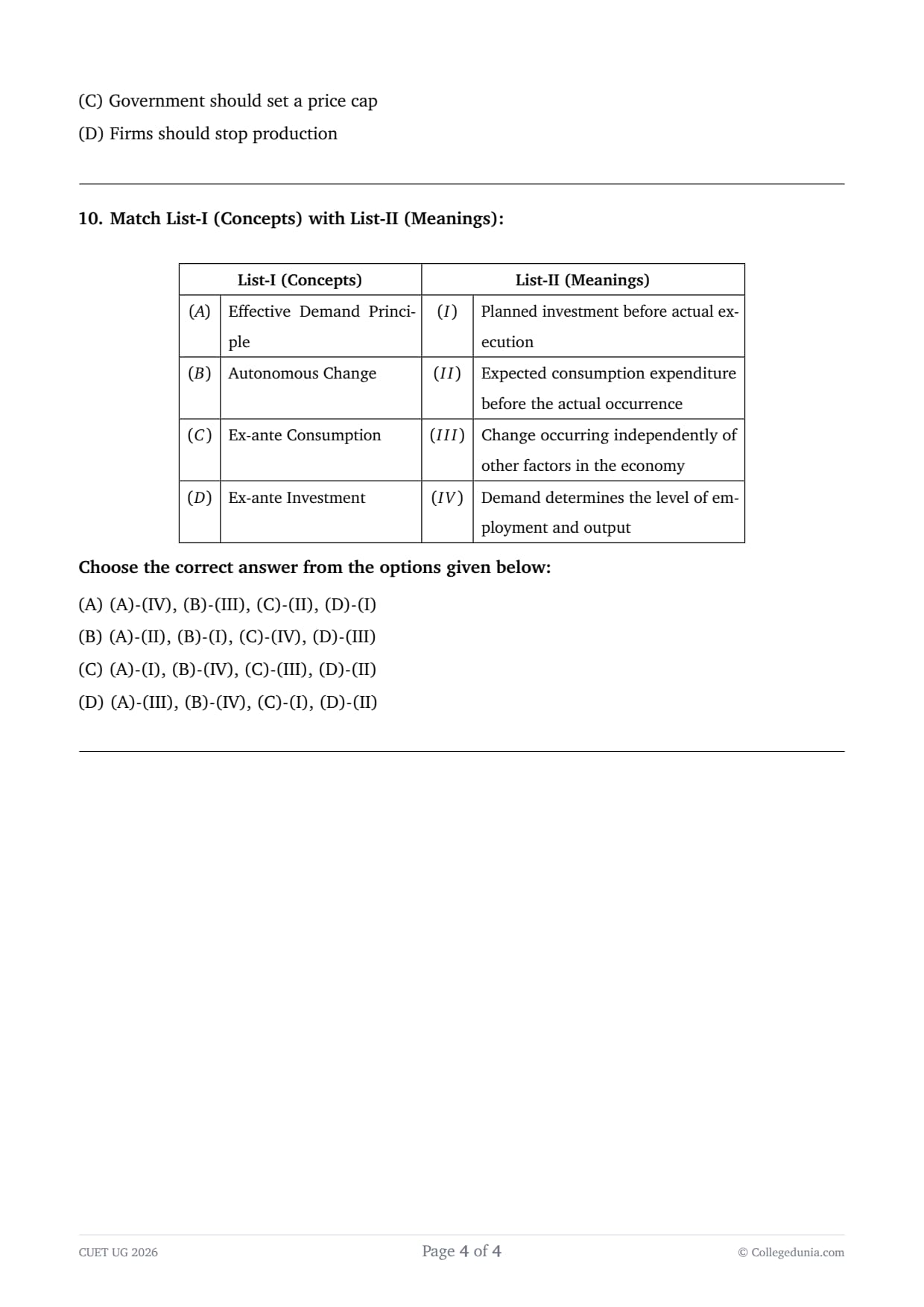
If excess demand exists in the market, what should happen to restore equilibrium?
View Solution
Step 1: Understand excess demand.
Excess demand occurs when: \[ Q_d > Q_s \]
that is: \[ \mathrm{Quantity\ Demanded > Quantity\ Supplied} \]
This creates shortage in the market.
Step 2: Effect on price.
Due to shortage: \[ \mathrm{Buyers\ compete\ for\ limited\ goods} \]
As a result: \[ \mathrm{Price\ rises} \]
Step 3: How equilibrium is restored.
Increase in price:
Reduces demand
Increases supply
Eventually: \[ Q_d = Q_s \]
and equilibrium is restored.
Step 4: Analyze remaining options.
Option (B)
Price decrease would increase excess demand further.
\[ \Rightarrow \mathrm{Incorrect} \]
Option (C)
Price cap may worsen shortage.
\[ \Rightarrow \mathrm{Incorrect} \]
Option (D)
Stopping production reduces supply further.
\[ \Rightarrow \mathrm{Incorrect} \]
Step 5: Identify the correct option.
Therefore: \[ \boxed{\mathrm{Prices\ should\ increase}} \]
Hence, the correct answer is: \[ \boxed{\mathrm{(A)}} \] Quick Tip: Excess demand: \[ Q_d > Q_s \] Leads to: \[ \mathrm{Rise\ in\ Price} \]
Match List-I (Concepts) with List-II (Meanings)
| List-I (Concepts) | List-II (Meanings) | ||
|---|---|---|---|
| (A) | Effective Demand Principle | (I) | Planned investment before actual execution |
| (B) | Autonomous Change | (II) | Expected consumption expenditure before the actual occurrence |
| (C) | Ex-ante Consumption | (III) | Change occurring independently of other factors in the economy |
| (D) | Ex-ante Investment | (IV) | Demand determines the level of employment and output |
Choose the correct answer from the options given below:
View Solution
Step 1: Match Effective Demand Principle.
According to Keynes: \[ \mathrm{Demand\ determines\ employment\ and\ output} \]
Thus: \[ (A)\rightarrow(IV) \]
Step 2: Match Autonomous Change.
Autonomous change means: \[ \mathrm{Change\ independent\ of\ other\ economic\ factors} \]
Thus: \[ (B)\rightarrow(III) \]
Step 3: Match Ex-ante Consumption.
Ex-ante consumption means: \[ \mathrm{Planned\ or\ expected\ consumption\ expenditure} \]
before actual occurrence.
Thus: \[ (C)\rightarrow(II) \]
Step 4: Match Ex-ante Investment.
Ex-ante investment means: \[ \mathrm{Planned\ investment} \]
before actual execution.
Thus: \[ (D)\rightarrow(I) \]
Step 5: Identify correct combination.
Correct matching is: \[ (A)\rightarrow(IV) \]
\[ (B)\rightarrow(III) \]
\[ (C)\rightarrow(II) \]
\[ (D)\rightarrow(I) \]
Hence, the correct answer is: \[ \boxed{\mathrm{(A)}} \] Quick Tip: Ex-ante: \[ \mathrm{Planned\ Values} \] Ex-post: \[ \mathrm{Actual\ Values} \]
CUET UG 2026 Exam Pattern
| Parameter | Details |
|---|---|
| Exam Name | Common University Entrance Test (CUET UG) 2026 |
| Conducting Body | National Testing Agency (NTA) |
| Exam Mode | Computer-Based Test (CBT) |
| Exam Duration | 60 minutes per test |
| Total Sections | 3 (Languages, Domain Subjects, General Test) |
| Question Type | Multiple Choice Questions (MCQs) |
| Questions per Test | 50 questions (all compulsory) |
| Marking Scheme | +5 for correct, -1 for incorrect |
| Maximum Marks | 250 marks per test |
| Maximum Subject Choices | 5 subjects in total |
| Syllabus Base | Class 12 NCERT (mainly for Domain Subjects) |





Comments