CUET 2026 May 15 Shift 1 Biology Question Paper is available for download here. NTA is conducting the CUET 2026 exam from 11th May to 31st May.
- CUET 2026 Biology exam consists of 50 questions for 250 marks to be attempted in 60 minutes.
- As per the marking scheme, 5 marks are awarded for each correct answer, and 1 mark is deducted for incorrect answer.
Candidates can download CUET 2026 May 15 Shift 1 Biology Question Paper with Answer Key and Solution PDF from links provided below.
Related Links:
CUET 2026 Biology May 15 Shift 1 Question Paper with Solution PDF
| CUET May 15 Shift 1 Biology Question Paper 2026 | Download PDF | Check Solutions |
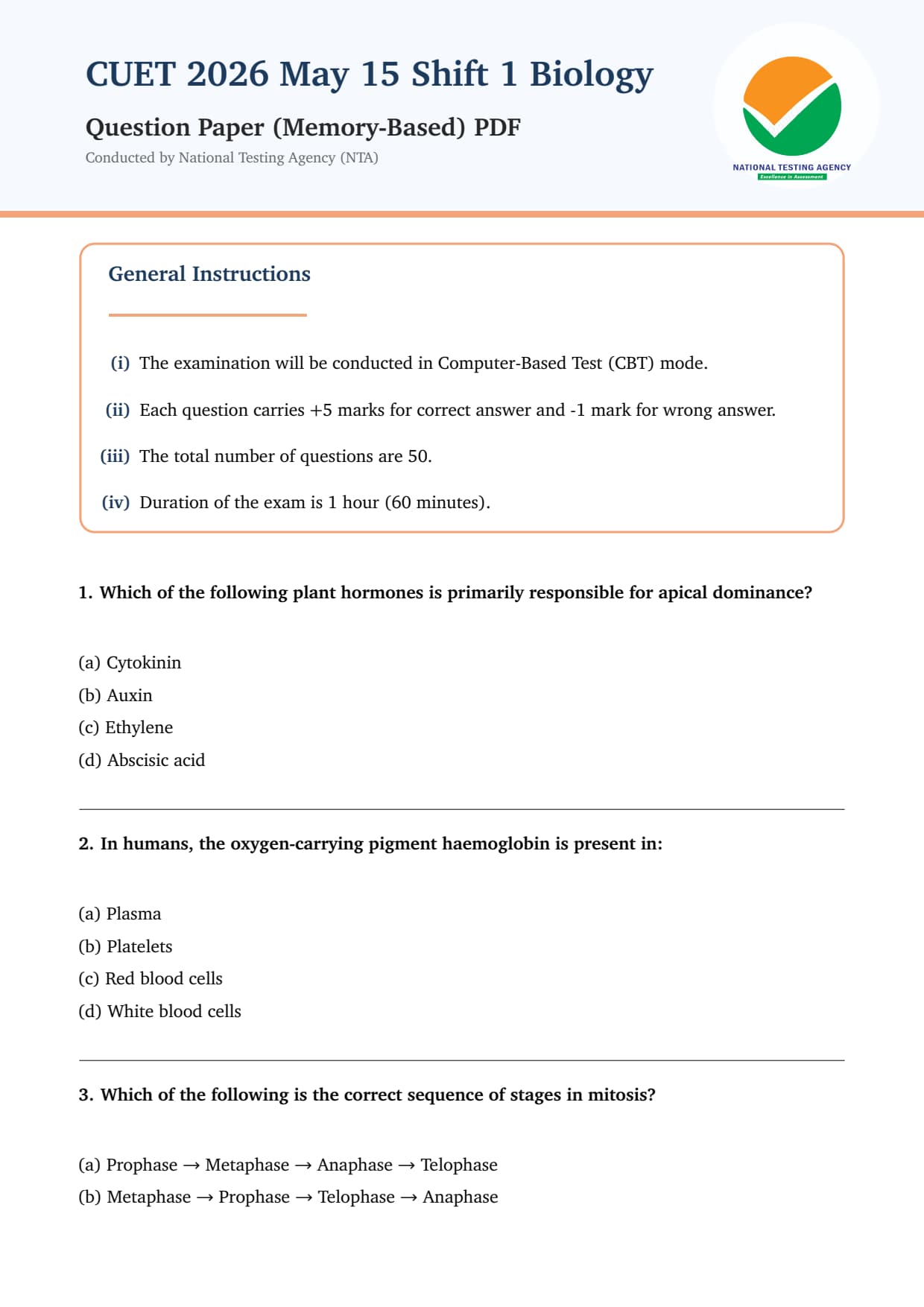
Which of the following plant hormones is primarily responsible for apical dominance?
View Solution
Step 1: Understanding the Concept:
Apical dominance is a phenomenon where the central stem of a plant grows more strongly than the side (lateral) stems. This is controlled by chemical messengers called hormones.
Step 2: Key Formula or Approach:
The primary hormone produced in the shoot tip (apex) is Auxin.
Step 3: Detailed Explanation:
Auxin is synthesized at the tip of the stem. It moves downward and inhibits the growth of lateral buds. This ensures the plant grows vertically toward light. If the tip is removed, the source of auxin is gone, allowing lateral buds to grow, which makes the plant "bushy."
Step 4: Final Answer:
The hormone primarily responsible for apical dominance is Auxin. Quick Tip: To remember this, think: Auxin = Apical. It's all about the "A" level growth!
In humans, the oxygen-carrying pigment haemoglobin is present in:
View Solution
Step 1: Understanding the Concept:
Blood is composed of different specialized components. Hemoglobin is a complex protein that has a high affinity for oxygen.
Step 2: Key Formula or Approach:
Red Blood Cells (RBCs), also known as Erythrocytes, are the primary vehicles for gas transport in the body.
Step 3: Detailed Explanation:
Hemoglobin contains iron, which binds to oxygen molecules in the lungs. Because RBCs are packed with hemoglobin, they can transport oxygen to tissues throughout the body. Their biconcave shape also increases the surface area for this exchange.
Step 4: Final Answer:
Hemoglobin is found within the Red blood cells. Quick Tip: Hemoglobin contains iron. This iron is what gives blood its Red color, which is why it's found in the Red blood cells!
Which of the following is the correct sequence of stages in mitosis?
View Solution
Step 1: Understanding the Concept:
Mitosis is the process of cell division that results in two genetically identical daughter cells. It follows a very strict, logical order to ensure DNA is divided correctly.
Step 2: Key Formula or Approach:
The standard order of phases is often remembered by the acronym PMAT.
Step 3: Detailed Explanation:
Prophase: Chromosomes condense and the nuclear envelope breaks down.
Metaphase: Chromosomes line up in the Middle of the cell.
Anaphase: Sister chromatids are pulled Away toward opposite poles.
Telophase: Two new nuclei form at the ends of the cell.
Step 4: Final Answer:
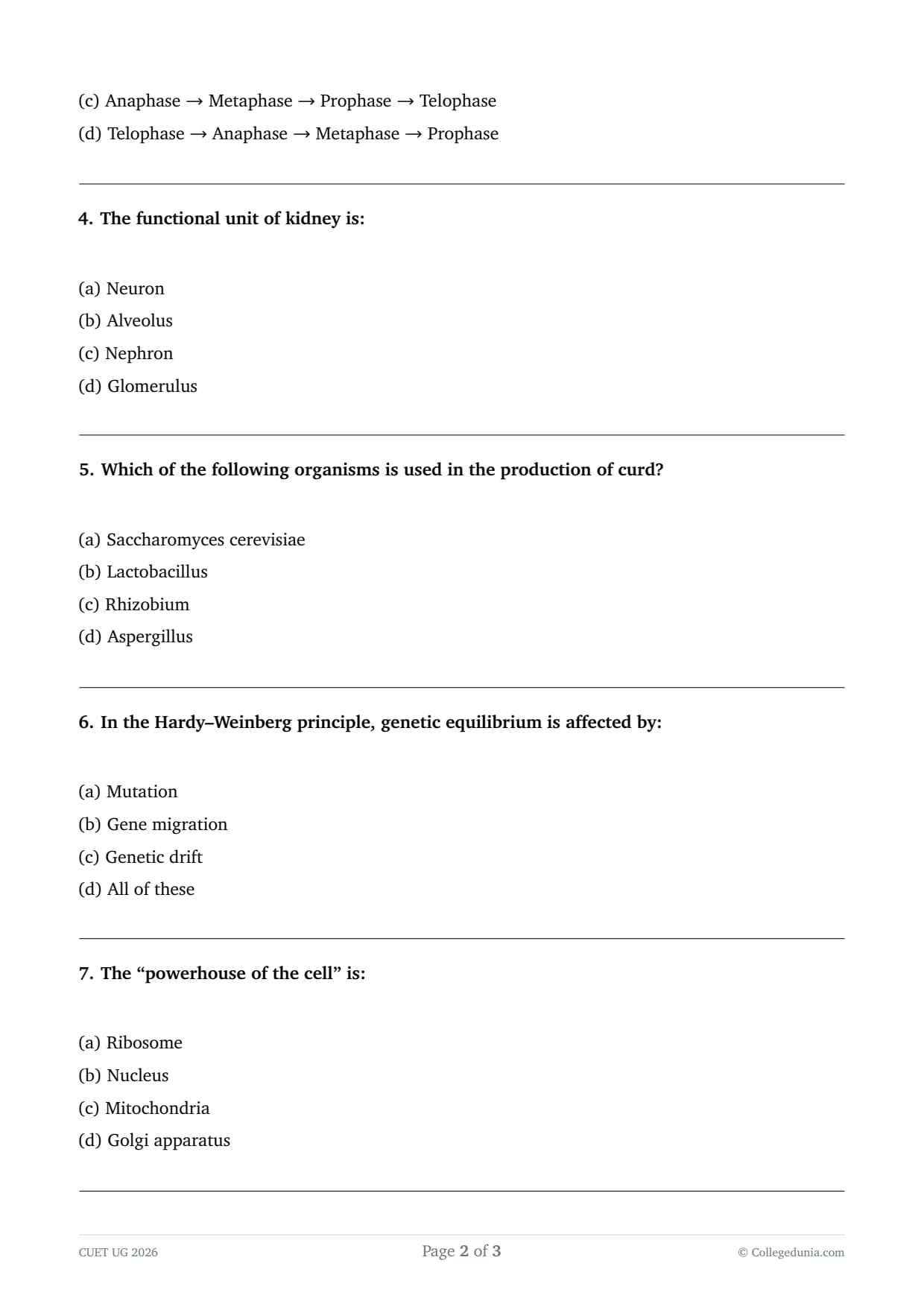
The correct sequence is Prophase \(\rightarrow\) Metaphase \(\rightarrow\) Anaphase \(\rightarrow\) Telophase. Quick Tip: Use the mnemonic: Please Make Another Two. (Prophase, Metaphase, Anaphase, Telophase).
The functional unit of kidney is:
View Solution
Step 1: Understanding the Concept:
Every major organ has a specialized microscopic structure that performs the organ's primary job. For the kidney, this job is filtering blood and forming urine.
Step 2: Key Formula or Approach:
Distinguish between the units of different systems:
Neuron: Nervous system unit.
Alveolus: Respiratory system unit.
Nephron: Excretory system unit.
Step 3: Detailed Explanation:
A single human kidney contains about one million nephrons. A nephron consists of a renal corpuscle (which includes the glomerulus) and a renal tubule. It filters waste products from the blood while reabsorbing essential nutrients and water back into the bloodstream. While the glomerulus is a part of the nephron, the nephron as a whole is considered the complete functional unit.
Step 4: Final Answer:
The functional unit of the kidney is the Nephron. Quick Tip: Don't confuse Neuron with Nephron. Remember: N-E-P-H relates to the NEPHrology (the study of kidneys).
Which of the following organisms is used in the production of curd?
View Solution
Step 1: Understanding the Concept:
Curd formation is a biochemical process where milk proteins are coagulated by the action of specific bacteria that convert sugars into acid.
Step 2: Key Formula or Approach:
Lactic Acid Bacteria (LAB) are the primary agents in dairy fermentation.
Step 3: Detailed Explanation:
Lactobacillus bacteria convert the lactose sugar found in milk into lactic acid. This acid lowers the pH of the milk, causing the milk protein (casein) to denature and coagulate, turning the liquid milk into a thick solid (curd).
Step 4: Final Answer:
Lactobacillus is the organism used in the production of curd. Quick Tip: The name gives it away: Lacto (milk) + Bacillus (rod-shaped bacteria).
In the Hardy–Weinberg principle, genetic equilibrium is affected by:
View Solution
Step 1: Understanding the Concept:
The Hardy–Weinberg principle states that allele and genotype frequencies in a population will remain constant (in equilibrium) from generation to generation in the absence of evolutionary influences.
Step 2: Key Formula or Approach:
The mathematical equilibrium is expressed as: \(\)p^2 + 2pq + q^2 = 1\(\)
Where \(p\) and \(q\) represent the frequency of alleles.
Step 3: Detailed Explanation:
For equilibrium to exist, five conditions must be met: no mutation, no gene flow (migration), large population size (no genetic drift), random mating, and no natural selection. If any of these occur, the equilibrium is disturbed:
Mutation: Introduces new alleles.
Gene migration: Moves alleles in or out of a population.
Genetic drift: Random changes in allele frequency in small populations.
Step 4: Final Answer:
All of the listed factors (Mutation, Gene migration, and Genetic drift) affect genetic equilibrium. Quick Tip: Hardy-Weinberg equilibrium is like a "still pond." Mutation, Migration, and Selection are the "stones" that create ripples and change the water's state.
The “powerhouse of the cell” is:
View Solution
Step 1: Understanding the Concept:
All living cells require energy to perform various functions. This energy must be converted into a form the cell can actually use.
Step 2: Key Formula or Approach:
The universal "energy currency" of the cell is Adenosine Triphosphate (ATP).
Step 3: Detailed Explanation:
Mitochondria are double-membraned organelles where cellular respiration takes place. They take in nutrients from the cell and break them down to create energy-rich molecules (ATP). Because this is where the cell's energy is produced, they are metaphorically called the "powerhouse."
Step 4: Final Answer:
Mitochondria is known as the powerhouse of the cell. Quick Tip: The inner membrane of mitochondria is folded into "cristae" to increase surface area, allowing more energy to be produced in a smaller space!
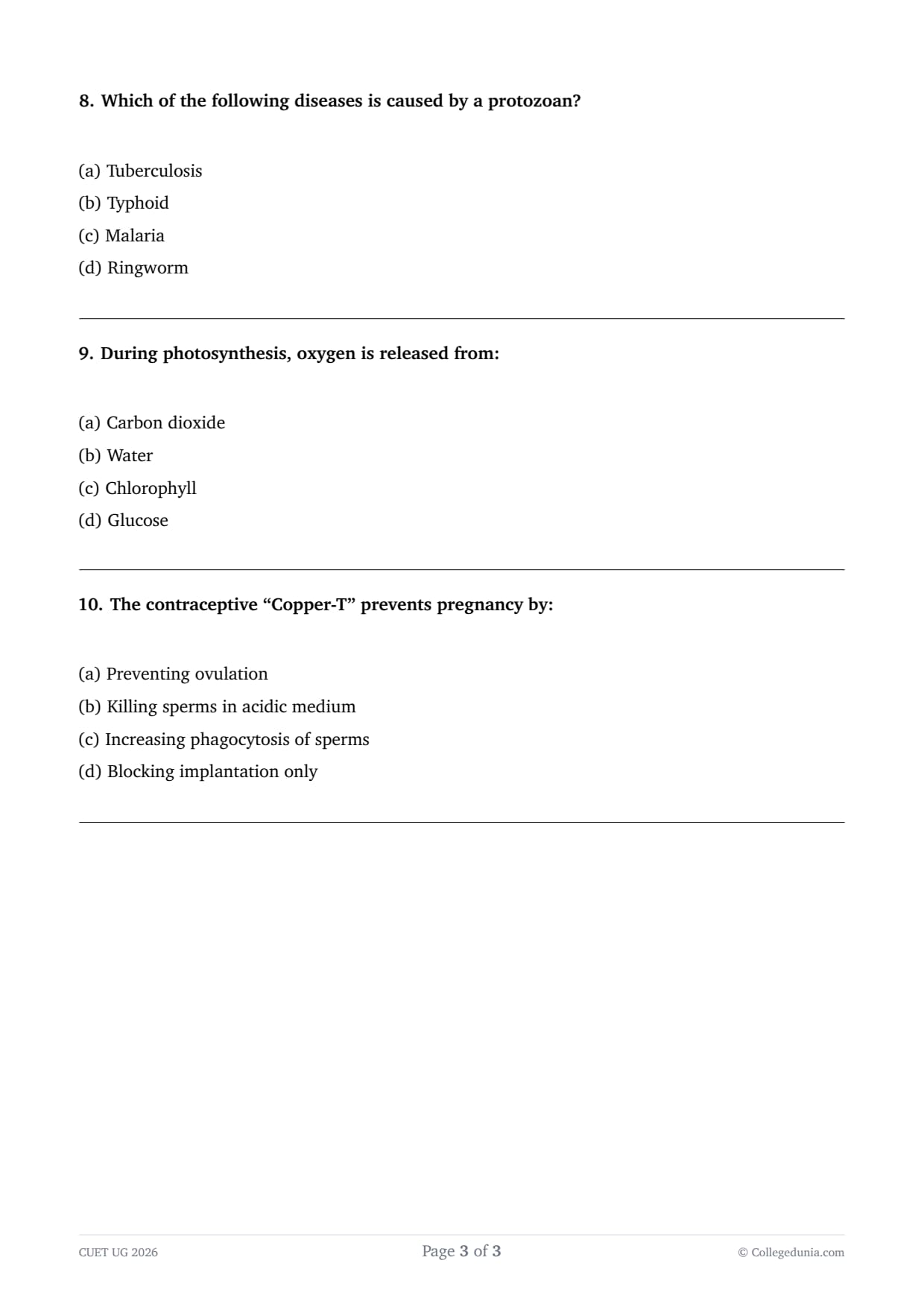
Which of the following diseases is caused by a protozoan?
View Solution
Step 1: Understanding the Concept:
Human diseases are caused by various pathogens, including bacteria, viruses, fungi, and protozoans. Each category requires different treatments.
Step 2: Key Formula or Approach:
Identify the pathogen for each:
Tuberculosis: Bacterium ({Mycobacterium tuberculosis)
Typhoid: Bacterium ({Salmonella typhi)
Malaria: Protozoan ({Plasmodium)
Ringworm: Fungus
Step 3: Detailed Explanation:
Malaria is caused by the Plasmodium parasite, which is a single-celled eukaryote (protozoan). It is transmitted to humans through the bite of an infected female {Anopheles mosquito. The parasite travels to the liver and then infects red blood cells.
Step 4: Final Answer:
Malaria is the disease caused by a protozoan. Quick Tip: Remember: The mosquito is only the carrier (vector). The actual cause (pathogen) is the protozoan Plasmodium.
During photosynthesis, oxygen is released from:
View Solution
Step 1: Understanding the Concept:
Photosynthesis is a two-stage process: Light-dependent reactions and Light-independent reactions (Calvin Cycle). Oxygen is a byproduct of the first stage.
Step 2: Key Formula or Approach:
The overall equation for photosynthesis is: \(\)6CO_2 + 6H_2O \xrightarrow{\text{light C_6H_{12O_6 + 6O_2\(\)
Step 3: Detailed Explanation:
During the light-dependent reactions, chlorophyll absorbs solar energy. This energy is used to split water molecules (\(H_2O\)) in a process called photolysis. The water molecule splits into hydrogen ions, electrons, and oxygen gas. The oxygen is then released into the atmosphere through the stomata.
Step 4: Final Answer:
The oxygen released during photosynthesis comes from Water. Quick Tip: Many people mistakenly think oxygen comes from \(CO_2\), but isotopes have proven it comes entirely from \(H_2O\)!
The contraceptive “Copper-T” prevents pregnancy by:
View Solution
Step 1: Understanding the Concept:
Intrauterine Devices (IUDs) like Copper-T are inserted into the uterus to provide long-term contraception by altering the uterine environment.
Step 2: Key Formula or Approach:
Copper ions released from the device act as a spermicide.
Step 3: Detailed Explanation:
Copper-T works primarily by releasing copper ions (\(Cu^{2+}\)) into the uterine fluid. These ions are toxic to sperm; they suppress sperm motility (movement) and their ability to fertilize the egg. Crucially, the presence of the device triggers an inflammatory response in the uterus, which leads to the increased phagocytosis (destruction) of sperms by white blood cells.
Step 4: Final Answer:
Copper-T prevents pregnancy primarily by increasing the phagocytosis of sperms within the uterus. Quick Tip: While it also makes the uterus unsuitable for implantation, its primary action is reducing the number and activity of sperms before they even reach the egg.
CUET UG 2026 Exam Pattern
| Parameter | Details |
|---|---|
| Exam Name | Common University Entrance Test (CUET UG) 2026 |
| Conducting Body | National Testing Agency (NTA) |
| Exam Mode | Computer-Based Test (CBT) |
| Exam Duration | 60 minutes per test |
| Total Sections | 3 (Languages, Domain Subjects, General Test) |
| Question Type | Multiple Choice Questions (MCQs) |
| Questions per Test | 50 questions (all compulsory) |
| Marking Scheme | +5 for correct, -1 for incorrect |
| Maximum Marks | 250 marks per test |
| Maximum Subject Choices | 5 subjects in total |
| Syllabus Base | Class 12 NCERT (mainly for Domain Subjects) |





Comments