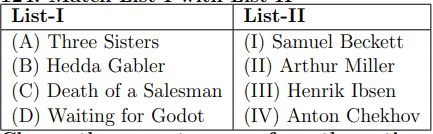
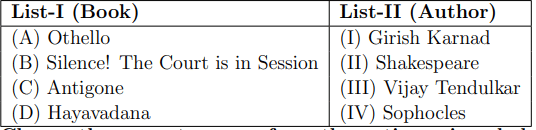
The CUET Performing Arts exam in 2025 will be held from 13th May to 3rd June, and students will be able to download the question paper, answer key, and solution PDF after the exam. The paper tests knowledge of financial accounting, partnership accounts, company accounts, and analysis of financial statements.
Students must attempt 50 questions in 60 minutes, totaling 250 marks, with +5 for each correct answer and –1 for each incorrect one.
CUET UG Performing Arts 2025 Question Paper with Answer Key PDF
| CUET UG Performing Arts Question Paper with Solutions PDF | Download PDF | Check Solutions |
CUET UG Performing Arts 2025 Question Paper with Solutions
Read the passages below and answer the questions that follow.
Passage 1: Prabandh As Sarangadeva describes in his book ”Sangit- Ratnakar”, Prabandh had two prime forms, namely Nibaddha gana and Anibaddha gana. The components of Prabandh is called as Dhatu. There are four Dhatus or parts of a Prabandh. The first one is called Udgraha, the second is Melapak, third is Dhurva and Fourth is Abhog. There is another part called Antra which was not essential to Prabandh. It was inserted in between the Dhruva and the Abhoga in a particular variety of Prabandh. Prabandh also has six Angas: 1. Swara, 2. Viruda, 3. Pada, 4. Tenak, 5. Paat, 6. Tala. The Prabandh has five Varieties or Jatis namely: Medini, Anandini, Dipani, Bhavani, and Taravali. The Jati having all six Angas is known as Medani, the jati having five Angas is known as Anandini, the Jati having four Angas is known as Dipani, the Jati having three Angas is known as Bhavani, the Jati having two Angas is known as Taravali.
Question 1:
Number of Dhatus in Prabandh:
View Solution
Step 1: Understanding the Concept:
The question asks for the number of Dhatus, or components, in a Prabandh, based on the provided text.
Step 2: Detailed Explanation:
The text explicitly states: "The components of Prabandh is called as Dhatu. There are four Dhatus or parts of a Prabandh."
It further lists them: "The first one is called Udgraha, the second is Melapak, third is Dhurva and Fourth is Abhog."
Therefore, there are four Dhatus in a Prabandh.
Step 3: Final Answer:
Based on the direct information from the passage, the number of Dhatus in a Prabandh is 4.
Quick Tip: In comprehension-based questions, always locate the exact sentence or phrase that answers the question. The answer is usually stated directly in the text.
Number of Angas in Prabandha ?
View Solution
Step 1: Understanding the Concept:
The question asks for the total number of Angas (limbs or parts) in a Prabandha according to the given text.
Step 2: Detailed Explanation:
The passage clearly states: "Prabandh also has six Angas:".
It then enumerates all six Angas: 1. Swara, 2. Viruda, 3. Pada, 4. Tenak, 5. Paat, 6. Tala.
Counting these elements confirms that there are six Angas.
Step 3: Final Answer:
The text explicitly lists six Angas for a Prabandh. Thus, the correct answer is 6.
Quick Tip: When the text provides a list of items to answer a "how many" question, quickly count the items to confirm the number. Don't just rely on the number mentioned; verify it with the list provided.
Taravali is one of the....
View Solution
Step 1: Understanding the Concept:
The question asks to identify what category 'Taravali' belongs to within the structure of Prabandh, based on the text.
Step 2: Detailed Explanation:
The first passage states: "The Prabandh has five Varieties or Jatis namely: Medini, Anandini, Dipani, Bhavani, and Taravali."
This sentence directly lists Taravali as one of the five Jatis of Prabandh.
The text further specifies: "the Jati having two Angas is known as Taravali."
Step 3: Final Answer:
The passage explicitly categorizes Taravali as a 'Jati' of Prabandh. Therefore, option (A) is correct.
Quick Tip: Pay close attention to classification terms like "namely," "such as," or "called." These words often introduce examples or members of a specific category, which is key to answering this type of question.
The Jaati of Prabandh having three Angas is known as:
View Solution
Step 1: Understanding the Concept:
The question requires identifying the specific name of the Jati of Prabandh that is characterized by having exactly three Angas.
Step 2: Detailed Explanation:
The last paragraph of the first passage describes the Jatis based on the number of Angas they contain.
The text says: "...the Jati having three Angas is known as Bhavani...".
This directly links the number of Angas (three) to the name of the Jati (Bhavani).
Step 3: Final Answer:
According to the text, the Jati with three Angas is Bhavani.
Quick Tip: For questions involving definitions or specific characteristics, scan the text for keywords from the question (e.g., "three Angas"). The answer is almost always in the same sentence or the one immediately following.
Number of Jatis in Prabandh:
View Solution
Step 1: Understanding the Concept:
This question asks for the total number of Jatis (or Varieties) in a Prabandh as described in the provided document.
Step 2: Detailed Explanation:
The relevant information is found in the first passage.
The passage states: "The Prabandh has five Varieties or Jatis namely: Medini, Anandini, Dipani, Bhavani, and Taravali."
By counting the names listed, we can confirm there are five Jatis.
Step 3: Final Answer:
The text explicitly mentions and lists five Jatis of Prabandh. Therefore, the correct answer is 5.
Quick Tip: In passages describing a system or structure, questions about the number of components are very common. Highlight these numbers and lists as you read to quickly locate answers.
Passage 2: Mohiniyattam
Mohiniyattam, literally Dance of the Enchanttress, has its seeds in the deep past of Kerala. Its present form, designed exclusively for the female dancer, is however, a recent creation inspired by the living matrix of Kerala’s social ensemble dances performed on festive occasions like Kaikottikali and Thiruvathirakali, and Nangyar Kootu, The female component of the highly stylized Kudiyattam, a souviour of Sanskrit theatre. The word, Mohini, occurs in an eighteenth-century Malayalam commentary of the Vyavah¯aram¯ala composed two hundred years earlier by Mazhamangalam Narayanan Nambudiri. Much later, the creator of Ottam Thullal, Kunjan Nambiar in his Goshayatra mentions Mohiniyattam. Reformer Vallathol traced the dance right down to the days of the Silappadikaram because of the definite reference to Kerala’s Chakyars while scholars like Pisharoti believed the dance had a six hundred-year-old history. Kalyanikuttyamma, Kunjukuttyamma, Kanak Rele are some of the great dancers of Mohiniyattam.
Question 6:
`Mohiniyattam' literally means?
View Solution
Step 1: Understanding the Concept:
The question asks for the literal meaning of the term 'Mohiniyattam' based on the provided passage about the dance form.
Step 2: Detailed Explanation:
The first sentence of the second passage on Mohiniyattam provides a direct answer.
It reads: "Mohiniyattam, literally Dance of the Enchanttress, has its seeds in the deep past of Kerala."
This sentence explicitly defines the literal meaning of the word.
Step 3: Final Answer:
The passage states that 'Mohiniyattam' literally means "Dance of the Enchanttress".
Quick Tip: Questions asking for the literal meaning of a term are often answered in the very first sentence where the term is introduced. Look for keywords like "literally," "means," or "defined as."
Mohiniyattam is a.....
View Solution
Step 1: Understanding the Concept:
The question asks to classify Mohiniyattam into one of the given categories of dance based on the passage.
Step 2: Detailed Explanation:
The text describes Mohiniyattam as a "highly stylized" dance form. It is discussed in the context of other established, sophisticated art forms like "Kudiyattam, a souviour of Sanskrit theatre."
The mention of its deep history, scholarly debate about its origins (tracing back to Silappadikaram), and association with great dancers points towards a sophisticated, codified art form, which is characteristic of classical dance.
While the text doesn't use the exact phrase "classical dance," the description strongly implies it. Mohiniyattam is indeed recognized as one of India's major classical dance forms.
Step 3: Final Answer:
Based on the description of its stylized nature, historical depth, and scholarly context, Mohiniyattam is classified as a Classical dance.
Quick Tip: Sometimes a comprehension passage won't use the exact keyword in the answer options. In such cases, you must infer the correct category based on the descriptive language and context provided in the text.
Koodiyattam is a ................
View Solution
Step 1: Understanding the Concept:
The question asks to identify the nature or origin of the art form 'Koodiyattam' (spelled as Kudiyattam in the text).
Step 2: Detailed Explanation:
The passage on Mohiniyattam provides context for Koodiyattam.
It mentions: "...Nangyar Kootu, The female component of the highly stylized Kudiyattam, a souviour of Sanskrit theatre."
The phrase "a souviour of Sanskrit theatre" directly categorizes Kudiyattam as a Sanskrit theatre form.
Step 3: Final Answer:
The text explicitly describes Koodiyattam as a form of Sanskrit theatre.
Quick Tip: Be aware of alternative spellings of terms (Koodiyattam vs. Kudiyattam). Comprehension tests may use slight variations. The answer is often found in a descriptive clause set off by commas.
The 'Vyavaharamāla' is a .....
View Solution
Step 1: Understanding the Concept:
The question asks to identify the nature of the specific version of 'Vyavaharamāla' mentioned in the text.
Step 2: Detailed Explanation:
The text states: "The word, Mohini, occurs in an eighteenth-century Malayalam commentary of the Vyavahāramāla..."
This means the reference where the word "Mohini" is found is not the original Vyavahāramāla itself, but a commentary on it written in Malayalam. Therefore, within the context of the passage, the work being discussed is a Malayalam commentary.
Step 3: Final Answer:
The passage specifically refers to a "Malayalam commentary" of the Vyavaharamāla. Therefore, this is the correct answer based on the provided text.
Quick Tip: Exam questions can sometimes be about a specific reference within a text, not the original work itself. Read carefully to distinguish between a primary text and a commentary or translation of it.
Who is the creator of Ottam Thullal?
View Solution
Step 1: Understanding the Concept:
The question asks to identify the creator of the art form 'Ottam Thullal' from the given list of names.
Step 2: Detailed Explanation:
The passage about Mohiniyattam contains the answer.
The sentence states: "Much later, the creator of Ottam Thullal, Kunjan Nambiar in his Goshayatra mentions Mohiniyattam."
This clause clearly identifies "Kunjan Nambiar" as "the creator of Ottam Thullal."
Step 3: Final Answer:
According to the passage, Kunjan Nambiar is the creator of Ottam Thullal.
Quick Tip: Look for appositive phrases, which are descriptive phrases set off by commas that rename or identify a noun. In this case, "Kunjan Nambiar" is identified by the appositive "the creator of Ottam Thullal."
Read the passage below and answer the questions that follow.
Passage: Percussive Musical Instruments of India
India is very rich in the number and variety of musical instruments. From time immemorial, musical instruments have been connected with various Gods and goddesses according to mythology. Musical Instruments have been classified into Thata, Avanadha, Ghana and Sushira. We came across this classification first in Natyashastra. Thata variety, is an instrument with strings and played by plucking or bowing. The instruments like Veena, Sitar, violin, Sarangi etc. come under this category. The Avandha variety are instruments with skin-covered heads, and are played by beating on both sides or one side. Mridangam, Pakhawaj, Tabla etc. come under this category. Ghana vadyas are those made with metal content. Manjira, Ghatom etc. are some of the examples of Ghana Vadya. Sushira Vadya are those instruments with holes and make the sound by blowing air through the holes. Flute, Nagaswaram, Saxophone, Clarinet are some of the examples.
Question 11:
In which musical text, four varieties of instruments are mentioned first?
View Solution
Step 1: Understanding the Concept:
The question asks to identify the ancient text where the four-fold classification of musical instruments was first mentioned, according to the provided passage.
Step 2: Detailed Explanation:
The passage introduces the four categories of instruments: Thata, Avanadha, Ghana, and Sushira.
The next sentence provides the answer directly: "We came across this classification first in Natyashastra."
Step 3: Final Answer:
Based on the explicit statement in the passage, the classification was first mentioned in the Natyashastra.
Quick Tip: For questions asking about the origin or first mention of a concept, scan the text for keywords like "first," "origin," or "source." The answer is usually located very close to these words.
Goddess Saraswati is associated with which instrument?
View Solution
Step 1: Understanding the Concept:
The question asks to identify the musical instrument associated with the Goddess Saraswati. This question tests general knowledge related to Indian culture and mythology, prompted by the passage's mention of instruments and deities.
Step 2: Detailed Explanation:
The passage states, "musical instruments have been connected with various Gods and goddesses according to mythology."
While it doesn't specify which deity is linked to which instrument, it sets the context.
From general knowledge, Goddess Saraswati, the Hindu goddess of knowledge, music, art, speech, wisdom, and learning, is traditionally depicted holding a Veena.
The passage also lists the Veena as an example of a 'Thata' instrument.
Step 3: Final Answer:
Based on common mythological and cultural depictions, Goddess Saraswati is associated with the Veena.
Quick Tip: Some comprehension-based exams include questions that require you to connect the passage's topic with your general knowledge. If the answer isn't directly in the text, use the context to guide your thinking.
Mridangam comes in which category of instrument?
View Solution
Step 1: Understanding the Concept:
The question asks for the classification category of the Mridangam based on the descriptions given in the passage.
Step 2: Detailed Explanation:
The passage defines the 'Avanadha' variety of instruments.
It states: "The Avandha variety are instruments with skin-covered heads, and are played by beating on both sides or one side."
Immediately following this description, it gives examples: "Mridangam, Pakhawaj, Tabla etc. come under this category."
Step 3: Final Answer:
The text explicitly places Mridangam under the Avanadha (spelled Avandha in the text) category.
Quick Tip: When a passage defines several categories and then provides examples, the questions will almost certainly test your ability to match the examples to the correct categories. Pay close attention to the lists of examples.
Select one Ghana Vadya from the following
View Solution
Step 1: Understanding the Concept:
The question requires identifying an instrument belonging to the 'Ghana Vadya' category from the given options, using the information in the passage.
Step 2: Detailed Explanation:
First, let's find the definition of Ghana Vadya in the text: "Ghana vadyas are those made with metal content. Manjira, Ghatom etc. are some of the examples of Ghana Vadya."
Now, let's examine the options:
- Mridangam, Pakhawaj, and Tabla are explicitly listed as examples of 'Avanadha' instruments.
- Ghatam (spelled 'Ghatom' in the text) is explicitly listed as an example of a 'Ghana Vadya'.
Step 3: Final Answer:
According to the passage, Ghatam is the only instrument in the options that belongs to the Ghana Vadya category.
Quick Tip: This is a process of elimination question. Even if you're unsure about one option, you can often find the correct answer by confirming which categories the other options belong to.
Select one Sushira vadya from the following.
View Solution
Step 1: Understanding the Concept:
The question asks to identify an instrument from the 'Sushira Vadya' (wind instrument) category from the given list.
Step 2: Detailed Explanation:
Let's refer to the passage for the definition and examples of Sushira Vadya.
The text states: "Sushira Vadya are those instruments with holes and make the sound by blowing air through the holes. Flute, Nagaswaram, Saxophone, Clarinet are some of the examples."
Now, let's analyze the options:
- Manjira is listed as a 'Ghana Vadya'.
- Violin is listed as a 'Thata' (string) instrument.
- Dilrooba is a string instrument played with a bow, so it would fall under the 'Thata' category, although it is not explicitly mentioned.
- Nagaswaram is explicitly mentioned as an example of a 'Sushira Vadya'.
Step 3: Final Answer:
Based on the direct information in the passage, Nagaswaram is a Sushira Vadya.
Quick Tip: Always rely on the information given in the passage first. If an option is explicitly mentioned in the text as belonging to a certain category, it's a very strong candidate for the correct answer.
Read the passage below and answer the questions that follow.
Passage: The Darsanams of the Gosangi
Over the costumes, Gosangi wears various objects made up of leather, shells, metal and threads as ornaments. Traditionally, the prominent among them is known as Darsanam-s, which literally means vision or suggesting that which is visible. There are altogether seven Darsanams, which can be neither considered as costumes nor ornaments. But, for an outsider, they may look like ornaments. The first Darsanam that Gosangi wears,cover chest and the back. This is traditionally identified as Rommu Darsanam or Sanku Darsanam. The second one is tied around the neck and called as Kanta Darsanam. The third and fourth ones are tied around the arms of left and right hands. The fifth and sixth ones are tied to the left and right wrists. (For these specific names are mentioned by the performers). The seventh one is known as Siro Darsanam, and it is tied around the already tied hair (koppu). The performers also know all these Dasanam except the Rommu Darsanam and Dasthavejulu (records).
Question 16:
What is the rommu darsanam or sanku darsanam?
View Solution
Step 1: Understanding the Concept:
The question asks for the description of the "Rommu Darsanam" or "Sanku Darsanam" based on the provided text.
Step 2: Detailed Explanation:
The passage describes the seven Darsanams in order.
For the first one, it states: "The first Darsanam that Gosangi wears,cover chest and the back. This is traditionally identified as Rommu Darsanam or Sanku Darsanam."
This sentence directly links the Rommu Darsanam to the one that covers the chest and the back.
Step 3: Final Answer:
According to the passage, the Rommu Darsanam is the one that encompasses the chest and the back.
Quick Tip: When a text describes a list of items sequentially (first, second, third, etc.), questions will often ask you to match the item number or name with its description. Carefully read the description associated with each item in the sequence.
Which darasanam is worn around the neck?
View Solution
Step 1: Understanding the Concept:
The question asks to identify the specific Darsanam that is tied around the neck.
Step 2: Detailed Explanation:
The passage describes the second Darsanam as follows: "The second one is tied around the neck and called as Kanta Darsanam."
This provides a direct answer. Let's check the other options based on the text:
- Shiro (Siro) Darsanam is tied to the hair.
- Rommu Darsanam covers the chest and back.
- Dasthavejalu is a term for records, not a Darsanam worn on the body.
Step 3: Final Answer:
The text explicitly states that the Kanta Darsanam is worn around the neck.
Quick Tip: For "Which one..." questions, locate the keyword from the question (e.g., "neck") in the passage and identify the name associated with it. Process of elimination can also be effective.
Two Darsanam-s, the third and the fourth, are tied around:
View Solution
Step 1: Understanding the Concept:
The question asks about the placement of the third and fourth Darsanams on the performer's body.
Step 2: Detailed Explanation:
The passage continues its sequential description of the Darsanams.
After describing the second one, it says: "The third and fourth ones are tied around the arms of left and right hands."
This sentence directly answers the question. The text separately mentions that the fifth and sixth are tied to the wrists.
Step 3: Final Answer:
The third and fourth Darsanams are tied around the arms of the left and right hands.
Quick Tip: Pay attention to details that distinguish between similar body parts. The passage makes a clear distinction between "arms" (for the third and fourth Darsanams) and "wrists" (for the fifth and sixth).
The Seventh Darsanam, known as Siro Darsanam, is tied around:
View Solution
Step 1: Understanding the Concept:
This question asks for the specific location where the seventh Darsanam, the Siro Darsanam, is worn.
Step 2: Detailed Explanation:
The passage describes the seventh Darsanam last: "The seventh one is known as Siro Darsanam, and it is tied around the already tied hair (koppu)."
The text is very specific, even providing the local term "koppu" for the tied hair.
Step 3: Final Answer:
The Siro Darsanam is tied around the already tied hair (Koppu).
Quick Tip: Information provided in parentheses, like "(koppu)" here, is often included to clarify a term and can be a key part of the correct answer. Don't ignore parenthetical details.
Which term do performers use to define all Darsanam-s except the Rommu Darsanam?
View Solution
Step 1: Understanding the Concept:
The question asks for the specific term that performers use to refer to a collective group of Darsanams, with the exception of the Rommu Darsanam. This requires careful interpretation of the last sentence.
Step 2: Detailed Explanation:
The last sentence of the passage is: "The performers also know all these Dasanam except the Rommu Darsanam and Dasthavejulu (records)."
This sentence structure is slightly unconventional. It can be interpreted to mean that the performers have a term for "all these Darsanams (except the Rommu Darsanam)," and that term is "Dasthavejulu." The word "records" in parentheses clarifies the meaning of Dasthavejulu. In this context, it seems the performers refer to this set of sacred objects as their 'records' or 'documents'.
Let's analyze the options:
- Vision: This is the literal meaning of "Darsanam," not the collective term used by performers.
- Kanta Darsanam: This is just one of the seven Darsanams.
- Ornaments: The passage explicitly states they are not considered ornaments.
Therefore, by elimination and interpretation of the final sentence, Dasthavejulu is the most plausible answer.
Step 3: Final Answer:
Based on the interpretation of the final, somewhat ambiguous sentence, the term the performers use is Dasthavejulu.
Quick Tip: Sometimes, sentences in translated texts can have unusual grammar. Try to understand the intended meaning by considering the context and eliminating other, clearly incorrect options. The last sentence often holds key summary information.
How many qualities does 'NAAD' have?
View Solution
Step 1: Understanding the Concept:
The question asks about the fundamental qualities of 'Naad' in the context of Indian classical music. 'Naad' refers to any musical sound.
Step 2: Detailed Explanation:
In Indian musicology, Naad is described as having three main characteristics:
1. Taarata (Pitch): The highness or lowness of the sound, determined by its frequency.
2. Tivrata (Magnitude/Loudness): The intensity or amplitude of the sound, which makes it loud or soft.
3. Guna or Jaati (Timbre/Quality): The unique character of a sound that distinguishes it from another sound of the same pitch and loudness (e.g., the sound of a sitar vs. a violin playing the same note).
Step 3: Final Answer:
Based on the established principles of Indian music, Naad has three distinct qualities.
Quick Tip: Remember the acronym \(\textbf{P-L-T}\) (Pitch, Loudness, Timbre) to recall the three main qualities of any musical sound (Naad). This is a fundamental concept in both Indian and Western music theory.
In Bhatkhande Notation System, writing Ga is to show:
View Solution
Step 1: Understanding the Concept:
The question asks to identify the meaning of a specific symbol in the Bhatkhande notation system used in Hindustani classical music. The symbol in question is the swara 'Ga' with a horizontal line underneath it.
Step 2: Detailed Explanation:
In the Bhatkhande system:
- A horizontal line under a swara (Swar) indicates that it is a 'Komal' (flat) note. The swaras that can be komal are Re, Ga, Dha, and Ni.
- A vertical line above the swara 'Ma' indicates 'Tivra' (sharp) Ma.
- An arc over a group of swaras indicates a 'Meend' (glissando).
- A smaller note written to the top-left of a main note indicates a 'Kan' (grace note).
Therefore, Ga represents Komal Gandhar.
Step 3: Final Answer:
The horizontal line under 'Ga' is the standard notation for Komal Gandhar Swar in the Bhatkhande system.
Quick Tip: Memorize the key symbols of the Bhatkhande system: dot below (mandra saptak), dot above (taar saptak), horizontal line below (komal), and vertical line above (tivra Ma). These are the most frequently tested notation concepts.
Tala has Khali on its first beat in .... taal
View Solution
Step 1: Understanding the Concept:
The question asks to identify a Tala (rhythmic cycle) from the given options where the first beat (matra) is a 'Khali' (unaccented beat, shown with a wave of the hand) instead of the 'Sam' (the first and most accented beat).
Step 2: Detailed Explanation:
Let's analyze the structure of the given Talas:
- Jhaptal (10 beats): Divided 2-3-2-3. Taali on beats 1, 3, 8. Khali on beat 6. The first beat is Sam (Taali).
- Rupak (7 beats): Divided 3-2-2. This is a unique and common Tala where the first beat is the Khali. Taalis are on beats 4 and 6.
- Dadra (6 beats): Divided 3-3. Taali on beat 1. Khali on beat 4. The first beat is Sam (Taali).
- Keharwa (8 beats): Divided 4-4. Taali on beat 1. Khali on beat 5. The first beat is Sam (Taali).
Step 3: Final Answer:
Rupak is the only taal among the options that begins with a Khali on its first beat.
Quick Tip: Rupak taal is a famous exception in the Tala system for starting with a Khali. Remember this unique characteristic as it is a very common question in music exams.
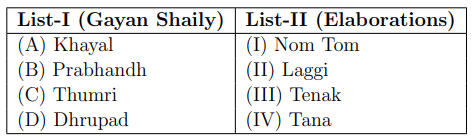
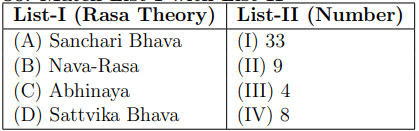
Match List-I with List-II

Choose the correct answer from the options given below:
View Solution
Step 1: Understanding the Concept:
The question requires matching different styles of Hindustani vocal music (Gayan Shaily) with their characteristic elements or forms of elaboration.
Step 2: Detailed Explanation:
- (A) Khayal: A prominent feature of Khayal singing is the use of 'Tanas', which are fast-paced melodic passages sung on vowels. So, (A) matches with (IV).
- (D) Dhrupad: The alap section of Dhrupad, an ancient and austere vocal style, is elaborated using meaningless syllables like 'nom', 'tom', 'ri', 'na'. This is known as Nom-Tom alap. So, (D) matches with (I).
- (C) Thumri: A semi-classical form. Towards the end of a Thumri presentation, the tabla often plays a fast, lively pattern called a 'Laggi' to which the singer responds. So, (C) matches with (II).
- (B) Prabhandh: An ancient compositional form described in musical treatises. One of its six constituent parts ('angas') is 'Tenak', which refers to the use of auspicious words or syllables. So, (B) matches with (III).
Step 3: Final Answer:
The correct matching is A-IV, B-III, C-II, D-I, which corresponds to option (D).
Quick Tip: For matching questions, try to match the one you are most certain about first. For instance, 'Tana' is almost synonymous with 'Khayal', and 'Nom Tom' with 'Dhrupad'. This can help you quickly eliminate incorrect options.
Number of Talis in the theka of Ektaal:
View Solution
Step 1: Understanding the Concept:
The question asks for the total number of 'Talis' (clapped beats) in one cycle of Ektaal.
Step 2: Detailed Explanation:
Ektaal is a rhythmic cycle of 12 matras (beats), divided into six vibhags (sections) of 2 matras each.
The structure of Taalis and Khalis is as follows:
- Beat 1: Taali (Sam)
- Beat 3: Khali
- Beat 5: Taali
- Beat 7: Khali
- Beat 9: Taali
- Beat 11: Taali
Counting the beats marked as 'Taali', we have claps on the 1st, 5th, 9th, and 11th beats.
Step 3: Final Answer:
There are a total of 4 Talis in the theka of Ektaal.
Quick Tip: Remember the structure of common taals like Teentaal (3 talis, 1 khali), Ektaal (4 talis, 2 khalis), and Jhaptal (3 talis, 1 khali). Knowing the number of talis and khalis is a fundamental aspect of Tala theory.
In Hindustani music, "Bada khayal" is sung in...
View Solution
Step 1: Understanding the Concept:
The question asks about the characteristic tempo (Laya) of a "Bada Khayal" composition in Hindustani classical music.
Step 2: Detailed Explanation:
A typical Khayal performance consists of two parts:
1. Bada Khayal (Great Khayal): This is the first composition, which is rendered in a very slow tempo, known as Vilambit Laya. The slow pace allows for detailed and expansive melodic improvisation (badhat) of the raga.
2. Chhota Khayal (Small Khayal): This follows the Bada Khayal and is set to a medium (Madhya Laya) or fast tempo (Drut Laya).
Step 3: Final Answer:
"Bada khayal" is characteristically sung in a slow tempo (Vilambit Laya).
Quick Tip: Associate "Bada" (big/great) with slow and expansive, and "Chhota" (small) with faster and more agile. This simple association will help you remember the tempos for Bada Khayal and Chhota Khayal.
Maseet Khani gat is played in:
View Solution
Step 1: Understanding the Concept:
The question asks about the specific tempo (Laya) associated with the Maseet Khani gat, a type of instrumental composition in Hindustani music.
Step 2: Detailed Explanation:
In Hindustani instrumental music, particularly on sitar and sarod, there are two primary styles of gat (fixed composition):
1. Maseet Khani Gat: Created by Maseet Khan, this style is known for its graceful and dignified structure. It is always played in Vilambit Laya (Slow Tempo). Its characteristic feature is that its main phrase (mukhda) typically starts from the 12th beat of Teentaal.
2. Razakhani Gat: This style is played in Drut Laya (Fast Tempo) and is known for its lively and virtuosic nature.
Step 3: Final Answer:
Maseet Khani gat is characteristically played in a Slow Tempo (Vilambit Laya).
Quick Tip: Remember the two main gat styles: Maseet Khani = Vilambit (Slow), and Razakhani = Drut (Fast). This is a fundamental distinction in the instrumental repertoire of Hindustani music.
Pt. Omkar Nath Thakur was the disciple of:
View Solution
Step 1: Understanding the Concept:
The question asks to identify the Guru (teacher) of the eminent Hindustani classical vocalist, Pandit Omkar Nath Thakur.
Step 2: Detailed Explanation:
Pandit Omkar Nath Thakur (1897-1967) was a celebrated vocalist of the Gwalior Gharana. He was a principal disciple of Pandit Vishnu Digambar Paluskar, a visionary musician and musicologist who founded the Gandharva Mahavidyalaya. Paluskar played a pivotal role in popularizing classical music among the masses.
Step 3: Final Answer:
Pandit Omkar Nath Thakur was the disciple of Pandit Vishnu Digambar Paluskar.
Quick Tip: Knowing the Guru-Shishya (teacher-disciple) lineages of famous musicians is very important for music history questions. Associate Pt. V.D. Paluskar with his most famous disciple, Pt. Omkar Nath Thakur.
Famous Sitarist Pt. Ravi Shankar was the Disciple of:
View Solution
Step 1: Understanding the Concept:
The question asks to identify the Guru of the world-renowned sitar virtuoso, Pandit Ravi Shankar.
Step 2: Detailed Explanation:
Pandit Ravi Shankar (1920-2012) was one of the most famous Indian musicians of the 20th century. His guru was the legendary multi-instrumentalist and music teacher, Ustad Allauddin Khan of the Maihar Gharana. Ustad Allauddin Khan was also the guru of other celebrated artists like Ustad Ali Akbar Khan (sarod) and Annapurna Devi (surbahar).
Step 3: Final Answer:
Pandit Ravi Shankar was the disciple of Ustad Allauddin Khan.
Quick Tip: Ustad Allauddin Khan is a monumental figure, and his disciples are some of the biggest names in Hindustani music. Remember the 'Maihar Trio': Pt. Ravi Shankar (sitar), Ustad Ali Akbar Khan (sarod), and Annapurna Devi (surbahar), all disciples of Ustad Allauddin Khan.
Harmonium is a....
View Solution
Step 1: Understanding the Concept:
The question asks for the classification of the Harmonium based on how it produces sound.
Step 2: Detailed Explanation:
The Harmonium produces sound when air, pumped by hand-operated bellows, flows past a set of metallic reeds, causing them to vibrate. Since the sound is generated by means of air (wind), it falls under the category of wind instruments. In the Indian classification system, it is a 'Sushira Vadya'. It is specifically a 'free-reed aerophone'.
- String Instruments (Tata Vadya) produce sound from vibrating strings (e.g., Sitar).
- Percussion Instruments (Avanaddha Vadya) produce sound by being struck (e.g., Tabla).
- Metallic Instrument (Ghana Vadya) is a type of percussion where a solid metallic body is struck (e.g., Manjira), which is different from the harmonium's mechanism.
Step 3: Final Answer:
The Harmonium is classified as a Wind Instrument.
Quick Tip: To classify an instrument, always ask the question: "What vibrates to create the initial sound?" For the harmonium, it's air making the reeds vibrate. Therefore, it's a wind instrument.
Which Swara is not used in raga Bhupali?
(A) Re(B) Ma
(C) Pa
(D) Ni
Choose the correct answer from the options given below:
View Solution
Step 1: Understanding the Concept:
The question asks to identify the swaras (notes) that are omitted (varjit) in Raga Bhupali.
Step 2: Detailed Explanation:
Raga Bhupali is a popular Audav Jati (pentatonic) raga. This means it uses only five notes in both its ascent (aroha) and descent (avaroha).
The scale of Raga Bhupali is:
- Aroha: S R G P D S'
- Avaroha: S' D P G R S
The seven standard swaras are Sa (S), Re (R), Ga (G), Ma (M), Pa (P), Dha (D), Ni (N).
By comparing the Bhupali scale to the full seven-note scale, we can see that Madhyam (Ma) and Nishad (Ni) are not used.
From the list given: (A) Re is used, (B) Ma is not used, (C) Pa is used, and (D) Ni is not used.
Therefore, the swaras not used are (B) Ma and (D) Ni.
Step 3: Final Answer:
The correct combination of swaras not used in Raga Bhupali is (B) and (D).
Quick Tip: Memorizing the scales of major Audav (pentatonic) ragas like Bhupali (S R G P D), Malkauns (S g M d n), and Durga (S R M P D) is essential for exams. Knowing which two notes are omitted is the key to identifying them.
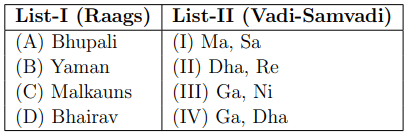
Match List-I with List-II

Choose the correct answer from the options given below:
View Solution
Step 1: Understanding the Concept:
This question requires matching four prominent Hindustani ragas with their respective Vadi (most important) and Samvadi (second most important) swaras.
Step 2: Detailed Explanation:
- (A) Bhupali: An audav raga of Kalyan that. Its Vadi swara is Gandhar (Ga) and its Samvadi swara is Dhaivat (Dha). So, (A) matches with (IV).
- (B) Yaman: A sampurna raga of Kalyan that. Its Vadi swara is Gandhar (Ga) and its Samvadi swara is Nishad (Ni). So, (B) matches with (III).
- (C) Malkauns: An audav raga of Bhairavi that. Its Vadi swara is Madhyam (Ma) and its Samvadi swara is Shadja (Sa). So, (C) matches with (I).
- (D) Bhairav: The namesake raga of Bhairav that. It uses Komal Re and Komal Dha. Its Vadi swara is Komal Dhaivat (Dha) and its Samvadi swara is Komal Rishabh (Re). So, (D) matches with (II).
Step 3: Final Answer:
The correct set of matches is A-IV, B-III, C-I, D-II, which corresponds to option (D).
Quick Tip: The Vadi-Samvadi pair is crucial to a raga's identity. For beginner/intermediate level exams, focus on memorizing the Vadi-Samvadi for at least 10-15 major ragas like Yaman, Bhupali, Bhairav, Malkauns, Bihag, etc.
The most prominent Swara of a raga is
View Solution
Step 1: Understanding the Concept:
In the structure of a raga, swaras (notes) are categorized based on their importance and function. The question asks to identify the most important or prominent swara.
Step 2: Detailed Explanation:
The four categories of swaras in a raga are:
1. Vadi (King): This is the most important and most frequently used swara in a raga. It is the central point around which the melodic phrases are built.
2. Samvadi (Minister/Queen): This is the second most important swara. It has a consonant relationship with the Vadi swara, typically being four or five notes away.
3. Anuvadi (Attendant): These are all the other swaras present in the raga, apart from the Vadi and Samvadi.
4. Vivadi (Enemy): This is a dissonant note that is not part of the raga's scale. It is either completely avoided or used very sparingly by a skilled musician to add a specific emotional color.
Step 3: Final Answer:
Based on the definitions, the Vadi is the most prominent swara of a raga.
Quick Tip: Remember the hierarchy of swaras using the analogy of a royal court: Vadi is the King, Samvadi is the Minister, Anuvadis are the subjects, and Vivadi is the enemy. This makes it easy to recall their relative importance.
Select the raga with Suddha Rishabha
View Solution
Step 1: Understanding the Concept:
The question asks to identify the Carnatic raga from the given options that uses 'Suddha Rishabha' (R1), which is the lowest of the three Rishabha variants.
Step 2: Detailed Explanation:
Let's analyze the Rishabha (Re) swara used in each raga:
- Kalyani: This is the 65th Melakarta raga and uses Chatushruti Rishabham (R2).
- Sreeranjani: A janya of the 22nd Melakarta Kharaharapriya, it also uses Chatushruti Rishabham (R2).
- Mayamalavgaula: This is the 15th Melakarta raga. Its scale is S R1 G3 M1 P D1 N3 S'. It uses Suddha Rishabham (R1) and is the raga in which initial music lessons are taught in Carnatic music.
- Mohanam: A popular pentatonic raga, it uses Chatushruti Rishabham (R2).
Step 3: Final Answer:
Mayamalavgaula is the raga among the options that employs Suddha Rishabha (R1).
Quick Tip: Mayamalavgaula is the foundational raga for learning Carnatic music. Remember its unique scale (S R1 G3 M1 P D1 N3 S') as it is frequently featured in theory questions regarding basic swara varieties.
Select the musical instrument that comes under Tantri Vadya (String Instruments)
View Solution
Step 1: Understanding the Concept:
The question asks to identify a string instrument (Tantri Vadya or Tata Vadya) from the given options, based on the Indian system of instrument classification.
Step 2: Detailed Explanation:
The four main categories of Indian musical instruments are:
- Tantri Vadya (Chordophones): String instruments, like the Veena, Sitar, Violin.
- Sushira Vadya (Aerophones): Wind instruments, like the Flute, Nagaswaram, Shehnai.
- Avanaddha Vadya (Membranophones): Percussion instruments with a skin membrane, like the Tabla, Mridangam.
- Ghana Vadya (Idiophones): Solid percussion instruments, like the Ghatam, Manjira.
Based on this classification, the Veena is a Tantri Vadya.
Step 3: Final Answer:
The Veena is the correct option as it is a string instrument.
Quick Tip: Familiarize yourself with the four main categories of Indian musical instruments and be able to classify at least two or three common instruments from each category.
Select the Ghana Vadya from the following
View Solution
Step 1: Understanding the Concept:
The question asks to identify a 'Ghana Vadya' (Idiophone) from the given options. Ghana Vadyas are solid instruments that produce sound when struck, without the use of strings or membranes.
Step 2: Detailed Explanation:
Let's classify the given instruments:
- Harmonium: A Sushira Vadya (wind instrument).
- Mridangam: An Avanaddha Vadya (percussion instrument with a membrane).
- Kartal (Manjira): A pair of small cymbals made of metal that are struck together. This is a classic example of a Ghana Vadya.
- Tanpura: A Tantri Vadya (string instrument).
Step 3: Final Answer:
Kartal (Manjira) is the only Ghana Vadya in the given list.
Quick Tip: Think of Ghana Vadyas as instruments that are solid and self-sounding. Common examples include Ghatam (clay pot), Manjira/Kartal (cymbals), and Morsing (Jew's harp).
Select the Audava raga from the following
View Solution
Step 1: Understanding the Concept:
The question asks to identify an 'Audava' raga from the options. Ragas are classified by their 'Jati' based on the number of notes in their scale. An Audava raga is a pentatonic raga, meaning it uses five notes in its scale.
Step 2: Detailed Explanation:
- Sreeranjani: This is an Audava-Shadava raga (5 notes in ascent, 6 in descent).
- Mohanam: This is a classic Audava raga with the scale S R G P D S'. It has exactly five notes.
- Sankarabharanam: This is a Sampurna raga (a complete scale with all seven notes).
- Kalyani: This is also a Sampurna raga (seven notes).
Step 3: Final Answer:
Mohanam is the Audava raga among the choices provided.
Quick Tip: Memorize the classification of a few very popular ragas. Mohanam and Hindolam are the most common examples of Audava (pentatonic) ragas that appear in exams.
Usually, how many Angas a Kriti has?
View Solution
Step 1: Understanding the Concept:
The question asks for the typical number of sections or parts (Angas) in a Kriti, a major compositional form in Carnatic music.
Step 2: Detailed Explanation:
A standard Kriti is structured with three main Angas:
1. Pallavi: The opening section, which acts as a refrain.
2. Anupallavi: The second section, which develops the musical ideas further, usually exploring the upper notes of the scale.
3. Charanam: The final and longest section, which often contains the bulk of the lyrical content.
While some Kritis might have multiple Charanams or additional sections like a Chittaswaram, the fundamental structure is tripartite.
Step 3: Final Answer:
A Kriti usually has three Angas.
Quick Tip: Remember the P-A-C structure for a Kriti: Pallavi, Anupallavi, Charanam. This is the most common and fundamental format for this type of composition.
How many Matras are there in Roopak tala?
View Solution
Step 1: Understanding the Concept:
The question asks for the total number of beats (Matras) in the Hindustani rhythmic cycle (tala) known as Roopak.
Step 2: Detailed Explanation:
Roopak tala is a common tala in Hindustani classical music. It consists of a cycle of 7 matras. Its structure is unique as it is divided into three sections (vibhags) of 3, 2, and 2 matras respectively. Another distinguishing feature is that its first beat is a Khali (an unstressed beat, indicated by a wave of the hand) rather than the Sam (the first, stressed beat).
Step 3: Final Answer:
Roopak tala has 7 matras.
Quick Tip: It is crucial to memorize the number of matras for the most common Hindustani talas: Teentaal (16), Jhaptaal (10), Ektaal (12), Roopak (7), Dadra (6), and Keharwa (8).
How many Moorchana existed in total?
View Solution
Step 1: Understanding the Concept:
The question refers to the concept of 'Moorchana' from ancient Indian music theory and asks for the total number described in ancient texts.
Step 2: Detailed Explanation:
A Moorchana is a melodic scale derived by shifting the tonic note (Sa) to other notes of a parent scale, known as a 'Grama'. Ancient Indian music theory describes three Gramas:
1. Shadja Grama
2. Madhyama Grama
3. Gandhara Grama (mentioned in texts but considered lost or obsolete)
Each Grama, being a heptatonic (7-note) scale, could produce 7 Moorchhanas by starting the scale from each of its 7 notes.
Therefore, the total number of Moorchhanas was 7 (from Shadja Grama) + 7 (from Madhyama Grama) + 7 (from Gandhara Grama) = 21.
Step 3: Final Answer:
In total, twenty-one Moorchhanas existed according to ancient musicological texts.
Quick Tip: Remember the formula: Number of Gramas × Number of notes in a Grama = Total Moorchhanas. In ancient theory, this was 3 Gramas × 7 notes = 21 Moorchhanas.
Select the Shadava raga from the following
View Solution
Step 1: Understanding the Concept:
The question asks to identify a 'Shadava' raga from the list. A Shadava raga is hexatonic, meaning it uses six notes in its scale (either in ascent, descent, or both).
Step 2: Detailed Explanation:
- Mohanam: An Audava raga (5 notes: S R G P D S).
- Hindolam: Another Audava raga (5 notes: S G M D N S).
- Sreeranjani: This raga is classified as Audava-Shadava. Its ascent (Aroha) has 5 notes (S R G M D S), and its descent (Avaroha) has 6 notes (S N D M G R S). Since it contains a six-note phrase, it can be considered a Shadava raga.
- Kalyani: A Sampurna raga, using all 7 notes.
Among the given choices, Sreeranjani is the only one that fits the definition of a Shadava raga due to its six-note descent.
Step 3: Final Answer:
Sreeranjani is the correct choice as it is an Audava-Shadava raga.
Quick Tip: Ragas can have different numbers of notes in their ascent and descent (e.g., Audava-Shadava). Such a raga can be classified under the more complex of its scales, so an Audava-Shadava raga is a type of Shadava raga.
Kshetrayya popularized which form of music?
View Solution
Step 1: Understanding the Concept:
The question asks to identify the musical form for which the composer Kshetrayya is famous.
Step 2: Detailed Explanation:
Kshetrayya (c. 17th century) was a prolific and highly influential composer in the tradition of Carnatic music. He is especially renowned for his mastery in composing 'Padams'. A Padam is a lyrical and expressive compositional form, typically centered on the theme of 'Sringara' (love, both divine and human). Kshetrayya's Padams are considered benchmarks of the genre for their poetic beauty and profound musical depth.
Step 3: Final Answer:
Kshetrayya popularized the musical form known as Padam.
Quick Tip: Associate major composers with their signature forms: Tyagaraja with Kriti, Annamacharya with Sankirtana, Kshetrayya with Padam, and Jayadeva with Ashtapadi. This is a common pattern in music history questions.
Select the ragas with Chatushruti Rishabham
View Solution
Step 1: Understanding the Concept:
The question asks to identify which of the given ragas use 'Chatushruti Rishabham' (R2), a specific variety of the Rishabha swara in Carnatic music.
Step 2: Detailed Explanation:
Let's examine the scale of each raga:
- (A) Mohanam: Its scale is S R2 G3 P D2 S'. It uses Chatushruti Rishabham (R2).
- (B) Hindolam: Its scale is S G2 M1 D1 N2 S'. This raga does not use Rishabham at all; it is a 'varjit' (omitted) swara.
- (C) Kalyani: Its scale is S R2 G3 M2 P D2 N3 S'. It uses Chatushruti Rishabham (R2).
- (D) Sreeranjani: Its scale is S R2 G2 M1 D2 S' / S N2 D2 M1 G2 R2 S'. It uses Chatushruti Rishabham (R2).
Therefore, the ragas that use Chatushruti Rishabham are Mohanam, Kalyani, and Sreeranjani.
Step 3: Final Answer:
The correct combination is (A), (C), and (D).
Quick Tip: When analyzing ragas for specific swaras, remember that some ragas may omit certain notes entirely. In this case, Hindolam omits both Rishabham (R) and Panchamam (P), which immediately eliminates it from the list of ragas containing any type of Rishabham.
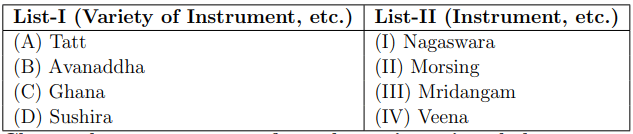
Match List-I with List-II

Choose the correct answer from the options given below:
View Solution
Step 1: Understanding the Concept:
This question requires matching the categories of Indian musical instruments (List-I) with an example of an instrument from that category (List-II). Note that 'Tatt' is another term for 'Tata' (string).
Step 2: Detailed Explanation:
- (A) Tatt (Tata) Vadya: String instruments. The Veena (IV) is a string instrument. Thus, A matches with IV.
- (B) Avanaddha Vadya: Membranophones (drums). The Mridangam (III) is a percussion drum. Thus, B matches with III.
- (C) Ghana Vadya: Idiophones (solid percussion). The Morsing (II), or Jew's harp, is a plucked idiophone. Thus, C matches with II.
- (D) Sushira Vadya: Aerophones (wind instruments). The Nagaswara (I) is a double-reed wind instrument. Thus, D matches with I.
Step 3: Final Answer:
The correct matching is A-IV, B-III, C-II, D-I.
Quick Tip: Even if one category or instrument is unfamiliar (like Morsing), you can often solve matching questions by correctly pairing the ones you know for sure and then using the process of elimination.
Select the correct sequence of the following variety of swara in the increasing order
View Solution
Step 1: Understanding the Concept:
The question asks to arrange four specific Carnatic swaras in ascending order of their pitch. This requires knowledge of the 12 swarasthanas (note positions) in an octave.
Step 2: Detailed Explanation:
The 12 swarasthanas in increasing order of pitch are:
S, Suddha Rishabha (R1), Chatushruti Rishabha (R2), Sadharana Gandhara (G2), Antara Gandhara (G3), Suddha Madhyama (M1), Prati Madhyama (M2), P, Suddha Dhaivata (D1), Chatushruti Dhaivata (D2), Kaisiki Nishada (N2), Kakali Nishada (N3).
Let's place the given swaras in this sequence:
1. (A) Suddha Rishabha (R1)
2. (C) Antara Gandhara (G3)
3. (B) Prati Madhyama (M2)
4. (D) Kaisiki Nishada (N2)
Therefore, the correct sequence in increasing order of pitch is A, C, B, D.
Step 3: Final Answer:
The correct ascending order of the given swaras is (A) Suddha Rishabha, (C) Antara Gandhara, (B) Prati Madhyama, (D) Kaisiki Nishada.
Quick Tip: Visualize the keyboard or a fretted instrument to remember the order of the 12 swarasthanas. Remembering the relative positions of the main variants (R1 vs R2, G2 vs G3, etc.) is key to solving such questions.
"dhi na dhi dhi na" bol belongs to:
View Solution
Step 1: Understanding the Concept:
The question asks to identify the Hindustani tala with which the given rhythmic phrase (bol) "dhi na dhi dhi na" is associated.
Step 2: Detailed Explanation:
The standard theka (basic phrase) for Dadra tala is "Dha Dhi Na | Dha Tu Na". The phrase in the question, "dhi na dhi dhi na", is a very common and characteristic variation or 'laggi' pattern played in Dadra tala, especially in light classical and film music. Its rhythmic feel strongly corresponds to the 6-beat cycle of Dadra. While the other taals have their own distinct phrases, this particular bol is most emblematic of Dadra.
Step 3: Final Answer:
The bol "dhi na dhi dhi na" is characteristically associated with Dadra taal.
Quick Tip: Listen to theka and laggi patterns of common talas. Dadra's 3+3 feel is very recognizable, and this phrase is one of its most popular expressions.
Mention the number of Grama :
View Solution
Step 1: Understanding the Concept:
The question asks for the total number of 'Gramas' as described in the ancient theoretical texts of Indian classical music.
Step 2: Detailed Explanation:
A Grama is an ancient concept referring to a standard parent scale from which various melodies and scales (Moorchhanas) could be derived. The foundational texts of Indian music, such as Bharata's Natyashastra, describe three such Gramas:
1. Shadja Grama (the scale starting on Sa)
2. Madhyama Grama (the scale starting on Ma)
3. Gandhara Grama (an ancient scale which later became obsolete)
Step 3: Final Answer:
There are three Gramas mentioned in the theoretical tradition of Indian music.
Quick Tip: The concept of the three Gramas is a cornerstone of ancient Indian music theory. Remembering the number '3' and the names (Shadja, Madhyama, Gandhara) is important for history-based questions.
Mention the time of Malkauns according to Time theory
View Solution
Step 1: Understanding the Concept:
The question asks for the specific time of day or night assigned to Raga Malkauns according to the 'Samay Chakra' or Time Theory of Hindustani ragas.
Step 2: Detailed Explanation:
Raga Malkauns is a profound, meditative raga belonging to the Bhairavi that. According to the time theory, it is assigned to the last prahar (a 3-hour period) of the night. This period corresponds to the time just after midnight. Therefore, its designated performance time is 'Madhya Ratri' or midnight.
Step 3: Final Answer:
The time of Raga Malkauns is Madhya Ratri (Mid Night).
Quick Tip: Associate ragas with their moods and times. Malkauns has a deep, serious, and introspective mood, which is perfectly suited for the quiet and stillness of midnight.
Which tala was introduced by Tyagaraja?
View Solution
Step 1: Understanding the Concept:
The question asks to identify a tala or a concept related to tala that was particularly popularized or introduced in compositions by the great Carnatic composer, Saint Tyagaraja.
Step 2: Detailed Explanation:
While the concept may have existed earlier, Saint Tyagaraja is widely credited with extensively using and popularizing the 'Desadi' tala structure in a vast number of his kritis. The Desadi tala is a specific application of Adi tala where the composition begins after a delay of 1.5 aksharas from the start of the tala cycle. This creates a unique rhythmic gait and is a hallmark of many of his most famous compositions. The other options are general tala types not specifically introduced by him.
Step 3: Final Answer:
The Desadi tala is strongly associated with and was extensively popularized by Tyagaraja.
Quick Tip: When thinking of Tyagaraja's contributions to tala, the terms 'Desadi' and 'Madhyadi' (another way of starting a composition within the Adi tala cycle) should come to mind. He was a master of rhythmic innovation within traditional structures.
Select the Sandhiprakash raga from the following
View Solution
Step 1: Understanding the Concept:
The question asks to identify a 'Sandhiprakash' raga from the given list. Sandhiprakash ragas are those that are performed during the twilight hours—dawn (sunrise) and dusk (sunset).
Step 2: Detailed Explanation:
The key characteristic of Sandhiprakash ragas is the use of Komal Rishabh (re) and Komal Dhaivat (dha). Let's analyze the options:
- Alhaiya Bilawal: A morning raga (9 AM - 12 PM), uses all Shuddha (natural) notes.
- Bageshree: A late-night raga (12 AM - 3 AM).
- Bhairav: This is the archetypal morning Sandhiprakash raga, sung at sunrise. It is defined by its use of Komal Re and Komal Dha.
- Bhupali: An evening raga, but it belongs to the Kalyan that and does not use the characteristic Komal Re and Dha of Sandhiprakash ragas.
Step 3: Final Answer:
Bhairav is the Sandhiprakash raga among the given options.
Quick Tip: Remember the key formula for Sandhiprakash ragas: Twilight time (dawn/dusk) + Komal Re + Komal Dha. Ragas like Bhairav, Marwa, and Puriya Dhanashree fit this category.
Name the ancient Indian treatise of the performing arts which encompasses theater, dance and music?
View Solution
Step 1: Understanding the Concept:
The question asks to identify a comprehensive ancient Indian text that covers all major performing arts: theatre, dance, and music.
Step 2: Detailed Explanation:
- The Natyashastra, attributed to the sage Bharata Muni, is the most ancient and exhaustive treatise on the performing arts in India. It is often called the "fifth Veda" and serves as the foundational text for classical Indian drama, dance (Natya), and music (Gandharva).
- Abhinayadarpanam and Abhinaya Chandrika are important texts, but they focus more specifically on dance techniques (Abhinaya).
- Sangeet Ratnakara by Sarangadeva is a monumental 13th-century text, but it primarily focuses on music and dance, and is from a much later period than the Natyashastra.
Step 3: Final Answer:
The Natyashastra is the earliest and most comprehensive treatise that encompasses theatre, dance, and music.
Quick Tip: When a question asks for a single, all-encompassing ancient text on performing arts, the answer is almost always the Natyashastra. Think of it as the encyclopedia or the root text from which other arts branched out.
What leads to a 'perception' when we talk about 'Rasa'?
View Solution
Step 1: Understanding the Concept:
The question is about the 'Rasa' theory from the Natyashastra. 'Rasa' is the aesthetic flavour or sentiment that an audience experiences. The question asks what causes or initiates the perception of this emotion.
Step 2: Detailed Explanation:
According to Bharata Muni's Rasa Sutra, the experience of Rasa is created by the combination of three elements:
- Vibhava (Determinant): The cause or stimulus for the emotion. It is the determinant that leads to the initial 'perception'. For example, seeing a lion in a play is the Vibhava for the emotion of fear.
- Anubhava (Consequent): The physical manifestations or effects of the emotion, such as wide eyes or trembling in fear.
- Vyabhichari/Sanchari Bhava (Transitory States): Fleeting emotions that support the main emotion, like anxiety or panic.
These three combine to bring forth the Sthayi Bhava (the dominant, latent emotion in a person) and transform it into Rasa. The Vibhava is the primary trigger for this entire process.
Step 3: Final Answer:
Vibhava is the element that leads to the 'perception' or is the cause of the emotion that culminates in Rasa.
Quick Tip: Remember the cause-and-effect relationship in Rasa theory: Vibhava is the \(\textbf{cause}\), and Anubhava is the \(\textbf{effect}\). The perception starts with the cause.
Which of these are Avanaddha Vādyas?
View Solution
Step 1: Understanding the Concept:
The question asks to identify the 'Avanaddha Vadyas' from the given list. Avanaddha Vadyas are membranophones, i.e., percussion instruments that produce sound through a vibrating stretched membrane or skin.
Step 2: Detailed Explanation:
- (A) Mouth Organ: This is a wind instrument (Sushira Vadya) where sound is produced by blowing air across reeds. It is not an Avanaddha Vadya.
- (B) Khol: This is a terracotta two-sided drum with parchment heads, used in devotional music in Eastern India. It is an Avanaddha Vadya.
- (C) Damru: A small two-headed drum, often associated with Lord Shiva. It is an Avanaddha Vadya.
- (D) Edakka: A traditional hourglass-shaped pressure drum from Kerala, with two skin heads. It is an Avanaddha Vadya.
Therefore, Khol, Damru, and Edakka are all Avanaddha Vadyas.
Step 3: Final Answer:
The correct combination is (B), (C), and (D).
Quick Tip: The word 'Avanaddha' means 'covered'. Think of Avanaddha Vadyas as any instrument that is 'covered' with skin, like a drum. This makes it easy to identify them.
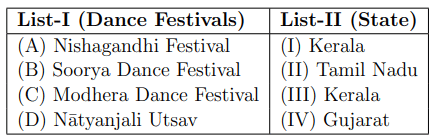
Match List-I with List-II

Choose the correct answer from the options given below:
View Solution
Step 1: Understanding the Concept:
The question requires matching famous classical dance festivals of India with the states in which they are held.
Step 2: Detailed Explanation:
- (A) Nishagandhi Festival: This annual festival is organized by the Kerala Tourism Department at the Nishagandhi Auditorium in Thiruvananthapuram, Kerala. So, A matches with (I) or (III).
- (B) Soorya Dance Festival: This is another prestigious and long-running dance festival held in Thiruvananthapuram, Kerala. So, B also matches with (I) or (III).
- (C) Modhera Dance Festival: This festival is held at the famous 11th-century Sun Temple in Modhera, Gujarat. So, C matches with (IV).
- (D) Nātyanjali Utsav: This is a major annual dance festival dedicated to Lord Nataraja, held in the great temple at Chidambaram, Tamil Nadu. So, D matches with (II).
Based on this, the correct combination is C-(IV) and D-(II). The only option that has this is option (C), which assigns A and B to the two 'Kerala' options (I and III).
Step 3: Final Answer:
The correct matching is (A)-Kerala, (B)-Kerala, (C)-Gujarat, (D)-Tamil Nadu. This corresponds to option (C).
Quick Tip: Major cultural festivals are often linked to famous heritage sites. Associating Modhera with the Sun Temple in Gujarat and Natyanjali with the Chidambaram Temple in Tamil Nadu can help you quickly solve such questions.
Which of these are Bharatanatyam Exponents?
View Solution
Step 1: Understanding the Concept:
The question asks to identify the renowned exponents of the Bharatanatyam dance form from the given list of artists.
Step 2: Detailed Explanation:
- (A) Rukmini Devi Arundale: She was a pivotal figure in the 20th-century revival of Bharatanatyam and the founder of the Kalakshetra Foundation. She is a celebrated Bharatanatyam exponent.
- (B) Yamini Krishnamurthy: She is an eminent dancer, renowned for her mastery of both Bharatanatyam and Kuchipudi.
- (C) Ranjana Gauhar: She is a world-renowned exponent of the Odissi dance form.
- (D) Saroja Vaidyanathan: She was a highly respected Bharatanatyam guru, choreographer, and performer.
Thus, Rukmini Arundale, Yamini Krishnamurthy, and Saroja Vaidyanathan are all exponents of Bharatanatyam.
Step 3: Final Answer:
The correct combination of Bharatanatyam exponents is (A), (B), and (D).
Quick Tip: For questions identifying artists, it's as important to know who does *not* belong as it is to know who does. Recognizing Ranjana Gauhar as an Odissi dancer is the key to eliminating the incorrect options here.
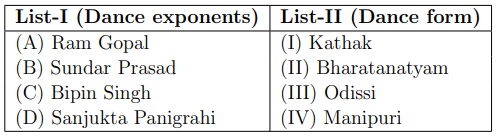
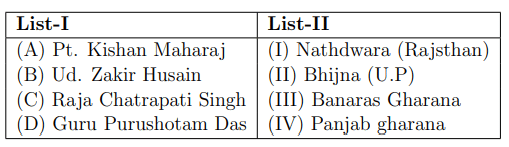
Match List-I with List-II

Choose the correct answer from the options given below:
View Solution
Step 1: Understanding the Concept:
The question requires matching prominent gurus and exponents of Indian classical dance with their respective dance forms.
Step 2: Detailed Explanation:
- (A) Ram Gopal: He was a pioneering solo dancer and choreographer in the mid-20th century, celebrated for his presentations of Bharatanatyam. So, A matches with (II).
- (B) Sundar Prasad: He was a renowned guru of the Jaipur gharana of Kathak. So, B matches with (I).
- (C) Bipin Singh: Guru Bipin Singh is widely regarded as the father of the Manipuri dance revival and is a master of Manipuri dance. So, C matches with (IV).
- (D) Sanjukta Panigrahi: She was the foremost female exponent who played a crucial role in the revival and popularization of Odissi dance globally. So, D matches with (III).
Step 3: Final Answer:
The correct set of matches is A-II, B-I, C-IV, D-III.
Quick Tip: In matching questions, try to identify the most famous pairs first. Sanjukta Panigrahi and Odissi are almost synonymous, as are Guru Bipin Singh and Manipuri. This can help you quickly narrow down the options.
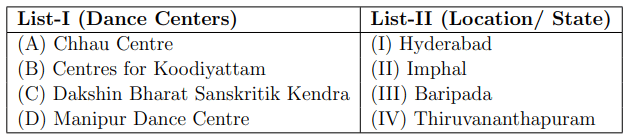
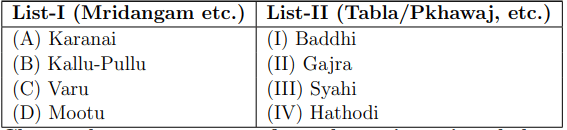
Match List-I with List-II

Choose the correct answer from the options given below:
View Solution
Step 1: Understanding the Concept:
This question requires matching various dance and cultural centers with their correct locations.
Step 2: Detailed Explanation:
- (A) Chhau Centre: The Mayurbhanj style of Chhau dance is famous, and a major centre for its training and promotion is located in Baripada, Odisha. So, A matches with (III).
- (B) Centres for Koodiyattam: Koodiyattam is a traditional Sanskrit theatre form from Kerala. Major institutions preserving it, such as Kerala Kalamandalam, are located in the region of Thiruvananthapuram (Kerala). So, B matches with (IV).
- (D) Manipur Dance Centre: Manipuri dance originates from Manipur. The Jawaharlal Nehru Manipur Dance Academy, a premier institution, is located in Imphal, the capital of Manipur. So, D matches with (II).
- (C) Dakshin Bharat Sanskritik Kendra: This translates to "South Indian Cultural Centre." By elimination, it matches with Hyderabad (I). While Hyderabad is not the only southern cultural hub, this is the logical pairing left.
Step 3: Final Answer:
The correct matching is A-III, B-IV, C-I, D-II.
Quick Tip: When matching institutions to locations, always start with the most obvious pairs. A Manipur Dance Centre will be in Manipur (Imphal), and a Koodiyattam Centre will be in Kerala. This process of elimination simplifies the question.
'Tamasha' is a folk dance of which state?
View Solution
Step 1: Understanding the Concept:
The question asks to identify the state of origin for the folk art form 'Tamasha'.
Step 2: Detailed Explanation:
Tamasha is a traditional and popular form of folk theatre from the state of Maharashtra. It is known for its vibrant blend of music, lavani dance, and humorous dialogues or skits, often with social or political commentary.
Step 3: Final Answer:
'Tamasha' is a folk theatre form of Maharashtra.
Quick Tip: Associate key folk forms with their states: Tamasha and Lavani with Maharashtra, Nautanki with Uttar Pradesh, Bhavai with Gujarat/Rajasthan, and Jatra with Bengal/Odisha.
Which organization organises Shakti festivals of Music, Dance and Drama and celebrate the temple tradition and is held at seven Shakti peeth?
View Solution
Step 1: Understanding the Concept:
The question asks to identify the national organization responsible for organizing a specific series of festivals called 'Shakti' at seven Shakti Peeths (pilgrimage sites) to celebrate temple traditions.
Step 2: Detailed Explanation:
The Sangeet Natak Akademi, India's national academy for music, dance, and drama, is the apex body for the performing arts. One of its initiatives is to organize festivals that preserve and promote traditional and temple-based art forms. The series of festivals celebrating performing arts at various Shakti Peeths across the country is an initiative undertaken by the Sangeet Natak Akademi.
Step 3: Final Answer:
The Sangeet Natak Akademi is the organization that organises the Shakti festivals.
Quick Tip: When a question refers to a major, nationwide festival series or an award related to performing arts, the Sangeet Natak Akademi is often the correct answer, as it is the primary governmental body for these activities.
Choose the correct sequence according to the seniority.
View Solution
Step 1: Understanding the Concept:
The question asks to arrange four legendary gurus of the Lucknow Gharana of Kathak in chronological order, from the most senior (earliest) to the most recent.
Step 2: Detailed Explanation:
This requires knowledge of the Guru-Shishya Parampara (teacher-disciple lineage) of the Lucknow Gharana.
- (D) Ishwari Prasad: He is traditionally credited as the founder of the Lucknow Gharana of Kathak. He is the earliest figure in this list.
- (C) Bindadin Maharaj: He was a direct descendant in the lineage of Ishwari Prasad and, along with his brother Kalka Prasad, was a legendary court dancer in Awadh who greatly refined the art form. He is senior to Achhan Maharaj.
- (B) Achhan Maharaj: He was the son of Kalka Prasad and the nephew of Bindadin Maharaj. He was a prominent guru in the early 20th century. He is the father of Birju Maharaj.
- (A) Birju Maharaj: He was the son and disciple of Achhan Maharaj and the most recent and globally acclaimed torchbearer of this lineage.
The correct sequence from earliest to latest is Ishwari Prasad -> Bindadin Maharaj -> Achhan Maharaj -> Birju Maharaj.
Step 3: Final Answer:
The correct chronological sequence according to seniority is (D), (C), (B), (A).
Quick Tip: Understanding the family tree of major Gharanas is key to answering seniority questions. For the Lucknow Kathak Gharana, remember the famous father-son successions: Kalka-Bindadin brothers -> Acchan-Lachhu-Shambhu Maharaj -> Birju Maharaj.
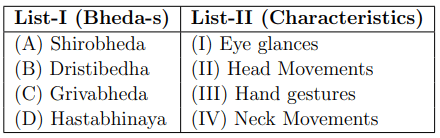
Match List-I with List-II

Choose the correct answer from the options given below:
View Solution
Step 1: Understanding the Concept:
The question requires matching Sanskrit technical terms for different types of bodily movements ('bhedas' or classifications) used in Indian classical dance with their English meanings.
Step 2: Detailed Explanation:
- (A) Shirobheda: 'Shira' means head. Therefore, Shirobheda refers to the different types of Head Movements. So, A matches with (II).
- (B) Dristibedha: 'Drishti' means sight or eye. Therefore, Dristibedha refers to the different types of Eye glances. So, B matches with (I).
- (C) Grivabheda: 'Griva' means neck. Therefore, Grivabheda refers to the different types of Neck Movements. So, C matches with (IV).
- (D) Hastabhinaya: 'Hasta' means hand and 'Abhinaya' means expression. Therefore, Hastabhinaya refers to expression through Hand gestures (Mudras). So, D matches with (III).
Step 3: Final Answer:
The correct set of matches is A-II, B-I, C-IV, D-III.
Quick Tip: Learning the basic Sanskrit roots for body parts is extremely helpful for dance theory: Shira (head), Drishti (eye), Griva (neck), Hasta (hand), and Pada (foot). This knowledge makes decoding such technical terms much easier.
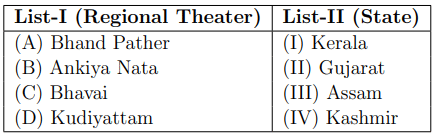
Match List-I with List-II

Choose the correct answer from the options given below:
View Solution
Step 1: Understanding the Concept:
The question requires matching traditional regional theatre forms of India with their respective states of origin.
Step 2: Detailed Explanation:
- (A) Bhand Pather: This is a traditional satirical and mimetic theatre form exclusively associated with the Kashmir valley. So, A matches with (IV).
- (B) Ankiya Nata: These are one-act plays, a form of traditional theatre created by the Vaishnava saint Srimanta Sankardev in Assam. So, B matches with (III).
- (C) Bhavai: This is a popular folk theatre form of western India, primarily found in the state of Gujarat. So, C matches with (II).
- (D) Kudiyattam: This is a form of Sanskrit theatre, recognized by UNESCO, which is traditionally practiced in the state of Kerala. So, D matches with (I).
Step 3: Final Answer:
The correct matching is A-IV, B-III, C-II, D-I.
Quick Tip: Creating a simple table of folk arts and their corresponding states is an excellent study technique for exams. This helps in quick recall for matching questions.
Which text is named the 'Manual of Dance'?
View Solution
Step 1: Understanding the Concept:
The question asks to identify the specific ancient text that is often referred to as a "Manual of Dance" due to its focused and detailed treatment of dance techniques.
Step 2: Detailed Explanation:
While the Natyashastra is the foundational encyclopedia for all performing arts, the Abhinayadarpanam by Nandikeshvara is a concise and highly specialized text. It deals almost exclusively with the techniques of dance (Nritta, Nritya, and Natya), with detailed descriptions of hand gestures (hastas), head movements, eye movements, and postures. Because of its practical, focused nature, it is widely considered a primary handbook or "manual" for classical dancers.
Step 3: Final Answer:
The Abhinayadarpanam is famously known as the 'Manual of Dance'.
Quick Tip: Distinguish between the "encyclopedia" (Natyashastra) and the "manual" (Abhinayadarpanam). The encyclopedia is broad and covers theory, while the manual is specific and provides practical instructions.
The Saatvika Abhinaya is performed by which means of emotions?
View Solution
Step 1: Understanding the Concept:
The question is about 'Saatvika Abhinaya', one of the four types of Abhinaya (expression) in Indian classical dance. Saatvika Abhinaya refers to the expression of emotions through genuine, involuntary physiological responses that arise from the performer's internal emotional state (sattva).
Step 2: Detailed Explanation:
The Natyashastra lists eight 'Saatvika Bhavas' (involuntary emotional responses). Let's check the options against this list:
- (A) Sweating (Sweda): This is one of the eight Saatvika Bhavas.
- (B) Garlands: This is an element of costume and adornment, which belongs to 'Aharya Abhinaya' (external expression through costume, makeup, etc.). It is not a Saatvika Bhava.
- (C) Tears (Ashru) and Fainting (Pralaya): Both tears and fainting are listed as Saatvika Bhavas.
- (D) Break of voice (Svarabhanga): A change or break in voice due to intense emotion is also a Saatvika Bhava.
Therefore, the correct means of performing Saatvika Abhinaya from the list are sweating, tears, fainting, and break of voice.
Step 3: Final Answer:
The correct combination is (A), (C), and (D).
Quick Tip: Remember the four types of Abhinaya: Angika (body), Vachika (voice/speech), Aharya (costume/makeup), and Saatvika (internal/involuntary). Saatvika is about genuine physical reactions like sweating, crying, or trembling, which cannot be easily faked.
When the face is raised towards the upper direction, it is called...
View Solution
Step 1: Understanding the Concept:
This question pertains to 'Shirobheda', which are the classifications of head movements as described in classical dance texts like the Abhinayadarpanam.
Step 2: Detailed Explanation:
The various head movements have specific names and meanings:
- Adhomukha: The face is cast down or looking downwards.
- Alolita: The head is moved in a circular motion.
- Dhuta: The head is moved from side to side, as if indicating 'no'.
- Udvahita: The head is raised upwards.
Therefore, raising the face towards the upper direction is called Udvahita.
Step 3: Final Answer:
Based on the classical definitions of head movements, the correct term is Udvahita.
Quick Tip: To remember these terms, focus on the Sanskrit roots. 'Urdhva' means up, which is related to 'Udvahita'. 'Adho' means down, relating to 'Adhomukha'. This can help in quickly identifying the correct movement.
Which Mudra or hand gesture used to denote lightning, a creeper, corner of an eye?
View Solution
Step 1: Understanding the Concept:
The question asks to identify a specific Asamyukta Hasta (single hand gesture) based on its 'viniyogas' (usages).
Step 2: Detailed Explanation:
The Kartarimukha mudra, which translates to "scissor's face," is formed by extending the index and middle fingers while the thumb holds down the ring and little fingers. According to classical texts, its various uses (viniyogas) include:
- Separation of a man and woman.
- Opposition or plunder.
- The corner of an eye.
- Death.
- Disagreement.
- Lightning.
- A creeper.
Therefore, Kartarimukha is the correct gesture for the items listed.
Step 3: Final Answer:
The Kartarimukha mudra is used to denote lightning, a creeper, and the corner of an eye.
Quick Tip: Memorizing the primary viniyogas (usages) for the most common hand gestures like Pataka, Tripataka, Kartarimukha, and Alapadma is crucial for dance theory exams. Create flashcards to aid memorization.
What is the name of the 'Mandalakar' form of dancing in which reference to Lord Krishna?
View Solution
Step 1: Understanding the Concept:
The question asks for the name of a circular ('Mandalakar') dance form associated with Lord Krishna.
Step 2: Detailed Explanation:
- Raaslila (or Ras Leela) is the traditional dance drama of Vrindavan, which depicts the divine love story of Krishna and the Gopis (milkmaids). Its most iconic representation is the 'Maha Raas', where Krishna multiplies himself to dance with each Gopi in a large circle. This is a quintessential 'Mandalakar' dance.
- Hallisaka is an ancient term from texts like the Natyashastra for a circular group dance led by one man and many women, which fits the description but 'Raaslila' is the specific name of the performance tradition.
- Kathak and Satriya are classical dance forms that are not primarily defined as circular group dances, although they may contain such elements.
Step 3: Final Answer:
Raaslila is the famous 'Mandalakar' dance form that revolves around Lord Krishna.
Quick Tip: The image of Lord Krishna dancing in a circle with the Gopis is one of the most famous in Indian mythology. This divine dance is universally known as the Raaslila.
T. Balasaraswati is an exponent of which dance form?
View Solution
Step 1: Understanding the Concept:
The question requires identifying the classical dance form associated with the legendary artist T. Balasaraswati.
Step 2: Detailed Explanation:
Tanjore Balasaraswati (1918–1984) was one of the most important and influential figures in the history of Bharatanatyam in the 20th century. Hailing from a traditional matrilineal family of temple dancers and musicians (devadasis), she was celebrated for her profound mastery of 'Abhinaya' (expressional dance). Her artistry set a benchmark for the form and she was instrumental in gaining global recognition for Bharatanatyam.
Step 3: Final Answer:
T. Balasaraswati was a legendary exponent of Bharatanatyam.
Quick Tip: Remember the three pioneering women of the modern Bharatanatyam revival: T. Balasaraswati (for preserving the traditional 'sringara' essence), Rukmini Devi Arundale (for sanitizing and institutionalizing it in Kalakshetra), and Yamini Krishnamurthy (for popularizing it on the modern stage).
In Bharatanatyam repertoire followed by Jatiswaram, in which item the melody/syllables is added to the movement?
View Solution
Step 1: Understanding the Concept:
The question asks to identify the item in the traditional Bharatanatyam repertoire (margam) that comes after Jatiswaram and is the first to introduce lyrics (syllables) and abhinaya (expression).
Step 2: Detailed Explanation:
The typical sequence of a Bharatanatyam performance is:
1. Alarippu: An invocatory piece of pure dance (Nritta).
2. Jatiswaram: A more complex pure dance piece where melodic notes (swaras) are set to rhythmic patterns (jatis). It has melody but no lyrics.
3. Shabdam: This is the first item where lyrics (sahitya or syllables praising a deity or king) are introduced, along with Abhinaya (expressional dance).
4. Varnam: The centrepiece, a complex mix of Nritta and Abhinaya.
Therefore, Shabdam is the correct answer as it follows Jatiswaram and introduces lyrical content.
Step 3: Final Answer:
The item that follows Jatiswaram and adds lyrics/syllables is Shabdam.
Quick Tip: Think of the Bharatanatyam margam as a gradual unfolding. It starts with pure rhythm (Alarippu), adds melody (Jatiswaram), then adds meaning/lyrics (Shabdam), and finally combines all elements in a complex way (Varnam).
The Oja-Pali dance is from which state?
View Solution
Step 1: Understanding the Concept:
The question asks for the state of origin of the traditional dance form Oja-Pali.
Step 2: Detailed Explanation:
Oja-Pali is a traditional narrative folk performance art from the state of Assam. It is considered one of the oldest art forms of the region and is seen as a precursor to the classical dance form of Satriya. The performance involves a main narrator ('Oja') and a group of chorus singers and dancers ('Pali') who retell stories from epics and Puranas through song, dance, and gestures.
Step 3: Final Answer:
Oja-Pali dance is from Assam.
Quick Tip: Associate Oja-Pali with the Vaishnavite tradition of Assam and the great saint-reformer Srimanta Sankardev. This art form was a powerful medium for storytelling and is linked to the development of Satriya dance and Bhaona theatre.
Choose the correct combination.
View Solution
Step 1: Understanding the Concept:
The question asks to identify a group of related terms from the given list. This requires recognizing which items belong to the same cultural or artistic tradition.
Step 2: Detailed Explanation:
- (D) Manipuri: This is the name of a major Indian classical dance form from the state of Manipur.
- (A) Pung cholam: This is a vibrant and dynamic drum dance ('Pung' is the drum, 'cholam' means dance) that is an integral part of the Manipuri tradition.
- (B) Nata sankirtan: This is the ritualistic performance art of Manipur that involves singing, drumming, and dancing. It is central to the Manipuri Vaishnavite culture and has been inscribed on UNESCO's Representative List of the Intangible Cultural Heritage of Humanity. Pung Cholam is a key element of Nata Sankirtan.
- (C) Ramlila: This is a folk dramatic performance of the Ramayana epic, primarily performed in North India, and is not part of the Manipuri tradition.
Therefore, Pung cholam, Nata sankirtan, and Manipuri are all intrinsically related.
Step 3: Final Answer:
The correct combination of related terms is (A), (B), and (D).
Quick Tip: For combination questions, find the "odd one out". Here, Ramlila is geographically and culturally distinct from the other three terms, which are all specific to the art forms of Manipur.
The Yumjao Paphal symbolizing the god Pankhamba is from the symbolic Yantra of which dance form?
View Solution
Step 1: Understanding the Concept:
The question asks to identify the dance form associated with the specific cultural symbol 'Yumjao Paphal' and the deity 'Pakhangba'.
Step 2: Detailed Explanation:
The Yumjao Paphal is a powerful symbol in the Meitei culture of Manipur. It depicts two coiled serpents interlocked, representing the primordial cosmic order. This symbol is deeply connected to the pre-Vaishnavite traditions of Manipur and the deity Pakhangba. The symbolic patterns and yantras of the Meitei tradition form a philosophical and structural base for Manipuri dance, especially in its Lai Haraoba festival context.
Step 3: Final Answer:
The Yumjao Paphal is a symbolic yantra associated with Manipuri dance.
Quick Tip: Keywords like 'Pakhangba', 'Lai Haraoba', and 'Yumjao Paphal' are unique to the Meitei culture and are strong indicators that the question is related to the Manipuri dance form.
Maharis or Gotipuas are the dancers of which dance form?
View Solution
Step 1: Understanding the Concept:
The question asks to identify the classical dance form that evolved from the traditions of the Mahari and Gotipua dancers.
Step 2: Detailed Explanation:
The modern classical dance form of Odissi traces its lineage to two primary historical traditions in Odisha:
1. Maharis: These were the ritual temple dancers (similar to the devadasis of South India) who danced in the Jagannath temple in Puri. They represented the feminine or 'lasya' aspect of the dance.
2. Gotipuas: These were young boys dressed as females who danced in public spaces and outside the temples. They incorporated more acrobatic and virile 'tandava' elements into the dance.
The confluence of these two traditions led to the reconstruction and revival of Odissi in the 20th century.
Step 3: Final Answer:
Maharis and Gotipuas are the traditional dancers associated with the Odissi dance form.
Quick Tip: Remember the historical precursors for major dance forms. For Odissi, the key terms are Mahari (female temple dancers) and Gotipua (young boy dancers). For Bharatanatyam, it's the Devadasis.
Karma Dance is the oldest form of folk dance mainly related to the fertility cult. This dance form is performed in which state?
View Solution
Step 1: Understanding the Concept:
The question asks for the state where the Karma folk dance, a dance related to fertility and the Karam festival, is performed.
Step 2: Detailed Explanation:
The Karma dance is a significant folk and tribal dance performed during the Karam festival. This festival is celebrated by numerous tribal communities across the Chota Nagpur Plateau region of central-eastern India. The dance is performed to propitiate Karam Devta, the god of power and youth. This tradition is particularly prominent in the state of Jharkhand, and is also found in neighbouring regions of Chhattisgarh, Madhya Pradesh, Odisha, and West Bengal. Among the given options, Jharkhand is the most appropriate answer.
Step 3: Final Answer:
Karma dance is prominently performed in the state of Jharkhand.
Quick Tip: Many important tribal folk dances in India are concentrated in the Chota Nagpur Plateau region. When you see names like Karma, Chhau, or Sarhul, think of states like Jharkhand, Chhattisgarh, and Odisha.
Which type of instrument 'Pung Cholam' is?
View Solution
Step 1: Understanding the Concept:
The question asks for the classification of the instrument used in 'Pung Cholam' according to the Indian system of musical instruments.
Step 2: Detailed Explanation:
'Pung Cholam' is a dance form from Manipur, but the question is about the instrument, the 'Pung'. The Manipuri Pung is a long-bodied, two-headed drum. Instruments that produce sound from a stretched membrane or skin (i.e., drums) are classified as Avanaddha Vadya (membranophones).
- Sushira Vadyas are wind instruments.
- Ghana Vadyas are solid percussion instruments (idiophones).
- Tata Vadyas are string instruments (chordophones).
Step 3: Final Answer:
The Pung is a type of drum, making it an Avanaddha instrument.
Quick Tip: Break down the term 'Pung Cholam'. 'Pung' is the instrument (a drum), and 'Cholam' means movement or dance. The question is about the instrument, not the dance itself. Identifying the Pung as a drum immediately places it in the Avanaddha category.
Which term translates as a 'day-time enactment'?
View Solution
Step 1: Understanding the Concept:
The question asks to identify a term for a traditional performance art that literally means 'day-time enactment'.
Step 2: Detailed Explanation:
The term Pagati Veysham comes from the Telugu language, spoken in Andhra Pradesh and Telangana.
- 'Pagati' means 'day-time'.
- 'Veysham' means 'costume', 'disguise', or 'role'.
Thus, the term literally translates to "day-time roles" or "day-time enactment". It is a folk theatre form where performers, in various costumes and roles, enact stories during the day, often moving from village to village.
Step 3: Final Answer:
Pagati Veysham is the term that translates as a 'day-time enactment'.
Quick Tip: Even without knowing the specific art form, a basic knowledge of Dravidian language roots can help. 'Pagal' or 'Pagati' is a common word for 'day' in several South Indian languages.
An introductory sequence which states the substance of a play is called ....
View Solution
Step 1: Understanding the Concept:
The question asks for the technical term for the prologue or introduction of a play in the tradition of Sanskrit drama.
Step 2: Detailed Explanation:
In classical Sanskrit theatre, the Prastavana (also spelled Prasthaavana) is the introductory part of the play that comes after the initial benediction (Nandi). In the Prastavana, the Sutradhara (Stage Manager) enters and, often in dialogue with an actress (Nati) or another character, introduces the name of the playwright, the title of the play, and hints at the plot or the main theme. It serves to set the scene and capture the audience's attention.
Step 3: Final Answer:
The introductory sequence that states the substance of a play is called the Prastavana.
Quick Tip: Remember the key roles in a Sanskrit play's introduction: the 'Nandi' (benediction) is the opening prayer, and the 'Prastavana' (prologue) is where the 'Sutradhara' (stage manager) introduces the play.
Choose the correct sequence of the items performed in Bharatanatyam
View Solution
Step 1: Understanding the Concept:
The question asks for the correct chronological order of specific items within the traditional Bharatanatyam repertoire, known as the 'margam'.
Step 2: Detailed Explanation:
The standard sequence of a full Bharatanatyam recital progresses from simple to complex, and from pure dance to expressive dance and back. The order of the given items is:
1. (B) Alarippu: An invocatory piece of pure dance, meaning 'flowering bud'. It is the opening item.
2. (A) Shabdam: After Alarippu and Jatiswaram (not listed), this is the first item to introduce abhinaya (expression) with lyrics.
3. (D) Varnam: The centerpiece and longest item of the recital, combining pure dance (Nritta) and expressive dance (Nritya) in complex patterns.
4. (C) Tillana: The concluding item, a joyous and fast-paced pure dance piece with intricate rhythmic patterns.
Thus, the correct sequence is B, A, D, C.
Step 3: Final Answer:
The correct sequence of the items is Alaripu, Shabdam, Varnam, and Tillana.
Quick Tip: A simple mnemonic to remember the basic Bharatanatyam sequence: \(\textbf{A}\)ll \(\textbf{J}\)olly \(\textbf{S}\)tudents \(\textbf{V}\)alue \(\textbf{P}\)erfect \(\textbf{T}\)iming (Alarippu, Jatiswaram, Shabdam, Varnam, Padam, Tillana).
Identify the Bharatanatyam dancers
View Solution
Step 1: Understanding the Concept:
The question asks to identify the exponents of the Bharatanatyam dance form from the given list of artists.
Step 2: Detailed Explanation:
- (A) Shobha Naidu: She was a legendary and highly acclaimed exponent of the Kuchipudi dance form.
- (B) T. Balasaraswathi: A matriarch and one of the foremost exponents of Bharatanatyam in the 20th century, renowned for her abhinaya.
- (C) C.V. Chandrasekhar: A highly respected guru, performer, and choreographer of Bharatanatyam.
- (D) Ram Gopal: A pioneering male dancer who was instrumental in popularizing Bharatanatyam in the West during the mid-20th century.
Therefore, Balasaraswathi, Chandrasekhar, and Ram Gopal are Bharatanatyam dancers, while Shobha Naidu is a Kuchipudi dancer.
Step 3: Final Answer:
The correct combination of Bharatanatyam dancers is (B), (C), and (D).
Quick Tip: Being able to differentiate dancers from closely related forms like Bharatanatyam and Kuchipudi is a common challenge in exams. Associate key names with each style: e.g., Shobha Naidu and Vempati Chinna Satyam with Kuchipudi; Balasaraswati and Rukmini Devi with Bharatanatyam.
Match List-I with List-II

Choose the correct answer from the options given below:
View Solution
Step 1: Understanding the Concept:
The question requires matching key concepts from Indian aesthetic (Rasa) and dramatic theory with the specific number associated with them in classical texts.
Step 2: Detailed Explanation:
- (A) Sanchari Bhava (or Vyabhichari Bhava): These are the transitory or fleeting emotions that support the main dominant emotion (Sthayi Bhava). Classical texts enumerate 33 of them. So, A matches with (I).
- (B) Nava-Rasa: This refers to the 'nine rasas' or aesthetic sentiments experienced by the audience. Originally, Bharata Muni listed eight, but later scholars added Shanta Rasa (peace) to make a total of 9. So, B matches with (II).
- (C) Abhinaya: This is the art of expression in drama and dance. It is classified into 4 types: Angika (body), Vachika (voice), Aharya (costume/makeup), and Sattvika (internal emotion). So, C matches with (III).
- (D) Sattvika Bhava: These are the eight involuntary physical manifestations of an internal emotional state. The classical texts list 8 of them (e.g., sweating, tears, trembling). So, D matches with (IV).
Step 3: Final Answer:
The correct matching is A-I, B-II, C-III, D-IV.
Quick Tip: Remembering these key numbers is fundamental to understanding Rasa theory: 4 types of Abhinaya, 8 Sthayi Bhavas, 8 Sattvika Bhavas, 9 Rasas (Nava-Rasa), and 33 Sanchari Bhavas.
How many holes are there in Gajara of tabla ?
View Solution
Step 1: Understanding the Concept:
The question asks about a specific detail in the construction of a tabla. The 'Gajara' is the braided leather ring that encircles the 'Pudi' (drumhead).
Step 2: Detailed Explanation:
The Gajara serves as the anchor for the leather straps ('baddhi'). These straps are threaded through the holes in the Gajara and run down the side of the tabla shell, where they are tied to the bottom ring, providing tension to the drumhead. A standard, professionally made tabla has 16 holes in its Gajara to accommodate the 16 straps.
Step 3: Final Answer:
The standard number of holes in the Gajara of a tabla is 16.
Quick Tip: While there can be variations, 16 is the standard and most widely accepted number for tabla construction, ensuring even tension across the drumhead.
"Dha Kitatak Dhum Kitatak" bol is used for this percussion instruments
View Solution
Step 1: Understanding the Concept:
The question asks to identify the percussion instrument associated with a specific rhythmic phrase ('bol').
Step 2: Detailed Explanation:
The 'bols' (syllables) of different percussion instruments have distinct phonetic qualities reflecting their sound.
- Pakhawaj is known for its deep, open, and resonant sounds. Bols like "Dha," "Dhum," and "Kitatak" with a full, rounded sound are characteristic of the Pakhawaj. The bol "Dha Kitatak Dhum Kitatak" is a classic Pakhawaj phrase.
- Tabla bols are generally sharper and more crisp (e.g., Na, Tin, TeTe).
- Nakkara and Dhol are folk drums with less complex and standardized bol systems.
Step 3: Final Answer:
The given bol is a characteristic phrase of the Pakhawaj.
Quick Tip: Listen to recordings of different Indian percussion instruments. The Pakhawaj has a noticeably deeper and more resonant "voice" than the Tabla, which will help you distinguish their bols.
Bolparan and Gatparan are types of
View Solution
Step 1: Understanding the Concept:
The question asks to categorize 'Bolparan' and 'Gatparan' within the compositional forms of Tabla and Kathak dance.
Step 2: Detailed Explanation:
- A Paran is a type of fixed composition played on the Tabla or recited in Kathak that uses the powerful, open bols characteristic of the Pakhawaj.
- Bolparan: This is a specific type of Paran that incorporates Kathak dance bols ('bols' of the composition) into the rhythmic structure.
- Gatparan: This is another type of Paran that is derived from or inspired by a 'Gat' (an instrumental composition or a specific type of dance composition).
Both are fundamentally elaborations of the main compositional form, the Paran.
Step 3: Final Answer:
Bolparan and Gatparan are specialized types of Paran.
Quick Tip: The suffix '-paran' in both 'Bolparan' and 'Gatparan' is a strong clue that they are varieties of the parent form 'Paran'. Pay attention to root words in technical terms.
This jati was formed by the combination of Tishra and Chaturashra Jati.
View Solution
Step 1: Understanding the Concept:
The question pertains to the five 'Jatis' in the Carnatic tala system, which define the number of beats in a Laghu. The question asks to identify the Jati formed by combining a 3-beat pattern and a 4-beat pattern.
Step 2: Key Formula or Approach:
The five Jatis and their corresponding number of aksharas (beats) are:
- Tishra Jati = 3 beats
- Chaturashra Jati = 4 beats
- Khanda Jati = 5 beats
- Mishra Jati = 7 beats
- Sankirna Jati = 9 beats
Step 3: Detailed Explanation:
The question states that the new jati is a combination of Tishra and Chaturashra.
\[ Tishra (3) + Chaturashra (4) = 7 \]
The jati with 7 beats is known as Mishra Jati. The term 'Mishra' itself means 'mixed', reflecting its composite nature.
Step 4: Final Answer:
The combination of Tishra (3) and Chaturashra (4) results in 7 beats, which is Mishra Jati.
Quick Tip: Memorize the five Jatis and their corresponding numbers: 3, 4, 5, 7, 9. Remember that 'Mishra' means 'mixed' and is 7 (3+4), and 'Sankirna' means 'complex' and is 9 (4+5).
Who is the Guru of Chhatarpati Singh?
View Solution
Step 1: Understanding the Concept:
The question asks to identify the teacher (Guru) of Raja Chhatrapati Singh, a famous patron and exponent of Pakhawaj.
Step 2: Detailed Explanation:
Raja Chhatrapati Singh of Bijna was a celebrated Pakhawaj player from a royal family in Uttar Pradesh. He was a prominent disciple of the legendary Pakhawaj maestro of the Kudau Singh tradition, Guru Purushottam Das. This lineage is known for its complex and powerful style of Pakhawaj playing.
Step 3: Final Answer:
The Guru of Raja Chhatrapati Singh was Guru Purushottam Das.
Quick Tip: Knowing the Guru-Shishya (teacher-disciple) lineages is crucial for questions on music history. Raja Chhatrapati Singh is a key figure in the history of Pakhawaj, and his association with Guru Purushottam Das is well-documented.
Which symbol is used for Khali in Paluskar tala Notation System.
View Solution
Step 1: Understanding the Concept:
The question asks for the specific symbol used to denote 'Khali' (the unstressed beat, indicated by a wave of the hand) in the notation system developed by Pt. Vishnu Digambar Paluskar.
Step 2: Detailed Explanation:
There are two main notation systems for Hindustani music tala:
- Bhatkhande System: Uses 'x' for Sam (the first beat) and '0' for Khali.
- Paluskar System: Uses '1' for Sam and '+' for Khali.
Therefore, in the Paluskar system, the symbol for Khali is the plus sign (+).
Step 3: Final Answer:
The symbol '+' is used for Khali in the Paluskar tala notation system.
Quick Tip: Create a small chart to remember the differences between the two main notation systems. It's a very common point of confusion and a frequent exam question.

In which type of Kayada, open and loud sound is used.
View Solution
Step 1: Understanding the Concept:
The question asks to identify a type of 'Kayada' (a specific compositional form in Tabla) that is characterized by the use of open and loud sounds ('Khula Baaj').
Step 2: Detailed Explanation:
- Peshkar: An introductory form, typically played with improvisation, not defined by being loud.
- Anawat Kayada: 'Anawat' means difficult or unusual, focusing on complex rhythmic structures.
- Lagginuma Kayada: A kayada that mimics the style of a 'Laggi', a fast pattern used in light music.
- Gatkayada: A kayada that is composed in the style of a 'Gat' (an instrumental composition). Gats are often characterized by clear, resonant, and open bols ('Khula Baaj'). Therefore, a Gatkayada would also feature these open and loud sounds.
Step 3: Final Answer:
Gatkayada is the type of Kayada most associated with open and loud sounds.
Quick Tip: Associate the term 'Gat' with instrumental music played on instruments like Sitar, which often features clear, melodic, and resonant phrases. A 'Gatkayada' on the tabla aims to replicate this quality.
How many parts are there in Tripushkar Vadya?
View Solution
Step 1: Understanding the Concept:
The question asks for the number of components in an ancient musical instrument known as 'Tripushkar Vadya'.
Step 2: Detailed Explanation:
The name 'Tripushkar' itself provides the answer. It is a Sanskrit term that can be broken down:
- 'Tri' means 'three'.
- 'Pushkar' is an ancient term for drums or percussion instruments.
Thus, 'Tripushkar' refers to a set of three drums, mentioned in ancient texts like the Natyashastra. It is considered an ancestor of modern percussion instruments like the tabla.
Step 3: Final Answer:
Tripushkar Vadya consists of 3 parts or drums.
Quick Tip: Learning basic Sanskrit number prefixes (like Eka-1, Dvi-2, Tri-3, Chatur-4) can be very helpful for deciphering ancient musicological terms in exams.
Mention the type of Baaj in Ajarada Gharana
View Solution
Step 1: Understanding the Concept:
The question asks to identify the characteristic playing style ('Baaj') of the Ajarada Gharana of Tabla.
Step 2: Detailed Explanation:
Tabla Gharanas are broadly classified into two styles:
- Band Baaj (Closed Style): Characterized by the extensive use of finger strokes, intricate patterns, and controlled, less resonant sounds. The Delhi and Ajarada Gharanas are the prime examples of this style. Ajarada is particularly known for its 'aad' or diagonal strokes and complex layakari.
- Khula Baaj (Open Style): Characterized by the use of open-hand strokes, producing a more resonant and powerful sound. The Purbi (Eastern) Gharanas like Lucknow, Farukhabad, and Banaras exemplify this style.
Step 3: Final Answer:
The Ajarada Gharana is a proponent of the Band Baaj.
Quick Tip: A simple way to remember the Baaj classification is to link them geographically. The western gharanas, Delhi and Ajarada, founded the 'Band Baaj'. The eastern (Purbi) gharanas, Lucknow, Farukhabad, and Banaras, developed the 'Khula Baaj'.
Select the Gharanas with Khula Baaj
View Solution
Step 1: Understanding the Concept:
The question asks to identify which of the listed Tabla Gharanas are known for the 'Khula Baaj' (open playing style).
Step 2: Detailed Explanation:
- (A) Farukhabad, (B) Lucknow, (C) Banaras: These three are known as the 'Purbi' (Eastern) Gharanas and are the primary proponents of the Khula Baaj, which emphasizes resonant, open-handed strokes.
- (D) Punjab: While the Punjab Gharana has its own distinct baaj, it is heavily influenced by the Pakhawaj and is characterized by powerful, open strokes. Therefore, it is also considered a Khula Baaj gharana, distinct from the closed style of Delhi and Ajarada.
Since all four gharanas listed utilize an open playing style as their primary characteristic, all of them can be classified as having 'Khula Baaj'.
Step 3: Final Answer:
All four gharanas—Farukhabad, Lucknow, Banaras, and Punjab—are associated with the Khula Baaj.
Quick Tip: Remember the two 'Band Baaj' gharanas: Delhi and Ajarada. All the other four major gharanas (Lucknow, Farukhabad, Banaras, Punjab) are classified under 'Khula Baaj'. This makes identification easier.
Choose the Talas having equal number of matras.
View Solution
Step 1: Understanding the Concept:
The question asks to identify which of the given Hindustani talas have the same number of matras (beats).
Step 2: Detailed Explanation:
Let's list the number of matras for each tala:
- (A) Teental: This is the most common tala in Hindustani music, and it has 16 matras.
- (B) Tilwada: This is a slow-tempo tala with a different theka (bol pattern) from Teental, but it also has 16 matras.
- (C) Panjabi: Also known as Punjabi Theka, this is another 16-matra tala, often used in light classical music. It has 16 matras.
- (D) Adha: Adha Teental is yet another variation with a distinct theka, and it also has 16 matras.
Since all four talas listed are 16-matra cycles, they all have an equal number of matras.
Step 3: Final Answer:
All the given talas - Teental, Tilwada, Panjabi, and Adha - have 16 matras each.
Quick Tip: Be aware that many different talas can share the same number of matras. What distinguishes them is their 'theka' (the set of bols), their 'vibhag' (division), and their characteristic tempo. Teental is the most famous 16-beat cycle, but many others exist.
Arrange the following Gharanas in chronological order.
View Solution
Step 1: Understanding the Concept:
The question requires arranging four of the six major Tabla Gharanas in the order of their establishment. This is a question about the history and evolution of Tabla playing.
Step 2: Detailed Explanation:
The chronological development of these gharanas is generally accepted as follows:
1. (C) Lucknow Gharana: Considered the oldest of the 'Purbi Baaj' gharanas, founded in the late 18th century by Miyan Bakshu Khan and Modhu Khan.
2. (B) Farukhabad Gharana: This gharana was founded by Haji Vilayat Ali Khan, who was a disciple of Miyan Bakshu Khan of Lucknow. Thus, it came after the Lucknow Gharana.
3. (D) Punjab Gharana: This gharana developed independently but its codification as a major gharana is generally placed in the early 19th century under Miyan Qader Baksh II.
4. (A) Banaras Gharana: This gharana was founded by Pandit Ram Sahai in the early 19th century. He was a disciple of Modhu Khan of Lucknow. While its origins are contemporary with Farukhabad and Punjab, in many chronologies, it is placed after them.
Based on the options, the sequence (C) Lucknow \(\rightarrow\) (B) Farukhabad \(\rightarrow\) (D) Punjab \(\rightarrow\) (A) Banaras is a plausible and historically sound ordering.
Step 3: Final Answer:
The correct chronological order is Lucknow, Farukhabad, Punjab, and Banaras.
Quick Tip: Remember the lineage: The Lucknow Gharana is the parent of the Farukhabad and Banaras gharanas. This fact alone helps to establish the beginning of the sequence, making it easier to select the correct option.
Match List-I with List-II

Choose the correct answer from the options given below:
View Solution
Step 1: Understanding the Concept:
The question requires matching prominent percussion artists with their respective Gharanas (schools) or places of association.
Step 2: Detailed Explanation:
- (A) Pt. Kishan Maharaj: He was one of the most celebrated Tabla maestros of the 20th century and a leading exponent of the (III) Banaras Gharana.
- (B) Ud. Zakir Husain: The world-renowned Tabla virtuoso, son and disciple of Ustad Alla Rakha, is the foremost representative of the (IV) Panjab Gharana.
- (C) Raja Chatrapati Singh: He was the king of (II) Bijna (U.P) (often misspelled Bhijna) and a famous Pakhawaj player.
- (D) Guru Purushotam Das: He was a legendary Pakhawaj maestro of the (I) Nathdwara tradition in Rajasthan. He was also the guru of Raja Chhatrapati Singh.
Step 3: Final Answer:
The correct set of matches is A-III, B-IV, C-II, D-I.
Quick Tip: Even if you are unsure about all the artists, matching the most famous ones first (like Kishan Maharaj with Banaras and Zakir Hussain with Punjab) will significantly narrow down the options and often lead to the correct answer.
The left-hand side of the Mridangam is known as
View Solution
Step 1: Understanding the Concept:
The question asks for the specific name of the left-hand drum head of the Carnatic percussion instrument, the Mridangam.
Step 2: Detailed Explanation:
The Mridangam is a double-sided drum.
- The right side, which is smaller, produces high-pitched, sharp sounds. It is called the 'Valanthalai'.
- The left side is larger and produces the bass sounds. This side is known as the 'Toppi'. A temporary paste of flour and water is often applied to the Toppi to lower its pitch and give it a rich bass tone.
The other terms refer to playing strokes.
Step 3: Final Answer:
The left-hand side of the Mridangam is called the Toppi.
Quick Tip: Remember the two main parts of the Mridangam: 'Valanthalai' (right head) and 'Toppi' (left head). The Toppi is the larger, bass side.
Which variety of Mridangam is played for female singers
View Solution
Step 1: Understanding the Concept:
The question asks to identify the specific type or pitch-variety of Mridangam that is suitable for accompanying female vocalists.
Step 2: Detailed Explanation:
The pitch of a Mridangam needs to be tuned to the tonic note (Shruti) of the main performer. Since female singers generally have a higher vocal range and sing at a higher pitch (typically from G to B, known as 5 to 7 kattai/shruti), a Mridangam that is smaller and can be tuned to a higher pitch is required. This variety is known as 'Kappi' Mridangam. A lower-pitched Mridangam, used for male vocalists, is known as 'Kutchi'.
Step 3: Final Answer:
The Kappi variety of Mridangam is used to accompany female singers.
Quick Tip: Associate 'Kappi' with higher pitches (female voice) and 'Kutchi' with lower pitches (male voice). This distinction is fundamental for accompanists in Carnatic music.
Leather straps by which both side of the Mridangam is tighten
View Solution
Step 1: Understanding the Concept:
The question asks for the specific term for the leather straps used to apply tension to the drumheads of a Mridangam.
Step 2: Detailed Explanation:
In the construction of a Mridangam, the two drumheads (Valanthalai and Toppi) are held in place and tensioned by numerous thick leather straps that run along the length of the wooden shell. These straps are known as 'Varu'. By adjusting the tension of the Varu, the pitch of the Mridangam is controlled.
Step 3: Final Answer:
The leather straps on a Mridangam are called Varu.
Quick Tip: Just as the Tabla has 'baddhi' for its straps, the Mridangam has 'Varu'. Knowing the specific terminology for different instruments is important.
The number that represents Sankirna jati
View Solution
Step 1: Understanding the Concept:
The question asks for the number of aksharas (beats) corresponding to the 'Sankirna' Jati in the Carnatic tala system.
Step 2: Detailed Explanation:
The five main Jatis in Carnatic music are:
- Tishra = 3 beats
- Chaturashra = 4 beats
- Khanda = 5 beats
- Mishra = 7 beats
- Sankirna = 9 beats
The term 'Sankirna' means complex or varied, reflecting its composition from a 4-beat and a 5-beat pattern (4+5=9).
Step 3: Final Answer:
The number that represents Sankirna Jati is nine.
Quick Tip: Memorize the five Jatis and their counts as a sequence: \(\textbf{3, 4, 5, 7, 9}\). This simple sequence is the key to solving many questions related to the Carnatic tala structure.
The word "Atodya" means
View Solution
Step 1: Understanding the Concept:
The question asks for the meaning of the ancient Sanskrit term "Atodya".
Step 2: Detailed Explanation:
In ancient Indian texts on music and drama, particularly Bharata Muni's Natyashastra, the term 'Atodya' (or 'Atodya Vadya') is used as a generic term for musical instruments. The Natyashastra classifies 'Atodya' into four main categories: Tata (stringed), Avanaddha (covered/drums), Ghana (solid/cymbals), and Sushira (hollow/wind).
Step 3: Final Answer:
The word "Atodya" means Musical Instruments.
Quick Tip: 'Vadya' is a common word for instrument. 'Atodya' is a more ancient, scholarly term from foundational texts. Both refer to the same concept.
The total number of Suladi tala
View Solution
Step 1: Understanding the Concept:
The question asks for the total number of talas in the 'Suladi' system, which forms the foundation of the Carnatic tala system.
Step 2: Detailed Explanation:
The Carnatic tala system is primarily based on a set of seven foundational tala structures, known as the Suladi Sapta Talas. The word 'Sapta' means seven. These seven talas are:
1. Dhruva Tala
2. Matya Tala
3. Rupaka Tala
4. Jhampa Tala
5. Triputa Tala
6. Ata Tala
7. Eka Tala
By combining these seven tala structures with the five Jatis, a total of 35 different talas can be formed. However, the number of 'Suladi talas' themselves is seven.
Step 3: Final Answer:
The total number of Suladi talas is seven.
Quick Tip: The key to this question is the term 'Suladi Sapta Talas'. 'Sapta' is Sanskrit for seven. Remembering this full name provides the answer directly.
Which finger is counted after the initial beat in reckoning a Laghu
View Solution
Step 1: Understanding the Concept:
The question asks about the specific procedure for counting the beats ('aksharas') of a 'Laghu', one of the 'angas' (limbs) of a Carnatic tala.
Step 2: Detailed Explanation:
A Laghu is represented by a vertical line and consists of a fixed beat followed by a variable number of finger counts. The process of reckoning a Laghu is as follows:
1. An initial beat or clap ('ghata') on the lap.
2. This is followed by counting the fingers, starting with the Little Finger, then the Ring Finger, then the Middle Finger, and finally the Index Finger.
The Jati of the Laghu determines how many finger counts are used after the initial beat. For example, a Chaturashra Jati Laghu would be: 1 beat + 3 finger counts (Little, Ring, Middle).
Step 3: Final Answer:
The finger counted immediately after the initial beat of a Laghu is the Little Finger.
Quick Tip: Remember that the counting of a Laghu is a cumulative process. The beat itself is the first count, and the finger counts follow. The finger counting always starts from the little finger.
Which tempo is considered as fast in Carnatic Tala system
View Solution
Step 1: Understanding the Concept:
The question asks for the term used to describe 'fast' tempo ('laya') in the Carnatic music system.
Step 2: Detailed Explanation:
In both Carnatic and Hindustani music, the tempo is categorized into three main speeds ('kaala' or 'laya'):
- Vilamba Laya: Slow tempo.
- Madhya Laya: Medium tempo.
- Druta Laya: Fast tempo.
'Ati Vilamba' would mean 'very slow', which is a sub-category of Vilamba. The primary term for fast tempo is Druta.
Step 3: Final Answer:
Druta laya is the term for fast tempo in the Carnatic Tala system.
Quick Tip: The terms for tempo are largely the same across both major Indian classical systems. Vilamba (slow), Madhya (medium), and Druta (fast) are universal concepts.
Which part of Mridangam produces bass sound
View Solution
Step 1: Understanding the Concept:
This question asks to identify the specific part of the Mridangam responsible for producing low-frequency, or bass, sounds.
Step 2: Detailed Explanation:
The Mridangam is a two-sided drum. The two heads are distinct in size and sound:
- The right side ('Valanthalai') is smaller and produces high-pitched, metallic sounds.
- The left side ('Toppi') is larger. A paste of flour and water is applied to it before playing to lower its pitch and give it a characteristic deep, resonant bass sound.
The other options ('Chapu', 'Meetu', 'Arachapu') are names of strokes played on the instrument, not parts of the instrument itself.
Step 3: Final Answer:
The Toppi, or the left side of the Mridangam, produces the bass sound.
Quick Tip: This is the third question in this set about the Toppi. It highlights the importance of knowing the basic anatomy of major instruments. Remember: Toppi = Left Side = Larger Head = Bass Sound.
Arrange the following in the decreasing order of its Akshara
View Solution
Step 1: Understanding the Concept:
The question requires arranging the given Carnatic Jatis in descending (decreasing) order based on their 'Akshara' count (number of beats).
Step 2: Detailed Explanation:
First, let's list the Akshara count for each Jati:
- (A) Sankeerna (Sankirna): 9 aksharas
- (B) Chaturasra: 4 aksharas
- (C) Mishra: 7 aksharas
- (D) Khanda: 5 aksharas
Now, let's arrange these in decreasing order (from largest to smallest):
1. Sankeerna (9)
2. Mishra (7)
3. Khanda (5)
4. Chaturasra (4)
This corresponds to the sequence A, C, D, B.
Step 3: Final Answer:
The correct decreasing order of Aksharas is Sankeerna, Mishra, Khanda, Chaturasra.
Quick Tip: To answer ordering questions quickly, first write down the value next to each item and then perform the sort. For Jatis, the values are Sankeerna=9, Mishra=7, Khanda=5, Chaturasra=4, Tishra=3.
Match List-I with List-II

Choose the correct answer from the options given below:
View Solution
Step 1: Understanding the Concept:
The question requires matching legendary artists of South India with their primary field of specialization.
Step 2: Detailed Explanation:
- (A) Palghat Mani Iyer: He was a pioneering and legendary virtuoso of the (III) Mridangam and is credited with elevating its status to a solo instrument. So, A matches with (III).
- (B) Balamurali Krishna: Dr. M. Balamurali Krishna was a celebrated Carnatic (IV) Vocalist, multi-instrumentalist, composer, and actor. His primary identity was as a vocalist. So, B matches with (IV).
- (C) Balasaraswati: T. Balasaraswati was a world-renowned exponent of the (II) Bharata Natyam dance form, celebrated for her profound abhinaya. So, C matches with (II).
- (D) Lalgudi Jayaraman: He was a virtuoso Carnatic (I) Violinist, vocalist, and composer, famous for his lyrical and expressive playing style that emulated the human voice. So, D matches with (I).
Step 3: Final Answer:
The correct set of matches is A-III, B-IV, C-II, D-I.
Quick Tip: When faced with matching questions, identify the artist you are most certain about first. For example, Palghat Mani Iyer is synonymous with Mridangam. This can help you quickly eliminate incorrect options.
Select the talas from the following with equal Akshara
View Solution
Step 1: Understanding the Concept:
The question asks to identify which of the given Carnatic talas have the same total number of 'Aksharas' (beats) in one cycle. This requires calculating the total Aksharas for each tala.
Step 2: Key Formula or Approach:
The total Aksharas are calculated by summing the Aksharas of each 'anga' (limb) in the tala's structure. The angas are Laghu (I), Drutam (O), and Anudrutam (U). The value of Laghu changes with the Jati (Tishra=3, Chaturasra=4, Khanda=5, Mishra=7, Sankirna=9), while Drutam is always 2 and Anudrutam is always 1.
- Mathya Tala structure: I O I
- Ata Tala structure: I I O O
- Roopaka Tala structure: O I
- Jhampa Tala structure: I U O
Step 3: Detailed Explanation:
Let's calculate the Akshara count for each option:
- (A) Chaturasra Jati Mathya Tala: I\(_{4}\) O\(_{2}\) I\(_{4}\) = 4 + 2 + 4 = 10 Aksharas.
- (B) Tishra Jati Ata Tala: I\(_{3}\) I\(_{3}\) O\(_{2}\) O\(_{2}\) = 3 + 3 + 2 + 2 = 10 Aksharas.
- (C) Sankirna Jati Roopaka Tala: O\(_{2}\) I\(_{9}\) = 2 + 9 = 11 Aksharas.
- (D) Mishra Jati Jhampa Tala: I\(_{7}\) U\(_{1}\) O\(_{2}\) = 7 + 1 + 2 = 10 Aksharas.
Comparing the results, talas (A), (B), and (D) each have 10 Aksharas.
Step 4: Final Answer:
The talas with an equal number of Aksharas are (A) Chaturasra Jati Mathya, (B) Tisra Jati Ata Tala, and (D) Mishra Jati Jhampa.
Quick Tip: To solve these questions quickly, you must memorize the structures of the 7 Suladi Talas and the Akshara counts for the 5 Jatis. Practice these calculations as they are very common in Carnatic music theory exams.
How many times, "Sam" can come in a tala ?
View Solution
Step 1: Understanding the Concept:
The question asks about the number of occurrences of "Sam" within a single cycle of any given tala.
Step 2: Detailed Explanation:
'Sam' is a fundamental concept in the tala systems of both Hindustani and Carnatic music. It refers specifically to the first beat of the rhythmic cycle. It is the most emphasized beat and serves as the point of resolution and convergence for both the melodic and rhythmic improvisations. By its very definition as the first beat, there can only be one Sam in each cycle (avartana) of a tala.
Step 3: Final Answer:
"Sam" comes only once in a tala cycle.
Quick Tip: Do not confuse 'Sam' with 'Taali' (clap). A tala can have multiple Taalis, but the first Taali is always the Sam. The Sam is unique; it is the starting point of the cycle.
In which category of instruments Tabla belongs ?
View Solution
Step 1: Understanding the Concept:
The question asks for the classification of the Tabla according to the ancient Indian system of instrument categorization.
Step 2: Detailed Explanation:
The Indian system classifies instruments into four main categories based on how they produce sound:
- Sushira Vadya: Aerophones or wind instruments (e.g., Flute, Shehnai).
- Ghana Vadya: Idiophones or solid instruments that are struck (e.g., Ghatam, Manjira).
- Avanaddha Vadya: Membranophones or instruments with a stretched skin/membrane (e.g., Tabla, Mridangam, Dhol). The word 'Avanaddha' means 'covered'.
- Tantra/Tata Vadya: Chordophones or string instruments (e.g., Sitar, Veena).
Since the Tabla is a drum that produces sound from a vibrating skin head, it belongs to the Avanaddha Vadya category.
Step 3: Final Answer:
The Tabla belongs to the Avanaddha category of instruments.
Quick Tip: Remember the Sanskrit roots to easily classify instruments: 'Sushira' (hollow), 'Ghana' (solid), 'Avanaddha' (covered), and 'Tata' (string/thread). A tabla is 'covered' with skin, so it is Avanaddha.
Mridangam playing without any calculations and particular form, but in perfect laya in a Tala
View Solution
Step 1: Understanding the Concept:
The question asks for the specific term that describes a style of Mridangam playing focused on spontaneous flow and adherence to the basic pulse (laya), rather than complex rhythmic calculations.
Step 2: Detailed Explanation:
- Koraipu, Mohra, Muktayipu: These are all cadential patterns (ending patterns) that are highly structured and involve precise rhythmic calculations (kanakku).
- Sarvalaghu: This term literally means 'all simple' or 'all flowing'. It refers to a style of playing that emphasizes the natural grace and swing ('gati') of the tala. The playing is spontaneous and improvisatory, flowing along with the melody without being filled with complex mathematical patterns. It perfectly matches the description of playing "without any calculations... but in perfect laya".
Step 3: Final Answer:
The style of Mridangam playing described is known as Sarvalaghu.
Quick Tip: Associate 'Sarvalaghu' with 'flow' and spontaneity. Contrast this with 'Kanakku', which means 'calculation' and is associated with complex patterns like Korvais and Mohras.
Match List-I with List-II

Choose the correct answer from the options given below:
View Solution
Step 1: Understanding the Concept:
The question asks to match the technical terms for parts of a Mridangam (List-I) with their equivalent or analogous parts on a Tabla or Pakhawaj (List-II).
Step 2: Detailed Explanation:
- (A) Karanai: On a Mridangam, this term often refers to the black paste applied to the right drumhead, which is functionally and materially the same as the (III) Syahi on a Tabla. So, A matches with (III).
- (B) Kallu-Pullu: This refers to the braided leather ring on the Mridangam head, through which the straps pass. This is directly equivalent to the (II) Gajra on a Tabla. So, B matches with (II).
- (C) Varu: These are the long leather straps that run the length of the Mridangam to provide tension. They are the direct equivalent of the (I) Baddhi on a Tabla. So, C matches with (I).
- (D) Mootu: These are the small wooden blocks on a Mridangam that are moved to make fine adjustments to the pitch. While not a direct part-for-part equivalent, their tuning function is analogous to the action of the (IV) Hathodi (tuning hammer) used on a Tabla's gattas. So, D matches with (IV) by function.
Step 3: Final Answer:
The correct set of matches is A-III, B-II, C-I, D-IV.
Quick Tip: Focus on the most direct equivalents first. 'Varu' (Mridangam straps) and 'Baddhi' (Tabla straps) are a perfect match. Similarly, the black paste (Karanai/Syahi) is another direct link. This can help you quickly find the correct option.
Mention the Guru of Palani Subramanya Pillai
View Solution
Step 1: Understanding the Concept:
The question asks to identify the Guru (teacher) of the legendary Mridangam artist, Palani Subramanya Pillai.
Step 2: Detailed Explanation:
Palani Subramanya Pillai (1908-1962) was a titan of Carnatic percussion. While his initial training was under his father, Pazhani Muthaiah Pillai, and his uncle, Mamundiya Pillai (also a valid guru), his style and musical vision were profoundly shaped by the legendary maestro Pudukkotai Dakshinamurty Pillai. Dakshinamurty Pillai was a master of both Mridangam and Kanjira and the architect of the 'Pudukkotai style' of percussion, known for its intricate calculations and aesthetics. He is widely considered one of the most significant gurus of Palani Subramanya Pillai. Among the given options, he is the most celebrated and influential teacher associated with Palani.
Step 3: Final Answer:
Pudukkotai Dakshinamurty Pillai was a prominent Guru of Palani Subramanya Pillai.
Quick Tip: The Guru-Shishya Parampara (teacher-disciple lineage) is a vital part of Indian classical music. Associating legendary students with their equally legendary gurus is a common theme in music history questions. The Palani-Pudukkotai connection is a famous one.
who is the writer of Svapna Vasavdatta?
View Solution
Step 1: Understanding the Concept:
The question asks to identify the author of the ancient Sanskrit play Svapnavasavadatta (The Vision of Vasavadatta).
Step 2: Detailed Explanation:
Svapnavasavadatta is one of the most celebrated plays in Sanskrit literature. It is attributed to the ancient Indian playwright Bhasa, who is considered one of the earliest and most significant figures in Sanskrit drama, predating even Kalidasa. The other authors are known for different works: Kalidasa for plays like Abhijnanasakuntalam, Bhavabhuti for Uttararamacarita, and Mohan Rakesh for modern Hindi plays like *Adhe Adhoore*.
Step 3: Final Answer:
The writer of *Svapnavasavadatta* is Bhasa.
Quick Tip: Associate major Sanskrit playwrights with their most famous works. Bhasa is renowned for plays like Svapnavasavadatta and Urubhangam, which were rediscovered in the 20th century.
The Dasha-rupaka or ten forms of dramatic composition, deals with dramatic critic, is the work of
View Solution
Step 1: Understanding the Concept:
The question asks to identify the author of the treatise Dasharupaka, a significant work on Sanskrit dramaturgy and criticism.
Step 2: Detailed Explanation:
The Dasharupaka is a 10th-century text that deals with the principles of dramatic composition ('natya' or 'rupaka'). It elaborates on the ten types of drama first mentioned in Bharata's Natyashastra. This important work of dramatic criticism was written by Dhananjaya, who was a scholar in the court of the Paramara king Munja.
Step 3: Final Answer:
The Dasharupaka is the work of Dhananjaya.
Quick Tip: Remember the two key texts on dramaturgy that followed the Natyashastra: the Dasharupaka by Dhananjaya and the Sahityadarpana by Vishvanatha. These are fundamental texts in Indian aesthetic theory.
Lok Dharmi and Natya Dharmi are the types of....
View Solution
Step 1: Understanding the Concept:
The question asks to identify the art form to which the concepts of 'Lok Dharmi' and 'Natya Dharmi' belong.
Step 2: Detailed Explanation:
'Lok Dharmi' and 'Natya Dharmi' are two fundamental modes of presentation or 'vritti' in classical Indian Drama (Natya), as codified in the Natyashastra.
- Lok Dharmi: The realistic mode, which imitates the behavior, actions, and objects of the everyday world ('loka'). It is naturalistic.
- Natya Dharmi: The stylized or conventional mode, which uses artistic conventions, gestures, poetic speech, and stylization that are specific to the art of theatre and not found in everyday life.
These concepts apply to acting, movement, and presentation within a dramatic context.
Step 3: Final Answer:
Lok Dharmi and Natya Dharmi are two modes of presentation in Drama.
Quick Tip: Think of 'Lok' as 'local' or 'worldly' (realistic) and 'Natya' as 'theatrical' (stylized). This distinction between realism and stylization is a core principle of Indian performance theory.
which play of Ashwagosha deals with two young men who gain the Buddha's favor?
View Solution
Step 1: Understanding the Concept:
The question asks to identify a play by the Buddhist poet-dramatist Ashvaghosha that focuses on the conversion of two young men to Buddhism.
Step 2: Detailed Explanation:
- (A) Sariputra Prakarana: This is a famous play by Ashvaghosha. Its plot revolves around the story of two Brahmin youths, Sariputra and Maudgalyayana, who become disciples of the Buddha, ultimately gaining his favor and becoming his chief disciples.
- (B) Urubhangam: A play by Bhasa.
- (C) Mrichchhakatika: A play by Shudraka.
- (D) Adhe Adhoore: A modern Hindi play by Mohan Rakesh.
Therefore, Sariputra Prakarana is the correct answer.
Step 3: Final Answer:
The play by Ashvaghosha that deals with two young men gaining the Buddha's favor is Sariputra Prakarana.
Quick Tip: Ashvaghosha was a Buddhist philosopher and poet. His works, including plays and poems like Buddhacharita, are centered on Buddhist themes and stories. This context helps in identifying his works.
Identify folk forms of north India
View Solution
Step 1: Understanding the Concept:
The question requires identifying which pairs of folk theatre forms belong to the North India region.
Step 2: Detailed Explanation:
- (A) Bhand Mirasi, Bhand Pather: Bhand Pather is from Kashmir, and Bhand Mirasi is associated with Punjab and nearby regions. Both are North Indian forms.
- (B) Dasavatara, Burrakatha: Dasavatara is from the Konkan region (Goa, Maharashtra), and Burrakatha is from Andhra Pradesh (South India). This is not a North Indian pair.
- (C) Bhagavatamela, Burrakatha: Bhagavatamela is from Tamil Nadu (South India), and Burrakatha is from Andhra Pradesh (South India). This is not a North Indian pair.
- (D) Kariyala, Khyal: Kariyala is a folk form from Himachal Pradesh, and Khyal is a prominent folk theatre of Rajasthan. Both are North Indian states.
Therefore, the pairs from North India are (A) and (D).
Step 3: Final Answer:
The correct combination of North Indian folk forms is (A) and (D).
Quick Tip: A mental map of India is very useful for such questions. Quickly place each folk form in its state to determine if it belongs to the required region (North, South, East, West).
P. V. Sambandha Mudaliar is considered as the father of Modern....
View Solution
Step 1: Understanding the Concept:
The question asks to identify the regional theatre tradition for which Pammal Vijayaranga Sambandha Mudaliar is considered a foundational figure.
Step 2: Detailed Explanation:
P. V. Sambandha Mudaliar (1873-1964) was a pioneering figure in the world of Indian theatre. He was a lawyer by profession but dedicated his life to reforming and revitalizing the stage. He wrote over 90 plays, adapted many from Shakespeare, and founded the Suguna Vilasa Sabha, a theatre group that professionalized acting and production. For his immense contributions, he is widely revered as the "Father of Modern Tamil Theatre".
Step 3: Final Answer:
P. V. Sambandha Mudaliar is considered the father of Modern Tamil Theatre.
Quick Tip: Remember the key figures who revolutionized modern regional theatre in India, such as P. V. Sambandha Mudaliar (Tamil), Girish Chandra Ghosh (Bengali), and Annasaheb Kirloskar (Marathi).
'Sakharam Binder' is a Marathi play written by....
View Solution
Step 1: Understanding the Concept:
The question asks to identify the playwright of the famous Marathi play *Sakharam Binder*.
Step 2: Detailed Explanation:
Sakharam Binder (1972) is a landmark and highly controversial play in modern Indian theatre. It deals with themes of male dominance, sexuality, and social hypocrisy. The play was written by the eminent Marathi playwright Vijay Tendulkar, who is also famous for other powerful plays like Ghashiram Kotwal and Shantata! Court Chalu Aahe. The other options are also famous Marathi playwrights, but Sakharam Binder is Tendulkar's work.
Step 3: Final Answer:
Sakharam Binder is a Marathi play written by Vijay Tendulkar.
Quick Tip: Vijay Tendulkar is one of the most important figures in post-independence Indian theatre. Associating him with his "big three" plays—*Sakharam Binder*, *Ghashiram Kotwal*, and *Shantata! Court Chalu Aahe*—is essential for exams.
The play Raktakarbi is written by:
View Solution
Step 1: Understanding the Concept:
The question asks to identify the author of the play Raktakarabi (Red Oleanders).
Step 2: Detailed Explanation:
Raktakarabi is a powerful symbolic play written in 1926 by the Nobel laureate Rabindranath Tagore. The play critiques dehumanizing materialism and greed through the allegory of a town ruled by a king who hides behind an iron net, exploiting his workers to dig for gold. The red oleander flower symbolizes life, love, and freedom.
Step 3: Final Answer:
The play Raktakarabi is written by Rabindranath Tagore.
Quick Tip: Remember Rabindranath Tagore's major plays, which are often symbolic and philosophical, such as Raktakarabi (Red Oleanders), Dak Ghar (The Post Office), and Raja (The King of the Dark Chamber).
An open-air production of 'Andha Yug' staged against the battlements of a ruined fort in Delhi(purana pila) was directed by......
View Solution
Step 1: Understanding the Concept:
The question asks to identify the director of a landmark, site-specific production of Dharamvir Bharati's play Andha Yug.
Step 2: Detailed Explanation:
The 1963 production of Andha Yug is one of the most iconic events in the history of modern Indian theatre. It was directed by Ebrahim Alkazi, then the director of the National School of Drama (NSD). He chose the ruins of Feroz Shah Kotla (often associated with Purana Qila's environs) in Delhi as the venue. This environmental, open-air staging perfectly complemented the epic scale and tragic grandeur of the play, which is set in the aftermath of the Mahabharata war.
Step 3: Final Answer:
The open-air production of Andha Yug was directed by Ebrahim Alkazi.
Quick Tip: Ebrahim Alkazi's tenure as the director of NSD is considered a golden age. His large-scale, proscenium-breaking productions like *Andha Yug* at Feroz Shah Kotla and *Tughlaq* at Purana Qila are legendary.
The plays written by Mohan Rakesh are
View Solution
Step 1: Understanding the Concept:
The question asks to identify the plays written by the modern Hindi playwright Mohan Rakesh from the given list.
Step 2: Detailed Explanation:
- (A) Adhe Adhoore: This is one of Mohan Rakesh's most famous and influential plays, dealing with middle-class disillusionment.
- (B) Andha Yug: This play was written by Dharamvir Bharati.
- (C) Lehron Ke Rajhansh: This is another major historical play by Mohan Rakesh, about Nanda and Sundari.
- (D) Khamosh Adalat Jaari hai: This is the Hindi translation of Vijay Tendulkar's Marathi play Shantata! Court Chalu Aahe.
Therefore, only (A) and (C) are plays by Mohan Rakesh.
Step 3: Final Answer:
The plays written by Mohan Rakesh are *Adhe Adhoore* and *Lehron Ke Rajhansh*.
Quick Tip: Remember the "big three" plays of Mohan Rakesh, a central figure in Hindi theatre: Ashadh Ka Ek Din, Lehron Ke Rajhansh, and Adhe Adhoore.
Match List-I with List-II

Choose the correct answer from the options given below:
View Solution
Step 1: Understanding the Concept:
The question requires matching significant plays and theatre groups from modern Indian theatre with their respective playwrights or founders.
Step 2: Detailed Explanation:
- (A) Naya Theatre: This influential theatre company, based in Bhopal and known for working with folk artists, was founded by (IV) Habib Tanvir.
- (B) Pagla Ghodha (Mad Horse): This is a well-known play written by the Bengali playwright (II) Badal Sircar.
- (C) Tughlaq: This is a critically acclaimed historical play about the Sultan Muhammad bin Tughlaq, written by (I) Girish Karnad.
- (D) Rang Vidushak: This theatre group, also based in Bhopal and known for its clowning and folk-inspired style, was founded by the director (III) Bansi Kaul.
Step 3: Final Answer:
The correct set of matches is A-IV, B-II, C-I, D-III.
Quick Tip: For matching questions in modern Indian theatre, focus on connecting major groups to their founders (e.g., Naya Theatre-Habib Tanvir) and landmark plays to their authors (e.g., Tughlaq-Girish Karnad).
Who is the founder of 'Bahurupi Theater Group' of kolkata?
View Solution
Step 1: Understanding the Concept:
The question asks to identify the founder of the influential Bengali theatre group, 'Bohurupee'.
Step 2: Detailed Explanation:
'Bohurupee' is one of the most important theatre groups in the history of post-independence Bengali theatre. It was founded in Kolkata in 1948 by Sombhu Mitra along with other artists like Tripti Mitra. The group staged landmark productions of plays by Tagore, Ibsen, and Sophocles, and was a central part of the Group Theatre Movement in Bengal.
Step 3: Final Answer:
The founder of 'Bohurupee' was Sombhu Mitra.
Quick Tip: Remember the key figures of the Bengali Group Theatre Movement and their groups: Sombhu Mitra (Bohurupee), Utpal Dutt (Little Theatre Group), and Badal Sircar (Shatabdi).
Lucky and Pojo are the characters who belong to the play.....
View Solution
Step 1: Understanding the Concept:
The question asks to identify the play that features the characters Lucky and Pozzo (misspelled as Pojo).
Step 2: Detailed Explanation:
The characters Vladimir, Estragon, Pozzo, and Lucky are the central figures in Samuel Beckett's absurdist masterpiece, Waiting for Godot. In the play, Pozzo is a bombastic master who leads his slave, Lucky, by a rope and forces him to carry his belongings and "think" on command. Their appearance in both acts provides a major point of action and philosophical debate.
Step 3: Final Answer:
The characters Lucky and Pozzo belong to the play Waiting for Godot.
Quick Tip: The five characters of Waiting for Godot are iconic: the two main tramps Vladimir (Didi) and Estragon (Gogo), the master-slave pair Pozzo and Lucky, and the boy who acts as Godot's messenger.
Match List-I with List-II

Choose the correct answer from the options given below:
View Solution
Step 1: Understanding the Concept:
The question requires matching famous modern plays with their respective playwrights.
Step 2: Detailed Explanation:
- (A) Three Sisters: This is a major work of modern theatre, a naturalistic play written by the Russian playwright (IV) Anton Chekhov.
- (B) Hedda Gabler: This is a landmark of theatrical realism and one of the most famous plays by the Norwegian playwright (III) Henrik Ibsen, often called the "father of modern drama."
- (C) Death of a Salesman: This is a classic of American theatre, a tragedy about the American Dream, written by (II) Arthur Miller.
- (D) Waiting for Godot: This is the quintessential play of the Theatre of the Absurd, written by the Irish playwright (I) Samuel Beckett.
Step 3: Final Answer:
The correct set of matches is A-IV, B-III, C-II, D-I.
Quick Tip: Create a timeline or a list of "movements" in modern drama (Realism, Absurdism, etc.) and associate the key playwrights and their representative plays with each movement. This will help organize your knowledge for matching questions.
who has proposed The Theory of 'V' effect?
View Solution
Step 1: Understanding the Concept:
The question asks to identify the theatre practitioner who developed the concept of the 'V' effect.
Step 2: Detailed Explanation:
The 'V' effect, or Verfremdungseffekt, is a German term that translates to "alienation effect" or "distancing effect". It is the central theoretical concept of the German playwright and director Bertolt Brecht's "Epic Theatre". The goal of the V-effect is to make the familiar strange, to prevent the audience from empathizing emotionally with the characters, and instead encourage them to think critically and intellectually about the social and political issues presented in the play.
Step 3: Final Answer:
The Theory of the 'V' effect was proposed by Bertolt Brecht.
Quick Tip: Associate key theoretical concepts with their proponents: Brecht with the Alienation Effect, Stanislavski with the 'Magic If' and Emotional Recall, Artaud with the Theatre of Cruelty, and Grotowski with Poor Theatre.
What is the full form of NCZCC?
View Solution
Step 1: Understanding the Concept:
The question asks for the full name of the organization abbreviated as NCZCC.
Step 2: Detailed Explanation:
NCZCC stands for the North Central Zone Cultural Centre. It is one of the seven Zonal Cultural Centres established by the Government of India to preserve and promote the folk and tribal arts and culture of the country. The NCZCC is headquartered in Prayagraj (Allahabad), Uttar Pradesh.
Step 3: Final Answer:
The full form of NCZCC is North Central Zone Cultural Center.
Quick Tip: India has seven Zonal Cultural Centres. Knowing their names (e.g., North Zone, South Zone, East Zone) and headquarters is useful for questions on cultural administration in India.
Who is the present Director (2025) of Sangeet Natak Akademi, New Delhi?
View Solution
Step 1: Understanding the Concept:
The question asks to identify the current head of the Sangeet Natak Akademi, India's national academy for music, dance, and drama. The question specifies the year 2025.
Step 2: Detailed Explanation:
The head of the Sangeet Natak Akademi is designated as the Chairman. As of the latest information available leading into 2025, Dr. Sandhya Purecha, an eminent Bharatanatyam exponent and guru, holds the position of Chairman of the Sangeet Natak Akademi. The term "Director" in the question is likely used interchangeably with Chairman, the highest office in the organization.
Step 3: Final Answer:
Dr. Sandhya Purecha is the current Chairman of the Sangeet Natak Akademi.
Quick Tip: For questions about current officeholders in major cultural institutions (like Sangeet Natak Akademi, National School of Drama, Sahitya Akademi), it's important to stay updated, as these positions can change.
'Bharat Rang Mahotsav' started in the year of ...
View Solution
Step 1: Understanding the Concept:
The question asks for the founding year of the Bharat Rang Mahotsav.
Step 2: Detailed Explanation:
The Bharat Rang Mahotsav is the annual international theatre festival organized by the National School of Drama (NSD) in New Delhi. It has grown to become one of the largest theatre festivals in Asia. The first Bharat Rang Mahotsav was held in the year 1999 to commemorate the 50th anniversary of India's independence.
Step 3: Final Answer:
'Bharat Rang Mahotsav' started in the year 1999.
Quick Tip: Associate the Bharat Rang Mahotsav with its parent organization, the National School of Drama (NSD), and its status as a major international theatre festival. Knowing its founding year (1999) is a key piece of trivia for Indian theatre history.
Who is regarded as the first of the great tragedians in Greek theater?
View Solution
Step 1: Understanding the Concept:
The question asks to identify the earliest of the three great Athenian tragedians whose works have survived.
Step 2: Detailed Explanation:
The golden age of Greek tragedy in the 5th century BCE is defined by the works of three major playwrights. Their chronological order is:
1. Aeschylus (c. 525 – c. 456 BCE): Often described as the "father of tragedy," he is the earliest of the three. He is credited with introducing the second actor, which allowed for dialogue independent of the chorus.
2. Sophocles (c. 497 – c. 406 BCE): He came after Aeschylus and is credited with introducing the third actor and developing characterization more deeply.
3. Euripides (c. 480 – c. 406 BCE): The last of the great tragedians, known for his psychological realism and questioning of traditional values.
Aristophanes was a comic playwright, not a tragedian.
Step 3: Final Answer:
Aeschylus is regarded as the first of the great Greek tragedians.
Quick Tip: Remember the chronological order of the big three Greek tragedians: \(\textbf{A}\)eschylus, \(\textbf{S}\)ophocles, \(\textbf{E}\)uripides (A-S-E). Aeschylus always comes first.
The play 'Medea' is written by...
View Solution
Step 1: Understanding the Concept:
The question asks to identify the author of the ancient Greek tragedy Medea.
Step 2: Detailed Explanation:
Medea is one of the most famous and powerful plays of Greek antiquity. It tells the story of the sorceress Medea seeking revenge on her unfaithful husband, Jason. The play was written by the Athenian tragedian Euripides and was first produced in 431 BCE.
Step 3: Final Answer:
The play Medea was written by Euripides.
Quick Tip: Associate each of the three great Greek tragedians with their most famous play: Aeschylus with *The Oresteia*, Sophocles with *Oedipus Rex*, and Euripides with *Medea*.
The play 'Merchant of Venice' was written by...
View Solution
Step 1: Understanding the Concept:
The question asks to identify the author of the play The Merchant of Venice.
Step 2: Detailed Explanation:
*The Merchant of Venice is one of the most well-known and widely studied plays in English literature. It was written by the English playwright and poet William Shakespeare, likely between 1596 and 1598. The play is famous for its complex characters, including the moneylender Shylock, and its exploration of themes like justice, mercy, and prejudice.
Step 3: Final Answer:
The play The Merchant of Venice was written by William Shakespeare.
Quick Tip: While this is a very famous play, it's good practice to be able to identify the major works of key playwrights like Shakespeare, Miller, Chekhov, and their contemporaries to avoid confusion.
Stage Left, Stage Right, Down Stage, and Upstage are the terms used from the point of ...
View Solution
Step 1: Understanding the Concept:
The question asks to identify the perspective from which stage directions like 'Stage Left' and 'Stage Right' are determined.
Step 2: Detailed Explanation:
In theatre terminology, all stage directions are given from the perspective of the actor as they are on stage facing the audience.
- Stage Right is the actor's right.
- Stage Left is the actor's left.
- Upstage is the area of the stage furthest from the audience.
- Downstage is the area of the stage closest to the audience.
This is a universal convention in theatre to avoid confusion during rehearsals and performances.
Step 3: Final Answer:
The terms are used from the point of view of the Actor.
Quick Tip: To remember this, imagine you are standing on the stage looking out at the seats. Your left is Stage Left, and your right is Stage Right. The audience's perspective is the opposite (they see Stage Right on their left).
What is primarily every make-up artist should focus on before applying beauty make-up on the subject?
View Solution
Step 1: Understanding the Concept:
The question asks for the most fundamental factor a makeup artist must consider before starting an application.
Step 2: Detailed Explanation:
Before any makeup can be applied effectively, the artist must first analyze the subject's canvas, which is their skin. The most crucial aspect of this is the Skin Tone (and undertone). Choosing the correct foundation, concealer, and color palette that complements the subject's natural skin tone is the primary and most essential step. All other aspects, such as blending, proportion, and product quality, depend on this initial assessment. An incorrect match in skin tone will make the entire makeup application look unnatural.
Step 3: Final Answer:
The primary focus for a makeup artist before application is the Skin Tone of the subject.
Quick Tip: Think of makeup like painting. You must first understand your canvas—its color, texture, and type—before you can choose the right paints and techniques. For makeup, the skin tone is the foundational color of the canvas.
According to Natyashastra, Ranga-bhumi and Ranga mandala means...
View Solution
Step 1: Understanding the Concept:
The question asks for the meaning of terms related to the structure of the ancient Indian theatre as described in the Natyashastra.
Step 2: Detailed Explanation:
The Natyashastra provides detailed architectural plans for a theatre house ('Natyamandapa').
- Ranga-bhumi or Ranga-pitha refers to the stage floor, the area where the performance takes place.
- Ranga-mandala refers to the entire stage area or the stage-house itself, which is also called the Rangsala.
- The auditorium, or the seating area for the spectators, is called the Preksagriha (or Preksagrah).
The question asks what `Ranga-bhumi` and `Ranga mandala` mean together. This combination refers to the entire performance space, encompassing both the stage itself and the larger structure it is part of, which includes the auditorium. Therefore, 'Rangsala' (stage-house) and 'Preksagrah' (auditorium) best represent the complete theatrical space being described.
Step 3: Final Answer:
The terms broadly refer to the Stage-house (Rangsala) and the Auditorium (Preksagrah).
Quick Tip: Remember the three main divisions of a classical Indian theatre: 'Nepathya' (backstage/greenroom), 'Ranga' (stage), and 'Preksagriha' (auditorium). 'Ranga' itself has subdivisions like 'Rangapitha' and 'Rangashirsha'.
According to Bharata, the three shapes (Sannivesa) of a theater house have been fixed by
View Solution
Step 1: Understanding the Concept:
The question asks who, according to the Natyashastra, designed the three prescribed shapes of a classical Indian theatre house.
Step 2: Detailed Explanation:
In the second chapter of the Natyashastra, Bharata Muni describes the construction of the 'Natyamandapa' or playhouse. He recounts that after receiving the art of theatre from Lord Brahma, the gods requested a proper space for its performance. Brahma then summoned Vishwakarma, the divine architect and craftsman of the gods, and instructed him to design and build the first theatre hall according to specific principles. Vishwakarma then laid down the plans for the three types of theatres: rectangular ('Vikrishta'), square ('Chaturasra'), and triangular ('Tryasra').
Step 3: Final Answer:
The three shapes of a theatre house were fixed by Vishwakarma.
Quick Tip: In Hindu mythology, Vishwakarma is the divine architect responsible for all major constructions for the gods. Whenever a question refers to the design or architecture of a mythical or classical structure, he is almost always the correct answer.
Match List-I with List-II

Choose the correct answer from the options given below:
View Solution
Step 1: Understanding the Concept:
The question requires matching a list of famous plays from both Indian and Western theatre with their respective playwrights.
Step 2: Detailed Explanation:
- (A) Othello: This is one of the great tragedies written by the English playwright (II) Shakespeare.
- (B) Silence! The Court is in Session: This is the English title for the landmark Marathi play Shantata! Court Chalu Aahe, written by (III) Vijay Tendulkar.
- (C) Antigone: This is a classic Athenian tragedy written by the ancient Greek playwright (IV) Sophocles.
- (D) Hayavadana: This is a famous modern Indian play that uses folk forms, written by the Kannada playwright (I) Girish Karnad.
Step 3: Final Answer:
The correct set of matches is A-II, B-III, C-IV, D-I.
Quick Tip: This question tests a broad knowledge of world drama. It's helpful to be familiar with at least one or two major works by foundational playwrights like Sophocles, Shakespeare, Tendulkar, and Karnad.
The plays written by Girish Karnad are....
View Solution
Step 1: Understanding the Concept:
The question asks to identify which of the plays in the list were written by the eminent Indian playwright Girish Karnad.
Step 2: Detailed Explanation:
Girish Karnad was a prolific and celebrated playwright, and all the plays listed are among his most famous works.
- (A) Tughlaq: A historical play about the Sultan Muhammad bin Tughlaq.
- (B) Yayati: His debut play, based on a myth from the Mahabharata.
- (C) Nagamandala: A play based on two folk tales from Karnataka.
- (D) Hayavadana: A play inspired by Thomas Mann's *The Transposed Heads*, which itself was based on an ancient Indian story.
All four are major plays in Girish Karnad's oeuvre.
Step 3: Final Answer:
All the plays listed—Tuglak, Yayati, Nagamandala, and Hayavadana—were written by Girish Karnad.
Quick Tip: Familiarize yourself with the bibliography of major modern Indian playwrights like Girish Karnad, Vijay Tendulkar, Badal Sircar, and Mohan Rakesh, as questions often ask to identify their collections of work.
Who is the most notable and celebrated 20th century Russian dramatist?
View Solution
Step 1: Understanding the Concept:
The question asks to identify the most significant Russian playwright of the 20th century.
Step 2: Detailed Explanation:
- Anton Chekhov (1860-1904) is universally regarded as one of the greatest playwrights and short-story writers in history. His major plays, such as The Seagull, Uncle Vanya, Three Sisters, and The Cherry Orchard, written at the turn of the 20th century, revolutionized theatre with their focus on internal drama, subtext, and realism.
- Shakespeare was English and from a much earlier period.
- Stanislavsky was a revolutionary Russian director and acting theorist, but not primarily a dramatist.
- Michael Chekhov, Anton's nephew, was a brilliant actor and acting teacher, not a notable dramatist.
Step 3: Final Answer:
Anton Chekhov is the most celebrated 20th-century Russian dramatist.
Quick Tip: Distinguish between playwrights, directors, and theorists. While Stanislavsky and Chekhov are famously linked through the Moscow Art Theatre, Chekhov was the writer and Stanislavsky was the director who brought his plays to life.
The sequence of making a performance is
View Solution
Step 1: Understanding the Concept:
The question asks for the correct chronological order of the key stages in creating a theatrical performance.
Step 2: Detailed Explanation:
The logical sequence of production is as follows:
1. (C) Blocking: This is one of the earliest stages, where the director works with the actors to set their basic movements, positions, and entrances/exits on the stage.
2. (D) Rehearsals: This is the main, extended period where actors work on their characters, lines, and interactions, and the director refines the performance. Blocking is part of the overall rehearsal process.
3. (B) Technical run-through: This happens late in the rehearsal process, just before the public performance. It's a full run of the show specifically to integrate and practice all the technical elements like lights, sound, set changes, and costumes with the actors' performance.
4. (A) Public performance: This is the final stage, where the finished production is presented to an audience.
Therefore, the correct sequence is C \(\rightarrow\) D \(\rightarrow\) B \(\rightarrow\) A.
Step 3: Final Answer:
The correct sequence is (C) Blocking, (D) Rehearsals, (B) Technical run-through, (A) Public performance.
Quick Tip: Think of building a play like constructing a house. Blocking is the foundation and frame. Rehearsals are building the walls and rooms. The technical run-through is installing the electrical and plumbing systems. The public performance is the final housewarming party.
Who has written the play 'The King of the Dark Chamber' (Raja)?
View Solution
Step 1: Understanding the Concept:
The question asks to identify the author of the play Raja, also known by its English title, The King of the Dark Chamber.
Step 2: Detailed Explanation:
Raja (1910) is a significant allegorical play by the Nobel Prize-winning Bengali writer Rabindranath Tagore. The play explores themes of spiritual truth versus superficial appearance through the story of a queen who longs to see her king, who remains unseen in a dark chamber. The play was translated into English by Tagore himself and gained international acclaim.
Step 3: Final Answer:
The play The King of the Dark Chamber (Raja) was written by Rabindranath Tagore.
Quick Tip: Tagore's plays are often known by both their Bengali and English titles. It's useful to be familiar with both, such as Raja (The King of the Dark Chamber), Dak Ghar (The Post Office), and Raktakarabi (Red Oleanders).


Comments