The CUET Sociology 2025 exam was conducted from 13th May to 3rd June, and its question paper, answer key, and solution PDF were made available for download following the examination. Sociology in CUET examined a student’s conceptual clarity and understanding of Indian society and institutions, as well as social change.
According to the revised exam pattern, students were required to attempt all 50 questions in 60 minutes, with the paper totaling 250 marks. Each correct answer fetched +5 marks, and every incorrect response incurred a –1 mark penalty.
Also Check: CUET 2025 Question Paper with Solution PDF
CUET Sociology Question Paper 2025 with Answer Key
Question 1:
Which of the following is a structural change that happened in Indian economy due to British rule?
- (A) Modernisation of thought
- (B) Sanskritisation of lower castes
- (C) Dependency on British industrialisation
- (D) Westernisation of mass media
Question 2:
Why is detailed demographic data important?
- (A) It helps in the planning and implementation of State policies.
- (B) It is a hallmark of modern nation-state.
- (C) It helps to have a birds's eye view of the population.
- (D) It helps to understand demographic transition.
Question 3:
What does the word 'dwija' imply?
- (A) Double standards
- (B) Twice-born
- (C) Jajmani system
- (D) Prejudice
Question 4:
The 'Population Explosion' happens in which of the following stages?
- (A) First Stage
- (B) Third stage
- (C) Second stage
- (D) Developed stage
Question 5:
In order to avoid the provisions of the Land Ceiling Act, which among the following strategies was adopted by the landowners?
- (A) Benami transfers
- (B) Contract farming
- (C) Abolition of zamindari system
- (D) Pay tax
Question 6:
What is the purpose of the Pre-natal Diagnostic Techniques (Regulation and Prevention of Misuse) Act?
- (A) To prevent abortion due to poverty and ignorance.
- (B) To give incentives to families to raise girl child.
- (C) To prevent female infanticide.
- (D) To prevent misuse of technology for selective abortions.
Question 7:
Which of the following is an "acquired" trait to classify tribes in India?
- (A) language
- (B) livelihood
- (C) racial features
- (D) habitat
Question 8:
What was "Raiyatwari" system?
- (A) The tenants could keep two-third of the agricultural produce.
- (B) A situation of absentee landlords.
- (C) The cultivators paid agricultural tax directly to the British government.
- (D) Buying land in the name of others after land ceiling.
Question 9:
During 1960's Banshi and his fellow peasant workers organised committees to fight back against the atrocities and oppressions of their landlords. This social movement strived to change the existing social and political arrangement. What is this kind of movement called?
- (A) Redemptive
- (B) Reformist
- (C) Revolutionary
- (D) Radical
Question 10:
Who had given the three aspects to the modern framework of change in colonial India?
- (A) Satish Saberwal
- (B) M. S. Rao
- (C) Keshav Chandra Sen
- (D) Vishnu Shastri
- (A) \(\textbf{New forms of communication and technology:}\) Such as the printing press, railways, and telegraph, which enabled faster and wider dissemination of information and connection of people.
- (B) \(\textbf{New forms of organisation:}\) Including the modern nation-state, bureaucracy, army, and market-based economy, which operated on principles different from traditional structures.
Question 11:
What is the Liberal and Marxist critique of Malthus's theory of population growth?
- (A) That he disregarded poverty as a social problem.
- (B) That he only talked about positive and preventive checks.
- (C) That he did not give a detailed theory of demographic transition.
- (D) That he failed to give a theory of population explosion.
Question 12:
What is the specific purpose of introducing Panchayati Raj governance?
- (A) To ensure direct grassroot democracy.
- (B) To act on poverty alleviation.
- (C) To ensure population control.
- (D) To ensure effective policy for State.
Question 13:
Which of the following is a correct statement about demography?
- (A) Demographic change is purely biological.
- (B) Demographic data is a static data for a population.
- (C) Population explosion does not happen in every country.
- (D) Demographic change is based on economic, social and cultural variables.
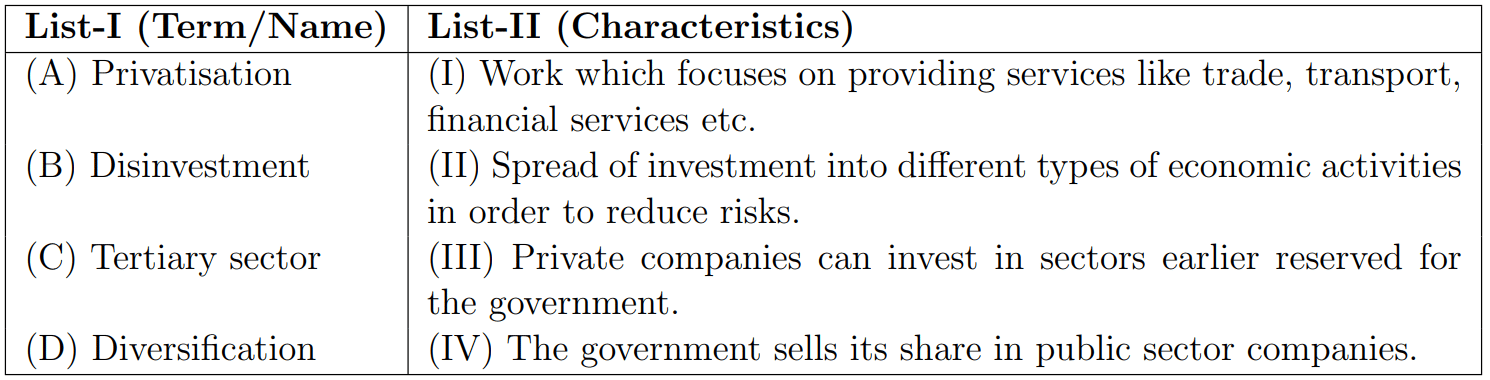
Question 14:
Match List-I with List-II
![]()
- (A) (A) - (II), (B) - (III), (C) - (IV), (D) - (I)
- (B) (A) - (I), (B) - (III), (C) - (II), (D) - (IV)
- (C) (A) - (II), (B) - (III), (C) - (I), (D) - (IV)
- (D) (A) - (III), (B) - (IV), (C) - (I), (D) - (II)
Question 15:
Which of the following are features of capitalism as a social system?
- (A) Commodification of labour power.
- (B) Caste based networks of trading.
- (C) Surplus value.
- (D) Rising inequalities.
\(\textbf{Choose the correct answer from the options below.}\)
- (A) (A), (B) and (D) only
- (B) (A), (C) and (D) only
- (C) (B), (C) and (D) only
- (D) (A), (B) and (C) only
Question 16:
What is the term given by Jan Breman to migrant workers?
- (A) Dalit
- (B) Foot loose labour
- (C) Circulation of labour
- (D) Labour force
Question 17:
The Nakarattars banking system is based on:-
- (A) Class based banking system
- (B) Caste based banking system
- (C) Western banking system
- (D) Free-Trade system
Question 18:
What are the characteristics of social stratification?
- (A) It is based on natural differences.
- (B) It is a function of individual differences.
- (C) It persists over generations.
- (D) It is supported by patterns of belief/ideology.
\(\textbf{Choose the correct answer from the options given below:}\)
- (A) (A) and (D) only
- (B) (C) and (B) only
- (C) (C) and (D) only
- (D) (A) and (B) only
- (A) \(\textbf{It is a trait of society, not simply a reflection of individual differences.}\) Stratification is a system that ranks categories of people, not just individuals based on their personal merits. So, (B) is incorrect.
- (B) \(\textbf{It carries over from generation to generation.}\) A person's social position is often ascribed, meaning it is passed down from their parents. Social mobility can happen, but the system's structure ensures that stratification persists. So, (C) is correct.
- (C) \(\textbf{It is universal but variable.}\) Stratification exists in all societies, but what is considered valuable and how inequality is structured varies from one society to another.
Question 19:
Match List-I with List-II
![]()
- (A) (A) - (IV), (B) - (II), (C) - (III), (D) - (I)
- (B) (A) - (III), (B) - (IV), (C) - (I), (D) - (II)
- (C) (A) - (I), (B) - (II), (C) - (IV), (D) - (III)
- (D) (A) - (III), (B) - (II), (C) - (I), (D) - (IV)
Question 20:
Which of the following is correct about unorganised sector work in India?
- (A) Less number of people work in this sector.
- (B) It is independent of personal relationships.
- (C) Lack of proper wages and other working conditions.
- (D) It is only for women and unskilled labourers.
Question 21:
The characteristics of the caste system:-
- (A) Caste is an ascribed status.
- (B) Caste groups are 'endogamous'.
- (C) Caste is an achieved status.
- (D) Castes involve segmental organization.
- (E) Caste groups are based on choice of individuals
\(\textbf{Choose the correct answer from the options given below:}\)
- (A) (A), (B) and (D) only
- (B) (D), (B) and (C) only
- (C) (A), (B) and (E) only
- (D) (B), (C) and (E) only
Question 22:
In a democratic state, which of the following is a key actor in governance?
- (A) Women's groups
- (B) Status groups
- (C) Political parties
- (D) International organisations
Question 23:
According to Emile Durkheim, what is the cause of suicide?
- (A) It is based on individual mindset.
- (B) It is based on biological anomaly.
- (C) It is influenced by social causes.
- (D) It is more prevalent in western countries.
Question 24:
Which of the following is an example of the reformist social movement?
- (A) Right To Information
- (B) Bolshevik Revolution
- (C) Naxalite Movement
- (D) Anti-abortion Movement
Question 25:
According to Max Weber, on what basis classes and status groups are differentiated?
- (A) Social facts
- (B) Lifestyles
- (C) Caste system
- (D) Market economy
- (A) \(\textbf{Class:}\) This is determined by a person's economic position and life chances in the \(\textbf{market economy}\). It is purely an economic category. (Related to Option D)
- (B) \(\textbf{Status (Status Group):}\) This is based on social honour and prestige. Status groups are communities of people who share a common \(\textbf{lifestyle}\) and are accorded a certain level of social esteem. For example, intellectuals and military officers might have high status but not necessarily high class position. (Related to Option B)
Question 26:
Which among the following statement(s) is/are correct about the Raiyatwari system:-
- (A) Raiyat means cultivator.
- (B) The actual cultivators were responsible for paying the tax.
- (C) Zamindars play a dominant role.
- (D) Colonial government dealt directly with the farmer.
Choose the correct answer from the options given below:
Question 27:
Arrange the following in chronological order:-
- (A) Bengal Revolt
- (B) Champaran Satyagraha
- (C) Deccan Riots
- (D) Bardoli Satyagraha
Choose the correct answer from the options given below:
Question 28:
The process by which something which was not a commodity before in market economy and is made into a commodity is known as:-
- (A) Commoditisation
- (B) Capitalism
- (C) Labour power
- (D) Mode of production
Question 29:
Match List-I with List-II
![]()
Choose the correct answer from the options given below:
- (A) (A) - (II), (B) - (I), (C) - (IV), (D) - (III)
- (B) (A) - (I), (B) - (III), (C) - (II), (D) - (IV)
- (C) (A) - (III), (B) - (IV), (C) - (II), (D) - (I)
- (D) (A) - (III), (B) - (IV), (C) - (I), (D) - (II)
Question 30:
Match List-I with List-II
![]()
Choose the correct answer from the options given below:
- (A) (A) - (II), (B) - (I), (C) - (III), (D) - (IV)
- (B) (A) - (III), (B) - (IV), (C) - (I), (D) - (II)
- (C) (A) - (III), (B) - (IV), (C) - (II), (D) - (I)
- (D) (A) - (I), (B) - (III), (C) - (II), (D) - (IV)
Question 31:
Prejudices are often grounded in:-
- (A) Direct evidence
- (B) Logical conclusions
- (C) Stereotypes
- (D) Critical thinking
Question 32:
Which of the following statements are correct in respect of New Farmer's Movement:-
- (A) It began in Punjab and Tamil Nadu.
- (B) It was party oriented.
- (C) Ideology was anti-state and anti-urban.
- (D) The focus of demand was price and its related issues.
Choose the correct answer from the options given below:
Question 33:
Match List-I with List-II
![]()
\(\textbf{Choose the correct answer from the options given below:}\)
- (1) (A) - (IV), (B) - (III), (C) - (II), (D) - (I)
- (2) (A) - (II), (B) - (I), (C) - (III), (D) - (IV)
- (3) (A) - (II), (B) - (I), (C) - (IV), (D) - (III)
- (4) (A) - (III), (B) - (IV), (C) - (I), (D) - (II)
Question 34:
The Adi Dharma Movement in India belonged to which category of social movement?
- (1) Caste Based Movement
- (2) Worker's Movement
- (3) Peasant Movement
- (4) Ecological Movement
Question 35:
Arrange the following in chronological order:-
(A) Caste Disabilities Removal Act
(B) First Backward Commission
(C) The Scheduled Castes and Scheduled Tribes (prevention atrocities) Act
(D) State Reorganization Commission
Choose the correct answer from the options given below:
- (1) (D), (B), (C), (A)
- (2) (A), (B), (D), (C)
- (3) (B), (A), (D), (C)
- (4) (C), (B), (D), (A)
Question 36:
The term 'dikus' refers to:-
- (1) Adivasis
- (2) Dalit
- (3) Migrant traders and Money lenders
- (4) Migrant workers
Question 37:
Which of the following denotes racial discrimination followed in South Africa?
- (1) Apartheid
- (2) Assimilation
- (3) Reservation
- (4) Prejudice
Question 38:
Arrange the following in order of their year of occurrence:-
(A) Statehood for Jharkhand
(B) All India Trade Union Congress
(C) Bihar Provincial Kisan Sabha
(D) All India Kisan Sabha
Choose the correct answer from the options given below:
- (1) (B), (C), (D), (A)
- (2) (A), (C), (B), (D)
- (3) (B), (A), (D), (C)
- (4) (C), (B), (D), (A)
Question 39:
Ritu works for an IT firm and is happy that the firm gives her freedom of working hours. She can even work late on Saturday night and come late on Monday, every time her boss gives her a deadline. Also, most meetings happen over a weekend dinner at the office. What is Ritu being subjected to?
- (1) knowledge economy where her work is in the IT sector
- (2) 'flexi-time' but in reality expansion of working hours by the management
- (3) globalisation because her clients are in Japan
- (4) gender discrimination
Question 40:
Arrange the following events in order of their occurrence:-
(A) Hong Kong Influenza
(B) Spanish Flu
(C) Asian Influenza
(D) First Population Policy in India
Choose the correct answer from the options given below:
- (1) (B), (D), (C), (A)
- (2) (A), (C), (B), (D)
- (3) (B), (A), (D), (C)
- (4) (C), (B), (D), (A)
Read the passage carefully and answer the questions based on the passage:
The Right to Information Act 2005 (Act No. 22/2005) is a law enacted by the Parliament of India giving Indians access to government records. Under the terms of the Act, any person may request information from a ”public authority” (a body of Government or instrumentality of State) which is expected to reply expeditiously or within thirty days. The Act also requires every public authority to computerize their records for wide dissemination and to proactively publish certain categories of information so that the citizens need minimum recourse to request for information formally. This law was passed by Parliament on 15 June 2005 and came into force on 13 October 2005. Information disclosure in India was hitherto restricted by the Official Secrets Act 1923 and various other special laws, which the new RTI Act now overrides. The Act specifies that citizens have a right to:
• Request any information (as defined)
• Take copies of documents
• Inspect documents, works and records
• Take certified samples of materials of work.
• Obtain information in the form of printouts, diskettes, floppies, tapes, video cassettes or in any other electronic mode.
Question 41:
The Right To Information Act came into force on:-
- (1) 15 June, 2005
- (2) 13 October, 2005
- (3) 22 October, 2005
- (4) 17 June, 2005
Question 42:
Under RTI who is given accountability?
- (1) A Public Authority
- (2) Private Organisations
- (3) Citizen of India
- (4) Civil Society
Question 43:
Which of the following act is overrided by RTI Act?
- (1) Prevention of Atrocity Act
- (2) Official Secrets Act
- (3) Persons With Disability Act
- (4) Government of India Act
Question 44:
Which of the following statements are correct about the purpose of RTI Act?
- (1) Gives citizens access to government records.
- (2) Prohibit public authorities to provide data voluntarily to the public.
- (3) RTI brings transparency in private organisations too.
- (4) Put accountability on public for good governance.
Question 45:
Within how many days, a public authority is expected to reply under RTI?
- (1) 20 days
- (2) 10 days
- (3) 30 days
- (4) 41 days
Read the passage carefully and answer the questions based on the passage:
There has been greater recognition that both men and women are constrained by dominant gender identities. For instance, men in patriarchal societies feel they must be strong and successful. It is not manly, to express oneself emotionally. A gender-just society would allow both men and women to be free. This, of course, rests on the idea that for true freedom to grow and develop, injustices of all kinds have to end. The idea of a gender-just society is based upon two important factors - educated women with multiple roles and improved sex ratio. The programme of the Government of India, Beti Bachao, Beti Padhao Yojana is an important effort in the actualization of a gender-just society.
Question 46:
Patriarchal society refers to:-
- (1) Dominant role of men
- (2) Dominant role of women
- (3) Rule of residence
- (4) Rule of lineage
Question 47:
What is the basis for a gender-just society?
- (1) Gender identities based on commonsense.
- (2) Multiple gender roles and conflicts.
- (3) Presence of dominant gendered identities as role models.
- (4) Presence of educated women with multiple roles and improved sex ratio.
Question 48:
What do men in patriarchal society usually feel?
- (1) Strong and successful
- (2) Equal to women
- (3) Underprivileged
- (4) Assume secondary role
Question 49:
The government scheme of Beti-Bachao, Beti-Padhao is an example of :-
- (1) Gender biasness towards girl child.
- (2) Changes in patriarchal society.
- (3) Improved social status of girl child.
- (4) Actualisation of a gender-just society.
Question 50:
What is the situation of women in patriarchal society?
- (1) Have dominant role in household.
- (2) Can do all kinds of work.
- (3) Have equal access to resources.
- (4) Face discrimination in various spheres.
CUET Sociology 2025 vs Previous Years: Exam Format & Focus Comparison
The CUET Sociology paper in 2025 marks a shift in format and focus compared to previous years, emphasizing a more analytical approach. Unlike 2023 and 2024, where students could choose 40 out of 50 questions, in 2025, all 50 questions became compulsory to attend by students. The exam continues to follow the +5/-1 marking scheme, but the time duration now standardized to 60 mins, gives more consistency across years. So overall the 2025 format points to a more application-oriented and conceptually diverse paper, requiring students to prepare broadly and critically.
| Aspect |
2025(Expected) |
2024 |
2023 |
| Total Questions |
50 ( All Compulsory) |
50 ( Attempt any 40) |
50 ( Attempt any 40) |
| Time Allotted |
60 Minutes |
60 minutes |
45 minutes |
| Marking Scheme |
+5/-1 |
+5/-1 |
+5/-1 |
| Difficulty Level |
Moderate |
Easy to Moderate |
Moderate |
| Paper Structure |
All objective MCQs |
MCQs (Optional Selection) |
MCQs (Option selection) |
| Topic Distribution |
Balanced across Paper 1 & 2 |
Slight Focus on Paper 1 |
Focus on dynamic issues |
| Trend |
More Application-based questions |
More theoretical + examples |
Case-based + memory recall |
Also Check:













Comments