




The CUET Physical Education 2025 exam was held from 13th May to 3rd June. The question paper, answer key, and solution PDF are available for download here. This paper evaluated a student's knowledge of physical fitness, sports psychology, training methods, biomechanics, and the science behind sports and physical activity.
As per the revised exam pattern, students were required to attempt all 50 questions within a 60-minute duration. The paper carried a total of 250 marks, where each correct answer earned +5 marks and every incorrect answer led to a –1 mark deduction.
Also Check:
CUET 2025 Question Paper with Solution PDF
CUET Physical Education Question Paper with Solution PDF
| CUET 2025 Physical Education Question Paper with Solutions PDF | Download PDF | Check Solutions |
Communicable diseases are also known as ________ diseases.
Which one of the following diseases is caused due to inadequate secretion of the insulin hormone?
National Rural Health Mission was launched in which year by the Central Government of India?
Annapurna Yojna was launched in _______ .
NRHM is operational in whole country with special focus on ________ states.
If Ramesh is suffering from Malaria, his disease is classified as ________ causative disease.
Match the different types of sports ball listed in List-I with their respective official weight in List-II

In swimming, the water temperature shall not be less than?
The Basketball court shall have a flat, hard surface free from obstructions with dimensions of ________ measured from the inner edge of the boundary line.
The order of Triple Jump is _______
Match the Equipment listed in List-I with their associative sports in List-II.

If savvy indicates the number of fouls committed by each player by raising the player's foul marker in a manner visible to both head coaches in the game of basketball, she is acting as a ______________.
If Ranvir covers 1500 meters in a swimming competition, then in which of the following events Ranvir is participating?
Which of the following are classified under the head of pranayama in yoga?
Arrange the following steps of Sun salutation in order from start to end:
Which of the following asana is not practiced in standing position?
What is the meaning of the word Bhramari in Bhramari Pranayama?
In which of the following, the shape of the tongue resembles a fresh curled leaf while performing it?
________ is a posture in which certain organs or parts of the body are contracted and controlled.
What does the word "bhati" mean in kapalbhati?
Match the sports injuries given in List-I with their correct explanations given in List-II.

Identify the B.M.I. range of Grade II obesity:
Which of the following substances falls under the category of "Stimulants"?
Harry was playing in the courtyard, while kicking a football. Stretching or tearing of his ligaments took place. Identify the name of Harry’s injury:
Which of the following is Not the role of sports to address social issues and promote social justice?
The National Anti-Doping Agency (NADA) is the national organization responsible for promoting, coordinating, and monitoring the doping ________.
Arrange the following courses in a sequential order with respect to their duration from maximum to minimum:
Which of the following is the highest sporting honor in India?
A cash prize of Rs. 25 lakhs is given in which of the following award?
________ program was launched in 2017-18 to improve India's sports culture at the grassroot level. It includes talent identification, competitions and infrastructure development. The program also emphasizes traditional Indian games.
All teaching courses in India should be specially recognized by ________ to be valid in India for teaching.
Appointment of ______ is done by the tournament organizing agency in consultation with the concerned recognized sport organisation.
Match List-I with List-II:
![]()
- (A) (A) - (I), (B) - (II), (C) - (III), (D) - (IV)
- (B) (A) - (II), (B) - (I), (C) - (III), (D) - (IV)
- (C) (A) - (III), (B) - (I), (C) - (IV), (D) - (II)
- (D) (A) - (III), (B) - (IV), (C) - (I), (D) - (II)

Match the types of Facilitation Approach of motivational technique listed in List-I with their correct explanation in List-II.
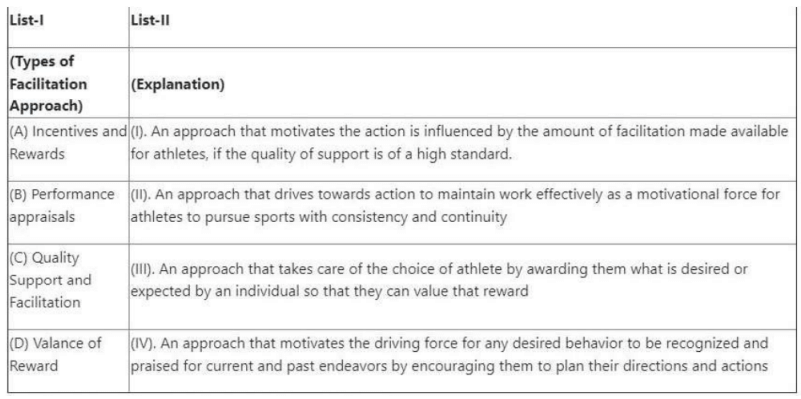
Which of the following statements are true:
Which of these are the potential sociological obstacles that may interfere with women’s sports participation?
In which of the following sports, body balance is an important motor performance factor?
Arrange the following steps involved in the administration of the 50 Yard sprint test in a sequential order starting from first to last:
Arrange the following motivational properties according to motivational cycle:
Arrange the following sports injuries starting from head to toe with respect to the place of injury on the human body:
Read the passage carefully and answer questions strictly as per the passage below:
In a space flight emergency, maximal explosive power may be critical for survival. Antonutto and coworkers measured maximal explosive power (single maximal contractions with both legs) with a dynamometer after as long as 180 days of flight. The maximal explosive power was reduced by 30% after 1 month and by 45% after 6 months. In the Skylab program, as the duration of each mission increased from 28 to 56 to 84 days, in-flight exercise was increased from 30 to 60 to 90 min/day, respectively. Submaximal cycle exercise tests were performed before flight, every 5 to 6 days during flight and 2 days after flight. When the in-flight exercise responses were maintained, exercise responses after flight (including decreased cardiac output, stroke volume, and oxygen pulse, and elevated heart rate and ventilation) significantly decreased. The decrement after flight did not worsen with increasing flight duration, which led the investigators to conclude that the in-flight exercise was useful for shortening the recovery period after flight. The effects of in-flight dynamic exercise during shuttle missions on improving exercise responses after flight was evaluated on 30 shuttle crew members who performed various levels of in-flight exercise. The investigators evaluated exercise responses after flight by measuring the change in heart rate during a graded cycle exercise test. Even moderate volumes of in-flight dynamic exercise (cycle or treadmill exercise performed three times per week for 20 minutes per session) reduced the exercise heart rate response after flight.
Question 41:
Maximal Explosive power (single maximal contractions with both legs) is measured with:
What was the percentage of decrease in explosive power by the end of a month?
The decrement after flight did not worsen with increasing flight ______.
The effects of in-flight dynamic exercise during shuttle missions on improving exercise responses after flight was evaluated on:
Even moderate volumes of which exercise reduced the exercise heart rate response after flight?
Read the passage carefully and answer questions strictly as per the passage below:
Muscular power is one’s ability to produce maximum muscular strength (force) in the shortest time. In other words, power means one’s capacity of work output per unit of time. Mathematically,
\[ Power = \frac{Force \times Distance}{Time} \text{or} Power = \frac{Work done}{Time} \]
\[ \text{or Power = Force} \times \text{Velocity, because Force} \times \text{distance = Work done and Distance/Time = Velocity}\]
In vertical jumping, power is given by Body weight × Distance/Time.
Where distance is equal to jump performance of the subject. In general, power describes the speed of movement of force along with the direction of movement. Thus, power tells one’s speed of performing work. In sports, we often come across the term ‘explosive power’ required in performing certain instant activities like high jump, shot-put, sprints in athletics, and calisthenics in individual sportive activities. Such instant power production is relatively unimportant in some sports activities like marathon running, long distance running, long distance swimming and pure skill-based events. Keeping in view the above description, power may be defined in many different ways. For instance - Power is defined as ”work done per second” and Power may be defined as product of force and velocity.
Question 46:
What describes the speed of movement of force along with the direction of movement?
Instant power production is relatively less important in ________
One's ability to produce maximum muscular strength in the shortest time is called ______.
Power tells one’s _______ of performing work.
Which of the following mathematical equation is correct with respect to the concept of power?



Comments