




Content Curator
Ganga Action Plan (GAP) was launched to protect rivers from extensive water pollution due to rapid industrialization and urbanization. It was a direct intervention made by the Government of India to safeguard our water bodies and prevent the outbreak of deadly waterborne diseases. Ganga Action Plan has significant importance as it was the first of its kind, that spread awareness among the masses, and influenced the adoption of government policies for controlling water pollution.
| Table of Content |
Key Takeaways: Ganga Action Plan, Water Pollution, Waterborne diseases, Solid waste management, Sewage Treatment, National River, Environmental Protection Act
Ganga Action Plan - Why was it Needed?
[Click Here for Previous Year Questions]
- The increase in industrialization and urbanization during the late 70s caused a rapid boom in the discharge of untreated waste into water bodies.
- This increased rate of pollution posed a risk of the outbreak of water-borne diseases like cholera, typhoid, etc, and reduced the availability of fresh drinking water.
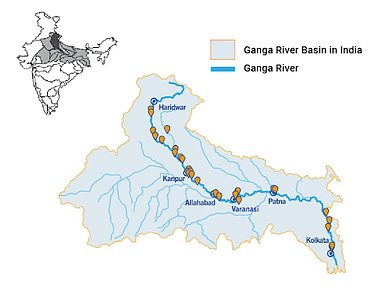
Ganga River Map
- Especially the national river of India, the Ganga, saw a rapid increase in contamination due to practices like open defecation, the release of untreated industrial discharge, etc.
- All this occurred because of a lack of awareness among the masses and zero policies in place to keep these industries in control.
- The Ganga Action Plan was thus initiated in 1985. Ganga Action Plan (GAP) Phase I came into full force on 14th January 1986. GAP phase 2 came into action in 1993.
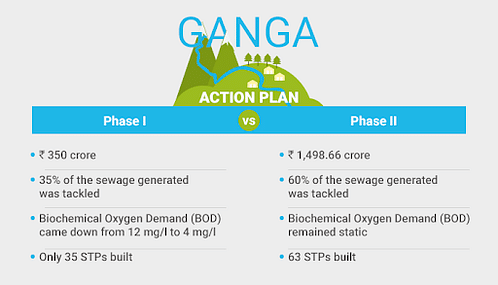
Ganga Action Plan Policy
Objectives of Ganga Action Plan
[Click Here for Sample Questions]
- To install sewage treatment plants to reduce the harm caused by the direct release of sewage into the river Ganga.
- To spread awareness among the masses regarding the importance of keeping their rivers clean and teaching them ways on how they can do that.
- To provide people with low-cost sanitation to prevent open defecation.
- To prevent the drainage of sewage directly into the river by redirecting the drainage flow.
- To develop the riverfront and help in its growth.
- To restore biodiversity along the course of river Ganga.
Read More:
| Read more about Pollution | ||
|---|---|---|
| Pollution | Algal bloom | Biomagnification |
| Effects of Noise Pollution | Greenhouse Effect and Global Warming | Air Pollution Control |
Importance of Sewage Treatment Plants (STP) in GAP
[Click Here for Previous Year Questions]
- Sewage Treatment Plants work in a two-step process to reduce the harm caused to the environment to a minimum.
- In the primary stage, all the solid waste is removed, while in the second stage it is treated with anaerobic and aerobic bacteria to reduce the biochemical oxygen demand of the sludge.
- It also produces biogas by the bacterial digestion of sludge, which can be used to produce energy.

Sewage Treatment Process
Official Information on Ganga Action Plan
[Click Here for Sample Questions]
- Ganga Action Plan was an initiative made by then Prime Minister, Rajiv Gandhi. The authority for this was headed by the Prime Minister and Chief Minister of the states through which the river flows.
- In Ganga Action Plan Phase 1 only three states were included: Uttar Pradesh, Bihar, and West Bengal. In GAP Phase 2 a total 7 states were included: Uttar Pradesh, Bihar, West Bengal, Uttrakhand, Jharkhand, Delhi, and Haryana.
- Under this plan, Ganga was declared the national river of India.
- In Ganga Action Plan Phase 2, tributaries of the river Ganga were also included, including Yamuna, Gomti, Mahananda, and Damodar.
- Under the Environment Protection Act 1986, the Central Ganga Authority was created which was in charge of the whole implementation of the GAP.
Read More:
Things to Remember
- The Ganga Action Plan was carried out in two phases, Phase 1 was launched on 14th April 1986 and Phase 2 was launched in 1993.
- Phase 1 included three states Uttarpradesh, Bihar, and West Bengal. Phase 2 included 7 states which are Uttarpradesh, Bihar, West Bengal, Uttrakhand, Jharkhand, Delhi, and Haryana.
- Phase 2 included tributaries of the river Ganga including Yamuna, Gomti, Mahananda, Damodar.
- Central Ganga Authority is responsible for the smooth running of the Ganga Action Plan.
- GAP was launched under the supervision of the Prime Minister of India Rajiv Gandhi.
Sample Questions
Ques 1. Which of the following states were added in phase 2 of the Ganga action plan? (1 mark)
a.Madhya Pradesh
b.Haryana
c.Both c) and b)
d.Uttarakhand
Ans. Answer is (c) as both Haryana and Uttarakhand were among the 7 states in phase 2 of Ganga Action Plan.
Ques 2. What are the main objectives of the Ganga Action Plan? (2 marks)
Ans. Following are the main objectives of GAP:-
- To promote the installation of sewage treatment plants.
- To restore biodiversity along the river.
- To prevent direct dumping of sewage into the river.
- To spread awareness among the masses.
- To provide low-cost sanitation to locals.
- To develop the riverfront.
Ques 3. Which authority is in charge of controlling and smooth running of GAP? (2 marks)
Ans. Under the Environment protection act 1986, the Central Ganga Authority was created which was in charge of the whole implementation and smooth running of the GAP.
Ques 4. What were the major reasons for the contamination of the river Ganga? (2 marks)
Ans. Following are the major reasons for the contamination of the river Ganga:-
- Open defecation
- Direct dumping of sewage into the river.
- Direct dumping of harmful chemical waste by factories into the river.
Ques 5. Who prepared the Ganga Action Plan? (2 marks)
Ans. Department of Environment prepared an action plan for an immediate reduction of pollution load on the river Ganga. The Cabinet approved the Ganga Action Plan as a 100 percent centrally sponsored scheme.
Ques 6. When was Ganga Action Plan initiated? (2 marks)
Ans. The Ganga Action Plan (GAP) was launched on 14 January 1986 by the then Prime Minister of India Rajeev Gandhi. The main objective of GAP is pollution abatement of the river Ganga and to improve the water quality by interception.
Ques 7. What is the authority constituted by the Government of India for the implementation of the Ganga Action Plan? (2 marks)
Ans. For the implementation of the Ganga Action Plan and to lay down policies and programmes and maintenance of the Ganga Action Plan, Government of India constituted the Central Ganga Authority (CGA) in February 1985.
Ques 8. When was the National River Conservation Directorate established? (2 marks)
Ans. In order to look after the implementation of Ganga Action Plan, the Central Ganga Authority was established. Later it was changed to National River Conservation Directorate (NRCD) in June 1994.
Ques 9. When did Phase 2 of the Ganga Action Plan start? (2 marks)
Ans. Phase 2 of the Ganga Action Plan began in 1993. States such as Uttar Pradesh, Bihar, West Bengal, Delhi and Haryana were to implement the Phase-2 by treating 1912 mld (Million litres per day) still Ganga Action Plan didn’t complete its target.
Ques 10. What was the ultimate objective of the Ganga Action Plan? (2 marks)
Ans. The ultimate objective of the GAP is to clean and restore the entire Ganga river basin and its tributaries. It also has an approach of integrated river basin management considering abiotic and biotic ecosystems.
Ques 11. Which is the top board in the Ganga Action Plan? (2 marks)
Ans. National River Conservation Authority is the top level board in Ganga Action Plan. t forms policies and sanctioned approvals. It is followed by Standing Committee, Monitoring Committee and National River Conservation Directorate.
Ques 12. Which state has the highest number of towns selected for Ganga Action Plan 1? (2 marks)
Ans. West Bengal had the highest number of towns selected for Ganga Action Plan with a total of 15 towns. It is followed by 6 towns in Uttar Pradesh and 4 towns in Bihar.
Ques 13. For interception and diversion under Ganga Action Plan 2, how many schemes are sanctioned? (2 marks)
Ans. The NRCD sanctioned 4 schemes of interception and diversion under the GAP-2. But the target of the program was not achieved even after the stipulated time period.
Ques 14. Which authority laid sewer liner under Ganga Action Plan 2 in West Bengal? (2 marks)
Ans. Calcutta Metropolitan Development Authority (CMDA) laid sewer lines under the Ganga Action Plan 2 with 3 pumping stations at Cossipore-Chitpur.
Ques 15. How many interception and diversion schemes are sanctioned by NRCD in Uttar Pradesh? (2 marks)
Ans. The NRCD sanctioned 51 interception and diversion schemes under the Ganga Action Plan 2. The Uttar Pradesh Jal Nigam could complete only 30 out of 51 by March 2000.
Ques 16. In how many cities the Ganga Action Plan was executed? (2 marks)
Ans. The Ganga Action Plan was executed in 5 major cities where the river run along. These include Kanpur, Haridwar, Varanasi and Allahabad.
Ques 17. Was Ganga Action Plan a successful program? (2 marks)
Ans. The Ganga Action Plan is a failure. The pollution levels in Ganga are either same or even higher now. The relationship between the quantity and quality, inflow and outflow, renewable energy and pollutant have not been understood and this led to the failure of the Ganga Action Plan.
For Latest Updates on Upcoming Board Exams, Click Here: https://t.me/class_10_12_board_updates
Check-Out:



Comments