



Education Journalist | Study Abroad Lead
Fertilizers refer to any organic or manufactured substances that are added to the soil to make it rich in nutrients. Farmers make use of fertilizers to increase crop yield and to aid the fast growth of plants. Fertilizers contain various macro and micronutrients, including nitrogen (N), phosphorus (P), potassium (K), and other elements like calcium, magnesium, and sulfur.
| Table of Content |
Key Terms: Fertilizers, Crops, Water Retention, Soil, Chemical Substances, Biofertilizers, Nitrogen (N), Phosphorus (P), Potassium (K), Calcium, Magnesium, Sulfur
What are Fertilizers?
[Click Here for Sample Questions]
Fertilizers are the chemical or natural substances supplied to the soil to increase its fertility and production. They may be chemically produced or naturally existing in nature.
- They increase the soil's natural fertility and restore the chemical substances and nutrients in the soil that are taken away by previous crops.
- The capacity of water retention of the soil also increases as a result of this.
- The use of fertilizers is the major reason behind the sufficient quantity of crops that are available for the increasing human population.

Fertilizers
Farmers use fertilizers regularly for their crops to increase their productivity. Fertilizers are used in soil to provide all necessary nutrients to the tissues of plants for their better growth. The major nutrients required by plants for their growth are Nitrogen, Phosphorus, and Potassium which are widely known as NPK. These fertilizers can be applied to crops in different ways like pelletized, dry, and liquid application processes and can be supplied through big agricultural equipment and hand tools.
Also Read: Air Composition
Components of Fertilizer
[Click Here for Sample Questions]
Nutrient-rich additives are to be added to plants in the form of fertilizers to increase their productivity. Fertilizers also work by changing the water retention and aeration of the soil to increase the crop yield.
- The three main micro-nutrients used and their functionalities are:
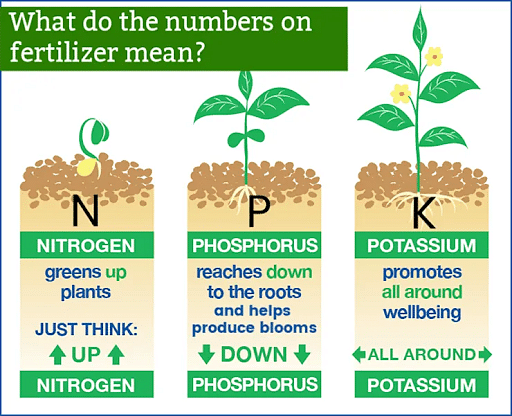
- Nitrogen (N): Growth of the leaves
- Phosphorus (P): For all-round development of flowers, roots, fruit, seeds
- Potassium (K): For strong growth of leaves, promoting flowering and fruiting, and proper movement of water in plants
- Calcium, Magnesium, and Sulphur are other secondary nutrients used in the growth of plants.
- Some micronutrients like Iron, Copper, Manganese, Boron, Zinc, Molybdenum, Cobalt, Silicon, and Vanadium are also required in plants.
Hydrogen, carbon, oxygen, and nitrogen are the primary elements found in plants. Nitrogen, even after being abundantly available in the atmosphere, is not in the suitable form to be taken by plants, there are only a few plants and microorganisms that convert the Nitrogen in the atmosphere to ammonia, thereby fixing it.
Types of Fertilizers
[Click Here for Sample Questions]
There are various types of fertilizers. Some of them are explained below:
1. Organic Fertilizers
Natural Fertilizers that are obtained by plants and animals are known as organic fertilizers. Organic fertilizers enrich the soil and crops with carbonic compounds that are essential for plant growth. Organic fertilizers help to increase the organic content of the soil, the production of microorganisms and change the physical and chemical properties of soil. Agricultural waste, Industrial waste, Livestock Manure, Municipal Sludge, etc are some of the sources of organic fertilizers. They are not harmful to the crops or soil and increase the fertility of the soil naturally.

Organic and Synthetic Fertilizers
2. Inorganic Fertilizers
Chemical fertilizers that are used in crops to provide necessary nutrients to plants and are made from chemical mean synthetically in the industry are known as inorganic fertilizers. Inorganic fertilizers are of different types:
-
Single Nutrient Fertilizer
Fertilizers that contain only one necessary nutrient as per the requirement of crops are single-nutrient fertilizers. Some of them are:
- Nitrogen Fertilizers contain nitrogen that is necessary for the development of crops. Nitrogen is a major constituent of chlorophyll. It helps in maintaining balance and helps plants in the process of photosynthesis. It is a part of amino acid in plants and contains protein. These fertilizers increase the quality and quantity of crops.
- Phosphorus Fertilizers increase the quantity of Phosphorus in the protoplasm of plant cell and plays a vital role in the growth of cells and proliferation. Phosphorus fertilizers strengthen the roots of plants.
- Potassium Fertilizers help plants to resist diseases and increase crop yields with overall quality. Potassium fertilizers also protect plants against cold or dry weather and strengthen the roots.
Numbers on Fertilizers
-
Multi-nutrient Fertilizer
Fertilizers made up of two or more nutrients are known as multi-nutrient fertilizers. These are widely used.
- Binary Fertilizers: NP Fertilizers are the best example of binary fertilizers that contain Nitrogen and Phosphorus. Two of the most used NP fertilizers are diammonium phosphate fertilizer (DAP) and Monoammonium Phosphate Fertilizer (MAP).
- NPK Fertilizers: Nitrogen, Phosphorus, and Potassium are three major constituents of fertilizers. And the fertilizers that contain all three nutrients are NPK fertilizers. 16-16-16 fertilizer is the best example of NPK fertilizer.
Importance of Fertilizers
[Click Here for Sample Questions]
A lack of fertility, an increase in pests, unsupported climatic condition, and a lack of nutrients has resulted in reduced production of agricultural products. This increases the importance of fertilizers in agriculture as:
- Fertilizers help to increase the immunity of plants so that they can fight against pests and diseases.
- Fertilizers increase root depth and also the water-holding capacity of roots.
- Potassium present in fertilizers increases the growth of straws and stalks of plants.
- Fertilizers restore the natural fertility of soil as well as provide additional nutrients required by plants for better yield.
- Phosphorus present in the plants enhances the growth and formation of seeds.
- Nitrogen increases the chlorophyll content of leaves and increases the growth of leaves.
- Fertilizers increase the disease-resistant power of soil and also make it tolerant against the pests that harm the crops
Inorganic fertilizers are known to harm the soil, therefore biofertilizers are also widely in use nowadays.
What are Biofertilizers?
[Click Here for Sample Questions]
Biofertilizers contain living organisms and enhance the growth of plants using various methods like nitrogen fixation, phosphorus solubilization, etc. Nutrients are supplied to plants via natural processes like phosphorus solubilization, nitrogen fixation, etc by biofertilizers. Biofertilizers contain micronutrients that restore the organic matter of soil and its natural nutrient cycle. Biofertilizers improve soil health and sustainability. Biofertilizers are somewhat capable to replace the need for chemical fertilizers and have no adverse effect on the environment or consumer’s health.

Biofertilizers
Also Read: Two Kingdom Classification
Production of various fertilizers
[Click Here for Sample Questions]
Certain chemical operations are to be performed for the production of fertilizers. Some of the fertilizers along with their production processes are described below:
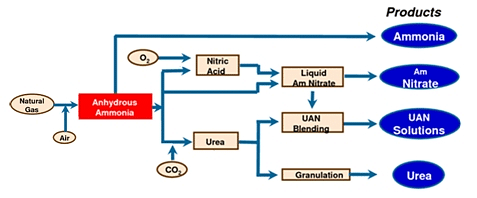
- Nitrogen Fertilizers: Nitrogen fertilizers are prepared from ammonia (NH3) which is prepared in the laboratory by Haber’s process. The Haber-Bosch process is an energy-extensive process that requires hydrogen from natural gas and nitrogen available freely in the air. All the nitrogen fertilizers like urea require ammonia. Oswald’s techniques are also used to produce nitrates from ammonia.
- Phosphate Fertilizers: Phosphate rock that contains minerals like fluorapatite and hydroxyapatite is used to extract phosphorus used in the preparation of phosphate fertilizers. These minerals are treated with phosphoric or sulphuric acids to get converted into water-soluble salts. Odda process can also be followed to convert Phosphorus rock by dissolving it in nitric acid to phosphoric acid and calcium nitrate. This process helps to obtain all major NPK nutrients into a water-soluble form.
- Potassium Fertilizers: Potassium fertilizers are prepared from potash (K2O) which are water-soluble nutrients and can be extracted by several purification processes. Potassium sulphate, potassium nitrate, etc are some examples of potassium fertilizers.
Manufacturing of Nitrogen Fertilizer
Advantages of Fertilizers
[Click Here for Sample Questions]
- Fertilizers are easy to store and apply.
- Fertilizers make it easy to supply specifically required nutrients to plants.
- Fertilizers are easily absorbed by plants.
- Fertilizers have a rapid effect on crops.
- Fertilizers cause an increment in crop yield.
- Fertilizers are predictable and reliable.
Disadvantages of Fertilizers
[Click Here for Sample Questions]
- Fertilizers are expensive.
- Excessive use of fertilizers may destroy soil fertility.
- Fertilizers may be toxic to the skin.
- Fertilizers cause eutrophication in water bodies.
- Fertilizers reduce the microbial ability of soil.
Also Read:
| Related Articles | ||
|---|---|---|
| Carbon Cycle | Biomass | Aquatic Ecosystem |
| Biotic Factors | Deltoid Muscle | Ecology and Environment |
| Binomial Nomenclature | Taxonomy | Taxonomic Hierarchy of Plants and Animals |
Uses of Fertilizers
[Click Here for Sample Questions]
Some major uses of fertilizers are:
- To provide necessary nutrients to plants.
- Increment in crop yield.
- Improve the texture and fertility of the soil.
- To replace lost nutrients.
- To protect plants against pests and diseases.
Things to Remember
- Chemical or natural substances that are supplied to the crops to increase their productivity are known as fertilizers.
- Major Nutrients: Nitrogen, Phosphorus, and Potassium
- Types of fertilizers: Natural Fertilizers (Manure, Biofertilizers) and Chemical Fertilizers (Nitrogen Fertilizers, Phosphorus Fertilizers, and Potassium Fertilizers)
- Biofertilizer is a material containing living organisms and enhances the growth of plants using various methods like nitrogen fixation, phosphorus solubilization, etc.
- The process of fertilizers reaching stagnant water bodies like lakes and causing excessive amounts of nutrients that result in the growth of algae blooms and the death of animal bodies.
- 16-16-16 fertilizers are fertilizers that have 16% nitrogen, 16% potassium and 16% phosphorus.
Also Read: Atmosphere Layers
Sample Questions
Ques. Define fertilizer. (1 mark)
Ans. Fertilizer is a chemical or natural substance that is applied to crops to increase their yield and better the quality of agricultural production.
Ques. What are the major nutrients in fertilizers? (1 mark)
Ans. Fertilizers contain Nitrogen, Potassium, and Phosphorus as major constituents which help in the overall growth of plants.
Ques. Are there any drawbacks of using fertilizers? (2 marks)
Ans. Yes, fertilizers have some adverse effects on crops as well as soil. Excessive use of fertilizers reduces the fertility of the soil and also when these fertilizers move to water bodies like the lake, rivers, they cause eutrophication and make algae bloom, affecting the water bodies.
Ques. What do numbers on fertilizers signify? (2 marks)
Ans. Number like 10-10-10 on fertilizers signify 10% nitrogen, 10% phosphorus and 10% potassium. This label is on the national standard and is known as fertilizer grade.
Ques. What are the adverse effects of fertilizers on human health? (3 marks)
Ans. There are many adverse effects of fertilizers on human health. Some of them are:
- Pollution during the application may cause difficulty in breathing, irritation in the eyes, and skin diseases in the farmers.
- Fertilizers get mixed in water bodies and make drinking water polluted. Some nutrients that get mixed into the water cannot be removed and cause various diseases when consumed.
- Excessive use of fertilizers can also be toxic to soil hence making the harvested crops dangerous to consume
Ques. What are the differences between fertilizers and manure? (2 marks)
Ans. Manure is a natural substance added to restore the soil’s natural nutrient cycle and fertility while fertilizers are chemical substances added to crops to increase yield and supply necessary nutrients to plants.
Ques. What are balanced fertilizers? (2 marks)
Ans. Balanced fertilizers are those containing nitrogen, phosphorus, and potassium in equal proportions like 10-10-10 fertilizers. But the balanced fertilizers contain an excessive amount of Phosphorus than the actual requirement.
Ques. How are natural fertilizers prepared? (2 marks)
Ans. Natural fertilizers are prepared by cow dung, straw, and many other household and agricultural wastes. All the feedstock is put into a reservoir and closed for some time and then applied to crops to increase their yield.
For Latest Updates on Upcoming Board Exams, Click Here: https://t.me/class_10_12_board_updates
Check-Out:



Comments