


The candidate can calculate CUET percentile 2026 by using the NTA formula of percentile calculation = (M ÷ N) × 100, where M is the number of candidates who scored equal to or less than you in your session and N is the total number of candidates in that session.
- The CUET 2026 does not rank students by raw marks as it is held in multiple shifts and days so to ensure fairness the normalised percentile score is used for admission across all participating universities.
- NTA has published the aggregate subject-wise and category-wise score for five subjects on the official website.
- You can calculate the CUET raw marks as (Correct Answers × 5)- (Incorrect Answers × 1) and there is no marking for unattempted questions.
- The CUET cutoff varies university-wise and you need to check CUET percentile of various institutes at their official sites after the counselling session.
- Candidates can check the details related to how to calculate CUET percentile 2026 and normalization process below.
Related Articles:
- CUET 2026 Marks vs Percentile
- CUET 2026 Cutoff: DU, BHU, JNU
- CUET UG Results 2026 OUT: Check Direct Link, Score Card at cuet.nta.nic.in

Key Summary
- Candidates with CUET percentile 2026 of around 99.5 after normalization will easily get admission to top colleges such as SRCC, Hindu College and DU North Campus colleges in top branches.
- With a score of around 190 out of 250, you have a chance of securing admission to DU South Campus colleges as you will have apercentile of around 90+
- The CUET uses equipercentile method to calculate CUETpercentile for normalization process.
How to Calculate CUET Raw Marks 2026
Before CUET Percentile calculation, NTA first computes your raw CUET score using the marking scheme: +5 for every correct answer and -1 for every incorrect answer.
- Each subject in CUET 2026 has 50 questions with a maximum of 250 marks.
- Unattempted questions carry zero marks as there is no penalty for skipping.
- Example: If you attempt 40 correct, 7 incorrect, and leave 3 unattempted so your raw score = (40 × 5) – (7 × 1) = 200 – 7 = 193 marks.
| Response Type | Marks Awarded | Example (50 Qs) |
|---|---|---|
| Correct Answer | +5 | 40 correct = +200 |
| Incorrect Answer | –1 | 7 incorrect = –7 |
| Unattempted | 0 | 3 skipped = 0 |
| Total Raw Score | – | 193 out of 250 |
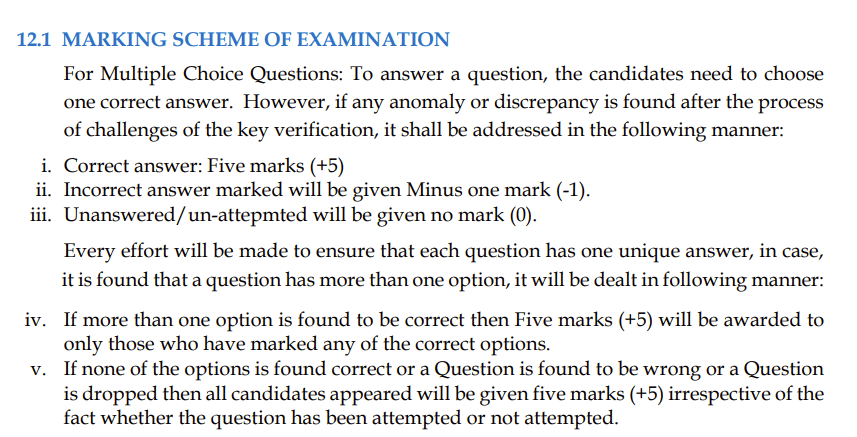
Source: CUET 2026 Information Bulletin
Related Articles:
- CUET Score Calculator 2026: Calculate Marks from Response Sheet
- CUET Total Marks 2026: Subject-Wise and Stream-Wise Breakdown
- How to calculate CUET Score 2026
Ques. What is the maximum score in CUET UG 2026 per subject?
Ans. Each subject carries a maximum of 250 marks (50 questions × 5 marks each). If you appear for 5 subjects, the total raw score can go up to 1250 marks.
Ques. Is there negative marking in CUET 2026?
Ans. Yes. Each incorrect answer deducts 1 mark from your raw score. Unattempted questions carry zero — no penalty for skipping.
CUET Percentile Calculation Formula 2026
The details regarding how to calculate CUET percentile based on NTA formula is shown below:
Percentile Score = (M ÷ N) × 100, where M = number of candidates in your session who scored equal to or less than your raw score, and N = total candidates who appeared in that session.
- This is a relative score and your percentile depends on how others in your session performed, not just your own marks.
- A 99 percentile means you scored better than 99% of candidates in your session for that subject.
- Example: If a session had 15,000 candidates and 14,850 scored equal to or below your marks — your percentile = (14,850 ÷ 15,000) × 100 = 99.00 percentile.
- The 100th percentile is awarded to the highest scorer(s) in each session — it represents the top rank in that shift.
| Variable | What It Means | Example Value |
|---|---|---|
| M | Candidates scoring ≤ your raw score in the session | 14,850 |
| N | Total candidates in your exam session | 15,000 |
| Percentile | (M ÷ N) × 100 | 99.00 |
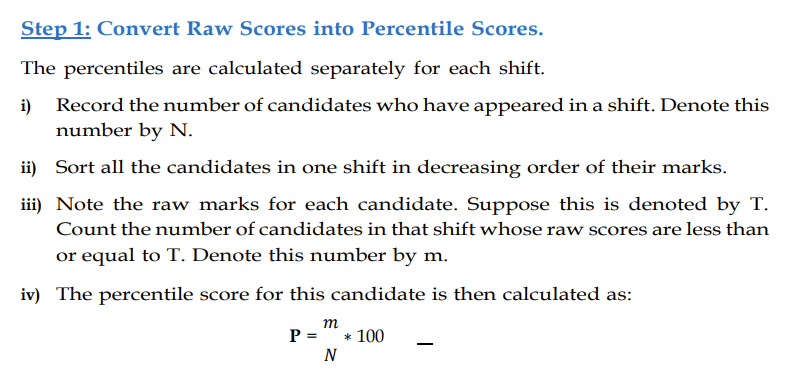
Source: CUET 2026 Information Bulletin
Related Articles:
- CUET UG 2026: Is 150 Marks Safe for General Category in Central Universities
- CUET Cut Off for 5 Subjects
- CUET 2026 Cutoff for General Category for 5 Subjects
Ques. Can two students with the same raw marks get different percentiles?
Ans. Yes, if they appeared in different shifts. The percentile is calculated within each session separately. Normalisation then converts session-wise percentiles into comparable final scores.
CUET Normalisation Process 2026: Equipercentile Method Explained
When a CUET subject is held across multiple shifts, NTA uses the equipercentile normalisation method to ensure students in harder shifts are not disadvantaged compared to those who got easier papers.
- Step 1 Compute raw scores: All candidates' raw marks are calculated using the +5 / –1 marking scheme within their respective session.
- Step 2 Rank within session: All candidates in a session are arranged in decreasing order of raw scores and assigned a session-wise percentile.
- Step 3 Equate across sessions: Percentiles from all shifts of the same subject are equated and a candidate at the 99th percentile in Shift A and a candidate at the 99th percentile in Shift B are treated as equivalent, regardless of their raw marks.
- Step 4 Convert to normalised score: These equated percentiles are then converted back to a normalised mark on a common scale.
- Step 5 Result Publication: A candidate who scored 180 marks in a tough shift (99th percentile) will get a higher final NTA score than a candidate who scored 180 marks in an easier shift (94th percentile).
| Step | Action | Outcome |
|---|---|---|
| 1 | Calculate raw marks using +5 / –1 scheme | Raw Score (0–250) |
| 2 | Rank all candidates within the session | Session-wise percentile |
| 3 | Equate percentiles across all shifts of same subject | Cross-shift equivalence |
| 4 | Convert equated percentile to normalised score | Final NTA normalised score |
| 5 | Generate percentile from final normalised score | CUET Percentile (0–100) |
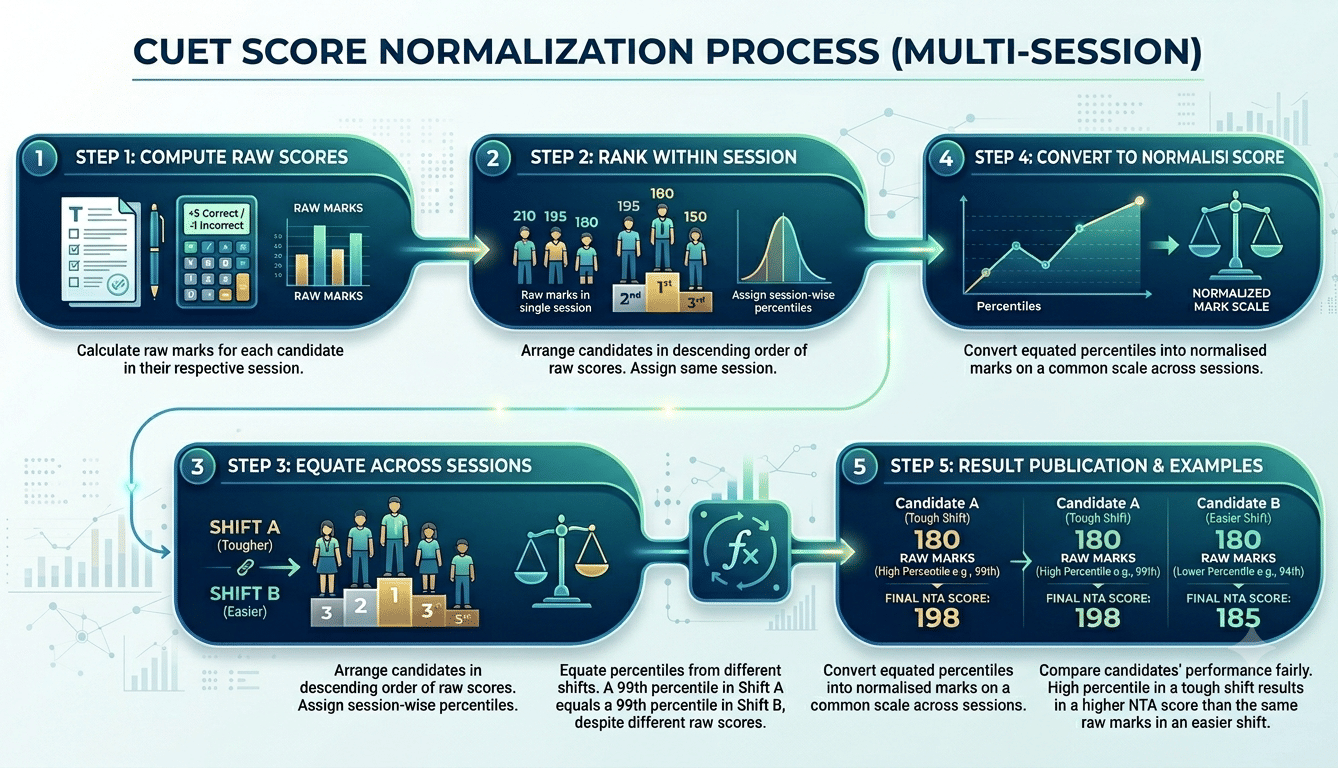
Candidates can check the detailed CUET Normalization Process 2026 by clicking on the link: CUET 2026 Information Bulletin
Related Articles:
- Is 600 a Good Score in CUET Out of 1000
- What is a Good Score in CUET UG 2026 Out of 1000 Marks?
- CUET 2026: Minimum Marks Required for DU Admission out of 1250
Ques. What is the equipercentile method in CUET?
Ans. The equipercentile method is the statistical technique NTA uses to equate marks across different exam shifts. It ensures that candidates at the same relative rank in their respective shifts receive an equivalent final score, regardless of paper difficulty.
CUET 2026 Marks vs Percentile: Expected Range
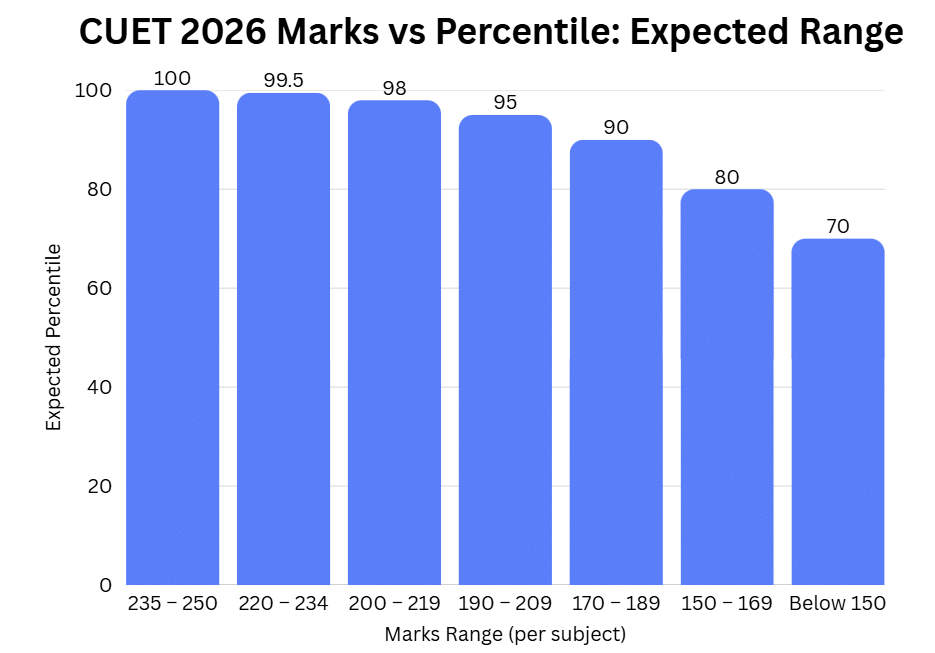
Based on previous year trends, a raw score of 220+ out of 250 per subject is expected to give you a 99+ percentile in CUET 2026, while 190–209 marks per subject falls in the 90–94 percentile range.
- Subjects like Political Science and Business Studies have tighter competition — you may need 230–245 marks for a 99th+ percentile.
- The General Test is slightly more accessible — a score of 210–225 marks can fetch a 99th+ percentile.
- For a combined score of 1100+ marks (5 subjects), students are expected to secure a 99+ percentile overall.
| Marks Range (Out of 250 per Subject) | Expected Percentile | Admission Prospects |
|---|---|---|
| 235 – 250 | 99.5 – 100 | SRCC, Hindu College, St. Stephen's (DU) |
| 220 – 234 | 98 – 99.5 | Top DU colleges, BHU (priority courses) |
| 200 – 219 | 95 – 98 | Mid-tier DU colleges, BHU, AMU, JMI |
| 190 – 209 | 90 – 95 | DU South Campus, Hyderabad University, AMU |
| 170 – 189 | 80 – 90 | State central universities, Allahabad University |
| 150 – 169 | 70 – 80 | State universities, private CUET-accepting colleges |
| Below 150 | Below 70 | Lower-tier participating universities |
Note: All percentile values above are based on previous year CUET trends and expert estimates. Actual percentiles will vary based on the number of candidates, shift difficulty, and normalisation outcome for CUET 2026.
Related Article: CUET 2026 Cutoff for UG Courses: Check Cutoff for DU and BHU
Ques. How much do I need to score for DU admission through CUET 2026?
Ans. For top DU colleges like SRCC, Hindu, and St. Stephen's, you generally need 235+ marks per subject to achieve a 99.5+ percentile. For other DU colleges, 200–220 marks per subject (95th–98th percentile) is considered competitive.
Ques. Is 200 out of 250 a good CUET score?
Ans. Yes, 200 out of 250 is a strong score. It reflects roughly 80% marks and typically places you in the 95th–98th percentile range, making you competitive for BHU, AMU, Hyderabad University, and mid-tier DU colleges depending on the course.
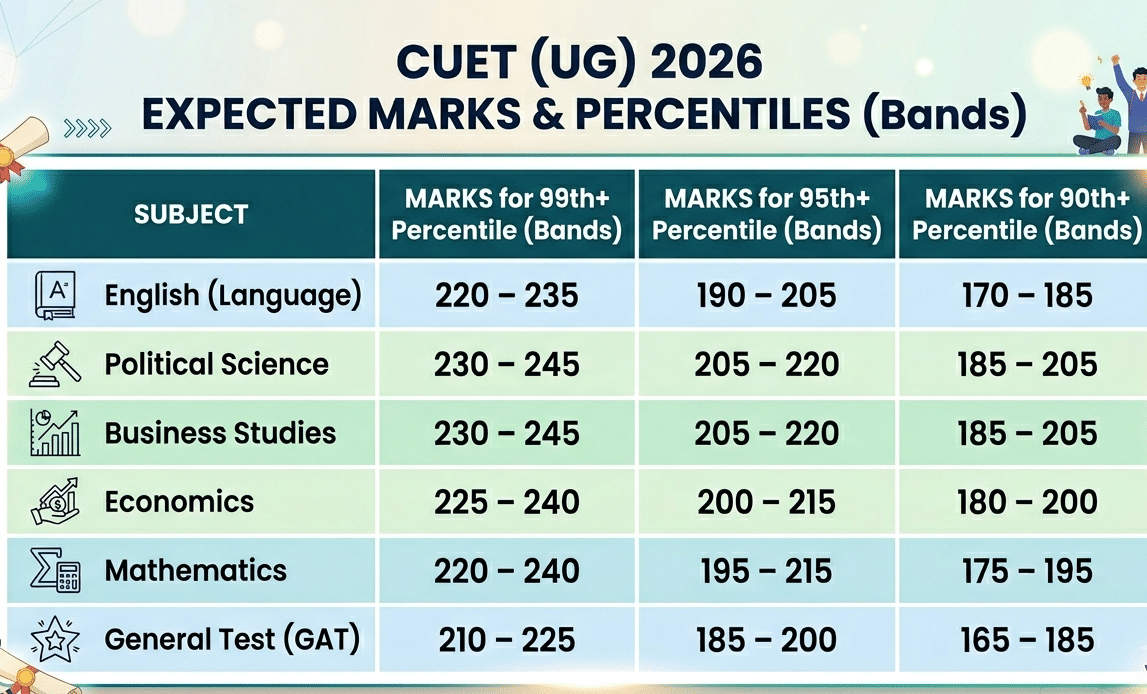
CUET 2026 Subject-wise Percentile: Expected Trends
Percentile requirements differ by subject — more competitive subjects like English, Economics, and Political Science have higher cutoffs than less-attempted domain subjects.
| Subject | Marks for 99th+ Percentile | Marks for 95th+ Percentile | Marks for 90th+ Percentile |
|---|---|---|---|
| English (Language) | 220 – 235 | 190 – 205 | 170 – 185 |
| Political Science | 230 – 245 | 205 – 220 | 185 – 205 |
| Business Studies | 230 – 245 | 205 – 220 | 185 – 205 |
| Economics | 225 – 240 | 200 – 215 | 180 – 200 |
| Mathematics | 220 – 240 | 195 – 215 | 175 – 195 |
| General Test (GAT) | 210 – 225 | 185 – 200 | 165 – 185 |
Related Articles:
- CUET 2026 Cutoff for ST Category: Check Expected Cutoff DU, BHU, JNU, SRCC
- CUET 2026: Minimum Marks Required for DU Admission
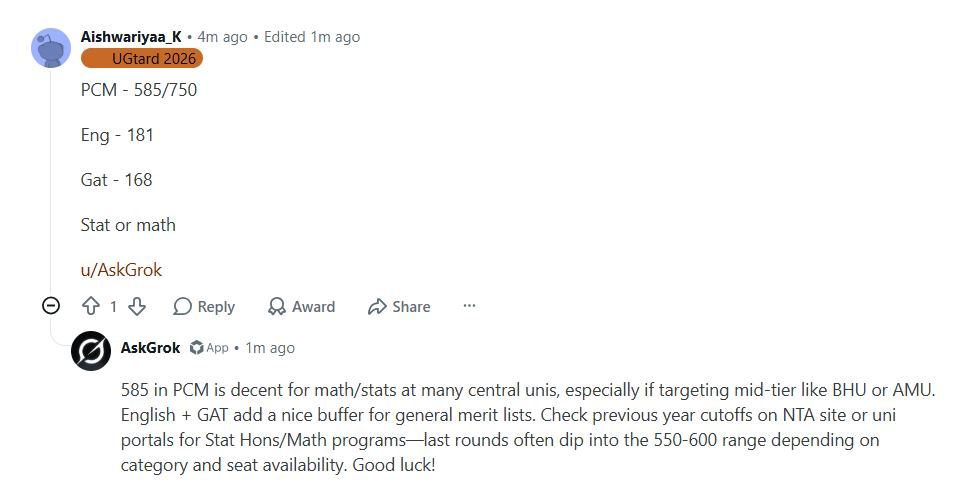
According to a reddit post a user wanted to know the college chances with CUET 2026 score of around 565 out of 750 in Science Stream. As per discussion it was said that he/she will get admission to central universitues like BHU and AMU as it is a good performance.
Source: Reddit
CUET Marks vs Percentile: Official PDFs — Last 3 Years
You can download official CUET result and normalisation data from the NTA website links below:
| Year | Document | Download Link |
|---|---|---|
| 2026 | CUET UG 2026 Result & Scorecard (OUT) | View on Official NTA Site |
| 2025 | CUET UG 2025 Score Card & Normalisation Data | View on Official NTA Site |
| 2024 | CUET UG 2024 Result PDF and Percentile Data | View on Official NTA Site |
Note: All percentile and normalisation PDFs are published by NTA on cuet.nta.nic.in. Links are updated as official documents are released.
- CUET 2026 Result Impact on DU, JNU and BHU Admissions: Merit List, CSAS Portal & Seat Allotment
- CUET Seat Allotment 2026: Check Total Seats, Reservation, Cut-Off, and Seat Allotment List
- CUET Counselling: Check Schedule, Seat Allotment, Reservation & Minimum Marks for DU
Ques. When will CUET 2026 result be declared?
Ans. NTA has declared the CUET UG 2026 result on June 23, 2026. The scorecard is available on cuet.nta.nic.in and you can download it using your application number and date of birth.
Ques. Does CUET release a combined percentile for all subjects?
Ans. No, NTA releases subject-wise percentiles only there is no composite or overall CUET percentile. Each university uses the percentile of specific subjects relevant to the course you are applying for.
Ques. Can my normalised score be lower than my raw score?
Ans. Yes, if you appeared in an easier shift where many candidates scored high, normalisation may adjust your score slightly downward. Similarly, if your shift was tougher, your normalised score may be higher than your raw score.



Comments