




The Class 12th and CUET UG syllabus overlap with around 70%–90% that makes board preparation a strong base for CUET UG. Class 12th Board exam will end on April 10, 2026 and CUET UG exam will start on May 11, 2026.
- Subjects like Biology (90%+) and Business Studies (85%) have maximum overlap.
- Physics and Chemistry show some difference: Boards focus on derivations and theory CUET focuses on concept application.
- According to the toppers Chemistry and Biology questions are ditrectly picked Class 12th NCERT.
- For Mathematics candidates must shift from step by step solution to speed with accuracy.
Candidates are getting around 1 month after the board to prepare for CUET UG, but the overlapping syllabus can be a plus point in the CUET PG preparation.
Also Check:
- CUET Preparation Tips 2026: Check How to Prepare, Study Plan, Timetable & Books
- Last 2 Months CUET UG 2026 Strategy by Toppers
- CUET Important Books for Preparation

Key Summary
- Students are advised to solve 20–30 MCQs daily from topics studied for boards to build CUET aptitude gradually.
- Daily MCQ practice is compulsory (even during boards).
- Students who prepare daily with small CUET practice perform better than those who start everything after boards.
Check YouTube:
Ushank sir mentioned in video “Do NOT treat CUET and Boards as separate exams. The strategy is to integrate preparation, not divide it. Study one chapter for boards then immediately practice MCQs from the same chapter for CUET”.
He also mentioned that “Time management is more important than long study hours.”
Students Experience in CUET Exam
A CUET topper, Ayushmaan Bhatra, highlighted the importance of practice and mocks. He mentioned that “students should attempt 10–15 mock tests for effective preparation”.
Another user on Reddit also mentioned that “Mock test is very important to aim for top ranking colleges. They test knowledge, time management, and speed. Practicing CUET previous year questions will help in understanding question types, and taking full-length mocks on platforms like Careers360 can also be beneficial for preparation.”
Another User in the same thread mentioned that “Practicing CUET previous year questions will help in understanding question types.”
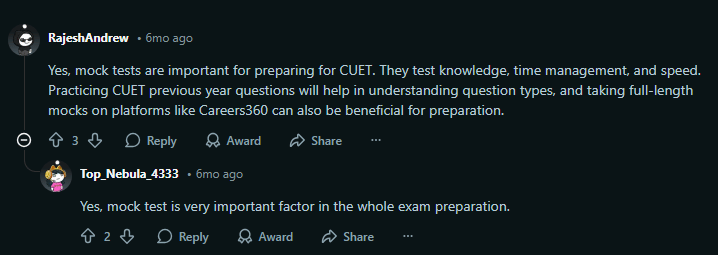
Source: Reddit.
Some students also mentioned that “delaying CUET preparation until after boards often resulted in low confidence during full-length tests”.
How Class 12 Preparation Directly Strengthens CUET UG 2026 Performance
- Around 70%–90% syllabus is common, so board preparation directly helps in CUET.
- NCERT is the most important book, especially for Chemistry and Biology.
- Time management and accuracy are key for CUET success.
- Maths needs speed practice, not long step solutions like boards.
| Subject | Overlap | CUET Focus | Smart Strategy (Boards to CUET) | Example |
|---|---|---|---|---|
| Physics | 75–80% | Concept-based numericals & assertion reason MCQs | After completing theory, practice formula-based MCQs in a timed manner | After Electrostatics, solve 40+ MCQs focusing on formula application instead of derivations |
| Chemistry | 80–85% | NCERT-based factual + reaction-based MCQs | Revise NCERT line-by-line, especially Inorganic; convert reactions into MCQs | From p-block, practice questions on trends, exceptions, and properties directly from NCERT |
| Biology | 90%+ | Direct NCERT line-based MCQs | Memorize NCERT statements, diagrams, and keywords; avoid extra sources | Questions from Human Physiology are often direct NCERT lines with slight changes |
| Mathematics | 70–75% | Speed-based problem-solving MCQs | Practice questions with time limits; focus on shortcuts and formula application | Solve Integration MCQs within 1–2 minutes instead of full step solutions |
| Accountancy | 75–80% | Concept-driven MCQs from practical problem | Convert numerical problems into objective scenarios; focus on adjustments | From Partnership, practice MCQs based on common adjustments and entries |
| Business Studies | 85% | Case-based MCQs | Focus on application of concepts through case studies instead of rote learning | Solve situation-based questions from Principles of Management |
| Economics | 80–85% | Concept + data-based MCQs | Practice graph-based and numerical MCQs along with theory revision | From National Income, attempt calculation-based MCQs |
| Artts | 80–90% | Fact + concept-based MCQs | Break chapters into facts, timelines, and key points for quick revision | From History, focus on timelines and events for direct MCQs |
Attempt CUET UG Mock Tests
| CUET UG English Mock Test | Attempt Now |
| CUET UG General Mock Test | Attempt Now |
| CUET UG Political Mock Test | Attempt Now |
| CUET UG History Mock Test | Attempt Now |
| CUET UG Sociology Mock Test | Attempt Now |
CUET UG Week-Wise Dual Preparation Plan
- First 2 weeks candidates must focus on basics to revise NCERT and start light MCQ practice.
- From Week 3, preparare with sectional tests and performance analysis.
- In the last 2 weeks focus on revision only and not new topics.
| Week | Boards Focus (NCERT-Based) | CUET Focus (Application) | Strategy (What to Do Precisely) |
|---|---|---|---|
| Week 1 (18 – 24 March) | Identify weak chapters from boards; revise NCERT summaries & formulas | Start MCQ practice (basic level) | Attempt 20–30 MCQs/subject daily; map mistakes to NCERT lines; no full tests yet |
| Week 2 (25 – 31 March) | Revise high-weightage NCERT chapters (e.g., Organic named reactions, Business Studies principles) | Topic-wise MCQs (untimed → timed) | Solve 40–50 MCQs/subject; maintain an error log (conceptual vs factual errors) |
| Week 3 (1 – 7 April) | Line-by-line NCERT revision (especially factual subjects like Biology, Inorganic Chemistry) | Sectional tests begin | Attempt 1 sectional test/subject (30–45 mins); analyze accuracy; revise same-day weak topics |
| Week 4 (8 – 14 April) | Revise formulas, definitions, case-study frameworks | Timed sectional tests + mixed MCQs | Target 70–75% accuracy; reduce guesswork; practice assertion-reason & case-based questions |
| Week 5 (15 – 21 April) | Quick revision of weak NCERT chapters identified from error log | Full-length mocks (alternate days) | Attempt 3–4 mocks/week; spend 2–3 hrs on analysis; track time per section |
| Week 6 (22 – 28 April) | Revise NCERT highlights, tables, diagrams, exceptions | Full-length mocks (increasing frequency) | Attempt 4–5 mocks/week; push accuracy to 80%+; focus on question selection strategy |
| Week 7 (29 April – 5 May) | Rapid revision: formulas, reactions, key facts only | Daily full-length mocks | Attempt 1 mock/day; aim 85–90% accuracy; avoid repeating mistakes from error log |
| Week 8 (6 – 10 May) | Final revision of short notes & NCERT keywords | Light mocks + Previous Year Questions | Solve PYQs; avoid new topics; focus on retention & confidence building |
Also Check: CUET Exam Pattern 2026: Check Section-Wise Pattern, Marking Scheme & Previous-Year Papers
Daily Time Table Strategy: Balancing Boards and CUET UG 2026
- Balancing board exams with CUET UG preparation needs a smart daily timetable and not longer study hours.
- Both exams are closely linked with NCERT syllabus so students can prepare for both together by dividing their time in concept revision (boards) and MCQ practice (CUET).
- A well-planned daily strategy can improve consistency, time management, and accuracy.
During School / Pre-Boards Phase
| Time Allocation | Study Component | What to Do (Specific Tasks) | Outcome |
|---|---|---|---|
| 70% Boards / 30% CUET | Concept Study (Boards), 2 to 3 hrs | Study NCERT chapters, write answers, practice derivations/numericals | Strong conceptual base for both exams |
| MCQ Practice (CUET) – 1 hr | Solve 20–30 MCQs per subject from same topics studied | Converts theory into application | |
| Revision – 1 hr | Revise formulas, definitions, key points from NCERT | Improves retention and accuracy | |
| Weekly Practice | Weekly Practice | Builds exam familiarity |
After Boards (Post-March)
| Time Allocation | Study Component | What to Do (Specific Tasks) | Outcome |
|---|---|---|---|
| 90% CUET Focus | Concept + Quick Revision – 2 hrs | Revise NCERT line-by-line; focus on weak areas | Strengthens high-weightage topics |
| MCQ Practice – 2 hrs | Solve 40–60 MCQs per subject in timed mode | Improves speed and accuracy | |
| Mock Test – 1.5 to 2 hrs | Attempt full-length or sectional tests | Real exam simulation | |
| Analysis – 1 hr | Review mistakes; update error notebook | Reduces repeated errors | |
| Quick Revision – 30 mins | Revise formulas, facts, and short notes | Boosts retention before next day |
Also Check: CUET UG Paper Analysis
Post-Boards CUET UG 2026 Preparation Plan (April 11 – May 11)
| Phase | Duration | Subject-Wise Focus | Practice Plan | Key Strategy |
|---|---|---|---|---|
| Phase 1 | 11 – 17 April | NCERT revision + basics | 30–40 MCQs/subject daily | Shift from theory to MCQs; identify weak areas |
| Phase 2 | 18 – 25 April | Concept application | 1 sectional test/subject + 40–50 MCQs | Build accuracy; maintain error notebook |
| Phase 3 | 26 April – 2 May | Intensive practice | 3–4 full mocks/week | Improve time management & reduce mistakes |
| Phase 4 | 3 – 7 May | Full exam simulation | 1 mock test daily + PYQs | Focus on speed, accuracy & question selection |
| Phase 5 | 8 – 10 May | Final revision | PYQs + light MCQs | Revise formulas, NCERT facts; avoid new topics |
Related News:



Comments