




For CUET 2026, Commerce candidates need 230+ marks out of 250 in Accountancy and Business Studies which can get an expected 99+ percentile.
- Candidates scoring 245+ marks in CUET 2026 can get an expected 99.9 percentile which can get admission in top DU colleges like SRCC, LSR, and Hindu College.
- Both Accountancy and Business Studies papers carry 250 marks each in which it consists of 50 MCQs with +5 marks for correct answers and -1 mark for incorrect answers.
- In CUET UG 2025 results, a total of 2357 candidates achieved 100 percentile in Business Studies.
- For top DU commerce colleges like SRCC, LSR, Hindu and Hansraj, candidates need 245+ marks in the CUET exam in both subjects.
- Business Studies is comparatively more scoring than Accountancy as it is theoretical and based on direct NCERT concepts.
Related Articles:
- CUET 2026 Cutoff for Top Universities
- CUET 2026 Marks vs Rank
- CUET UG 2026 Admit Cards Out; Download Hall Tickets Now

Key Summary
- CUET Accountancy and Business Studies are core subjects for commerce stream candidates who are aiming for courses such as B.Com (Hons), BBA and BA Economics.
- For admission in top DU commerce colleges, candidates require 245+ marks in both subjects to remain safely above the expected cutoff range.
- The marks-to-percentile relationship becomes steeper at higher scores where a difference of 10 marks can lead to a shift of around 1-2 percentile points in the 99+ percentile range.
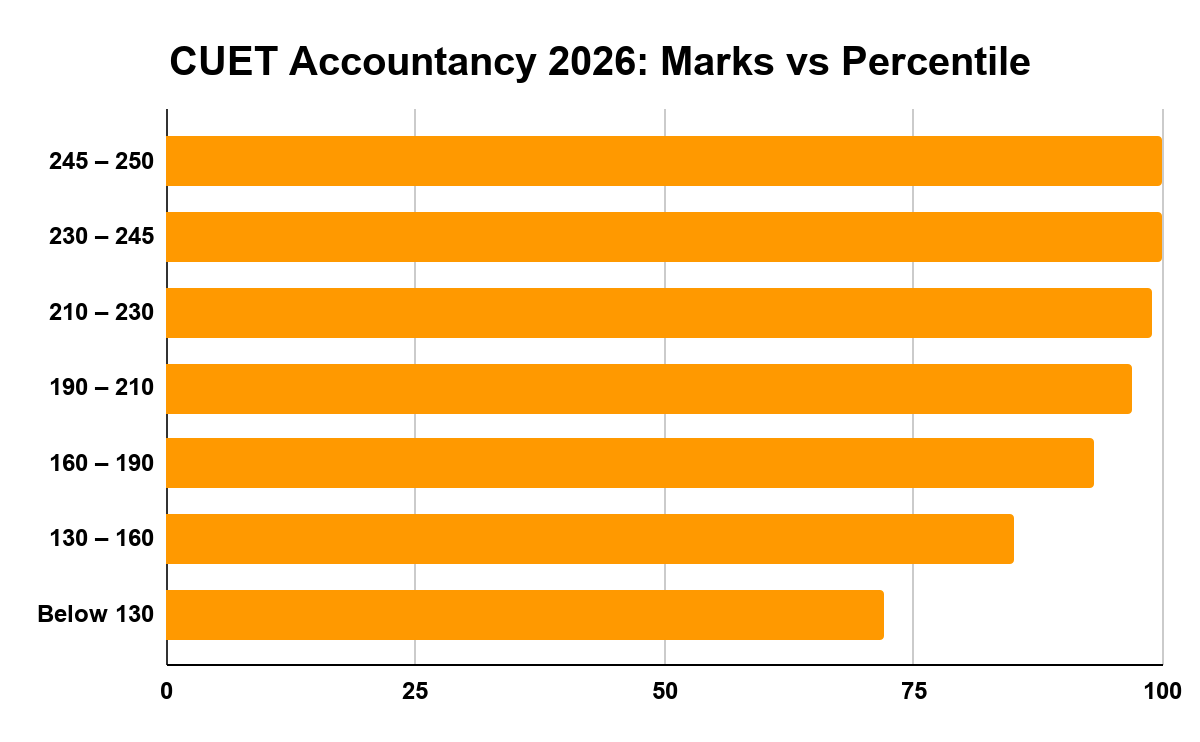
CUET Accountancy 2026: Marks vs Percentile
For CUET Accountancy 2026, candidates scoring 230+ marks can expect a 99+ percentile while a score of 245+ marks can place candidates in the 99.9+ percentile.
- Candidates with 99.9+ percentile can get admission in top DU and BHU Commerce programs.
- A score of 240+ marks in Accountancy is expected to get 99.5+ percentile in the CUET 2026 exam.
- Securing a top 1000 rank in the commerce stream candidate needs 245+ marks in all subjects.
- Mid-tier DU Colleges have cutoff marks for Accountancy is 200-220 marks in CUET 2026 exam.
| Marks Range (out of 250) | Expected Percentile | Category Standing |
|---|---|---|
| 245 – 250 | 99.9 – 100 | Top Tier / DU Premier Colleges |
| 230 – 245 | 99.0 – 99.9 | Excellent / DU Top Tier |
| 210 – 230 | 97.0 – 99.0 | Very Good / BHU, JMI Top Programs |
| 190 – 210 | 93.0 – 97.0 | Good / Mid-tier DU, AMU |
| 160 – 190 | 85.0 – 93.0 | Average / State Central Universities |
| 130 – 160 | 72.0 – 85.0 | Below Average / Low-cutoff Colleges |
| Below 130 | Below 72 | Low Merit |
Also Read:
Ques. Are Accountancy and Business Studies compulsory for CUET commerce admissions?
Ans. Yes, Accountancy and Business Studies are required for admission to B.Com Hons and most BBA programs at top universities like DU, BHU, JMI, and AMU.
Ques. What is a good score in CUET Accountancy 2026?
Ans. A good score in CUET Accountancy 2026 is 210+ marks with 97+ percentile. For top DU commerce colleges, the cutoff marks is 240+ marks with 99.5+ percentile, while for BHU and JMI the candidates need 230+ marks.
CUET Business Studies 2026: Marks vs Percentile
In CUET 2026 Commerce, Business studies is considered to be one of the easiest subject in which candidates can score 100 percentile.
- A score range of 225-240 marks can get an expected 96-98 percentile range due to high number of candidates in this score range.
- Candidates with 205-225 marks with 91-96 percentile can get admission in good colleges like JMI and AMU.
| Marks Range (out of 250) | Expected Percentile | Category Standing |
|---|---|---|
| 250 | 100 | Top of Top Tier (8,024 candidates in 2025) |
| 240 – 249 | 99.0 – 99.9 | Excellent / DU Top Colleges |
| 225 – 240 | 96.0 – 99.0 | Very Good / DU Mid-tier, BHU |
| 205 – 225 | 91.0 – 96.0 | Good / JMI, AMU |
| 180 – 205 | 83.0 – 91.0 | Average / State Central Universities |
| 150 – 180 | 70.0 – 83.0 | Below Average |
| Below 150 | Below 70 | Low Merit |

Ques. Is Business Studies easier than Accountancy in CUET 2026?
Ans. Yes, Business Studies is generally considered easier than Accountancy in CUET 2026 because it is largely theoretical and concept-based, with questions drawn directly from Class 12 NCERT. Accountancy includes numerical problems that take more time and require accuracy, making it relatively tougher.
Marks vs Rank for Top DU/BHU Commerce Colleges
Candidates with 230+ marks in both Accountancy and Business Studies for CUET 2026 exam can get admission in top commerce programs in DU and BHU. The average safe score in 4 commerce subjects is above 235 marks.
| Target College / Course | Course | Accountancy Score | Business Studies Score | Aggregate (4 Subjects) |
|---|---|---|---|---|
| SRCC | B.Com Hons | 245+ | 245+ | 950+ / 1000 |
| LSR / Hindu | B.Com Hons | 240+ | 240+ | 920+ / 1000 |
| Hansraj / Kirori Mal | B.Com Hons | 235+ | 235+ | 900+ / 1000 |
| BHU | B.Com Hons | 225+ | 225+ | 850+ / 1000 |
| JMI | BBA / B.Com | 215+ | 215+ | 820+ / 1000 |
| AMU | B.Com Hons | 200+ | 200+ | 770+ / 1000 |
| DU | BA Programme (Mid-tier) | 185+ | 185+ | 720+ / 1000 |
Also Read:
- Best universities for 95 percentile CUET UG 2026
- CUET UG DU Cutoff 2026: Qualifying Marks, Admission Criteria, Score vs Rank & Seat Reservation
Ques. What score is needed for SRCC B.Com Hons through CUET 2026?
Ans. For B.Com Hons in Shri Ram College of Commerce (SRCC) through CUET 2026, candidates need 245+ marks in Accountancy, Business Studies, and Mathematics with an aggregate above 950 out of 1000 across 4 subjects.
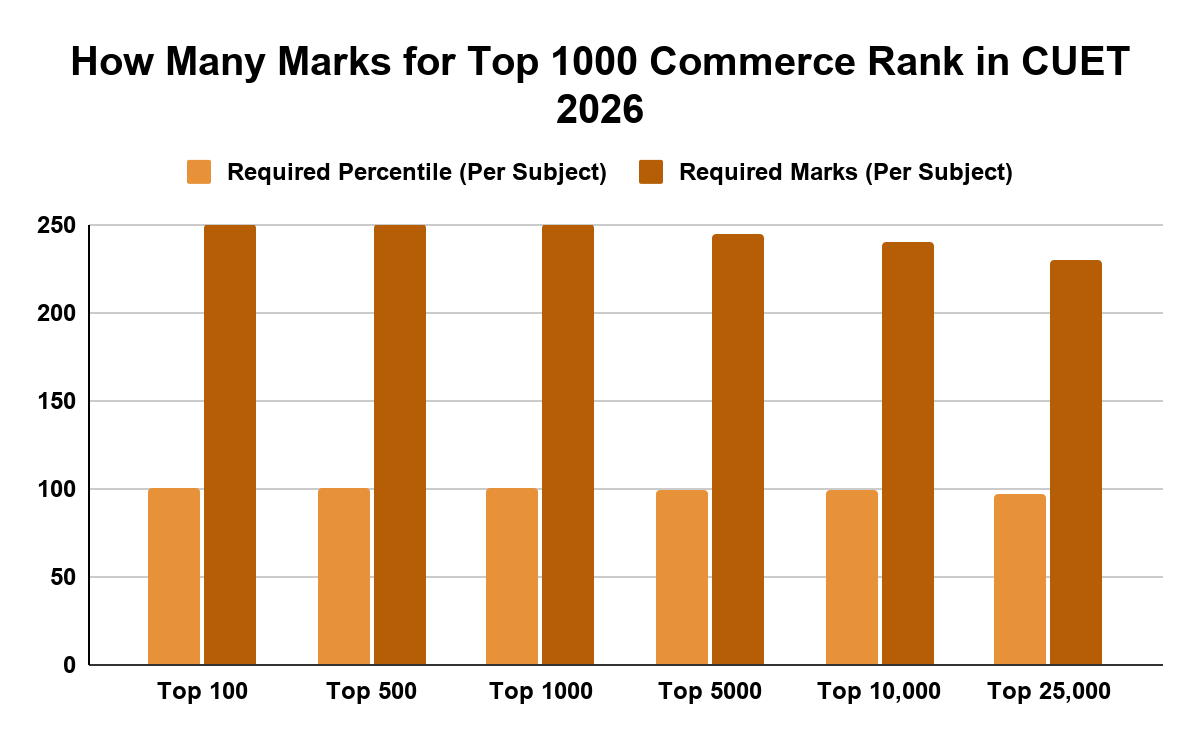
How Many Marks for Top 1000 Commerce Rank in CUET 2026
To secure a top 1000 rank in CUET 2026 commerce stream, candidates need approximately 99.9+ percentile across all four subjects, translating to 240+ marks in Accountancy, Business Studies, Mathematics, and Economics.
| Rank Range | Required Percentile (Per Subject) | Required Marks (Per Subject) |
|---|---|---|
| Top 100 | 99.99+ | 248 – 250 |
| Top 500 | 99.95+ | 245 – 250 |
| Top 1000 | 99.9+ | 240 – 250 |
| Top 5000 | 99.5+ | 230 – 245 |
| Top 10,000 | 99.0+ | 225 – 240 |
| Top 25,000 | 97.5+ | 215 – 230 |
Also Read:
- CUET Cutoff: DU, BHU, JNU & Course-wise, Marks vs Percentile, Good Marks, and Minimum Qualifying Marks
- CUET BHU Cutoff 2026: Check Course & Category-wise Cutoff, passing marks & Previous-Year Cutoff
Ques. Can a candidate get a top 1000 rank with 240 in Accountancy and 250 in Business Studies?
Ans. Yes, a candidate scoring 240 marks in Accountancy and 250 marks in Business Studies can get them rank in top 1000, provided the other two subjects (Mathematics and Economics or English) are also above 235 each. The aggregate normalised NTA score determines the final rank, not individual subject scores.
Section-wise Strategy to Score 230+ in Both Subjects
To score 230+ marks in both Accountancy and Business Studies, candidates should follow a focused NCERT based revision strategy along with regular mock tests practice.
- In Accountancy the key topics such as Partnership Accounts, Company Accounts, Cash Flow Statements, and Financial Statement Analysis has around 60% of paper weightage.
- In Business Studies, topics like Principles of Management, Marketing Management, Financial Management, and Consumer Protection are theory based.
- Candidates should solve at least 5 years of CUET previous year papers in both subjects to understand the exam pattern and question trends.
- Candidates should take at least 3 full length mock tests per subject before the exam to improve speed and accuracy.
- Candidates should maintain an accuracy level of 85% or above and questions with less than 60% confidence should be skipped to avoid negative marking.
| Subject | High-Yield Topics | Expected Questions |
|---|---|---|
| Accountancy | Partnership Accounts | 10 – 12 |
| Company Accounts | 8 – 10 | |
| Financial Statement Analysis | 6 – 8 | |
| Cash Flow Statements | 5 – 7 | |
| Business Studies | Principles of Management | 10 – 12 |
| Marketing Management | 8 – 10 | |
| Financial Management | 6 – 8 | |
| Consumer Protection & Business Environment | 6 – 8 |
Also Read:
- Allahabad University CUET Cut Off: Check Previous Years' Course-wise CUET Cut off Percentile Scores
- CUET Merit List: Check Dates, How to find Merit List, Previous year list & Colleges
CUET 2026 Official Notifications: Last 3 Years
Candidates can refer to the official CUET UG result statistics and subject-wise topper notifications from the National Testing Agency below:
| Year | Document | Download Link |
|---|---|---|
| 2026 | CUET UG 2026 Information Bulletin | View on Official Site |
| 2025 | CUET UG 2025 Subject-wise Topper List & Statistics | View on Official Site |
Note: Notifications are published by the National Testing Agency (NTA). Subject-wise statistics include the count of 100 percentile scorers per subject.
Ques. How many candidates appear for CUET Accountancy and Business Studies?
Ans. Based on 2024 data, approximately 166022 candidates appeared for CUET Business Studies and 156473 candidates appeared for Accountancy in the CUET exam.
Ques. What is the difference between marks and percentile in CUET 2026?
Ans. Marks are the actual raw score earned per subject, while percentile is the normalised score showing the candidate's position relative to others in the same session. Universities use percentile for admission, not raw marks, to ensure fairness across multiple shifts.



Comments