




For CUET 2026, the raw score is the direct marks earned out of 250. The NTA score is normalised score on the basis of shift difficulty. Universities provides admission on the basis of NTA score and percentile and not the raw marks.
- Raw Score = (Number of correct answers × 5) – (Number of wrong answers × 1), out of 250 per subject.
- Universities provide admission primarily on the basis of the NTA Normalised Score (not the raw marks).
- The percentile is used only as an intermediate step during the normalisation process and is not separately considered for most admissions.
- Percentile shows the percentage of candidates scoring equal to or less than a candidate, calculated session-wise then shift-wise.
- For example a candidate with 160 raw marks in an easier shift can get a normalised score of 155 while another candidate with 150 raw marks in a tougher shift can get 160.
Related Articles:
- Check CUET Marks vs Percentile
- How to Calculate CUET Rank
- CUET UG Results 2026: Expected Date, Direct Link, Score Card

Key Summary
- Raw Score is the direct calculation from the response sheet and answer key, before any adjustments.
- NTA Score is the normalised score that adjusts for varying shift difficulty across multiple sessions.
- Percentile is calculated using the formula: (Candidates with score ≤ yours / Total candidates) × 100.
- Universities use the NTA score (not raw marks) to prepare merit lists, and most cutoffs are expressed in percentile.
What is CUET 2026 Raw Score?
The CUET 2026 raw score is the direct mark earned per subject, calculated as (Correct × 5) - (Wrong × 1), with a maximum of 250 marks for each domain or general test paper.
- The raw score is the actual performance metric before any normalisation is applied.
- Each subject paper has 50 MCQs, with +5 for correct and -1 for incorrect answers.
- Unattempted questions earn 0 marks.
- The raw score does not appear on the official scorecard for admission, only the NTA score and percentile are shown.
| Parameter | Detail |
|---|---|
| Formula | (Correct × 5) - (Wrong × 1) |
| Maximum Marks | 250 per subject |
| Minimum Marks | -50 (theoretically, all wrong) |
| Source: | Response sheet + Final answer key |
| Use in Admission | Not used directly |
Ques. How do candidates calculate their CUET 2026 raw score?
Ans. Candidates can calculate their CUET 2026 raw score by downloading the response sheet from the official portal, comparing each answer with the final answer key, counting correct and incorrect responses, and applying the formula: (Correct × 5) - (Wrong × 1). This gives a quick estimate before the official scorecard is released.
Also Check: CUET Marks vs Percentile Out of 1250
What is CUET 2026 NTA Score?
The CUET 2026 NTA score is the normalised score calculated using the equipercentile method to neutralise differences in shift difficulty, ensuring fair comparison across all candidates regardless of which session they appeared in.
- The NTA score is displayed up to 7 decimal places on the official scorecard.
- It is calculated session-wise first, then equated across shifts using the equipercentile method.
- Universities use the NTA score (not raw marks) to prepare admission rank lists.
- For sessions with fewer candidates, NTA clubs them with larger sessions to maintain statistical accuracy.
| Parameter | Detail |
|---|---|
| Calculation Method | Equipercentile Method |
| Adjustment Factor | Shift difficulty variation |
| Decimals Shown | Up to 7 decimal places |
| Range | 0 – 250 per subject (theoretically) |
| Source: | NTA official scorecard |
| Use in Admission | Yes, primary metric |
Ques. Why does NTA normalise CUET scores?
Ans. NTA normalises CUET scores because the exam is conducted in multiple shifts across several days, and the difficulty of papers can vary slightly between sessions. Without normalisation, a candidate appearing in a tougher shift would be unfairly disadvantaged compared to someone in an easier shift. The equipercentile method ensures all candidates are compared fairly.
What is CUET 2026 Percentile?
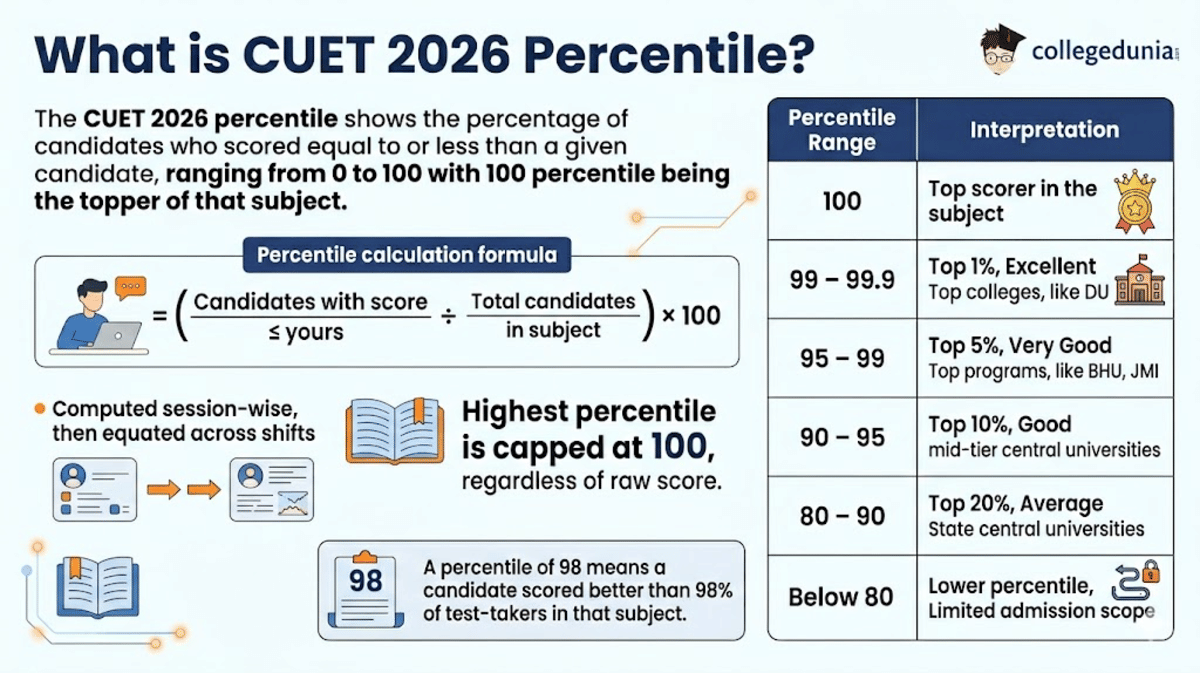
The CUET 2026 percentile shows the percentage of candidates who scored equal to or less than a given candidate, ranging from 0 to 100 with 100 percentile being the topper of that subject.
- The percentile is calculated using the formula: (Candidates with score ≤ yours ÷ Total candidates in subject) × 100.
- It is computed session-wise first, then equated across shifts for the final result.
- A percentile of 98 means a candidate scored better than 98% of test-takers in that subject.
- The highest percentile is capped at 100, regardless of raw score.
| Percentile Range | Interpretation |
|---|---|
| 100 | Top scorer in the subject |
| 99 – 99.9 | Top 1%, Excellent (DU top colleges) |
| 95 – 99 | Top 5%, Very Good (BHU, JMI top programs) |
| 90 – 95 | Top 10%, Good (mid-tier central universities) |
| 80 – 90 | Top 20%, Average (state central universities) |
| Below 80 | Lower percentile, Limited admission scope |
Ques. Is CUET percentile the same as percentage?
Ans. No, CUET percentile is not the same as percentage. Percentage shows the marks scored as a fraction of total marks (e.g., 200/250 = 80%), while percentile shows a candidate's position relative to others. A 98 percentile candidate has scored better than 98% of test-takers, regardless of their raw mark percentage.
Also Check: CUET Seats Intake 2026: University-Wise Expected Seats, Number of Applicants, and Participating Institutes
CUET 2026: Raw Score vs NTA Score vs Percentile Comparison
The three CUET 2026 metrics serve different purposes — raw score is for self-evaluation, NTA score is for university merit lists, and percentile is for cutoff comparison.
| Aspect | Raw Score | NTA Score | Percentile |
|---|---|---|---|
| Definition | Direct marks before normalisation | Normalised marks across shifts | Relative position vs other candidates |
| Formula | (C × 5) - (W × 1) | Equipercentile method | (Candidates ≤ you / Total) × 100 |
| Range | -50 to 250 | 0 to 250 (decimal) | 0 to 100 |
| Where Shown | Self-calculation only | Official scorecard | Official scorecard |
| Use for Admission | No | Yes | Yes |
| Affected by Shift | Not adjusted | Adjusted | Adjusted |
| Decimal Precision | Whole number | 7 decimals | 2 – 7 decimals |
Also check: Check CUET 2026 Rank Predictor
Why CUET 2026 Uses NTA Score Instead of Raw Marks
The CUET 2026 uses NTA scores instead of raw marks because the exam is conducted across multiple days and shifts, and normalisation is essential to ensure fairness when paper difficulty varies between sessions.
- Different shifts may have different question sets with varying difficulty levels.
- Without normalisation, candidates in tougher shifts would be unfairly disadvantaged.
- The equipercentile method ensures candidates are compared based on relative performance in their session.
- NTA scores are computed up to 7 decimal places to minimise tie-breaking at top ranks.
Ques. What is the equipercentile method in CUET 2026?
Ans. The equipercentile method in CUET 2026 is a statistical normalisation technique where percentiles from one shift are equated with those of other shifts. The shift with the highest candidate count is set as the base, and other shifts are aligned to it. This ensures a candidate's score reflects their performance relative to peers in the same session, regardless of paper difficulty.
Also Check: CUET UG 2026 Percentile vs Rank vs Admission Chances
Real Example: How CUET Normalisation Changes Your Score
The CUET 2026 normalisation can either increase or decrease a raw score depending on the shift difficulty. A candidate in a tougher shift may see their normalised score go up, while a candidate in an easier shift may see it go down.
| Scenario | Raw Score | Shift Difficulty | Normalised NTA Score | Change |
|---|---|---|---|---|
| Candidate A | 160 / 250 | Easier Shift | 155 | - 5 marks |
| Candidate B | 150 / 250 | Tougher Shift | 160 | + 10 marks |
| Candidate C | 200 / 250 | Average Shift | 200 | No change |
| Candidate D | 240 / 250 | Easier Shift | 235 | - 5 marks |
| Candidate E | 225 / 250 | Tougher Shift | 235 | + 10 marks |
Note: These are illustrative examples based on previous CUET normalisation patterns. Actual changes for 2026 will depend on the exam's shift-wise difficulty distribution.
Ques. Can the normalised NTA score be higher than the raw score?
Ans. Yes, the normalised NTA score can be higher than the raw score if a candidate appeared in a tougher shift. The equipercentile method gives such candidates a compensatory adjustment based on relative performance. Conversely, candidates in easier shifts may see their NTA score reduced compared to their raw marks.
Also Check: CUET Merit List 2026: Check Dates, How to find Merit List, Previous year list & Colleges
How to Read Your CUET 2026 Scorecard
The CUET 2026 official scorecard displays the candidate's normalised NTA score and percentile per subject, along with the aggregate NTA score across all chosen subjects.
- Each domain subject, language paper, and the General Test shows its own NTA score and percentile.
- The aggregate NTA score is the sum of NTA scores across all opted subjects, used by universities for course-wise rank lists.
- Universities create course-specific merit lists using only the relevant subject combination required for that course.
- Candidates can download their scorecard by logging in at cuet.nta.nic.in with their application number and date of birth.
| Scorecard Element | What It Shows |
|---|---|
| Personal Details | Name, application number, date of birth, category |
| Subject-wise NTA Score | Normalised score per subject (up to 7 decimals) |
| Subject-wise Percentile | Position relative to all candidates in that subject |
| Total NTA Score | Aggregate across all opted subjects |
| Qualifying Status | Whether candidate is eligible for admission process |
Related Links:
- CUET Cutoff 2026: DU, BHU, JNU & Course-wise, Marks vs Percentile, Good Marks, and Minimum Qualifying Marks
- CUET Counselling 2026: Check Schedule, Seat Allotment, Reservation & Minimum Marks for DU
CUET 2026 Official Notifications: Last 3 Years
Candidates can refer to the official CUET UG normalisation methodology and result notifications from the National Testing Agency below:
| Year | Document | Download Link |
|---|---|---|
| 2026 | CUET UG 2026 Information Bulletin | View on Official Site |
| 2025 | CUET UG 2025 Result & Normalisation Methodology | View on Official Site |
| 2024 | CUET UG 2024 Result & Normalisation Methodology | View on Official Site |
Note: Notifications are published by the National Testing Agency (NTA). The official normalisation procedure is part of the CUET information bulletin each year.
Ques. Which score do universities use for CUET 2026 admission?
Ans. Universities use the NTA score (normalised) and percentile for CUET 2026 admission, not the raw marks. The aggregate NTA score across the chosen subjects is summed and used to create course-wise merit lists. Each university decides its own subject combination for specific courses.
Ques. Can candidates appeal the CUET 2026 normalised score?
Ans. No, candidates cannot directly appeal the normalised NTA score. However, candidates can raise objections on the provisional answer key within the specified window (typically 2 – 3 days after release). NTA reviews the objections and releases the final answer key, which is used to compute the official scorecard.
Related Articles:



Comments