


CUET 2026 May 31 Shift 1 English Question Paper is available for download here. NTA is conducting the CUET 2026 exam from 11th May to 31st May.
- CUET 2026 English exam consists of 50 questions for 250 marks to be attempted in 60 minutes.
- As per the marking scheme, 5 marks are awarded for each correct answer, and 1 mark is deducted for incorrect answer.
Candidates can download CUET 2026 May 31 Shift 1 English Question Paper with Answer Key and Solution PDF from links provided below.
Related Links:
CUET 2026 English May 31 Shift 1 Question Paper with Solution PDF
| CUET May 31 Shift 1 English Question Paper 2026 | Download PDF | Check Solutions |


Choose the word that is closest in meaning to “intransigent” as used in the sentence:
“The negotiations failed because both parties remained intransigent despite repeated attempts at compromise.”
View Solution
Concept:
The word \emph{intransigent refers to a person who refuses to change opinions or compromise.
Step 1:
Analyze contextual meaning.
The sentence indicates refusal to compromise.
Step 2:
Compare options.
Reconciliatory = willing to restore harmony
Obstinate = stubborn and unwilling to change
Persuasive = convincing
Pragmatic = practical
Therefore,
\[ \boxed{Obstinate} \] Quick Tip: Intransigent, obdurate, adamant, and obstinate are high-frequency advanced vocabulary words tested in competitive exams.
Choose the sentence that is grammatically correct.
View Solution
Concept:
With Neither...nor, the verb agrees with the subject nearest to it.
[Teachers]
is plural.
Therefore:
Neither the principal nor the teachers were aware
is correct. Quick Tip: For Either...or and Neither...nor constructions, verb agreement follows the subject closest to the verb.
Choose the word that is opposite in meaning to “equivocal” as used in the sentence:
“The witness gave an equivocal response that created further confusion during the investigation.”
View Solution
Concept:
Vocabulary questions at the difficult CUET level often test subtle distinctions between closely related words. The word \emph{equivocal refers to something that is open to more than one interpretation, deliberately unclear, ambiguous, or uncertain in meaning. Such words are frequently confused with related terms like vague, dubious, or ambiguous.
To answer correctly, it is necessary not only to know the meaning of the given word but also to identify its true opposite.
Step 1: Understand the meaning of the given word.
The sentence states:
\emph{“The witness gave an equivocal response that created further confusion during the investigation.”
The phrase \emph{created further confusion provides a strong contextual clue.
Thus,
\[ Equivocal = ambiguous = unclear = capable of multiple interpretations \]
An equivocal statement does not communicate a clear and definite meaning.
Step 2: Analyze each option carefully.
Option (A):
\[ Ambiguous \]
Ambiguous means unclear or having multiple possible meanings.
This is actually a synonym of equivocal rather than an antonym.
Hence, option (A) is incorrect.
Option (B):
\[ Vague \]
Vague means imprecise, indefinite, or lacking clarity.
Again, this is closely related to equivocal.
Hence, option (B) is incorrect.
Option (C):
\[ Explicit \]
Explicit means clearly stated, leaving no room for doubt or confusion.
This is exactly opposite to equivocal.
Hence, option (C) is a strong candidate.
Option (D):
\[ Dubious \]
Dubious means doubtful, questionable, or uncertain.
Although related to uncertainty, it is not the opposite of equivocal.
Hence, option (D) is incorrect.
Step 3: Identify the true antonym.
Since
\[ Equivocal = unclear \]
and
\[ Explicit = clear and definite \]
the correct antonym is:
\[ \boxed{Explicit} \]
Step 4: Final verification through sentence substitution.
Replacing the word in the sentence conceptually:
\emph{“The witness gave an explicit response.”
Such a response would reduce confusion rather than increase it.
Therefore the opposite meaning is correctly captured.
\[ \boxed{Option (C)} \] Quick Tip: High-level CUET vocabulary questions often use pairs such as Equivocal–Explicit, Obdurate–Flexible, Laconic–Verbose, and Magnanimous–Petty.
Choose the grammatically correct sentence.
View Solution
Concept:
This question tests inversion structures and correlative conjunctions, which are frequently used in difficult grammar sections.
The structure involving \emph{Hardly follows a fixed grammatical pattern:
\[ Hardly had + Subject + Past Participle + when \]
Students often confuse \emph{when with \emph{than, which creates a common examination trap.
Step 1: Recall the standard structure.
The accepted grammatical construction is:
\[ Hardly \dots when \]
Similarly,
\[ No sooner \dots than \]
The two structures must not be mixed.
Step 2: Examine Option (A).
\[ Hardly had the lecture begun when the fire alarm rang. \]
This perfectly follows:
\[ Hardly + inversion + when \]
Hence it is grammatically correct.
Step 3: Examine Option (B).
The sentence uses:
\[ Hardly \dots than \]
which is grammatically incorrect.
Step 4: Examine Option (C).
The inversion structure is missing.
The placement of auxiliary verb is incorrect.
Hence option (C) is incorrect.
Step 5: Examine Option (D).
The word order violates English syntax rules.
Therefore option (D) is incorrect.
Step 6: Final conclusion.
Only option (A) follows both inversion and conjunction rules correctly.
\[ \boxed{Option (A)} \] Quick Tip: Remember the fixed pairs: No sooner–than, Hardly–when, Scarcely–when. Mixing them is a common competitive-exam trap.
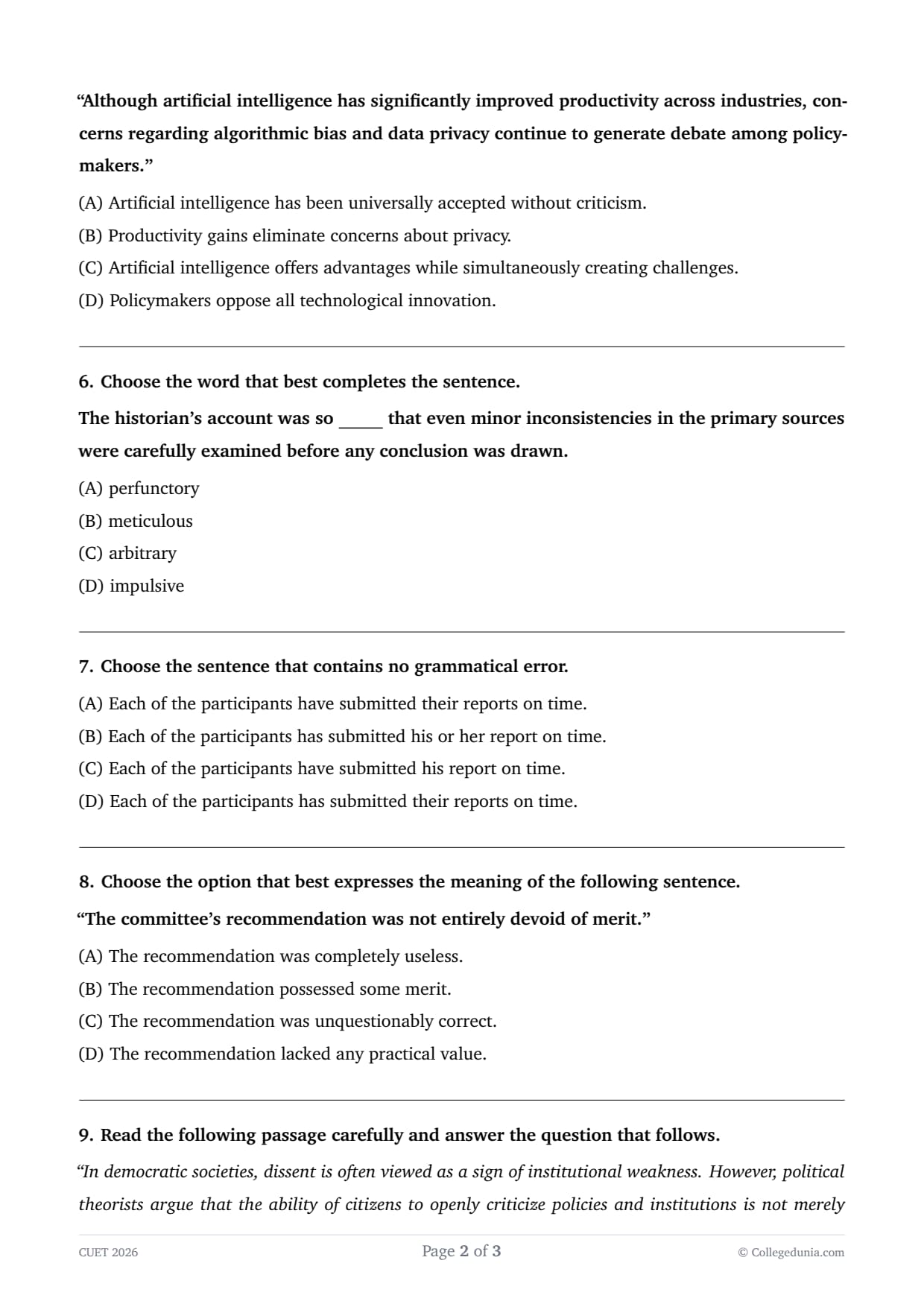
Read the statement carefully and choose the most logical inference.
“Although artificial intelligence has significantly improved productivity across industries, concerns regarding algorithmic bias and data privacy continue to generate debate among policymakers.”
View Solution
Concept:
Inference questions require identifying the conclusion that is directly supported by the information provided. The correct answer must be based entirely on the passage and should avoid exaggeration or unsupported assumptions.
Step 1: Identify positive information.
The passage states:
\[ AI has significantly improved productivity \]
This is a benefit.
Step 2: Identify negative information.
The passage also states:
\[ Algorithmic bias \]
and
\[ Data privacy concerns \]
These represent challenges.
Step 3: Evaluate Option (A).
The passage explicitly mentions debate and concerns.
Therefore universal acceptance is incorrect.
Step 4: Evaluate Option (B).
The passage never states that productivity eliminates privacy concerns.
Hence this conclusion is unsupported.
Step 5: Evaluate Option (D).
The statement does not claim that policymakers oppose all technology.
This is an extreme interpretation.
Hence it is incorrect.
Step 6: Evaluate Option (C).
The passage clearly presents both benefits and challenges.
Therefore:
\[ \boxed{AI offers advantages while simultaneously creating challenges} \]
is the most logical inference.
\[ \boxed{Option (C)} \] Quick Tip: In difficult inference questions, eliminate options containing absolute words such as always, never, only, completely, and universally unless directly supported by the passage.
Choose the word that best completes the sentence.
The historian's account was so \hspace{1cm} that even minor inconsistencies in the primary sources were carefully examined before any conclusion was drawn.
View Solution
Concept:
Contextual vocabulary questions test not merely the dictionary meaning of words but also the ability to understand how a word functions within a sentence. The correct choice must fit logically, grammatically, and contextually.
The key to solving such questions is identifying the clue words present in the sentence.
Step 1: Identify the contextual clue.
The sentence states:
\emph{“even minor inconsistencies in the primary sources were carefully examined before any conclusion was drawn.”
The phrase
\[ carefully examined \]
suggests extreme attention to detail.
Thus, the missing word must indicate thoroughness and precision.
Step 2: Examine Option (A).
\[ Perfunctory \]
means done with minimal effort or interest.
A perfunctory historian would not carefully examine minor inconsistencies.
Hence option (A) contradicts the context.
Step 3: Examine Option (B).
\[ Meticulous \]
means extremely careful and precise.
This perfectly matches the idea of scrutinizing even minor inconsistencies.
Hence option (B) strongly fits the context.
Step 4: Examine Option (C).
\[ Arbitrary \]
means based on random choice rather than reason.
This has no connection with careful examination.
Hence option (C) is incorrect.
Step 5: Examine Option (D).
\[ Impulsive \]
means acting without careful thought.
This is actually the opposite of the required meaning.
Hence option (D) is incorrect.
Step 6: Final conclusion.
The sentence describes a historian who investigates evidence with exceptional care.
Therefore the most suitable word is:
\[ \boxed{Meticulous} \]
\[ \boxed{Option (B)} \] Quick Tip: Common difficult vocabulary pairs: Meticulous–Careless, Perfunctory–Thorough, Laconic–Verbose, Magnanimous–Petty.
Choose the sentence that contains no grammatical error.
View Solution
Concept:
This question tests subject-verb agreement, one of the most frequently tested grammar topics in competitive examinations.
The word
\[ Each \]
is always singular and therefore requires a singular verb.
Step 1: Identify the true subject.
Many students incorrectly assume that
\[ participants \]
is the subject.
However, the grammatical subject is:
\[ Each \]
which is singular.
Therefore the verb must also be singular.
Step 2: Evaluate Option (A).
\[ Each of the participants have submitted \]
The verb
\[ have \]
is plural.
This violates subject-verb agreement.
Hence incorrect.
Step 3: Evaluate Option (B).
\[ Each of the participants has submitted his or her report \]
The singular subject correctly takes:
\[ has \]
The pronoun agreement is also correct.
Hence this option is grammatically accurate.
Step 4: Evaluate Option (C).
The verb remains incorrect because:
\[ have \]
is plural.
Hence incorrect.
Step 5: Evaluate Option (D).
The verb is correct, but
\[ their reports \]
creates a pronoun-agreement issue in strict formal grammar.
Hence option (D) is not the best answer.
Step 6:
Therefore,
\[ \boxed{Option (B)} \]
is the grammatically correct sentence. Quick Tip: Words such as each, every, either, neither, everybody, someone, and anyone are grammatically singular and take singular verbs.
Choose the option that best expresses the meaning of the following sentence.
“The committee's recommendation was not entirely devoid of merit.”
View Solution
Concept:
This question tests understanding of double negatives and formal academic English.
The phrase:
\[ not entirely devoid of merit \]
contains a subtle double-negative structure.
Step 1: Understand the word “devoid”.
\[ Devoid = completely lacking \]
Thus:
\[ devoid of merit = having no merit \]
Step 2: Interpret the negation.
The sentence says:
\[ not entirely devoid of merit \]
which means:
\[ not completely lacking merit \]
Therefore some merit exists.
Step 3: Evaluate the options.
Option (A):
States the recommendation was useless.
Incorrect.
Option (B):
States that some merit existed.
Correct.
Option (C):
Claims the recommendation was unquestionably correct.
Too strong and unsupported.
Option (D):
Again suggests no value.
Incorrect.
Step 4:
Hence,
\[ \boxed{Option (B)} \]
is the most accurate interpretation. Quick Tip: Difficult CUET English questions often use double negatives. Convert them into positive statements before evaluating the options.
Read the following passage carefully and answer the question that follows.
\textit{“In democratic societies, dissent is often viewed as a sign of institutional weakness. However, political theorists argue that the ability of citizens to openly criticize policies and institutions is not merely compatible with democracy but essential to its survival. A society that suppresses criticism may achieve temporary stability, but such stability often masks deeper structural problems that remain unresolved.”
Which of the following assumptions is most strongly supported by the passage?
View Solution
Concept:
This is a higher-order inference and critical reasoning question. Unlike direct factual questions, assumption-based questions require identifying an idea that must logically be true if the author's argument is accepted.
The correct answer is usually not explicitly stated. Instead, it is implied by the reasoning of the passage.
Step 1: Identify the central argument of the passage.
The passage presents two contrasting viewpoints.
The first viewpoint is:
\[ Dissent indicates institutional weakness \]
The author then challenges this view and argues that:
\[ Open criticism is essential for democracy \]
This means the author supports dissent rather than viewing it negatively.
Step 2: Analyze the final sentence carefully.
The passage states:
\emph{“A society that suppresses criticism may achieve temporary stability, but such stability often masks deeper structural problems.”
This statement is extremely important.
The author is suggesting that criticism performs an important social function.
Without criticism:
\[ Problems remain hidden \]
and therefore:
\[ Problems remain unresolved \]
Step 3: Evaluate Option (A).
\[ All criticism is justified \]
The passage never makes such an absolute claim.
Some criticism may be unreasonable.
The author only argues that criticism should be allowed.
Hence option (A) is incorrect.
Step 4: Evaluate Option (B).
This directly contradicts the author's position.
The passage argues that criticism strengthens democracy.
Hence option (B) is incorrect.
Step 5: Evaluate Option (C).
If criticism reveals hidden problems, then criticism helps society identify issues that need attention.
This is precisely what the passage implies.
Thus option (C) is strongly supported.
Step 6: Evaluate Option (D).
The author explicitly warns against stability achieved through suppression.
Therefore option (D) is contrary to the passage.
Step 7: Final conclusion.
The passage supports the idea that criticism helps expose and address deeper societal problems.
Therefore:
\[ \boxed{Option (C)} \]
is the best answer. Quick Tip: In difficult inference questions, avoid options containing words such as \emph{all}, \emph{always}, \emph{never}, and \emph{only}. Such options are frequently designed as distractors.
Arrange the following sentences in the most logical order to form a coherent paragraph.
P. As a result, researchers have increasingly emphasized the importance of digital literacy.
Q. The rapid growth of online platforms has transformed how information is created and consumed.
R. Individuals must now evaluate the credibility of information from a vast number of sources.
S. This transformation has brought both opportunities and challenges.
T. Misinformation can spread quickly when users fail to verify the accuracy of content.
View Solution
Concept:
Advanced para-jumble questions test logical flow, coherence, cause-effect relationships, and pronoun references.
Rather than focusing on individual sentences, one must determine how ideas develop across the paragraph.
Step 1: Identify the opening sentence.
Sentence Q states:
\emph{“The rapid growth of online platforms has transformed how information is created and consumed.”
This introduces the central topic.
Since no prior context is required, Q is the ideal opening sentence.
Therefore the paragraph must begin with:
\[ Q \]
Step 2: Locate the sentence containing a reference word.
Sentence S begins with:
\emph{“This transformation...”
The phrase
\[ This transformation \]
clearly refers back to the transformation introduced in sentence Q.
Thus:
\[ Q \rightarrow S \]
must occur together.
Step 3: Determine what follows the discussion of challenges.
Sentence S mentions:
\[ opportunities and challenges \]
The next sentence should logically explain one of those challenges.
Sentence R discusses the challenge of evaluating information credibility.
Hence:
\[ S \rightarrow R \]
is logical.
Step 4: Identify the consequence of poor evaluation.
Sentence T states:
\emph{“Misinformation can spread quickly when users fail to verify the accuracy of content.”
This naturally follows sentence R.
If people cannot properly evaluate information:
\[ Misinformation spreads \]
Therefore:
\[ R \rightarrow T \]
Step 5: Find the concluding statement.
Sentence P begins with:
\[ As a result \]
which indicates a conclusion derived from the preceding discussion.
Because misinformation can spread easily, digital literacy becomes important.
Hence:
\[ T \rightarrow P \]
Step 6: Construct the complete sequence.
Combining all established links:
\[ Q \rightarrow S \rightarrow R \rightarrow T \rightarrow P \]
Therefore the correct arrangement is:
\[ \boxed{QSTRP} \]
Step 7: Final answer.
\[ \boxed{Option (C)} \] Quick Tip: In difficult para-jumbles, first identify: (1) the introductory sentence, (2) pronoun-reference links, (3) cause-effect chains, and (4) conclusion indicators such as “therefore”, “thus”, “hence”, and “as a result”.
CUET UG 2026 Exam Pattern
| Parameter | Details |
|---|---|
| Exam Name | Common University Entrance Test (CUET UG) 2026 |
| Conducting Body | National Testing Agency (NTA) |
| Exam Mode | Computer-Based Test (CBT) |
| Exam Duration | 60 minutes per test |
| Total Sections | 3 (Languages, Domain Subjects, General Test) |
| Question Type | Multiple Choice Questions (MCQs) |
| Questions per Test | 50 questions (all compulsory) |
| Marking Scheme | +5 for correct, -1 for incorrect |
| Maximum Marks | 250 marks per test |
| Maximum Subject Choices | 5 subjects in total |
| Syllabus Base | Class 12 NCERT (mainly for Domain Subjects) |



Comments