


CUET 2026 May 31 Shift 1 Economics Question Paper is available for download here. NTA conducted the CUET 2026 exam from 11th May to 31st May.
- CUET 2026 Economics exam consists of 50 questions for 250 marks to be attempted in 60 minutes.
- As per the marking scheme, 5 marks are awarded for each correct answer, and 1 mark is deducted for incorrect answer.
Candidates can download CUET 2026 May 31 Shift 1 Economics Question Paper with Answer Key and Solution PDF from links provided below.
Related Links:
- CUET 2026 May 31 Shift 1 Economics Answer Key
- CUET UG 2026 Economics Marks vs Expected Percentile and Colleges
CUET 2026 Economics May 31 Shift 1 Question Paper with Solution PDF
| CUET May 31 Shift 1 Economics Question Paper 2026 | Download PDF | Check Solutions |
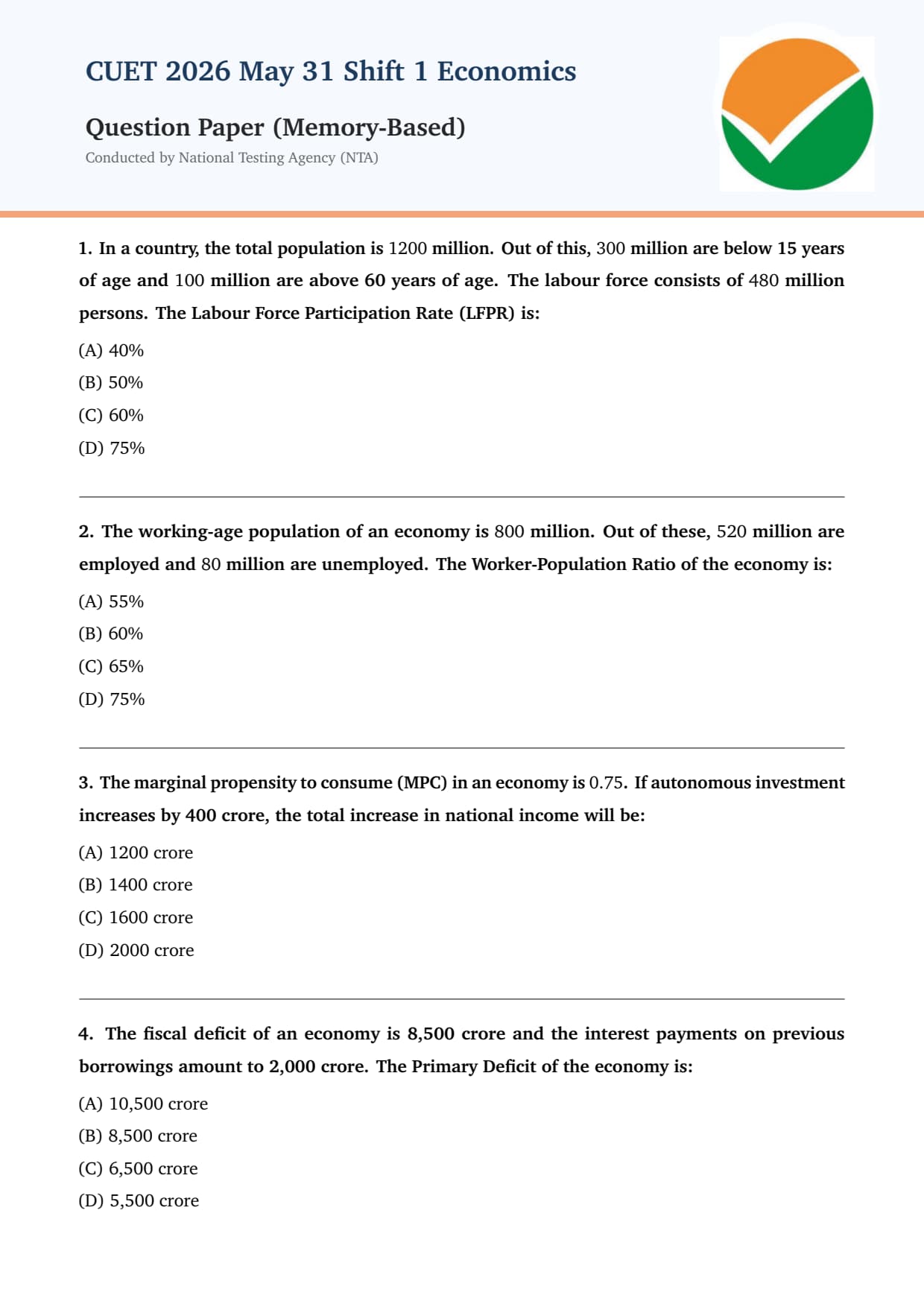

In a country, the total population is \(1200\) million. Out of this, \(300\) million are below 15 years of age and \(100\) million are above 60 years of age. The labour force consists of \(480\) million persons. The Labour Force Participation Rate (LFPR) is:
View Solution
Concept:
Labour Force Participation Rate (LFPR) is one of the most important concepts from Employment chapter in Macroeconomics and Indian Economic Development. It measures the percentage of total population that is part of the labour force.
The formula is:
\[ LFPR=\frac{Labour Force}{Total Population}\times100 \]
where Labour Force includes both employed and unemployed persons who are willing and able to work.
Step 1: Identify the values given in the question.
Total Population:
\[ 1200 million \]
Labour Force:
\[ 480 million \]
Step 2: Apply the LFPR formula.
\[ LFPR = \frac{480}{1200} \times100 \]
\[ = 0.4\times100 \]
\[ = 40 \]
\[ =40% \]
Step 3: Understand why age-group data is given.
The population below 15 years and above 60 years has been provided merely to distract students.
For Labour Force Participation Rate, we directly use:
\[ Labour Force \]
and
\[ Total Population \]
Therefore those values are not required for calculation.
Step 4: Verification.
\[ 40% of 1200 = 480 \]
Hence our answer is correct.
Step 5: Final conclusion.
Therefore:
LFPR=40%
Hence,
\[ \boxed{Option (A)} \] Quick Tip: Remember: \[ LFPR=\frac{Labour Force}{Total Population}\times100 \] CUET often gives extra demographic data to confuse students. Focus only on the quantities required in the formula.
The working-age population of an economy is \(800\) million. Out of these, \(520\) million are employed and \(80\) million are unemployed. The Worker-Population Ratio of the economy is:
View Solution
Concept:
Worker-Population Ratio indicates the proportion of population that is actually employed.
It differs from Labour Force Participation Rate because LFPR includes both employed and unemployed persons whereas Worker-Population Ratio includes only employed persons.
Formula:
\[ Worker-Population Ratio = \frac{Number of Workers}{Population} \times100 \]
Step 1: Extract relevant information.
Workers:
\[ 520 million \]
Population:
\[ 800 million \]
Step 2: Apply the formula.
\[ \frac{520}{800} \times100 \]
\[ = 0.65\times100 \]
\[ = 65% \]
Step 3: Analyze the role of unemployed persons.
Many students mistakenly add unemployed persons.
However:
\[ Worker-Population Ratio \]
uses only employed workers.
Thus:
\[ 80 million unemployed \]
is not used directly.
Step 4: Verification.
\[ 65% of 800 = 520 \]
Hence the answer is verified.
Step 5: Final conclusion.
65%
Hence,
\[ \boxed{Option (C)} \] Quick Tip: LFPR and Worker-Population Ratio are different. LFPR includes employed + unemployed. Worker-Population Ratio includes only employed workers.
The marginal propensity to consume (MPC) in an economy is \(0.75\). If autonomous investment increases by ₹400 crore, the total increase in national income will be:
View Solution
Concept:
The Investment Multiplier is one of the most important concepts in Macroeconomics and has been repeatedly reported by students in recent CUET examinations.
The multiplier shows how much national income changes when autonomous investment changes.
Formula:
\[ K=\frac{1}{1-MPC} \]
where:
\[ K=Multiplier \]
\[ MPC=Marginal Propensity to Consume \]
National income change:
\[ \Delta Y = K\times\Delta I \]
Step 1: Identify the given values.
\[ MPC=0.75 \]
\[ \Delta I=₹400 crore \]
Step 2: Calculate the multiplier.
\[ K = \frac{1}{1-0.75} \]
\[ = \frac{1}{0.25} \]
\[ =4 \]
Thus:
\[ K=4 \]
Step 3: Calculate change in income.
\[ \Delta Y = 4\times400 \]
\[ = 1600 \]
Therefore:
\[ \Delta Y = ₹1600 crore \]
Step 4: Economic interpretation.
The initial investment of ₹400 crore creates income for producers.
A portion of this income is spent on consumption.
This expenditure becomes income for others.
The process continues repeatedly.
As a result:
\[ ₹400 crore \]
generates a much larger increase in national income:
\[ ₹1600 crore \]
Step 5: Verification.
\[ 4\times400=1600 \]
The result is consistent with the multiplier formula.
Step 6: Final conclusion.
\[ \boxed{\Delta Y=₹1600 crore} \]
Hence,
\[ \boxed{Option (C)} \] Quick Tip: For multiplier questions: \[ K=\frac{1}{1-MPC} \] and \[ \Delta Y=K\times\Delta I \] Higher MPC implies a larger multiplier.
The fiscal deficit of an economy is ₹8,500 crore and the interest payments on previous borrowings amount to ₹2,000 crore. The Primary Deficit of the economy is:
View Solution
Concept:
Primary Deficit is an important concept from Government Budget and the Economy. It measures the fiscal deficit after excluding interest obligations on past debt.
It helps economists understand whether the current government's expenditure is responsible for the deficit or whether the deficit is mainly due to interest burden accumulated from previous years.
The formula is:
\[ Primary Deficit = Fiscal Deficit - Interest Payments \]
Step 1: Write the given values.
Fiscal Deficit:
\[ ₹8,500 crore \]
Interest Payments:
\[ ₹2,000 crore \]
Step 2: Apply the formula.
\[ Primary Deficit = 8500-2000 \]
\[ = 6500 \]
Thus,
\[ Primary Deficit = ₹6,500 crore \]
Step 3: Understand the economic significance.
The fiscal deficit includes:
Current expenditure
Development expenditure
Interest burden from previous borrowings
Primary deficit removes the effect of past borrowing.
Therefore it reflects the current year's fiscal position more accurately.
Step 4: Verify the answer.
\[ 8500-2000 = 6500 \]
The calculation is correct.
Step 5: Final conclusion.
\[ \boxed{Primary Deficit=₹6,500 crore} \]
Hence,
\[ \boxed{Option (C)} \] Quick Tip: Remember the hierarchy: Revenue Deficit Fiscal Deficit Primary Deficit and \[ Primary Deficit = Fiscal Deficit - Interest Payments \] This formula is frequently tested in CUET.
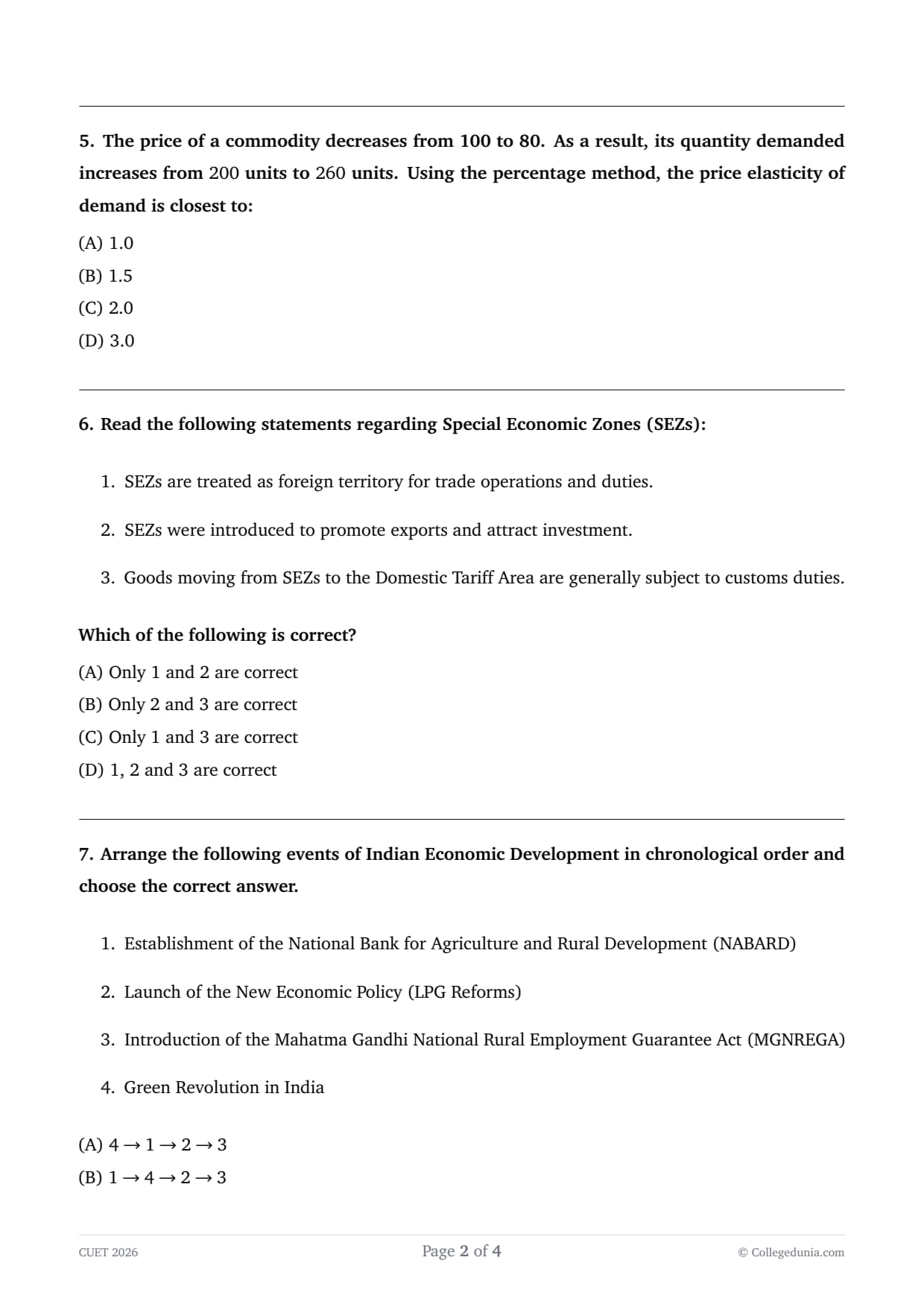
The price of a commodity decreases from ₹100 to ₹80. As a result, its quantity demanded increases from \(200\) units to \(260\) units. Using the percentage method, the price elasticity of demand is closest to:
View Solution
Concept:
Price Elasticity of Demand measures the responsiveness of quantity demanded to a change in price.
Formula:
\[ E_d = \frac{%\Delta Q}{%\Delta P} \]
Since elasticity is usually expressed as an absolute value in objective questions, we ignore the negative sign.
Step 1: Calculate percentage change in quantity demanded.
Initial quantity:
\[ Q_1=200 \]
Final quantity:
\[ Q_2=260 \]
Change:
\[ 260-200=60 \]
Percentage change:
\[ \frac{60}{200}\times100 \]
\[ =30% \]
Step 2: Calculate percentage change in price.
Initial price:
\[ P_1=100 \]
Final price:
\[ P_2=80 \]
Change:
\[ 80-100=-20 \]
Percentage change:
\[ \frac{-20}{100}\times100 \]
\[ =-20% \]
Ignoring sign:
\[ 20% \]
Step 3: Calculate elasticity.
\[ E_d = \frac{30}{20} \]
\[ = 1.5 \]
Step 4: Interpret the result.
Since:
\[ E_d>1 \]
Demand is relatively elastic.
Consumers respond significantly to changes in price.
Step 5: Verification.
\[ \frac{30}{20}=1.5 \]
Hence the answer is verified.
Step 6: Final conclusion.
\[ \boxed{E_d=1.5} \]
Therefore,
\[ \boxed{Option (B)} \] Quick Tip: For MCQs, use: \[ E_d = \frac{%\Delta Q}{%\Delta P} \] If: \[ E_d>1 \] Demand is elastic. If: \[ E_d<1 \] Demand is inelastic.
Read the following statements regarding Special Economic Zones (SEZs):
1. SEZs are treated as foreign territory for trade operations and duties.
2. SEZs were introduced to promote exports and attract investment.
3. Goods moving from SEZs to the Domestic Tariff Area are generally subject to customs duties.
Which of the following is correct?
View Solution
Concept:
Special Economic Zones (SEZs) are among the most important topics in Indian Economic Development and Economic Reforms.
Recent CUET papers have repeatedly asked conceptual questions regarding SEZs, foreign investment, export promotion and trade liberalisation.
SEZs were established to create internationally competitive business environments.
Step 1: Analyze Statement 1.
Statement 1 says:
SEZs are treated as foreign territory for trade operations and duties.
This is correct.
For customs and trade purposes, SEZs are considered outside the domestic customs territory.
Therefore:
\[ \boxed{Statement 1 is correct \]
Step 2: Analyze Statement 2.
SEZs were established to:
Promote exports
Increase foreign investment
Generate employment
Improve infrastructure
Hence:
\[ \boxed{Statement 2 is correct} \]
Step 3: Analyze Statement 3.
When goods move from an SEZ into the Domestic Tariff Area (DTA), they are generally treated as imports.
Consequently customs duties become applicable.
Hence:
\[ \boxed{Statement 3 is correct} \]
Step 4: Evaluate the options.
Statement 1:
Correct
Statement 2:
Correct
Statement 3:
Correct
Therefore all statements are true.
Step 5: Final conclusion.
\[ \boxed{1, 2 and 3 are correct} \]
Hence,
\[ \boxed{Option (D)} \] Quick Tip: SEZ Keywords: Export Promotion Foreign Investment Employment Generation Duty Benefits Infrastructure Development These are frequently tested in CUET Economics.
Arrange the following events of Indian Economic Development in chronological order and choose the correct answer.
1. Establishment of the National Bank for Agriculture and Rural Development (NABARD)
2. Launch of the New Economic Policy (LPG Reforms)
3. Introduction of the Mahatma Gandhi National Rural Employment Guarantee Act (MGNREGA)
4. Green Revolution in India
View Solution
Concept:
Chronology-based questions have become increasingly important in CUET Economics, especially from Indian Economic Development. Such questions test factual understanding along with historical sequencing.
Students often know individual events but lose marks because they cannot place them correctly in time.
Step 1: Identify the year of the Green Revolution.
The Green Revolution began during the mid-1960s.
The introduction of HYV seeds, irrigation facilities, fertilizers, and mechanization significantly increased agricultural productivity.
Approximate period:
\[ 1966-67 \]
Therefore:
\[ \boxed{Green Revolution comes first} \]
Step 2: Identify the establishment of NABARD.
NABARD was established in:
\[ 1982 \]
It became the apex institution for agricultural and rural development finance.
Therefore:
\[ \boxed{NABARD comes after the Green Revolution} \]
Step 3: Identify the New Economic Policy.
Economic Liberalisation, Privatisation and Globalisation reforms were launched in:
\[ 1991 \]
These reforms transformed the Indian economy.
Therefore:
\[ \boxed{LPG Reforms come after NABARD} \]
Step 4: Identify MGNREGA.
MGNREGA was enacted in:
\[ 2005 \]
and implemented in phases from 2006 onward.
Therefore:
\[ \boxed{MGNREGA is the latest event} \]
Step 5: Arrange all events chronologically.
\[ Green Revolution \rightarrow NABARD \rightarrow LPG Reforms \rightarrow MGNREGA \]
or
\[ 4 \rightarrow 1 \rightarrow 2 \rightarrow 3 \]
Step 6: Final conclusion.
\[ \boxed{4 \rightarrow 1 \rightarrow 2 \rightarrow 3} \]
Hence,
\[ \boxed{Option (A)} \] Quick Tip: Important years frequently asked in CUET: Green Revolution -- 1960s NABARD -- 1982 LPG Reforms -- 1991 MGNREGA -- 2005 Keep a separate chronology sheet while revising Indian Economic Development.
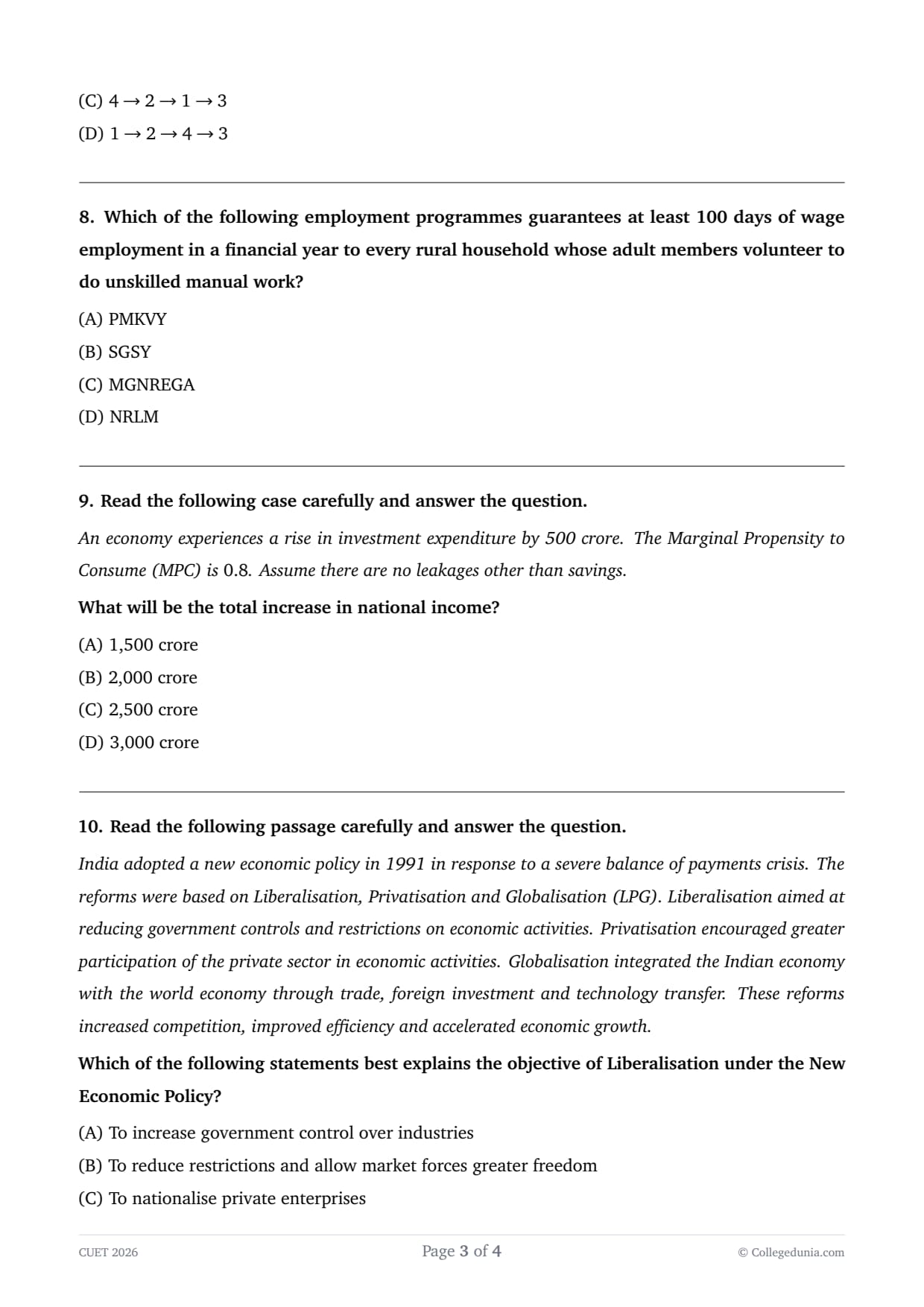
Which of the following employment programmes guarantees at least 100 days of wage employment in a financial year to every rural household whose adult members volunteer to do unskilled manual work?
View Solution
Concept:
Employment generation programmes are a major component of Indian Economic Development. Questions from this area are usually direct, but CUET often creates confusion by providing names of multiple government schemes.
The student must understand the objective of each programme.
Step 1: Understand the key phrase in the question.
The most important phrase is:
\[ 100 days of guaranteed wage employment \]
This phrase is directly associated with:
\[ MGNREGA \]
Step 2: Recall the full form.
MGNREGA stands for:
\[ Mahatma Gandhi National Rural Employment Guarantee Act \]
It was enacted in:
\[ 2005 \]
and implemented from:
\[ 2006 \]
Step 3: Analyze the objective.
The programme guarantees:
At least 100 days of wage employment
Rural households
Adult members
Unskilled manual work
This guarantee makes MGNREGA unique among employment schemes.
Step 4: Eliminate the remaining options.
PMKVY:
Skill development programme.
SGSY:
Self-employment programme.
NRLM:
Rural livelihood mission.
None of these provide a legal guarantee of 100 days of employment.
Step 5: Final conclusion.
The correct answer is:
\[ \boxed{MGNREGA} \]
Hence,
\[ \boxed{Option (C)} \] Quick Tip: Whenever you see: ``100 Days Guaranteed Employment'' immediately think of MGNREGA.
Read the following case carefully and answer the question.
An economy experiences a rise in investment expenditure by ₹500 crore. The Marginal Propensity to Consume (MPC) is \(0.8\). Assume there are no leakages other than savings.
What will be the total increase in national income?
View Solution
Concept:
This is a case-based question involving the Investment Multiplier. Such questions are increasingly common in CUET because they test conceptual understanding instead of direct memorization.
The multiplier is calculated using:
\[ K = \frac{1}{1-MPC} \]
and
\[ \Delta Y = K \times \Delta I \]
Step 1: Identify the given information.
Increase in investment:
\[ \Delta I = ₹500 crore \]
Marginal Propensity to Consume:
\[ MPC = 0.8 \]
Step 2: Calculate the multiplier.
\[ K = \frac{1}{1-0.8} \]
\[ = \frac{1}{0.2} \]
\[ = 5 \]
Step 3: Calculate the change in income.
\[ \Delta Y = 5 \times 500 \]
\[ = 2500 \]
Thus:
\[ \Delta Y = ₹2500 crore \]
Step 4: Economic interpretation.
The initial investment becomes income for producers.
A portion of this income is consumed.
That consumption becomes income for others.
The process continues repeatedly.
As a result:
\[ ₹500 crore \]
creates a much larger increase in aggregate income:
\[ ₹2500 crore \]
Step 5: Verification.
\[ 5 \times 500 = 2500 \]
Correct.
Step 6: Final conclusion.
\[ \boxed{₹2500 crore} \]
Hence,
\[ \boxed{Option (C)} \] Quick Tip: The closer MPC is to 1, the larger the multiplier. For example: \[ MPC=0.8 \Rightarrow K=5 \] \[ MPC=0.9 \Rightarrow K=10 \]
Read the following passage carefully and answer the question.
India adopted a new economic policy in 1991 in response to a severe balance of payments crisis. The reforms were based on Liberalisation, Privatisation and Globalisation (LPG). Liberalisation aimed at reducing government controls and restrictions on economic activities. Privatisation encouraged greater participation of the private sector in economic activities. Globalisation integrated the Indian economy with the world economy through trade, foreign investment and technology transfer. These reforms increased competition, improved efficiency and accelerated economic growth.
Which of the following statements best explains the objective of Liberalisation under the New Economic Policy?
View Solution
Concept:
Passage-based questions have become an important part of CUET Economics. Although the answer may appear direct, students often make mistakes because multiple options seem partially correct.
The key strategy is to identify the exact economic concept being tested and then match it with the relevant statement.
This passage focuses on:
\[ LPG Reforms \]
introduced in:
\[ 1991 \]
The question specifically asks about:
\[ Liberalisation \]
Therefore, we must understand the meaning and objectives of Liberalisation.
Step 1: Understand the meaning of Liberalisation.
Liberalisation refers to the process of reducing unnecessary government controls and restrictions on economic activities.
Before 1991, many industries required government approval for expansion, production and investment.
This system was commonly known as:
\[ License Raj \]
Liberalisation sought to reduce these restrictions.
Thus:
\[ \boxed{Liberalisation means giving greater economic freedom} \]
Step 2: Analyze Option (A).
Option (A) states:
To increase government control over industries.
This is exactly opposite to the objective of Liberalisation.
Liberalisation reduces excessive government intervention.
Therefore:
Option (A) is incorrect
Step 3: Analyze Option (B).
Option (B) states:
To reduce restrictions and allow market forces greater freedom.
This is the precise definition and objective of Liberalisation.
The passage itself mentions reducing controls and restrictions.
Therefore:
Option (B) is correct
Step 4: Analyze Option (C).
Option (C) states:
To nationalise private enterprises.
Nationalisation means transferring ownership to the government.
This is contrary to Liberalisation and Privatisation.
Hence:
Option (C) is incorrect
Step 5: Analyze Option (D).
Option (D) states:
To prohibit foreign investment in India.
Globalisation and Liberalisation actually encouraged foreign investment.
The reforms aimed to attract international capital and technology.
Therefore:
Option (D) is incorrect
Step 6: Connect Liberalisation with economic outcomes.
Liberalisation resulted in:
Greater competition
Improved efficiency
Reduction of licensing requirements
Easier entry for firms
Better allocation of resources
Higher economic growth
These outcomes were expected because firms were allowed to operate with fewer restrictions.
Step 7: Final conclusion.
The objective of Liberalisation was:
\[ \boxed{To reduce restrictions and allow market forces greater freedom} \]
Therefore,
\[ \boxed{Option (B)} \] Quick Tip: Remember the LPG Reforms: L = Liberalisation = Removal of unnecessary restrictions P = Privatisation = Greater role of private sector G = Globalisation = Integration with the world economy CUET frequently asks direct and passage-based questions from these three concepts.
CUET UG 2026 Exam Pattern
| Parameter | Details |
|---|---|
| Exam Name | Common University Entrance Test (CUET UG) 2026 |
| Conducting Body | National Testing Agency (NTA) |
| Exam Mode | Computer-Based Test (CBT) |
| Exam Duration | 60 minutes per test |
| Total Sections | 3 (Languages, Domain Subjects, General Test) |
| Question Type | Multiple Choice Questions (MCQs) |
| Questions per Test | 50 questions (all compulsory) |
| Marking Scheme | +5 for correct, -1 for incorrect |
| Maximum Marks | 250 marks per test |
| Maximum Subject Choices | 5 subjects in total |
| Syllabus Base | Class 12 NCERT (mainly for Domain Subjects) |



Comments