


CUET 2026 May 31 Shift 1 Computer Science Question Paper is available for download here. NTA conducted the CUET 2026 exam from 11th May to 31st May.
- CUET 2026 Computer Science exam consists of 50 questions for 250 marks to be attempted in 60 minutes.
- As per the marking scheme, 5 marks are awarded for each correct answer, and 1 mark is deducted for incorrect answer.
Candidates can download CUET 2026 May 31 Shift 1 Computer Science Question Paper with Answer Key and Solution PDF from links provided below.
Related Links:
CUET 2026 Computer Science May 31 Shift 1 Question Paper with Solution PDF
| CUET May 31 Shift 1 Computer Science Question Paper 2026 | Download PDF | Check Solutions |


Which switching technique is used in the Internet?
View Solution
Concept:
Packet switching is a communication method in which data is divided into small packets before transmission. Each packet may travel through different routes and is reassembled at the destination.
Step 1: Understand Internet communication
The Internet does not establish a dedicated communication path between sender and receiver. Instead, data is broken into packets.
Step 2: Identify the switching technique
Since data travels in the form of packets through various network routes, the Internet uses packet switching.
Final Answer:
\[ \boxed{Packet Switching} \] Quick Tip: The Internet is the most common example of a packet-switched network.
Telephone conversation is an example of:
View Solution
Concept:
Communication modes describe the direction of data flow between devices.
Simplex: One-way communication only.
Half Duplex: Both directions, but one at a time.
Full Duplex: Both directions simultaneously.
Step 1: Analyze telephone communication
During a telephone call, both persons can speak and listen at the same time.
Step 2: Identify the communication mode
Since communication occurs simultaneously in both directions, it is a full duplex system.
Final Answer:
\[ \boxed{Full Duplex} \] Quick Tip: Mobile phones and landline telephones are examples of full duplex communication.
Linear search works best on:
View Solution
Concept:
Linear search checks each element one by one until the desired item is found.
Step 1: Understand linear search
In linear search, elements are examined sequentially from the beginning to the end of the list.
Step 2: Determine where it is useful
Linear search does not require the data to be sorted. Therefore, it is most useful for unsorted lists.
Final Answer:
\[ \boxed{Unsorted List} \] Quick Tip: Linear search can work on both sorted and unsorted data, but it is especially useful when data is unsorted.
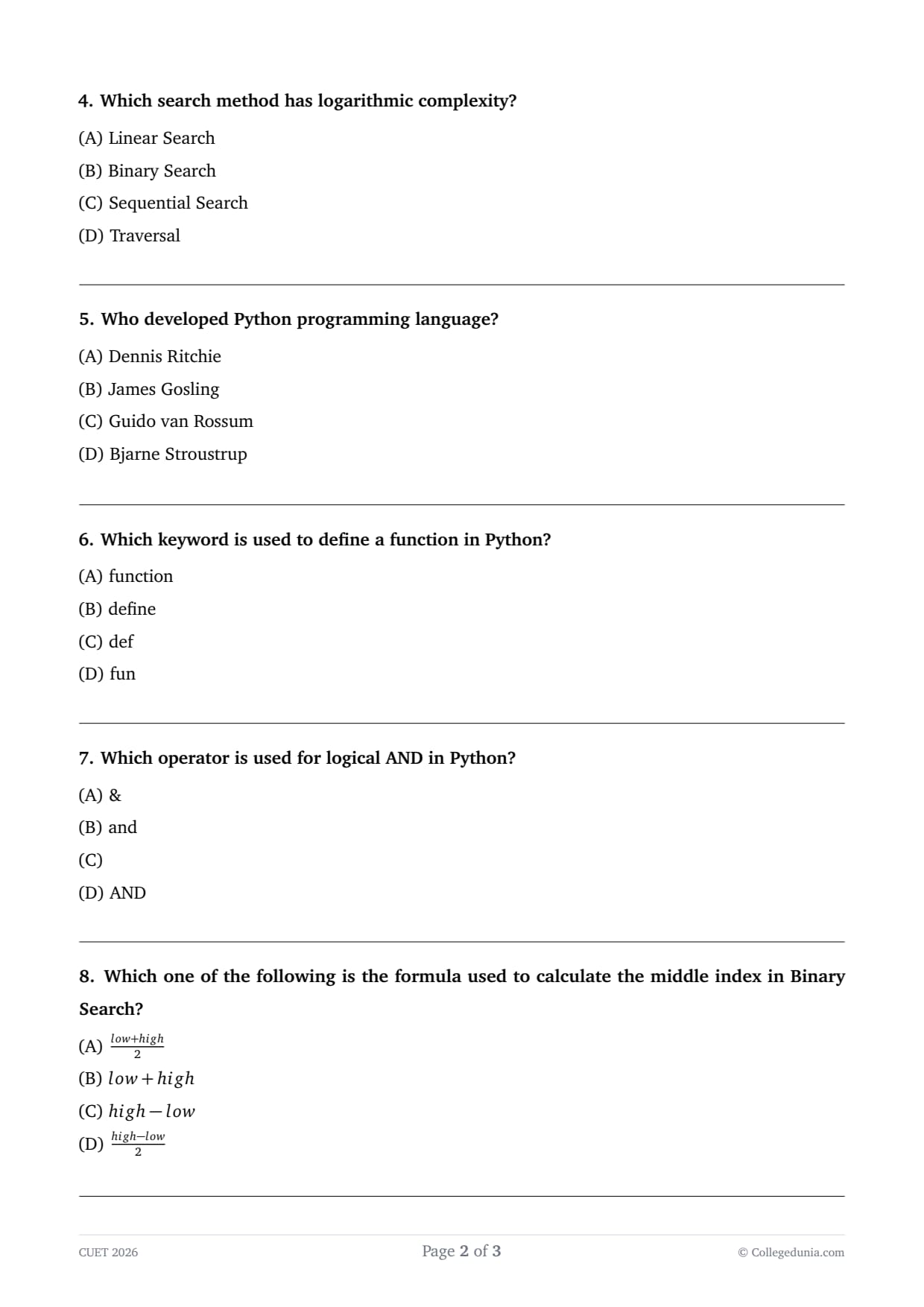
Which search method has logarithmic complexity?
View Solution
Concept:
Time complexity measures the number of operations required by an algorithm as the size of input increases.
Step 1: Recall complexities
\[ Linear Search = O(n) \]
\[ Binary Search = O(\log n) \]
Step 2: Identify logarithmic search
Binary search repeatedly divides the search space into two halves, reducing the number of comparisons significantly.
Final Answer:
\[ \boxed{Binary Search} \] Quick Tip: Binary Search requires the data to be sorted before searching.
Who developed Python programming language?
View Solution
Concept:
Python is a high-level, interpreted, and general-purpose programming language.
Step 1: Recall the creator of Python
Python was developed by Guido van Rossum in the late 1980s and was officially released in 1991.
Step 2: Compare with other options
Dennis Ritchie developed C.
James Gosling developed Java.
Bjarne Stroustrup developed C++.
Therefore, Python was developed by Guido van Rossum.
Final Answer:
\[ \boxed{Guido van Rossum} \] Quick Tip: Python was named after the comedy series "Monty Python's Flying Circus," not after the snake.
Which keyword is used to define a function in Python?
View Solution
Concept:
A function is a reusable block of code that performs a specific task. In Python, functions are created using the def keyword.
Step 1: Recall the syntax for function definition
General syntax:
def function_name():Example:
def add(a, b):
    return a + b
Step 2: Identify the correct keyword
Python uses the keyword def to define a function.
\[ \boxed{\texttt{def}} \] Quick Tip: Every user-defined function in Python begins with the keyword
def.
Which operator is used for logical AND in Python?
View Solution
Concept:
Logical operators are used to combine conditional expressions.
Step 1: Recall Python logical operators
Python provides:
\[ \texttt{and,\ or,\ not} \]
Step 2: Identify the AND operator
The logical AND operator returns True only when both conditions are True.
Example:
x = 10
y = 20

x > 5 and y > 15
The expression evaluates to True.
Final Answer:
\[ \boxed{\texttt{and}} \] Quick Tip: Python uses words (and, or, not) instead of symbols such as \&\& used in some other languages.
Which one of the following is the formula used to calculate the middle index in Binary Search?
View Solution
Concept:
Binary Search repeatedly divides a sorted list into two halves and checks the middle element.
Step 1: Understand Binary Search
To locate an element efficiently, Binary Search first finds the middle position of the current search range.
Step 2: Apply middle index formula
The middle index is calculated as:
\[ mid=\frac{low+high}{2} \]
where:
\[ low = starting index \]
\[ high = ending index \]
Final Answer:
\[ \boxed{\frac{low+high}{2}} \] Quick Tip: Modern implementations often use \(low+\frac{high-low}{2}\) to avoid overflow.
Which of the following is NOT an element of communication?
View Solution
Concept:
Communication is the process of exchanging information between individuals or devices.
Step 1: Recall the elements of communication
The basic elements are:
Sender
Message
Medium/Channel
Receiver
Feedback
Step 2: Examine the options
Sender, Receiver and Message are communication elements.
A Compiler is a software program that translates source code into machine code and is unrelated to the communication process.
Final Answer:
\[ \boxed{Compiler} \] Quick Tip: Compiler is a programming concept, whereas sender, receiver and message belong to communication systems.
Linear Search is useful when:
View Solution
Concept:
Linear Search examines each element one by one until the desired element is found.
Step 1: Consider unsorted data
Linear Search does not require the elements to be arranged in any particular order.
Step 2: Consider small datasets
For a small number of records, Linear Search is simple to implement and performs efficiently.
Step 3: Choose the most appropriate option
Since Linear Search is suitable for both unsorted data and small datasets, the correct answer is:
\[ \boxed{Both A and B} \]
Final Answer:
\[ \boxed{Both A and B} \] Quick Tip: Linear Search is simple but becomes inefficient for very large datasets because its time complexity is \(O(n)\).
CUET UG 2026 Exam Pattern
| Parameter | Details |
|---|---|
| Exam Name | Common University Entrance Test (CUET UG) 2026 |
| Conducting Body | National Testing Agency (NTA) |
| Exam Mode | Computer-Based Test (CBT) |
| Exam Duration | 60 minutes per test |
| Total Sections | 3 (Languages, Domain Subjects, General Test) |
| Question Type | Multiple Choice Questions (MCQs) |
| Questions per Test | 50 questions (all compulsory) |
| Marking Scheme | +5 for correct, -1 for incorrect |
| Maximum Marks | 250 marks per test |
| Maximum Subject Choices | 5 subjects in total |
| Syllabus Base | Class 12 NCERT (mainly for Domain Subjects) |




Comments