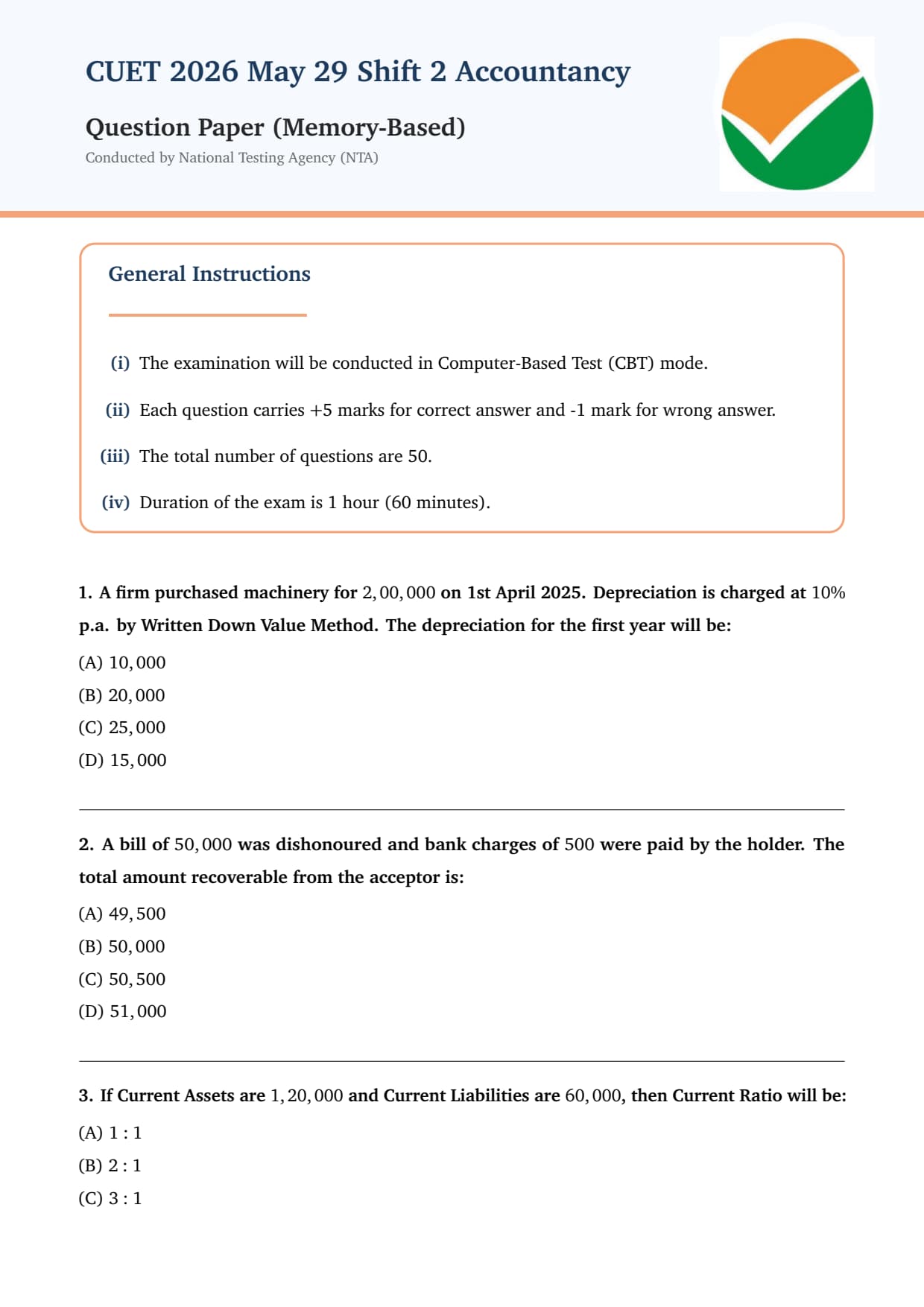
CUET 2026 May 29 Shift 2 Accountancy Question Paper is available for download here. NTA is conducting the CUET 2026 exam from 11th May to 31st May.

  • CUET 2026 Accountancy exam consists of 50 questions for 250 marks to be attempted in 60 minutes.
  • As per the marking scheme, 5 marks are awarded for each correct answer, and 1 mark is deducted for incorrect answer.

Candidates can download CUET 2026 May 29 Shift 2 Accountancy Question Paper with Answer Key and Solution PDF from links provided below.

Related Links:

CUET 2026 Accountancy May 29 Shift 2 Question Paper with Solution PDF

CUET May 29 Shift 2 Accountancy Question Paper 2026 Download PDF Check Solutions


Question 1:

A firm purchased machinery for \( \ 2,00,000 \) on 1st April 2025. Depreciation is charged at \(10%\) p.a. by Written Down Value Method. The depreciation for the first year will be:

  • (A) \( \ 10,000 \)
  • (B) \( \ 20,000 \)
  • (C) \( \ 25,000 \)
  • (D) \( \ 15,000 \)
Correct Answer: (B) \( \ 20,000 \)
View Solution


Concept:
Under the Written Down Value (WDV) Method, depreciation is calculated on the book value of the asset each year. \[ Depreciation = \frac{R \times V}{100} \]
where \(R\) is rate of depreciation and \(V\) is value of asset.

Step 1: Substitute the values into the formula.
\[ Depreciation = \frac{10 \times 2,00,000}{100} \]
\[ = 20,000 \]

Hence, depreciation for the first year is: \[ \boxed{\ 20,000} \] Quick Tip: Under WDV Method, depreciation every year is calculated on reduced book value and not on original cost.


Question 2:

A bill of \( 50,000 \) was dishonoured and bank charges of \( 500 \) were paid by the holder. The total amount recoverable from the acceptor is:

  • (A) \( 49,500 \)
  • (B) \( 50,000 \)
  • (C) \( 50,500 \)
  • (D) \( 51,000 \)
Correct Answer: (C) \( 50,500 \)
View Solution


Concept:

A Bill of Exchange is a written instrument containing an unconditional order directing a person to pay a specified amount on a specified date.

When the acceptor fails to make payment on the due date, the bill is said to be dishonoured. In such a situation, the holder may incur certain additional expenses known as noting charges or bank charges.

According to accounting principles, these charges are recoverable from the acceptor because the dishonour occurred due to the acceptor's failure to pay the bill on time.

Therefore:
\[ Amount Recoverable = Bill Amount + Noting Charges \]


Step 1: Write the information given in the question.

Value of Bill:
\[ 50,000 \]

Bank Charges (Noting Charges):
\[ 500 \]

We are required to calculate the total amount recoverable from the acceptor.


Step 2: Understand the effect of dishonour.

When a bill is dishonoured, the holder has already paid the noting charges to the bank or notary public.

Since these charges arise because of the acceptor's default, the acceptor is liable to reimburse them.

Thus, both the bill amount and the noting charges become recoverable from the acceptor.


Step 3: Calculate the total recoverable amount.

Using the formula:
\[ Recoverable Amount = Bill Amount + Noting Charges \]

Substituting the given values:
\[ = 50,000 + 500 \]
\[ = 50,500 \]


Step 4: Determine the correct option.

The total amount recoverable from the acceptor is:
\[ 50,500 \]

Therefore, the correct answer is:
\[ \boxed{50,500} \]


Final Answer:
\[ \boxed{50,500} \]

Hence, the correct option is:
\[ \boxed{(C) 50,500} \] Quick Tip: Remember: \[ Amount Recoverable = Bill Amount + Noting Charges \] Whenever a bill is dishonoured, noting charges are always borne by the acceptor because the default occurred on his part.


Question 3:

If Current Assets are \( 1,20,000 \) and Current Liabilities are \( 60,000 \), then Current Ratio will be:

  • (A) \(1:1\)
  • (B) \(2:1\)
  • (C) \(3:1\)
  • (D) \(4:1\)
Correct Answer: (B) \(2:1\)
View Solution


Concept:

The Current Ratio is a liquidity ratio that measures the ability of a business to meet its short-term obligations using its current assets.

It compares Current Assets with Current Liabilities and indicates the short-term financial strength of the business.

The formula is:
\[ Current Ratio = \frac{Current Assets}{Current Liabilities} \]

A higher ratio generally indicates a stronger liquidity position, whereas a very low ratio may indicate difficulty in paying short-term debts.


Step 1: Write the values given in the question.

Current Assets:
\[ 1,20,000 \]

Current Liabilities:
\[ 60,000 \]


Step 2: Apply the Current Ratio formula.
\[ Current Ratio = \frac{Current Assets} {Current Liabilities} \]

Substituting the values:
\[ = \frac{1,20,000} {60,000} \]


Step 3: Perform the calculation.
\[ \frac{1,20,000}{60,000} = 2 \]

Therefore:
\[ Current Ratio = 2:1 \]


Step 4: Interpret the result.

A Current Ratio of \(2:1\) means that for every \(1\) of current liability, the business has \(2\) of current assets available.

This indicates a satisfactory short-term financial position and the ability of the business to pay its current obligations comfortably.


Final Answer:
\[ \boxed{2:1} \]

Hence, the correct option is:
\[ \boxed{(B) 2:1} \] Quick Tip: Remember the formula: \[ Current Ratio = \frac{Current Assets} {Current Liabilities} \] The generally accepted ideal Current Ratio is: \[ \boxed{2:1} \] which indicates a sound liquidity position of the business.


Question 4:

Goods costing \( 15,000 \) were distributed as free samples. This will be recorded in:

  • (A) Sales Account
  • (B) Purchases Account
  • (C) Advertisement Account
  • (D) Drawings Account
Correct Answer: (C) Advertisement Account
View Solution


Concept:

Businesses often distribute goods free of cost to customers for promotional purposes. Such goods are known as free samples. The objective of distributing free samples is to advertise the product, attract potential customers, increase sales, and create awareness about the product in the market.

Since the purpose of distributing free samples is advertisement and sales promotion, the cost of such goods is treated as an Advertisement Expense and not as a sale.

Therefore, the value of goods distributed as free samples is debited to Advertisement Account.


Step 1: Understand the nature of the transaction.

Goods costing:
\[ 15,000 \]

have been distributed free of cost.

Since no money is received from customers, it cannot be treated as a sale.

The distribution is made solely for publicity and promotion of the business.

Hence, it represents an advertisement expense.


Step 2: Identify the accounts affected.

The goods distributed as free samples are taken out of the stock or purchases of the business.

Therefore:


Advertisement Account increases (expense increases).
Purchases Account or Inventory decreases.


According to the rules of accounting:


Expenses are debited.
Assets or purchases are credited when goods are withdrawn for non-trading purposes.


Step 3: Pass the journal entry.

The journal entry for distribution of free samples is:
\[ Advertisement A/c Dr. 15,000 \]
\[ To Purchases A/c 15,000 \]

This entry records the cost of free samples as an advertisement expense.


Step 4: Determine the correct account.

Since the debit is made to Advertisement Account, the transaction is recorded in:
\[ \boxed{Advertisement Account} \]


Why other options are incorrect?


Sales Account: Incorrect because no sale has taken place and no revenue is earned.
Purchases Account: Incorrect because Purchases Account is credited, not debited.
Drawings Account: Incorrect because goods are not withdrawn by the proprietor for personal use.
Advertisement Account: Correct because free samples are distributed for promotional purposes.


Final Answer:
\[ \boxed{Advertisement Account} \]

Hence, the correct option is:
\[ \boxed{(C) Advertisement Account} \] Quick Tip: Remember: \[ Goods given as free samples = Advertisement Expense \] The standard journal entry is: \[ Advertisement A/c Dr. \] \[ To Purchases A/c \] Free samples are a marketing and promotional expense, not a sale.


Question 5:

A partner is entitled to salary of \( 5,000 \) per month. If salary outstanding at year end is for 2 months, the outstanding amount will be:

  • (A) \( 5,000 \)
  • (B) \( 7,500 \)
  • (C) \( 10,000 \)
  • (D) \( 12,000 \)
Correct Answer: (C) \( 10,000 \)
View Solution


Concept:

Outstanding expenses are those expenses which have become due during the accounting period but have not yet been paid by the end of the financial year.

According to the Accrual Basis of Accounting, all expenses relating to the current year must be recorded in that year whether they are paid or not. Therefore, any unpaid partner's salary at the end of the year is treated as an outstanding expense and is shown as a liability in the Balance Sheet.


Step 1: Write the information given in the question.

The partner is entitled to a monthly salary of:
\[ 5,000 per month \]

Salary outstanding at the end of the year is for:
\[ 2 months \]

We have to calculate the amount of salary that remains unpaid.


Step 2: Apply the formula for outstanding salary.

Outstanding Salary is calculated as:
\[ Outstanding Salary = Monthly Salary \times Number of Outstanding Months \]

Substituting the given values:
\[ Outstanding Salary = 5,000 \times 2 \]


Step 3: Perform the calculation.
\[ 5,000 \times 2 = 10,000 \]

Therefore, the salary due but not yet paid to the partner is:
\[ 10,000 \]


Step 4: Accounting treatment of outstanding salary.

At the end of the accounting year, the outstanding partner's salary is recorded through an adjusting entry:
\[ Partner's Salary A/c Dr. \]
\[ To Outstanding Salary A/c \]

This ensures that the expense is charged to the current year's Profit and Loss Account and the unpaid amount is shown as a liability.


Final Answer:
\[ \boxed{10,000} \]

Hence, the correct option is:
\[ \boxed{(C) 10,000} \] Quick Tip: Remember: \[ Outstanding Amount = Monthly Amount \times Number of Months Outstanding \] Outstanding expenses are always added to the related expense account and shown as Current Liabilities in the Balance Sheet.


Question 6:

A company forfeited 100 shares of \( \ 10 \) each issued at par for non-payment of final call of \( \ 2 \) per share. The amount forfeited will be:

  • (A) \( \ 200 \)
  • (B) \( \ 800 \)
  • (C) \( \ 1,000 \)
  • (D) \( \ 1,200 \)
Correct Answer: (B) \( \ 800 \)
View Solution


Concept:
Share forfeiture amount equals the amount already received from shareholders before forfeiture.

Step 1: Calculate amount received per share.

Face value per share: \[ 10 \]

Final call unpaid: \[ 2 \]

Amount received per share: \[ 10 - 2 = 8 \]

Step 2: Calculate total forfeited amount.
\[ 100 \times 8 = 800 \]

Hence, \[ \boxed{800} \] Quick Tip: Forfeited amount = Amount already paid by shareholders before default.


Question 7:

If Gross Profit is \( 80,000 \) and Net Sales are \( 4,00,000 \), the Gross Profit Ratio will be:

  • (A) \(10%\)
  • (B) \(15%\)
  • (C) \(20%\)
  • (D) \(25%\)
Correct Answer: (C) \(20%\)
View Solution


Concept:

Gross Profit Ratio is an important profitability ratio that measures the relationship between Gross Profit and Net Sales. It indicates how efficiently a business is generating profit from its trading activities before considering operating and administrative expenses.

The formula for Gross Profit Ratio is:
\[ Gross Profit Ratio = \frac{Gross Profit}{Net Sales} \times 100 \]

A higher Gross Profit Ratio generally indicates better profitability and efficient management of production or purchasing costs.


Step 1: Write the given information.

From the question:
\[ Gross Profit = 80,000 \]
\[ Net Sales = 4,00,000 \]

We have to calculate the Gross Profit Ratio.


Step 2: Apply the Gross Profit Ratio formula.

Using the formula:
\[ Gross Profit Ratio = \frac{Gross Profit}{Net Sales} \times 100 \]

Substituting the given values:
\[ Gross Profit Ratio = \frac{80,000}{4,00,000} \times 100 \]


Step 3: Perform the calculation.

First calculate the fraction:
\[ \frac{80,000}{4,00,000} = 0.20 \]

Now multiply by \(100\):
\[ 0.20 \times 100 = 20 \]

Therefore,
\[ Gross Profit Ratio = 20% \]


Step 4: Interpret the result.

A Gross Profit Ratio of \(20%\) means that for every \(100\) of net sales, the business earns \(20\) as gross profit before deducting operating expenses, administrative expenses, selling expenses, and other indirect costs.

This ratio helps management compare profitability across different accounting periods and evaluate the efficiency of trading operations.


Final Answer:

\[ \boxed{20\%} \]


Hence, the correct option is:
\[ \boxed{20\%} \] Quick Tip: Remember the formula: \[ Gross Profit Ratio = \frac{Gross Profit}{Net Sales} \times 100 \] If Gross Profit Ratio increases over time, it generally indicates improved trading efficiency and better control over the cost of goods sold.


Question 8:

Goodwill brought in cash by the incoming partner is credited to:

  • (A) Revaluation Account
  • (B) Cash Account
  • (C) Old Partners’ Capital Accounts
  • (D) Incoming Partner’s Capital Account
Correct Answer: (C) Old Partners’ Capital Accounts
View Solution


Concept:

When a new partner is admitted into a partnership firm, he acquires a share in the future profits of the business. The existing partners sacrifice a portion of their profit-sharing rights in favour of the incoming partner.

To compensate the old partners for this sacrifice, the incoming partner is generally required to bring an amount as premium for goodwill. This goodwill represents the value of the firm's reputation, customer base, business connections, and earning capacity built by the old partners over the years.

Therefore, the goodwill brought by the incoming partner belongs to the old partners and must be credited to their capital accounts in the sacrificing ratio.

Step 1: Understand the purpose of goodwill brought by the incoming partner.

When a new partner joins the firm, he gains the right to share future profits.

The old partners give up (sacrifice) a part of their share of profits. To compensate them for this sacrifice, the incoming partner pays premium for goodwill.

Thus, goodwill is a compensation paid to the existing partners.


Step 2: Identify who receives the benefit of goodwill.

Since the old partners are sacrificing their share of profits, they are entitled to receive the goodwill amount.

Hence, the goodwill brought in cash cannot be credited to:


Revaluation Account (because goodwill is not a revaluation gain),
Cash Account (cash is only the asset received),
Incoming Partner's Capital Account (because he is paying the amount).


The amount must be transferred to the capital accounts of the old partners.


Step 3: Apply the accounting treatment.

Suppose the incoming partner brings goodwill in cash:
\[ Cash A/c Dr. \]
\[ To Old Partners' Capital A/cs \]

The credit is distributed among the old partners in their sacrificing ratio.

Therefore, goodwill brought in cash by the incoming partner is credited to:
\[ \boxed{Old Partners' Capital Accounts} \]


Final Answer:
\[ \boxed{Old Partners' Capital Accounts} \] Quick Tip:

Remember the rule: Goodwill follows sacrifice. The partner who sacrifices future profits receives compensation through goodwill. Therefore, goodwill brought by the incoming partner is always credited to the old partners' capital accounts in the sacrificing ratio.


Question 9:


Cash deposited into bank by the proprietor should be recorded in:


  • (A) Cash Book only
  • (B) Bank Book only
  • (C) Both Cash and Bank columns of Cash Book
  • (D) Journal Proper
Correct Answer: (C) Both Cash and Bank columns of Cash Book
View Solution


Concept:

When cash is deposited into a bank account, there is a transfer of funds from one form of asset (cash in hand) to another form of asset (cash at bank).

Such transactions affect both the Cash Account and the Bank Account simultaneously. These are known as Contra Entries because the debit and credit aspects of the transaction are recorded within the same Cash Book.

A Contra Entry does not involve any external party and therefore does not require a separate journal entry.

Step 1: Understand the transaction

The transaction states:
\[ Cash deposited into bank by the proprietor \]

This means money is being moved from the cash box of the business to its bank account.

As a result:
\[ Cash Balance decreases \]

and
\[ Bank Balance increases \]

Step 2: Identify the accounts affected

Two accounts are affected:


Cash Account
Bank Account


Since cash is going out:
\[ Cash Account is credited \]

Since money is received by the bank:
\[ Bank Account is debited \]

Therefore, the journal entry is:
\[ Bank A/c Dr. \]
\[ To Cash A/c \]

Step 3: Determine where the entry is recorded

In a Double Column or Triple Column Cash Book, both Cash and Bank columns are maintained together.

Since the transaction affects:
\[ Cash Account \]

and
\[ Bank Account \]

the entry is recorded on both sides of the Cash Book.

Hence it is entered:


In the Bank Column on the debit side
In the Cash Column on the credit side


This is called a Contra Entry and is usually marked with the letter \(\mathbf{C}\).

Step 4: Eliminate incorrect options

Option (A): Cash Book only

Incorrect because the transaction affects both cash and bank balances, not only cash.

Option (B): Bank Book only

Incorrect because cash balance also decreases and must be recorded.

Option (D): Journal Proper

Incorrect because contra transactions are recorded directly in the Cash Book and not in the Journal Proper.

Step 5: Choose the correct answer

Since the transaction affects both Cash and Bank Accounts simultaneously and is recorded as a Contra Entry:
\[ \boxed{Both Cash and Bank columns of Cash Book} \]


Final Answer:
\[ \boxed{(C) Both Cash and Bank columns of Cash Book} \] Quick Tip: Whenever money is transferred between Cash Account and Bank Account (cash deposited into bank or cash withdrawn from bank), it is called a Contra Entry. Such transactions are recorded in both the Cash and Bank columns of the Cash Book and are usually marked with the letter “C”.


Question 10:


A machine purchased for \(1,50,000\) has a residual value of \(30,000\) and a useful life of 6 years. Annual depreciation under the Straight Line Method (SLM) will be:


  • (A) \(15,000\)
  • (B) \(18,000\)
  • (C) \(20,000\)
  • (D) \(25,000\)
Correct Answer: (C) \(20,000\)
View Solution


Concept:

Depreciation is the systematic reduction in the value of a fixed asset due to usage, wear and tear, passage of time, or obsolescence.

Under the Straight Line Method (SLM), the same amount of depreciation is charged every year throughout the useful life of the asset.

The formula for annual depreciation under SLM is:
\[ Annual Depreciation = \frac{Cost of Asset - Residual Value} {Useful Life} \]

where,


Cost of Asset = Original purchase price of the asset
Residual Value (Scrap Value) = Estimated value of the asset at the end of its useful life
Useful Life = Number of years for which the asset is expected to be used


Step 1: Write the values given in the question

Cost of Machine:
\[ =1,50,000 \]

Residual Value:
\[ =30,000 \]

Useful Life:
\[ =6 years \]

Step 2: Calculate the depreciable amount

The depreciable amount is the portion of the asset's cost that has to be written off during its useful life.
\[ Depreciable Amount = Cost - Residual Value \]

Substituting the values:
\[ =1,50,000-30,000 \]
\[ =1,20,000 \]

Thus, the total amount to be depreciated over 6 years is:
\[ \boxed{1,20,000} \]

Step 3: Apply the Straight Line Method formula
\[ Annual Depreciation = \frac{Depreciable Amount} {Useful Life} \]
\[ = \frac{1,20,000}{6} \]
\[ =20,000 \]

Step 4: Verify the result

Since depreciation is charged equally every year under SLM:
\[ 20,000 \times 6 = 1,20,000 \]

This equals the total depreciable amount, confirming that the calculation is correct.

Step 5: Check the book value at the end of useful life
\[ Book Value after 6 years = Cost - Total Depreciation \]
\[ = 1,50,000 - 1,20,000 \]
\[ =30,000 \]

This is exactly equal to the residual value given in the question.

Hence, the answer is verified.


Final Answer:
\[ \boxed{Annual Depreciation = 20,000} \]

Therefore, the correct option is
\[ \boxed{(C) 20,000} \] Quick Tip: For Straight Line Method (SLM), \[ Annual Depreciation = \frac{Cost of Asset - Residual Value} {Useful Life} \] The depreciation amount remains the same every year throughout the asset's useful life.

CUET UG 2026 Exam Pattern

Parameter Details
Exam Name Common University Entrance Test (CUET UG) 2026
Conducting Body National Testing Agency (NTA)
Exam Mode Computer-Based Test (CBT)
Exam Duration 60 minutes per test
Total Sections 3 (Languages, Domain Subjects, General Test)
Question Type Multiple Choice Questions (MCQs)
Questions per Test 50 questions (all compulsory)
Marking Scheme +5 for correct, -1 for incorrect
Maximum Marks 250 marks per test
Maximum Subject Choices 5 subjects in total
Syllabus Base Class 12 NCERT (mainly for Domain Subjects)

CUET UG 2026 Paper Analysis