CUET 2026 May 25 Shift 1 Chemistry Question Paper is available for download here. NTA is conducting the CUET 2026 exam from 11th May to 31st May.

  • CUET 2026 Chemistry exam consists of 50 questions for 250 marks to be attempted in 60 minutes.
  • As per the marking scheme, 5 marks are awarded for each correct answer, and 1 mark is deducted for incorrect answer.

Candidates can download CUET 2026 May 25 Shift 1 Chemistry Question Paper with Answer Key and Solution PDF from links provided below.

Related Links:

CUET 2026 Chemistry May 25 Shift 1 Question Paper with Solution PDF

CUET May 25 Shift 1 Chemistry Question Paper 2026 Download PDF Check Solutions

Question 1:

Which of the following compounds shows acidic character?

  • (A) Phenol
  • (B) Ethanol
  • (C) Ether
  • (D) Ethene
Correct Answer: (A) Phenol
View Solution


Step 1: Understanding the Question:

The objective of this question is to identify which of the given organic compounds exhibits a significant acidic character in comparison to the others.


Step 2: Key Formula or Approach:

The acidic strength of an organic compound is directly proportional to the stability of the conjugate base formed after losing a proton (\(H^+\)).
\[ Acidic Strength \propto Stability of Conjugate Base \]


Step 3: Detailed Explanation:


Conjugate Base of Phenol: When phenol (\(C_6H_5OH\)) loses a proton, it forms the phenoxide ion (\(C_6H_5O^-\)).

Resonance Stabilization: The negative charge on the oxygen atom of the phenoxide ion is delocalized over the ortho and para positions of the aromatic benzene ring.

Effect of Resonance: This resonance delocalization stabilizes the phenoxide ion, making the starting phenol relatively eager to release its proton.

Conjugate Base of Ethanol: Deprotonation of ethanol (\(C_2H_5OH\)) yields the ethoxide ion (\(C_2H_5O^-\)).

Inductive Destabilization: The ethyl group in the ethoxide ion exerts a \(+I\) inductive effect, which pushes electron density toward the already negatively charged oxygen, destabilizing the conjugate base.

Acidity of Ether and Ethene: Ether lacks a polar \(O-H\) bond and cannot easily release a proton.

Acidity of Ethene: Ethene (\(C_2H_4\)) contains \(sp^2\) hybridized carbon atoms with low electronegativity, resulting in negligible acidity.


Step 4: Final Answer:

Therefore, phenol is the most acidic compound among the choices, which matches option (A).
Quick Tip: To quickly compare the acidity of organic compounds, look for resonance.
The phenoxide ion is stabilized by resonance, whereas alkoxide ions are destabilized by the \(+I\) effect of alkyl groups.
This makes phenols significantly more acidic than aliphatic alcohols like ethanol.


Question 2:

Arrange the following in increasing order of basic strength:

  • (A) Aniline \(<\) Ammonia \(<\) Ethylamine
  • (B) Ammonia \(<\) Aniline \(<\) Ethylamine
  • (C) Ethylamine \(<\) Ammonia \(<\) Aniline
  • (D) Aniline \(<\) Ethylamine \(<\) Ammonia
Correct Answer: (A) Aniline \(<\) Ammonia \(<\) Ethylamine
View Solution


Step 1: Understanding the Question:

The question asks us to arrange aniline, ammonia, and ethylamine in the increasing order of their basic strengths.


Step 2: Key Formula or Approach:

The basic strength of a nitrogenous base is determined by the ease with which its nitrogen atom can donate its lone pair of electrons to a proton (\(H^+\)).
\[ Basic Strength \propto Electron Density on Nitrogen \propto \frac{1}{Resonance Delocalization} \]


Step 3: Detailed Explanation:


Structure of Aniline: In aniline (\(C_6H_5NH_2\)), the lone pair of electrons on the nitrogen atom is conjugate with the \(\pi\)-electrons of the benzene ring.

Resonance Effect in Aniline: The lone pair is delocalized into the ring via resonance, making it less available for protonation.

Basicity of Ammonia: Ammonia (\(NH_3\)) has a lone pair on the nitrogen atom that is fully localized, as there are no conjugate systems or alkyl groups.

Structure of Ethylamine: Ethylamine (\(CH_3CH_2NH_2\)) contains an ethyl group, which is an electron-donating group.

Inductive Effect in Ethylamine: The ethyl group exerts a \(+I\) inductive effect, increasing the electron density on the nitrogen atom and making its lone pair highly available for donation.

Comparative Summary: Aniline is the weakest base because of resonance, ammonia is stronger than aniline, and ethylamine is the strongest due to the \(+I\) effect.


Step 4: Final Answer:

The correct increasing order of basic strength is Aniline \(<\) Ammonia \(<\) Ethylamine, which corresponds to option (A).
Quick Tip: Aromatic amines are always less basic than aliphatic amines and ammonia.
This is due to the resonance delocalization of the nitrogen lone pair into the aromatic ring.
Conversely, aliphatic alkyl groups push electron density onto nitrogen, boosting its basicity.


Question 3:

Identify the correct IUPAC name of the compound: \(CH_3–CH_2–CHO\)

  • (A) Propanone
  • (B) Propanal
  • (C) Propanoic acid
  • (D) Propene
Correct Answer: (B) Propanal
View Solution


Step 1: Understanding the Question:

The goal is to determine the correct systematic IUPAC name for the given organic molecular structure.


Step 2: Key Formula or Approach:

To name an organic compound, identify the longest continuous carbon chain, determine the principal functional group, and assign the appropriate suffixes and prefixes.
\[ IUPAC Name = Word Root + Primary Suffix + Secondary Suffix \]


Step 3: Detailed Explanation:


Counting the Carbons: The given structure is \(CH_3–CH_2–CHO\). There are three carbon atoms in the longest continuous chain.

Determining the Word Root: A three-carbon chain corresponds to the word root "prop".

Determining the Primary Suffix: The carbon atoms are linked by single bonds, which means the hydrocarbon chain is saturated. The primary suffix is therefore "an".

Identifying the Functional Group: The functional group present is \(–CHO\), which is an aldehyde group.

Determining the Secondary Suffix: The secondary suffix for an aldehyde functional group is "-al".

Combining the Components: Adding the root, primary suffix, and secondary suffix gives: \(prop + an + al = propanal\).

Eliminating Other Options: Propanone is a ketone, propanoic acid is a carboxylic acid, and propene is an alkene. None of these match the aldehyde structure.


Step 4: Final Answer:

The correct IUPAC name for the given compound is Propanal, which is represented by option (B).
Quick Tip: The carbon in the aldehyde group (\(–CHO\)) is always counted as part of the main carbon chain.
It is also assigned position number 1 during numbering.
Therefore, a three-carbon chain containing \(–CHO\) is simply named propanal, and no locant number is needed.


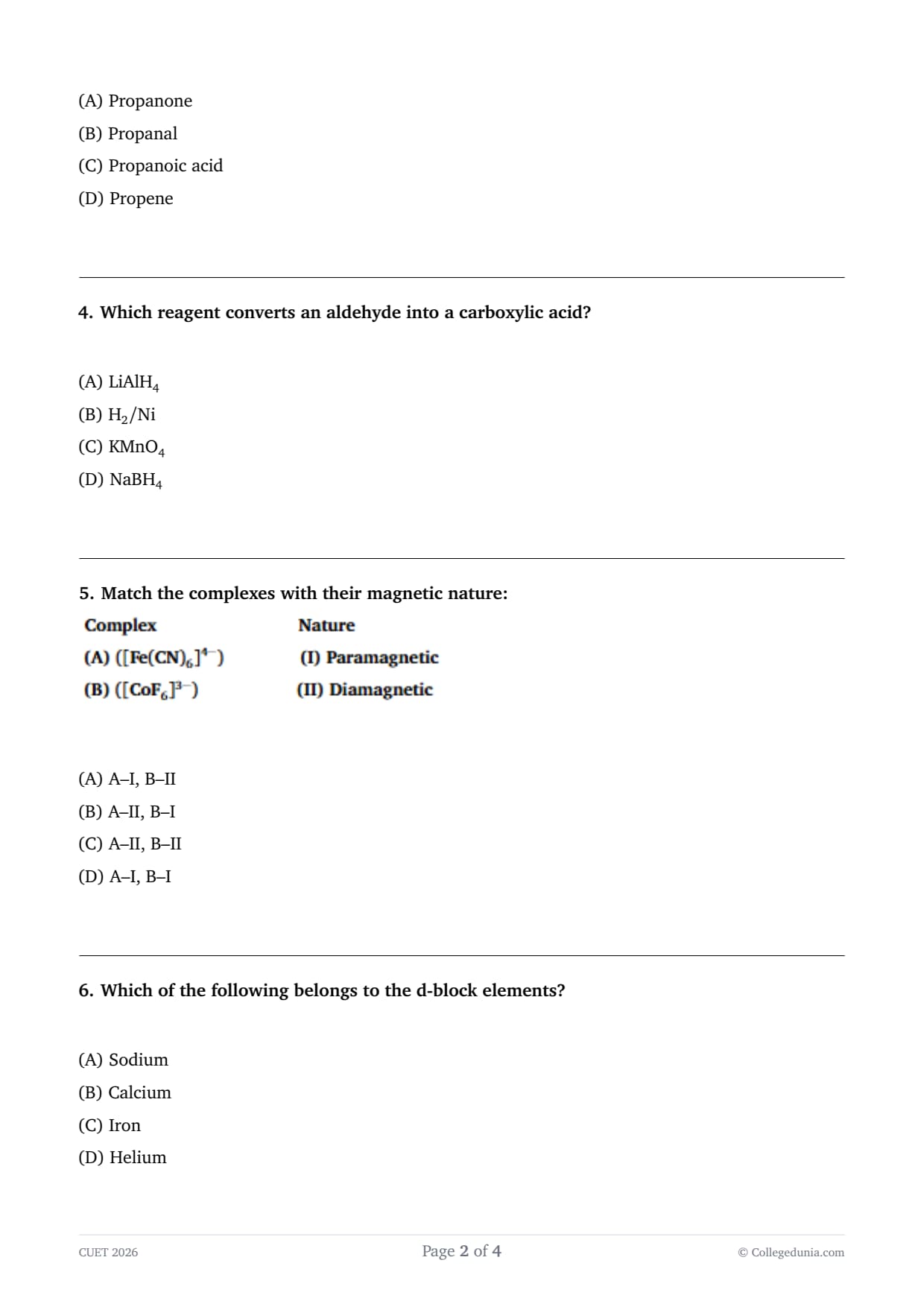
Question 4:

Which reagent converts an aldehyde into a carboxylic acid?

  • (A) \(LiAlH_4\)
  • (B) \(H_2/Ni\)
  • (C) \(KMnO_4\)
  • (D) \(NaBH_4\)
Correct Answer: (C) \(\text{KMnO}_4\)
View Solution


Step 1: Understanding the Question:

The question asks to identify the correct chemical reagent that can oxidize an aldehyde functional group to a carboxylic acid group.


Step 2: Key Formula or Approach:

Converting an aldehyde to a carboxylic acid is an oxidation reaction that requires an oxidizing agent.
\[ R–CHO \xrightarrow{Oxidizing Agent [O]} R–COOH \]


Step 3: Detailed Explanation:


Role of Potassium Permanganate: \(KMnO_4\) (Potassium permanganate) is a strong oxidizing agent. It readily supplies oxygen to convert aldehydes into their corresponding carboxylic acids.

Role of Lithium Aluminium Hydride: \(LiAlH_4\) is a powerful reducing agent. Instead of oxidizing, it reduces aldehydes to primary alcohols (\(R–CH_2OH\)).

Role of Sodium Borohydride: \(NaBH_4\) is a mild reducing agent that is also used to reduce aldehydes and ketones to alcohols.

Role of Hydrogen with Nickel: \(H_2/Ni\) is a catalytic hydrogenation system. This is a reducing agent that converts aldehydes to primary alcohols.

Conclusion on Reagents: Since three of the given options are reducing agents, only \(KMnO_4\) can perform the oxidation.


Step 4: Final Answer:

The reagent that converts an aldehyde into a carboxylic acid is \(KMnO_4\), which corresponds to option (C).
Quick Tip: Always classify chemical reagents as oxidizing or reducing agents when dealing with organic conversions.
Aldehydes have a hydrogen atom attached to the carbonyl carbon, which makes them very easy to oxidize.
Even a mild oxidizing agent like Tollens' or Fehling's reagent, or a strong one like \(KMnO_4\), can complete this conversion.


Question 5:

Match the complexes with their magnetic nature:

  • (A) A–I, B–II
  • (B) A–II, B–I
  • (C) A–II, B–II
  • (D) A–I, B–I
Correct Answer: (B) A–II, B–I
View Solution


Step 1: Understanding the Question:

This matching question requires us to determine whether the given coordination complexes are paramagnetic (containing unpaired electrons) or diamagnetic (containing only paired electrons).


Step 2: Key Formula or Approach:

We use the Crystal Field Theory (CFT) to find the oxidation state, the d-electron configuration of the metal, and the pairing behavior under strong-field or weak-field ligands.
\[ Paramagnetic: Unpaired electrons present (n > 0) \]
\[ Diamagnetic: All electrons paired (n = 0) \]


Step 3: Detailed Explanation:


Analyzing Complex (A) \([Fe(CN)_6]^{4-}\):

The oxidation state of iron is \(+2\) because:

\[ x + 6(-1) = -4 \implies x = +2 \]

The electronic configuration of \(Fe^{2+}\) is \([Ar] 3d^6\).

The cyanide ion (\(CN^-\)) is a strong-field ligand, which causes pairing of electrons in the \(t_{2g}\) orbitals.

The 6 electrons occupy the \(t_{2g}\) orbitals as three pairs: \(t_{2g}^6 e_g^0\).

Since there are no unpaired electrons, the complex is diamagnetic, matching with (II).

Analyzing Complex (B) \([CoF_6]^{3-}\):

The oxidation state of cobalt is \(+3\) because:

\[ y + 6(-1) = -3 \implies y = +3 \]

The electronic configuration of \(Co^{3+}\) is \([Ar] 3d^6\).

The fluoride ion (\(F^-\)) is a weak-field ligand, which does not cause pairing of electrons.

The 6 electrons occupy the orbitals as \(t_{2g}^4 e_g^2\), leaving 4 unpaired electrons.

Since unpaired electrons are present, the complex is paramagnetic, matching with (I).


Step 4: Final Answer:

The correct matching is A–II and B–I, which is given in option (B).
Quick Tip: Strong-field ligands (such as \(CN^-\), \(CO\)) typically force pairing, resulting in low-spin diamagnetic complexes.
Weak-field ligands (such as \(F^-\), \(Cl^-\)) do not force pairing, which often leads to high-spin paramagnetic complexes.
Knowing the spectrochemical series helps you quickly determine the magnetic nature of complexes.


Question 6:

Which of the following belongs to the d-block elements?

  • (A) Sodium
  • (B) Calcium
  • (C) Iron
  • (D) Helium
Correct Answer: (C) Iron
View Solution


Step 1: Understanding the Question:

The question asks to identify which of the listed chemical elements belongs to the d-block of the periodic table.


Step 2: Key Formula or Approach:

An element belongs to a particular block (s, p, d, f) depending on the subshell into which the last differentiating electron enters.


Step 3: Detailed Explanation:


Electronic Configuration of Sodium: Sodium (\(Na\), \(Z = 11\)) has the electronic configuration:

\[ 1s^2 2s^2 2p^6 3s^1 \]

The last electron enters the \(3s\) orbital, making it an s-block element.

Electronic Configuration of Calcium: Calcium (\(Ca\), \(Z = 20\)) has the electronic configuration:

\[ 1s^2 2s^2 2p^6 3s^2 3p^6 4s^2 \]

The last electron enters the \(4s\) orbital, making it an s-block element.

Electronic Configuration of Iron: Iron (\(Fe\), \(Z = 26\)) has the electronic configuration:

\[ 1s^2 2s^2 2p^6 3s^2 3p^6 3d^6 4s^2 \]

The last electron enters the \(3d\) subshell, which classifies it as a d-block transition metal.

Electronic Configuration of Helium: Helium (\(He\), \(Z = 2\)) has the electronic configuration:

\[ 1s^2 \]

Its valence shell is \(1s\), classifying it as an s-block element, though it is placed in Group 18 due to its noble gas properties.


Step 4: Final Answer:

Thus, Iron is the d-block element, which matches option (C).
Quick Tip: d-block elements, also known as transition metals, lie in the middle of the periodic table in Groups 3 to 12.
Familiarity with the first transition series (Scandium to Zinc, \(Z = 21\) to \(30\)) is extremely important for competitive exams.
Iron (\(Fe\), \(Z=26\)) is a well-known member of this transition series.


Question 7:

Lanthanoids are known for:

  • (A) Variable oxidation states only
  • (B) Formation of coloured ions
  • (C) Absence of magnetic properties
  • (D) Non-metallic character
Correct Answer: (B) Formation of coloured ions
View Solution


Step 1: Understanding the Question:

The objective is to identify a prominent characteristic feature of the lanthanoid elements from the given options.


Step 2: Key Formula or Approach:

Lanthanoids have partially filled \(4f\) subshells, which enables electronic transitions that absorb and emit visible light, resulting in coloured compounds.


Step 3: Detailed Explanation:


Coloured Ions: Most trivalent lanthanoid ions (\(Ln^{3+}\)) are coloured in both solid and aqueous states.

Reason for Colour: The colour is due to the absorption of light in the visible region, causing \(f–f\) electronic transitions because of the presence of unpaired electrons in the \(4f\) subshell.

Analyzing Option (A) - Variable oxidation states only: Lanthanoids do show oxidation states of \(+2\) and \(+4\) besides their stable \(+3\) state, but the term "only" makes this option incorrect.

Analyzing Option (C) - Absence of magnetic properties: Lanthanoids exhibit magnetic properties due to the unpaired electrons in their \(4f\) orbitals. Thus, they are paramagnetic, not diamagnetic.

Analyzing Option (D) - Non-metallic character: Lanthanoids are highly electropositive and silvery-white metals, so they have a strong metallic character rather than a non-metallic one.


Step 4: Final Answer:

The key property lanthanoids are known for is the formation of coloured ions, which corresponds to option (B).
Quick Tip: The characteristic colours of lanthanoid ions depend on the number of \(f\)-electrons.
Interestingly, \(x\)-electrons and \((14-x)\)-electrons in the \(4f\) shell often produce similar colours.
For example, \(Pr^{3+}\) (\(4f^2\)) and \(Tm^{3+}\) (\(4f^{12}\)) both exhibit a green colour.


Question 8:

Which of the following is an application of coordination compounds?

  • (A) Manufacture of soap only
  • (B) Extraction of metals
  • (C) Production of plastics only
  • (D) Preparation of fertilizers only
Correct Answer: (B) Extraction of metals
View Solution


Step 1: Understanding the Question:

This question asks us to identify a correct, real-world application of coordination compounds from the provided industrial processes.


Step 2: Key Formula or Approach:

Coordination complexes are widely used in metallurgy because of their ability to form stable, soluble complexes with precious metals.


Step 3: Detailed Explanation:


Role in Metallurgy: Coordination compounds play a critical role in the extraction of metals like gold and silver from their ores.

Gold Extraction Process: In the cyanide process, crushed gold ore is treated with an aqueous solution of sodium cyanide in the presence of air to form a soluble cyano-complex:

\[ 4Au + 8CN^- + 2H_2O + O_2 \rightarrow 4[Au(CN)_2]^- + 4OH^- \]

Metal Recovery: The gold metal is subsequently recovered from this stable coordination complex by displacement with zinc:

\[ 2[Au(CN)_2]^- + Zn \rightarrow [Zn(CN)_4]^{2-} + 2Au \]

Purification of Nickel: Nickel is purified via the Mond process by forming a volatile coordination complex, nickel tetracarbonyl (\([Ni(CO)_4]\)).

Evaluating Other Options: Soaps, plastics, and typical chemical fertilizers are not manufactured through coordination complex pathways, making options A, C, and D incorrect.


Step 4: Final Answer:

The extraction of metals is a primary application of coordination compounds, which is option (B).
Quick Tip: Metallurgical processes like the extraction of gold/silver and the Mond process for purifying nickel are classic textbook applications of coordination chemistry.
Keep these key processes in mind as they are frequently tested in board and competitive examinations.


Question 9:

Cisplatin is used in:

  • (A) Water purification
  • (B) Fertilizer industry
  • (C) Cancer treatment
  • (D) Food preservation
Correct Answer: (C) Cancer treatment
View Solution


Step 1: Understanding the Question:

The question asks for the primary practical and medicinal application of the chemical compound known as cisplatin.


Step 2: Key Formula or Approach:

Cisplatin is a neutral coordination complex of platinum with the formula \(cis-[Pt(NH_3)_2Cl_2]\). It is widely recognized for its biological activity.


Step 3: Detailed Explanation:


What is Cisplatin: Cisplatin is the cis-isomer of diamminedichloroplatinum(II), which acts as a key chemotherapeutic agent.

Mechanism of Action: Once inside the cell, cisplatin loses its chloride ligands and binds directly to the nitrogen bases of DNA, particularly guanine.

DNA Cross-Linking: This binding forms intra-strand cross-links that distort the DNA double helix.

Cell Apoptosis: The structural damage to the DNA halts replication and transcription processes, forcing cancer cells to undergo programmed cell death.

Medical Use: It is widely used to treat solid tumors, such as testicular, ovarian, bladder, and lung cancers.

Contrast with Transplatin: The \textit{trans-isomer of the complex, \(trans-[Pt(NH_3)_2Cl_2]\), is biologically inactive, emphasizing the importance of stereochemistry in drugs.


Step 4: Final Answer:

Cisplatin is used in cancer treatment, which corresponds to option (C).
Quick Tip: Cisplatin, \(cis-[Pt(NH_3)_2Cl_2]\), is a classic example of an inorganic drug used in oncology.
Make sure to remember that only the \textit{cis-isomer is effective as an anticancer drug, while the trans-isomer is inactive.


Question 10:

Which of the following compounds will show maximum acidic strength?

  • (A) \(CH_3OH\)
  • (B) \(C_2H_5OH\)
  • (C) Phenol
  • (D) Ethane
Correct Answer: (C) Phenol
View Solution


Step 1: Understanding the Question:

The question requires us to determine which of the listed substances displays the highest acidic strength.


Step 2: Key Formula or Approach:

The acidic strength of a molecule depends on the ease of releasing a proton and the stability of its conjugate base.
\[ Acidic Strength \propto Stability of Conjugate Base \]


Step 3: Detailed Explanation:


Acidic Dissociation of Phenol: When phenol loses a proton, it forms the phenoxide ion (\(C_6H_5O^-\)).

Resonance Stabilization: The negative charge on the oxygen atom of the phenoxide ion is delocalized over the aromatic benzene ring, making the conjugate base highly stable.

Acidic Dissociation of Methanol and Ethanol: Methanol (\(CH_3OH\)) and ethanol (\(C_2H_5OH\)) form methoxide and ethoxide ions, respectively.

Inductive Destabilization: The alkyl groups (\(–CH_3\) and \(–C_2H_5\)) exert a \(+I\) inductive effect, which pushes electron density toward the oxygen atom, destabilizing the conjugate base.

Comparison with Ethane: Ethane (\(C_2H_6\)) is an alkane with non-polar \(C–H\) bonds and has practically no acidic behavior (\(pK_a \approx 50\)).

Comparison of pKa Values: Phenol has a \(pK_a\) value of approximately 10, whereas methanol and ethanol have \(pK_a\) values of around 15.5 and 15.9, making phenol the strongest acid.


Step 4: Final Answer:

Therefore, Phenol has the maximum acidic strength, which matches option (C).
Quick Tip: An aromatic hydroxyl group (like in phenol) is always more acidic than aliphatic hydroxyl groups (like in methanol or ethanol).
This is due to the resonance delocalization of the negative charge on the phenoxide oxygen into the benzene ring.


Question 11:

In the periodic table, actinoids belong to:

  • (A) s-block
  • (B) p-block
  • (C) d-block
  • (D) f-block
Correct Answer: (D) f-block
View Solution


Step 1: Understanding the Question:

The question asks to identify the specific block of the modern periodic table to which actinoids belong.


Step 2: Key Formula or Approach:

The block classification in the periodic table is determined by the subshell into which the differentiating (last) electron enters.


Step 3: Detailed Explanation:


Actinoid Series Definition: Actinoids consist of the 14 elements following Actinium, ranging from Thorium (\(Th\), \(Z = 90\)) to Lawrencium (\(Lr\), \(Z = 103\)).

Electronic Configuration: In these elements, the differentiating electrons progressively fill the \(5f\) inner-transition subshell.

Definition of f-block: Elements in which the \(4f\) and \(5f\) orbitals are progressively filled are classified as f-block elements.

Comparing Other Blocks:


s-block: Comprises Groups 1 and 2, where the outermost s-orbital is filled.

p-block: Comprises Groups 13 to 18, where the outermost p-orbitals are filled.

d-block: Comprises transition elements of Groups 3 to 12, where the d-orbitals are filled.


Position in Periodic Table: The f-block is placed at the bottom of the periodic table as two separate horizontal rows to maintain structural symmetry.


Step 4: Final Answer:

Therefore, actinoids belong to the f-block, which matches option (D).
Quick Tip: The f-block elements are known as inner transition elements.
The lanthanoids represent the \(4f\) series in period 6, while the actinoids represent the \(5f\) series in period 7.
Remembering this structure helps in solving basic periodic table placement questions.


Question 12:

The hybridization and geometry of \(([Ni(CN)_4]^{2-})\) are respectively:

  • (A) \(sp^3\), tetrahedral
  • (B) \(dsp^2\), square planar
  • (C) \(d^2sp^3\), octahedral
  • (D) \(sp^2\), trigonal planar
Correct Answer: (B) \(\text{dsp}^2\), square planar
View Solution


Step 1: Understanding the Question:

The objective is to determine the hybridization and molecular geometry of the tetracyanidonickelate(II) complex ion, \([Ni(CN)_4]^{2-}\).


Step 2: Key Formula or Approach:

We determine the oxidation state of the metal, identify its electronic configuration, analyze the field strength of the ligand, and determine the configuration and hybridization of the orbitals.


Step 3: Detailed Explanation:


Oxidation State of Nickel:

In \([Ni(CN)_4]^{2-}\), let the oxidation state of Nickel be \(x\).

\[ x + 4(-1) = -2 \implies x = +2 \]

Electronic Configuration: The configuration of neutral \(Ni\) is \([Ar] 3d^8 4s^2\). For \(Ni^{2+}\), it is \([Ar] 3d^8 4s^0\).

Ligand Field Strength: Cyanide (\(CN^-\)) is a very strong-field ligand according to the spectrochemical series.

Electron Pairing: The strong-field ligand forces the pairing of the two unpaired electrons in the \(3d\) orbitals of \(Ni^{2+}\).

Available Orbitals: Pairing leaves one of the \(3d\) orbitals empty. The empty orbitals available for bonding are: one \(3d\), one \(4s\), and two \(4p\) orbitals.

Hybridization and Geometry: These four orbitals hybridize to form four equivalent \(dsp^2\) hybrid orbitals. A \(dsp^2\) hybridized complex adopts a square planar geometry.

Magnetic Properties: Since all the electrons are paired up after pairing, the complex is diamagnetic.


Step 4: Final Answer:

The hybridization is \(dsp^2\) and the geometry is square planar, which corresponds to option (B).
Quick Tip: For four-coordinate Nickel complexes:
If the ligand is a weak field (like \(Cl^-\)), no pairing occurs, leading to \(sp^3\) hybridization and tetrahedral geometry.
If the ligand is a strong field (like \(CN^-\)), pairing occurs, leading to \(dsp^2\) hybridization and square planar geometry.

CUET UG 2026 Exam Pattern

Parameter Details
Exam Name Common University Entrance Test (CUET UG) 2026
Conducting Body National Testing Agency (NTA)
Exam Mode Computer-Based Test (CBT)
Exam Duration 60 minutes per test
Total Sections 3 (Languages, Domain Subjects, General Test)
Question Type Multiple Choice Questions (MCQs)
Questions per Test 50 questions (all compulsory)
Marking Scheme +5 for correct, -1 for incorrect
Maximum Marks 250 marks per test
Maximum Subject Choices 5 subjects in total
Syllabus Base Class 12 NCERT (mainly for Domain Subjects)

CUET UG 2026 Paper Analysis