CUET 2026 May 24 Shift 1 Business Studies Question Paper is available for download here. NTA is conducting the CUET 2026 exam from 11th May to 31st May.
- CUET 2026 Business Studies exam consists of 50 questions for 250 marks to be attempted in 60 minutes.
- As per the marking scheme, 5 marks are awarded for each correct answer, and 1 mark is deducted for incorrect answer.
Candidates can download CUET 2026 May 24 Shift 1 Business Studies Question Paper with Answer Key and Solution PDF from links provided below.
Related Links:
- CUET 2026 May 24 Shift 1 Business Studies Answer Key
- CUET UG 2026 Business Studies Marks vs Expected Percentile and Colleges
CUET 2026 Business Studies May 24 Shift 1 Question Paper with Solution PDF
| CUET May 24 Shift 1 Business Studies Question Paper 2026 | Download PDF | Check Solutions |
Factors affecting financing decisions include:
[A.] Risk
[B.] Floatation cost
[C.] Cash flow position of the company
[D.] Taxation Policy
Choose the correct answer from the options given below:
View Solution
Concept:
Financing decisions refer to decisions related to the selection of sources of funds for a business organisation. Every company requires funds for purchasing fixed assets, meeting working capital requirements, expansion, modernization, and daily operations.
While taking financing decisions, management carefully evaluates several important factors because the wrong financing decision can increase financial risk and reduce profitability. The major factors influencing financing decisions include risk, floatation cost, cash flow position, and taxation policy.
Step 1: Understanding the role of Risk.
Risk is one of the most important factors affecting financing decisions. Different sources of finance involve different levels of financial risk.
Debt financing increases fixed financial obligations in the form of interest payments.
If the company fails to generate sufficient income, repayment of debt becomes difficult.
Higher debt increases financial leverage and chances of insolvency.
Therefore, management always considers the level of risk before selecting a financing source.
Hence, statement A is correct.
Step 2: Understanding Floatation Cost.
Floatation cost refers to the expenses incurred while raising funds from the market.
These costs include:
Brokerage charges
Underwriting commission
Advertisement expenses
Printing and legal expenses
A company generally prefers a financing source with lower floatation costs because excessive issue expenses reduce the actual amount of funds received.
Hence, statement B is also correct.
Step 3: Analyzing the Cash Flow Position of the Company.
Cash flow position determines the ability of the business to meet fixed financial commitments.
A company having stable and strong cash flows can safely use debt financing because it can regularly pay interest and principal.
Companies with weak or uncertain cash flows generally avoid excessive debt.
Thus, the cash flow position directly influences financing decisions.
Hence, statement C is correct.
Step 4: Understanding the importance of Taxation Policy.
Taxation policy also affects financing decisions because interest paid on debt is generally treated as a tax-deductible expense.
Debt financing can reduce taxable income.
This creates a tax advantage known as a tax shield.
Therefore, companies often compare tax benefits before choosing between debt and equity.
Hence, statement D is also correct.
Step 5: Selecting the correct option.
Since all four statements correctly represent factors affecting financing decisions, the correct answer is:
\[ \boxed{(D) A, B, C and D only} \] Quick Tip: Major factors affecting financing decisions include: Cost of capital Risk involved Cash flow position Tax implications Floatation cost Always remember that financing decisions aim at achieving an optimum capital structure.
Which of the following is incorrect?
View Solution
Concept:
Coordination is the process of synchronizing the activities of different departments, individuals, and groups in an organisation to achieve common objectives efficiently and effectively.
It is considered the essence of management because it binds together all managerial functions such as planning, organizing, staffing, directing, and controlling.
Step 1: Analyzing Statement A.
Statement A says that coordination is a group effort.
This statement is correct because coordination becomes necessary only when multiple individuals or departments work together in an organisation.
Different departments may have different objectives.
Coordination integrates their activities toward common goals.
Hence, coordination is definitely a group effort.
Step 2: Analyzing Statement B.
Statement B says that coordination is an intentional process.
This statement is also correct because managers deliberately attempt to harmonize activities among employees and departments.
Coordination does not happen automatically; it requires conscious managerial effort.
Hence, statement B is correct.
Step 3: Analyzing Statement C.
Statement C states that coordination is a deliberate function.
This statement is again correct because managers intentionally coordinate activities at every stage of management.
Coordination helps in:
Reducing conflicts
Avoiding duplication of work
Ensuring unity of action
Thus, coordination is deliberate in nature.
Step 4: Analyzing Statement D.
Statement D says that coordination is a reactive function.
This statement is incorrect.
Coordination is actually a proactive function rather than a reactive one because managers anticipate problems and align activities in advance to avoid confusion and conflict.
It aims at preventing problems before they occur.
Hence, statement D is incorrect.
Step 5: Selecting the correct answer.
Since statement D is incorrect, the correct option is:
\[ \boxed{(D) Co-ordination is a reactive function} \] Quick Tip: Features of Coordination: It is a continuous process. It is a deliberate function. It integrates group efforts. It ensures unity of action. It is the essence of management.
Many companies are making use of new technologies like AI (Artificial Intelligence) to increase effectiveness and efficiency of their business. Which of the following points regarding importance of Business Environment does this statement reflect?
View Solution
Concept:
Business environment refers to all the external forces, factors, and institutions that influence the functioning of a business enterprise. These factors include technological changes, economic conditions, social trends, government policies, market competition, and global developments.
Modern businesses operate in a highly dynamic environment where technological advancements occur rapidly. Therefore, organizations must continuously adapt themselves to survive and remain competitive.
Step 1: Understanding the situation given in the question.
The question states that many companies are adopting modern technologies such as Artificial Intelligence (AI) to improve efficiency and effectiveness.
This clearly indicates that businesses are responding to technological developments occurring in the external environment.
Step 2: Understanding technological changes in business environment.
Technology is one of the most dynamic dimensions of the business environment.
Technological changes can include:
Artificial Intelligence (AI)
Automation
Robotics
Data Analytics
Cloud Computing
Digital Marketing
Businesses that fail to adapt to such rapid technological changes may lose competitiveness and market share.
Therefore, companies continuously update their systems and operations to cope with changing business conditions.
Step 3: Analyzing the given options.
Option (A): Assisting planning is related to forecasting future conditions, but the question mainly focuses on adapting to new technology.
Option (B): Coping with rapid changes perfectly matches the situation because businesses are adopting AI to adjust to technological advancements.
Option (C): Identifying threats and warning signals relates more to recognizing future risks rather than adapting to technology.
Option (D): Tapping useful resources refers to acquiring inputs such as finance, manpower, or raw materials.
Thus, the most appropriate answer is option (B).
Step 4: Final conclusion.
The statement highlights the importance of business environment in helping firms adapt themselves according to technological developments and rapid environmental changes.
Hence, the correct answer is:
\[ \boxed{(B) It helps in coping with rapid changes} \] Quick Tip: Importance of Business Environment: Helps in identifying opportunities Helps in coping with rapid changes Assists in planning and policy formulation Helps in improving performance Provides first mover advantage
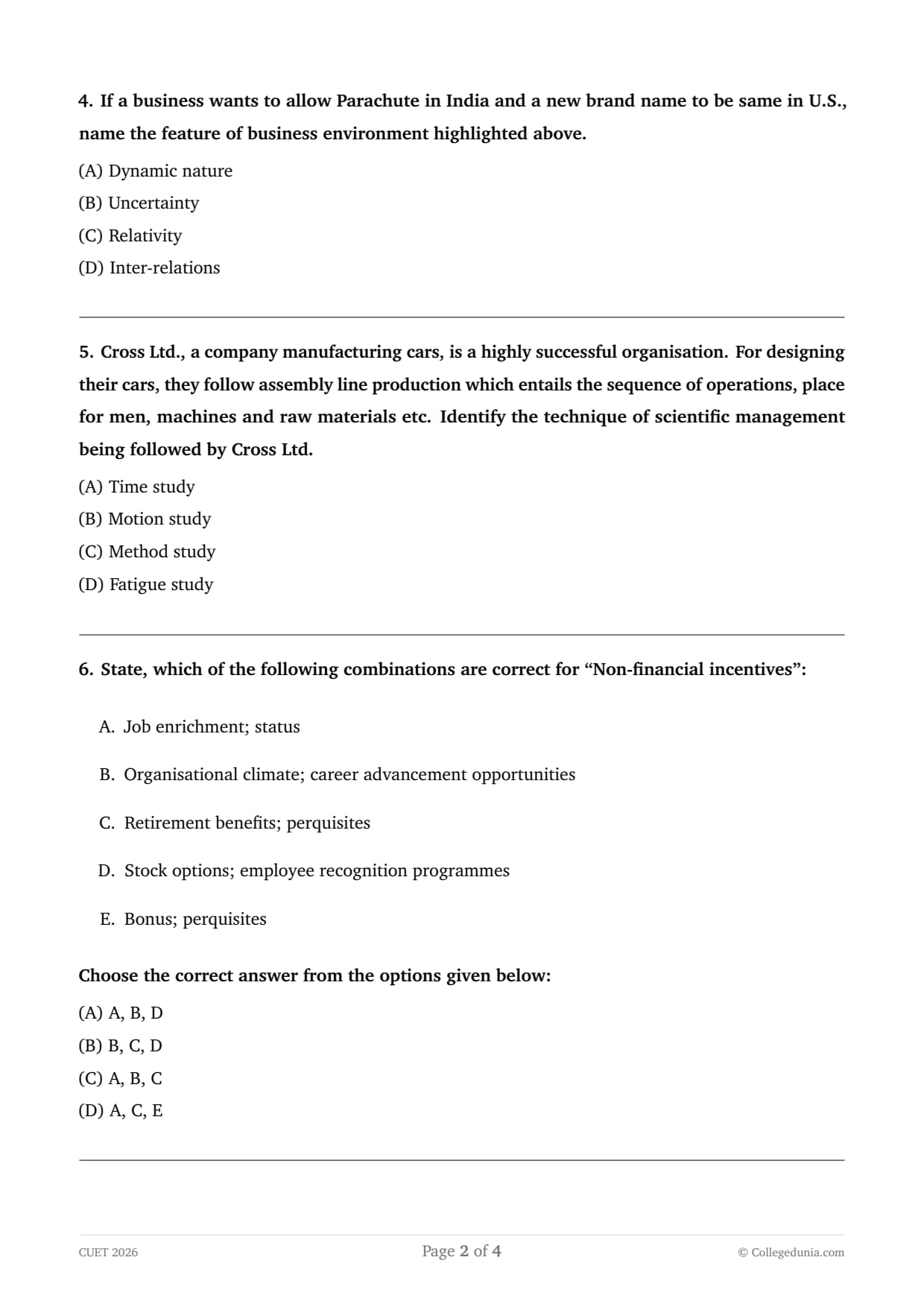
If a business wants to allow Parachute in India and a new brand name to be same in U.S., name the feature of business environment highlighted above.
View Solution
Concept:
The business environment differs from country to country and region to region. A practice, product, strategy, or business decision that is successful in one country may not necessarily succeed in another country because cultural, social, legal, economic, and consumer preferences vary across nations.
This characteristic of business environment is known as Relativity.
Step 1: Understanding the meaning of Relativity.
Relativity means that the business environment is not identical everywhere.
Consumer preferences vary across countries.
Government regulations differ from nation to nation.
Social values and cultural beliefs are different in different regions.
As a result, businesses must modify their products, branding, advertising, and strategies according to local conditions.
Step 2: Analyzing the given statement.
The question discusses the use of a brand name in India and the United States.
This indicates that:
A business strategy suitable in one country may not be suitable in another.
Brand acceptance depends upon local market conditions and consumer perception.
Therefore, the statement highlights differences in business environments across countries.
Step 3: Analyzing the options.
Option (A): Dynamic nature refers to continuous changes in the environment over time.
Option (B): Uncertainty means future business conditions cannot be predicted accurately.
Option (C): Relativity means business environments differ from place to place and country to country.
Option (D): Inter-relations refers to interconnectedness among environmental factors.
Thus, the most suitable option is relativity.
Step 4: Final conclusion.
The feature of business environment highlighted in the question is:
\[ \boxed{(C) Relativity} \] Quick Tip: Features of Business Environment: Totality of external forces Dynamic nature Relativity Complexity Uncertainty Inter-relatedness
Cross Ltd., a company manufacturing cars, is a highly successful organisation. For designing their cars, they follow assembly line production which entails the sequence of operations, place for men, machines and raw materials etc. Identify the technique of scientific management being followed by Cross Ltd.
View Solution
Concept:
Scientific Management was developed by Frederick Winslow Taylor with the objective of increasing efficiency and productivity in industrial operations.
Taylor introduced several techniques to improve production efficiency, including:
Time Study
Motion Study
Method Study
Fatigue Study
Among these techniques, Method Study focuses on identifying the best possible way of performing a job.
Step 1: Understanding Method Study.
Method Study refers to the systematic analysis of production processes to determine:
The best sequence of operations
Proper arrangement of machines
Proper placement of workers
Efficient handling of raw materials
Reduction of unnecessary activities
Its primary objective is to improve efficiency and minimize wastage of time, effort, and resources.
Step 2: Analyzing the situation given in the question.
The question states that Cross Ltd. follows assembly line production involving:
Sequence of operations
Place for men
Arrangement of machines
Handling of raw materials
All these activities are directly related to determining the best method of performing work.
Therefore, the company is applying Method Study.
Step 3: Why other options are incorrect.
Time Study: Determines the standard time required to perform a task.
Motion Study: Analyzes body movements involved in work to eliminate unnecessary motions.
Fatigue Study: Determines rest intervals to reduce worker fatigue.
Since the question focuses on arrangement and sequence of production activities, these options are not appropriate.
Step 4: Final conclusion.
The technique of scientific management used by Cross Ltd. is:
\[ \boxed{Method Study} \] Quick Tip: Method Study aims at: Finding the best method of doing work Improving workflow Reducing production cost Increasing efficiency It is widely used in assembly line production systems.
State, which of the following combinations are correct for ``Non-financial incentives'':
[A.] Job enrichment; status
[B.] Organisational climate; career advancement opportunities
[C.] Retirement benefits; perquisites
[D.] Stock options; employee recognition programmes
[E.] Bonus; perquisites
Choose the correct answer from the options given below:
View Solution
Concept:
Incentives are rewards provided to employees to improve their motivation, efficiency, morale, and productivity. Incentives can broadly be classified into:
Financial Incentives
Non-financial Incentives
Non-financial incentives are those rewards which do not involve direct monetary benefits but satisfy psychological, emotional, and social needs of employees.
These incentives help employees feel valued, respected, and motivated within the organisation.
Step 1: Analyzing Statement A.
Statement A includes:
Job enrichment
Status
Job enrichment means giving employees more responsibility, authority, and challenging tasks to increase job satisfaction.
Status refers to recognition, prestige, or importance given to employees within the organisation.
Both are examples of non-financial incentives because they provide psychological satisfaction rather than direct monetary gain.
Hence, statement A is correct.
Step 2: Analyzing Statement B.
Statement B includes:
Organisational climate
Career advancement opportunities
A positive organisational climate creates a supportive and comfortable working environment.
Career advancement opportunities motivate employees by offering growth, promotions, and better future prospects.
Both are non-financial incentives because they improve employee motivation without direct cash payments.
Hence, statement B is correct.
Step 3: Analyzing Statement C.
Statement C includes:
Retirement benefits
Perquisites
Retirement benefits and perquisites involve monetary or material benefits provided by the employer.
These are classified as financial incentives rather than non-financial incentives.
Hence, statement C is incorrect.
Step 4: Analyzing Statement D.
Statement D includes:
Stock options
Employee recognition programmes
Employee recognition programmes are definitely non-financial incentives because they provide appreciation and recognition.
In many academic business studies questions, stock options are considered long-term motivational incentives associated with employee involvement and recognition.
Thus, statement D is considered correct according to the given options.
Step 5: Analyzing Statement E.
Statement E includes:
Bonus
Perquisites
Both bonus and perquisites involve direct financial or material rewards.
Therefore, these are financial incentives.
Hence, statement E is incorrect.
Step 6: Selecting the correct option.
The correct combinations representing non-financial incentives are:
\[ A, B, D \]
Therefore, the correct answer is:
\[ \boxed{(A) A, B, D} \] Quick Tip: Examples of Non-financial Incentives: Recognition Job enrichment Status Employee participation Career advancement opportunities Organisational climate Examples of Financial Incentives: Bonus Commission Retirement benefits Perquisites
Yashaswi started a better manufacturing business. She has set objectives and developed premises. Now she must engage in the next step in the planning process. List the steps in planning process in correct sequence:
[A.] To check if plans are being implemented accordingly
[B.] To select an optimal alternative from the plan
[C.] Evaluating alternative courses of action
[D.] Identifying alternative courses of action
[E.] Select the best possible alternative
Rearrange consequences: Choose the correct answer from the options given below:
View Solution
Concept:
Planning is the primary function of management. It involves deciding in advance what is to be done, how it is to be done, when it is to be done, and by whom it is to be done.
Planning follows a systematic process consisting of several logical steps.
Step 1: Understanding the planning process.
The usual sequence in the planning process is:
Setting objectives
Developing premises
Identifying alternative courses of action
Evaluating alternative courses
Selecting the best alternative
Implementing the plan
Follow-up and monitoring
The question states that objectives and premises are already completed.
Step 2: Identifying alternative courses of action.
After establishing objectives and assumptions, managers identify different possible ways to achieve organizational goals.
This corresponds to:
\[ (D) Identifying alternative courses of action \]
Step 3: Evaluating alternatives.
Once alternatives are identified, each alternative is carefully evaluated on the basis of:
Cost
Risk
Feasibility
Benefits
Suitability
This corresponds to:
\[ (C) Evaluating alternative courses of action \]
Step 4: Selecting the best alternative.
After evaluation, management selects the most suitable and efficient alternative.
This corresponds to:
\[ (E) Select the best possible alternative \]
Step 5: Choosing the optimal plan and follow-up.
The selected plan is finalized and implemented.
After implementation, managers continuously check whether plans are working properly.
This corresponds to:
\[ (B) \rightarrow (A) \]
Step 6: Selecting the correct sequence.
Thus, the correct sequence becomes:
\[ C \rightarrow D \rightarrow E \rightarrow B \rightarrow A \]
Hence, the correct answer is:
\[ \boxed{(D) C, D, E, B, A} \] Quick Tip: Planning Process: Setting objectives Developing premises Identifying alternatives Evaluating alternatives Selecting the best plan Implementation Follow-up
`Off the job training methods are used away from the workplace and means learning before doing.' Find out the correct job methods from the following:
[A.] Films
[B.] Coaching
[C.] Case Study
[D.] Job Rotation
[E.] Vestibule Training
Choose the correct answer from the options given below:
View Solution
Concept:
Training is the process of improving the knowledge, skills, abilities, and efficiency of employees for performing jobs effectively.
Training methods are broadly classified into:
On-the-job training
Off-the-job training
Off-the-job training is conducted away from the actual workplace. Employees learn concepts, techniques, and methods before performing the real job.
Step 1: Understanding Off-the-job Training.
Off-the-job training takes place outside the actual work environment.
The main objective is to provide theoretical and practical learning without disturbing regular work operations.
Examples include:
Lectures
Films
Vestibule training
Case studies
Computer simulations
Step 2: Analyzing Statement A -- Films.
Films are used to demonstrate procedures, techniques, safety practices, and operational methods visually.
Employees learn through observation and understanding before performing the task practically.
Therefore, Films are an example of off-the-job training.
Hence, statement A is correct.
Step 3: Analyzing Statement B -- Coaching.
Coaching involves direct guidance provided by a superior or experienced employee during actual work.
The trainee learns while performing the job.
Therefore, Coaching is an on-the-job training method.
Hence, statement B is incorrect.
Step 4: Analyzing Statement C -- Case Study.
Case study method involves analyzing business situations and solving organizational problems in a classroom or training environment.
Employees improve decision-making and analytical skills.
Therefore, Case Study is an off-the-job training method.
Hence, statement C is correct.
Step 5: Analyzing Statement D -- Job Rotation.
Job rotation involves shifting employees from one department or job to another within the organization for practical exposure.
Since learning occurs during actual work performance, it is an on-the-job training method.
Hence, statement D is incorrect.
Step 6: Analyzing Statement E -- Vestibule Training.
Vestibule training is conducted in a separate training area equipped with machines similar to the real workplace.
Employees practice and learn before entering the actual production environment.
Therefore, Vestibule Training is an off-the-job training method.
Hence, statement E is correct.
Step 7: Selecting the correct option.
The correct off-the-job training methods are:
\[ A, C, E \]
Therefore, the correct answer is:
\[ \boxed{(A) A, C and E only} \] Quick Tip: Examples of Off-the-job Training: Vestibule training Case study Films and lectures Role playing Simulation exercises Examples of On-the-job Training: Coaching Internship Apprenticeship Job rotation
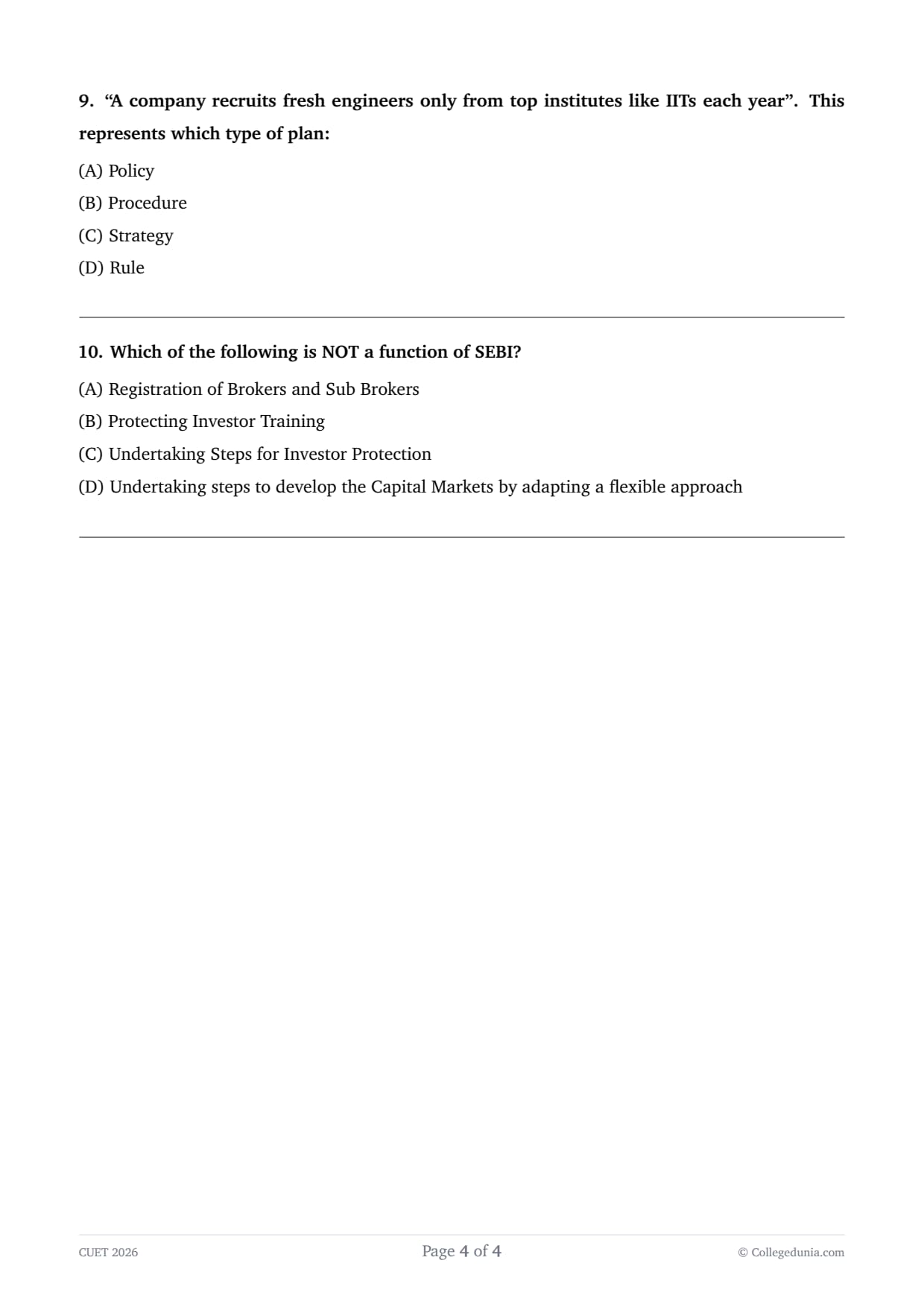
``A company recruits fresh engineers only from top institutes like IITs each year''. This represents which type of plan:
View Solution
Concept:
Plans are predetermined courses of action that guide organizational decisions and activities. Different types of plans are prepared according to organizational needs.
Major types of plans include:
Objectives
Policies
Procedures
Rules
Strategies
Programmes
Budgets
A policy provides broad guidelines for managerial decision-making.
Step 1: Understanding the meaning of Policy.
A policy is a general statement that guides managers and employees while making decisions.
Policies:
Provide direction
Maintain consistency in decisions
Help in achieving organizational objectives
Policies allow some flexibility while taking decisions.
Step 2: Analyzing the statement given in the question.
The company has decided to recruit engineers only from top institutes such as IITs.
This acts as a guideline for recruitment decisions followed every year.
It directs the HR department regarding:
Where recruitment should be conducted
Which institutes should be preferred
What recruitment standard should be maintained
Thus, it represents a recruitment policy.
Step 3: Why other options are incorrect.
Procedure: Specifies the exact sequence of steps to perform a task.
Strategy: Refers to long-term plans prepared to face competition or achieve major objectives.
Rule: A rule strictly specifies what must or must not be done without flexibility.
Since the statement provides a broad guideline rather than strict instructions or sequential steps, it is a policy.
Step 4: Final conclusion.
Therefore, the type of plan represented in the statement is:
\[ \boxed{Policy} \] Quick Tip: Difference between Policy and Rule: Policy provides flexibility and guidance. Rule provides strict instructions with no flexibility.
Which of the following is NOT a function of SEBI?
View Solution
Concept:
SEBI stands for Securities and Exchange Board of India. It is the regulatory authority established by the Government of India to regulate and supervise the securities market in India.
SEBI was established in 1988 and was given statutory powers in 1992 through the SEBI Act.
The main objectives of SEBI are:
Protection of investors
Development of securities market
Regulation of capital market intermediaries
SEBI plays a very important role in maintaining transparency, fairness, and efficiency in the capital market.
Step 1: Analyzing Option (A).
Option (A) states:
\[ Registration of Brokers and Sub Brokers \]
One of the major functions of SEBI is to regulate market intermediaries such as:
Brokers
Sub-brokers
Merchant bankers
Portfolio managers
Underwriters
SEBI grants registration and ensures that these intermediaries follow proper rules and ethical practices.
Therefore, option (A) is a correct function of SEBI.
Step 2: Analyzing Option (B).
Option (B) states:
\[ Protecting Investor Training \]
This statement is incorrect and improperly framed.
SEBI conducts:
Investor education
Investor awareness programmes
Investor protection measures
However, the phrase ``Protecting Investor Training'' is not recognized as a formal or valid function of SEBI.
Thus, this option does not correctly represent any actual SEBI function.
Hence, option (B) is NOT a function of SEBI.
Step 3: Analyzing Option (C).
Option (C) states:
\[ Undertaking Steps for Investor Protection \]
Investor protection is one of the primary objectives of SEBI.
SEBI protects investors by:
Preventing fraudulent practices
Ensuring fair trading
Maintaining transparency
Regulating insider trading
Therefore, option (C) correctly represents a function of SEBI.
Step 4: Analyzing Option (D).
Option (D) states:
\[ Undertaking steps to develop the Capital Markets by adapting a flexible approach \]
SEBI is responsible for the development and regulation of the capital market.
It continuously introduces reforms and flexible policies to improve:
Market efficiency
Transparency
Investor confidence
Technological advancement
Thus, option (D) is also a valid function of SEBI.
Step 5: Final conclusion.
Among all the given options, the statement that does NOT correctly represent a function of SEBI is:
\[ \boxed{(B) Protecting Investor Training} \] Quick Tip: Main Functions of SEBI: Regulates stock exchanges Protects investor interests Prevents unfair trade practices Registers intermediaries Develops the securities market SEBI Motto: \[ ``Protect the interests of investors and regulate the securities market.'' \]
CUET UG 2026 Exam Pattern
| Parameter | Details |
|---|---|
| Exam Name | Common University Entrance Test (CUET UG) 2026 |
| Conducting Body | National Testing Agency (NTA) |
| Exam Mode | Computer-Based Test (CBT) |
| Exam Duration | 60 minutes per test |
| Total Sections | 3 (Languages, Domain Subjects, General Test) |
| Question Type | Multiple Choice Questions (MCQs) |
| Questions per Test | 50 questions (all compulsory) |
| Marking Scheme | +5 for correct, -1 for incorrect |
| Maximum Marks | 250 marks per test |
| Maximum Subject Choices | 5 subjects in total |
| Syllabus Base | Class 12 NCERT (mainly for Domain Subjects) |





Comments