CUET 2026 May 24 Shift 1 Accountancy Question Paper is available for download here. NTA is conducting the CUET 2026 exam from 11th May to 31st May.

  • CUET 2026 Accountancy exam consists of 50 questions for 250 marks to be attempted in 60 minutes.
  • As per the marking scheme, 5 marks are awarded for each correct answer, and 1 mark is deducted for incorrect answer.

Candidates can download CUET 2026 May 24 Shift 1 Accountancy Question Paper with Answer Key and Solution PDF from links provided below.

Related Links:

CUET 2026 Accountancy May 24 Shift 1 Question Paper with Solution PDF

CUET May 24 Shift 1 Accountancy Question Paper 2026 Download PDF Check Solutions

Question 1:

A firm earned Rs 60,000 as profit, normal rate of return being 10%. Assets of the firm are Rs 7,20,000 (excluding goodwill) and Liabilities are Rs 2,40,000. Find the value of Goodwill by Capitalisation of Average Profit Method.

  • (A) Rs 2,40,000
  • (B) Rs 1,80,000
  • (C) Rs 1,20,000
  • (D) Rs 60,000
Correct Answer: (C) Rs 1,20,000
View Solution


Step 1: Understanding the Question:

The question asks us to compute the value of goodwill of a firm using the Capitalisation of Average Profit Method.

We are given the actual profit (average profit) of the firm, the normal rate of return, total assets (excluding goodwill), and external liabilities.


Step 2: Key Formula or Approach:

The formulas required for the Capitalisation of Average Profit Method are:
\[ Capitalised Value of Average Profit = \frac{Average Profit}{Normal Rate of Return} \times 100 \]
\[ Capital Employed (Net Assets) = Total Assets - External Liabilities \]
\[ Goodwill = Capitalised Value of Average Profit - Capital Employed \]


Step 3: Detailed Explanation:


Calculate Capitalised Value of Average Profit:

The average profit earned by the firm is Rs 60,000.

The normal rate of return in this line of business is 10%.

Using the formula:

\[ Capitalised Value = \frac{60,000}{10} \times 100 = Rs 6,00,000 \]

This represents the amount of capital needed to earn a profit of Rs 60,000 at the normal rate of return.


Calculate Capital Employed (Net Assets):

The actual capital employed is calculated by subtracting external liabilities from total assets (excluding goodwill).

Given Assets = Rs 7,20,000 and Liabilities = Rs 2,40,000.

Using the formula:

\[ Capital Employed = 7,20,000 - 2,40,000 = Rs 4,80,000 \]


Calculate Value of Goodwill:

Goodwill is the excess of the capitalised value of average profits over the actual capital employed.

Using the formula:

\[ Goodwill = 6,00,000 - 4,80,000 = Rs 1,20,000 \]


Analysis of Options:

Option (A) Rs 2,40,000 is incorrect as it represents the liability value.

Option (B) Rs 1,80,000 is incorrect due to calculation error.

Option (C) Rs 1,20,000 is the correct valuation.

Option (D) Rs 60,000 is incorrect as it equals the annual profit.


Step 4: Final Answer:

The value of goodwill calculated using the Capitalisation of Average Profit Method is Rs 1,20,000, which corresponds to Option (C).
Quick Tip: Under the capitalisation of average profit method, if the capitalised value of the average profits is less than or equal to the actual capital employed, the firm does not possess any goodwill (goodwill is zero).
Always make sure to exclude existing goodwill, fictitious assets, and non-trade investments from total assets while calculating Capital Employed.


Question 2:

Money received in advance from shareholders before it is actually called-up by the directors is

  • (A) Debited to Calls in Advance Account.
  • (B) Credited to Calls-in-Advance Account.
  • (C) Debited to Share Capital Account.
  • (D) Credited to Share Capital Account.
Correct Answer: (B) Credited to Calls-in-Advance Account.
View Solution


Step 1: Understanding the Question:

This question concerns the accounting treatment of share money received in advance from shareholders before a formal call is made by the directors of a company.


Step 2: Key Formula or Approach:

The entry for receiving any money in advance is to debit the liquid asset (Bank) and credit a liability/suspense account representing the advance.


Step 3: Detailed Explanation:


Concept of Calls-in-Advance:

Sometimes shareholders pay a part or whole of the amount remaining unpaid on their shares even before the company calls for it.

This advance money is not yet part of the share capital because the call has not been formally made.

Hence, it cannot be credited directly to the Share Capital Account.


Journal Entry:

When the company receives this advance money, the following journal entry is recorded in the books of the company:

\[ Bank A/c \quad Dr. \]

\[ \quad To Calls-in-Advance A/c \]

This entry clearly shows that the Calls-in-Advance Account is credited.


Balance Sheet Presentation and Legal Guidelines:

Calls-in-Advance is a liability of the company towards its shareholders until the actual call is made.

In the balance sheet, it is shown as a separate item under the head "Current Liabilities" and sub-head "Other Current Liabilities".

According to Table F of Schedule I of the Companies Act, 2013, the company is authorized to pay interest on calls-in-advance at a rate not exceeding 12% per annum.


Analysis of Incorrect Options:

Option (A) is incorrect because debiting Calls-in-Advance would decrease a liability, which is wrong when receiving funds.

Options (C) and (D) are incorrect because the money cannot be adjusted or transferred to the Share Capital Account until the actual call is formally made and due.


Step 4: Final Answer:

The amount received as advance is credited to the Calls-in-Advance Account, which is a liability account, making Option (B) the correct answer.
Quick Tip: Remember the dual aspects of Calls-in-Advance:
1. It is credited when received: Bank A/c Dr. To Calls-in-Advance A/c.
2. It is debited when the actual call becomes due to adjust the advance: Calls-in-Advance A/c Dr. To Share Call A/c.
Also, remember that the maximum interest rate on Calls-in-Advance is 12% p.a. while on Calls-in-Arrears it is 10% p.a. as per Table F.


Question 3:

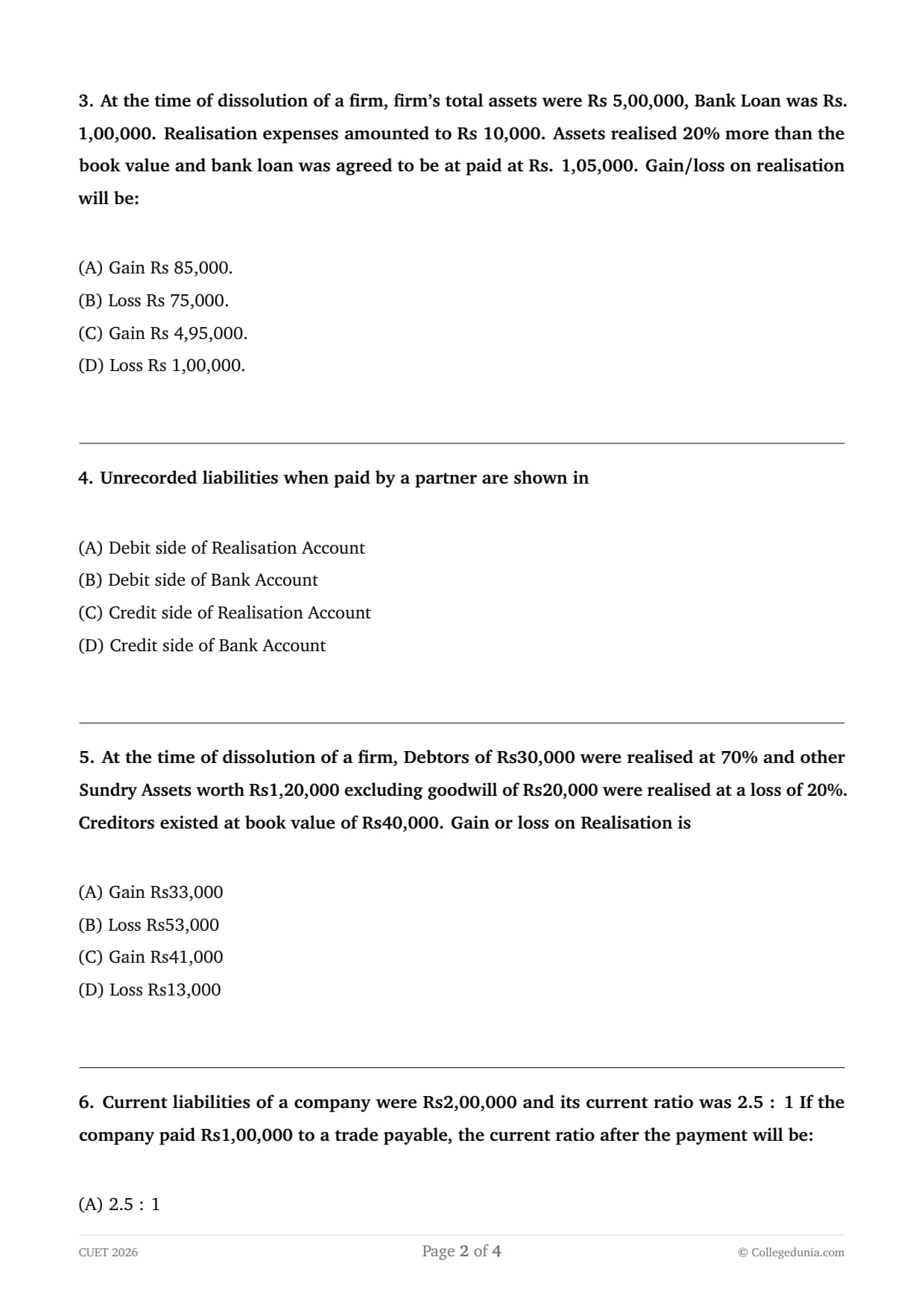
At the time of dissolution of a firm, firm's total assets were Rs 5,00,000, Bank Loan was Rs. 1,00,000. Realisation expenses amounted to Rs 10,000. Assets realised 20% more than the book value and bank loan was agreed to be at paid at Rs. 1,05,000. Gain/loss on realisation will be:

  • (A) Gain Rs 85,000.
  • (B) Loss Rs 75,000.
  • (C) Gain Rs 4,95,000.
  • (D) Loss Rs 1,00,000.
Correct Answer: (A) Gain Rs 85,000.
View Solution


Step 1: Understanding the Question:

The question asks us to compute the net gain or loss on the realisation of assets and settlement of liabilities during the dissolution of a partnership firm.


Step 2: Key Formula or Approach:

We can compute the gain or loss by preparing a nominal account called the Realisation Account.

The net gain or loss is the difference between total credits (inflows from asset sales and liability transfers) and total debits (book value of assets and cash outflows for expenses and liability payments).


Step 3: Detailed Explanation:


Transfer of Assets and Liabilities to Realisation Account:

Assets (Book Value) transferred to Debit Side = Rs 5,00,000.

Bank Loan (Book Value) transferred to Credit Side = Rs 1,00,000.


Realisation of Assets:

Assets realised at 20% more than the book value.

\[ Realised Value = 5,00,000 + (20% of 5,00,000) \]

\[ Realised Value = 5,00,000 + 1,00,000 = Rs 6,00,000 \]

This amount is credited to the Realisation Account.


Payment of Liabilities and Expenses:

Bank Loan was agreed to be paid at Rs 1,05,000. This is debited to the Realisation Account.

Realisation expenses paid amounted to Rs 10,000. This is also debited to the Realisation Account.


Realisation Account Summary:

Let us total the Debit side and Credit side:

Debit Side (Expenses and payments):

1. Transfer of Assets: Rs 5,00,000

2. Bank Loan payment: Rs 1,05,000

3. Realisation Expenses: Rs 10,000

\[ Total Debit = 5,00,000 + 1,05,000 + 10,000 = Rs 6,15,000 \]


Credit Side (Receipts and transfers):

1. Transfer of Bank Loan liability: Rs 1,00,000

2. Asset realisation: Rs 6,00,000

\[ Total Credit = 1,00,000 + 6,00,000 = Rs 7,00,000 \]


Calculation of Net Gain/Loss:

Since Credit Total is greater than Debit Total, there is a Gain.

\[ Gain on Realisation = Total Credit - Total Debit \]

\[ Gain on Realisation = 7,00,000 - 6,15,000 = Rs 85,000 \]


Step 4: Final Answer:

The net gain on realisation is Rs 85,000, which matches Option (A).
Quick Tip: A quick shortcut formula to find Gain/Loss on Realisation:
\[ Gain/Loss \] \[= (Actual Asset Realised - Asset Book Value) - (Actual Liability Paid - Liability Book Value) - Expenses \]
Applying the values:
\[ (6,00,000 - 5,00,000) - (1,05,000 - 1,00,000) - 10,000 \]
\[ = 1,00,000 - 5,00,000 - 10,000 = 85,000 (Gain) \]
This approach saves valuable time in the exam!


Question 4:

Unrecorded liabilities when paid by a partner are shown in

  • (A) Debit side of Realisation Account
  • (B) Debit side of Bank Account
  • (C) Credit side of Realisation Account
  • (D) Credit side of Bank Account
Correct Answer: (A) Debit side of Realisation Account
View Solution


Step 1: Understanding the Question:

The question asks where the payment of unrecorded liabilities by a partner is recorded during the dissolution process of a partnership firm.


Step 2: Key Formula or Approach:

We need to determine the journal entry passed when an unrecorded liability is discharged by a partner and check how this affects the ledger accounts.


Step 3: Detailed Explanation:


Concept of Unrecorded Liabilities:

Unrecorded liabilities are those obligations of the firm that were not recorded in the balance sheet prior to the date of dissolution.

On dissolution, all liabilities (whether recorded or unrecorded) must be paid off.


Journal Entry for Payment by Partner:

When a partner agrees to pay off an unrecorded liability, the firm's liability to the outsider is settled, but the firm now owes that amount to the partner.

Thus, the partner's capital account must be credited.

The nominal account for dissolution, i.e., Realisation Account, must be debited to record the expense/settlement.

The journal entry is:

\[ Realisation A/c \quad Dr. \]

\[ \quad To Partner's Capital A/c \]


Ledger Posting:

This entry shows that the transaction is posted to the Debit side of the Realisation Account and to the Credit side of the Partner's Capital Account.


Analysis of Incorrect Options:

Option (B) and Option (D) are incorrect because the bank account is not affected since the payment is made by the partner personally, and no cash outflow occurs from the firm's bank account.

Option (C) is incorrect because the credit side of the Realisation account is used to record the transfer of recorded liabilities and the receipts from the realisation of assets.


Step 4: Final Answer:

The payment of an unrecorded liability by a partner is debited to the Realisation Account, which corresponds to Option (A).
Quick Tip: Remember the general rule for liability payment on dissolution:
Any payment made for a liability (whether recorded or unrecorded) is always debited to the Realisation Account.
If paid in cash: To Bank A/c.
If settled by a partner: To Partner's Capital A/c.
Since it is a debit to Realisation Account, it will always appear on the debit side of the Realisation Account.


Question 5:

At the time of dissolution of a firm, Debtors of Rs30,000 were realised at 70% and other Sundry Assets worth Rs1,20,000 excluding goodwill of Rs20,000 were realised at a loss of 20%. Creditors existed at book value of Rs40,000. Gain or loss on Realisation is

  • (A) Gain Rs33,000
  • (B) Loss Rs53,000
  • (C) Gain Rs41,000
  • (D) Loss Rs13,000
Correct Answer: (B) Loss Rs53,000
View Solution


Step 1: Understanding the Question:

We are required to find the net gain or loss on the Realisation Account during the dissolution of a partnership firm.

We have information about the book values and realised values of debtors, sundry assets, goodwill, and creditors.


Step 2: Key Formula or Approach:

The net gain or loss is determined by calculating the difference between total debits (book value of all assets transferred + payments made) and total credits (book value of liabilities transferred + asset realisation receipts) in the Realisation Account.


Step 3: Detailed Explanation:


Determine Book Values of Assets Transferred (Debit Side):

1. Debtors = Rs 30,000

2. Other Sundry Assets (excluding goodwill) = Rs 1,20,000

3. Goodwill = Rs 20,000 (goodwill is also a recorded asset and is transferred to the Realisation Account)

\[ Total Assets Transferred = 30,000 + 1,20,000 + 20,000 = Rs 1,70,000 \]


Determine Book Value of Liabilities Transferred (Credit Side):

1. Creditors = Rs 40,000


Determine Realised Values of Assets (Credit Side):

1. Debtors realised at 70%:

\[ 30,000 \times 70% = Rs 21,000 \]

2. Sundry Assets realised at a loss of 20% (i.e., at 80% of book value):

\[ 1,20,000 \times 80% = Rs 96,000 \]

3. Goodwill: No information is given about the realisation of goodwill. On dissolution, if no information is given about the realisation of an intangible asset like goodwill, it is assumed to have realised nil value.

\[ Total Cash Realised from Assets = 21,000 + 96,000 = Rs 1,17,000 \]


Determine Payments for Liabilities (Debit Side):

Creditors are paid at book value since no other agreement is mentioned:

\[ Payment to Creditors = Rs 40,000 \]


Calculate Total Debits and Credits:

\[ Total Debit Side = Book Value of Assets + Payment of Creditors \]

\[ Total Debit Side = 1,70,000 + 40,000 = Rs 2,10,000 \]

\[ Total Credit Side = Book Value of Creditors + Realised Value of Assets \]

\[ Total Credit Side = 40,000 + 1,17,000 = Rs 1,57,000 \]


Find Net Gain/Loss:

Since Debit exceeds Credit, there is a loss:

\[ Loss on Realisation = 2,10,000 - 1,57,000 = Rs 53,000 \]


Step 4: Final Answer:

The net loss on realisation is Rs 53,000, which corresponds to Option (B).
Quick Tip: Remember:
1. Intangible assets like Goodwill, Patents, etc., if not mentioned to be realised, are assumed to have realized zero value.
2. Tangible assets, if not mentioned, are also assumed to realize zero value.
3. Liabilities, if silent, must always be paid off completely at 100% of their book value.
Calculating only the net differences of transactions:
Debtors loss = \(30% of 30,000 = 9,000 loss\)
Sundry Assets loss = \(20% of 1,20,000 = 24,000 loss\)
Goodwill loss = \(100% of 20,000 = 20,000 loss\)
Total Loss = \(9,000 + 24,000 + 20,000 = 53,000\)
This short calculation is very reliable when there are no changes in liability settlement values!


Question 6:

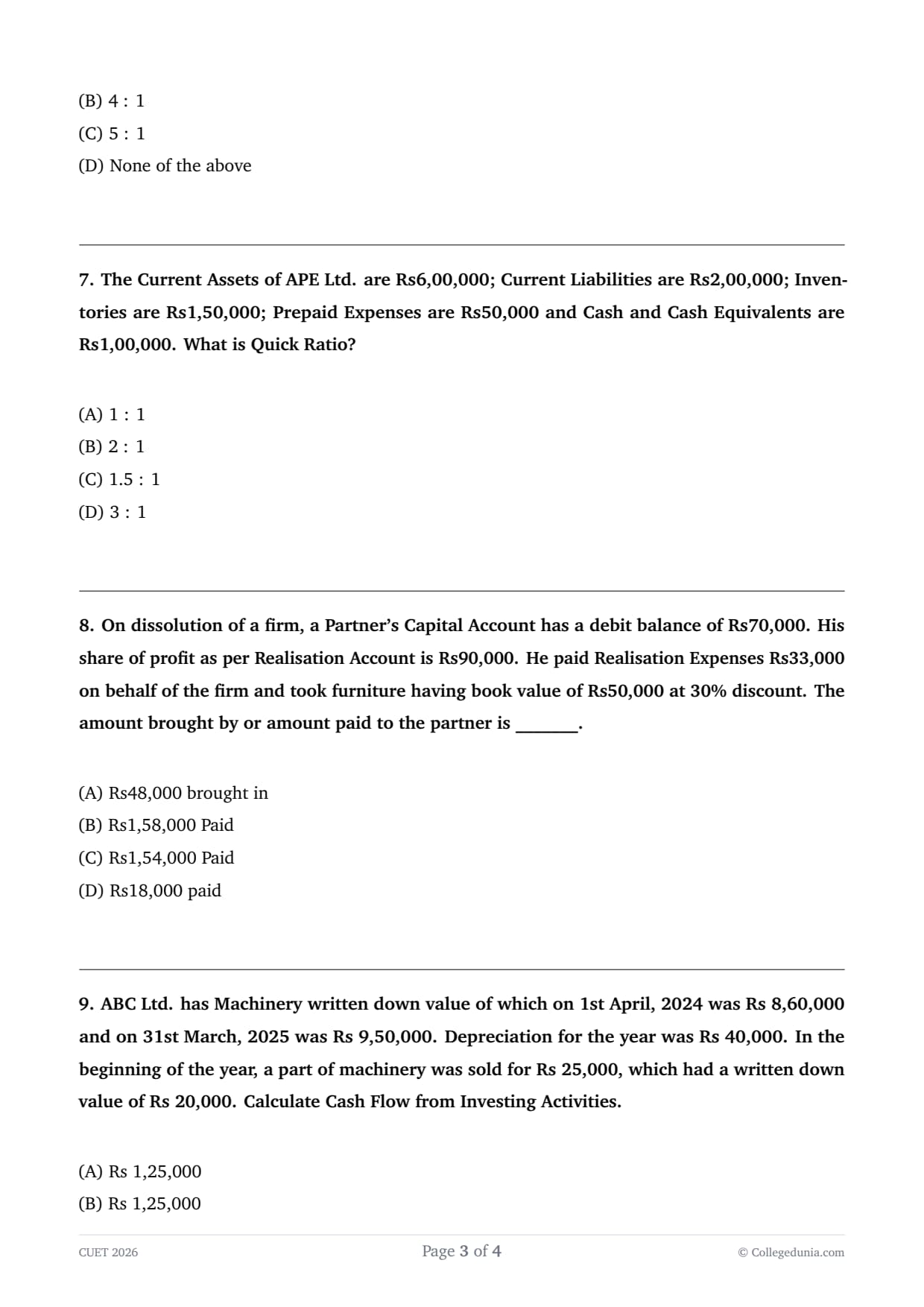
Current liabilities of a company were Rs2,00,000 and its current ratio was 2.5 : 1 If the company paid Rs1,00,000 to a trade payable, the current ratio after the payment will be:

  • (A) 2.5 : 1
  • (B) 4 : 1
  • (C) 5 : 1
  • (D) None of the above
Correct Answer: (B) 4 : 1
View Solution


Step 1: Understanding the Question:

The question asks us to calculate the new current ratio of a company after it pays Rs1,00,000 to one of its trade payables (a current liability).


Step 2: Key Formula or Approach:

The standard formula for Current Ratio is:
\[ Current Ratio = \frac{Current Assets}{Current Liabilities} \]


Step 3: Detailed Explanation:


Calculate Initial Current Assets:

We are given:

Current Liabilities = Rs 2,00,000

Current Ratio = 2.5 : 1

Using the ratio formula:

\[ 2.5 = \frac{Current Assets}{2,00,000} \]

\[ Current Assets = 2.5 \times 2,00,000 = Rs 5,00,000 \]


Effect of Payment to Trade Payable:

The company paid Rs 1,00,000 to a trade payable.

This payment is made in cash/bank, which is a Current Asset. Therefore, Current Assets will decrease by Rs 1,00,000.

Trade Payable is a Current Liability. Therefore, Current Liabilities will also decrease by Rs 1,00,000.


Calculate New Current Assets and Current Liabilities:

\[ New Current Assets = 5,00,000 - 1,00,000 = Rs 4,00,000 \]

\[ New Current Liabilities = 2,00,000 - 1,00,000 = Rs 1,00,000 \]


Calculate New Current Ratio:

\[ New Current Ratio = \frac{New Current Assets}{New Current Liabilities} = \frac{4,00,000}{1,00,000} = 4 \]

Thus, the new ratio is 4 : 1.


Step 4: Final Answer:

The new current ratio after payment of trade payables is 4 : 1, which corresponds to Option (B).
Quick Tip: Conceptual Rule:
If the current ratio is greater than 1 : 1, payment of a current liability in cash will always increase the current ratio because the percentage decrease in current liabilities is higher than the percentage decrease in current assets.
If the current ratio is less than 1 : 1, payment of a current liability will decrease the ratio.
If it is equal to 1 : 1, payment will leave the ratio unchanged.


Question 7:

The Current Assets of APE Ltd. are Rs6,00,000; Current Liabilities are Rs2,00,000; Inventories are Rs1,50,000; Prepaid Expenses are Rs50,000 and Cash and Cash Equivalents are Rs1,00,000. What is Quick Ratio?

  • (A) 1 : 1
  • (B) 2 : 1
  • (C) 1.5 : 1
  • (D) 3 : 1
Correct Answer: (B) 2 : 1
View Solution


Step 1: Understanding the Question:

The question asks for the Quick Ratio (also known as the Acid-Test Ratio or Liquid Ratio) of APE Ltd. based on the given financial data.


Step 2: Key Formula or Approach:

The formulas needed to calculate the Quick Ratio are:
\[ Quick Ratio = \frac{Quick Assets}{Current Liabilities} \]
\[ Quick Assets = Current Assets - Inventories - Prepaid Expenses \]


Step 3: Detailed Explanation:


Identify Given Values:

Current Assets = Rs 6,00,000

Current Liabilities = Rs 2,00,000

Inventories = Rs 1,50,000

Prepaid Expenses = Rs 50,000

Cash and Cash Equivalents = Rs 1,00,000 (Note: This is already a part of Current Assets and is a liquid asset. We do not need to add it separately).


Calculate Quick Assets:

Quick assets represent those current assets that can be converted into cash almost immediately.

Inventories are excluded because they take time to sell.

Prepaid expenses are excluded because they cannot be converted into cash at all.

Using the formula:

\[ Quick Assets = 6,00,000 - 1,50,000 - 50,000 \]

\[ Quick Assets = 6,00,000 - 2,00,000 = Rs 4,00,000 \]


Calculate Quick Ratio:

Using the ratio formula:

\[ Quick Ratio = \frac{4,00,000}{2,00,000} = 2 \]

Thus, the ratio is 2 : 1.


Step 4: Final Answer:

The Quick Ratio of APE Ltd. is 2 : 1, which corresponds to Option (B).
Quick Tip: An ideal Quick Ratio is considered to be 1 : 1.
Do not get confused by extra information like Cash and Cash Equivalents in this question; since it is already a component of Current Assets, adding it again would lead to double counting.
Always subtract Inventories and Prepaid Expenses directly from the total Current Assets to find Quick Assets.


Question 8:

On dissolution of a firm, a Partner's Capital Account has a debit balance of Rs70,000. His share of profit as per Realisation Account is Rs90,000. He paid Realisation Expenses Rs33,000 on behalf of the firm and took furniture having book value of Rs50,000 at 30% discount. The amount brought by or amount paid to the partner is _______.

  • (A) Rs48,000 brought in
  • (B) Rs1,58,000 Paid
  • (C) Rs1,54,000 Paid
  • (D) Rs18,000 paid
Correct Answer: (D) Rs18,000 paid
View Solution


Step 1: Understanding the Question:

The question asks us to find the final settlement amount of a partner's capital account upon the dissolution of a partnership firm, considering various debit and credit adjustments.


Step 2: Key Formula or Approach:

We need to determine the final balance of the Partner's Capital Account by compiling all the debit and credit items:
\[ Closing Balance = Credits - Debits \]

If the net balance is credit (positive), the firm pays the partner. If it is debit (negative), the partner must bring cash into the firm.


Step 3: Detailed Explanation:


Identify Capital Account Adjustments:

1. Opening Balance: Debit balance of Rs 70,000. (This is a debit entry).

2. Share of Realisation Profit: Rs 90,000. (This is a credit entry because profits increase partner's capital).

3. Realisation Expenses paid by partner: Rs 33,000. Since he paid on behalf of the firm, the firm owes him this money, which increases his capital. (This is a credit entry).

4. Asset (Furniture) taken over:

Book value of furniture = Rs 50,000.

Taken over at 30% discount.

\[ Value of furniture taken over = 50,000 - (30% of 50,000) \]

\[ Value of furniture taken over = 50,000 - 15,000 = Rs 35,000 \]

This is debited to the partner's capital account because he is taking an asset from the firm.


Prepare Capital Account Summary:

Total Credits:

- Share of profit: Rs 90,000

- Expenses paid on behalf of firm: Rs 33,000

\[ Total Credits = 90,000 + 33,000 = Rs 1,23,000 \]


Total Debits:

- Opening Debit Balance: Rs 70,000

- Furniture taken over: Rs 35,000

\[ Total Debits = 70,000 + 35,000 = Rs 1,05,000 \]


Calculate Final Settlement Amount:

\[ Net Balance = Total Credits - Total Debits \]

\[ Net Balance = 1,23,000 - 1,05,000 = Rs 18,000 (Credit Balance) \]

Since there is a positive credit balance of Rs 18,000, this amount must be paid to the partner to close his account.


Step 4: Final Answer:

The amount paid to the partner is Rs 18,000, which corresponds to Option (D).
Quick Tip: While solving capital account adjustments, simply treat credit items as plus \((+)\) and debit items as minus \((-)\):
\[ Balance =\] \[ - 70,000 (Opening Dr) + 90,000 (Profit Cr) + 33,000 (Expenses Cr) - 35,000 (Asset taken over Dr) \]
\[ Balance = + 18,000 \]
Since the sign is positive, it represents a Credit Balance, meaning the amount is "Paid to the partner".


Question 9:

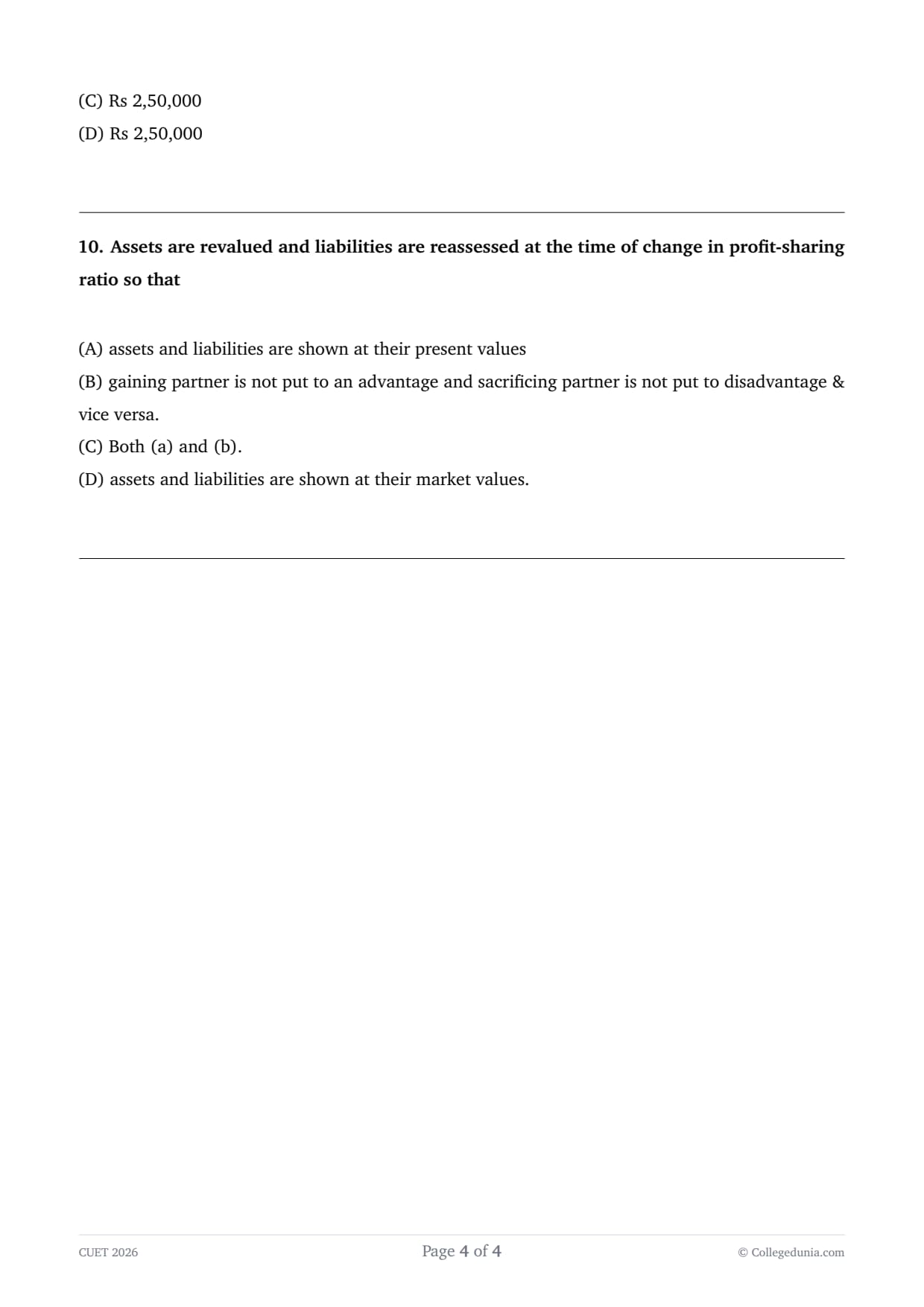
ABC Ltd. has Machinery written down value of which on 1st April, 2024 was Rs 8,60,000 and on 31st March, 2025 was Rs 9,50,000. Depreciation for the year was Rs 40,000. In the beginning of the year, a part of machinery was sold for Rs 25,000, which had a written down value of Rs 20,000. Calculate Cash Flow from Investing Activities.

  • (A) Rs 1,25,000
  • (B) Rs 1,25,000
  • (C) Rs 2,50,000
  • (D) Rs 2,50,000
Correct Answer: (B) Rs 1,25,000
View Solution


Step 1: Understanding the Question:

The question asks us to find the Net Cash Flow from Investing Activities. This requires us to analyze the purchases and sales of machinery during the financial year using a Machinery Account ledger.


Step 2: Key Formula or Approach:

We will construct the Machinery Account (at Written Down Value) to find the missing figure, which represents the purchase of new machinery during the year.


Step 3: Detailed Explanation:


Analyze the Transactions and WDV changes:

Opening Balance (1st April, 2024) = Rs 8,60,000

Closing Balance (31st March, 2025) = Rs 9,50,000

Depreciation during the year = Rs 40,000

Sale of Machinery = Rs 25,000 (having WDV of Rs 20,000)

Gain on Sale of Machinery = Sale Value - WDV = \( 25,000 - 20,000 = Rs 5,000 \).


Construct Machinery Account (to find Purchase of Machinery):

Let's draft the ledger entries:

Debit Side:

- To Balance b/d (Opening): Rs 8,60,000

- To Gain on Sale of Machinery: Rs 5,000

- To Bank A/c (Purchase - Balancing Figure)


Credit Side:

- By Depreciation A/c: Rs 40,000

- By Bank A/c (Sale of machinery): Rs 25,000

- By Balance c/d (Closing): Rs 9,50,000


Calculate the Balancing Figure (Purchase of Machinery):

\[ Total Credit Side = 40,000 + 25,000 + 9,50,000 = Rs 10,15,000 \]

\[ Total Debit Side (excluding purchases) = 8,60,000 + 5,000 = Rs 8,65,000 \]

\[ Purchase of Machinery (Balancing Figure) = 10,15,000 - 8,65,000 = Rs 1,50,000 \]

Since this is a purchase, it represents a cash outflow of Rs 1,50,000.


Calculate Cash Flow from Investing Activities:

\[ Inflow from Sale of Machinery = + Rs 25,000 \]

\[ Outflow for Purchase of Machinery = - Rs 1,50,000 \]

\[ Net Cash Flow from Investing Activities = 25,000 - 1,50,000 = - Rs 1,25,000 \]

An outflow is represented inside brackets as Rs (1,25,000).


Step 4: Final Answer:

The net cash flow from investing activities is an outflow of Rs 1,25,000, represented as Rs (1,25,000), which corresponds to Option (B).
Quick Tip: To quickly find purchases of any asset at WDV:
\[ Purchases = Closing WDV + Depreciation + WDV of Asset Sold - Opening WDV \]
Applying the formula:
\[ Purchases = 9,50,000 + 40,000 + 20,000 - 8,60,000 = 1,50,000 \]
Net Cash Flow from Investing = \(Sale Price - Purchase Price = 25,000 - 1,50,000 = (1,25,000)\).
This avoids having to draw out the full ledger account during the exam!


Question 10:

Assets are revalued and liabilities are reassessed at the time of change in profit-sharing ratio so that

  • (A) assets and liabilities are shown at their present values
  • (B) gaining partner is not put to an advantage and sacrificing partner is not put to disadvantage \& vice versa.
  • (C) Both (a) and (b).
  • (D) assets and liabilities are shown at their market values.
Correct Answer: (C) Both (a) and (b).
View Solution


Step 1: Understanding the Question:

The question asks for the underlying reasons and objectives behind revaluing assets and reassessing liabilities during a change in the profit-sharing ratio among existing partners.


Step 2: Detailed Explanation:


Concept of Reconstitution of Firm:

A change in the profit-sharing ratio represents a reconstitution of the partnership firm.

The old partnership agreement comes to an end, and a new agreement comes into force.


Avoiding Unfair Advantage or Disadvantage (Option B):

Over time, the value of assets might have appreciated or depreciated, and the value of liabilities might have changed.

Any gain or loss arising from these changes belongs to the partners in their old profit-sharing ratio because it accumulated during the period prior to the change.

If the assets and liabilities are not revalued, the gaining partner would get an unfair share of these past gains in the future, while the sacrificing partner would be unfairly disadvantaged.

Thus, revaluation prevents any unfair advantage or disadvantage.


Updating to Present Values (Option A):

Revaluation ensures that the assets and liabilities are updated and recorded at their current revised/present values in the books of the reconstituted firm.

This gives a true and fair view of the financial position of the firm under the new agreement.


Conclusion:

Since both statements (a) and (b) represent key and valid objectives of the revaluation process, Option (C) is the most comprehensive and correct choice.


Step 3: Final Answer:

The correct option is (C) as it correctly includes both (a) and (b).
Quick Tip: Whenever there is any change in the constitution of a firm (admission, retirement, death, or change in profit-sharing ratio), a Revaluation Account is prepared.
All old accumulated profits, losses, and revaluation balances must be shared in the \textbf{Old Profit-Sharing Ratio} to ensure equity among partners.

CUET UG 2026 Exam Pattern

Parameter Details
Exam Name Common University Entrance Test (CUET UG) 2026
Conducting Body National Testing Agency (NTA)
Exam Mode Computer-Based Test (CBT)
Exam Duration 60 minutes per test
Total Sections 3 (Languages, Domain Subjects, General Test)
Question Type Multiple Choice Questions (MCQs)
Questions per Test 50 questions (all compulsory)
Marking Scheme +5 for correct, -1 for incorrect
Maximum Marks 250 marks per test
Maximum Subject Choices 5 subjects in total
Syllabus Base Class 12 NCERT (mainly for Domain Subjects)

CUET UG 2026 Paper Analysis