CUET 2026 May 23 Shift 1 Political Science Question Paper is available for download here. NTA conducted the CUET 2026 exam from 11th May to 31st May.
- CUET 2026 Political Science exam consists of 50 questions for 250 marks to be attempted in 60 minutes.
- As per the marking scheme, 5 marks are awarded for each correct answer, and 1 mark is deducted for incorrect answer.
Candidates can download CUET 2026 May 23 Shift 1 Political Science Question Paper with Answer Key and Solution PDF from links provided below.
Related Links:
CUET 2026 Political Science May 23 Shift 1 Question Paper with Solution PDF
| CUET May 23 Shift 1 Political Science Question Paper 2026 | Download PDF | Check Solutions |
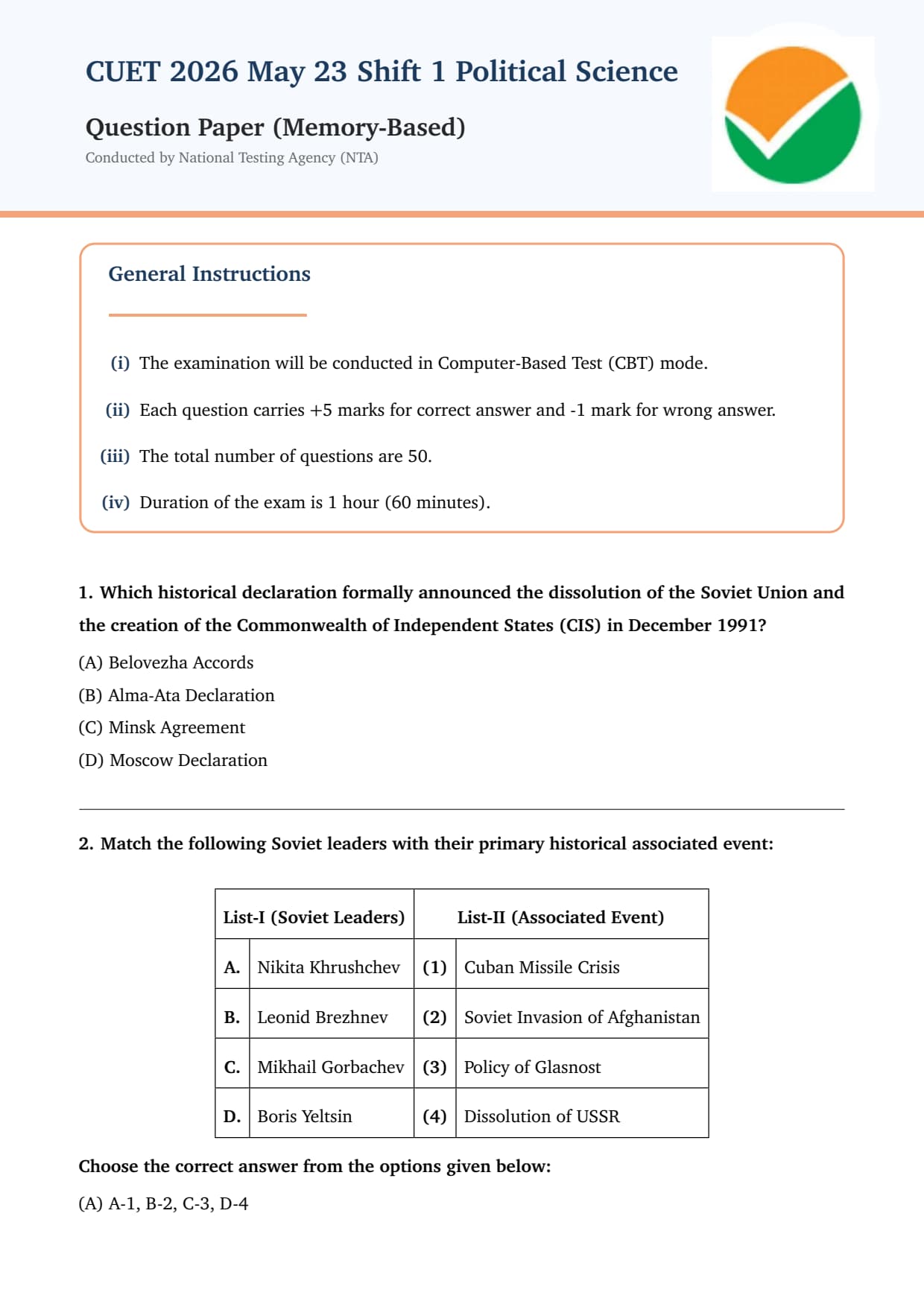
Which historical declaration formally announced the dissolution of the Soviet Union and the creation of the Commonwealth of Independent States (CIS) in December 1991?
View Solution
Concept:
The dissolution of the Soviet Union in 1991 led to the formation of the Commonwealth of Independent States (CIS), an organization formed by former Soviet republics to maintain cooperation after the breakup of the USSR.
Step 1:Understand the Alma-Ata Declaration.
The: \[ {Alma-Ata\ Declaration} \]
was signed in December \(1991\) by several former Soviet republics.
It officially:
Confirmed the dissolution of the Soviet Union
Established the Commonwealth of Independent States (CIS)
Step 2:Eliminate the incorrect options.
Belovezha Accords initiated the process of dissolving the USSR but did not formally include all republics.
Minsk Agreement is generally associated with peace negotiations related to Ukraine conflict.
Moscow Declaration is unrelated to the formal creation of CIS.
Thus, the declaration that formally announced the dissolution of the Soviet Union and creation of CIS was: \[ \boxed{Alma-Ata\ Declaration} \] Quick Tip: Remember: USSR dissolved in: \[ 1991 \] CIS was formally created through: \[ Alma-Ata\ Declaration \] Signed by former Soviet republics in Kazakhstan
Match the following Soviet leaders with their primary historical associated event:
| List-I (Soviet Leaders) | List-II (Associated Event) | ||
|---|---|---|---|
| (A) | Nikita Khrushchev | (1) | Cuban Missile Crisis |
| (B) | Leonid Brezhnev | (2) | Soviet Invasion of Afghanistan |
| (C) | Mikhail Gorbachev | (3) | Policy of Glasnost |
| (D) | Boris Yeltsin | (4) | Dissolution of USSR |
Choose the correct answer from the options given below:
View Solution
Concept:
Different Soviet leaders are associated with major Cold War events and reforms that shaped world history.
Step 1:Match Nikita Khrushchev.
Nikita Khrushchev was the Soviet leader during: \[ Cuban\ Missile\ Crisis (1962) \]
Thus: \[ A \rightarrow 1 \]
Step 2:Match Leonid Brezhnev.
Leonid Brezhnev is associated with: \[ Soviet\ Invasion\ of\ Afghanistan (1979) \]
Thus: \[ B \rightarrow 2 \]
Step 3:Match Mikhail Gorbachev.
Mikhail Gorbachev introduced reforms such as: \[ Glasnost \]
and \[ Perestroika \]
Thus: \[ C \rightarrow 3 \]
Step 4:Match Boris Yeltsin.
Boris Yeltsin played a major role during: \[ Dissolution\ of\ USSR \]
Thus: \[ D \rightarrow 4 \]
Hence, the correct matching is: \[ A-1,\quad B-2,\quad C-3,\quad D-4 \]
Therefore, \[ \boxed{A-1,\; B-2,\; C-3,\; D-4} \] Quick Tip: Remember: Khrushchev \(\rightarrow\) Cuban Missile Crisis Brezhnev \(\rightarrow\) Afghanistan Invasion Gorbachev \(\rightarrow\) Glasnost Boris Yeltsin \(\rightarrow\) Dissolution of USSR
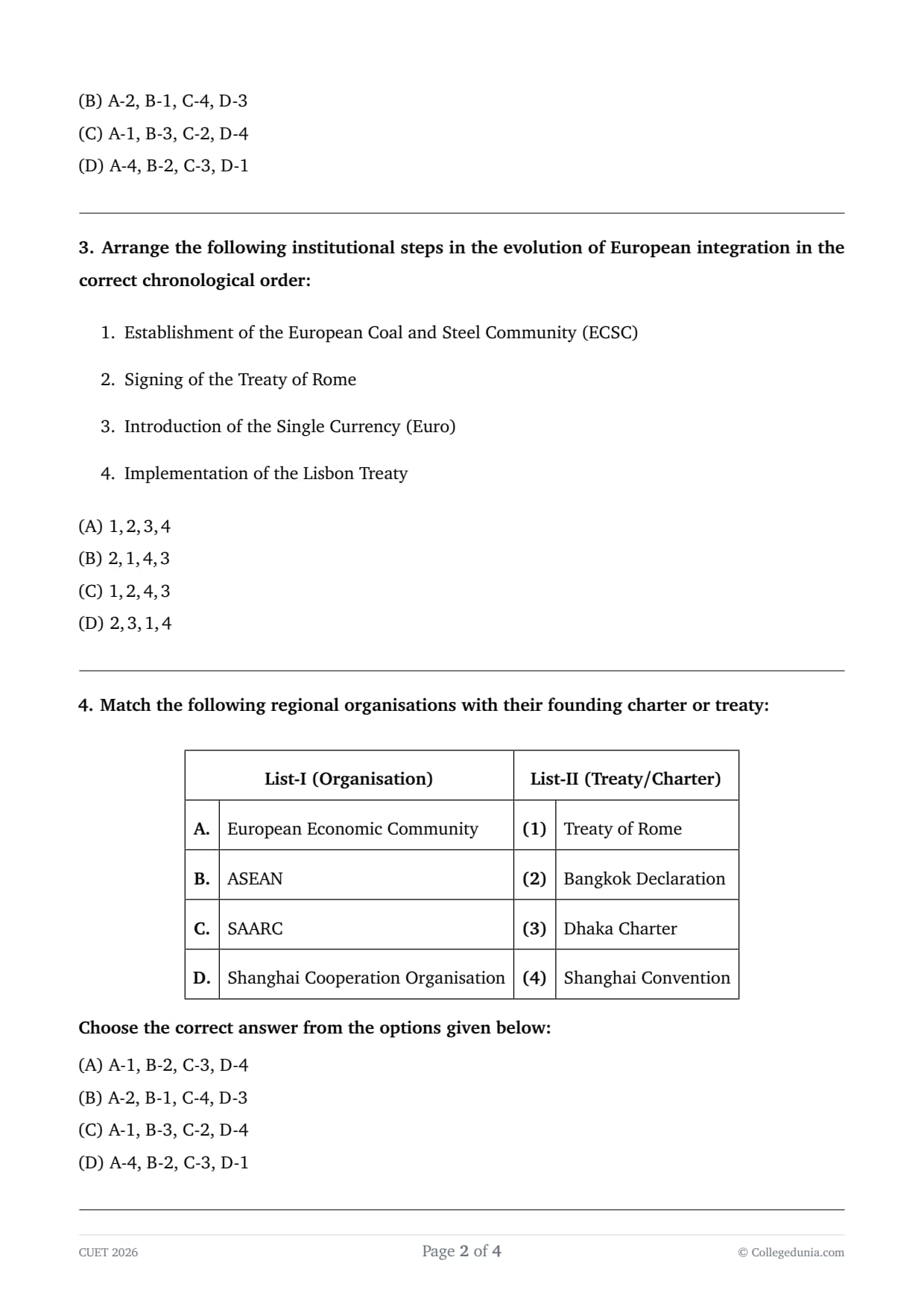
Arrange the following institutional steps in the evolution of European integration in the correct chronological order:
1.Establishment of the European Coal and Steel Community (ECSC)
2.Signing of the Treaty of Rome
3.Introduction of the Single Currency (Euro)
4.Implementation of the Lisbon Treaty
View Solution
Concept:
European integration evolved gradually through treaties, economic cooperation, and institutional reforms that ultimately led to the formation of the European Union (EU).
Step 1:Identify the earliest event.
The: \[ European\ Coal\ and\ Steel\ Community (ECSC) \] was established in: \[ 1951 \]
It was the first major step toward European integration.
Thus: \[ 1\ comes\ first \]
Step 2:Place the Treaty of Rome.
The: \[ Treaty\ of\ Rome \] was signed in: \[ 1957 \]
It established the: \[ European\ Economic\ Community (EEC) \]
Thus: \[ 2\ comes\ after\ 1 \]
Step 3:Place the introduction of Euro.
The: \[ Euro \]
was introduced in: \[ 1999 \]
Thus: \[ 3\ comes\ after\ 2 \]
Step 4:Place the Lisbon Treaty.
The: \[ Lisbon\ Treaty \]
was implemented in: \[ 2009 \]
Thus: \[ 4\ comes\ last \]
Hence, the correct chronological order is: \[ 1,2,3,4 \]
Therefore, \[ \boxed{1,2,3,4} \] Quick Tip: Remember the timeline: ECSC \(\rightarrow 1951\) Treaty of Rome \(\rightarrow 1957\) Euro introduced \(\rightarrow 1999\) Lisbon Treaty \(\rightarrow 2009\)
Match the following regional organisations with their founding charter or treaty:
| List-I (Organisation) | List-II (Treaty/Charter) | ||
|---|---|---|---|
| (A) | European Economic Community | (1) | Treaty of Rome |
| (B) | ASEAN | (2) | Bangkok Declaration |
| (C) | SAARC | (3) | Dhaka Charter |
| (D) | Shanghai Cooperation Organisation | (4) | Shanghai Convention |
Choose the correct answer from the options given below:
View Solution
Concept:
Many international and regional organisations are established through treaties, declarations, or charters that define their objectives and structure.
Step 1:Match the European Economic Community (EEC).
The: \[ European\ Economic\ Community \]
was established through: \[ Treaty\ of\ Rome (1957) \]
Thus: \[ A \rightarrow 1 \]
Step 2:Match ASEAN.
ASEAN was formed through the: \[ Bangkok\ Declaration (1967) \]
Thus: \[ B \rightarrow 2 \]
Step 3:Match SAARC.
SAARC was established with the: \[ Dhaka\ Charter \]
Thus: \[ C \rightarrow 3 \]
Step 4:Match Shanghai Cooperation Organisation (SCO).
The SCO is associated with the: \[ Shanghai\ Convention \]
Thus: \[ D \rightarrow 4 \]
Hence, the correct matching is: \[ A-1,\quad B-2,\quad C-3,\quad D-4 \]
Therefore, \[ \boxed{A-1,\; B-2,\; C-3,\; D-4} \] Quick Tip: Remember: EEC \(\rightarrow\) Treaty of Rome ASEAN \(\rightarrow\) Bangkok Declaration SAARC \(\rightarrow\) Dhaka Charter SCO \(\rightarrow\) Shanghai Convention
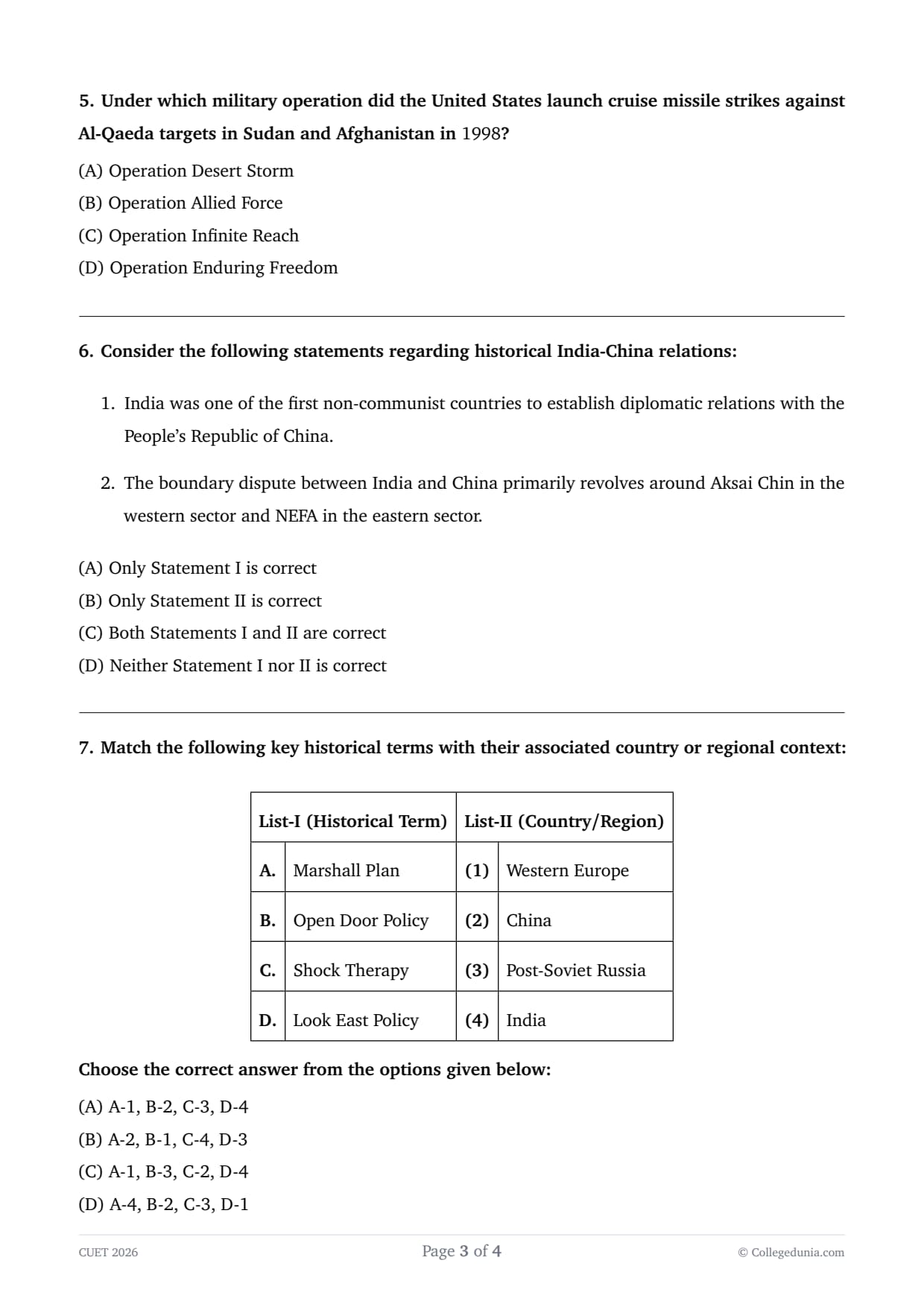
Under which military operation did the United States launch cruise missile strikes against Al-Qaeda targets in Sudan and Afghanistan in \(1998\)?
View Solution
Concept:
In response to the 1998 bombings of U.S. embassies in Kenya and Tanzania, the United States launched missile strikes against Al-Qaeda-linked targets.
Step 1:Identify the operation associated with the 1998 missile strikes.
The U.S. military operation conducted in: \[ 1998 \] against Al-Qaeda targets in: \[ Sudan\ and\ Afghanistan \] was called: \[ {Operation\ Infinite\ Reach} \]
Cruise missiles were launched against:
Terrorist training camps in Afghanistan
A pharmaceutical factory in Sudan suspected of links to chemical weapons production
Step 2:Eliminate the incorrect options.
Operation Desert Storm was related to the Gulf War against Iraq in 1991.
Operation Allied Force was NATO’s air campaign in Yugoslavia in 1999.
Operation Enduring Freedom began after the September 11 attacks in 2001.
Therefore, the correct answer is: \[ \boxed{Operation\ Infinite\ Reach} \] Quick Tip: Remember: Operation Infinite Reach \(\rightarrow\) 1998 Targeted Al-Qaeda bases in: \[ Sudan\ and\ Afghanistan \] Conducted after U.S. embassy bombings in East Africa
Consider the following statements regarding historical India-China relations:
Statement I : India was one of the first non-communist countries to establish diplomatic relations with the People's Republic of China.
Statement II : The boundary dispute between India and China primarily revolves around Aksai Chin in the western sector and NEFA in the eastern sector.
View Solution
Concept:
India-China relations have been shaped by diplomatic cooperation as well as territorial disputes since the mid-20th century.
Step 1:Examine Statement I.
India recognized the: \[ People's\ Republic\ of\ China (PRC) \] soon after its establishment in: \[ 1949 \]
India was among the first non-communist nations to establish diplomatic relations with China.
Therefore, \[ Statement\ I\ is\ correct. \]
Step 2:Examine Statement II.
The India-China border dispute mainly involves:
Aksai Chin in the western sector
NEFA (now Arunachal Pradesh) in the eastern sector
These regions were central to the: \[ 1962\ India-China\ War \]
Therefore, \[ Statement\ II\ is\ also\ correct. \]
Hence, both statements are correct.
\[ \boxed{Both\ Statements\ I and\ II\ are\ correct} \] Quick Tip: Remember: India recognized PRC in: \[ 1950 \] Main disputed regions: Aksai Chin \(\rightarrow\) Western sector NEFA/Arunachal Pradesh \(\rightarrow\) Eastern sector Major conflict: \[ 1962\ India-China War \]
Match the following key historical terms with their associated country or regional context:
| List-I (Historical Term) | List-II (Country/Region) | ||
|---|---|---|---|
| (A) | Marshall Plan | (1) | Western Europe |
| (B) | Open Door Policy | (2) | China |
| (C) | Shock Therapy | (3) | Post-Soviet Russia |
| (D) | Look East Policy | (4) | India |
Choose the correct answer from the options given below:
View Solution
Concept:
Several important political and economic policies are associated with particular countries or regions and played major roles in shaping modern international relations.
Step 1:Match the Marshall Plan.
The: \[ Marshall\ Plan \] was an American economic assistance programme for rebuilding: \[ Western\ Europe \] after World War II.
Thus: \[ A \rightarrow 1 \]
Step 2:Match the Open Door Policy.
The: \[ Open\ Door\ Policy \] is associated with: \[ China \]
It referred to policies promoting equal trade access in China.
Thus: \[ B \rightarrow 2 \]
Step 3:Match Shock Therapy.
The term: \[ Shock\ Therapy \] is linked to: \[ Post-Soviet\ Russia \]
It referred to rapid economic reforms after the collapse of the USSR.
Thus: \[ C \rightarrow 3 \]
Step 4:Match Look East Policy.
The: \[ Look\ East\ Policy \] was launched by: \[ India \] to strengthen relations with Southeast Asian countries.
Thus: \[ D \rightarrow 4 \]
Hence, the correct matching is: \[ A-1,\quad B-2,\quad C-3,\quad D-4 \]
Therefore, \[ \boxed{A-1,\; B-2,\; C-3,\; D-4} \] Quick Tip: Remember: Marshall Plan \(\rightarrow\) Western Europe Open Door Policy \(\rightarrow\) China Shock Therapy \(\rightarrow\) Russia Look East Policy \(\rightarrow\) India
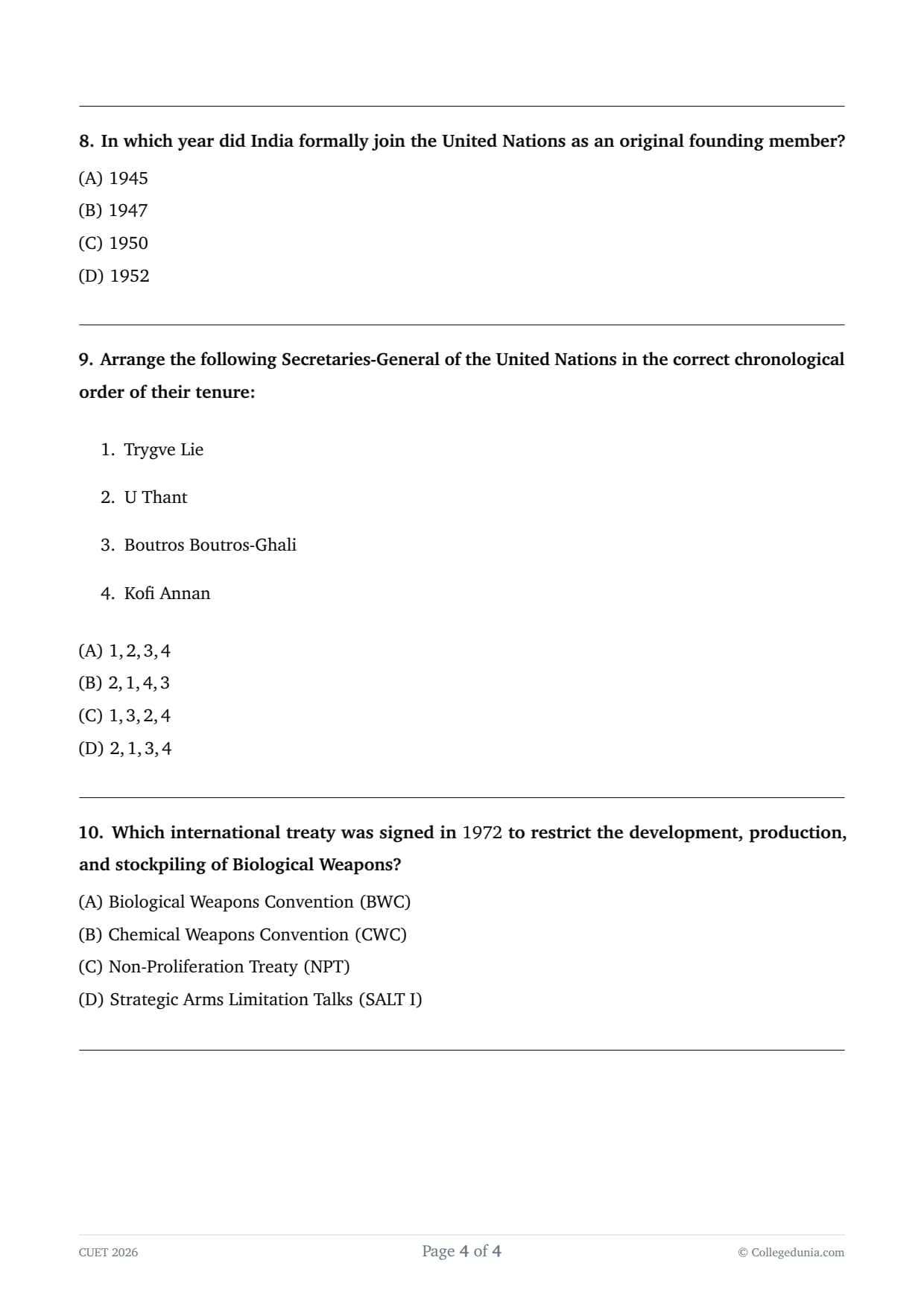
In which year did India formally join the United Nations as an original founding member?
View Solution
Concept:
The United Nations (UN) was established after World War II to promote international peace, security, and cooperation among nations.
Step 1:Identify the year of establishment of the United Nations.
The: \[ United\ Nations \] was officially established on: \[ 24\ October\ 1945 \]
Step 2:Understand India's role.
India was one of the: \[ original\ founding\ members \] of the United Nations and signed the UN Charter in: \[ 1945 \]
At that time, India participated as British India before independence in 1947.
Step 3:Eliminate the incorrect options.
\(1947\) is the year of India's independence.
\(1950\) is the year the Constitution of India came into effect.
\(1952\) has no connection with India's entry into the UN.
Therefore, the correct answer is: \[ \boxed{1945} \] Quick Tip: Remember: United Nations established: \[ 1945 \] India became an original founding member in: \[ 1945 \] UN Day is celebrated on: \[ 24 October \]
Arrange the following Secretaries-General of the United Nations in the correct chronological order of their tenure:
1.Trygve Lie
2.U Thant
3.Boutros Boutros-Ghali
4.Kofi Annan
View Solution
Concept:
The Secretary-General is the chief administrative officer of the United Nations and different leaders have served during different historical phases of global politics.
Step 1:Identify the first UN Secretary-General.
\[ Trygve\ Lie \] served as the first Secretary-General of the United Nations from: \[ 1946\ to\ 1952 \]
Thus: \[ 1\ comes\ first \]
Step 2:Place U Thant.
\[ U\ Thant \] served as Secretary-General from: \[ 1961\ to\ 1971 \]
Thus: \[ 2\ comes\ after\ 1 \]
Step 3:Place Boutros Boutros-Ghali.
\[ Boutros\ Boutros-Ghali \] served from: \[ 1992\ to\ 1996 \]
Thus: \[ 3\ comes\ after\ 2 \]
Step 4:Place Kofi Annan.
\[ Kofi Annan \] served from: \[ 1997\ to\ 2006 \]
Thus: \[ 4\ comes\ last \]
Hence, the correct chronological order is: \[ 1,2,3,4 \]
Therefore, \[ \boxed{1,2,3,4} \] Quick Tip: Remember the order: Trygve Lie \(\rightarrow\) First UN Secretary-General U Thant \(\rightarrow\) 1960s period Boutros Boutros-Ghali \(\rightarrow\) Early 1990s Kofi Annan \(\rightarrow\) Late 1990s and 2000s
Which international treaty was signed in \(1972\) to restrict the development, production, and stockpiling of Biological Weapons?
View Solution
Concept:
International treaties are created to control dangerous weapons and promote global peace and security.
Step 1:Identify the treaty related to biological weapons.
The: \[ Biological\ Weapons\ Convention (BWC) \] was signed in: \[ 1972 \]
Its purpose was to:
Prohibit development of biological weapons
Ban production and stockpiling
Prevent use of biological agents for warfare
Step 2:Eliminate the incorrect options.
Chemical Weapons Convention (CWC) deals with chemical weapons and came later in 1993.
Non-Proliferation Treaty (NPT) focuses on nuclear weapons.
SALT I was related to limitation of strategic nuclear arms between the USA and USSR.
Therefore, the correct answer is: \[ \boxed{Biological\ Weapons\ Convention (BWC)} \] Quick Tip: Remember: BWC \(\rightarrow\) Biological Weapons Signed in: \[ 1972 \] CWC \(\rightarrow\) Chemical Weapons NPT \(\rightarrow\) Nuclear Weapons
CUET UG 2026 Exam Pattern
| Parameter | Details |
|---|---|
| Exam Name | Common University Entrance Test (CUET UG) 2026 |
| Conducting Body | National Testing Agency (NTA) |
| Exam Mode | Computer-Based Test (CBT) |
| Exam Duration | 60 minutes per test |
| Total Sections | 3 (Languages, Domain Subjects, General Test) |
| Question Type | Multiple Choice Questions (MCQs) |
| Questions per Test | 50 questions (all compulsory) |
| Marking Scheme | +5 for correct, -1 for incorrect |
| Maximum Marks | 250 marks per test |
| Maximum Subject Choices | 5 subjects in total |
| Syllabus Base | Class 12 NCERT (mainly for Domain Subjects) |





Comments