CUET 2026 May 22 Shift 2 Mathematics Question Paper is available for download here. NTA is conducting the CUET 2026 exam from 11th May to 31st May.
- CUET 2026 Mathematics exam consists of 50 questions for 250 marks to be attempted in 60 minutes.
- As per the marking scheme, 5 marks are awarded for each correct answer, and 1 mark is deducted for incorrect answer.
Candidates can download CUET 2026 May 22 Shift 2 Mathematics Question Paper with Answer Key and Solution PDF from links provided below.
Related Links:
CUET 2026 Mathematics May 22 Shift 2 Question Paper with Solution PDF
| CUET May 22 Shift 2 Mathematics Question Paper 2026 | Download PDF | Check Solutions |
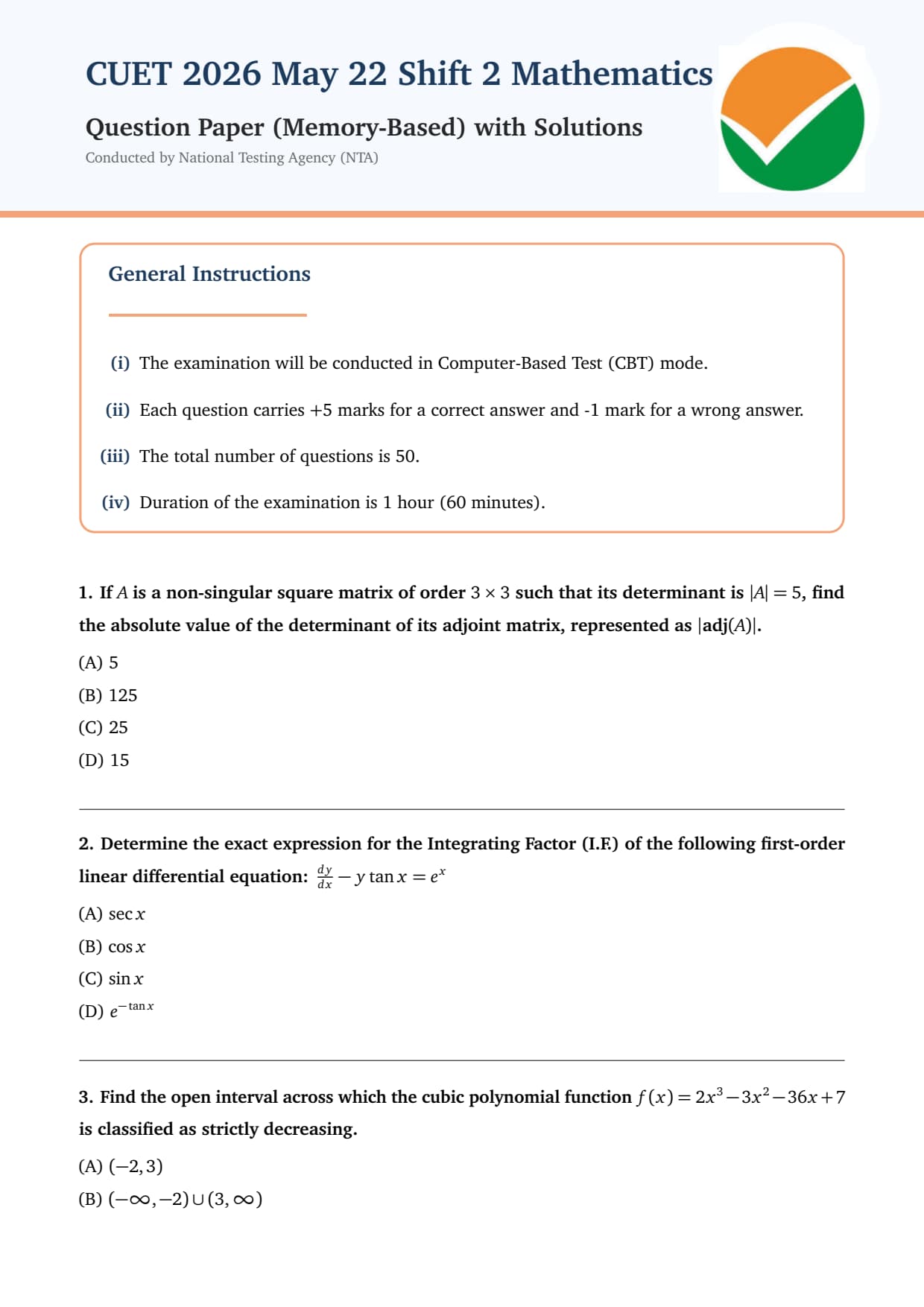
If \( A \) is a non-singular square matrix of order \( 3 \times 3 \) such that its determinant is \( |A| = 5 \), find the absolute value of the determinant of its adjoint matrix, represented as \( |adj(A)| \).
View Solution
Concept:
For any non-singular square matrix \( A \) of order \( n \times n \), the determinant of its adjoint matrix is directly related to the determinant of the original matrix through the fundamental algebraic identity: \[ |adj(A)| = |A|^{n-1} \]
This property allows us to calculate the value without needing to compute the individual elements of the adjoint matrix.
Step 1: Identify the matrix order and determinant from the problem values.
The problem provides the following parameters:
Matrix order (\( n \)) = 3
Determinant value (\( |A| \)) = 5
Step 2: Substitute parameters into the adjoint determinant identity.
Plug these values directly into the scaling formula: \[ |adj(A)| = 5^{3-1} = 5^2 \]
Step 3: Simplify the exponential expression.
Evaluating the exponent yields the final scalar determinant value: \[ |adj(A)| = 25 \] Quick Tip: Keep this related identity handy for multi-step matrix problems: the determinant of the adjoint of an adjoint matrix scales even higher, following the rule \( |adj(adj(A))| = |A|^{(n-1)^2} \).
Determine the exact expression for the Integrating Factor (I.F.) of the following first-order linear differential equation: \( \frac{dy}{dx} - y\tan x = e^x \)
View Solution
Concept:
A first-order linear differential equation written in standard form is expressed as: \[ \frac{dy}{dx} + Py = Q \]
Where \( P \) and \( Q \) are functions of \( x \) or constants. The Integrating Factor (I.F.) needed to solve this class of differential equations is given by the calculus formula: \[ I.F. = e^{\int P \, dx} \]
Step 1: Isolate the coefficient function \( P \) from the equation structure.
Comparing our given equation to the standard linear format shows: \[ P = -\tan x \]
*(Note: It is crucial to include the negative sign attached to the tangent function).*
Step 2: Evaluate the indefinite integral of \( P \).
Set up and integrate the tangent function with respect to \( x \): \[ \int P \, dx = \int -\tan x \, dx = -\ln|\sec x| \]
Using logarithmic properties, bring the negative sign inside as a reciprocal power: \[ -\ln|\sec x| = \ln\left| \frac{1}{\sec x} \right| = \ln|\cos x| \]
Step 3: Substitute the integrated term back into the exponential base.
Plug the evaluated integral into the final integrating factor template: \[ I.F. = e^{\ln|\cos x|} \]
Since the exponential base \( e \) and natural logarithm \( \ln \) cancel each other out, the expression simplifies to: \[ I.F. = \cos x \] Quick Tip: Always ensure your linear differential equation is in standard form before identifying \( P \). The coefficient of the leading \( \frac{dy}{dx} \) term must equal exactly 1. If it doesn't, divide the entire equation by that term first.
Find the open interval across which the cubic polynomial function \( f(x) = 2x^3 - 3x^2 - 36x + 7 \) is classified as strictly decreasing.
View Solution
Concept:
A continuous function \( f(x) \) is strictly decreasing across an open interval if its first derivative is strictly negative (\( f'(x) < 0 \)) at every point within that interval.
Step 1: Calculate the first derivative of the polynomial function.
Apply the standard power derivative rule to each term of the polynomial: \[ f'(x) = \frac{d}{dx}\left( 2x^3 - 3x^2 - 36x + 7 \right) = 6x^2 - 6x - 36 \]
Step 2: Find the critical roots by factoring the quadratic derivative expression.
Set the derivative expression equal to zero to isolate the boundary roots: \[ 6x^2 - 6x - 36 = 0 \quad \Rightarrow \quad 6\left( x^2 - x - 6 \right) = 0 \]
Factor the quadratic trinomial inside the parentheses: \[ 6(x - 3)(x + 2) = 0 \]
This isolates the critical turning points at \( x = 3 \) and \( x = -2 \).
Step 3: Analyze the derivative signs using the wavy curve method.
The critical points divide the real number line into three separate intervals: \( (-\infty, -2) \), \( (-2, 3) \), and \( (3, \infty) \).
For \( x \in (-\infty, -2) \), \( f'(x) > 0 \) (Strictly Increasing)
For \( x \in (-2, 3) \), \( f'(x) < 0 \) (Strictly Decreasing)
For \( x \in (3, \infty) \), \( f'(x) > 0 \) (Strictly Increasing)
Thus, the function is strictly decreasing on the open interval \( (-2, 3) \). Quick Tip: When evaluating quadratic inequalities of the form \( (x-a)(x-b) < 0 \) where \( a < b \), the solution space will always be the interior bounded range \( (a, b) \).
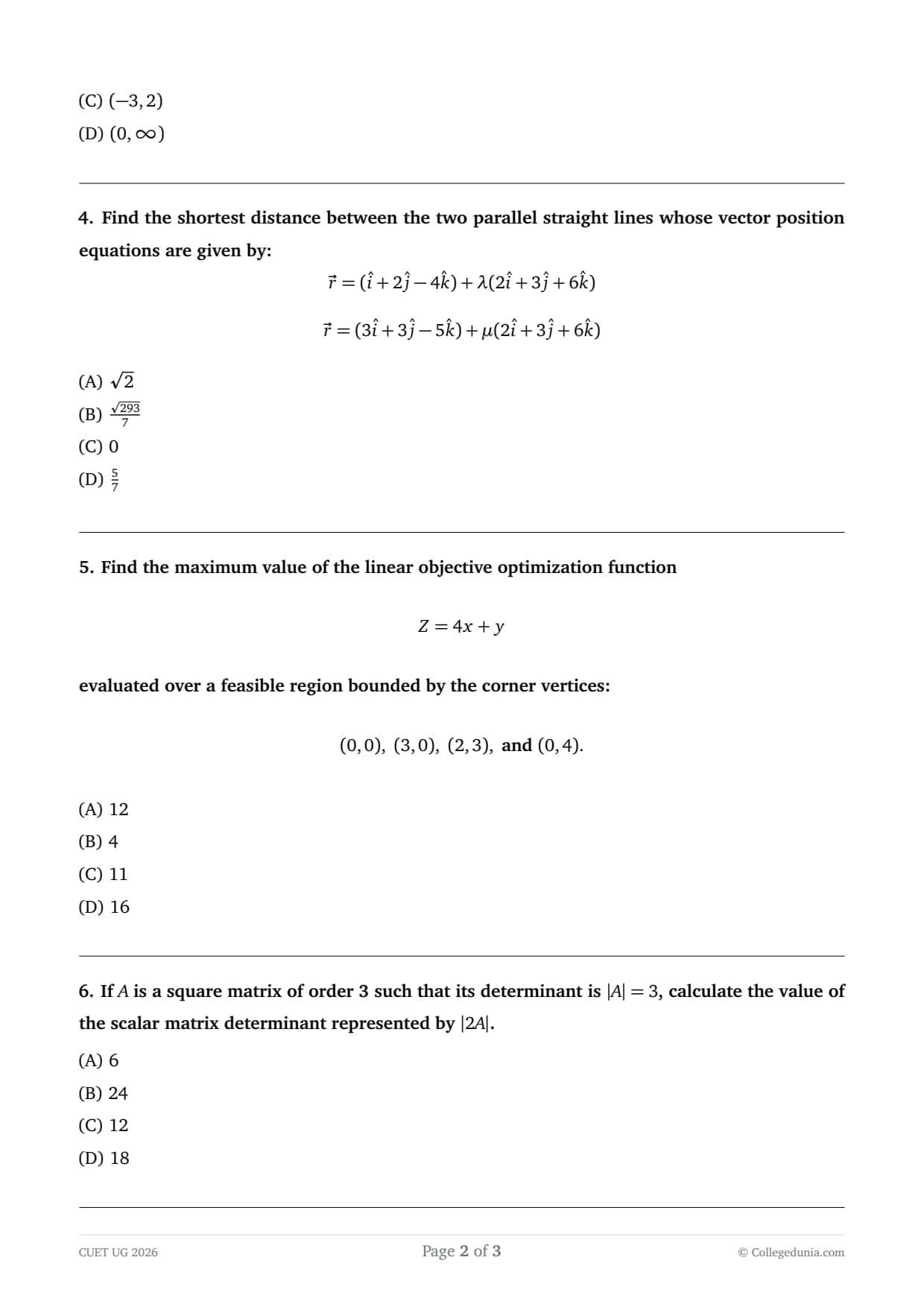
Find the shortest distance between the two parallel straight lines whose vector position equations are given by: \[ \vec{r} = (\hat{i} + 2\hat{j} - 4\hat{k}) + \lambda(2\hat{i} + 3\hat{j} + 6\hat{k}) \] \[ \vec{r} = (3\hat{i} + 3\hat{j} - 5\hat{k}) + \mu(2\hat{i} + 3\hat{j} + 6\hat{k}) \]
View Solution
Concept:
When two straight lines run completely parallel in a 3D space, they share the exact same directional heading vector \( \vec{b} \). The shortest distance (\( d \)) separating them depends on the cross product of their position difference with this direction vector: \[ d = \frac{|(\vec{a}_2 - \vec{a}_1) \times \vec{b}|}{|\vec{b}|} \]
Step 1: Extract the vector parameters and calculate the position difference.
From the provided parallel equations, isolate the coordinates:
\( \vec{a}_1 = \hat{i} + 2\hat{j} - 4\hat{k} \)
\( \vec{a}_2 = 3\hat{i} + 3\hat{j} - 5\hat{k} \)
Shared Direction Vector \( \vec{b} = 2\hat{i} + 3\hat{j} + 6\hat{k} \)
Calculate the initial displacement vector connecting the two starting points: \[ \vec{a}_2 - \vec{a}_1 = (3-1)\hat{i} + (3-2)\hat{j} + (-5 - (-4))\hat{k} = 2\hat{i} + \hat{j} - \hat{k} \]
Step 2: Compute the cross product vector \( (\vec{a}_2 - \vec{a}_1) \times \vec{b} \).
Set up the matrix determinant layout using standard unit coordinates: \[ (\vec{a}_2 - \vec{a}_1) \times \vec{b} = \left| \begin{matrix} \hat{i} & \hat{j} & \hat{k}
2 & 1 & -1
2 & 3 & 6 \end{matrix} \right| \]
Expanding along the top row: \[ = \hat{i}(6 - (-3)) - \hat{j}(12 - (-2)) + \hat{k}(6 - 2) = 9\hat{i} - 14\hat{j} + 4\hat{k} \]
Calculate its magnitude: \[ |(\vec{a}_2 - \vec{a}_1) \times \vec{b}| = \sqrt{9^2 + (-14)^2 + 4^2} = \sqrt{81 + 196 + 16} = \sqrt{293} \]
Step 3: Divide by the magnitude of the direction vector \( |\vec{b}| \).
Find the magnitude of the shared direction heading: \[ |\vec{b}| = \sqrt{2^2 + 3^2 + 6^2} = \sqrt{4 + 9 + 36} = \sqrt{49} = 7 \]
Combine these values into the parallel distance formula: \[ d = \frac{\sqrt{293}}{7} \] Quick Tip: Always double-check the direction vectors before starting. If they match or are direct scalar multiples of each other, the lines are parallel. You must use the parallel cross product formula, not the standard skew-lines formula.
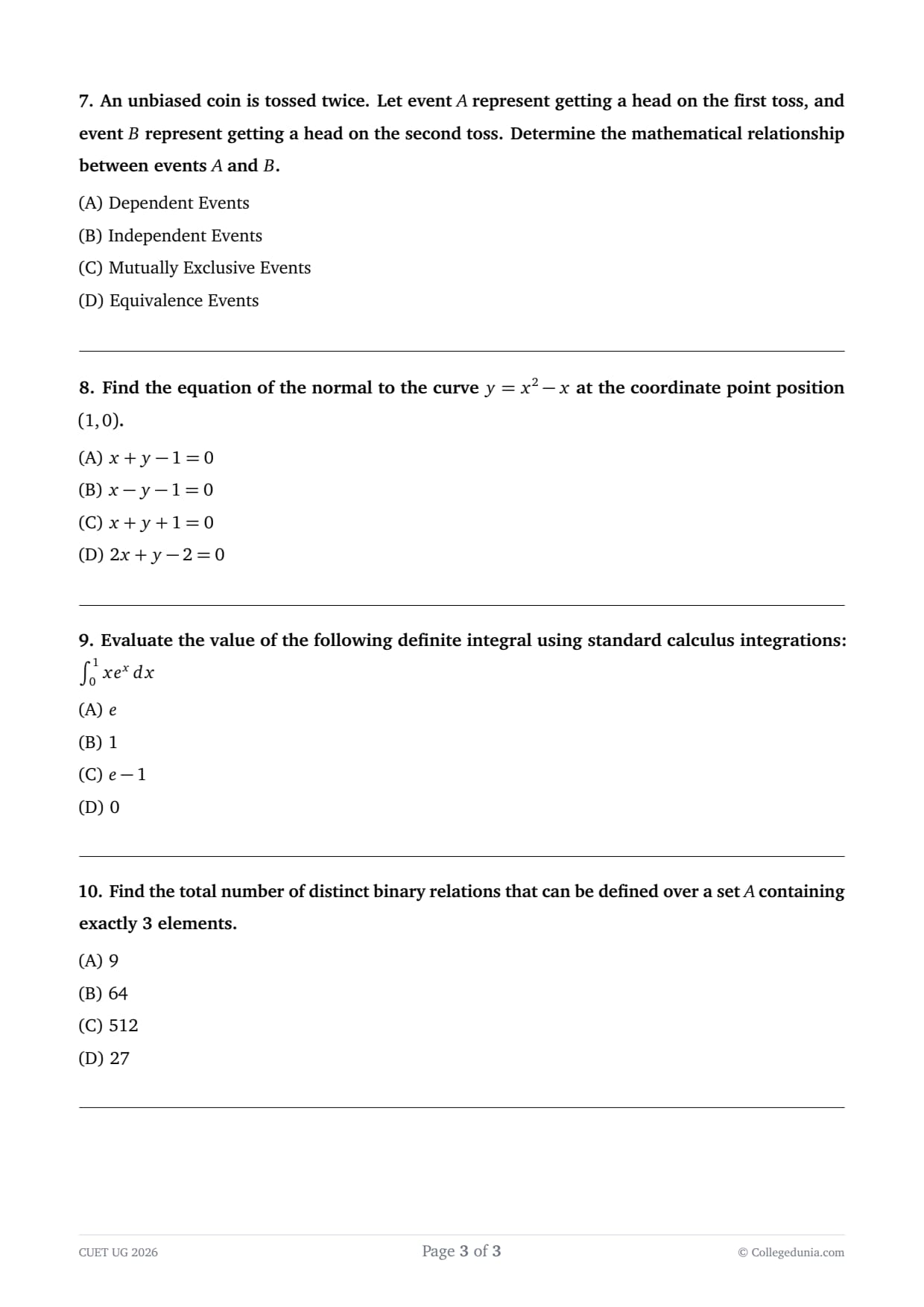
Find the maximum value of the linear objective optimization function \[ Z = 4x + y \]
evaluated over a feasible region bounded by the corner vertices: \[ (0,0), \ (3,0), \ (2,3), \ and \ (0,4). \]
View Solution
Concept:
In Linear Programming Problems (LPP), the maximum or minimum value of an objective function occurs at one of the corner points (vertices) of the feasible region.
Step 1: Identify the objective function.
The objective function is: \[ Z = 4x + y \]
The feasible region has the corner points: \[ (0,0), \ (3,0), \ (2,3), \ (0,4) \]
Step 2: Evaluate the objective function at each corner point.
\[ \begin{aligned} Z(0,0) &= 4(0) + 0 = 0 \\[0.2cm] Z(3,0) &= 4(3) + 0 = 12 \\[0.2cm] Z(2,3) &= 4(2) + 3 = 8 + 3 = 11 \\[0.2cm] Z(0,4) &= 4(0) + 4 = 4 \end{aligned} \]
Step 3: Determine the maximum value.
The obtained values are: \[ 0,\ 12,\ 11,\ 4 \]
The maximum among these is: \[ 12 \]
Hence, the maximum value of the objective function is: \[ \boxed{12} \]
Therefore, the correct answer is: \[ \boxed{(A)} \] Quick Tip: For Linear Programming Problems, always evaluate the objective function at all corner points of the feasible region. The optimal value always occurs at a vertex.
If \( A \) is a square matrix of order 3 such that its determinant is \( |A| = 3 \), calculate the value of the scalar matrix determinant represented by \( |2A| \).
View Solution
Concept:
For any square matrix \( A \) of order \( n \times n \), factoring out a scalar multiplier \( k \) from inside a determinant requires raising that scalar to the power of the matrix order: \[ |kA| = k^n |A| \]
This occurs because the scalar multiplier scales every individual row of the matrix uniformly.
Step 1: Identify the scale factor, matrix order, and base determinant.
The problem provides the following parameters:
Scalar factor (\( k \)) = 2
Matrix order (\( n \)) = 3
Base determinant (\( |A| \)) = 3
Step 2: Apply parameters to the determinant scaling property.
Substitute these values into the scaling identity: \[ |2A| = 2^3 \times |A| \]
Step 3: Simplify the numerical expression.
Evaluate the cubic exponent and multiply by the base determinant: \[ |2A| = 8 \times 3 = 24 \] Quick Tip: Remember to always check the order of the matrix (\( n \)) before scaling a determinant. Forgetting to raise the scalar factor to the power of \( n \) is a very common exam mistake.
An unbiased coin is tossed twice. Let event \( A \) represent getting a head on the first toss, and event \( B \) represent getting a head on the second toss. Determine the mathematical relationship between events \( A \) and \( B \).
View Solution
Concept:
Two events \( A \) and \( B \) are mathematically classified as Independent Events if and only if the occurrence of one does not affect the probability of the other. This condition can be verified using the multiplication rule: \[ P(A \cap B) = P(A) \cdot P(B) \]
Step 1: Define the sample space and calculate individual event probabilities.
Tossing an unbiased coin twice produces a sample space containing 4 equally likely outcomes: \[ S = \{HH, \, HT, \, TH, \, TT\} \quad \Rightarrow \quad n(S) = 4 \]
Map the outcomes for each event and calculate their probabilities:
Event \( A \) (Head on 1st toss) = \(\{HH, HT\} \Rightarrow P(A) = \frac{2}{4} = 0.5\)
Event \( B \) (Head on 2nd toss) = \(\{HH, TH\} \Rightarrow P(B) = \frac{2}{4} = 0.5\)
Step 2: Calculate the joint intersection probability of both events.
The intersection event \( A \cap B \) represents getting a head on both the first and second tosses: \[ A \cap B = \{HH\} \quad \Rightarrow \quad P(A \cap B) = \frac{1}{4} = 0.25 \]
Step 3: Verify the independent multiplication identity.
Multiply the individual event probabilities together: \[ P(A) \cdot P(B) = 0.5 \times 0.5 = 0.25 \]
Since \( P(A \cap B) = P(A) \cdot P(B) = 0.25 \), the two events are independent. Quick Tip: Do not confuse independent events with mutually exclusive events. Independent events can happen at the same time (\( P(A \cap B) \neq 0 \)), whereas mutually exclusive events can never occur together (\( P(A \cap B) = 0 \)).
Find the equation of the normal to the curve \( y = x^2 - x \) at the coordinate point position \( (1, 0) \).
View Solution
Concept:
The slope of the tangent line (\( m_t \)) to a curve at a given point is found by calculating its first derivative at that point. Because a normal line runs perpendicular to the tangent, its slope (\( m_n \)) is the negative reciprocal of the tangent slope: \[ m_n = -\frac{1}{m_t} = -\frac{1}{\left(\frac{dy}{dx}\right)} \]
Step 1: Calculate the first derivative and find the tangent slope.
Differentiate the curve's equation with respect to \( x \): \[ \frac{dy}{dx} = \frac{d}{dx}\left( x^2 - x \right) = 2x - 1 \]
Evaluate this derivative at the target x-coordinate (\( x = 1 \)) to find the tangent slope: \[ m_t = 2(1) - 1 = 1 \]
Step 2: Calculate the perpendicular slope of the normal line.
Take the negative reciprocal of the tangent slope: \[ m_n = -\frac{1}{1} = -1 \]
Step 3: Set up the line equation using point-slope form.
Using the point coordinates \( (1,0) \) and our normal slope \( m_n = -1 \), write the line equation: \[ y - y_1 = m_n(x - x_1) \quad \Rightarrow \quad y - 0 = -1(x - 1) \]
Distribute the negative sign and rearrange all terms to the left side: \[ y = -x + 1 \quad \Rightarrow \quad x + y - 1 = 0 \] Quick Tip: Always read the question carefully to see if it asks for the equation of the tangent or the normal. Forgetting to invert and negate the slope for a normal line is a common oversight under exam time pressure.
Evaluate the value of the following definite integral using standard calculus integrations: \( \int_{0}^{1} x e^x \, dx \)
View Solution
Concept:
When an integrand consists of a product of two distinct functions, apply the Integration by Parts rule: \[ \int u \, dv = uv - \int v \, du \]
Choose the parts systematically using the ILATE priority rule (Inverses, Logarithms, Algebraics, Trigonometrics, Exponentials).
Step 1: Assign integration variables following the ILATE rule.
For the integrand \( x e^x \), choose the algebraic term as \( u \) and the exponential term as \( dv \):
Let \( u = x \quad \Rightarrow \quad du = dx \)
Let \( dv = e^x \, dx \quad \Rightarrow \quad v = e^x \)
Step 2: Apply the integration by parts formula.
Substitute these terms into the integration by parts formula: \[ \int x e^x \, dx = x e^x - \int e^x \, dx \]
Evaluate the remaining integral: \[ \int x e^x \, dx = x e^x - e^x = e^x(x - 1) \]
Step 3: Evaluate the definite integral boundaries.
Apply the limits from \( 0 \) to \( 1 \) across the integrated expression: \[ \int_{0}^{1} x e^x \, dx = \left[ e^x(x - 1) \right]_{0}^{1} \]
Evaluate the upper limit (\( x = 1 \)) and subtract the lower limit (\( x = 0 \)): \[ = \left( e^1(1 - 1) \right) - \left( e^0(0 - 1) \right) \] \[ = 0 - (1 \cdot (-1)) = 0 - (-1) = 1 \] Quick Tip: Be careful when evaluating lower limits at zero, especially with exponential functions. While algebraic variables like \( x \) drop to 0, exponential terms evaluate to 1 (\( e^0 = 1 \)), which often changes the final result.
Find the total number of distinct binary relations that can be defined over a set \( A \) containing exactly 3 elements.
View Solution
Concept:
A binary relation defined on a set \( A \) is any subset of the Cartesian product set \( A \times A \). Therefore, the total number of distinct relations is equal to the total number of subsets in the power set of \( A \times A \), calculated using the formula: \[ Total Relations = 2^{n(A \times A)} = 2^{n^2} \]
Where \( n \) represents the total number of elements in set \( A \).
Step 1: Calculate the size of the Cartesian product set.
The problem states that set \( A \) contains exactly 3 elements (\( n = 3 \)). Find the total number of coordinate pairs in the Cartesian product: \[ n(A \times A) = n \times n = 3 \times 3 = 9 \]
Step 2: Calculate the total number of relation power subsets.
Raise 2 to the power of the Cartesian product size to find the total number of possible subsets: \[ Total Relations = 2^9 \]
Step 3: Evaluate the final exponential value.
Multiplying out the base-2 value yields: \[ 2^9 = 512 \] Quick Tip: Keep these related relation counting formulas memorized for matching questions: Total Relations = \( 2^{n^2} \) Total Reflexive Relations = \( 2^{n^2 - n} \) Total Symmetric Relations = \( 2^{\frac{n(n+1)}{2}} \)
CUET UG 2026 Exam Pattern
| Parameter | Details |
|---|---|
| Exam Name | Common University Entrance Test (CUET UG) 2026 |
| Conducting Body | National Testing Agency (NTA) |
| Exam Mode | Computer-Based Test (CBT) |
| Exam Duration | 60 minutes per test |
| Total Sections | 3 (Languages, Domain Subjects, General Test) |
| Question Type | Multiple Choice Questions (MCQs) |
| Questions per Test | 50 questions (all compulsory) |
| Marking Scheme | +5 for correct, -1 for incorrect |
| Maximum Marks | 250 marks per test |
| Maximum Subject Choices | 5 subjects in total |
| Syllabus Base | Class 12 NCERT (mainly for Domain Subjects) |





Comments