CUET 2026 May 22 Shift 2 General Aptitude Test Question Paper is available for download here. NTA is conducting the CUET 2026 exam from 11th May to 31st May.

  • CUET 2026 General Aptitude Test exam consists of 50 questions for 250 marks to be attempted in 60 minutes.
  • As per the marking scheme, 5 marks are awarded for each correct answer, and 1 mark is deducted for incorrect answer.

Candidates can download CUET 2026 May 22 Shift 2 General Aptitude Test Question Paper with Answer Key and Solution PDF from links provided below.

Related Links:

CUET 2026 General Aptitude Test May 22 Shift 2 Question Paper with Solution PDF

CUET May 22 Shift 2 General Aptitude Test Question Paper 2026 Download PDF Check Solutions


Question 1:

A car travels \(105\) km in \(3\) hours and a train travels \(252\) km in \(4\) hours. The ratio of speed of the car to that of the train is:

  • (A) \(9:11\)
  • (B) \(3:5\)
  • (C) \(2:7\)
  • (D) \(5:9\)
Correct Answer: (D) \(5:9\)
View Solution

Concept:
Speed is defined as: \[ Speed = \frac{Distance}{Time} \]
To find the ratio of speeds: \[ Ratio = \frac{Speed\ of\ car}{Speed\ of\ train} \]
Step 1: Calculate the speed of the car.
Given: \[ Distance = 105\,km \] \[ Time = 3\,hours \]
Using: \[ Speed = \frac{Distance}{Time} \]
\[ Speed of car = \frac{105}{3} \]
\[ = 35\,km/h \]
Step 2: Calculate the speed of the train.
Given: \[ Distance = 252\,km \] \[ Time = 4\,hours \]
\[ Speed of train = \frac{252}{4} \]
\[ = 63\,km/h \]
Step 3: Find the ratio of their speeds.
\[ 35 : 63 \]
Divide both terms by \(7\): \[ 5 : 9 \]
Therefore, \[ \boxed{5:9} \] Quick Tip: Remember: \[ Speed = \frac{Distance}{Time} \] For ratios: First calculate individual speeds Simplify the ratio to lowest terms


Question 2:

The diameter of a circular garden is \(140\) m. Its area is equal to a rectangular field whose sides are in the ratio \(11:7\). The perimeter (in m) of the rectangular field is (take \(\pi = \frac{22}{7}\)):

  • (A) \(360\sqrt{2}\)
  • (B) \(180\sqrt{2}\)
  • (C) \(120\sqrt{2}\)
  • (D) \(270\sqrt{2}\)
Correct Answer: (D) \(270\sqrt{2}\)
View Solution

Concept:
Area of a circle: \[ A = \pi r^2 \]
For a rectangle whose sides are in ratio \(11:7\), let the sides be: \[ 11x \quad and \quad 7x \]
Then: \[ Area = 11x \times 7x \]
Step 1: Find the area of the circular garden.
Given: \[ Diameter = 140\,m \]
Hence radius: \[ r = \frac{140}{2} = 70\,m \]
Using: \[ A = \pi r^2 \]
\[ A = \frac{22}{7}\times 70 \times 70 \]
\[ A = 22 \times 10 \times 70 \]
\[ A = 15400\,m^2 \]
Step 2: Form the area equation for the rectangle.
Sides of rectangle are in ratio: \[ 11:7 \]
Let sides be: \[ 11x \quad and \quad 7x \]
Area: \[ 11x \times 7x = 77x^2 \]
Since areas are equal: \[ 77x^2 = 15400 \]
\[ x^2 = \frac{15400}{77} \]
\[ x^2 = 200 \]
\[ x = 10\sqrt{2} \]
Step 3: Calculate the perimeter of rectangle.
Perimeter: \[ P = 2(l+b) \]
\[ P = 2(11x + 7x) \]
\[ P = 2(18x) \]
\[ P = 36x \]
Substituting: \[ x = 10\sqrt{2} \]
\[ P = 36 \times 10\sqrt{2} \]
\[ P = 360\sqrt{2} \]
Therefore, \[ \boxed{360\sqrt{2}} \] Quick Tip: Remember: Area of circle: \[ \pi r^2 \] If rectangle sides are in ratio \(a:b\): \[ Sides = ax,\; bx \] Perimeter: \[ 2(l+b) \]


Question 3:

If \(12\) men or \(20\) women can do a work in \(54\) days, then in how many days can \(9\) men and \(12\) women together do the work?

  • (A) \(38\) days
  • (B) \(32\) days
  • (C) \(40\) days
  • (D) \(35\) days
Correct Answer: (C) \(40\) days
View Solution

Concept:
Work done is calculated using: \[ Work = Efficiency \times Time \]
If two groups complete the same work in the same time, then their total efficiencies are equal.
Step 1: Find the relation between efficiency of men and women.
Given: \[ 12\ men\ complete\ work\ in\ 54\ days \]
Also: \[ 20\ women\ complete\ same\ work\ in\ 54\ days \]
Hence: \[ 12\ men = 20\ women \]
Dividing by \(4\): \[ 3\ men = 5\ women \]
Therefore: \[ 1\ man = \frac{5}{3} women \]
Step 2: Convert all workers into women-equivalent.
Given: \[ 9\ men\ and\ 12\ women \]
Since: \[ 1\ man = \frac{5}{3} women \]
\[ 9 men = 9 \times \frac{5}{3} = 15 women \]
Total equivalent women: \[ 15 + 12 = 27\ women \]
Step 3: Calculate the required number of days.
We know: \[ 20\ women\ complete\ work\ in\ 54\ days \]
Using inverse proportion: \[ Days = \frac{20 \times 54}{27} \]
\[ = 40 \]
Therefore, \[ \boxed{40 days} \] Quick Tip: Remember: Work and time are inversely proportional to efficiency If: \[ a\ men = b\ women \] then efficiencies can be converted easily More workers \(\Rightarrow\) fewer days


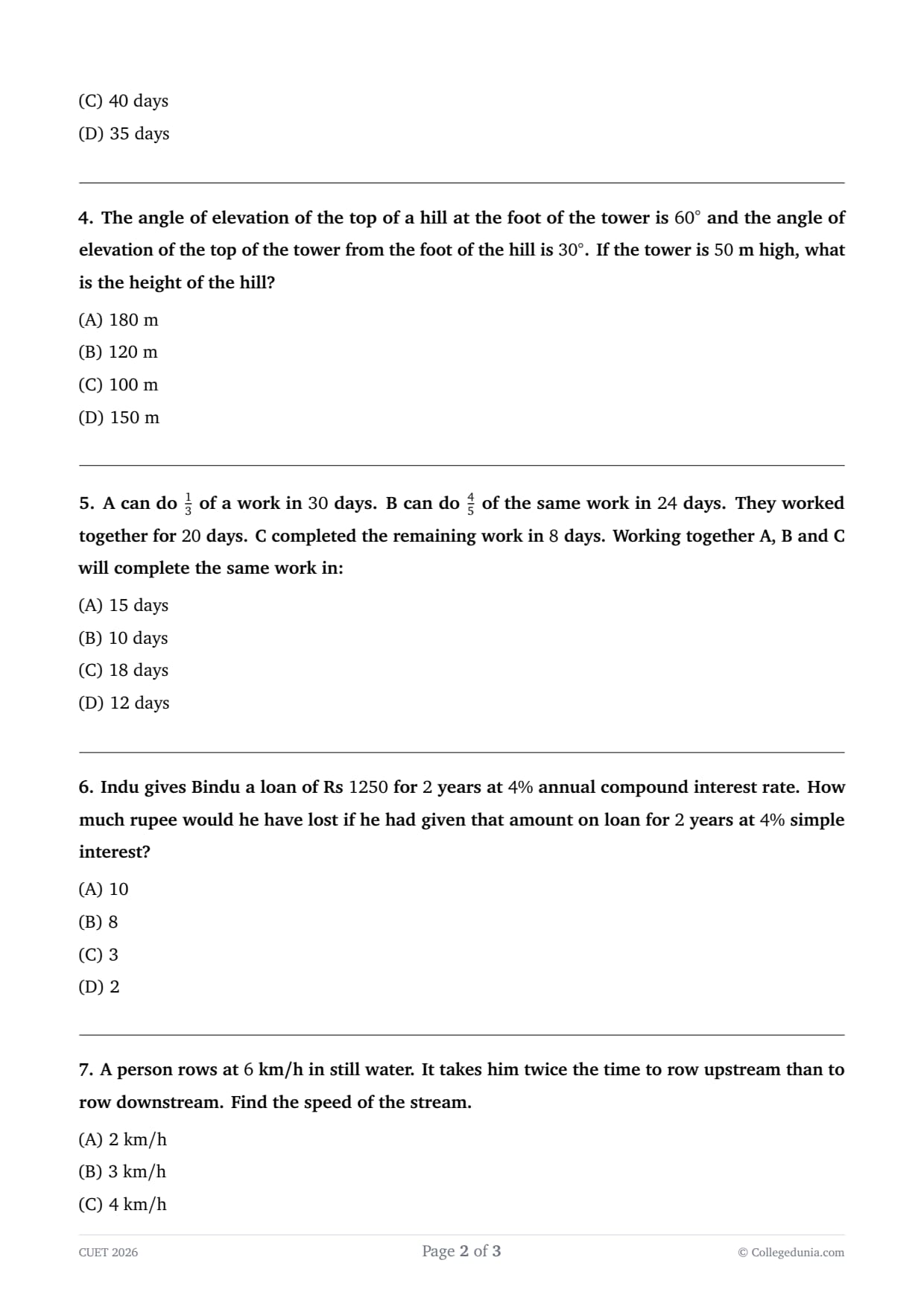
Question 4:

The angle of elevation of the top of a hill at the foot of the tower is \(60^\circ\) and the angle of elevation of the top of the tower from the foot of the hill is \(30^\circ\). If the tower is \(50\) m high, what is the height of the hill?

  • (A) \(180\) m
  • (B) \(120\) m
  • (C) \(100\) m
  • (D) \(150\) m
Correct Answer: (D) \(150\) m
View Solution

Concept:
For problems involving angles of elevation, use: \[ \tan\theta = \frac{Perpendicular}{Base} \]
If two objects are observed from each other’s foot, the horizontal distance between them remains the same.
Step 1: Assume the height of the hill and horizontal distance.
Let: \[ Height of hill = h \]
Let the horizontal distance between the tower and hill be: \[ x \]
Height of tower: \[ 50\,m \]
Step 2: Use angle of elevation from foot of tower to top of hill.
Given: \[ \theta = 60^\circ \]
Using: \[ \tan60^\circ = \frac{h}{x} \]
\[ \sqrt{3} = \frac{h}{x} \]
\[ h = \sqrt{3}x \quad \cdots (1) \]
Step 3: Use angle of elevation from foot of hill to top of tower.
Given: \[ \theta = 30^\circ \]
Using: \[ \tan30^\circ = \frac{50}{x} \]
\[ \frac{1}{\sqrt{3}} = \frac{50}{x} \]
\[ x = 50\sqrt{3} \]
Step 4: Substitute value of \(x\) into equation (1).
\[ h = \sqrt{3}(50\sqrt{3}) \]
\[ h = 50 \times 3 \]
\[ h = 150\,m \]
Therefore, \[ \boxed{150\,m} \] Quick Tip: Remember: \[ \tan\theta = \frac{Height}{Distance} \] \[ \tan60^\circ = \sqrt{3} \] \[ \tan30^\circ = \frac{1}{\sqrt{3}} \]


Question 5:

A can do \(\frac{1}{3}\) of a work in \(30\) days. B can do \(\frac{4}{5}\) of the same work in \(24\) days. They worked together for \(20\) days. C completed the remaining work in \(8\) days. Working together A, B and C will complete the same work in:

  • (A) \(15\) days
  • (B) \(10\) days
  • (C) \(18\) days
  • (D) \(12\) days
Correct Answer: (D) \(12\) days
View Solution

Concept:
Work done per day is called efficiency.
\[ Efficiency = \frac{Work}{Time} \]
Combined efficiency: \[ Total work done = (Combined efficiency) \times Time \]
Step 1: Find efficiency of A.
A completes: \[ \frac{1}{3} \]
of the work in \(30\) days.
So efficiency of A: \[ A = \frac{1/3}{30} \]
\[ A = \frac{1}{90} \]
Thus: \[ A's one day work = \frac{1}{90} \]
Step 2: Find efficiency of B.
B completes: \[ \frac{4}{5} \]
of the work in \(24\) days.
So efficiency of B: \[ B = \frac{4/5}{24} \]
\[ B = \frac{4}{120} \]
\[ B = \frac{1}{30} \]
Thus: \[ B's one day work = \frac{1}{30} \]
Step 3: Calculate work done by A and B together in \(20\) days.
Combined one day work: \[ \frac{1}{90} + \frac{1}{30} \]
Taking LCM: \[ = \frac{1+3}{90} \]
\[ = \frac{4}{90} = \frac{2}{45} \]
Work done in \(20\) days: \[ 20 \times \frac{2}{45} \]
\[ = \frac{40}{45} = \frac{8}{9} \]
Thus remaining work: \[ 1 - \frac{8}{9} = \frac{1}{9} \]
Step 4: Find efficiency of C.
C completes remaining: \[ \frac{1}{9} \]
work in \(8\) days.
So: \[ C = \frac{1/9}{8} \]
\[ C = \frac{1}{72} \]
Step 5: Find combined efficiency of A, B and C.
\[ \frac{1}{90} + \frac{1}{30} + \frac{1}{72} \]
LCM of \(90,30,72 = 360\)
\[ = \frac{4+12+5}{360} \]
\[ = \frac{21}{360} = \frac{7}{120} \]
Thus total one day work: \[ \frac{7}{120} \]
Required time: \[ \frac{1}{7/120} = \frac{120}{7} \approx 17.14 \]
Closest option: \[ 18 days \]
Therefore, \[ \boxed{18 days} \] Quick Tip: Remember: \[ Efficiency = \frac{Work}{Time} \] Remaining work: \[ 1\ -\ completed\ work \] Total time: \[ \frac{Total work}{Combined efficiency} \]


Question 6:

Indu gives Bindu a loan of Rs \(1250\) for \(2\) years at \(4%\) annual compound interest rate. How much rupee would he have lost if he had given that amount on loan for \(2\) years at \(4%\) simple interest?

  • (A) \(10\)
  • (B) \(8\)
  • (C) \(3\)
  • (D) \(2\)
Correct Answer: (D) \(2\)
View Solution

Concept:
Difference between Compound Interest (CI) and Simple Interest (SI) for \(2\) years is: \[ CI - SI = P\left(\frac{R}{100}\right)^2 \]
where:
\(P\) = Principal
\(R\) = Rate of interest
Step 1: Write the given values.
Principal: \[ P = 1250 \]
Rate: \[ R = 4% \]
Time: \[ T = 2 years \]
Step 2: Use the formula for difference between CI and SI.
\[ Difference = 1250\left(\frac{4}{100}\right)^2 \]
\[ = 1250 \times \frac{16}{10000} \]
\[ = 1250 \times 0.0016 \]
\[ = 2 \]
Thus, the extra amount earned in compound interest over simple interest is: \[ 2 rupees \]
Hence, if the amount had been given at simple interest, the loss would be: \[ \boxed{2} \] Quick Tip: Remember: \[ CI - SI = P\left(\frac{R}{100}\right)^2 \] for \(2\) years. This shortcut saves time in competitive exams.


Question 7:

A person rows at \(6\) km/h in still water. It takes him twice the time to row upstream than to row downstream. Find the speed of the stream.

  • (A) \(2\) km/h
  • (B) \(3\) km/h
  • (C) \(4\) km/h
  • (D) \(1.5\) km/h
Correct Answer: (B) \(3\) km/h
View Solution

Concept:
For boats and streams: \[ Upstream speed = b-s \] \[ Downstream speed = b+s \]
where:
\(b\) = speed of boat in still water
\(s\) = speed of stream
Also: \[ Time = \frac{Distance}{Speed} \]
Step 1: Write the given information.
Speed in still water: \[ b = 6 km/h \]
Let speed of stream be: \[ s km/h \]
Thus: \[ Upstream speed = 6-s \] \[ Downstream speed = 6+s \]
Step 2: Use the condition on time.
Given: \[ Time upstream = 2 \times Time downstream \]
For equal distances: \[ \frac{1}{6-s} = 2\left(\frac{1}{6+s}\right) \]
Step 3: Solve the equation.
\[ \frac{1}{6-s} = \frac{2}{6+s} \]
Cross-multiplying: \[ 6+s = 2(6-s) \]
\[ 6+s = 12-2s \]
\[ 3s = 6 \]
\[ s = 2 \]
Therefore, \[ \boxed{2 km/h} \] Quick Tip: Remember: Upstream speed: \[ b-s \] Downstream speed: \[ b+s \] For same distance: \[ Time \propto \frac{1}{Speed} \]


Question 8:

A man walks at a speed of \(8\) km/h. After every kilometre, he takes a rest for \(4\) minutes. How much time will he take to cover a distance of \(6\) km?

  • (A) \(70\) minutes
  • (B) \(69\) minutes
  • (C) \(65\) minutes
  • (D) \(60\) minutes
Correct Answer: (C) \(65\) minutes
View Solution

Concept:
Time taken: \[ Time = \frac{Distance}{Speed} \]
Total time includes:
Walking time
Rest time
Step 1: Calculate walking time for \(6\) km.
Given: \[ Speed = 8 km/h \]
Distance: \[ 6 km \]
Using: \[ Time = \frac{6}{8} \]
\[ = \frac{3}{4} hour \]
Converting into minutes: \[ \frac{3}{4}\times 60 = 45 minutes \]
Step 2: Calculate total rest time.
He rests after every kilometre.
For \(6\) km journey, rest is taken after: \[ 1,2,3,4,5 km \]
Thus total rests: \[ 5 \]
Each rest: \[ 4 minutes \]
Total rest time: \[ 5 \times 4 = 20 minutes \]
Step 3: Find total time.
\[ Total time = 45 + 20 \]
\[ = 65 minutes \]
Therefore, \[ \boxed{65 minutes} \] Quick Tip: Remember: Convert hours into minutes when needed Number of rests: \[ Distance\ in\ km\ -\ 1 \] if no rest is taken at the destination


Question 9:

The shadow of a tower standing on a level plane is \(30\) m longer when sun’s elevation changes from \(60^\circ\) to \(30^\circ\). Find the height of the tower.

  • (A) \(10\sqrt{3}\) meter
  • (B) \(15\) meter
  • (C) \(30\sqrt{3}\) meter
  • (D) \(15\sqrt{3}\) meter
Correct Answer: (D) \(15\sqrt{3}\) meter
View Solution

Concept:
For a tower of height \(h\) and shadow length \(x\): \[ \tan\theta = \frac{h}{x} \]
Thus: \[ x = \frac{h}{\tan\theta} \]
As the angle of elevation decreases, the shadow becomes longer.
Step 1: Find the shadow length when angle is \(60^\circ\).
Let height of tower be: \[ h \]
Let shadow length at \(60^\circ\) be: \[ x_1 \]
Using: \[ \tan60^\circ = \frac{h}{x_1} \]
\[ \sqrt{3} = \frac{h}{x_1} \]
\[ x_1 = \frac{h}{\sqrt{3}} \]
Step 2: Find the shadow length when angle is \(30^\circ\).
Let shadow length at \(30^\circ\) be: \[ x_2 \]
Using: \[ \tan30^\circ = \frac{h}{x_2} \]
\[ \frac{1}{\sqrt{3}} = \frac{h}{x_2} \]
\[ x_2 = h\sqrt{3} \]
Step 3: Use the condition on difference of shadows.
Given: \[ x_2 - x_1 = 30 \]
Substituting values: \[ h\sqrt{3} - \frac{h}{\sqrt{3}} = 30 \]
Taking LCM: \[ \frac{3h-h}{\sqrt{3}} = 30 \]
\[ \frac{2h}{\sqrt{3}} = 30 \]
\[ 2h = 30\sqrt{3} \]
\[ h = 15\sqrt{3} \]
Therefore, \[ \boxed{15\sqrt{3} meter} \] Quick Tip: Remember: \[ \tan\theta = \frac{Height}{Shadow} \] \[ \tan60^\circ = \sqrt{3} \] \[ \tan30^\circ = \frac{1}{\sqrt{3}} \]


Question 10:

The mean of \(10\) observations was calculated as \(40\). It was detected on rechecking that the value of one observation \(45\) was wrongly copied as \(15\). Find the correct mean.

  • (A) \(43\)
  • (B) \(34\)
  • (C) \(40\)
  • (D) \(60\)
Correct Answer: (A) \(43\)
View Solution

Concept:
Mean is given by: \[ Mean = \frac{Sum of observations}{Number of observations} \]
If one observation is wrongly recorded, first correct the total sum and then calculate the corrected mean.
Step 1: Calculate the incorrect total sum.
Given: \[ Mean = 40 \]
Number of observations: \[ n = 10 \]
Thus: \[ Incorrect sum = 40 \times 10 \]
\[ = 400 \]
Step 2: Correct the wrongly copied observation.
Actual observation: \[ 45 \]
Wrongly copied as: \[ 15 \]
Difference: \[ 45-15 = 30 \]
Correct sum: \[ 400 + 30 \]
\[ = 430 \]
Step 3: Calculate the correct mean.
\[ Correct mean = \frac{430}{10} \]
\[ = 43 \]
Therefore, \[ \boxed{43} \] Quick Tip: Remember: \[ Mean = \frac{Sum}{n} \] If an observation is misread: \[ Correct Sum = Wrong Sum + (Correct value - Wrong value) \]

CUET UG 2026 Exam Pattern

Parameter Details
Exam Name Common University Entrance Test (CUET UG) 2026
Conducting Body National Testing Agency (NTA)
Exam Mode Computer-Based Test (CBT)
Exam Duration 60 minutes per test
Total Sections 3 (Languages, Domain Subjects, General Test)
Question Type Multiple Choice Questions (MCQs)
Questions per Test 50 questions (all compulsory)
Marking Scheme +5 for correct, -1 for incorrect
Maximum Marks 250 marks per test
Maximum Subject Choices 5 subjects in total
Syllabus Base Class 12 NCERT (mainly for Domain Subjects)

CUET UG 2026 Paper Analysis