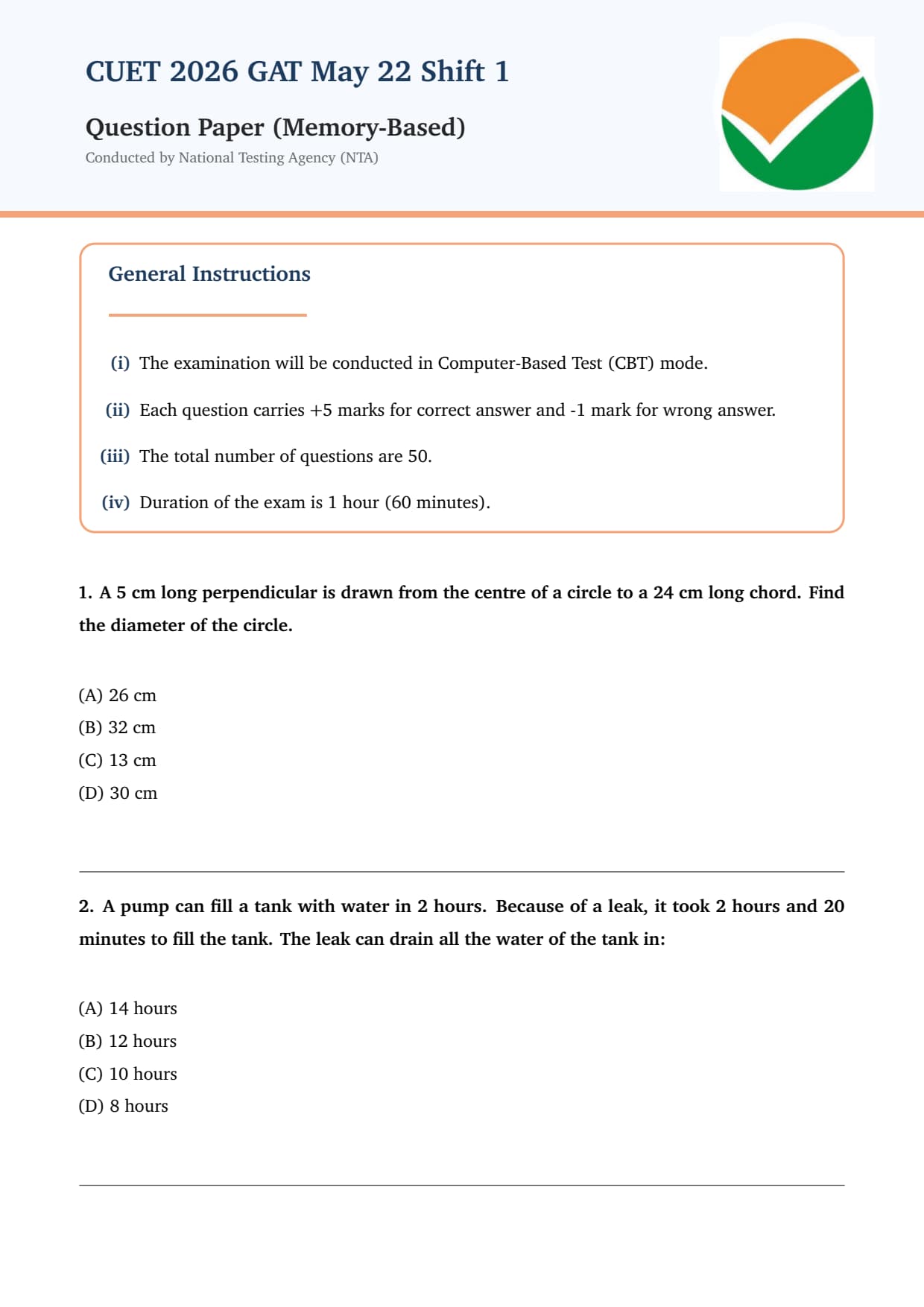
CUET 2026 May 22 Shift 1 General Aptitude Test Question Paper is available for download here. NTA is conducting the CUET 2026 exam from 11th May to 31st May.

  • CUET 2026 General Aptitude Test exam consists of 50 questions for 250 marks to be attempted in 60 minutes.
  • As per the marking scheme, 5 marks are awarded for each correct answer, and 1 mark is deducted for incorrect answer.

Candidates can download CUET 2026 May 22 Shift 1 General Aptitude Test Question Paper with Answer Key and Solution PDF from links provided below.

Related Links:

CUET 2026 General Aptitude Test May 22 Shift 1 Question Paper with Solution PDF

CUET May 22 Shift 1 General Aptitude Test Question Paper 2026 Download PDF Check Solutions

Question 1:

A 5 cm long perpendicular is drawn from the centre of a circle to a 24 cm long chord. Find the diameter of the circle.

  • (A) 26 cm
  • (B) 32 cm
  • (C) 13 cm
  • (D) 30 cm
Correct Answer: (A) 26 cm
View Solution


Step 1: Understanding the Question:

In this problem, we are given a circle with a chord of known length and the perpendicular distance from the center of the circle to this chord.

We need to determine the diameter of the circle.

This is a standard geometry problem that involves the relationship between the radius, the chord, and the perpendicular distance.

We will use circle geometry theorems and the Pythagorean theorem to find the radius and then compute the diameter.


Step 2: Key Formula or Approach:


A perpendicular line segment drawn from the center of a circle to any of its chords bisects the chord into two equal parts.

The radius (\(r\)), the perpendicular distance (\(p\)), and half of the chord length (\(c/2\)) form a right-angled triangle.

The Pythagorean theorem states: \( r^2 = p^2 + (c/2)^2 \), where \(r\) is the radius, \(p\) is the perpendicular distance, and \(c\) is the chord length.

The diameter (\(d\)) of the circle is twice its radius: \( d = 2r \).


Step 3: Detailed Explanation:


Let the center of the circle be represented by \(O\).

Let the chord be represented by \(AB\), with a given length of \(24 cm\).

Let the perpendicular line segment from \(O\) to the chord \(AB\) meet the chord at point \(M\).

The length of this perpendicular distance \(OM\) is given as \(5 cm\).

According to the property of circles, the perpendicular from the center bisects the chord. Thus, point \(M\) is the midpoint of \(AB\).

This gives the length of the half-chord: \( AM = MB = \frac{AB}{2} = \frac{24}{2} = 12 cm \).

Now, we can construct a right-angled triangle \(\triangle OMA\), where the hypotenuse \(OA\) represents the radius \(r\) of the circle.

Applying the Pythagorean theorem to \(\triangle OMA\):
\[ OA^2 = OM^2 + AM^2 \]

Substituting the given numerical values into the equation:
\[ r^2 = 5^2 + 12^2 \]

Evaluating the squares:
\[ r^2 = 25 + 144 \]
\[ r^2 = 169 \]

Taking the square root on both sides to find the radius \(r\):
\[ r = \sqrt{169} = 13 cm \]

To find the diameter \(d\) of the circle, we multiply the radius by 2:
\[ d = 2 \times r = 2 \times 13 = 26 cm \]

Therefore, the diameter of the circle is \(26 cm\).


Step 4: Final Answer:

The diameter of the circle is calculated to be \(26 cm\), which corresponds directly to Option (A).
Quick Tip: Remember the standard Pythagorean triple \((5, 12, 13)\).
When you see a perpendicular of \(5\) and a half-chord of \(12\), the radius must be \(13\).
Double this value immediately to get the diameter: \( 13 \times 2 = 26 cm \).
This saves valuable time during competitive exams.


Question 2:

A pump can fill a tank with water in 2 hours. Because of a leak, it took 2 hours and 20 minutes to fill the tank. The leak can drain all the water of the tank in:

  • (A) 14 hours
  • (B) 12 hours
  • (C) 10 hours
  • (D) 8 hours
Correct Answer: (A) 14 hours
View Solution


Step 1: Understanding the Question:

This question belongs to the topic of Pipes and Cisterns.

We are given the rate at which a pump can fill a tank.

However, when a leak is present, the effective filling rate decreases, resulting in an increased filling time.

We need to determine the rate of the leak and find how long it would take for this leak to completely empty a full tank.


Step 2: Key Formula or Approach:


Let the rate of the filling pump be \(R_{pump}\) and the rate of the leak be \(R_{leak}\) (which represents negative work).

The combined rate when both are active is \( R_{combined} = R_{pump} - R_{leak} \).

Rate is defined as the fraction of the tank filled or emptied per hour: \( R = \frac{1}{Time} \).

Total time taken by the leak to empty the tank is \( T_{leak} = \frac{1}{R_{leak}} \).


Step 3: Detailed Explanation:


First, express the rate of the pump alone:
\[ R_{pump} = \frac{1}{2} tank/hour \]

Convert the combined filling time with the leak from hours and minutes into a single fraction of hours.

The time taken with the leak is \(2 hours and 20 minutes\).

Since \(60 minutes = 1 hour\), \(20 minutes = \frac{20}{60} = \frac{1}{3} hours\).

Therefore, the total combined time is:
\[ T_{combined} = 2 + \frac{1}{3} = \frac{7}{3} hours \]

Now, express the combined rate of filling:
\[ R_{combined} = \frac{1}{T_{combined}} = \frac{3}{7} tank/hour \]

Set up the equation representing the relationship between the rates:
\[ R_{combined} = R_{pump} - R_{leak} \]

Substitute the calculated rate values into this equation:
\[ \frac{3}{7} = \frac{1}{2} - R_{leak} \]

Rearrange the equation to isolate \(R_{leak}\):
\[ R_{leak} = \frac{1}{2} - \frac{3}{7} \]

Find a common denominator to subtract the fractions:
\[ R_{leak} = \frac{7 - 6}{14} = \frac{1}{14} tank/hour \]

This means the leak can empty \(\frac{1}{14}\) of the tank in \(1 hour\).

To find the total time \(T_{leak}\) required for the leak to empty the entire tank:
\[ T_{leak} = \frac{1}{R_{leak}} = 14 hours \]

Thus, the leak can drain all the water of the tank in \(14 hours\).


Step 4: Final Answer:

The leak will take \(14 hours\) to empty the tank completely, which matches Option (A).
Quick Tip: For any work/rate problems, use the formula: \( \frac{1}{A} - \frac{1}{B} = \frac{1}{C} \).
Here, \( \frac{1}{2} - \frac{1}{L} = \frac{3}{7} \implies \frac{1}{L} = \frac{1}{2} - \frac{3}{7} = \frac{1}{14} \).
Instantly flip \( \frac{1}{14} \) to get the answer as \(14 hours\).


Question 3:

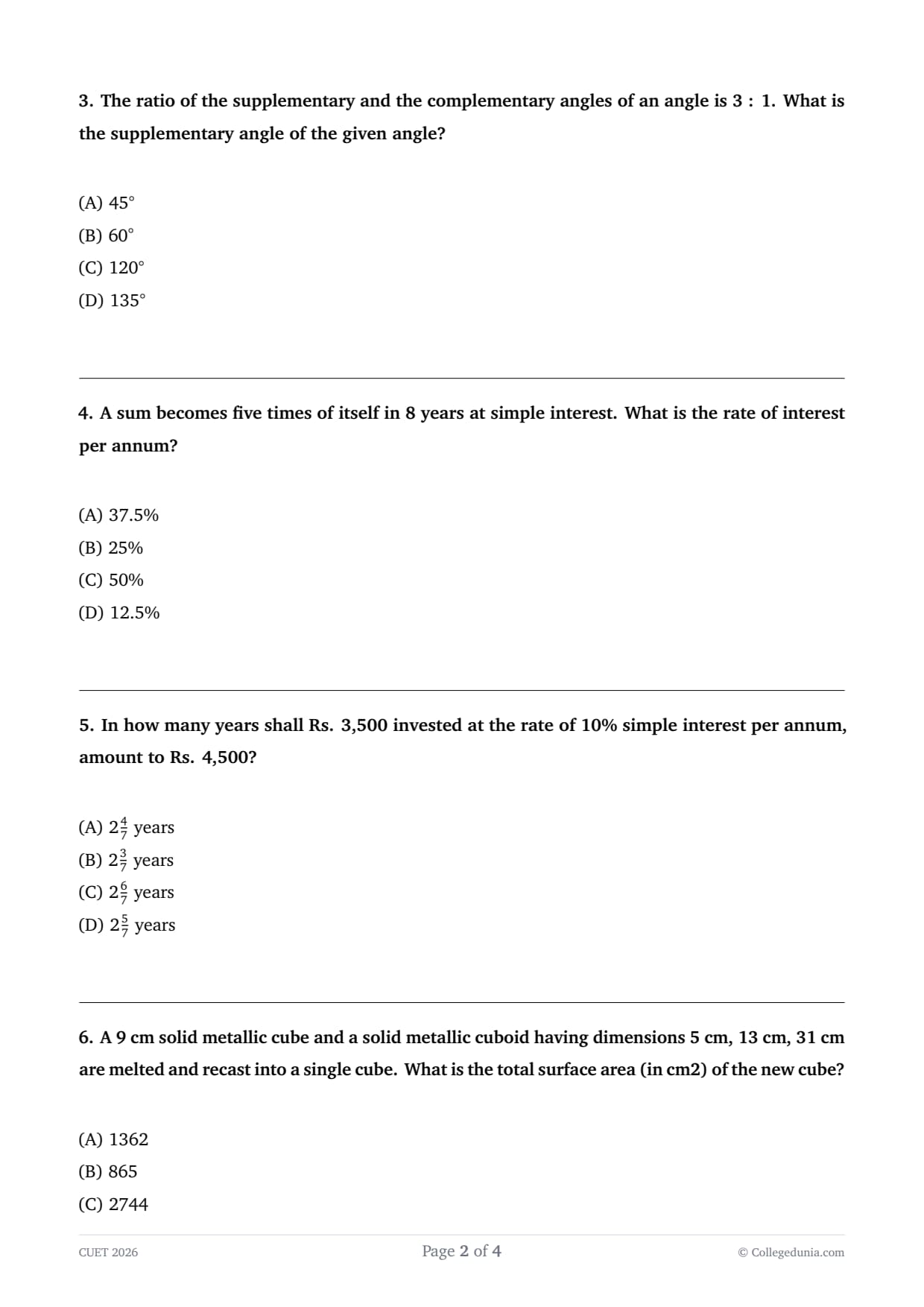
The ratio of the supplementary and the complementary angles of an angle is 3 : 1. What is the supplementary angle of the given angle?

  • (A) 45\(^{\circ}\)
  • (B) 60\(^{\circ}\)
  • (C) 120\(^{\circ}\)
  • (D) 135\(^{\circ}\)
Correct Answer: (D) 135\(^{\circ}\)
View Solution


Step 1: Understanding the Question:

This problem requires an understanding of basic geometric definitions of angles.

Specifically, we need to know the definitions of complementary angles and supplementary angles.

Complementary angles are two angles whose sum is \(90^\circ\), whereas supplementary angles are two angles whose sum is \(180^\circ\).

By setting up a ratio of these two quantities for a common angle, we can solve for the angle itself and then find its supplementary counterpart.


Step 2: Key Formula or Approach:


Let the unknown angle be represented as \(x\).

The complementary angle of \(x\) is defined as: \( 90^\circ - x \).

The supplementary angle of \(x\) is defined as: \( 180^\circ - x \).

The ratio of the supplementary angle to the complementary angle is given as:
\[ \frac{180^\circ - x}{90^\circ - x} = \frac{3}{1} \]


Step 3: Detailed Explanation:


Let us represent the given unknown angle as \(x\) (in degrees).

Express the supplementary angle as \((180 - x)\) and the complementary angle as \((90 - x)\).

Set up the algebraic equation based on the given ratio of \(3 : 1\):
\[ \frac{180 - x}{90 - x} = \frac{3}{1} \]

Perform cross-multiplication to solve the linear equation:
\[ 1 \times (180 - x) = 3 \times (90 - x) \]
\[ 180 - x = 270 - 3x \]

Rearrange the terms to group the variable \(x\) on one side and the constants on the other:
\[ 3x - x = 270 - 180 \]
\[ 2x = 90 \]

Divide by 2 to find the value of \(x\):
\[ x = 45^\circ \]

Thus, the original angle is \(45^\circ\).

Now, the question asks for the supplementary angle of this given angle \(x\).

Calculate the supplementary angle:
\[ Supplementary Angle = 180^\circ - x = 180^\circ - 45^\circ = 135^\circ \]

Hence, the supplementary angle is \(135^\circ\).


Step 4: Final Answer:

The supplementary angle of the given angle is \(135^\circ\), which corresponds to Option (D).
Quick Tip: Let the complement be \(C\) and the supplement be \(S\).
The difference between the supplement and complement of any angle is always exactly \( 180^\circ - 90^\circ = 90^\circ \).
Since the ratio is \(3 : 1\), the difference in ratio units is \( 3 - 1 = 2 \) units.
Therefore, \( 2 units = 90^\circ \implies 1 unit (Complement) = 45^\circ \).
So, the Supplement is \( 3 units = 3 \times 45^\circ = 135^\circ \).
This method allows you to solve the entire problem mentally!


Question 4:

A sum becomes five times of itself in 8 years at simple interest. What is the rate of interest per annum?

  • (A) 37.5%
  • (B) 25%
  • (C) 50%
  • (D) 12.5%
Correct Answer: (C) 50%
View Solution


Step 1: Understanding the Question:

This question deals with Simple Interest (SI).

We are told that a principal sum of money grows to five times its original value over a duration of \(8 years\).

This growth is entirely due to the accumulation of simple interest.

We need to calculate the annual rate of interest (\(R%\)) that causes this specific growth.


Step 2: Key Formula or Approach:


Let the principal sum be \(P\).

If the sum becomes \(n\) times itself, the final Amount \( A = nP \).

Simple Interest is calculated as: \( SI = A - P = nP - P = (n - 1)P \).

The standard formula for Simple Interest is: \( SI = \frac{P \times R \times T}{100} \).

Substituting \( SI = (n - 1)P \), we get the rate formula: \( R = \frac{(n - 1) \times 100}{T} \).


Step 3: Detailed Explanation:


Let the principal sum of money invested be denoted as \(P\).

The final accumulated amount after \(8 years\) is \(5\) times the principal, so:
\[ A = 5P \]

The simple interest earned (\(SI\)) is the difference between the final amount and the initial principal:
\[ SI = A - P = 5P - P = 4P \]

The time period (\(T\)) for this investment is given as:
\[ T = 8 years \]

Now, write down the formula for simple interest:
\[ SI = \frac{P \times R \times T}{100} \]

Substitute the values of \(SI = 4P\) and \(T = 8\) into the formula:
\[ 4P = \frac{P \times R \times 8}{100} \]

Since \(P\) is positive and non-zero, we can divide both sides of the equation by \(P\) to eliminate it:
\[ 4 = \frac{8R}{100} \]

Rearrange the equation to solve for the rate of interest \(R\):
\[ 4 \times 100 = 8R \]
\[ 400 = 8R \]
\[ R = \frac{400}{8} = 50% \]


Step 4: Final Answer:

The rate of interest per annum is \(50%\), which corresponds to Option (C).
Quick Tip: Whenever a sum becomes \(n\) times itself, the interest earned is always \((n-1)\) times the principal.
For \(5\) times, the interest earned is \(400%\).
To find the rate, simply divide this interest percentage by the time period:
\[ Rate = \frac{400%}{8 years} = 50% per annum \]
This simple shortcut avoids any algebraic variable manipulation.


Question 5:

In how many years shall Rs. 3,500 invested at the rate of 10% simple interest per annum, amount to Rs. 4,500?

  • (A) 2\(\frac{4}{7}\) years
  • (B) 2\(\frac{3}{7}\) years
  • (C) 2\(\frac{6}{7}\) years
  • (D) 2\(\frac{5}{7}\) years
Correct Answer: (C) 2\(\frac{6}{7}\) years
View Solution


Step 1: Understanding the Question:

In this problem, we are given the Principal sum, the final Amount, and the annual rate of simple interest.

Our task is to find the duration or time period (in years) required for this growth to occur.

We will calculate the interest earned first and then apply the standard Simple Interest formula to solve for time.


Step 2: Key Formula or Approach:


Simple Interest (\(SI\)) is the difference between the final Amount (\(A\)) and the Principal (\(P\)): \( SI = A - P \).

The standard Simple Interest formula is: \( SI = \frac{P \times R \times T}{100} \).

Rearranging the formula to solve for Time (\(T\)): \( T = \frac{SI \times 100}{P \times R} \).


Step 3: Detailed Explanation:


Identify and write down the given values from the question:

Principal (\(P\)) = \(Rs. 3500\)

Amount (\(A\)) = \(Rs. 4500\)

Rate of Interest (\(R\)) = \(10%\) per annum

Calculate the total Simple Interest (\(SI\)) earned on the investment:
\[ SI = A - P = 4500 - 3500 = Rs. 1000 \]

Now, use the Simple Interest formula to express the relation between \(SI\), \(P\), \(R\), and \(T\):
\[ 1000 = \frac{3500 \times 10 \times T}{100} \]

Simplify the expression on the right-hand side by canceling the zeros:
\[ 1000 = \frac{35000 \times T}{100} \]
\[ 1000 = 350 \times T \]

Solve for the time period \(T\) by dividing both sides by \(350\):
\[ T = \frac{1000}{350} \]

Simplify the fraction by dividing the numerator and denominator by their greatest common divisor, which is \(50\):
\[ T = \frac{1000 \div 50}{350 \div 50} = \frac{20}{7} years \]

Convert the improper fraction \(\frac{20}{7}\) into a mixed fraction:
\[ 20 = 7 \times 2 + 6 \]
\[ T = 2\frac{6}{7} years \]

Thus, the time required is \(2\frac{6}{7} years\).


Step 4: Final Answer:

The time required for Rs. 3,500 to amount to Rs. 4,500 at a 10% interest rate is \(2\frac{6}{7} years\), which corresponds to Option (C).
Quick Tip: Quickly calculate the interest: \( 4500 - 3500 = 1000 \).
Since the interest rate is \(10%\) per annum, the interest earned in one year is \(10%\) of \( 3500 = 350 \).
To find the total number of years, divide the total interest by the interest earned in one year:
\[ T = \frac{1000}{350} = \frac{20}{7} = 2\frac{6}{7} years \]
This is highly intuitive and avoids formulas.


Question 6:

A 9 cm solid metallic cube and a solid metallic cuboid having dimensions 5 cm, 13 cm, 31 cm are melted and recast into a single cube. What is the total surface area (in cm2) of the new cube?

  • (A) 1362
  • (B) 865
  • (C) 2744
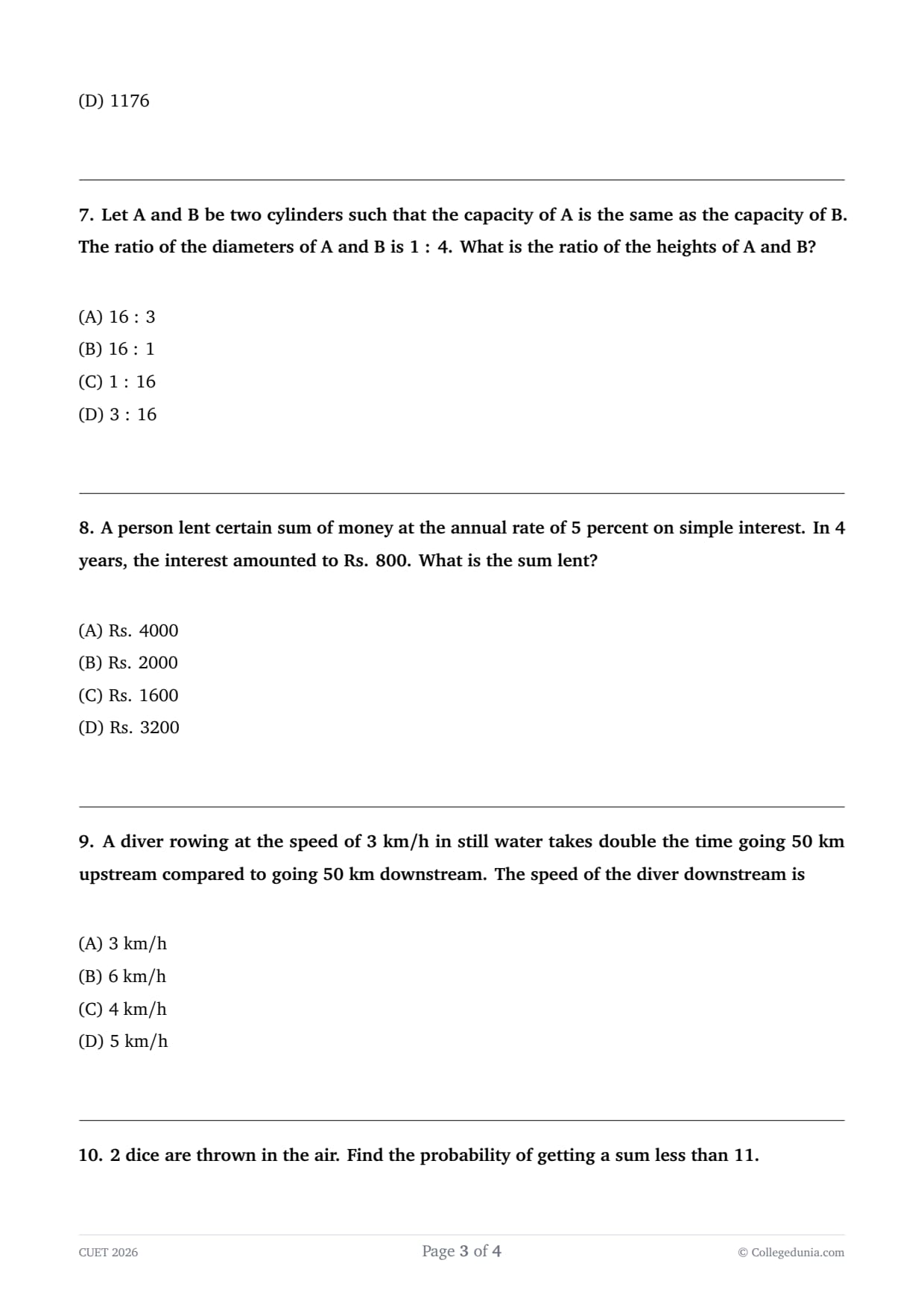
  • (D) 1176
Correct Answer: (D) 1176
View Solution


Step 1: Understanding the Question:

This problem is based on the concept of melting and recasting 3D geometric shapes.

When solid objects are melted and recast into a new shape, the total volume remains conserved.

We need to compute the combined volume of the original cube and the cuboid.

This combined volume will equal the volume of the newly formed single cube.

From this volume, we can find the side length of the new cube, and subsequently calculate its total surface area.


Step 2: Key Formula or Approach:


Volume of a cube with side \(s\) is: \( V_{cube} = s^3 \).

Volume of a cuboid with dimensions \(l\), \(b\), and \(h\) is: \( V_{cuboid} = l \times b \times h \).

Conserved total volume: \( V_{new cube} = V_{original cube} + V_{cuboid} \).

Let the side length of the new cube be \(a\). Thus, \( a^3 = V_{new cube} \implies a = \sqrt[3]{V_{new cube}} \).

Total Surface Area of the new cube is: \( TSA = 6a^2 \).


Step 3: Detailed Explanation:


First, calculate the volume of the original solid metallic cube.

The side length of the original cube is \(s = 9 cm\).
\[ V_{original cube} = 9^3 = 9 \times 9 \times 9 = 729 cm^3 \]

Next, calculate the volume of the original solid metallic cuboid.

The dimensions of the cuboid are length \(l = 5 cm\), width \(b = 13 cm\), and height \(h = 31 cm\).
\[ V_{cuboid} = 5 \times 13 \times 31 = 65 \times 31 = 2015 cm^3 \]

Since both metallic bodies are melted and recast together, the total volume of the new cube is:
\[ V_{new cube} = V_{original cube} + V_{cuboid} \]
\[ V_{new cube} = 729 + 2015 = 2744 cm^3 \]

Let \(a\) be the side of the newly formed cube.
\[ a^3 = 2744 \]

To find \(a\), take the cube root of \(2744\):
\[ a = \sqrt[3]{2744} \]

We know that \( 10^3 = 1000 \) and \( 20^3 = 8000 \). Since \(2744\) ends in 4, its cube root must end in 4. Let us test \(14\):
\[ 14 \times 14 \times 14 = 196 \times 14 = 2744 \]

This confirms that the side length of the new cube is \(a = 14 cm\).

Finally, calculate the total surface area (\(TSA\)) of the new cube using the formula \(6a^2\):
\[ TSA = 6 \times a^2 \]
\[ TSA = 6 \times 14^2 = 6 \times 196 \]
\[ TSA = 1176 cm^2 \]

Thus, the total surface area of the new cube is \(1176 cm^2\).


Step 4: Final Answer:

The total surface area of the recast cube is \(1176 cm^2\), which corresponds to Option (D).
Quick Tip: Familiarize yourself with cubes of numbers up to 20.
Knowing that \( 14^3 = 2744 \) instantly gives you the side length of the new cube as \(14 cm\).
Also, note that the surface area must be a multiple of 6 (from \( 6a^2 \)).
Checking the options:
\( 1362 \div 6 = 227 \) (not a perfect square)
\(865\) is not divisible by 6
\(2744\) is not divisible by 6
\( 1176 \div 6 = 196 = 14^2 \) (perfect match!)
This option analysis can solve the problem in seconds without even calculating the volume!


Question 7:

Let A and B be two cylinders such that the capacity of A is the same as the capacity of B. The ratio of the diameters of A and B is 1 : 4. What is the ratio of the heights of A and B?

  • (A) 16 : 3
  • (B) 16 : 1
  • (C) 1 : 16
  • (D) 3 : 16
Correct Answer: (B) 16 : 1
View Solution


Step 1: Understanding the Question:

This problem involves the geometric property of cylinders.

We are given that two cylinders, \(A\) and \(B\), have equal capacities (volumes).

We are also given the ratio of their diameters and need to find the ratio of their heights.

Using the cylinder volume formula, we can relate the radii and heights to find the required ratio.


Step 2: Key Formula or Approach:


The volume (capacity) of a cylinder is given by the formula: \( V = \pi r^2 h \), where \(r\) is the radius and \(h\) is the height.

Since the diameter ratio is equal to the radius ratio, we have: \( \frac{r_A}{r_B} = \frac{d_A}{d_B} = \frac{1}{4} \).

Since the volumes are equal (\( V_A = V_B \)), we can write: \( \pi r_A^2 h_A = \pi r_B^2 h_B \).

This simplifies to the ratio of heights: \( \frac{h_A}{h_B} = \left(\frac{r_B}{r_A}\right)^2 \).


Step 3: Detailed Explanation:


Let the radii of cylinders \(A\) and \(B\) be \(r_A\) and \(r_B\), respectively.

Let the heights of cylinders \(A\) and \(B\) be \(h_A\) and \(h_B\), respectively.

The ratio of the diameters of cylinder \(A\) to cylinder \(B\) is given as \(1 : 4\).

Since radius is half of the diameter, the ratio of the radii is also \(1 : 4\):
\[ \frac{r_A}{r_B} = \frac{1}{4} \]

This implies that:
\[ r_B = 4 r_A \]

The capacities of both cylinders are equal, meaning their volumes are identical:
\[ V_A = V_B \]

Substitute the volume formula for both cylinders into this relation:
\[ \pi r_A^2 h_A = \pi r_B^2 h_B \]

Divide both sides by \(\pi\) to simplify:
\[ r_A^2 h_A = r_B^2 h_B \]

Rearrange the terms to express the ratio of heights \(\frac{h_A}{h_B}\):
\[ \frac{h_A}{h_B} = \frac{r_B^2}{r_A^2} = \left(\frac{r_B}{r_A}\right)^2 \]

Substitute the ratio \(\frac{r_B}{r_A} = \frac{4}{1}\) into the equation:
\[ \frac{h_A}{h_B} = \left(\frac{4}{1}\right)^2 = \frac{16}{1} \]

Thus, the ratio of the heights of cylinder \(A\) to cylinder \(B\) is \(16 : 1\).


Step 4: Final Answer:

The ratio of the heights of cylinders A and B is \(16 : 1\), which matches Option (B).
Quick Tip: Since volume \( V \propto r^2 h \), for constant volume, height is inversely proportional to the square of the radius (\( h \propto \frac{1}{r^2} \)).
The radius ratio is \(1 : 4\).
Squaring this ratio gives \(1 : 16\).
Taking the inverse of this ratio gives the height ratio: \(16 : 1\).
This mental calculation avoids writing equations.


Question 8:

A person lent certain sum of money at the annual rate of 5 percent on simple interest. In 4 years, the interest amounted to Rs. 800. What is the sum lent?

  • (A) Rs. 4000
  • (B) Rs. 2000
  • (C) Rs. 1600
  • (D) Rs. 3200
Correct Answer: (A) Rs. 4000
View Solution


Step 1: Understanding the Question:

In this problem, we are given the details of a loan transaction involving simple interest.

The rate of interest is \(5%\) per annum, the duration is \(4 years\), and the total simple interest accrued is \(Rs. 800\).

We need to determine the original principal amount (the "sum lent").

This is a direct application of the standard simple interest formula.


Step 2: Key Formula or Approach:


The standard Simple Interest formula is: \( SI = \frac{P \times R \times T}{100} \).

Here, \(SI\) is the simple interest, \(P\) is the Principal, \(R\) is the Rate of interest per annum, and \(T\) is the Time in years.

Rearranging the formula to solve for the Principal (\(P\)): \( P = \frac{SI \times 100}{R \times T} \).


Step 3: Detailed Explanation:


Identify the given quantities from the problem statement:

Rate of Interest (\(R\)) = \(5%\) per annum

Time Period (\(T\)) = \(4 years\)

Simple Interest (\(SI\)) = \(Rs. 800\)

Let the sum lent (Principal) be represented by \(P\).

Substitute these values into the Simple Interest formula:
\[ 800 = \frac{P \times 5 \times 4}{100} \]

Simplify the numerator on the right-hand side:
\[ 5 \times 4 = 20 \]
\[ 800 = \frac{20P}{100} \]

Further simplify the fraction \(\frac{20}{100}\) to \(\frac{1}{5}\):
\[ 800 = \frac{P}{5} \]

Solve for the Principal \(P\) by multiplying both sides of the equation by \(5\):
\[ P = 800 \times 5 \]
\[ P = 4000 \]

Thus, the original sum of money lent is \(Rs. 4000\).


Step 4: Final Answer:

The sum lent is Rs. 4000, which corresponds to Option (A).
Quick Tip: Under simple interest, the interest percentage accumulates linearly.
For a rate of \(5%\) per annum over \(4 years\), the total interest earned is:
\[ 5% \times 4 = 20% of the principal \]
We are given that \(20%\) of the principal is equal to \(Rs. 800\).
To find the total principal (\(100%\)), simply multiply by 5:
\[ 100% = 800 \times 5 = Rs. 4000 \]
This is an efficient, non-algebraic method.


Question 9:

A diver rowing at the speed of 3 km/h in still water takes double the time going 50 km upstream compared to going 50 km downstream. The speed of the diver downstream is

  • (A) 3 km/h
  • (B) 6 km/h
  • (C) 4 km/h
  • (D) 5 km/h
Correct Answer: (C) 4 km/h
View Solution


Step 1: Understanding the Question:

This problem is from the topic of Boats and Streams.

We are given the speed of a diver in still water and a scenario comparing the travel times over the same distance (\(50 km\)) upstream and downstream.

The speed of the current affects the overall upstream and downstream speeds.

We need to determine this stream speed first and then calculate the final downstream speed of the diver.


Step 2: Key Formula or Approach:


Let the speed of the diver in still water be \(u = 3 km/h\).

Let the speed of the water current be \(v km/h\).

Downstream speed (\(S_{down}\)) is given by: \( u + v = 3 + v \).

Upstream speed (\(S_{up}\)) is given by: \( u - v = 3 - v \).

Since Time = \(\frac{Distance}{Speed}\), the times taken are: \( T_{up} = \frac{d}{u-v} \) and \( T_{down} = \frac{d}{u+v} \).

The problem states: \( T_{up} = 2 \times T_{down} \).


Step 3: Detailed Explanation:


Let the speed of the water current be \(v km/h\).

Write down the expressions for the speeds:

Downstream speed = \((3 + v) km/h\)

Upstream speed = \((3 - v) km/h\)

Write down the expressions for the travel times for a distance of \(50 km\):
\[ T_{up} = \frac{50}{3 - v} hours \]
\[ T_{down} = \frac{50}{3 + v} hours \]

According to the given condition, the upstream time is twice the downstream time:
\[ T_{up} = 2 \times T_{down} \]

Substitute the time expressions into the condition:
\[ \frac{50}{3 - v} = 2 \times \frac{50}{3 + v} \]

Divide both sides by \(50\) to simplify:
\[ \frac{1}{3 - v} = \frac{2}{3 + v} \]

Cross-multiply to solve for \(v\):
\[ 1 \times (3 + v) = 2 \times (3 - v) \]
\[ 3 + v = 6 - 2v \]

Rearrange the terms to group \(v\) on one side:
\[ v + 2v = 6 - 3 \]
\[ 3v = 3 \]
\[ v = 1 km/h \]

Now, determine the downstream speed of the diver:
\[ S_{down} = u + v = 3 + 1 = 4 km/h \]

Therefore, the downstream speed of the diver is \(4 km/h\).


Step 4: Final Answer:

The downstream speed of the diver is \(4 km/h\), which matches Option (C).
Quick Tip: If the time taken upstream is \(k\) times the time taken downstream over the same distance, then:
\[ \frac{u}{v} = \frac{k+1}{k-1} \]
Here, \(k = 2\) and \(u = 3\):
\[ \frac{3}{v} = \frac{2+1}{2-1} = 3 \implies v = 1 km/h \]
Downstream Speed = \( u + v = 3 + 1 = 4 km/h \).
This general formula is extremely useful for exams.


Question 10:

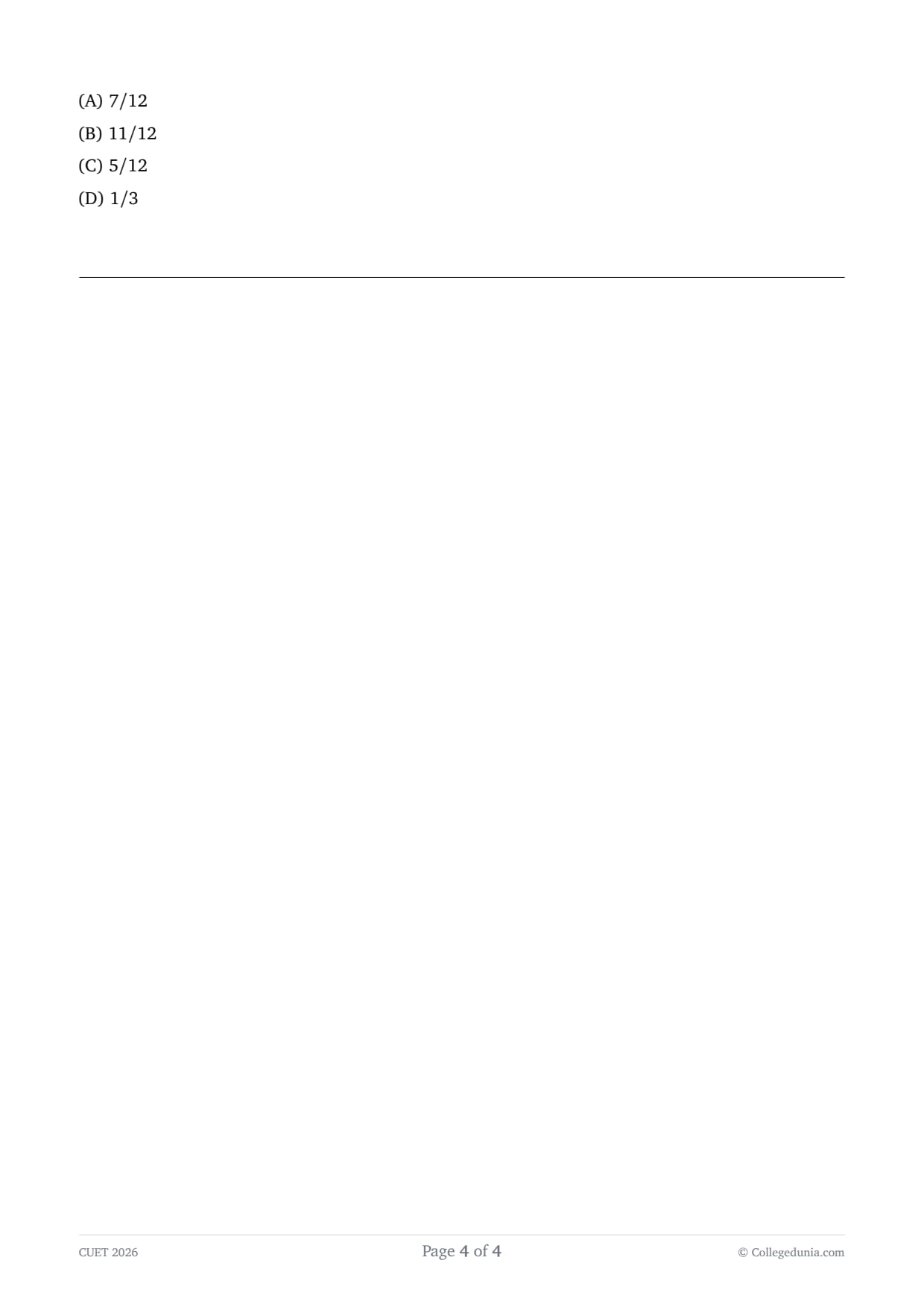
2 dice are thrown in the air. Find the probability of getting a sum less than 11.

  • (A) 7/12
  • (B) 11/12
  • (C) 5/12
  • (D) 1/3
Correct Answer: (B) 11/12
View Solution


Step 1: Understanding the Question:

This question relates to the study of probability when rolling two fair, independent, six-sided dice.

The sum of the numbers showing on top of both dice can range from a minimum of 2 up to a maximum of 12.

We need to find the probability of getting a sum that is strictly less than 11.

Since counting all outcomes for sums less than 11 is tedious, it is much easier to use the complementary probability rule.


Step 2: Key Formula or Approach:


Total number of outcomes when two dice are rolled is \( n(S) = 6 \times 6 = 36 \).

The complementary probability formula is: \( P(A) = 1 - P(A') \), where \(A'\) is the complement of event \(A\).

Here, event \(A\) is "sum is less than 11" (i.e., \( Sum < 11 \)).

The complement event \(A'\) is "sum is 11 or greater" (i.e., \( Sum \ge 11 \)).

The possible sums \( \ge 11 \) are \(11\) and \(12\).


Step 3: Detailed Explanation:


First, let us identify the total number of outcomes in the sample space \(S\) of rolling two six-sided dice:
\[ n(S) = 6 \times 6 = 36 \]

Now, let us define the complementary event \(A'\), where the sum of the two dice is greater than or equal to 11.

Let us list the specific outcomes that yield a sum of \(11\):

\((5, 6)\) and \((6, 5)\)

Let us list the specific outcomes that yield a sum of \(12\):

\((6, 6)\)

Thus, the total favorable outcomes for the complement event \(A'\) are:
\[ Outcomes(A') = \{(5,6), (6,5), (6,6)\} \]

The number of favorable outcomes for \(A'\) is:
\[ n(A') = 3 \]

Calculate the probability of the complementary event \(P(A')\):
\[ P(A') = \frac{n(A')}{n(S)} = \frac{3}{36} = \frac{1}{12} \]

Now, calculate the probability of the target event \(A\) (sum less than 11) using the complement rule:
\[ P(A) = 1 - P(A') \]
\[ P(A) = 1 - \frac{1}{12} \]
\[ P(A) = \frac{12 - 1}{12} = \frac{11}{12} \]

Thus, the probability of getting a sum less than 11 is \(\frac{11}{12}\).


Step 4: Final Answer:

The probability of getting a sum less than 11 is \(11/12\), which corresponds to Option (B).
Quick Tip: Always use the complement rule \( 1 - P(Not A) \) when asked for "less than" or "greater than" probabilities that contain many terms.
The total number of outcomes is 36.
The only sums that are NOT less than 11 are 11 (2 ways) and 12 (1 way).
This gives 3 outcomes out of 36.
Subtract from 1: \( 1 - \frac{3}{36} = 1 - \frac{1}{12} = \frac{11}{12} \).
This takes very little time to solve!

CUET UG 2026 Exam Pattern

Parameter Details
Exam Name Common University Entrance Test (CUET UG) 2026
Conducting Body National Testing Agency (NTA)
Exam Mode Computer-Based Test (CBT)
Exam Duration 60 minutes per test
Total Sections 3 (Languages, Domain Subjects, General Test)
Question Type Multiple Choice Questions (MCQs)
Questions per Test 50 questions (all compulsory)
Marking Scheme +5 for correct, -1 for incorrect
Maximum Marks 250 marks per test
Maximum Subject Choices 5 subjects in total
Syllabus Base Class 12 NCERT (mainly for Domain Subjects)

CUET UG 2026 Paper Analysis