CUET 2026 May 22 Shift 1 Chemistry Question Paper is available for download here. NTA conducted the CUET 2026 exam from 11th May to 31st May.
- CUET 2026 Chemistry exam consists of 50 questions for 250 marks to be attempted in 60 minutes.
- As per the marking scheme, 5 marks are awarded for each correct answer, and 1 mark is deducted for incorrect answer.
Candidates can download CUET 2026 May 22 Shift 1 Chemistry Question Paper with Answer Key and Solution PDF from links provided below.
Related Links:
CUET 2026 Chemistry May 22 Shift 1 Question Paper with Solution PDF
| CUET May 22 Shift 1 Chemistry Question Paper 2026 | Download PDF | Check Solutions |
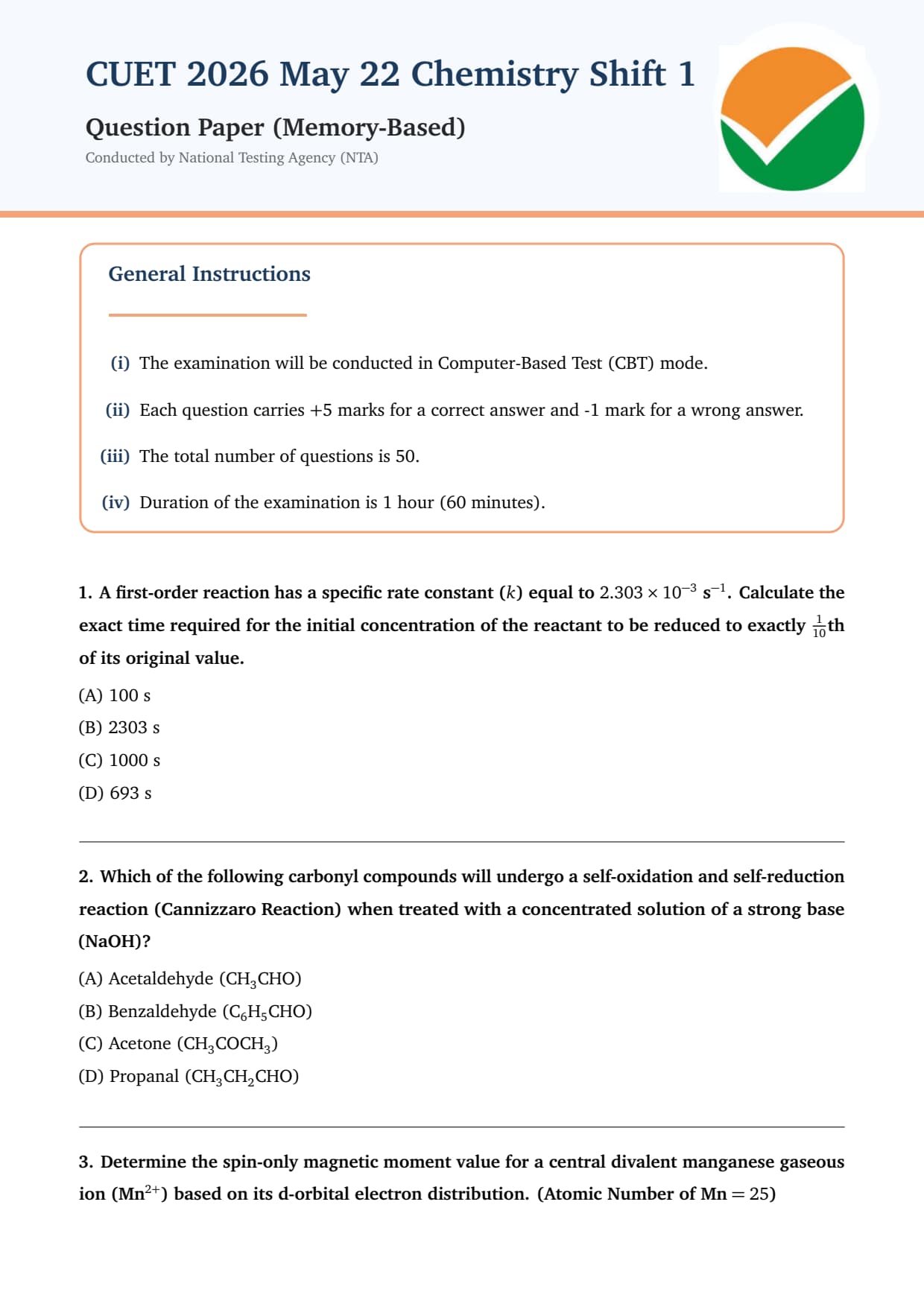
A first-order reaction has a specific rate constant (\( k \)) equal to \( 2.303 \times 10^{-3} s^{-1} \). Calculate the exact time required for the initial concentration of the reactant to be reduced to exactly \( \frac{1}{10} \)th of its original value.
View Solution
Concept:
For a first-order chemical reaction, the integrated rate equation expressing the relationship between the time elapsed (\( t \)), the rate constant (\( k \)), and concentration parameters is given by: \[ t = \frac{2.303}{k} \log_{10}\left( \frac{[A]_0}{[A]} \right) \]
Where \( [A]_0 \) represents the initial reactant concentration and \( [A] \) represents the final remaining concentration at time \( t \).
Step 1: Identify the concentration values and parameters from the problem structure.
The problem states that the final concentration drops to one-tenth of its initial value: \[ [A] = \frac{1}{10}[A]_0 \quad \Rightarrow \quad \frac{[A]_0}{[A]} = 10 \]
The rate constant parameter value is provided as: \[ k = 2.303 \times 10^{-3} s^{-1} \]
Step 2: Substitute values into the first-order kinetic formula.
Plug the isolated terms directly into our integrated rate equation: \[ t = \frac{2.303}{2.303 \times 10^{-3}} \log_{10}(10) \]
Step 3: Simplify the expression to find the final time.
Cancel out the common scalar value \( 2.303 \) from the fraction and use the logarithmic identity \( \log_{10}(10) = 1 \): \[ t = \frac{1}{10^{-3}} \cdot (1) = 10^3 = 1000 s \] Quick Tip: For first-order kinetics calculations, remember these common logarithmic milestones to speed up your calculation: \( \log_{10}(2) \approx 0.3010 \), \( \log_{10}(3) \approx 0.4771 \), and \( \log_{10}(10) = 1 \).
Which of the following carbonyl compounds will undergo a self-oxidation and self-reduction reaction (Cannizzaro Reaction) when treated with a concentrated solution of a strong base (\( NaOH \))?
View Solution
Concept:
The Cannizzaro Reaction is a redox disproportionation reaction characteristic of aldehydes that completely lack any \(\alpha\)-hydrogen atoms. When exposed to a concentrated strong base, one molecule of the aldehyde is reduced to a primary alcohol, while another molecule is oxidized to a carboxylic acid salt.
Step 1: Check for the presence of \(\alpha\)-hydrogens in each option.
An \(\alpha\)-hydrogen is any hydrogen atom attached to the carbon atom immediately adjacent to the carbonyl functional group (\(C=O\)).
Acetaldehyde (\(CH_3CHO\)): The methyl carbon has 3 active \(\alpha\)-hydrogens. It undergoes Aldol Condensation instead.
Acetone (\(CH_3COCH_3\)): Contains 6 total \(\alpha\)-hydrogens, making it highly reactive under Aldol pathways.
Propanal (\(CH_3CH_2CHO\)): The central \(CH_2\) group contains 2 active \(\alpha\)-hydrogens.
Step 2: Identify the compound lacking \(\alpha\)-hydrogens.
In Benzaldehyde (\(C_6H_5CHO\)), the carbonyl group is attached directly to an aromatic ring carbon that has no remaining hydrogen atoms. Because it completely lacks an \(\alpha\)-hydrogen, it undergoes the Cannizzaro reaction. Quick Tip: The two most common examples of aldehydes that lack \(\alpha\)-hydrogens in the NCERT curriculum are Formaldehyde (\(HCHO\)) and Benzaldehyde (\(C_6H_5CHO\)). Keep these memorized for quick name reaction classification questions.
Determine the spin-only magnetic moment value for a central divalent manganese gaseous ion (\( Mn^{2+} \)) based on its d-orbital electron distribution. (Atomic Number of \( Mn = 25 \))
View Solution
Concept:
The spin-only magnetic moment (\( \mu \)) of a transition metal ion depends on the total number of unpaired d-orbital electrons (\( n \)) present in its valence shell, calculated using the formula: \[ \mu = \sqrt{n(n + 2)} Bohr Magnetons (BM) \]
Step 1: Determine the electronic configuration of the divalent ion.
The neutral ground state configuration of Manganese (\( Z = 25 \)) is: \[ Mn = [Ar] \, 3d^5 \, 4s^2 \]
Forming the divalent ion (\( Mn^{2+} \)) requires removing the two outer valence electrons from the \( 4s \) orbital first: \[ Mn^{2+} = [Ar] \, 3d^5 \, 4s^0 \]
Step 2: Count the number of unpaired electrons using Hund's Rule.
The \( d \) subshell contains 5 separate degenerate orbitals. Distributing 5 electrons across these orbitals following Hund's rule gives 1 electron per orbital: \[ Number of unpaired electrons (n) = 5 \]
Step 3: Substitute \( n \) into the magnetic moment equation.
Plug the value \( n = 5 \) into our formula: \[ \mu = \sqrt{5(5 + 2)} = \sqrt{5 \times 7} = \sqrt{35} \]
Since \( \sqrt{36} = 6 \), the value of \( \sqrt{35} \) evaluates to just below 6: \[ \mu \approx 5.92 BM \] Quick Tip: Use this fast estimation shortcut for your exam: the first decimal digit of a spin-only magnetic moment value always matches the number of unpaired electrons (\( n \)). For example, if \( n=3 \), \( \mu \approx 3.8 BM \); if \( n=5 \), \( \mu \approx 5.9 BM \).
An organic amine compound 'X' reacts smoothly with Hinsberg's reagent (Benzenesulfonyl chloride) to form a solid precipitate. This precipitate remains completely insoluble when treated with an aqueous sodium hydroxide (\( NaOH \)) solution. Classify the amine 'X'.
View Solution
Concept:
The Hinsberg Test is used to distinguish between primary, secondary, and tertiary amines based on how they react with benzenesulfonyl chloride (\( C_6H_5SO_2Cl \)) and whether the resulting products dissolve in an alkaline solution.
Step 1: Analyze how each type of amine behaves during the test.
Primary Amines: React to form a sulfonamide that retains a highly acidic hydrogen atom on its nitrogen. This acidic hydrogen allows the product to dissolve completely in strong bases like \( NaOH \).
Secondary Amines: React with the reagent to form an \( N,N \)-dialkylbenzenesulfonamide product. Because the nitrogen has no remaining acidic hydrogen atoms, this product is completely insoluble in alkali.
Tertiary Amines: Lack any replaceable hydrogen atoms on the nitrogen and do not react with the test reagent under standard conditions.
Step 2: Match the compound's behavior to the correct category.
Because compound 'X' reacts with the reagent but forms a precipitate that does not dissolve in \( NaOH \), it matches the characteristic behavior of a Secondary Amine. Quick Tip: Keep this summary of the Hinsberg test outcomes memorized: Primary amine = Reacts, product dissolves in alkali. Secondary amine = Reacts, product remains insoluble in alkali. Tertiary amine = Does not react with the reagent at all.
According to IUPAC coordination nomenclature rules, what is the correct official name for the coordination compound represented by \( [Co(NH_3)_5(Cl)]Cl_2 \)?
View Solution
Concept:
Naming coordination compounds requires applying systematic IUPAC guidelines:
Name the ligands inside the coordination bracket first, in alphabetical order, before naming the central metal ion.
Stated numerical prefixes (di, tri, tetra, penta) do not alter the alphabetical priority order.
Specify the oxidation state of the central metal using Roman numerals in parentheses immediately after its name.
Step 1: Identify and alphabetize the ligands inside the coordination sphere.
The complex bracket contains two distinct types of ligands:
Five neutral ammonia molecules, named as ammine.
One anionic chloride ion, named as chloridocon or chlorido.
Arranging them alphabetically places "ammine" (starts with 'a') before "chlorido" (starts with 'c'), which gives: pentaamminechlorido.
Step 2: Calculate the oxidation state of the central Cobalt metal.
Let the unknown oxidation state of Cobalt be \( x \). The neutral ammine molecules carry a charge of 0, while each chloride ion carries a charge of \(-1\): \[ x + 5(0) + 1(-1) + 2(-1) = 0 \quad \Rightarrow \quad x - 1 - 2 = 0 \quad \Rightarrow \quad x = +3 \]
The metal is named as cobalt(III) because the complex ion carries a net positive charge.
Step 3: Combine the components into a single name.
Combine the alphabetized ligands, the metal with its oxidation state, and finish with the counter-anion name outside the bracket: \[ Pentaamminechloridocobalt(III) chloride \] Quick Tip: Pay close attention to spelling details during the exam: the coordinated neutral ammonia ligand must always be spelled with a double 'm' (ammine), whereas organic amine compounds use a single 'm' (amine).
Which of the following statement options accurately describes the structural carbohydrate linkages present inside a standard molecule of Sucrose?
View Solution
Concept:
Disaccharides are formed when two monosaccharides combine through a glycosidic linkage formed by a condensation reaction.
Different disaccharides differ in:
The monosaccharides involved
The carbon atoms participating in the linkage
The type of glycosidic bond formed
Step 1: Identify the monosaccharides present in sucrose.
Sucrose is a disaccharide composed of:
One molecule of \(\alpha\)-D-glucose
One molecule of \(\beta\)-D-fructose
Thus, sucrose is formed from glucose and fructose units.
Step 2: Determine the glycosidic linkage in sucrose.
In sucrose:
The C-1 carbon of \(\alpha\)-D-glucose
is linked to the C-2 carbon of \(\beta\)-D-fructose
Therefore, sucrose contains: \[ \alpha(1 \rightarrow 2)\beta \]
glycosidic linkage.
Since both anomeric carbons are involved in bond formation, sucrose behaves as a non-reducing sugar.
Step 3: Evaluate the options.
[(A)] Incorrect — This describes maltose, which contains two glucose units linked by a C-1 to C-4 bond.
[(B)] Correct — Sucrose contains a linkage between C-1 of \(\alpha\)-D-glucose and C-2 of \(\beta\)-D-fructose.
[(C)] Incorrect — This describes lactose, which contains galactose and glucose.
[(D)] Incorrect — This does not describe sucrose structure.
Hence, the correct answer is: \[ \boxed{(B)} \] Quick Tip: Important disaccharides and their linkages: Sucrose \(=\) Glucose + Fructose \(\rightarrow \alpha(1 \rightarrow 2)\beta\) Maltose \(=\) Glucose + Glucose \(\rightarrow \alpha(1 \rightarrow 4)\) Lactose \(=\) Galactose + Glucose \(\rightarrow \beta(1 \rightarrow 4)\)
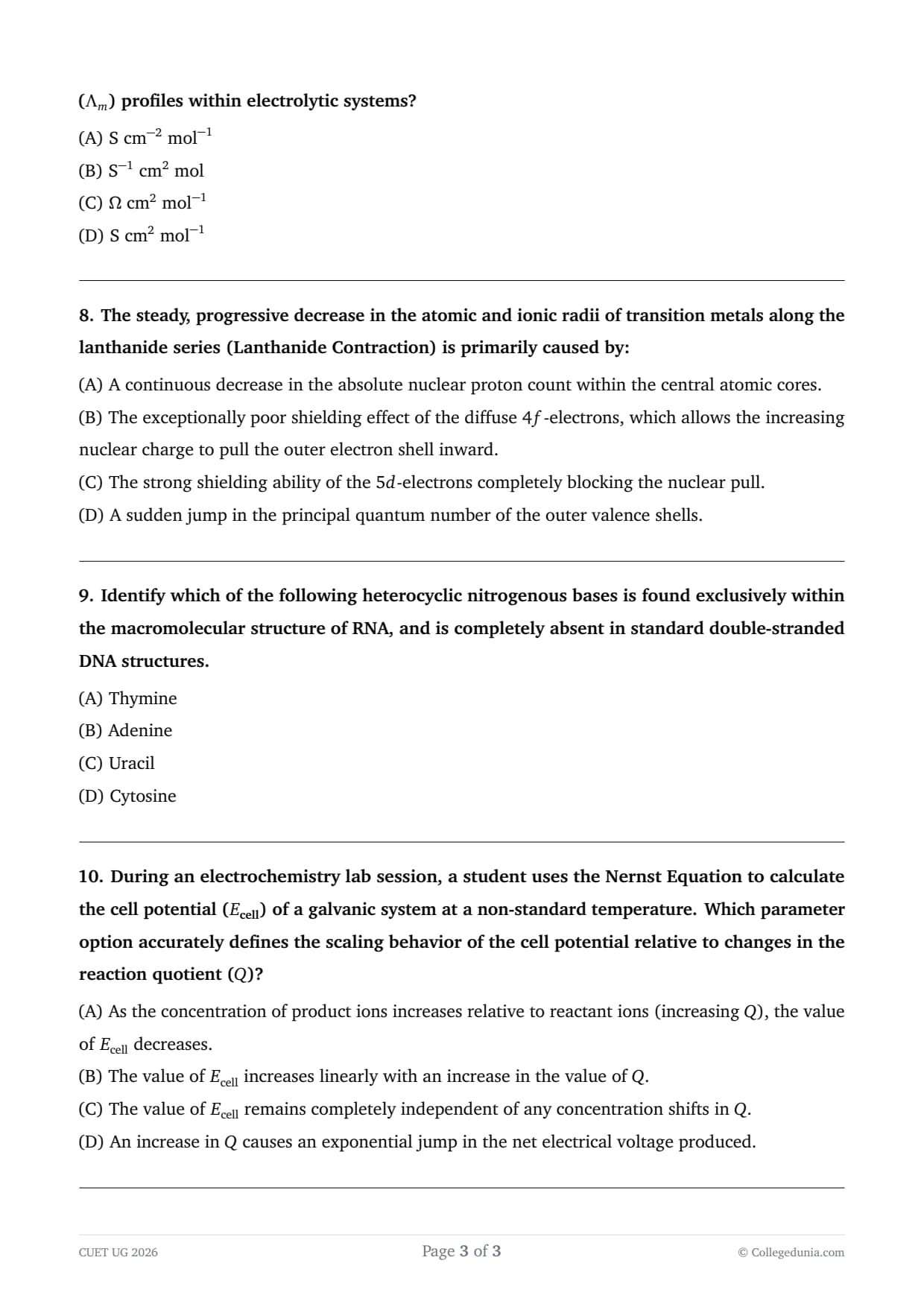
What is the correct official unit measurement scale used to represent Molar Conductivity (\( \Lambda_m \)) profiles within electrolytic systems?
View Solution
Concept:
Molar conductivity (\( \Lambda_m \)) measures the electrolytic conductance capacity of a solution containing exactly one mole of dissolved electrolyte. It is mathematically related to specific conductivity (\( \kappa \)) and concentration (\( C \)) by the equation: \[ \Lambda_m = \frac{\kappa}{C} \]
Step 1: Analyze the base units of the individual variables.
Derive the units systematically through dimensional analysis:
Specific Conductivity (\(\kappa\)): Measured in Siemens per centimeter (\( S cm^{-1} \)), where Siemens (\(S\)) represents reciprocal ohms (\(\Omega^{-1}\)).
Concentration (\(C\)): Expressed in terms of solution volume as moles per cubic centimeter (\( mol cm^{-3} \)).
Step 2: Combine the units within the equation.
Substitute these units into our molar conductivity expression: \[ Units of \Lambda_m = \frac{S cm^{-1}}{mol cm^{-3}} = S \cdot cm^{-1} \cdot cm^3 \cdot mol^{-1} \]
Simplify the overlapping centimeter exponents: \[ Units of \Lambda_m = S cm^2 mol^{-1} \] Quick Tip: When using concentration values in moles per liter (\(mol L^{-1}\)), apply a scaling factor of 1000 to keep your units consistent: \( \Lambda_m = \frac{\kappa \times 1000}{Molarity} \), which yields the final value directly in \( S cm^2 mol^{-1} \).
The steady, progressive decrease in the atomic and ionic radii of transition metals along the lanthanide series (Lanthanide Contraction) is primarily caused by:
View Solution
Concept:
Lanthanide contraction refers to the gradual decrease in atomic and ionic radii across the lanthanide series from La to Lu.
This occurs because electrons are progressively added to the \(4f\)-subshell while the nuclear charge also increases.
Step 1: Understand the shielding effect of \(4f\)-electrons.
As we move across the lanthanide series:
One proton is added to the nucleus at each step.
One electron is added to the \(4f\)-orbital.
However, \(4f\)-electrons have very poor shielding ability because their orbitals are highly diffuse and do not effectively block the nuclear attraction experienced by outer electrons.
The shielding effectiveness follows: \[ s > p > d > f \]
Thus, \(f\)-electrons are the least effective in shielding.
Step 2: Analyze the effect on atomic size.
Because the \(4f\)-electrons cannot effectively shield the increasing nuclear charge: \[ Z_{eff} \uparrow \]
where \(Z_{eff}\) represents effective nuclear charge.
As the effective nuclear charge increases, the outer electrons are pulled closer to the nucleus.
Therefore: \[ Atomic Radius \downarrow \]
This gradual decrease in size across the lanthanide series is called lanthanide contraction.
Step 3: Evaluate the options.
[(A)] Incorrect — Nuclear proton count increases across the series, it does not decrease.
[(B)] Correct — Poor shielding by \(4f\)-electrons causes increasing effective nuclear charge and contraction in size.
[(C)] Incorrect — \(5d\)-electrons are not responsible for lanthanide contraction.
[(D)] Incorrect — There is no sudden jump in the principal quantum number causing this effect.
Hence, the correct answer is: \[ \boxed{(B)} \] Quick Tip: Due to lanthanide contraction, elements of the \(4d\) and \(5d\) transition series in the same group often have very similar atomic radii and chemical properties, such as Zr and Hf.
Identify which of the following heterocyclic nitrogenous bases is found exclusively within the macromolecular structure of RNA, and is completely absent in standard double-stranded DNA structures.
View Solution
Concept:
Nucleic acids are biopolymers constructed from nucleotide monomers. Each nucleotide contains a pentose sugar, a phosphate group, and a nitrogenous base. These nitrogenous bases are divided into purines (double-ring structures) and pyrimidines (single-ring structures).
Step 1: Compare the nitrogenous bases used in DNA versus RNA.
DNA Base Composition: Uses the purines Adenine (A) and Guanine (G), and the pyrimidines Cytosine (C) and Thymine (T).
RNA Base Composition: Uses the exact same purines, Adenine (A) and Guanine (G), and the pyrimidine Cytosine (C). However, it replaces thymine with a different pyrimidine base called Uracil (U).
Step 2: Identify the base unique to RNA.
Uracil is found exclusively in RNA molecules, where it forms two hydrogen bonds with adenine during transcription. DNA structures utilize thymine instead. Quick Tip: Chemically, Thymine is also known as 5-Methyluracil. This means you can think of DNA's base as a methylated version of RNA's uracil, which provides greater structural stability for long-term genetic storage.
During an electrochemistry lab session, a student uses the Nernst Equation to calculate the cell potential (\( E_{cell} \)) of a galvanic system at a non-standard temperature. Which parameter option accurately defines the scaling behavior of the cell potential relative to changes in the reaction quotient (\( Q \))?
View Solution
Concept:
The Nernst Equation relates the cell potential of an electrochemical cell to the concentrations of reactants and products.
The equation is: \[ E_{cell} = E^\circ_{cell} - \frac{2.303RT}{nF}\log Q \]
where:
\(E^\circ_{cell}\) = Standard cell potential
\(R\) = Gas constant
\(T\) = Temperature
\(n\) = Number of electrons transferred
\(F\) = Faraday constant
\(Q\) = Reaction quotient
Step 1: Understand the role of the reaction quotient \(Q\).
The reaction quotient is given by: \[ Q = \frac{[Products]^p}{[Reactants]^r} \]
Thus:
Increase in product concentration \(\Rightarrow Q\) increases
Increase in reactant concentration \(\Rightarrow Q\) decreases
Step 2: Analyze the effect of increasing \(Q\) on cell potential.
In the Nernst equation: \[ E_{cell} = E^\circ_{cell} - \frac{2.303RT}{nF}\log Q \]
the logarithmic term is subtracted from the standard cell potential.
Therefore:
If \(Q\) increases, then \(\log Q\) increases.
A larger value is subtracted from \(E^\circ_{cell}\).
Hence, \(E_{cell}\) decreases.
Thus, cell potential decreases as the concentration of products increases relative to reactants.
Step 3: Evaluate the options.
[(A)] Correct — Increasing \(Q\) decreases the value of \(E_{cell}\).
[(B)] Incorrect — \(E_{cell}\) does not increase linearly with \(Q\).
[(C)] Incorrect — Cell potential depends directly on concentration changes through \(Q\).
[(D)] Incorrect — The variation is logarithmic, not exponential.
Hence, the correct answer is: \[ \boxed{(A)} \] Quick Tip: To increase the cell potential of a galvanic cell: Keep reactant concentration high Keep product concentration low This minimizes \(Q\) and increases \(E_{cell}\).
CUET UG 2026 Exam Pattern
| Parameter | Details |
|---|---|
| Exam Name | Common University Entrance Test (CUET UG) 2026 |
| Conducting Body | National Testing Agency (NTA) |
| Exam Mode | Computer-Based Test (CBT) |
| Exam Duration | 60 minutes per test |
| Total Sections | 3 (Languages, Domain Subjects, General Test) |
| Question Type | Multiple Choice Questions (MCQs) |
| Questions per Test | 50 questions (all compulsory) |
| Marking Scheme | +5 for correct, -1 for incorrect |
| Maximum Marks | 250 marks per test |
| Maximum Subject Choices | 5 subjects in total |
| Syllabus Base | Class 12 NCERT (mainly for Domain Subjects) |





Comments