CUET 2026 May 22 Shift 1 Biology Question Paper is available for download here. NTA is conducting the CUET 2026 exam from 11th May to 31st May.
- CUET 2026 Biology exam consists of 50 questions for 250 marks to be attempted in 60 minutes.
- As per the marking scheme, 5 marks are awarded for each correct answer, and 1 mark is deducted for incorrect answer.
Candidates can download CUET 2026 May 22 Shift 1 Biology Question Paper with Answer Key and Solution PDF from links provided below.
Related Links:
CUET 2026 Biology May 22 Shift 1 Question Paper with Solution PDF
| CUET May 22 Shift 1 Biology Question Paper 2026 | Download PDF | Check Solutions |
Ribozyme is:
View Solution
Concept:
A ribozyme is an RNA molecule that functions as a biological catalyst. Normally, enzymes are proteins, but certain RNA molecules can also catalyze biochemical reactions. Such catalytic RNA molecules are known as ribozymes.
Step 1: Understanding the term ribozyme.
The word ribozyme is derived from: \[ RNA + Enzyme \]
Hence, a ribozyme is an RNA molecule having enzymatic activity.
Step 2: Identifying the catalytic RNA in ribosomes.
In prokaryotic ribosomes:
The small subunit is \(30S\)
The large subunit is \(50S\)
The \(50S\) large subunit contains: \[ 23S \ rRNA \]
Step 3: Function of \(23S\) rRNA.
During protein synthesis, peptide bonds are formed between amino acids.
The catalytic activity responsible for peptide bond formation is called: \[ Peptidyl Transferase Activity \]
This activity is performed by: \[ 23S \ rRNA \]
and not by proteins.
Thus, \(23S\) rRNA acts as an enzyme and is therefore called a ribozyme.
Step 4: Eliminating incorrect options.
\(28S\) rRNA is present in eukaryotic ribosomes but is not commonly referred to in standard NCERT context as the ribozyme.
\(18S\) rRNA forms part of the small subunit and mainly helps in mRNA binding.
\(5.8S\) rRNA has structural functions.
Hence, the correct answer is: \[ 23S \ rRNA \] Quick Tip: Remember: \[ 23S \ rRNA \rightarrow Peptidyl transferase activity \] Therefore: \[ 23S \ rRNA = Ribozyme \]
The species-area relationship was explained by Alexander von Humboldt. Which of the following equations correctly represents this relationship?
View Solution
Concept:
The species-area relationship describes how the number of species increases with the increase in the explored area. Larger areas generally contain greater habitat diversity and therefore support more species.
Step 1: Understanding the relationship.
Alexander von Humboldt observed that within a region, species richness increases with increasing explored area, though not linearly.
Step 2: Writing the mathematical expression.
The relationship is represented as: \[ S = CA^{Z} \]
where:
\( S \) = Species richness
\( A \) = Area
\( C \) = Constant
\( Z \) = Regression coefficient
Step 3: Identifying the correct option.
The correct equation among the given options is: \[ S = CA^{Z} \] Quick Tip: Remember: In ecology, species richness increases with area according to the power-law equation \( S = CA^Z \).
In the graph of species-area relationship, what does the slope of the line represent when plotted on a log-log scale?
View Solution
Concept:
When the species-area relationship equation is converted into logarithmic form, it becomes a straight-line equation.
Step 1: Writing the original equation.
\[ S = CA^{Z} \]
Step 2: Taking logarithm on both sides.
\[ \log S = \log C + Z \log A \]
This equation is similar to: \[ y = mx + c \]
where:
\( y = \log S \)
\( x = \log A \)
\( m = Z \) (slope)
Step 3: Determining the slope.
Hence, the slope of the graph is: \[ Z \]
which is called the regression coefficient. Quick Tip: In the equation \( \log S = \log C + Z\log A \), the coefficient of \( \log A \) always represents the slope.
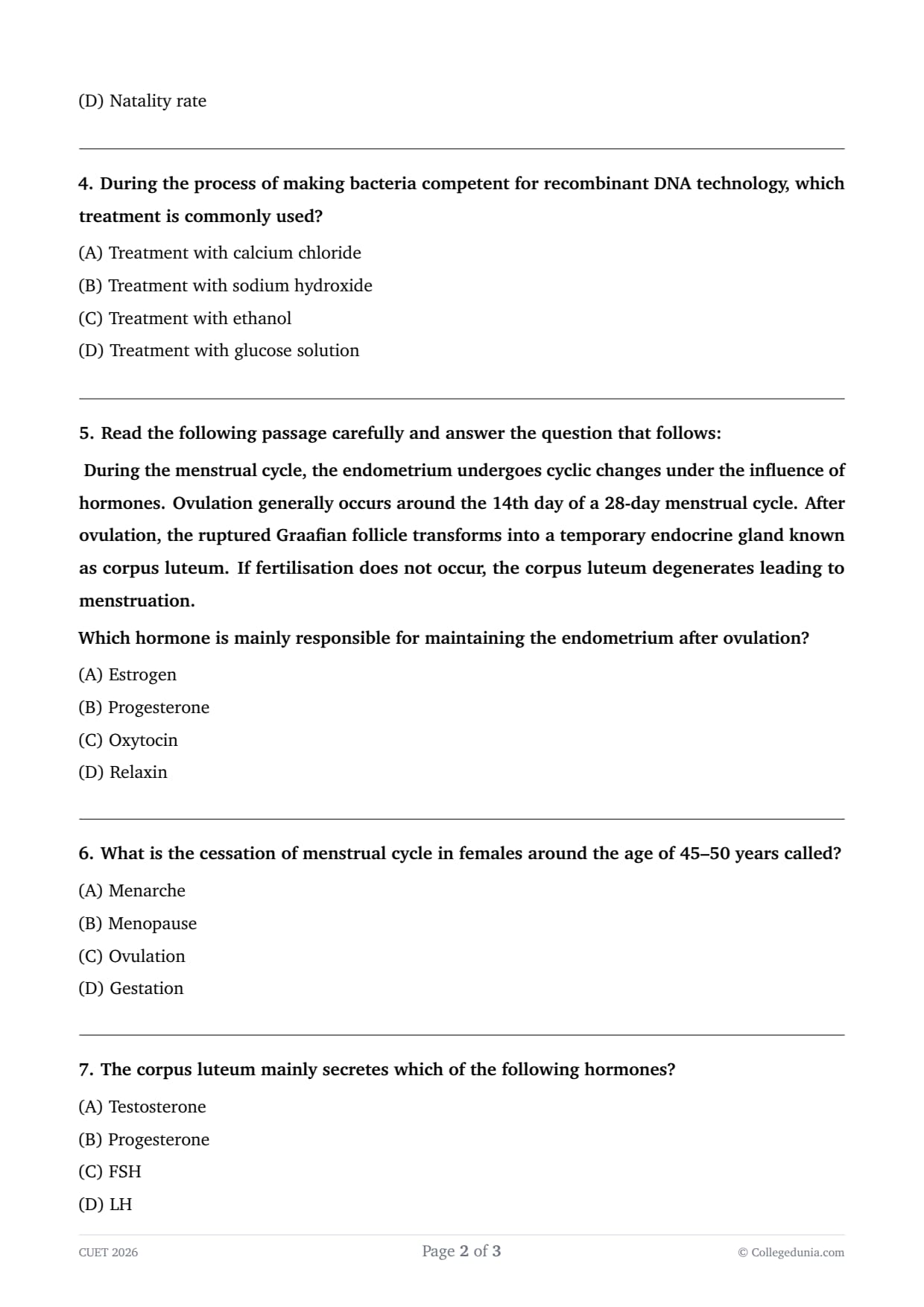
During the process of making bacteria competent for recombinant DNA technology, which treatment is commonly used?
View Solution
Concept:
Competent bacterial cells are cells capable of taking up foreign DNA from the surrounding medium.
Step 1: Understanding competency.
Normally, bacterial cell membranes repel negatively charged DNA molecules due to the presence of negatively charged phospholipids.
Step 2: Role of calcium chloride.
Cells are treated with chilled calcium chloride solution because:
Calcium ions neutralize negative charges.
Cell membrane permeability increases.
DNA uptake becomes easier.
Step 3: Heat shock process.
After calcium chloride treatment, cells are briefly exposed to higher temperature (heat shock), allowing plasmid DNA to enter the bacterial cell.
Step 4: Selecting the correct option.
Hence, calcium chloride treatment is used to make bacteria competent. Quick Tip: Remember: Competent cells in recombinant DNA technology are usually prepared using chilled \( CaCl_2 \) followed by heat shock.
Read the following passage carefully and answer the question that follows:
During the menstrual cycle, the endometrium undergoes cyclic changes under the influence of hormones. Ovulation generally occurs around the 14th day of a 28-day menstrual cycle. After ovulation, the ruptured Graafian follicle transforms into a temporary endocrine gland known as corpus luteum. If fertilisation does not occur, the corpus luteum degenerates leading to menstruation.
Which hormone is mainly responsible for maintaining the endometrium after ovulation?
View Solution
Concept:
After ovulation, the ruptured Graafian follicle converts into corpus luteum which secretes progesterone.
Step 1: Understanding the role of corpus luteum.
Corpus luteum acts as a temporary endocrine gland.
Step 2: Hormone secreted by corpus luteum.
The corpus luteum mainly secretes: \[ Progesterone \]
Step 3: Function of progesterone.
Progesterone:
Maintains the endometrium
Prepares uterus for implantation
Supports early pregnancy
Step 4: Identifying the correct option.
Hence, progesterone is the correct answer. Quick Tip: Corpus luteum = Progesterone secretion. This is one of the most important biology facts for CUET and NEET.
What is the cessation of menstrual cycle in females around the age of 45--50 years called?
View Solution
Concept:
The reproductive phase in human females ends at a particular age due to decline in ovarian activity.
Step 1: Understanding the term menopause.
Menopause is the permanent cessation of menstruation in females.
Step 2: Age at which menopause occurs.
It generally occurs between: \[ 45 to 50 years \]
Step 3: Physiological changes during menopause.
During menopause:
Ovulation stops
Estrogen and progesterone levels decrease
Menstrual cycle permanently ceases
Step 4: Eliminating incorrect options.
Menarche = beginning of menstruation
Ovulation = release of ovum
Gestation = pregnancy period
Thus, menopause is the correct answer. Quick Tip: Menarche marks the beginning of reproductive life, whereas menopause marks the end of reproductive life.
The corpus luteum mainly secretes which of the following hormones?
View Solution
Concept:
Corpus luteum is formed after ovulation from the ruptured Graafian follicle.
Step 1: Formation of corpus luteum.
After release of ovum during ovulation, the remaining follicular cells transform into corpus luteum.
Step 2: Hormone secreted by corpus luteum.
The corpus luteum mainly secretes: \[ Progesterone \]
A small amount of estrogen is also secreted.
Step 3: Functions of progesterone.
Progesterone:
Maintains uterine lining
Supports implantation
Prevents uterine contractions
Helps maintain pregnancy
Step 4: Selecting the correct option.
Therefore, progesterone is the correct answer. Quick Tip: LH forms corpus luteum, but corpus luteum secretes progesterone.
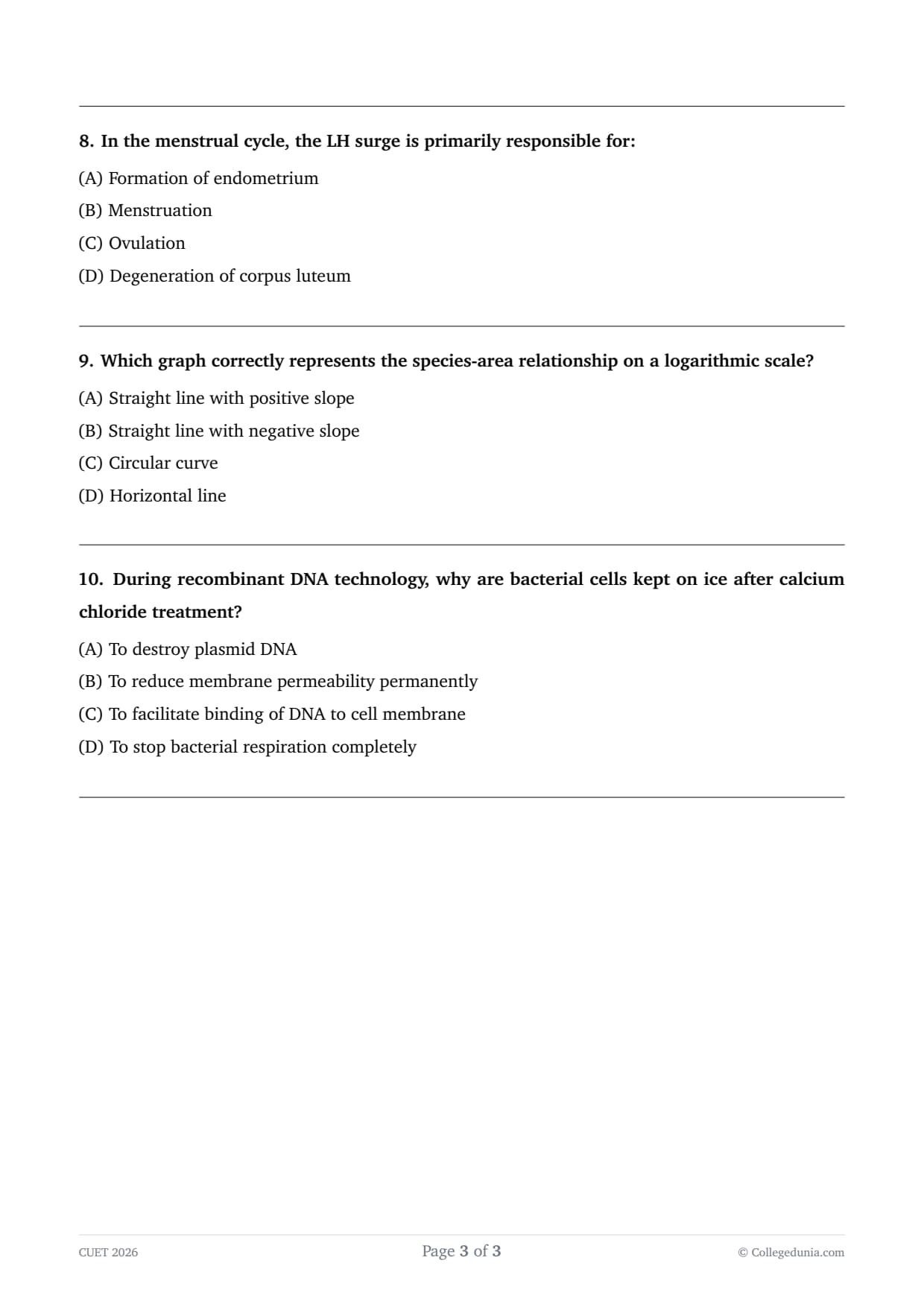
In the menstrual cycle, the LH surge is primarily responsible for:
View Solution
Concept:
Luteinising Hormone (LH) and Follicle Stimulating Hormone (FSH) are secreted by the anterior pituitary gland and regulate the ovarian cycle.
Step 1: Understanding LH surge.
During the middle of the menstrual cycle, estrogen secretion from the Graafian follicle increases significantly.
This high estrogen level stimulates the pituitary gland to release a large quantity of LH suddenly. This sudden increase is called the: \[ LH Surge \]
Step 2: Role of LH surge.
The LH surge causes:
Rupture of mature Graafian follicle
Release of ovum from ovary
Formation of corpus luteum
Step 3: Identifying the biological process.
Release of ovum from ovary is known as: \[ Ovulation \]
Step 4: Eliminating incorrect options.
Formation of endometrium is mainly influenced by estrogen.
Menstruation occurs when progesterone levels fall.
Degeneration of corpus luteum occurs if fertilisation does not happen.
Hence, ovulation is the correct answer. Quick Tip: LH Surge = Ovulation. This direct association is frequently asked in CUET and NEET examinations.
Which graph correctly represents the species-area relationship on a logarithmic scale?
View Solution
Concept:
Species richness increases with increase in explored area. This relationship becomes linear when plotted on a logarithmic scale.
Step 1: Writing the species-area equation.
The relationship is represented by: \[ S = CA^Z \]
Step 2: Converting into logarithmic form.
Taking logarithm on both sides: \[ \log S = \log C + Z\log A \]
This equation resembles: \[ y = mx + c \]
Step 3: Interpreting the graph.
Since the equation is linear in logarithmic form:
The graph becomes a straight line.
The slope of the line is positive because species richness increases with area.
Step 4: Choosing the correct option.
Hence, the correct graph is: \[ Straight line with positive slope \] Quick Tip: Normal species-area graph is curved, but log-log graph becomes a straight line.
During recombinant DNA technology, why are bacterial cells kept on ice after calcium chloride treatment?
View Solution
Concept:
In recombinant DNA technology, bacterial cells are made competent so they can take up foreign DNA molecules such as plasmids.
Step 1: Role of calcium chloride treatment.
Bacterial cell membrane and DNA are both negatively charged, so DNA cannot easily enter the cell naturally.
Treatment with chilled calcium chloride:
Neutralizes negative charges
Increases competency of cells
Helps DNA approach the membrane
Step 2: Importance of ice-cold conditions.
Keeping cells on ice stabilizes the membrane and allows plasmid DNA to attach properly to the bacterial surface.
Cold temperature also prepares cells for the next step known as: \[ Heat Shock \]
Step 3: Effect of heat shock.
A sudden increase in temperature creates pores in the membrane through which plasmid DNA enters the bacterial cell.
Step 4: Selecting the correct option.
Therefore, cells are kept on ice mainly to facilitate binding of DNA to the cell membrane. Quick Tip: In biotechnology: \[ Ice \rightarrow DNA attachment \] \[ Heat shock \rightarrow DNA entry \]
CUET UG 2026 Exam Pattern
| Parameter | Details |
|---|---|
| Exam Name | Common University Entrance Test (CUET UG) 2026 |
| Conducting Body | National Testing Agency (NTA) |
| Exam Mode | Computer-Based Test (CBT) |
| Exam Duration | 60 minutes per test |
| Total Sections | 3 (Languages, Domain Subjects, General Test) |
| Question Type | Multiple Choice Questions (MCQs) |
| Questions per Test | 50 questions (all compulsory) |
| Marking Scheme | +5 for correct, -1 for incorrect |
| Maximum Marks | 250 marks per test |
| Maximum Subject Choices | 5 subjects in total |
| Syllabus Base | Class 12 NCERT (mainly for Domain Subjects) |





Comments