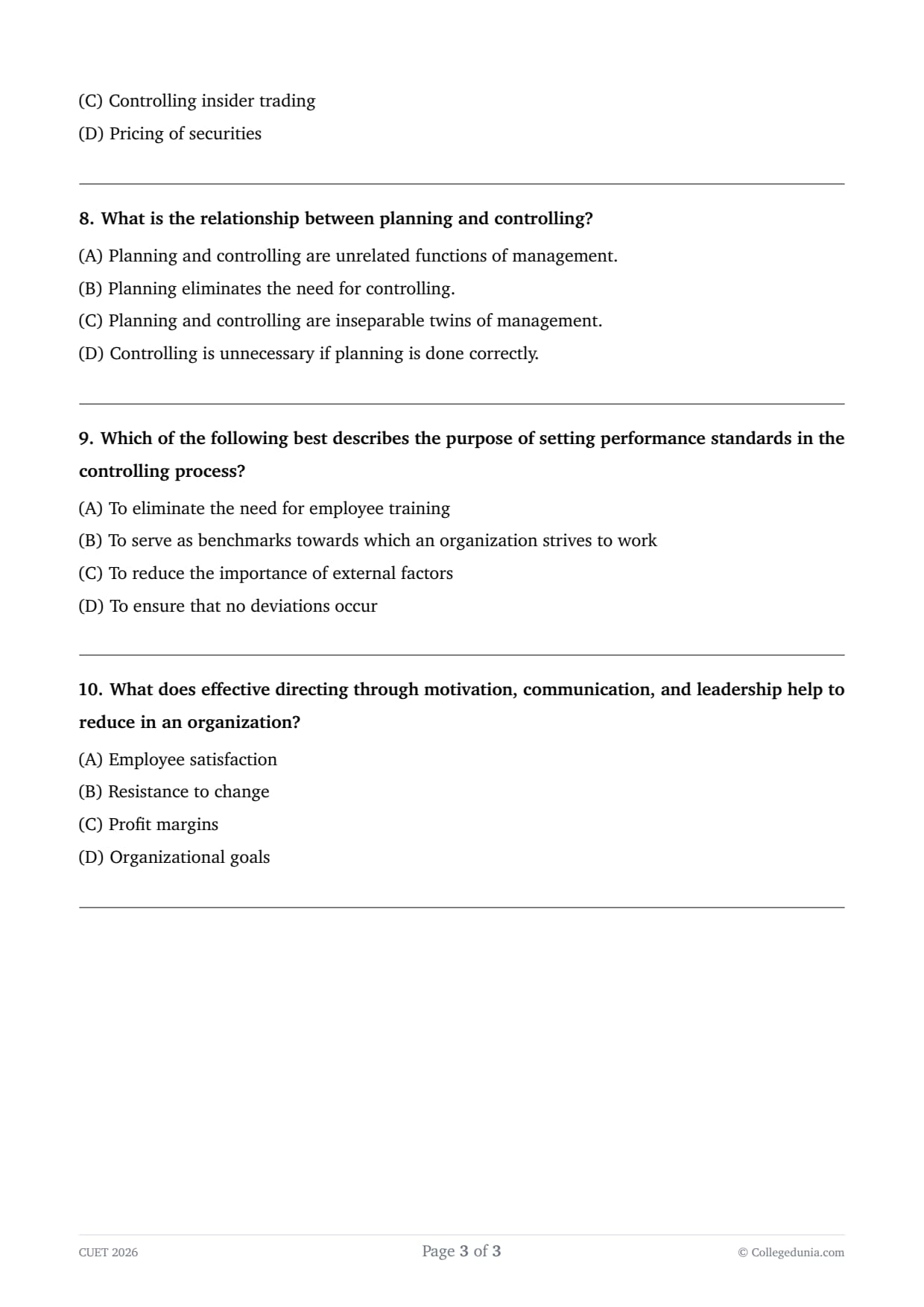
CUET 2026 May 21 Shift 2 Business Studies Question Paper is available for download here. NTA is conducting the CUET 2026 exam from 11th May to 31st May.

  • CUET 2026 Business Studies exam consists of 50 questions for 250 marks to be attempted in 60 minutes.
  • As per the marking scheme, 5 marks are awarded for each correct answer, and 1 mark is deducted for incorrect answer.

Candidates can download CUET 2026 May 21 Shift 2 Business Studies Question Paper with Answer Key and Solution PDF from links provided below.

Related Links:

CUET 2026 Business Studies May 21 Shift 2 Question Paper with Solution PDF

CUET May 21 Shift 2 Business Studies Question Paper 2026 Download PDF Check Solutions


Question 1:

Management consists of 3 dimensions — management of work, people and operations. Which characteristic of management is being highlighted here?

  • (A) Pervasive
  • (B) Multidimensional
  • (C) Goal-oriented
  • (D) Dynamic
Correct Answer: (B) Multidimensional
View Solution

Concept:
Management is considered multidimensional because it involves managing different aspects of an organization simultaneously.
The three important dimensions of management are:
Management of work
Management of people
Management of operations
These dimensions work together to achieve organizational goals efficiently.
Step 1: Understand the meaning of multidimensional management.
Management is not limited to only one activity. It includes:
Planning and organizing work
Managing human resources
Controlling operational activities
Thus, management has multiple dimensions.
Step 2: Eliminate the incorrect options.
Pervasive means management is applicable in all organizations.
Goal-oriented means management aims to achieve objectives.
Dynamic means management changes according to the environment.
These do not directly describe the three dimensions mentioned in the question.
Therefore, the characteristic highlighted here is Multidimensional.
\[ \boxed{Management is Multidimensional.} \] Quick Tip: Remember the three dimensions of management: Management of Work Management of People Management of Operations These together make management {multidimensional}.


Question 2:

In order to make the ‘Annual Day’ of the school a successful event, the Headmistress of the school segregated all the activities into task groups each one dealing with a specific area. For instance, decorations, refreshments, backstage support, etc. Each group was put under the charge of one teacher. Identify the function of management performed by the Headmistress by dividing the activities and assigning the duties?

  • (A) Planning
  • (B) Organising
  • (C) Staffing
  • (D) Directing
Correct Answer: (B) Organising
View Solution

Concept:
Organising is the management function that involves identifying and grouping activities, assigning duties, and establishing authority relationships to achieve organizational objectives efficiently.
It includes:
Division of work
Formation of departments or groups
Assignment of duties
Delegation of authority
Step 1: Identify the activities performed by the Headmistress.
The Headmistress:
Divided activities into different task groups
Assigned specific responsibilities
Put each group under one teacher
These actions involve arranging and coordinating resources systematically.
Step 2: Relate the actions to the correct management function.
The process of:
Grouping activities
Assigning duties
Creating responsibility structure is known as Organising.
Step 3: Eliminate the incorrect options.
Planning involves deciding objectives and future actions.
Staffing involves recruitment and selection of employees.
Directing involves guiding and motivating people.
These are not directly related to dividing work into groups and assigning duties.
Therefore, the management function performed is Organising.
\[ \boxed{The\ function\ of\ management\ performed\ is\ Organising.} \] Quick Tip: Remember: {Organising} \(\rightarrow\) Grouping activities and assigning duties It creates a proper structure for achieving goals efficiently


Question 3:

A company needs a detailed plan for its new project, ‘Construction of retail shops across the city’. Which type of plan should it prepare?

  • (A) Programme
  • (B) Rule
  • (C) Procedure
  • (D) Method
Correct Answer: (A) Programme
View Solution

Concept:
A Programme is a detailed plan prepared for a specific project or objective. It includes:
Goals to be achieved
Activities to be performed
Time schedule
Procedures and rules involved
Programmes are generally prepared for large and complex projects.
Step 1: Understand the requirement given in the question.
The company wants a detailed plan for: Construction of retail shops across the city 
This is a large project involving:
Multiple activities
Coordination
Time schedules
Resource allocation
Step 2: Identify the appropriate type of plan.
A Programme is specially designed for handling such comprehensive projects because it combines:
Policies
Procedures
Rules
Budgets
into one complete action plan.
Step 3: Eliminate the incorrect options.
Rule specifies what must or must not be done.
Procedure describes the sequence of steps.
Method refers to a particular way of performing one activity.
These are narrower in scope than a programme.
Therefore, the company should prepare a Programme.
\[ \boxed{The\ company\ should\ prepare\ a\ Programme.} \] Quick Tip: Remember: {Programme} \(\rightarrow\) Detailed plan for a project Includes objectives, procedures, rules, budgets, and schedules Used for large-scale activities


Question 4:

Which of the following principles of management by Fayol states that there should be one and only one boss for every individual employee?

  • (A) Unity of direction
  • (B) Order
  • (C) Unity of command
  • (D) Division of work
Correct Answer: (C) Unity of command
View Solution

Concept:
According to Henri Fayol’s principle of Unity of Command, an employee should receive orders and instructions from only one superior.
This principle helps in:
Avoiding confusion
Preventing conflict in instructions
Maintaining discipline and accountability
Step 1: Understand the statement given in the question.

The question states:
“There should be one and only one boss for every individual employee.”
This directly refers to a situation where:
An employee reports to only one superior
Multiple commands from different bosses are avoided
Step 2: Identify the correct Fayol principle.
The principle that supports this idea is:
\[ Unity of Command \]
Step 3: Eliminate the incorrect options.
Unity of direction means one plan and one head for similar activities.
Order refers to proper arrangement of resources and people.
Division of work means specialization of tasks.
These principles do not specifically relate to having only one boss.
Therefore, the correct answer is Unity of Command.
\[ \boxed{Unity of Command} \] Quick Tip: Remember: {Unity of Command} \(\rightarrow\) One employee should have only one boss Prevents confusion and conflicting instructions


Question 5:

It is usually found that specialists use technical jargon while explaining to persons who are not specialists in the concerned field. Therefore, they may not understand the actual meaning of many such words. Identify the type of barrier highlighted above:

  • (A) Personal barrier
  • (B) Organisational barrier
  • (C) Semantic barrier
  • (D) Psychological barrier
Correct Answer: (C) Semantic barrier
View Solution

Concept:
Semantic barriers arise when words, symbols, or language used in communication are not understood properly by the receiver.
Such barriers occur because of:
Technical jargon
Different interpretations of words
Complex language
Poor translation
Step 1: Understand the situation given in the question.
The question states that specialists use:
Technical jargon
Difficult professional terms
Non-specialists fail to understand the actual meaning of those words.
Step 2: Identify the communication barrier involved.
Since the misunderstanding is caused due to:
Language
Meaning of words
Technical terminology
the barrier is known as a Semantic Barrier.
Step 3: Eliminate the incorrect options.
Personal barrier relates to personal emotions or attitudes.
Organisational barrier arises due to organizational structure or rules.
Psychological barrier involves mental stress, emotions, or perceptions.
These do not directly involve misunderstanding of language or terminology.
Therefore, the barrier highlighted is Semantic Barrier.
\[ \boxed{Semantic Barrier} \] Quick Tip: Remember: {Semantic Barrier} \(\rightarrow\) Problem caused by language or meaning of words Technical jargon often creates semantic barriers in communication


Question 6:

In a company, employees are involved in decision-making of the issues related to them by forming joint management committees, work committees, canteen committees, etc. The non-financial incentive discussed above is -----------.

  • (A) Employee Participation
  • (B) Employee Empowerment
  • (C) Employee Recognition Programmes
  • (D) Organisational Climate
Correct Answer: (A) Employee Participation
View Solution

Concept:
Employee Participation is a non-financial incentive in which employees are involved in the decision-making process related to organizational activities and matters affecting them.
It improves:
Motivation
Job satisfaction
Sense of belongingness
Team spirit
Step 1: Understand the situation given in the question
The company forms:
Joint management committees
Work committees
Canteen committees
Employees participate in decisions related to their work and welfare.
Step 2: Identify the non-financial incentive involved.
Allowing employees to take part in decision-making is known as:
\[ Employee Participation \]
Step 3: Eliminate the incorrect options.
Employee Empowerment means giving authority and responsibility to employees.
Employee Recognition Programmes involve appreciation and rewards.
Organisational Climate refers to the overall work environment.
These do not specifically focus on participation in decision-making committees.
Therefore, the correct answer is Employee Participation.
\[ \boxed{Employee Participation} \] Quick Tip: Remember: {Employee Participation} \(\rightarrow\) Involvement of employees in decision-making Committees and group discussions are common examples


Question 7:

Which of the following is not a function of Securities and Exchange Board of India (SEBI)?

  • (A) Registration of brokers and sub-brokers and other players in the market
  • (B) Training of intermediaries of the securities market
  • (C) Controlling insider trading
  • (D) Pricing of securities
Correct Answer: (D) Pricing of securities
View Solution

Concept:
The Securities and Exchange Board of India (SEBI) is the regulatory authority for the securities market in India. It protects the interests of investors and regulates the functioning of the stock market.

Major functions of SEBI include:

Registration of brokers and intermediaries
Prevention of unfair trade practices
Controlling insider trading
Investor protection and market regulation
Training and regulating market intermediaries
Step 1: Examine Option (A).
SEBI registers and regulates:

Brokers
Sub-brokers
Merchant bankers
Other market intermediaries
Hence, this is a function of SEBI.
Step 2: Examine Option (B).

SEBI promotes training and education of intermediaries in the securities market.

Hence, this is also a function of SEBI.
Step 3: Examine Option (C).

SEBI takes measures to prevent and control insider trading to maintain fairness in the market.

Hence, this is a function of SEBI.
Step 4: Examine Option (D).

SEBI does not directly determine or fix the pricing of securities. Prices of securities are generally determined by:

Demand and supply forces
Market conditions
Investor behavior
Therefore, pricing of securities is not a direct function of SEBI.
Hence, the correct answer is:
\[ \boxed{Pricing of securities} \] Quick Tip: Remember: {SEBI} \(\rightarrow\) Regulates and protects the securities market Controls insider trading and registers intermediaries {Does not fix security prices directly}


Question 8:

What is the relationship between planning and controlling?

  • (A) Planning and controlling are unrelated functions of management.
  • (B) Planning eliminates the need for controlling.
  • (C) Planning and controlling are inseparable twins of management.
  • (D) Controlling is unnecessary if planning is done correctly.
Correct Answer: (C) Planning and controlling are inseparable twins of management.
View Solution

Concept:
Planning and controlling are closely related management functions. They are often called the inseparable twins of management because one cannot function effectively without the other.
Planning sets objectives and standards.
Controlling measures actual performance and compares it with planned standards.
Thus, controlling ensures that plans are properly implemented.
Step 1: Understand the role of planning.

Planning involves:

Deciding goals
Setting targets
Determining future actions
Without planning, there would be no standards against which performance could be measured.
Step 2: Understand the role of controlling.
Controlling involves:
Measuring actual performance
Comparing performance with standards
Taking corrective actions
Thus, controlling depends on planning.
Step 3: Identify the correct relationship.

Since planning provides the basis for controlling and controlling improves future planning, both functions are interdependent.

Therefore, they are called:
\[ Inseparable twins of management \]
Step 4: Eliminate the incorrect options.
Planning and controlling are not unrelated.
Planning does not eliminate the need for controlling.
Even with proper planning, controlling is still necessary.
Hence, the correct answer is:
\[ \boxed{Planning and controlling are inseparable twins of management.} \] Quick Tip: Remember: {Planning} sets standards {Controlling} checks performance against standards Both functions are interdependent and inseparable


Question 9:

Which of the following best describes the purpose of setting performance standards in the controlling process?

  • (A) To eliminate the need for employee training
  • (B) To serve as benchmarks towards which an organization strives to work
  • (C) To reduce the importance of external factors
  • (D) To ensure that no deviations occur
Correct Answer: (B) To serve as benchmarks towards which an organization strives to work
View Solution

Concept:
In the controlling process, performance standards are predetermined criteria used to measure actual performance.

These standards help managers:

Compare actual performance with expected performance
Identify deviations
Take corrective actions
Thus, standards act as benchmarks for organizational performance.
Step 1: Understand the meaning of performance standards.
Performance standards define:
Expected targets
Desired level of performance
Goals to be achieved
They provide a basis for evaluation during controlling.
Step 2: Identify the correct purpose of standards.

Since standards guide employees and management toward organizational objectives, they serve as:
\[ Benchmarks for performance \]

Therefore, option (B) is correct.
Step 3: Eliminate the incorrect options.
Performance standards do not eliminate the need for training.
They cannot reduce the importance of external factors.
Deviations may still occur even after setting standards.
Hence, these options are incorrect.
Therefore, the purpose of setting performance standards is to provide benchmarks for organizational performance.
\[ \boxed{To serve as benchmarks towards which an organization strives to work} \] Quick Tip: Remember: {Performance Standards} \(\rightarrow\) Benchmarks for evaluation Used to compare actual performance with planned performance Essential step in the controlling process


Question 10:

What does effective directing through motivation, communication, and leadership help to reduce in an organization?

  • (A) Employee satisfaction
  • (B) Resistance to change
  • (C) Profit margins
  • (D) Organizational goals
Correct Answer: (B) Resistance to change
View Solution

Concept:
Directing is an important function of management that includes:
Motivation
Leadership
Communication
Supervision
Effective directing helps employees understand organizational goals and encourages cooperation within the organization.
Step 1: Understand the role of motivation, communication, and leadership.
Motivation encourages employees to perform better.
Communication creates clarity and understanding.
Leadership guides employees toward organizational objectives.
These elements help employees accept organizational changes positively.
Step 2: Identify what is reduced through effective directing.

When employees are properly guided and informed:
Fear and confusion decrease
Cooperation improves
Opposition to organizational changes reduces
Therefore, effective directing helps reduce: \[ Resistance to change \]
Step 3: Eliminate the incorrect options.

Effective directing increases employee satisfaction rather than reducing it.
It aims to improve profits, not reduce profit margins.
It helps achieve organizational goals rather than reducing them.

Hence, these options are incorrect.
Therefore, the correct answer is: \[ \boxed{Resistance to change} \] Quick Tip: Remember: Effective directing improves cooperation and coordination Motivation + Leadership + Communication reduce resistance to change

CUET UG 2026 Exam Pattern

Parameter Details
Exam Name Common University Entrance Test (CUET UG) 2026
Conducting Body National Testing Agency (NTA)
Exam Mode Computer-Based Test (CBT)
Exam Duration 60 minutes per test
Total Sections 3 (Languages, Domain Subjects, General Test)
Question Type Multiple Choice Questions (MCQs)
Questions per Test 50 questions (all compulsory)
Marking Scheme +5 for correct, -1 for incorrect
Maximum Marks 250 marks per test
Maximum Subject Choices 5 subjects in total
Syllabus Base Class 12 NCERT (mainly for Domain Subjects)

CUET UG 2026 Paper Analysis