


CUET 2026 May 21 Shift 1 Physical Education Question Paper is available for download here. NTA is conducting the CUET 2026 exam from 11th May to 31st May.
- CUET 2026 Physical Education exam consists of 50 questions for 250 marks to be attempted in 60 minutes.
- As per the marking scheme, 5 marks are awarded for each correct answer, and 1 mark is deducted for incorrect answer.
Candidates can download CUET 2026 May 21 Shift 1 Physical Education Question Paper with Answer Key and Solution PDF from links provided below.
Related Links:
CUET 2026 Physical Education May 21 Shift 1 Question Paper with Solution PDF
| CUET May 21 Shift 1 Physical Education Question Paper 2026 | Download PDF | Check Solutions |
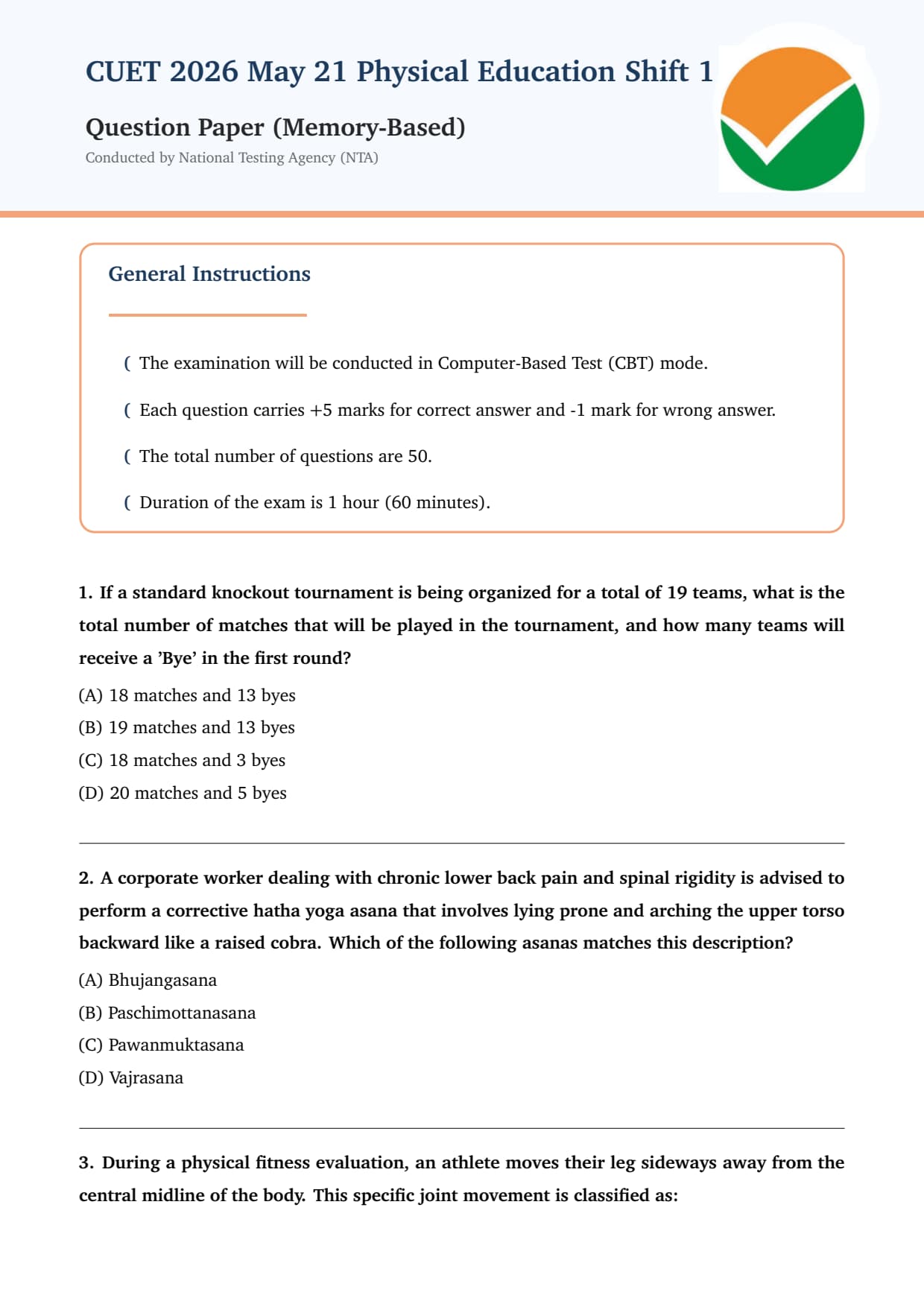
If a standard knockout tournament is being organized for a total of 19 teams, what is the total number of matches that will be played in the tournament, and how many teams will receive a 'Bye' in the first round?
View Solution
Concept:
Tournament planning requires specific structural formulas to arrange brackets efficiently. For a knockout tournament:
Total matches played (\( M \)) is always one less than the number of participating teams (\( N \)):
\[ M = N - 1 \]
Total byes distributed is calculated by subtracting the number of teams from the next highest power of two (\( 2^n \)):
\[ Total Byes = 2^n - N \]
Step 1: Calculate the total number of matches.
Given the number of competing teams is \( N = 19 \): \[ Matches = N - 1 = 19 - 1 = 18 matches \]
Step 2: Determine the number of byes using powers of two.
The powers of two are \( 2, 4, 8, 16, 32, \dots \) The next power of two strictly greater than 19 is 32 (\( 2^5 \)). Subtracting our team count from this boundary: \[ Total Byes = 32 - 19 = 13 byes \] Quick Tip: To save time during competitive shifts, remember that the total matches in *any* standard single-elimination knockout tournament is simply \( N - 1 \). This immediately narrows your options down without extra calculations.
A corporate worker dealing with chronic lower back pain and spinal rigidity is advised to perform a corrective hatha yoga asana that involves lying prone and arching the upper torso backward like a raised cobra. Which of the following asanas matches this description?
View Solution
Concept:
Yoga asanas act as non-invasive corrective methods to manage modern lifestyle disorders like obesity, diabetes, hypertension, and back pain by improving joint mobility and core muscular strength.
Step 1: Analyze the physical biomechanics of the described pose.
Lying prone (flat on the stomach) and extending the upper torso backward creates a deep stretch along the anterior abdominal muscles while strengthening the erector spinae muscles of the lower back. This specific backward bending alignment is the characteristic trait of Bhujangasana (commonly known as the Cobra Pose).
Step 2: Contrast with alternative lifestyle asanas.
Paschimottanasana: A seated forward bend that stretches the hamstrings and calves, running opposite to a prone backward extension.
Pawanmuktasana: The gas-relieving pose performed supine (on the back) by drawing knees to the chest. Quick Tip: Link the Sanskrit root words to their English meanings to quickly identify poses on the exam: Bhujanga translates to Cobra, Pawan means wind, and Paschima refers to the back of the body.
During a physical fitness evaluation, an athlete moves their leg sideways away from the central midline of the body. This specific joint movement is classified as:
View Solution
Concept:
Kinesiology maps human movement across standard anatomical planes using relative vector alignments:
Flexion/Extension: Movements occurring in the sagittal plane that decrease or increase the angle between joint components.
Abduction/Adduction: Lateral movements occurring in the frontal plane relative to the body's vertical midline axis.
Step 1: Define the direction of movement relative to the anatomical midline.
When a limb moves laterally away from the central longitudinal midline of the body (such as raising the arms or legs straight out to the sides), the movement is defined as Abduction.
Step 2: Contrast with the returning movement trajectory.
The opposite movement, which draws a limb back toward the central axis of the body, is called Adduction (think of "adding" the limb back to the body). Quick Tip: Use this simple linguistic trick to keep them straight: ABduction means a limb is taking off about or away, while ADDuction means you are bringing the limb back to add it to your torso midline.
During an intense basketball game, a player twists their ankle awkwardly, resulting in an acute tearing injury of the stabilizing lateral ligaments. This soft tissue injury is classified as a:
View Solution
Concept:
Sports injuries are systematically categorized based on the specific type of anatomical tissue damaged during trauma:
Soft Tissue Injuries: Includes damage to skin, muscles, tendons, or ligaments.
Hard Tissue Injuries: Includes structural damage to skeletal bones (fractures) or joint dislocations.
Step 1: Identify the specific tissue damaged during the ankle twist.
The problem explicitly states that the injury involves a tear of the ligaments (the tough, fibrous bands of connective tissue linking bone to bone at joints). Any stretching or tearing injury affecting ligaments is defined as a Sprain.
Step 2: Differentiate from muscle injuries.
If the trauma had instead damaged muscle fibers or their anchoring tendons, the injury would be classified as a Strain. Contusions describe deep bruising from impact, while abrasions are superficial skin scrapes. Quick Tip: Keep this structural pairing clear for your exam: Sprain corresponds to a Ligament injury (remember the letters S-L), while Strain corresponds to a Tendon/Muscle injury (remember the letter T in both Strain and Tendon).
Which of the following test protocols from the senior citizen Rikli \& Jones functional fitness battery is explicitly designed to assess the functional lower-body strength of older adults?
View Solution
Concept:
The Rikli & Jones Senior Citizen Fitness Test consists of a series of simple, safe exercises designed to track functional fitness parameters like strength, flexibility, speed, and aerobic endurance in older populations.
Step 1: Evaluate the functional focus of the Chair Stand Test.
The 30-Second Chair Stand Test requires an individual to transition from a fully seated position to a full stand repeatedly within a 30-second window. This movement relies on the extension capacity of the quadriceps and gluteal muscle groups, making it the primary method for evaluating lower-body strength.
Step 2: Map the purposes of alternative tests in the battery.
Arm Curl Test: Measures upper-body muscular strength using bicep curls.
Chair Sit and Reach Test: Evaluates lower-body hamstring flexibility.
Eight Foot Up and Go Test: Tracks speed, agility, and dynamic balance while moving. Quick Tip: When evaluating senior tests, think about the primary muscle groups required for the movement: Standing up from a chair relies entirely on your legs, making it the ideal test for lower-body power.
What is the total number of matches that will be played in a single league tournament containing 8 participating teams?
View Solution
Concept:
In a round-robin or league tournament format, every participating team must play a match against every other team exactly once. The mathematical formula used to calculate the total number of matches (\( M \)) required for a league tournament is: \[ M = \frac{N(N - 1)}{2} \]
where \( N \) represents the total number of participating teams.
Step 1: Substitute the given team parameter into the league formula.
We are given that the total number of competing teams is \( N = 8 \). Placed into our equation: \[ M = \frac{8 \cdot (8 - 1)}{2} \]
Step 2: Simplify the arithmetic expression to find the final match count.
\[ M = \frac{8 \cdot 7}{2} = \frac{56}{2} = 28 matches \]
Thus, 28 distinct matches must be scheduled to complete the single league rotation. Quick Tip: Be sure to check whether the problem specifies a single league or a double league tournament format. A single league uses \( \frac{N(N-1)}{2} \), while a double league requires you to skip the division step entirely, using the formula \( N(N-1) \).
A patient diagnosed with type-2 diabetes is looking to practice a seated forward-bending asana that compresses the abdominal organs and stretches the deep back muscles to help stimulate pancreatic function. Which asana matches this description?
View Solution
Concept:
Seated forward-bending asanas put gentle physical pressure on internal abdominal organs like the liver, stomach, and pancreas. This compression helps stimulate digestive blood flow and can improve metabolic function in patients with lifestyle disorders.
Step 1: Analyze the mechanics of Paschimottanasana.
Paschimottanasana is a classic seated forward bend where the practitioner reaches forward to hold their toes while lowering their torso onto their outstretched legs. This deep fold compresses the abdominal region, helping activate the endocrine functions of the pancreas to manage blood sugar levels.
Step 2: Contrast with alternative standing or basic poses.
Tadasana: A simple standing vertical stretch that does not involve forward bending or abdominal compression.
Sukhasana: A traditional cross-legged seated position used primarily for meditation rather than therapeutic physical stretching. Quick Tip: Forward-folding poses like Paschimottanasana or Pawanmuktasana are excellent options for managing diabetes and digestive issues because the physical compression helps stimulate the abdominal organs.
According to Newton's Third Law of Motion (Law of Action and Reaction), forces always occur in equal and opposite pairs. Which of the following sports movements directly demonstrates this law during execution?
View Solution
Concept:
Biomechanics applies Newton's laws of motion to analyze athletic performance:
First Law (Inertia): Objects resist changes to their current state of motion.
Second Law (\( F=ma \)): Acceleration is proportional to force and inversely proportional to mass.
Third Law (Action/Reaction): For every action force, there is an equal and opposite reaction force.
Step 1: Identify the action and reaction forces in the swimming movement.
When a swimmer performs a stroke, their hands and feet exert a backward force on the water (Action). According to Newton's third law, the water exerts an equal and opposite force forward on the swimmer's body (Reaction), driving them forward through the pool.
Step 2: Identify the mechanical laws behind the other options.
The shotput example describes the relationship between force, mass, and acceleration governed by the Second Law.
The sprinter sliding past the finish line demonstrates the property of inertia described by the First Law. Quick Tip: To identify a Third Law example on the exam, look for movements that involve pushing against a surface or medium (like jumping off the ground, rowing a boat, or swimming) to generate a forward reaction force.
Which of the following physical fitness metrics is explicitly evaluated using the standard Harvard Step Test protocol?
View Solution
Concept:
Fitness testing requires specialized, standardized exercises to measure specific physical attributes like strength, agility, speed, or aerobic capacity accurately.
Step 1: Analyze the physical mechanism of the Harvard Step Test.
The Harvard Step Test requires an athlete to step up and down on a stable gym bench at a fixed, rhythmic pace for 5 minutes (or until exhaustion). This continuous movement raises the heart rate, allowing testers to measure cardiac recovery efficiency and determine the athlete's overall Cardiovascular (Aerobic) Endurance.
Step 2: Recall alternative tests used to measure the other metrics.
Explosive Leg Power: Measured using a Standing Broad Jump or Vertical Jump Test.
Abdominal Strength: Evaluated using a 60-second timed Partial Curl-Up Test. Quick Tip: Any test that involves continuous, repetitive movements over a longer duration (like the Harvard Step Test or the 12-Minute Cooper Run) is designed to evaluate Cardiovascular Endurance.
During a soccer tournament, a player takes a direct hit to their shin from an opponent's boot. The impact leaves the skin unbroken but causes localized internal bleeding and deep bruising. This soft tissue injury is classified as a:
View Solution
Concept:
Soft tissue injuries are classified based on whether the trauma breaks the skin barrier (open wounds) or causes damage beneath intact skin (closed wounds).
Step 1: Evaluate the characteristics of the impact injury.
The problem describes an injury caused by a blunt force impact that leaves the skin unbroken but damages underlying capillaries, leading to internal bleeding and visible bruising. This specific closed soft tissue trauma is defined as a Contusion.
Step 2: Contrast with open skin wounds.
Abrasion: A superficial scrape caused by friction tearing away the top layer of skin.
Laceration: An irregular, jagged open tear through skin tissue caused by sharp impacts.
Incision: A clean, straight cut through the skin barrier caused by sharp objects. Quick Tip: Remember that a Contusion is simply the medical term for a deep bruise caused by a blunt force impact that leaves the surface skin intact.
CUET UG 2026 Exam Pattern
| Parameter | Details |
|---|---|
| Exam Name | Common University Entrance Test (CUET UG) 2026 |
| Conducting Body | National Testing Agency (NTA) |
| Exam Mode | Computer-Based Test (CBT) |
| Exam Duration | 60 minutes per test |
| Total Sections | 3 (Languages, Domain Subjects, General Test) |
| Question Type | Multiple Choice Questions (MCQs) |
| Questions per Test | 50 questions (all compulsory) |
| Marking Scheme | +5 for correct, -1 for incorrect |
| Maximum Marks | 250 marks per test |
| Maximum Subject Choices | 5 subjects in total |
| Syllabus Base | Class 12 NCERT (mainly for Domain Subjects) |





Comments