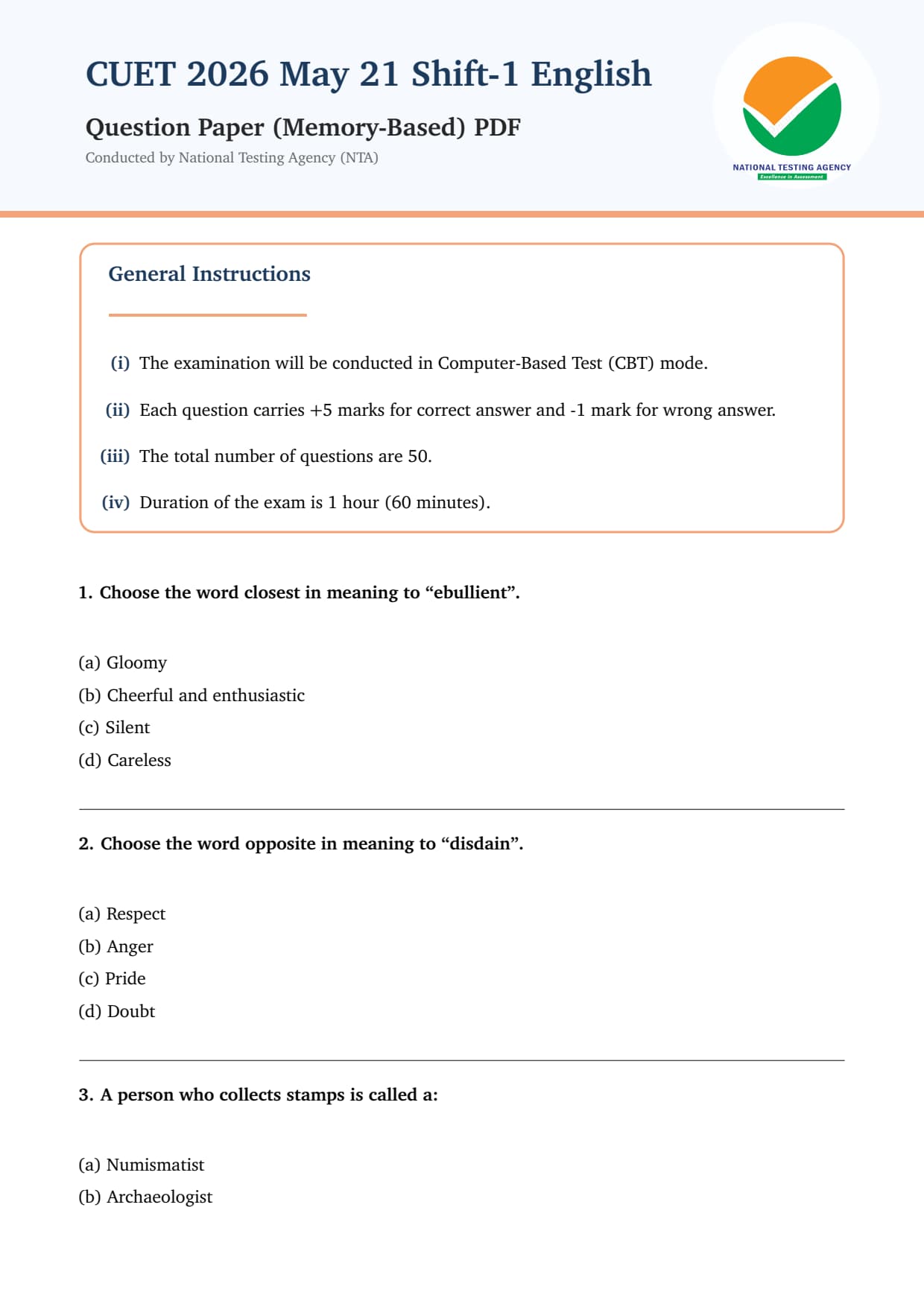
CUET 2026 May 21 Shift 1 English Question Paper is available for download here. NTA is conducting the CUET 2026 exam from 11th May to 31st May.

  • CUET 2026 English exam consists of 50 questions for 250 marks to be attempted in 60 minutes.
  • As per the marking scheme, 5 marks are awarded for each correct answer, and 1 mark is deducted for incorrect answer.

Candidates can download CUET 2026 May 21 Shift 1 English Question Paper with Answer Key and Solution PDF from links provided below.

Related Links:

CUET 2026 English May 21 Shift 1 Question Paper with Solution PDF

CUET May 21 Shift 1 English Question Paper 2026 Download PDF Check Solutions


Question 1:

Choose the word closest in meaning to “ebullient”.

  • (a) Gloomy
  • (b) Cheerful and enthusiastic
  • (c) Silent
  • (d) Careless
Correct Answer: (b) Cheerful and enthusiastic
View Solution


Step 1: Understanding the Concept:

Vocabulary questions checking for the "closest in meaning" require identifying a direct synonym. The word "ebullient" is an adjective derived from the Latin root ebullire, which literally translates to "boiling over" or "bubbling up". In contemporary English usage, it figuratively describes a person's behavior, mood, or energy levels.


Step 2: Detailed Explanation:

Let's analyze the precise definitions of all the options provided:
EBULLIENT: Overflowing with fervor, enthusiasm, energy, or high spirits. It behaves like a liquid that is joyfully bubbling over.
Gloomy (Antonym): Dark, dim, depressed, or deeply sad.
Cheerful and enthusiastic (Synonym): Full of visible happiness, high energy, and eagerness. This perfectly aligns with the definition of ebullient.
Silent: Refusing to speak or making no audible sound.
Careless: Not giving sufficient attention or thought to avoiding harm or errors.

Therefore, option (b) is the exact synonym choice.


Step 3: Final Answer:

The word closest in meaning to ebullient is Cheerful and enthusiastic (Option b). Quick Tip: To remember this word, think of it as sharing a root concept with a {boiling} pot of water (e-bull-ient). Just like a boiling liquid has high energy and {bubbles up}, an {ebullient} individual is bubbling over with {cheerful and enthusiastic} energy!


Question 2:

Choose the word opposite in meaning to “disdain”.

  • (a) Respect
  • (b) Anger
  • (c) Pride
  • (d) Doubt
Correct Answer: (a) Respect
View Solution


Step 1: Understanding the Concept:

Antonym questions require tracking down a word that carries the inverse semantic value of the prompt. The word "disdain" operates as both a noun and a verb, representing a total lack of admiration, value, or esteem toward an object, person, or concept deemed inferior.


Step 2: Detailed Explanation:

Let's look at the definitions to contrast the target word with the multiple choice options:
DISDAIN: The feeling that someone or something is unworthy of one's consideration, respect, or honor; contempt, scorn, or looking down on someone.
Respect (Antonym): A feeling of deep admiration for someone or something elicited by their abilities, qualities, or achievements. Because this is the direct opposite of viewing someone with worthless contempt, it is the perfect antonym.
Anger: A strong feeling of annoyance, displeasure, or hostility.
Pride: A feeling of deep pleasure or satisfaction derived from one's own achievements or possessions.
Doubt: A feeling of uncertainty or lack of conviction.

Thus, "Respect" is the correct opposite.


Step 3: Final Answer:

The word opposite in meaning to disdain is Respect (Option a). Quick Tip: Think of the prefix {Dis-} as indicating a negative direction or reversal. When you display {disdain} toward someone, you strip away all credit and treat them with zero worth. The ultimate positive inversion of treating someone with value and high regard is showing them {respect}!


Question 3:

A person who collects stamps is called a:

  • (a) Numismatist
  • (b) Archaeologist
  • (c) Philatelist
  • (d) Linguist
Correct Answer: (c) Philatelist
View Solution


Step 1: Understanding the Concept:

This problem belongs to the "One Word Substitution" category, which evaluates knowledge of specialized terminology used to categorize professions, hobbies, and academic fields of expertise.


Step 2: Detailed Explanation:

Let's define each professional term to trace their respective disciplines:
Numismatist: A person who collects, studies, or examines coins, tokens, paper currency, and medals.
Archaeologist: A scientist who studies human history and prehistory through the excavation of historical sites and the analysis of physical artifacts.
Philatelist (Correct): A person who collects, studies, or values postage stamps, postmarks, and related postal history materials. The term comes from the Greek roots philos (loving) and ateleia (exemption from tax/prepaid post).
Linguist: A person who specializes in the scientific study of human language and its structural or historical developments.

This confirms that choice (c) is the correct term.


Step 3: Final Answer:

A person who collects stamps is called a Philatelist (Option c). Quick Tip: Keep this essential pair locked down together in your vocabulary review logs to score easy marks on competitive exams: {Philatelist} = Collects and studies postage {stamps}. {Numismatist} = Collects and studies currency and {coins}. These two hobby terms are among the most frequently tested items in competitive exams!


Question 4:

Choose the correctly spelt word.

  • (a) Deliterious
  • (b) Deleterious
  • (c) Deletearious
  • (d) Delaterious
Correct Answer: (b) Deleterious
View Solution


Step 1: Understanding the Concept:

Spelling tests assess knowledge of standard English prefixes and suffix roots. The target word is an advanced formal adjective meaning causing harm or damage. It originates from the classical Greek word dēlētērios (meaning noxious or destructive).


Step 2: Detailed Explanation:

Let's break down the precise syllabic construction of the correct term:
The word is assembled in four distinct vocal beats: De - le - te - ri - ous.
Notice that the first three syllables are consistently anchored by the vowel character 'e': De- (\(1^{st\)), -le- (\(2^{nd\)), and -te- (\(3^{rd\)).
It concludes with the standard structural descriptive adjective suffix "-ous".
Combining these phonetic blocks gives the layout: D-E-L-E-T-E-R-I-O-U-S.

Let's review the breakdown errors in the other choices:
Option (a) incorrectly swaps the second 'e' for an 'i' (Deliterious).
Option (c) introduces an incorrect letter 'a' before the suffix ({Deletearious).
Option (d) incorrectly substitutes an 'a' in the second syllable ({Delaterious).

Hence, option (b) is the only authentic spelling.


Step 3: Final Answer:

The correctly spelt word is Deleterious (Option b). Quick Tip: To remember this word effortlessly, link it directly to the key function "Delete"! If something is deleterious, it is harmful enough that you would want to delete it entirely from your surroundings. Both share the exact same starting block: {D-E-L-E-T-E!


Question 5:

Fill in the blank with the correct option.
The church bells began to ______ loudly at noon.

  • (a) peel
  • (b) peal
  • (c) pale
  • (d) poll
Correct Answer: (b) peal
View Solution


Step 1: Understanding the Concept:

This problem evaluates your command over homophones—words that sound identical when spoken aloud but possess completely distinct meanings, origins, and spelling structures. Resolving the blank requires analyzing the context clue of the sentence ("church bells") to locate the correct verb association.


Step 2: Detailed Explanation:

Let's look at the operational definitions of all four homophones to find the proper fit:
peel: To strip or remove the outer skin, rind, or covering layer from something (e.g., peeling an orange or a potato). This is completely unrelated to sound.
peal (Correct): To ring or sound out loudly and continuously. As a noun or verb, it specifically refers to a loud, ringing chime of bells or a sudden echoing crash of thunder (e.g., a peal of thunder, bells pealing). This fits the context perfectly.
pale: Lacking intensity of color, headings, or light-colored; or a boundary stake.
poll: A record of voting, an election survey, or to cut off the horns/top of something.

Therefore, "peal" is the uniquely accurate option.


Step 3: Final Answer:

The complete sentence is: "The church bells began to peal loudly at noon." (Option b) Quick Tip: To separate these two easily confused words, anchor them to unique visual rhymes: You {p-e-e-l} a banana to {e-a-t} it. A bell will {p-e-a-l} out an {a-u-d-i-o} ring. Connecting the 'a' in {peal} to the 'a' in {audio} ensures you pick the correct acoustic term every single time!


Question 6:

Choose the correct meaning of “petulance”.

  • (a) Deep wisdom
  • (b) Childish irritability
  • (c) Great courage
  • (d) Honest behaviour
Correct Answer: (b) Childish irritability
View Solution


Step 1: Understanding the Concept:

Vocabulary questions checking definitions test your knowledge of formal nouns that describe emotional states and behavioral attitudes. The noun "petulance" tracks a specific negative temperament, often linked to an impatient or moody reaction when an individual fails to get their own way.


Step 2: Detailed Explanation:

Let's analyze the precise meaning of the word alongside the given options:
PETULANCE: The quality of being childishly sulky, bad-tempered, bad-mannered, or easily annoyed over trivial matters. It mimics the display of an impatient, angry tantrum.
Deep wisdom: An invalid definition; wisdom represents mature discernment and deep understanding, which is the complete opposite of petulance.
Childish irritability (Correct): This matches the definition exactly. A petulant person shows sudden, unwarranted annoyance over minor inconveniences, much like a stubborn child throwing a tantrum.
Great courage: An invalid choice; courage is bravery in the face of fear or pain.
Honest behaviour: An invalid choice; honesty deals with integrity, truthfulness, and transparency.

This confirms that choice (b) is the unique definition matching the term.


Step 3: Final Answer:

The correct meaning of petulance is Childish irritability (Option b). Quick Tip: To keep this definition locked in your memory, think of a spoiled, demanding {pet} throwing a noisy tantrum when it doesn't get its treats on time! Connecting {Pet-ulance} to a sulky, annoyed {pet} will instantly remind you of {childish irritability}!


Question 7:

Select the sentence with the correct usage of “furtherance”.

  • (a) He spoke in furtherance of the new policy.
  • (b) She furtherance the work yesterday.
  • (c) The furtherance was quickly running.
  • (d) They are furtherance to school.
Correct Answer: (a) He spoke in furtherance of the new policy.
View Solution


Step 1: Understanding the Concept:

To identify the correct usage of a word, we must understand its definition and its grammatical category (part of speech). The word "furtherance" is an abstract noun that means the advancement, promotion, or fostering of a scheme, plan, interest, or policy. It is standardly used within the idiomatic prepositional phrase "in furtherance of [something]".


Step 2: Detailed Explanation:

Let's analyze the syntax and grammatical function of the word across the given choices:
Option (a) [Correct]: "He spoke in furtherance of the new policy." Here, "furtherance" functions accurately as a noun inside the prepositional block "in furtherance of," meaning he spoke to help advance or promote the new policy. This is completely correct.
Option (b) [Incorrect]: {"She furtherance the work yesterday." Here, the word is incorrectly forced into acting as a past-tense verb. The correct verb would be furthered ({"She furthered the work...").
Option (c) [Incorrect]: {"The furtherance was quickly running." This sentence treats "furtherance" as a concrete noun capable of physical motion (running), which makes no semantic sense.
Option (d) [Incorrect]: {"They are furtherance to school." This sentence completely violates basic grammar by substituting a noun where a continuous action verb like going or walking is required.


Step 3: Final Answer:

The correct sentence is: "He spoke in furtherance of the new policy." (Option a) Quick Tip: To easily master this word, remember that {furtherance is a formal noun that almost always appears in the exact structural format: {"in furtherance of + [a goal, cause, or plan]!"} Spotting this standard phrase framework will instantly lead you to the right choice on any vocabulary exam!


Question 8:

What is a hamlet?

  • (a) A large kingdom
  • (b) A type of poem
  • (c) A small village
  • (d) A musical instrument
Correct Answer: (c) A small village
View Solution


Step 1: Understanding the Concept:

This vocabulary problem assesses knowledge of nouns that specify geographical human settlements based on structural scale, size, and population density.


Step 2: Detailed Explanation:

Let's define the terms to see how they match up:
A large kingdom: An extensive realm or territory ruled entirely by a monarch (king or queen).
A type of poem: Irrelevant; while Hamlet is the title of a legendary tragedy written by William Shakespeare, the common noun "hamlet" is not a poetic form.
A small village (Correct): In human geography, a hamlet is a very small human settlement that is structurally smaller than a standard village. Historically, a hamlet is distinguished by lacking its own dedicated parish church or marketplace, often consisting of just a tiny cluster of houses.
A musical instrument: An incorrect option with no connection to the word.

Therefore, choice (c) is the accurate definition.


Step 3: Final Answer:

A hamlet is a small village (Option c). Quick Tip: Think of the descending hierarchy of human settlements to easily keep these size terms organized in your mind: \(\)City \rightarrow Town \rightarrow Village \rightarrow \mathbf{ Hamlet}\(\) A {hamlet} sits at the very bottom of the scale as a cozy, tiny cluster of houses out in the countryside!


Question 9:

Identify the figure of speech in the expression: “Deafening silence”

  • (a) Hyperbole
  • (b) Metaphor
  • (c) Oxymoron
  • (d) Personification
Correct Answer: (c) Oxymoron
View Solution


Step 1: Understanding the Concept:

Figures of speech are literary devices that use language in non-literal ways to create emphasis, imagery, or dramatic effect. When two entirely contradictory or opposite terms are deliberately placed side-by-side to highlight a striking paradox, the literary device is called an oxymoron.


Step 2: Detailed Explanation:

Let's analyze the mechanics of the target phrase alongside the definitions of the literary figures:
Hyperbole: An extreme exaggeration used to add emphasis or humor, not a contradiction (e.g., "I am so hungry I could eat a horse").
Metaphor: A direct comparison between two unrelated things without using comparison words like "like" or "as" (e.g., {"Time is a thief").
Oxymoron (Correct): A literary device that couples two completely opposing or conflicting ideas next to each other. In the phrase "Deafening silence", the adjective deafening implies an intensely loud noise, while the noun silence means a total absence of sound. Placing them together emphasizes an intense, heavy, or uncomfortable quietness.
Personification: Attributing human characteristics, emotions, or behaviors to non-human objects or abstract ideas (e.g., {"The wind whispered through the trees").

This confirms that the phrase is an oxymoron.


Step 3: Final Answer:

The figure of speech used in the expression is an Oxymoron (Option c). Quick Tip: Whenever you spot a two-word description where the two words completely fight against one another's literal definitions, you are looking at an {Oxymoron! Keep these famous examples in mind for easy recognition: {Deafening} silence {Open} secret {Seriously} funny {Bittersweet} memories


Question 10:

Read the passage and answer the question.
Riya loved reading adventure stories. Every weekend, she visited the library and borrowed two new books. Her friends often asked her for recommendations because she always selected exciting novels.
Why did Riya’s friends ask her for book recommendations?

  • (a) She wrote books herself
  • (b) She worked in a library
  • (c) She usually chose interesting books
  • (d) She read books in a library
Correct Answer: (c) She usually chose interesting books
View Solution


Step 1: Understanding the Concept:

Reading comprehension questions evaluate your ability to identify explicit facts and causal relationships directly stated within a given text. To find the correct answer, look for explicit textual clues like "because" or "since" that link an action to its root cause.


Step 2: Detailed Explanation:

Let's locate the exact sentence in the passage that explains the behavior of Riya's friends:
The passage states: "Her friends often asked her for recommendations because she always selected exciting novels."
The word "because" marks the direct cause behind their requests. The text explicitly tells us that her friends valued her taste because she always picked out "exciting novels".
Let's check how the options match this fact:
Option (a) claims she wrote books, which is never mentioned in the passage.
Option (b) claims she worked in a library, but the text only says she visited the library as a regular reader.
Option (c) states that she usually chose interesting books. The word "interesting" is a direct, accurate synonym for the word "exciting" used in the text.

Therefore, option (c) is the only factually correct choice supported by the text.


Step 3: Final Answer:

Riya's friends asked her for book recommendations because she usually chose interesting books (Option c). Quick Tip: In reading comprehension, remember this golden rule: {Stick strictly to the provided text! Avoid making outside guesses or assumptions. Even if an option sounds plausible (like working in a library), if it isn't explicitly written in the passage, it is incorrect. Always trace the {"because"} keyword to find your answer!

CUET UG 2026 Exam Pattern

Parameter Details
Exam Name Common University Entrance Test (CUET UG) 2026
Conducting Body National Testing Agency (NTA)
Exam Mode Computer-Based Test (CBT)
Exam Duration 60 minutes per test
Total Sections 3 (Languages, Domain Subjects, General Test)
Question Type Multiple Choice Questions (MCQs)
Questions per Test 50 questions (all compulsory)
Marking Scheme +5 for correct, -1 for incorrect
Maximum Marks 250 marks per test
Maximum Subject Choices 5 subjects in total
Syllabus Base Class 12 NCERT (mainly for Domain Subjects)

CUET UG 2026 Paper Analysis