




CUET 2026 May 19 Shift 1 Sociology Question Paper is available for download here. NTA is conducting the CUET 2026 exam from 11th May to 31st May.
- CUET 2026 Sociology exam consists of 50 questions for 250 marks to be attempted in 60 minutes.
- As per the marking scheme, 5 marks are awarded for each correct answer, and 1 mark is deducted for incorrect answer.
Candidates can download CUET 2026 May 19 Shift 1 Sociology Question Paper with Answer Key and Solution PDF from links provided below.
Related Links:
CUET 2026 Sociology May 19 Shift 1 Question Paper with Solution PDF
| CUET May 19 Shift 1 Sociology Question Paper 2026 | Download PDF | Check Solutions |
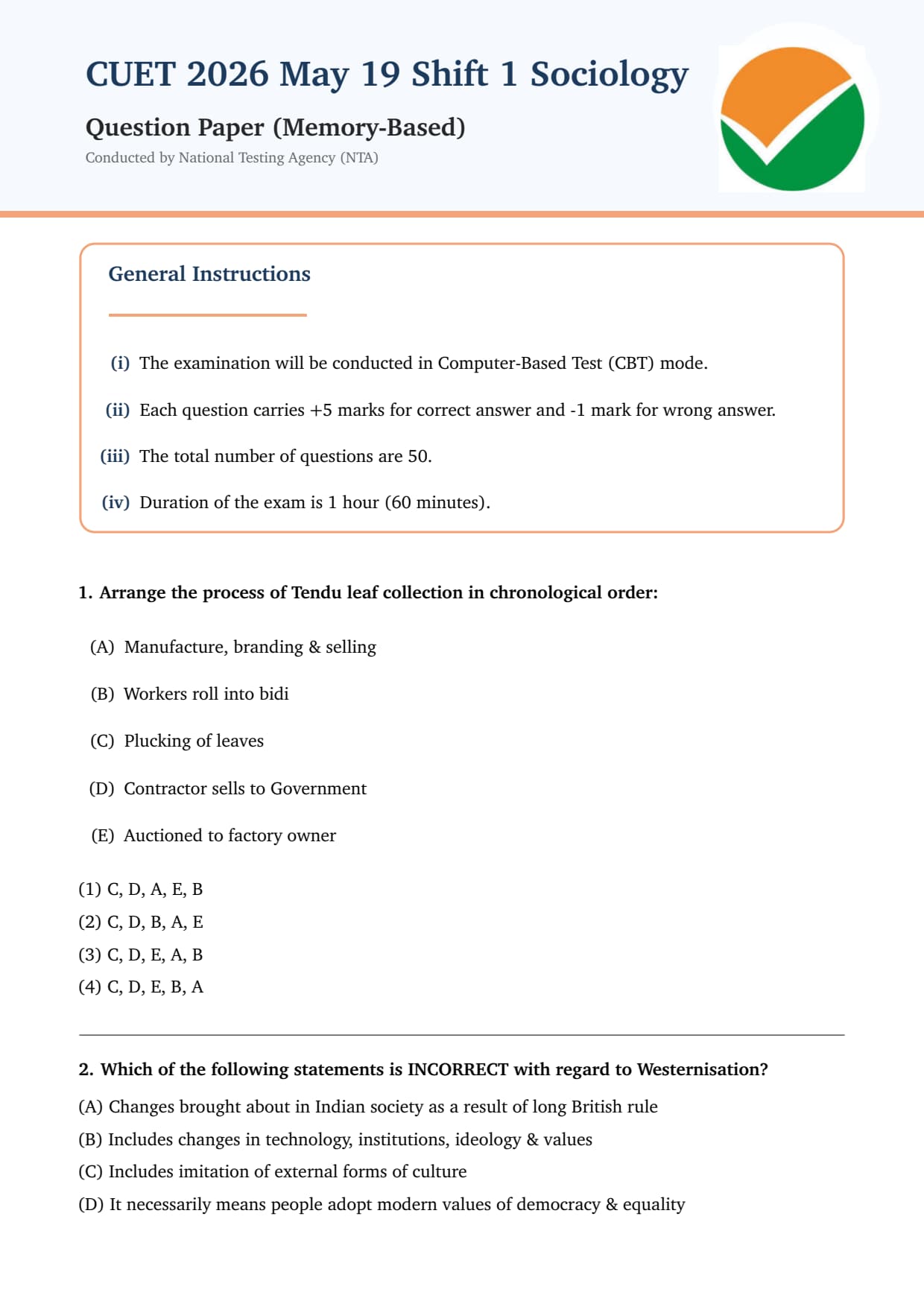
Arrange the process of Tendu leaf collection in chronological order:
A. Manufacture, branding & selling
B. Workers roll into bidi
C. Plucking of leaves
D. Contractor sells to Government
E. Auctioned to factory owner
View Solution
Tendu leaves are an important minor forest product widely used in the manufacture of bidis. The complete process involves collection, government procurement, industrial distribution, production, and final sale in the market.
The first step is the plucking of tendu leaves from forests by tribal and rural workers. Hence, step (C) comes first.
After collection, contractors gather the leaves and sell them to the Government. In many states, the tendu leaf trade is regulated by the Government to ensure organized procurement and reduce exploitation of forest workers. Therefore, step (D) follows.
The Government then auctions the collected leaves to factory owners and bidi manufacturers. Thus, step (E) comes next.
After purchasing the leaves, factory owners distribute tendu leaves and tobacco to workers who roll them into bidis. Hence, step (B) follows.
Finally, the bidis undergo:
Manufacturing and finishing
Packaging
Branding
Selling in the market
Thus, step (A) occurs at the end.
Therefore, the correct chronological sequence is:
\[ C \rightarrow D \rightarrow E \rightarrow B \rightarrow A \]
Hence, the correct answer is:
\[ \boxed{(4)} \] Quick Tip: In chronology-based process questions, identify the raw material collection stage first and the final commercial sale stage last.
Which of the following statements is INCORRECT with regard to Westernisation?
View Solution
The concept of Westernisation was explained by sociologist M.N. Srinivas. It refers to the social and cultural changes that took place in Indian society due to British rule over a long period.
Westernisation includes several types of changes such as:
Introduction of modern technology
Spread of English education
Development of new institutions
Changes in dress, food habits, and lifestyle
Adoption of certain Western ideas and values
Thus, statements (A), (B), and (C) correctly describe Westernisation.
However, Westernisation does not necessarily mean that a person fully adopts democratic or egalitarian values. A person may imitate Western clothing, language, or lifestyle without accepting ideas such as equality, secularism, or democracy.
Therefore, statement (D) is incorrect because Westernisation and modernization are not exactly the same concepts.
Hence, the correct answer is:
\[ \boxed{(D)} \] Quick Tip: Westernisation refers to influence of Western culture, whereas modernization mainly focuses on rationality, equality, and scientific outlook.
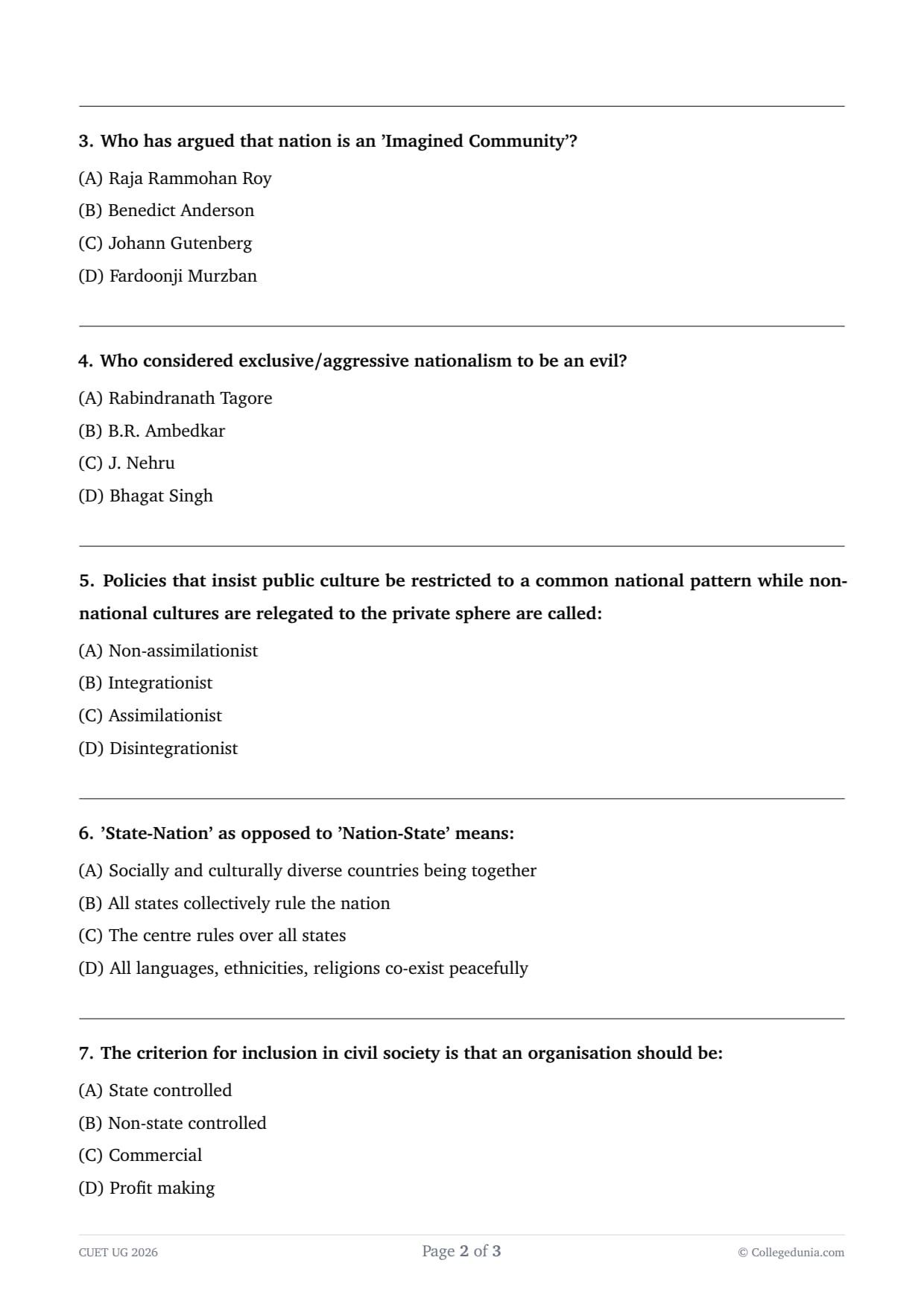
Who has argued that nation is an 'Imagined Community'?
View Solution
The concept of nation as an "Imagined Community" was proposed by political scientist and historian Benedict Anderson in his famous book Imagined Communities published in 1983.
According to Anderson:
Members of a nation may never meet each other personally.
Despite this, they imagine themselves as part of one community.
This shared feeling creates national identity and unity.
He argued that the rise of print media such as:
Newspapers
Books
Magazines
helped people develop a collective national consciousness.
Option analysis:
Raja Rammohan Roy was a social reformer.
Johann Gutenberg invented the printing press.
Fardoonji Murzban was associated with early Indian journalism.
Benedict Anderson gave the concept of "Imagined Community."
Therefore, the correct answer is:
(B)Quick Tip: Associate the term "Imagined Community" directly with Benedict Anderson.
Who considered exclusive/aggressive nationalism to be an evil?
View Solution
Rabindranath Tagore strongly criticized aggressive and exclusive nationalism. He believed that extreme nationalism could create hatred, violence, and conflict among nations.
Tagore emphasized:
Humanism
Universal brotherhood
Spiritual unity of humanity
He argued that blind nationalism may suppress moral and humanitarian values.
Although Tagore supported India's freedom, he warned against narrow and aggressive nationalism similar to that seen in many Western countries during that period.
Option analysis:
Rabindranath Tagore criticized aggressive nationalism.
B.R. Ambedkar mainly focused on social justice and equality.
Jawaharlal Nehru supported democratic nationalism.
Bhagat Singh was a revolutionary freedom fighter.
Hence, the correct answer is:
\[ \boxed{(A)} \] Quick Tip: Tagore promoted universal human values over narrow aggressive nationalism.
Policies that insist public culture be restricted to a common national pattern while non-national cultures are relegated to the private sphere are called:
View Solution
Assimilationist policies aim to create a culturally uniform society. Under such policies, minority groups are expected to adopt the language, customs, traditions, and lifestyle of the dominant national culture.
In assimilationist systems:
Public culture follows one common national identity.
Minority cultural practices are restricted mainly to private life.
Diversity in public institutions is discouraged.
The question describes exactly such a situation where:
Public culture is limited to one national pattern.
Other cultural identities are pushed into the private sphere.
Therefore, these policies are called assimilationist policies.
Option analysis:
Non-assimilationist policies allow greater cultural diversity.
Integrationist policies try to combine unity with diversity.
Assimilationist policies demand cultural uniformity.
Disintegrationist is not the correct sociological concept here.
Hence, the correct answer is:
\[ \boxed{(C)} \] Quick Tip: Assimilation means minority groups are expected to merge into the dominant national culture.
'State-Nation' as opposed to 'Nation-State' means:
View Solution
The concepts of Nation-State and State-Nation are important in political sociology and are used to understand how modern countries manage diversity.
A Nation-State generally refers to a political system where:
One nation corresponds to one state.
People share common culture, language, ethnicity, or identity.
Cultural homogeneity is encouraged.
In many classical European nation-states, governments attempted to create a single national identity by promoting one dominant culture and language.
On the other hand, a State-Nation refers to a country where:
Multiple cultures, languages, religions, and ethnic groups coexist.
Diversity is recognized and accommodated within one political framework.
Unity is maintained despite social and cultural differences.
India is often considered a good example of a State-Nation because:
It contains many languages and religions.
Different regional identities coexist within one democratic state.
Constitutional protections help maintain unity in diversity.
The phrase in the question refers to socially and culturally diverse groups remaining together within a single political state.
Option analysis:
Option (A): Correct because State-Nation refers to culturally diverse groups existing together.
Option (B): Incorrect because the concept is not about collective rule of states.
Option (C): Incorrect because central rule is unrelated to the definition.
Option (D): Partially true regarding coexistence, but it does not fully define the sociological concept.
Therefore, the correct answer is:
\[ \boxed{(A)} \] Quick Tip: Remember: Nation-State means "One State, One Dominant Culture," whereas State-Nation means "One State with Multiple Cultures."
The criterion for inclusion in civil society is that an organisation should be:
View Solution
Civil society refers to the sphere of organized social life that exists independently from the government and the market. It includes groups and organizations formed voluntarily by people to promote common interests, rights, welfare, or social causes.
Civil society organizations generally include:
Non-Governmental Organizations (NGOs)
Trade unions
Student organizations
Women's groups
Religious associations
Human rights organizations
Environmental groups
The most important criterion for inclusion in civil society is that the organization should be independent of direct state control.
This means:
It should not function as a government department.
It should operate autonomously.
Participation should usually be voluntary.
Civil society acts as a bridge between citizens and the state. It helps:
Protect democratic rights
Promote awareness
Mobilize public opinion
Hold governments accountable
Option analysis:
Option (A): Incorrect because state-controlled bodies are part of government structure.
Option (B): Correct because civil society organizations are non-state controlled.
Option (C): Incorrect because commercial organizations mainly belong to the market sector.
Option (D): Incorrect because profit-making is not the purpose of civil society organizations.
Hence, the correct answer is:
\[ \boxed{(B)} \] Quick Tip: Civil society exists between the State and the Market. It is voluntary, independent, and generally non-profit in nature.
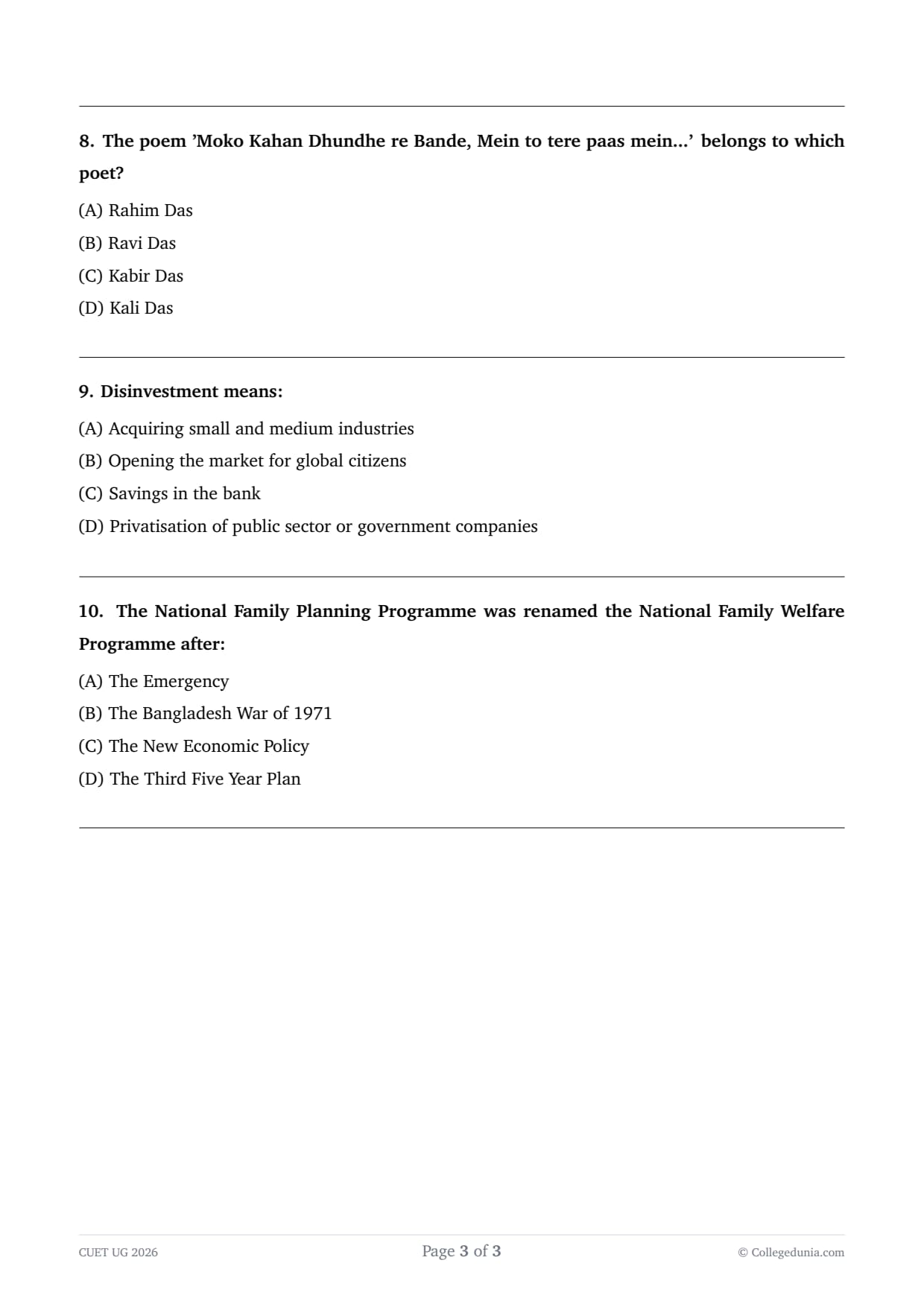
The poem 'Moko Kahan Dhundhe re Bande, Mein to tere paas mein...' belongs to which poet?
View Solution
The famous devotional line:
\[ ``Moko Kahan Dhundhe re Bande, Mein to tere paas mein'' \]
was written by the great Bhakti saint and poet Kabir Das.
Kabir Das was one of the most influential poet-saints of the Bhakti Movement in medieval India. His teachings emphasized:
Devotion to one God
Equality among human beings
Rejection of religious hypocrisy
Inner spirituality over external rituals
In this poem, Kabir explains that God cannot be found merely through:
Temples
Mosques
Pilgrimages
Rituals
Instead, he says that God resides within every human being and can be realized through inner purity and devotion.
Kabir's poetry is known for:
Simplicity of language
Deep philosophical meaning
Criticism of blind rituals
Universal human values
Option analysis:
Rahim Das was known for Hindi couplets but not this composition.
Ravi Das was another Bhakti saint.
Kabir Das is the correct poet of this famous verse.
Kalidas was a classical Sanskrit poet and dramatist.
Therefore, the correct answer is:
\[ \boxed{(C)} \] Quick Tip: Poems emphasizing inner spirituality and criticism of rituals are commonly associated with Kabir Das.
Disinvestment means:
View Solution
Disinvestment refers to the process through which the government reduces its ownership or shareholding in Public Sector Undertakings (PSUs) by selling shares to private investors or the general public.
The policy of disinvestment became especially important in India after the economic reforms of 1991.
The main objectives of disinvestment are:
Reducing financial burden on the government
Improving efficiency of industries
Encouraging private sector participation
Generating government revenue
Increasing competition in the economy
When the government sells a significant portion of its ownership in public sector companies, the process moves toward privatization.
Examples include reduction of government stake in:
Airlines
Banks
Oil companies
Manufacturing industries
Option analysis:
Option (A): Incorrect because disinvestment does not mean acquiring industries.
Option (B): Incorrect because this relates more to globalization.
Option (C): Incorrect because it is unrelated to banking savings.
Option (D): Correct because disinvestment involves privatization or reduction of government ownership.
Therefore, the correct answer is:
\[ \boxed{(D)} \] Quick Tip: Disinvestment means the government sells part of its ownership in public sector companies to private investors.
The National Family Planning Programme was renamed the National Family Welfare Programme after:
View Solution
India was the first country in the world to launch an official Family Planning Programme in 1952. The main aim of the programme was to control rapid population growth and improve the standard of living.
During the Emergency period (1975--1977), the family planning programme became highly controversial because of:
Forced sterilization campaigns
Coercive population control measures
Political misuse of administrative authority
Large numbers of people, especially poor and rural populations, were subjected to compulsory sterilization drives. This created widespread public anger and distrust toward the term "Family Planning."
After the Emergency ended, the new government attempted to restore public confidence by changing both the approach and the name of the programme.
Thus:
The programme was renamed as the National Family Welfare Programme.
Greater emphasis was placed on voluntary participation.
Focus shifted toward maternal and child welfare along with reproductive health.
Option analysis:
Option (A): Correct because the name change occurred after the Emergency.
Option (B): Incorrect because the Bangladesh War had no relation to this change.
Option (C): Incorrect because the New Economic Policy came much later in 1991.
Option (D): Incorrect because the Third Five Year Plan is unrelated to the renaming.
Therefore, the correct answer is:
\[ \boxed{(A)} \] Quick Tip: The Emergency period is strongly associated with forced sterilization campaigns and major changes in India's population policy.
CUET UG 2026 Exam Pattern
| Parameter | Details |
|---|---|
| Exam Name | Common University Entrance Test (CUET UG) 2026 |
| Conducting Body | National Testing Agency (NTA) |
| Exam Mode | Computer-Based Test (CBT) |
| Exam Duration | 60 minutes per test |
| Total Sections | 3 (Languages, Domain Subjects, General Test) |
| Question Type | Multiple Choice Questions (MCQs) |
| Questions per Test | 50 questions (all compulsory) |
| Marking Scheme | +5 for correct, -1 for incorrect |
| Maximum Marks | 250 marks per test |
| Maximum Subject Choices | 5 subjects in total |
| Syllabus Base | Class 12 NCERT (mainly for Domain Subjects) |



Comments