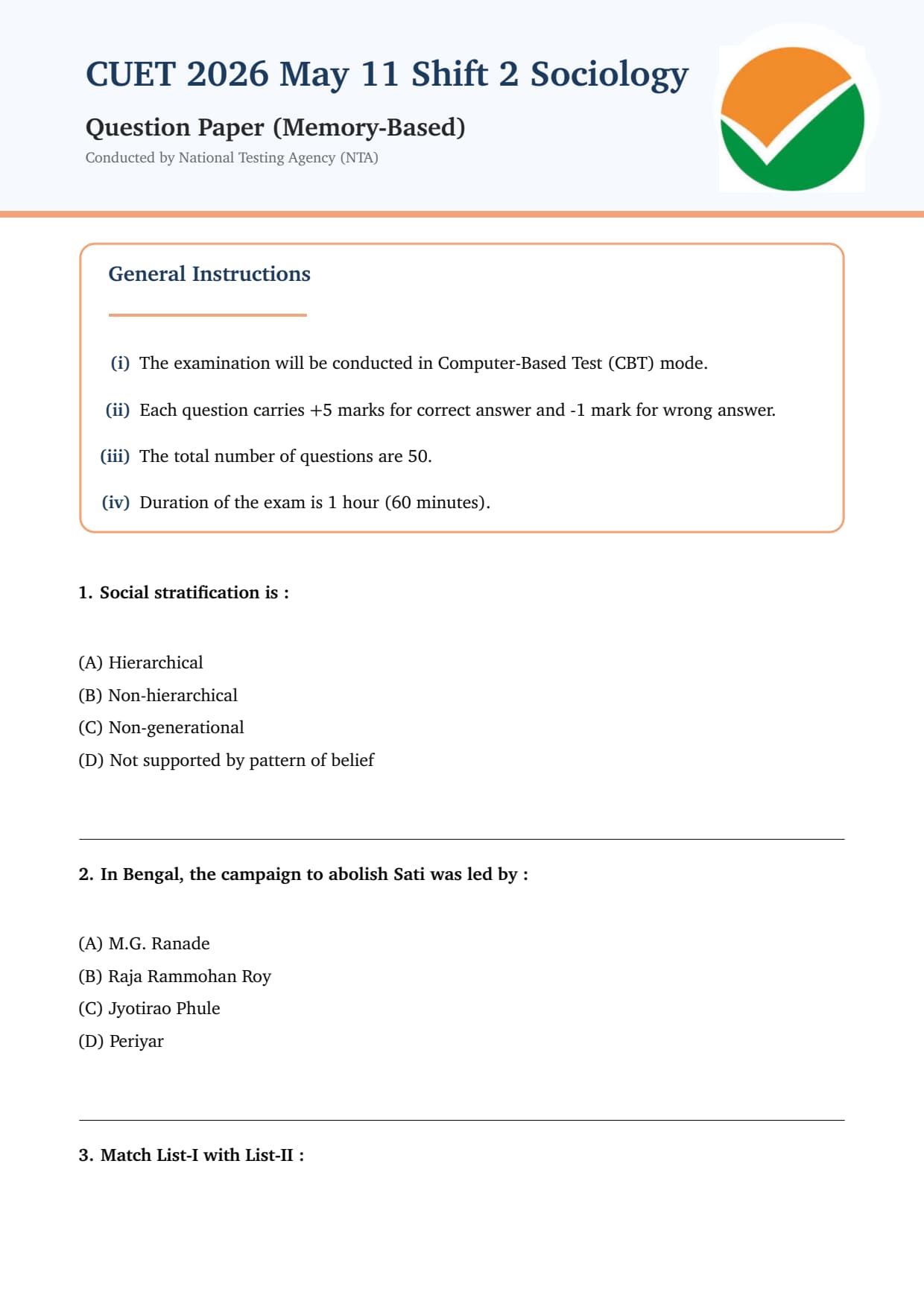
CUET 2026 May 11 Shift 2 Sociology Question Paper is available for download here. NTA is conducting the CUET UG 2026 exam from 11th May to 31st May.

  • CUET 2026 Sociology exam consists of 50 questions for 250 marks to be attempted in 60 minutes.
  • As per the marking scheme, 5 marks are awarded for each correct answer, and 1 mark is deducted for incorrect answer.

Candidates can download CUET 2026 May 11 Shift 2 Sociology Question Paper with Answer Key and Solution PDF from links provided below.

CUET 2026 Sociology May 11 Shift 2 Question Paper with Solution PDF

CUET May 11 Shift 2 Sociology Question Paper 2026 Download PDF Check Solutions


Question 1:

Social stratification is :

  • (A) Hierarchical
  • (B) Non-hierarchical
  • (C) Non-generational
  • (D) Not supported by pattern of belief
Correct Answer: (A) Hierarchical
View Solution


Step 1: Understanding the Concept:

Social stratification refers to a society's categorization of its people into rankings based on factors like wealth, income, education, family background, power, and social status. This system is often characterized by a hierarchy where different groups have unequal access to resources and opportunities.

Step 2: Analyzing the Options:

(A) Hierarchical: This aligns with the definition of social stratification, which implies a layered structure with higher and lower ranks.

(B) Non-hierarchical: This is the opposite of stratification.

(C) Non-generational: While stratification can change over generations, it is not inherently non-generational; indeed, intergenerational mobility is a key aspect studied within stratification.

(D) Not supported by pattern of belief: Social stratification is often supported and justified by societal beliefs, ideologies, and norms.

Step 3: Detailed Explanation:

Social stratification is fundamentally about the ranking of individuals and groups within a society. This ranking is not random but is structured in a hierarchical manner, meaning there are layers or strata, with those at the top having more advantages than those at the bottom. This hierarchy is based on various social and economic factors. Therefore, the most accurate description of social stratification is that it is hierarchical.

Step 4: Final Answer:

The definition of social stratification inherently involves a hierarchical structure.
Quick Tip: For questions on sociological concepts, always recall the core definition. Think about whether the term implies ranking, hierarchy, or equality. In this case, "stratification" directly implies layers or a hierarchy.


Question 2:

In Bengal, the campaign to abolish Sati was led by :

  • (A) M.G. Ranade
  • (B) Raja Rammohan Roy
  • (C) Jyotirao Phule
  • (D) Periyar
Correct Answer: (B) Raja Rammohan Roy
View Solution


Step 1: Understanding the Context:

The question asks about the leader of the campaign to abolish the Sati practice in Bengal. Sati was a historical practice where a widow immolated herself on her deceased husband's funeral pyre.

Step 2: Historical Knowledge Recall:

Raja Rammohan Roy was a prominent social reformer in Bengal during the 19th century. He is widely recognized for his relentless efforts and advocacy against the practice of Sati. He played a crucial role in persuading the British government to enact legislation banning the practice. Lord William Bentinck, the Governor-General of India, passed the Sati Prohibition Regulation in 1829, largely due to Roy's influence and campaigning.

Step 3: Evaluating Other Options:

(A) M.G. Ranade (Mahadev Govind Ranade) was a key figure in the Indian National Congress and a social reformer, active mainly in Maharashtra, known for his work on social reform and economic issues but not primarily associated with the abolition of Sati in Bengal.

(C) Jyotirao Phule was a social reformer from Maharashtra, known for his work on caste discrimination and women's education, but his activism was centered in Western India.

(D) Periyar E. V. Ramasamy was a social activist and politician from Tamil Nadu, known for his Dravidian movement and anti-caste activism, active much later than the Sati abolition movement in Bengal.

Step 4: Final Answer:

Raja Rammohan Roy was the central figure in the campaign to abolish Sati in Bengal.
Quick Tip: When dealing with historical questions about social reforms in India, recall the prominent reformers and their respective regions and key movements. Raja Rammohan Roy is synonymous with the anti-Sati campaign in Bengal.


Question 3:

Match List-I with List-II :


  • (1) A-III, B-I, C-II, D-IV
  • (2) A-III, B-II, C-I, D-IV
  • (3) A-III, B-IV, C-II, D-I
  • (4) A-III, B-IV, C-I, D-II
Correct Answer: (4) A-III, B-IV, C-I, D-II
View Solution


Step 1: Understanding the Task:

This question requires matching concepts from List-I with the sociologists/economists from List-II who are most associated with them.

Step 2: Matching Each Item:

(A) Wealth of Nations: This is the title of a seminal work by Adam Smith (III), which is foundational to classical economics.

(B) Alienation: The concept of alienation, particularly in the context of labor under capitalism, is a central theme in the work of Karl Marx (IV).

(C) Status Symbol: While discussed by many, the concept of status and its symbols, often linked to social class and lifestyle, is a significant area of work for Max Weber (I). Weber's multidimensional approach to stratification includes status alongside class and party.

(D) Fooloose Labour: This term likely refers to "Coolie Labour" or a similar concept related to exploitation of labor, often studied in the context of labor migration and exploitation in developing countries. Jan Breman (II) is a sociologist known for his extensive ethnographic work on labor, particularly in India, focusing on the conditions of the poor and marginalized laborers, including coolies.

Step 3: Assembling the Matches:

Based on the above:

A matches with III (Adam Smith)

B matches with IV (Karl Marx)

C matches with I (Max Weber)

D matches with II (Jan Breman)

Therefore, the correct matching is A-III, B-IV, C-I, D-II.

Step 4: Selecting the Correct Option:

Comparing this with the given options, Option (4) is A-III, B-IV, C-I, D-II.
Quick Tip: For matching questions involving authors and concepts, try to identify the most famous or central association first. For example, "Wealth of Nations" is definitively Adam Smith, and "Alienation" is definitively Karl Marx. This can quickly narrow down the possibilities.


Question 4:

Which of the following statements about demography are correct?

I. Demography is the systematic study of population.

II. Census is conducted every five years in India.

III. Demography studies birth rate, death rate, and migration.

IV. Age structure and sex ratio are important demographic indicators

Choose the correct answer:

  • (1) I and II only
  • (2) I, III and IV only
  • (3) II and III only
  • (4) I, II, III and IV
Correct Answer: (2) I, III and IV only
View Solution


Step 1: Understanding Demography:

Demography is the statistical study of populations, especially human beings. It encompasses the study of the size, structure, and distribution of these populations, and how populations change over time due to births, deaths, migration, and aging.

Step 2: Evaluating Each Statement:

I. Demography is the systematic study of population. This statement is correct. This is the fundamental definition of demography.

II. Census is conducted every five years in India. This statement is incorrect. In India, the census is conducted every ten years, not five years. The last census was in 2011, and the next one is delayed.

III. Demography studies birth rate, death rate, and migration. This statement is correct. These are core components of demographic analysis, often referred to as vital statistics or demographic processes.

IV. Age structure and sex ratio are important demographic indicators. This statement is correct. Age and sex are fundamental characteristics of a population that influence its dynamics and are crucial for understanding social and economic planning.

Step 3: Identifying Correct Statements:

Statements I, III, and IV are correct. Statement II is incorrect.

Step 4: Selecting the Correct Option:

Based on the correct statements, the answer is I, III, and IV only, which corresponds to Option (2).
Quick Tip: Pay close attention to details in statements, especially numerical facts (like frequencies of events). For demography questions, remember its core components: population size, structure (age, sex), and changes (births, deaths, migration).


Question 5:

The concept of 'Dominant Caste' in Indian sociology was given by :

  • (A) B.R. Ambedkar
  • (B) M.N. Srinivas
  • (C) G.S. Ghurye
  • (D) Louis Dumont
Correct Answer: (B) M.N. Srinivas
View Solution


Step 1: Understanding the Concept:

The question asks for the sociologist who introduced the concept of 'Dominant Caste' in the context of Indian sociology. This concept refers to a caste that wields significant economic, political, and social power in a village or region.

Step 2: Recalling Key Sociologists and Their Contributions:

M.N. Srinivas (Mandapalli Venkata Narasimha Srinivas) is a highly influential Indian sociologist. He is renowned for his fieldwork and conceptual contributions to understanding Indian society, particularly caste, village studies, and social change. He coined and popularized the concept of 'Dominant Caste' based on his research in villages in Mysore (now Karnataka). A caste becomes dominant if it is numerically strong and has significant land ownership and influence over village affairs, often including political and economic power.

Step 3: Evaluating Other Options:

(A) B.R. Ambedkar was a towering figure in the fight against caste discrimination and a key architect of the Indian Constitution. While he extensively analyzed the caste system and its oppressive nature, the term 'Dominant Caste' as a specific analytical concept is attributed to Srinivas.

(C) G.S. Ghurye was another pioneering Indian sociologist who studied caste extensively, focusing on its religious and structural aspects, but 'Dominant Caste' is not his primary concept.

(D) Louis Dumont was a French anthropologist who made significant contributions to the study of caste, particularly through his concept of 'hierarchy' and 'holism', but he did not originate the concept of 'Dominant Caste'.

Step 4: Final Answer:

M.N. Srinivas introduced and developed the concept of 'Dominant Caste'.
Quick Tip: When asked about specific concepts in Indian sociology, associate them with the most prominent sociologists known for their work on caste and village studies. M.N. Srinivas is critically important for his contributions, including the 'Dominant Caste'.


Question 6:

Which Article of the Indian Constitution prohibits denial of admission to State- funded educational institutions on grounds of religion, race, caste, or language?

  • (A) Article 29(1)
  • (B) Article 29(2)
  • (C) Article 30(1)
  • (D) Article 30(2)
Correct Answer: (B) Article 29(2)
View Solution


Step 1: Understanding the Constitutional Provision:

The question asks about the specific Article in the Indian Constitution that prohibits discrimination in admission to educational institutions receiving state funds, based on certain grounds.

Step 2: Analyzing the Options and Relevant Articles:

The Indian Constitution guarantees several fundamental rights, including the right to equality and cultural and educational rights. Articles 29 and 30 deal with cultural and educational rights.

Article 29 deals with the protection of interests of minorities.

- Article 29(1) states that any section of citizens residing in the territory of India or any part thereof having a distinct language, script or culture of its own shall have the right to conserve the same.

- Article 29(2) states that no citizen shall be denied admission into any educational institution maintained by the State or receiving aid out of State funds on grounds only of religion, race, caste, language or any of them.

Article 30 deals with the right of minorities to establish and administer educational institutions.

- Article 30(1) states that all minorities, whether based on religion or language, shall have the right to establish and administer educational institutions of their choice.

- Article 30(2) states that the State shall not, in granting aid to educational institutions, discriminate against any educational institution on the ground that it is under the management of a minority, whether based on religion or language.

Step 3: Identifying the Correct Article:

Article 29(2) explicitly prohibits the denial of admission into any educational institution maintained by the State or receiving aid out of State funds on grounds of religion, race, caste, or language. This perfectly matches the question's requirement.

Step 4: Eliminating Other Options:

Article 29(1) deals with the right to conserve distinct language, script, or culture.

Article 30(1) deals with the right of minorities to establish and administer educational institutions.

Article 30(2) deals with non-discrimination by the State in granting aid to educational institutions managed by minorities.

Step 5: Final Answer:

Article 29(2) is the correct provision.
Quick Tip: When answering questions about constitutional articles, carefully read the exact wording of each part of the article. Identify keywords in the question (e.g., "denial of admission," "State-funded," "grounds of religion, race, caste, or language") and match them to the specific provisions.


Question 7:

Which of the following customs is practised in Khasi society?

  • (A) Property passes from mother to daughter \& maternal uncle controls it
  • (B) Father controls all property
  • (C) Property is equally divided among sons
  • (D) No property rights for women
Correct Answer: (A) Property passes from mother to daughter \& maternal uncle controls it
View Solution


Step 1: Understanding the Question:

The question asks about a specific customary practice related to property inheritance and control within Khasi society. The Khasis are a prominent indigenous tribal community in Meghalaya, India.

Step 2: Recalling Khasi Social Structure:

Khasi society is renowned for being matrilineal, meaning descent and inheritance are traced through the mother's line. In a traditional Khasi family, the youngest daughter (Ka Khadduh) inherits the ancestral property and is responsible for maintaining the family. However, the administration and management of this property are typically vested in the maternal uncle (mother's brother). This practice is known as the significant role of the maternal uncle in property management within a matrilineal system.

Step 3: Evaluating the Options:

(A) Property passes from mother to daughter \& maternal uncle controls it: This accurately describes the traditional Khasi custom. The property is inherited by the daughter (typically the youngest), but the maternal uncle plays a crucial role in its management and guardianship.

(B) Father controls all property: This is characteristic of patrilineal societies, not matrilineal Khasi society.

(C) Property is equally divided among sons: This is also characteristic of patrilineal societies where sons are the primary inheritors.

(D) No property rights for women: This is directly contrary to the matrilineal nature of Khasi society, where women (especially the youngest daughter) are the principal inheritors of ancestral property.

Step 4: Final Answer:

The custom described in option (A) is practised in Khasi society.
Quick Tip: For questions about tribal societies, recall their unique social structures, such as matrilineal or patrilineal systems, and customs related to inheritance and family roles. The Khasis are a prime example of a matrilineal society where property and lineage are passed through women.


Question 8:

A person from a wealthy family completes an MBA abroad and gets a well-paid job through an influential relative. Which forms of capital does the person possess?

  • (A) Cultural Capital
  • (B) Social Capital
  • (C) Symbolic Capital
  • (D) Economic Capital
Correct Answer: (B) Social Capital
View Solution


Step 1: Understanding the Forms of Capital:

The question involves understanding different forms of capital as conceptualized in sociology, particularly by Pierre Bourdieu. The main forms are economic capital (money, assets), cultural capital (education, knowledge, skills, tastes), social capital (networks, relationships, connections), and symbolic capital (prestige, honor, recognition).

Step 2: Analyzing the Scenario:

The scenario describes a person with several advantages:

- Wealthy family: This indicates possession of Economic Capital (D).

- Completes an MBA abroad: This demonstrates acquired Cultural Capital (A) in the form of education and qualifications, which can also translate into prestige.

- Gets a well-paid job through an influential relative: This is the key indicator of Social Capital (B). The "influential relative" represents a valuable connection and network that facilitated the job acquisition. This network provides access to opportunities that might not be available otherwise.

Step 3: Considering Symbolic Capital:

Symbolic Capital (C) is a broader concept that includes prestige and recognition. While obtaining a well-paid job might enhance symbolic capital, the direct mechanism described for getting the job is the influential relative, which is the domain of social capital. Cultural capital (MBA) can also contribute to symbolic capital. However, the question asks which forms of capital the person *possesses* in the context of achieving this outcome.

Step 4: Identifying the Most Relevant Capital for the Job Acquisition:

The crucial element in securing the job is "through an influential relative." This directly points to the exploitation of social networks and connections. While economic and cultural capital are present and undoubtedly contributed to the person's overall advantage, the specific mechanism of getting the job highlights social capital. The question asks which forms of capital the person *possesses* in relation to the scenario as a whole. The person possesses economic capital (from wealthy family), cultural capital (MBA), and crucially, social capital (connections from influential relative) which directly led to the job. However, the question often implies the primary driver or the distinct advantage gained in this specific step of getting the job. Let's re-evaluate the question: "Which forms of capital does the person possess?". The person possesses all of them. However, typical exam questions of this nature often look for the *most salient* form of capital in a particular context or the one that distinguishes the success. The direct access to a well-paid job via an influential relative is a clear manifestation of social capital.

If the question implies a single best answer from the options, and the primary mechanism highlighted for job acquisition is the "influential relative," then Social Capital is the most appropriate choice. The person possesses all forms, but the question might be implicitly asking for the most direct facilitator of the job opportunity.


Step 5: Final Answer:

The person possesses economic capital (wealthy family), cultural capital (MBA), and social capital (influential relative). However, the prompt specifically highlights getting the job "through an influential relative," which is a direct manifestation of social capital. Thus, social capital is the most pertinent answer among the choices if a single best answer is expected.
Quick Tip: Understand Bourdieu's forms of capital: Economic (money, property), Cultural (education, skills, tastes), Social (networks, connections), and Symbolic (prestige, honor). In scenarios involving job acquisition through connections, social capital is the key concept.


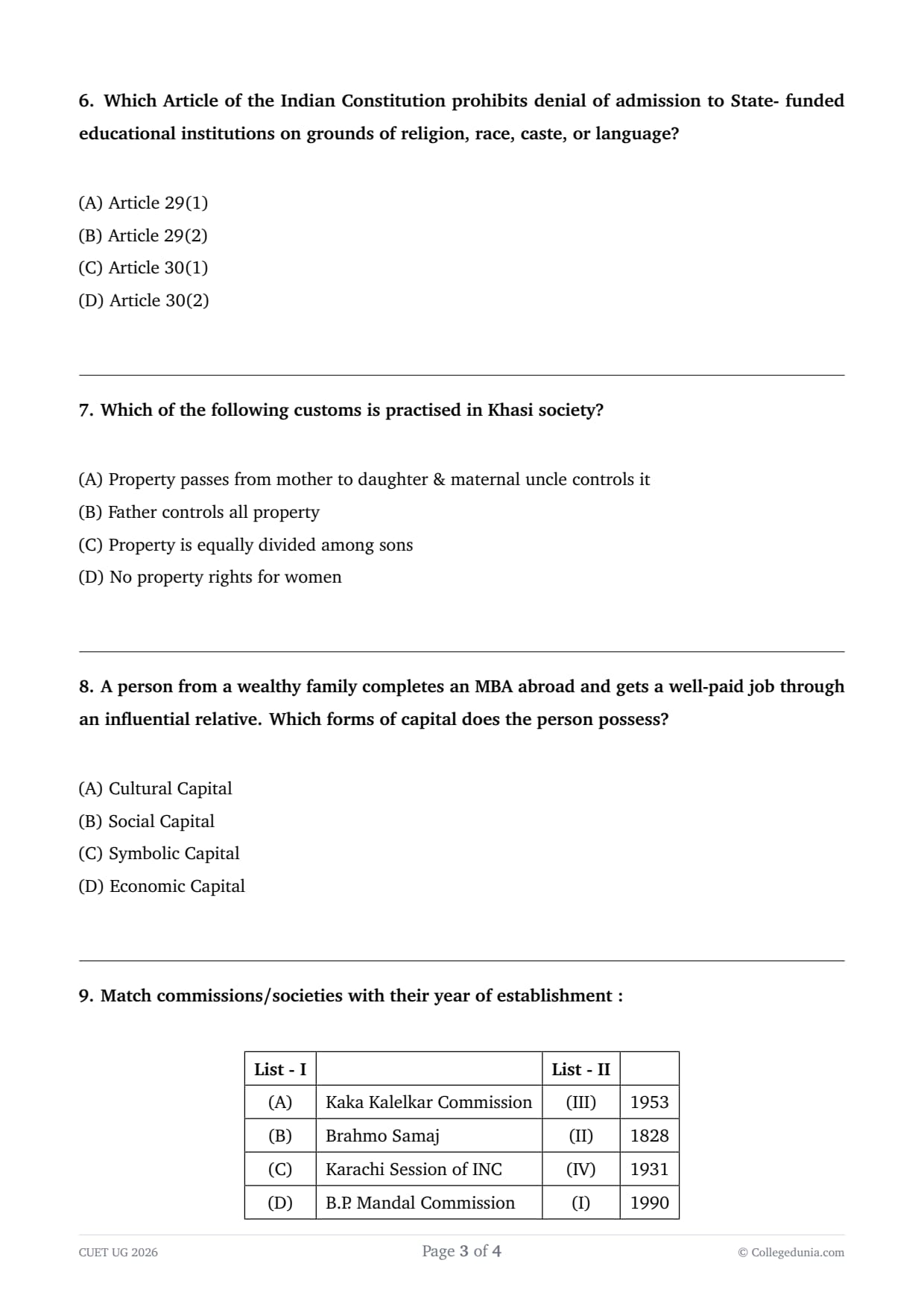
Question 9:

Match commissions/societies with their year of establishment :


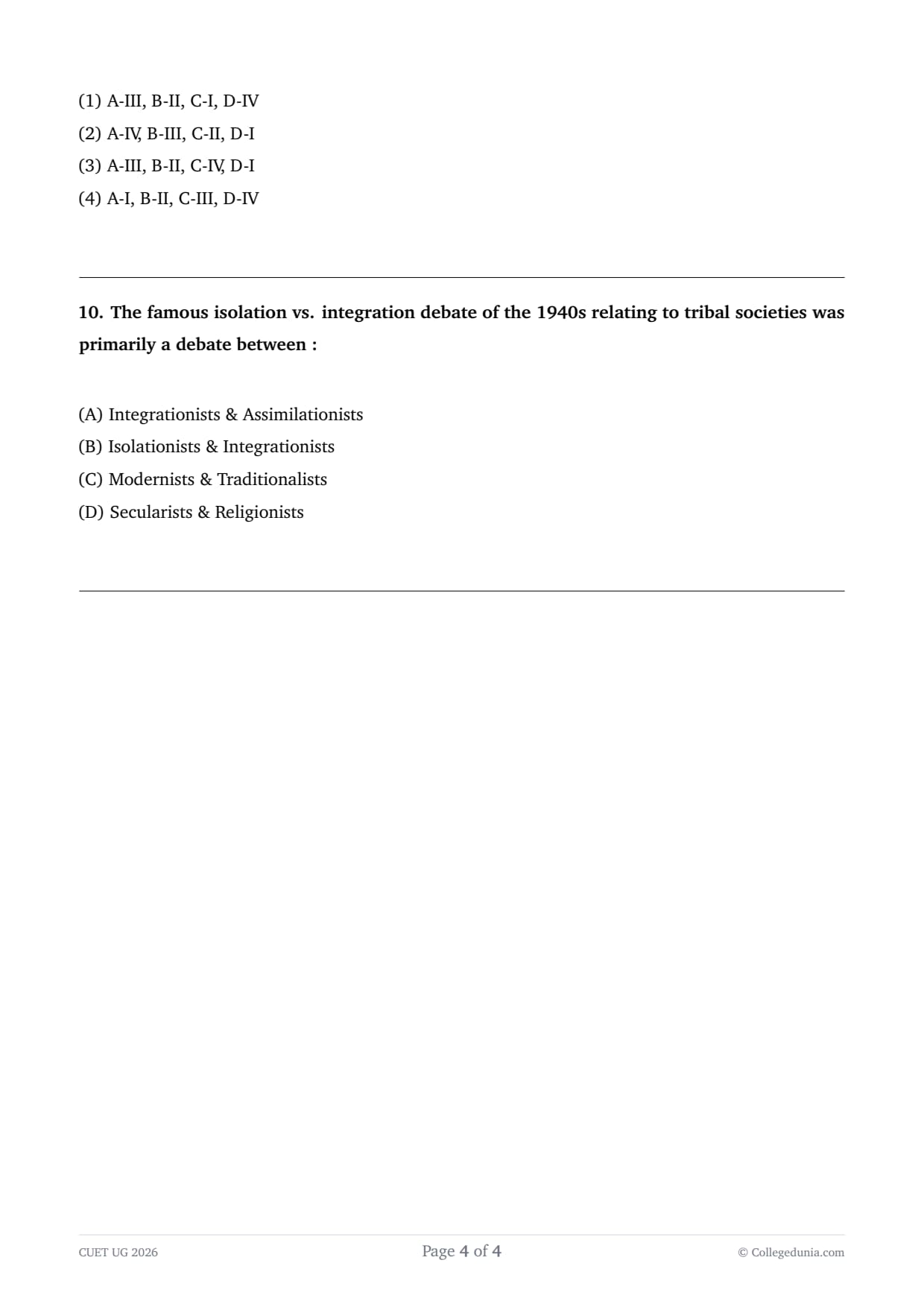
  • (1) A-III, B-II, C-I, D-IV
  • (2) A-IV, B-III, C-II, D-I
  • (3) A-III, B-II, C-IV, D-I
  • (4) A-I, B-II, C-III, D-IV
Correct Answer: (3) A-III, B-II, C-IV, D-I
View Solution


Step 1: Understanding the Task:

This question requires matching commissions and societies with their respective years of establishment.

Step 2: Matching Each Item:

(A) Kaka Kalelkar Commission: Also known as the First Backward Classes Commission, it was established in 1953. So, A matches with III.

(B) Brahmo Samaj: Founded by Raja Rammohan Roy, it was established in 1828. So, B matches with II.

(C) Karachi Session of INC: This important session of the Indian National Congress, where the resolution on Fundamental Rights and Economic Policy was passed, took place in 1931. So, C matches with IV.

(D) B.P. Mandal Commission: Also known as the Second Backward Classes Commission, it was established in 1979. However, its report was submitted in 1980, and the implementation of its recommendations (27% reservation) began in 1990. Given the options (I) 1990, (II) 1828, (III) 1953, (IV) 1931, the year 1990 (I) is most significantly associated with the Mandal Commission due to the implementation of its reservation policies. Thus, we match D with I.

Step 3: Assembling the Matches:

A - III (1953)

B - II (1828)

C - IV (1931)

D - I (1990)

This corresponds to A-III, B-II, C-IV, D-I.

Step 4: Selecting the Correct Option:

Comparing this with the given options:

Option (1): A-III, B-II, C-I, D-IV (Incorrect C and D)

Option (2): A-IV, B-III, C-II, D-I (Incorrect A, B, C)

Option (3): A-III, B-II, C-IV, D-I (Matches our derived matches)

Option (4): A-I, B-II, C-III, D-IV (Incorrect A, C)

Therefore, option (3) is the correct match.
Quick Tip: For matching questions involving historical dates, know the key establishments and events. For commissions, try to recall their primary purpose and the approximate era they were established or their recommendations were implemented. For political sessions, know the year they occurred.


Question 10:

The famous isolation vs. integration debate of the 1940s relating to tribal societies was primarily a debate between :

  • (A) Integrationists \& Assimilationists
  • (B) Isolationists \& Integrationists
  • (C) Modernists \& Traditionalists
  • (D) Secularists \& Religionists
Correct Answer: (B) Isolationists \& Integrationists
View Solution


Step 1: Understanding the Debate:

The question refers to a significant debate in the 1940s concerning the policy towards tribal societies in India. This debate revolved around how tribal communities should be incorporated into the broader national society.

Step 2: Defining the Terms:

- Isolationists: Advocated for maintaining tribal communities' distinctiveness and autonomy, minimizing contact with mainstream society to protect their culture and way of life. This approach suggested keeping them separate.

- Integrationists: Believed that tribal communities should be brought into the mainstream of national life and development, but in a way that respects their cultural identity and involves their participation. This is often seen as a more inclusive approach than assimilation.

- Assimilationists: Argued for tribal communities to be absorbed into the dominant culture, often leading to the erosion or loss of their own cultural traits.

- Modernists \& Traditionalists: This dichotomy is more general and relates to progress versus adherence to old ways, not specifically tied to the 1940s tribal policy debate's core.

- Secularists \& Religionists: Relates to the role of religion in public life, which is not the central theme of the isolation vs. integration debate for tribal societies.

Step 3: Identifying the Core Conflict:

The debate in the 1940s was precisely between those who wanted to keep tribal societies largely separate and protected (Isolationists) and those who wanted to bring them into the fold of the nation while respecting their identity (Integrationists). The policy that emerged, often associated with the integrationist approach, aimed to incorporate tribals into the development process without completely erasing their identity, distinguishing it from pure assimilation. Therefore, the primary dichotomy in this debate was between isolation and integration.

Step 4: Final Answer:

The debate was primarily between Isolationists and Integrationists.
Quick Tip: For debates and historical policy discussions, focus on the core ideological differences. The 1940s tribal debate was fundamentally about the extent of separation versus inclusion of tribal communities within the larger Indian polity.

CUET UG 2026 Exam Pattern

Parameter Details
Exam Name Common University Entrance Test (CUET UG) 2026
Conducting Body National Testing Agency (NTA)
Exam Mode Computer-Based Test (CBT)
Exam Duration 60 minutes per test
Total Sections 3 (Languages, Domain Subjects, General Test)
Question Type Multiple Choice Questions (MCQs)
Questions per Test 50 questions (all compulsory)
Marking Scheme +5 for correct, -1 for incorrect
Maximum Marks 250 marks per test
Maximum Subject Choices 5 subjects in total
Syllabus Base Class 12 NCERT (mainly for Domain Subjects)

CUET UG 2026 Sociology Question Paper Analysis