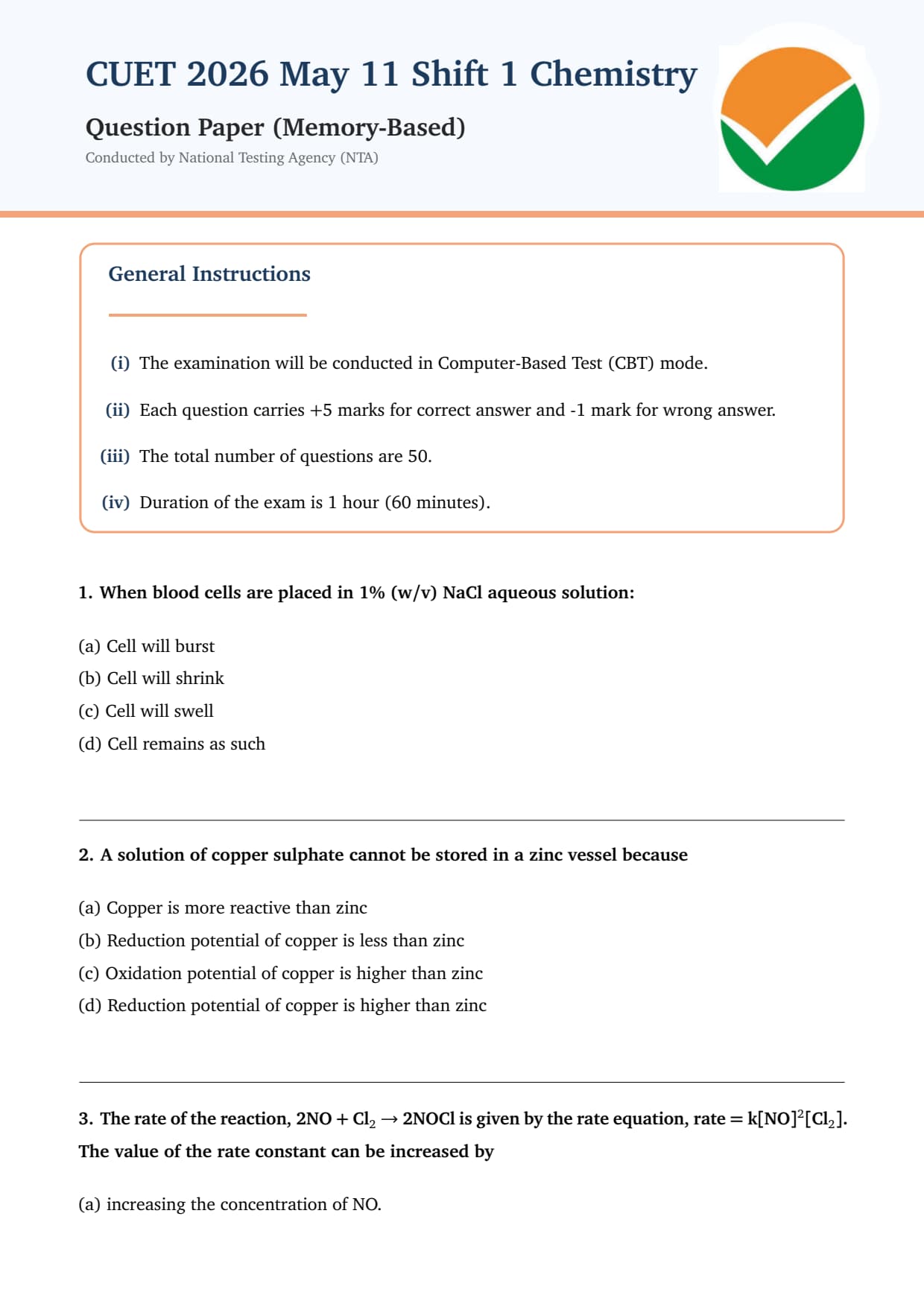
CUET 2026 May 11 Shift 1 Chemistry Question Paper is available for download here. NTA is conducting the CUET UG 2026 exam from 11th May to 31st May.

Also Check: CUET 2026 Chemistry Marks vs Percentile Expected - Full Analysis

  • CUET 2026 Chemistry exam consists of 50 questions for 250 marks to be attempted in 60 minutes.
  • As per the marking scheme, 5 marks are awarded for each correct answer, and 1 mark is deducted for incorrect answer.

Candidates can download CUET 2026 May 11 Shift 1 Chemistry Question Paper with Answer Key and Solution PDF from links provided below.

CUET 2026 Chemistry May 11 Shift 1 Question Paper with Solution PDF

CUET May 11 Shift 1 Chemistry Question Paper 2026 Download PDF Check Solutions
CUET 2026 May 11 Shift 1 Chemistry Question Paper with Solutions

Question 1:

When blood cells are placed in 1% (w/v) NaCl aqueous solution:

  • (a) Cell will burst
  • (b) Cell will shrink
  • (c) Cell will swell
  • (d) Cell remains as such
Correct Answer: (b) Cell will shrink
View Solution

The behavior of blood cells when placed in a solution of varying concentration is governed by the principle of osmosis. Osmosis is the net movement of solvent molecules (in this case, water) through a selectively permeable membrane from a region of higher solvent concentration (lower solute concentration) to a region of lower solvent concentration (higher solute concentration). Blood cells have a semipermeable membrane.

The concentration of the solution is given as 1% (w/v) NaCl. This concentration is generally considered hypertonic relative to the cytoplasm of mammalian red blood cells, which has an approximate osmotic concentration equivalent to 0.9% NaCl.


Hypertonic Solution (1% NaCl): When blood cells are placed in a hypertonic solution, the concentration of solutes (NaCl) outside the cells is higher than inside the cells. Consequently, the concentration of water is lower outside the cells than inside. Water will move by osmosis from the region of higher water concentration (inside the cell) to the region of lower water concentration (outside the cell) across the cell membrane. This loss of water causes the cell to shrink, a process known as crenation.

Hypotonic Solution: If the blood cells were placed in a hypotonic solution (e.g., pure water or a very dilute salt solution, < 0.9% NaCl), water would move into the cells, causing them to swell. In extreme cases, they could burst (hemolysis).

Isotonic Solution (approx. 0.9% NaCl): In an isotonic solution, the solute concentration outside the cells is equal to that inside the cells. There is no net movement of water, and the cells maintain their normal shape and volume.


Since the given solution is 1% NaCl, which is hypertonic, water will leave the blood cells, causing them to shrink.


Final Answer: \(\boxed{b}\) Quick Tip:Key Exam Tip:When dealing with osmosis and cell behavior: \textbf{Hypertonic Solution:} Higher solute concentration outside the cell \(\implies\) water moves out \(\implies\) cell shrinks (crenation). \textbf{Hypotonic Solution:} Lower solute concentration outside the cell \(\implies\) water moves in \(\implies\) cell swells and may burst (hemolysis). \textbf{Isotonic Solution:} Equal solute concentration \(\implies\) no net water movement \(\implies\) cell maintains shape. For red blood cells, 0.9% NaCl is approximately isotonic.


Question 2:

A solution of copper sulphate cannot be stored in a zinc vessel because

  • (a) Copper is more reactive than zinc
  • (b) Reduction potential of copper is less than zinc
  • (c) Oxidation potential of copper is higher than zinc
  • (d) Reduction potential of copper is higher than zinc
Correct Answer: (d) Reduction potential of copper is higher than zinc
View Solution

This question pertains to the reactivity of metals and their behavior in electrochemical reactions, specifically displacement reactions. The relative reactivity of metals can be determined by their standard electrode potentials. A metal's standard reduction potential (\(E^\circ\)) indicates its tendency to gain electrons and be reduced.

The standard reduction potentials for zinc and copper are:

Zn\(^{2+}\)(aq) + 2e\(^-\) \(\rightarrow\) Zn(s), \(E^\circ = -0.76\) V
Cu\(^{2+}\)(aq) + 2e\(^-\) \(\rightarrow\) Cu(s), \(E^\circ = +0.34\) V


A more reactive metal has a lower (more negative) reduction potential, meaning it has a greater tendency to be oxidized (lose electrons). Conversely, a less reactive metal has a higher (more positive) reduction potential, meaning its ions have a greater tendency to be reduced.

Let's analyze the options:

(a) Copper is more reactive than zinc: This is incorrect. Zinc has a lower reduction potential (-0.76 V) than copper (+0.34 V), signifying that zinc is more reactive and readily oxidized.
(b) Reduction potential of copper is less than zinc: This statement is factually incorrect. The reduction potential of copper (+0.34 V) is greater than that of zinc (-0.76 V).
(c) Oxidation potential of copper is higher than zinc: The oxidation potential is the negative of the reduction potential. For copper, it's -0.34 V. For zinc, it's +0.76 V. Thus, the oxidation potential of copper is lower than that of zinc. This statement is incorrect.
(d) Reduction potential of copper is higher than zinc: This statement is correct (\(+0.34 V > -0.76 V\)).


The reason a copper sulphate solution cannot be stored in a zinc vessel is due to the electrochemical reactivity difference. Since zinc has a lower reduction potential (is more reactive), it will spontaneously displace copper ions from the copper sulphate solution. The reaction is:
Zn(s) + Cu\(^{2+}\)(aq) \(\rightarrow\) Zn\(^{2+}\)(aq) + Cu(s)
This reaction consumes the zinc vessel and forms solid copper. The standard cell potential for this reaction is \(E_{cell} = E^\circ_{cathode} - E^\circ_{anode} = +0.34 V - (-0.76 V) = +1.10 V\). A positive cell potential confirms the spontaneity of the reaction.

Therefore, option (d) correctly states the electrochemical basis for why zinc is more reactive than copper and will react with copper sulphate solution.


Final Answer: \(\boxed{d}\) Quick Tip:Key Exam Tip:The reactivity of metals in displacement reactions is determined by their standard electrode potentials. A metal with a lower (more negative) reduction potential is more reactive and will displace metals with higher reduction potentials from their salt solutions.


Question 3:

The rate of the reaction, 2NO + Cl\(_2\) \(\rightarrow\) 2NOCl is given by the rate equation, rate = k[NO]\(^2\)[Cl\(_2\)]. The value of the rate constant can be increased by

  • (a) increasing the concentration of NO.
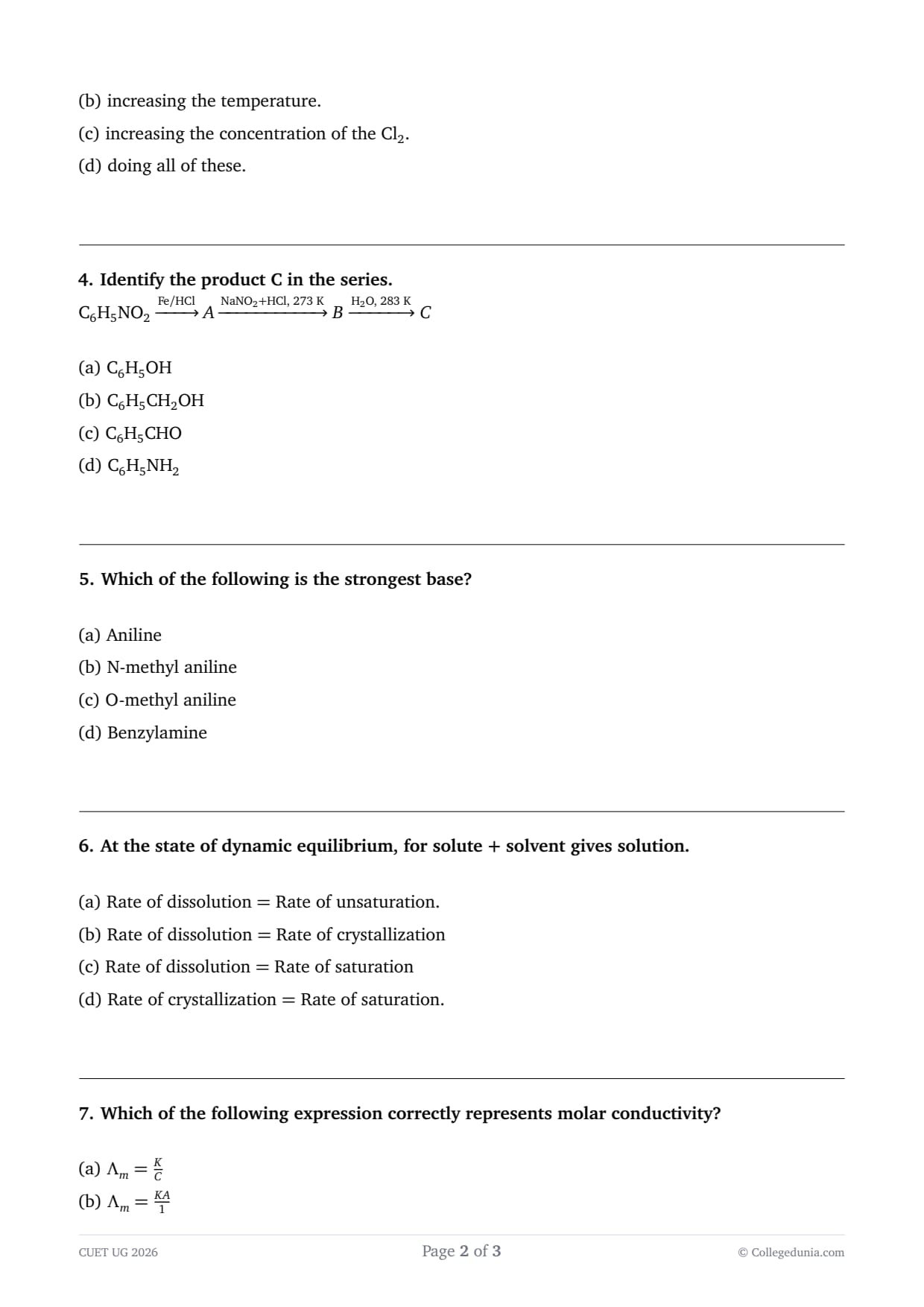
  • (b) increasing the temperature.
  • (c) increasing the concentration of the Cl\(_2\).
  • (d) doing all of these.
Correct Answer: (2) increasing the temperature.
View Solution

The given rate equation for the reaction 2NO + Cl\(_2\) \(\rightarrow\) 2NOCl is:
rate = k[NO]\(^2\)[Cl\(_2\)]

This equation describes how the rate of the reaction is dependent on the concentrations of the reactants NO and Cl\(_2\), and the rate constant, k. The rate constant (k) is a proportionality factor that is specific to a particular reaction at a particular temperature.

Let's analyze the effect of each option on the rate constant (k):

1) Increasing the concentration of NO:
The rate equation shows that the reaction rate is proportional to the square of the concentration of NO ([NO]\(^2\)). If the concentration of NO increases, the rate of the reaction will increase. However, the rate constant (k) is defined as the rate of reaction when all reactant concentrations are unity. Thus, 'k' is fundamentally independent of reactant concentrations at a constant temperature. Increasing [NO] increases the overall rate, but does not change the rate constant.

2) Increasing the temperature:
The rate constant (k) is strongly dependent on temperature. This relationship is described by the Arrhenius equation: \(k = Ae^{-E_a/RT}\)
where:

k is the rate constant
A is the pre-exponential factor (frequency of collisions)
\(E_a\) is the activation energy (minimum energy required for a reaction to occur)
R is the ideal gas constant
T is the absolute temperature (in Kelvin)

From the Arrhenius equation, as temperature (T) increases, the term \(e^{-E_a/RT}\) increases because the exponent becomes less negative. This leads to a higher value of the rate constant (k). Therefore, increasing the temperature directly increases the rate constant.

3) Increasing the concentration of Cl\(_2\):
Similar to NO, the rate equation shows that the rate is directly proportional to the concentration of Cl\(_2\) ([Cl\(_2\)]). Increasing [Cl\(_2\)] will increase the rate of the reaction. However, the rate constant (k) is independent of reactant concentrations at a constant temperature. Thus, increasing [Cl\(_2\)] increases the rate, but not the rate constant.

4) Doing all of these:
Since only increasing the temperature affects the rate constant, this option is incorrect.

The question specifically asks what can increase the *value of the rate constant*. Based on chemical kinetics principles, only temperature (and catalysts, which are not options here) affects the rate constant.


Final Answer: \(\boxed{2}\) Quick Tip:Key Exam Tip:Remember the distinction between factors affecting the \textbf{reaction rate} and factors affecting the \textbf{rate constant (k)}: \textbf{Concentrations of Reactants:} Affects the \textbf{rate} directly but \textbf{does not} change the rate constant (k). \textbf{Temperature:} Affects both the \textbf{rate} and the \textbf{rate constant} (k). An increase in temperature generally leads to a higher rate constant. \textbf{Catalyst:} Speeds up the reaction by increasing the rate constant (k) by lowering the activation energy (\(E_a\)).


Question 4:

Identify the product C in the series.

C\(_6\)H\(_5\)NO\(_2 \xrightarrow{Fe/HCl} A \xrightarrow{NaNO_2+HCl, 273 K} B \xrightarrow{H_2O, 283 K} C\)

  • (a) C\(_6\)H\(_5\)OH
  • (b) C\(_6\)H\(_5\)CH\(_2\)OH
  • (c) C\(_6\)H\(_5\)CHO
  • (d) C\(_6\)H\(_5\)NH\(_2\)
Correct Answer: (1) C\(_6\)H\(_5\)OH
View Solution

This is a classic sequence of reactions involving nitrobenzene and its transformation into phenol. Let's break down the steps:

Step 1: Reduction of nitrobenzene to aniline
C\(_6\)H\(_5\)NO\(_2\) (Nitrobenzene) \(\xrightarrow{Fe/HCl}\) A
Nitrobenzene is reduced to aniline (aminobenzene) in the presence of a reducing agent like Fe/HCl.
Therefore, A is C\(_6\)H\(_5\)NH\(_2\) (Aniline).

Step 2: Diazotization of aniline
A (C\(_6\)H\(_5\)NH\(_2\)) \(\xrightarrow{NaNO_2+HCl, 273 K}\) B
Aniline reacts with sodium nitrite (NaNO\(_2\)) and hydrochloric acid (HCl) at a low temperature (0-5 \(^\circ\)C, which is 273 K) to form a diazonium salt. This process is called diazotization.
Therefore, B is C\(_6\)H\(_5\)N\(_2^+\)Cl\(^-\) (Benzenediazonium chloride).

Step 3: Hydrolysis of the diazonium salt
B (C\(_6\)H\(_5\)N\(_2^+\)Cl\(^-\)) \(\xrightarrow{H_2O, 283 K}\) C
Benzenediazonium chloride reacts with water at a slightly elevated temperature (around 10-15 \(^\circ\)C, which is 283 K) to undergo hydrolysis. The diazonium group (-N\(_2^+\)) is replaced by a hydroxyl group (-OH), forming phenol. Nitrogen gas (N\(_2\)) and HCl are released as byproducts.
The reaction is:
C\(_6\)H\(_5\)N\(_2^+\)Cl\(^-\) + H\(_2\)O \(\xrightarrow{\Delta}\) C\(_6\)H\(_5\)OH + N\(_2\) + HCl

Therefore, the product C is C\(_6\)H\(_5\)OH (Phenol).

Let's check the options:
(1) C\(_6\)H\(_5\)OH (Phenol) - This matches our product.
(2) C\(_6\)H\(_5\)CH\(_2\)OH (Benzyl alcohol) - Incorrect.
(3) C\(_6\)H\(_5\)CHO (Benzaldehyde) - Incorrect.
(4) C\(_6\)H\(_5\)NH\(_2\) (Aniline) - This is intermediate A, not final product C.


Final Answer: \(\boxed{1}\) Quick Tip:Key Exam Tip:Remember the key transformations: Nitro group reduction to amine: e.g., R-NO\(_2 \xrightarrow{Fe/HCl or Sn/HCl} R-NH_2\). Diazotization of primary aromatic amines: R-NH\(_2 \xrightarrow{NaNO_2+HCl, low temp} R-N_2^+Cl^-\). Hydrolysis of diazonium salts: R-N\(_2^+X^- \xrightarrow{H_2O, heat} R-OH + N_2 + HX\).


Question 5:

Which of the following is the strongest base?

  • (a) Aniline
  • (b) N-methyl aniline
  • (c) O-methyl aniline
  • (d) Benzylamine
Correct Answer: (4) Benzylamine
View Solution

To determine the strongest base among the given options, we need to consider the factors that affect basicity. Basicity is related to the availability of the lone pair of electrons on the nitrogen atom to accept a proton (H\(^+\)).

Let's analyze each option:

(1) Aniline (C\(_6\)H\(_5\)NH\(_2\)):
In aniline, the lone pair of electrons on the nitrogen atom is delocalized into the benzene ring through resonance. This delocalization makes the lone pair less available to accept a proton, thus reducing its basicity. The resonance structures show the electron density being spread across the ring.

(2) N-methyl aniline (C\(_6\)H\(_5\)NHCH\(_3\)):
In N-methyl aniline, one hydrogen atom on the nitrogen is replaced by a methyl group (-CH\(_3\)). The methyl group is an electron-donating group (EDG) by inductive effect. This inductive effect pushes electron density towards the nitrogen atom, making the lone pair slightly more available for protonation compared to aniline. However, the lone pair is still delocalized into the benzene ring.

(3) O-methyl aniline (o-toluidine) (CH\(_3\)-C\(_6\)H\(_4\)-NH\(_2\)):
In o-methyl aniline, a methyl group is attached to the ortho position of the benzene ring. The methyl group is an electron-donating group (EDG) via the inductive effect. This inductive effect increases the electron density on the nitrogen atom. However, the ortho position also introduces steric hindrance, which can slightly impede the approach of a proton. Despite steric effects, the inductive donation generally increases basicity compared to aniline. Compared to N-methyl aniline, the electron donation is to the ring, indirectly affecting the nitrogen.

(4) Benzylamine (C\(_6\)H\(_5\)CH\(_2\)NH\(_2\)):
In benzylamine, the amino group (-NH\(_2\)) is attached to a methylene (-CH\(_2\)-) group, which is then attached to the benzene ring. The lone pair of electrons on the nitrogen atom is primarily localized on the nitrogen and is not directly involved in resonance with the benzene ring. The -CH\(_2\)- group is an electron-donating group by induction. This inductive effect increases the electron density on the nitrogen atom, making its lone pair more available for protonation. Compared to aniline and its derivatives where the lone pair is delocalized into the ring, the lone pair in benzylamine is much more localized and available.

Comparison:

Aniline is the least basic due to significant resonance delocalization of the lone pair.
N-methyl aniline and O-methyl aniline are more basic than aniline due to the electron-donating inductive effect of the methyl group. However, resonance in the aniline part of the molecule still reduces basicity.
Benzylamine is an aliphatic amine (attached via a CH\(_2\) group) and therefore its lone pair is significantly more localized and available for protonation. The electron-donating inductive effect of the methylene group further enhances its basicity.


Therefore, benzylamine is the strongest base among the given options.


Final Answer: \(\boxed{4}\) Quick Tip: Key Exam Tip:Basicity Order of Amines: Aliphatic amines (like alkylamines, benzylamine) are generally more basic than aromatic amines (like aniline). Electron-donating groups (like -CH\(_3\), -OCH\(_3\)) on the aromatic ring increase basicity of aromatic amines. Electron-withdrawing groups (like -NO\(_2\), -Cl) on the aromatic ring decrease basicity of aromatic amines. Resonance delocalization of the lone pair on nitrogen significantly reduces basicity. Benzylamine has a localized lone pair on nitrogen due to the intervening CH\(_2\) group, making it the strongest base here.


Question 6:

At the state of dynamic equilibrium, for solute + solvent gives solution.

  • (a) Rate of dissolution = Rate of unsaturation.
  • (b) Rate of dissolution = Rate of crystallization
  • (c) Rate of dissolution = Rate of saturation
  • (d) Rate of crystallization = Rate of saturation.
Correct Answer: (2) Rate of dissolution = Rate of crystallization
View Solution

Dynamic equilibrium in a saturated solution occurs when the rate of dissolution of the solute (solid going into solution) is equal to the rate of crystallization (dissolved solute coming out of solution). At this point, the concentration of the dissolved solute remains constant, and there is no net change in the amount of dissolved or undissolved solute.

Let's analyze the options:

Rate of dissolution = Rate of unsaturation: "Unsaturation" refers to a solution that is not saturated, meaning more solute can dissolve. This concept doesn't directly describe the equilibrium condition.
Rate of dissolution = Rate of crystallization: This is the definition of dynamic equilibrium in a saturated solution. The forward process (dissolution) is balanced by the reverse process (crystallization).
Rate of dissolution = Rate of saturation: "Rate of saturation" is not a standard term to describe a process. Saturation is a state, not a rate.
Rate of crystallization = Rate of saturation: Similar to option 3, "Rate of saturation" is not a meaningful term for describing an equilibrium.


Therefore, the condition for dynamic equilibrium in a solution is when the rate of dissolution equals the rate of crystallization.


Final Answer: \(\boxed{2}\) Quick Tip:Key Exam Tip:Dynamic equilibrium in a saturated solution is a state where opposing processes occur at equal rates. For dissolution, these processes are: \textbf{Dissolution:} Solute particles break away from the solid and enter the solution. \textbf{Crystallization:} Dissolved solute particles aggregate and return to the solid state. When these rates are equal, the solution is saturated, and no net change is observed.


Question 7:

Which of the following expression correctly represents molar conductivity?

  • (a) \(\Lambda_m = \frac{K}{C}\)
  • (b) \(\Lambda_m = \frac{KA}{1}\)
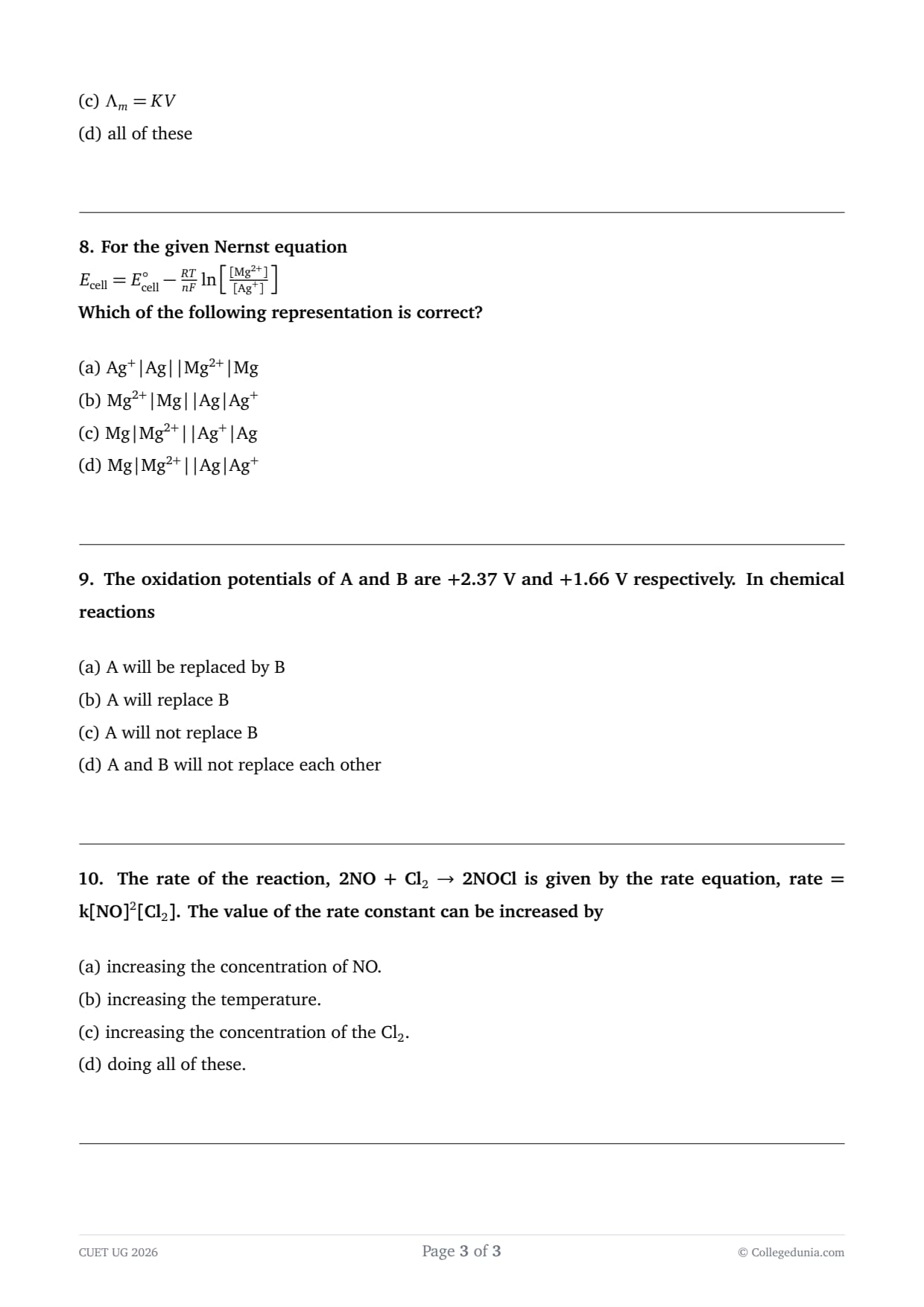
  • (c) \(\Lambda_m = KV\)
  • (d) all of these
Correct Answer: (1) \(\Lambda_m = \frac{K}{C}\)
View Solution

Molar conductivity (\(\Lambda_m\)) is a measure of the efficiency of ion conduction in a solution. It is defined as the conductivity of a solution divided by the molar concentration of the electrolyte.

The relationship between molar conductivity (\(\Lambda_m\)), specific conductivity (or conductivity, \(K\)), and molar concentration (\(C\)) is given by the formula: \(\Lambda_m = \frac{K}{C}\)

Where:

\(\Lambda_m\) is the molar conductivity (units: S m\(^2\) mol\(^{-1}\) or S cm\(^2\) mol\(^{-1}\)).
\(K\) (kappa) is the specific conductivity (or conductivity) of the solution (units: S m\(^{-1}\) or S cm\(^{-1}\)).
\(C\) is the molar concentration of the electrolyte (units: mol m\(^{-3}\) or mol cm\(^{-3}\), often mol L\(^{-1}\)).


Let's examine the given options:

\(\Lambda_m = \frac{K}{C}\): This is the correct definition of molar conductivity.
\(\Lambda_m = \frac{KA}{1}\): This expression is dimensionally incorrect. 'A' is not defined in this context, and the units would not match molar conductivity. If 'A' were meant to be volume, it would be \(\Lambda_m = \frac{K}{C} = \frac{K}{n/V} = \frac{KV}{n}\).
\(\Lambda_m = KV\): This expression is also dimensionally incorrect and does not represent molar conductivity. If 'V' represents the volume of solution containing one mole of electrolyte (i.e., V = 1/C), then \(\Lambda_m = K \times \frac{1}{C} = \frac{K}{C}\), which brings us back to option 1. However, as stated, it's incorrect.
all of these: Since options 2 and 3 are incorrect, this option is also incorrect.


Thus, the only correct expression for molar conductivity is \(\Lambda_m = \frac{K}{C}\).


Final Answer: \(\boxed{1}\) Quick Tip:Key Exam Tip:Molar conductivity (\(\Lambda_m\)) is the conductivity of one mole of electrolyte. It is calculated by dividing the specific conductivity (\(K\)) by the molar concentration (\(C\)). Ensure you use consistent units for \(K\) and \(C\) to obtain the correct units for \(\Lambda_m\).


Question 8:

For the given Nernst equation
\(E_{cell} = E^\circ_{cell} - \frac{RT}{nF} \ln \left[ \frac{[Mg\)^{2+\(]}{[Ag\)^+\(]} \right]\)

Which of the following representation is correct?

  • (a) Ag\(^+\)|Ag||Mg\(^{2+}\)|Mg
  • (b) Mg\(^{2+}\)|Mg||Ag|Ag\(^+\)
  • (c) Mg|Mg\(^{2+}\)||Ag\(^+ \)|Ag
  • (d) Mg|Mg\(^{2+}\)||Ag|Ag\(^+\)
Correct Answer: (c) Mg|Mg\(^{2+}\)||Ag\(^+ \)|Ag
View Solution

The Nernst equation relates the cell potential (\(E_{cell}\)) of an electrochemical cell to the standard cell potential (\(E^\circ_{cell}\)) and the concentrations of the ions involved. The general form of the Nernst equation for a redox reaction is: \(E_{cell} = E^\circ_{cell} - \frac{RT}{nF} \ln Q\)
where \(Q\) is the reaction quotient.

The given Nernst equation is: \(E_{cell} = E^\circ_{cell} - \frac{RT}{nF} \ln \left[ \frac{[Mg\)^{2+\(]}{[Ag\)^+\(]} \right]\)

In this equation, the term inside the logarithm, \(\frac{[Mg\)^{2+\(]}{[Ag\)^+\(]}\), represents the reaction quotient (\(Q\)). The reaction quotient is written as (products)/(reactants), considering the stoichiometric coefficients. The expression \(\ln \left[ \frac{[Mg\)^{2+\(]}{[Ag\)^+\(]} \right]\) indicates that Mg\(^{2+}\) is in the numerator (likely a product of oxidation) and Ag\(^+\) is in the denominator (likely a reactant in reduction).

A cell representation in shorthand notation is written as:
Anode | Anode Solution || Cathode Solution | Cathode

The anode is where oxidation occurs, and the cathode is where reduction occurs.
The species in the cell notation are written in the form of: Reduced form | Oxidized form (for anode) and Oxidized form | Reduced form (for cathode).

From the reaction quotient \(\frac{[Mg\)^{2+\(]}{[Ag\)^+\(]}\), we can infer the half-reactions:

Anode (Oxidation): Mg \(\rightarrow\) Mg\(^{2+}\) + 2e\(^-\) (Mg is oxidized to Mg\(^{2+}\))
Cathode (Reduction): Ag\(^+\) + e\(^-\) \(\rightarrow\) Ag (Ag\(^+\) is reduced to Ag)


Now let's construct the cell notation:

Anode half-cell: Reduced form is Mg, oxidized form is Mg\(^{2+}\). So, it's Mg | Mg\(^{2+}\).
Cathode half-cell: Oxidized form is Ag\(^+\), reduced form is Ag. So, it's Ag\(^+\) | Ag.


Connecting these with the salt bridge (||):
Anode || Cathode
Mg | Mg\(^{2+}\) || Ag\(^+\) | Ag

Let's check the given options:
(a) Ag\(^+\)|Ag||Mg\(^{2+}\)|Mg: This represents Ag as anode and Mg as cathode, which is incorrect based on the reaction quotient.
(b) Mg\(^{2+}\)|Mg||Ag|Ag\(^+\): This representation is incorrect in how it writes the half-cells. The reduced form should be on the left for the anode, and the oxidized form on the left for the cathode.
(c) Mg|Mg\(^{2+}\)||Ag\(^+ \)|Ag: This representation correctly shows Mg as the anode (oxidation) and Ag as the cathode (reduction), with the correct species in their respective states.
(d) Mg|Mg\(^{2+}\)||Ag|Ag\(^+\): This representation is incorrect in how it writes the cathode half-cell.

Therefore, the correct representation of the cell is Mg|Mg\(^{2+}\)||Ag\(^+ \)|Ag.


Final Answer: \(\boxed{c}\) Quick Tip:Key Exam Tip:In electrochemical cell notation: Anode (oxidation) is written first: Reduced form | Oxidized form. Cathode (reduction) is written second: Oxidized form | Reduced form. A single vertical line (|) separates phases (e.g., electrode and solution). A double vertical line (||) separates the anode and cathode compartments, representing the salt bridge. The Nernst equation's reaction quotient (\(Q\)) directly reveals which species are oxidized and reduced, and thus the anode and cathode half-cells.


Question 9:

The oxidation potentials of A and B are +2.37 V and +1.66 V respectively. In chemical reactions

  • (a) A will be replaced by B
  • (b) A will replace B
  • (c) A will not replace B
  • (d) A and B will not replace each other
Correct Answer: (2) A will replace B
View Solution

This question deals with the relative reactivity of two substances (A and B) based on their oxidation potentials. Oxidation potential is the tendency of a substance to lose electrons (undergo oxidation). A higher oxidation potential indicates a greater tendency to be oxidized, meaning the substance is more reactive.

Given oxidation potentials:
Oxidation potential of A = +2.37 V
Oxidation potential of B = +1.66 V

Comparing the oxidation potentials, we see that +2.37 V is greater than +1.66 V.
This means that substance A has a higher tendency to be oxidized than substance B. Therefore, A is more reactive than B.

In chemical reactions involving displacement, a more reactive substance can displace a less reactive substance from its compounds. Specifically, if A is more reactive than B, then A can displace B from its compounds.

Let's analyze the options in this context:

A will be replaced by B: This would happen if B were more reactive than A. Since A has a higher oxidation potential, it is more reactive, so this is incorrect.
A will replace B: This will happen if A is more reactive than B. Since A has a higher oxidation potential (+2.37 V > +1.66 V), A is more reactive and can displace B. This is the correct statement.
A will not replace B: This statement would be true if B were more reactive than A, or if neither could displace the other. Since A is more reactive, it can displace B. So, this is incorrect.
A and B will not replace each other: This would imply they have similar reactivity or are unable to displace each other. Since their oxidation potentials are different, a displacement reaction is possible. This is incorrect.


Therefore, A will replace B because its oxidation potential is higher, indicating greater reactivity.


Final Answer: \(\boxed{2}\) Quick Tip: Key Exam Tip:In displacement reactions, the more reactive element (or substance) displaces the less reactive element. Reactivity can be determined by: \textbf{Oxidation Potential:} A higher (more positive) oxidation potential means greater tendency to oxidize, hence higher reactivity. \textbf{Reduction Potential:} A lower (more negative) reduction potential means greater tendency to oxidize, hence higher reactivity. In this case, A has a higher oxidation potential than B, so A is more reactive.


Question 10:

The rate of the reaction, 2NO + Cl\(_2\) \(\rightarrow\) 2NOCl is given by the rate equation, rate = k[NO]\(^2\)[Cl\(_2\)]. The value of the rate constant can be increased by

  • (a) increasing the concentration of NO.
  • (b) increasing the temperature.
  • (c) increasing the concentration of the Cl\(_2\).
  • (d) doing all of these.
Correct Answer: (2) increasing the temperature.
View Solution

The given rate equation for the reaction 2NO + Cl\(_2\) \(\rightarrow\) 2NOCl is:
rate = k[NO]\(^2\)[Cl\(_2\)]

This equation shows that the rate of the reaction depends on the rate constant (k) and the concentrations of the reactants NO and Cl\(_2\). The rate constant (k) is a proportionality constant specific to a reaction at a given temperature.

Let's analyze how each factor affects the rate and specifically the rate constant:

1) Increasing the concentration of NO:
According to the rate equation, the rate is directly proportional to [NO]\(^2\). If [NO] increases, the rate of the reaction will increase significantly. However, the rate constant 'k' is independent of reactant concentrations at a constant temperature. Increasing the concentration of NO will increase the rate of the reaction, but not the rate constant.

2) Increasing the temperature:
The rate constant (k) is highly dependent on temperature. According to the Arrhenius equation, \(k = Ae^{-E_a/RT}\), where:

k is the rate constant.
A is the pre-exponential factor (frequency factor).
\(E_a\) is the activation energy.
R is the gas constant.
T is the absolute temperature.

As temperature (T) increases, the term \(e^{-E_a/RT}\) increases (because the exponent becomes less negative), leading to an increase in the rate constant (k). Therefore, increasing the temperature will increase the value of the rate constant.

3) Increasing the concentration of Cl\(_2\):
The rate equation shows that the rate is directly proportional to [Cl\(_2\)]. If [Cl\(_2\)] increases, the rate of the reaction will increase. However, like concentration of NO, the rate constant 'k' is independent of reactant concentrations at a constant temperature. Increasing the concentration of Cl\(_2\) will increase the rate of the reaction, but not the rate constant.

4) Doing all of these:
Since only increasing the temperature affects the rate constant, this option is incorrect.

The question specifically asks what can increase the *value of the rate constant*. Among the given options, only increasing the temperature affects the rate constant.


Final Answer: \(\boxed{2}\) Quick Tip:Key Exam Tip:Factors Affecting Reaction Rate vs. Rate Constant: Concentration of Reactants: Affects the rate of the reaction but not the rate constant (k). Temperature: Affects both the rate and the rate constant (k). Higher temperature generally leads to a higher rate constant. Catalyst: Affects the \textbf{rate} by lowering the activation energy, thus increasing the rate constant (k). In this question, only temperature and a catalyst (not provided as an option) affect the rate constant.

CUET UG 2026 Exam Pattern

Parameter Details
Exam Name Common University Entrance Test (CUET UG) 2026
Conducting Body National Testing Agency (NTA)
Exam Mode Computer-Based Test (CBT)
Exam Duration 60 minutes per test
Total Sections 3 (Languages, Domain Subjects, General Test)
Question Type Multiple Choice Questions (MCQs)
Questions per Test 50 questions (all compulsory)
Marking Scheme +5 for correct, -1 for incorrect
Maximum Marks 250 marks per test
Maximum Subject Choices 5 subjects in total
Syllabus Base Class 12 NCERT (mainly for Domain Subjects)

CUET UG 2026 May 11 Shift 1 Exam Analysis