CUET 2026 May 11 Shift 1 Political Science Question Paper is available for download here. NTA is conducting the CUET UG 2026 exam from 11th May to 31st May.

  • CUET 2026 Political Science exam consists of 50 questions for 250 marks to be attempted in 60 minutes.
  • As per the marking scheme, 5 marks are awarded for each correct answer, and 1 mark is deducted for incorrect answer.

Candidates can download CUET 2026 May 11 Shift 1 Political Science Question Paper with Answer Key and Solution PDF from links provided below.

CUET 2026 Political Science May 11 Shift 1 Question Paper with Solution PDF

CUET May 11 Shift 1 Political Science Question Paper 2026 Download PDF Check Solutions


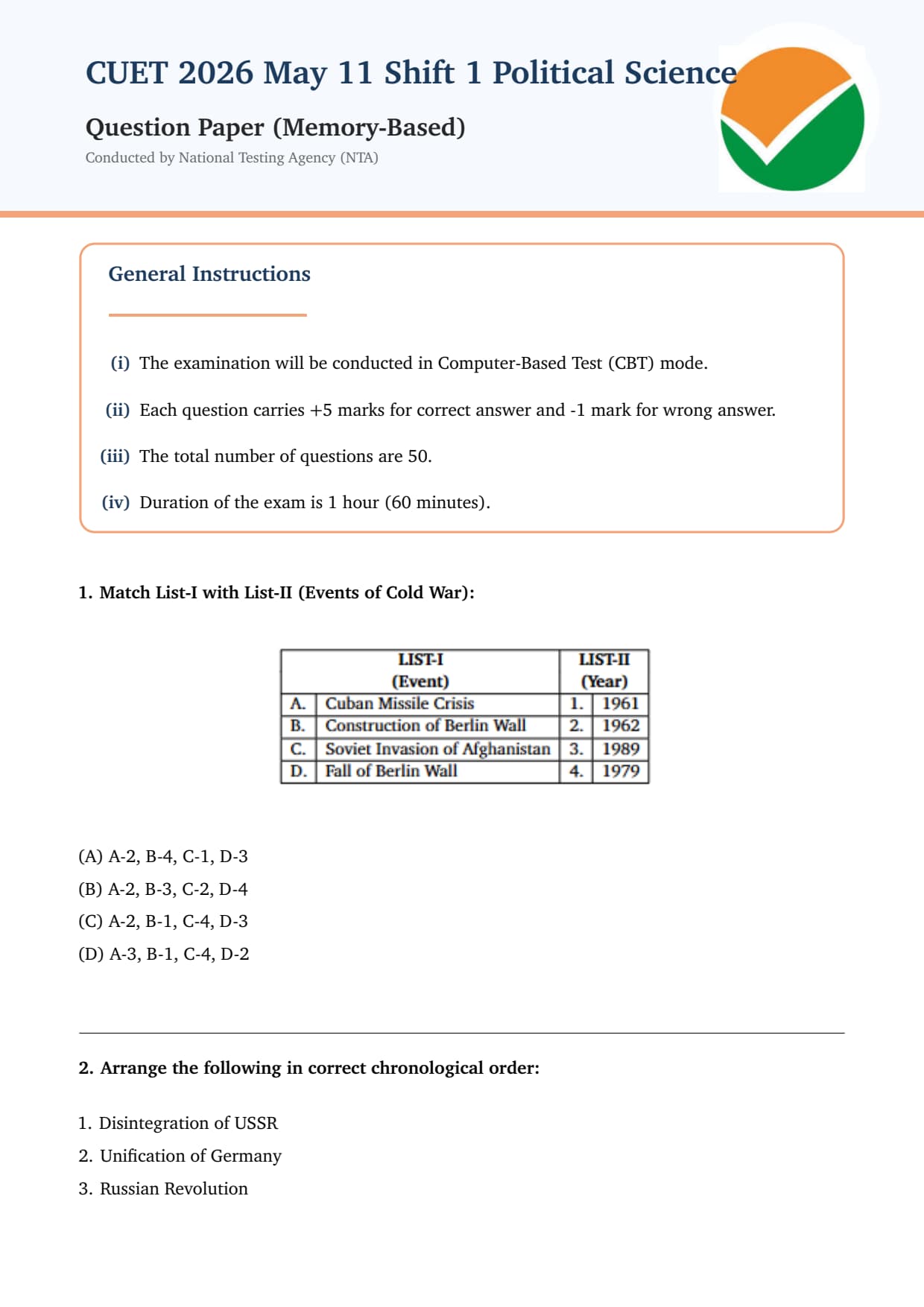
Question 1:

Match List-I with List-II (Events of Cold War):


  • (A) A-2, B-4, C-1, D-3
  • (B) A-2, B-3, C-2, D-4
  • (C) A-2, B-1, C-4, D-3
  • (D) A-3, B-1, C-4, D-2
Correct Answer: (C) A-2, B-1, C-4, D-3
View Solution

Step 1: Concept
The question requires matching significant historical events of the Cold War era with the specific years in which they occurred.

Step 2: Meaning
Each event represents a critical turning point in the geopolitical tension between the USA and the USSR, spanning from the 1960s to the late 1980s.

Step 3: Analysis

1. The Cuban Missile Crisis took place in 1962 (A-2).
2. The Construction of the Berlin Wall began in 1961 (B-1).
3. The Soviet Invasion of Afghanistan started in late 1979 (C-4).
4. The Fall of the Berlin Wall occurred in 1989 (D-3).

Step 4: Conclusion
Matching these pairs results in the sequence A-2, B-1, C-4, D-3.


Final Answer: (C) Quick Tip: Remember: The Berlin Wall stood for 28 years (1961 to 1989). Knowing these two dates often helps eliminate most options.


Question 2:

Arrange the following in correct chronological order:

1. Disintegration of USSR

2. Unification of Germany

3. Russian Revolution

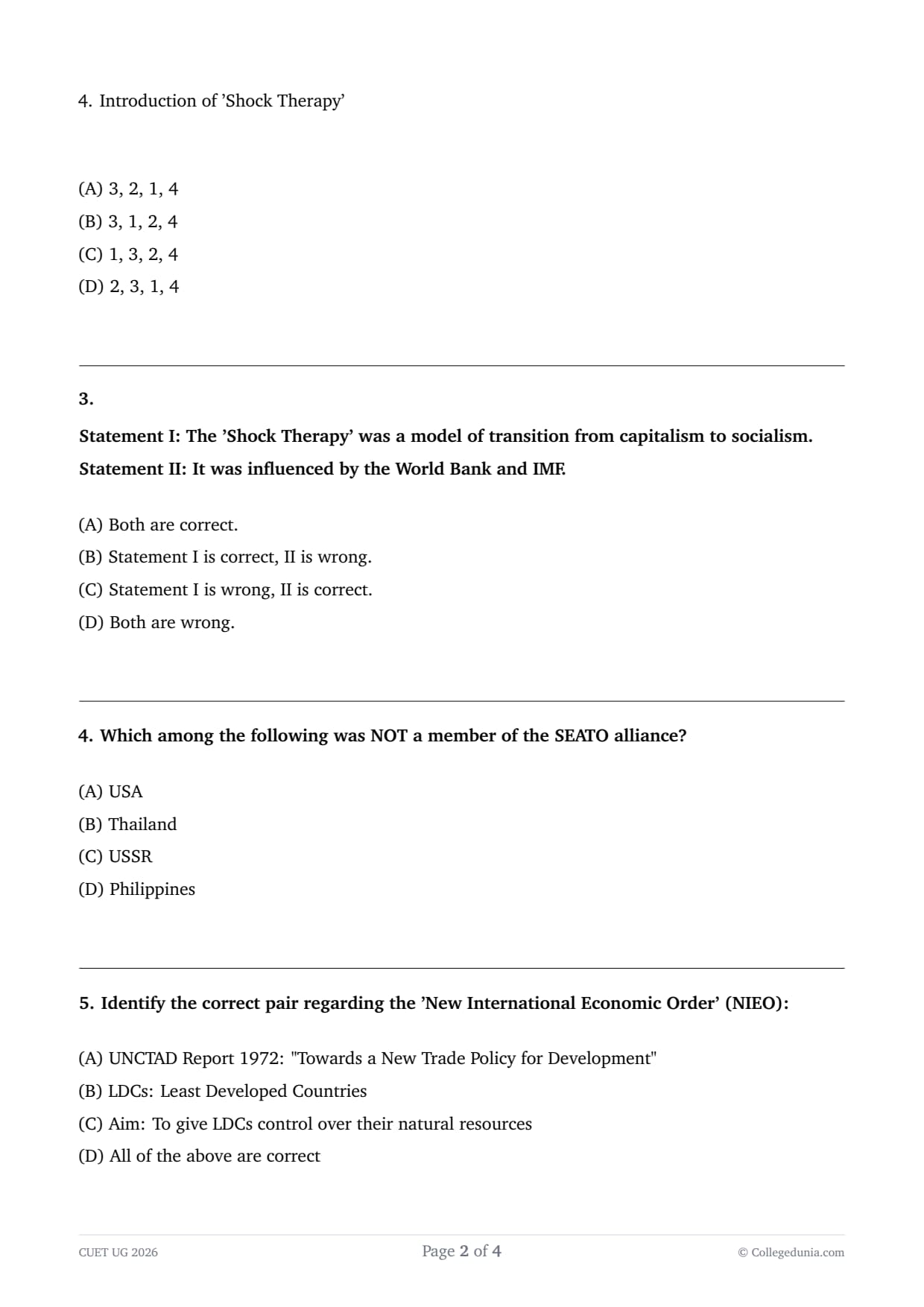
4. Introduction of 'Shock Therapy'

  • (A) 3, 2, 1, 4
  • (B) 3, 1, 2, 4
  • (C) 1, 3, 2, 4
  • (D) 2, 3, 1, 4
Correct Answer: (A) 3, 2, 1, 4
View Solution

Step 1: Concept
This task involves placing key events in Soviet and European history along a timeline to determine the correct order.

Step 2: Meaning
Chronological order means arranging events from the earliest occurrence to the latest.

Step 3: Analysis

1. The Russian Revolution occurred in 1917 (Event 3).
2. The Unification of Germany happened in October 1990 (Event 2).
3. The Disintegration of the USSR took place in December 1991 (Event 1).
4. 'Shock Therapy' was the economic transition process implemented after the collapse (Event 4).

Step 4: Conclusion
The sequence 1917 \(\rightarrow\) 1990 \(\rightarrow\) 1991 \(\rightarrow\) post-1991 leads to the order 3, 2, 1, 4.


Final Answer: (A) Quick Tip: History Hack: The Russian Revolution (1917) created the USSR, and the Disintegration (1991) ended it. Always start with the creation event.


Question 3:

Statement I: The 'Shock Therapy' was a model of transition from capitalism to socialism.
Statement II: It was influenced by the World Bank and IMF.

  • (A) Both are correct.
  • (B) Statement I is correct, II is wrong.
  • (C) Statement I is wrong, II is correct.
  • (D) Both are wrong.
Correct Answer: (C) Statement I is wrong, II is correct.
View Solution

Step 1: Concept
Shock Therapy refers to the sudden shift in economic policy in post-communist states.

Step 2: Meaning
It was a transition model designed to move states from a command economy (socialism) to a free-market economy (capitalism).

Step 3: Analysis
Statement I says it was a transition from capitalism to socialism, which is factually the reverse of what happened. Statement II is correct as the IMF and World Bank were the primary architects and influencers of this transition.

Step 4: Conclusion
Since Statement I is false and Statement II is true, Option (C) is the correct choice.


Final Answer: (C) Quick Tip: Recall: "Shock Therapy" was meant to "shock" the old socialist system into becoming a capitalist one.


Question 4:

Which among the following was NOT a member of the SEATO alliance?

  • (A) USA
  • (B) Thailand
  • (C) USSR
  • (D) Philippines
Correct Answer: (C) USSR
View Solution

Step 1: Concept
SEATO (Southeast Asia Treaty Organization) was a collective defense alliance created during the Cold War.

Step 2: Meaning
It was an anti-communist bloc led by Western powers to prevent the spread of communism in Southeast Asia.

Step 3: Analysis
The USA, Thailand, and the Philippines were all founding members of SEATO. The USSR (Soviet Union) was the primary communist rival to this alliance and would never have been a member.

Step 4: Conclusion
Therefore, the USSR is the entity that was not a member.


Final Answer: (C) Quick Tip: SEATO was the "Pacific version" of NATO—it was designed to contain the USSR, not include it!


Question 5:

Identify the correct pair regarding the 'New International Economic Order' (NIEO):

  • (A) UNCTAD Report 1972: "Towards a New Trade Policy for Development"
  • (B) LDCs: Least Developed Countries
  • (C) Aim: To give LDCs control over their natural resources
  • (D) All of the above are correct
Correct Answer: (D) All of the above are correct
View Solution

Step 1: Concept
NIEO was a set of proposals put forward during the 1970s by developing nations to promote their economic interests.

Step 2: Meaning
It sought to change the international economic system in favor of Least Developed Countries (LDCs).

Step 3: Analysis

1. UNCTAD did release a report in 1972 titled "Towards a New Trade Policy for Development."
2. LDC is the standard abbreviation for Least Developed Countries.
3. A core aim of NIEO was indeed to give these countries sovereignty and control over their own natural resources.

Step 4: Conclusion
Since all statements accurately describe facets of the NIEO, "All of the above" is the correct answer.


Final Answer: (D) Quick Tip: NIEO = Economic Justice for LDCs. If the options talk about helping poor countries control their resources, they are usually correct.


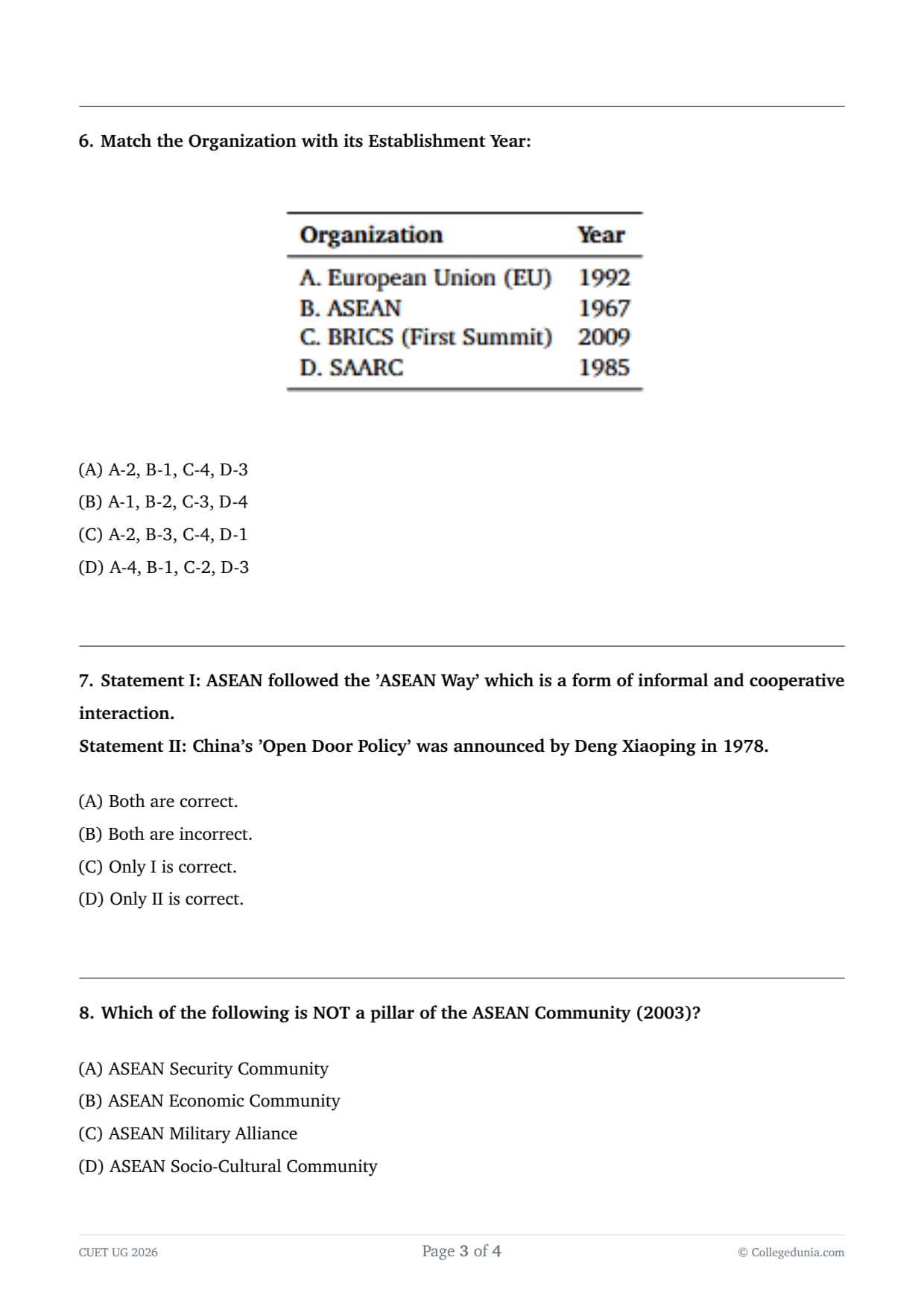
Question 6:

Match the Organization with its Establishment Year:


  • (A) A-2, B-1, C-4, D-3
  • (B) A-1, B-2, C-3, D-4
  • (C) A-2, B-3, C-4, D-1
  • (D) A-4, B-1, C-2, D-3
Correct Answer: (A) A-2, B-1, C-4, D-3
View Solution

Step 1: Concept
This involves matching international and regional organizations with the years they were formally established or held their first major summit.

Step 2: Meaning
Each organization represents a different era of regional cooperation.

Step 3: Analysis

1. The European Union was established by the Maastricht Treaty in 1992 (A-2).
2. ASEAN was established by the Bangkok Declaration in 1967 (B-1).
3. The first BRICS (then BRIC) summit was held in 2009 (C-4).
4. SAARC was established in 1985 (D-3).

Step 4: Conclusion
The correct matching sequence is A-2, B-1, C-4, D-3.


Final Answer: (A) Quick Tip: Mnemonics: ASEAN is the oldest (67), SAARC is mid-80s (85), EU is post-Cold War (92), and BRICS is modern (2009).


Question 7:

Statement I: ASEAN followed the 'ASEAN Way' which is a form of informal and cooperative interaction.
Statement II: China's 'Open Door Policy' was announced by Deng Xiaoping in 1978.

  • (A) Both are correct.
  • (B) Both are incorrect.
  • (C) Only I is correct.
  • (D) Only II is correct.
Correct Answer: (A) Both are correct.
View Solution

Step 1: Concept
This question tests knowledge of regional diplomatic norms and specific economic reforms in Asia.

Step 2: Meaning
The 'ASEAN Way' refers to a unique diplomatic style, while the 'Open Door Policy' refers to China's economic liberalization.

Step 3: Analysis
Statement I is true; the 'ASEAN Way' emphasizes consensus and non-interference. Statement II is also true; Deng Xiaoping initiated the 'Open Door Policy' in 1978 to modernize China's economy.

Step 4: Conclusion
Both statements are historically accurate.


Final Answer: (A) Quick Tip: Deng Xiaoping + 1978 = The start of China's rise to an economic superpower.


Question 8:

Which of the following is NOT a pillar of the ASEAN Community (2003)?

  • (A) ASEAN Security Community
  • (B) ASEAN Economic Community
  • (C) ASEAN Military Alliance
  • (D) ASEAN Socio-Cultural Community
Correct Answer: (C) ASEAN Military Alliance
View Solution

Step 1: Concept
In 2003, ASEAN established three distinct "pillars" to strengthen regional integration.

Step 2: Meaning
These pillars cover political/security, economic, and social spheres of cooperation.

Step 3: Analysis
The three official pillars are the Security Community, the Economic Community, and the Socio-Cultural Community. ASEAN has explicitly avoided becoming a formal 'Military Alliance' to maintain its principle of neutrality.

Step 4: Conclusion
Option (C) is the incorrect pillar.


Final Answer: (C) Quick Tip: ASEAN is for cooperation, not combat. It specifically rejects being called a military alliance.


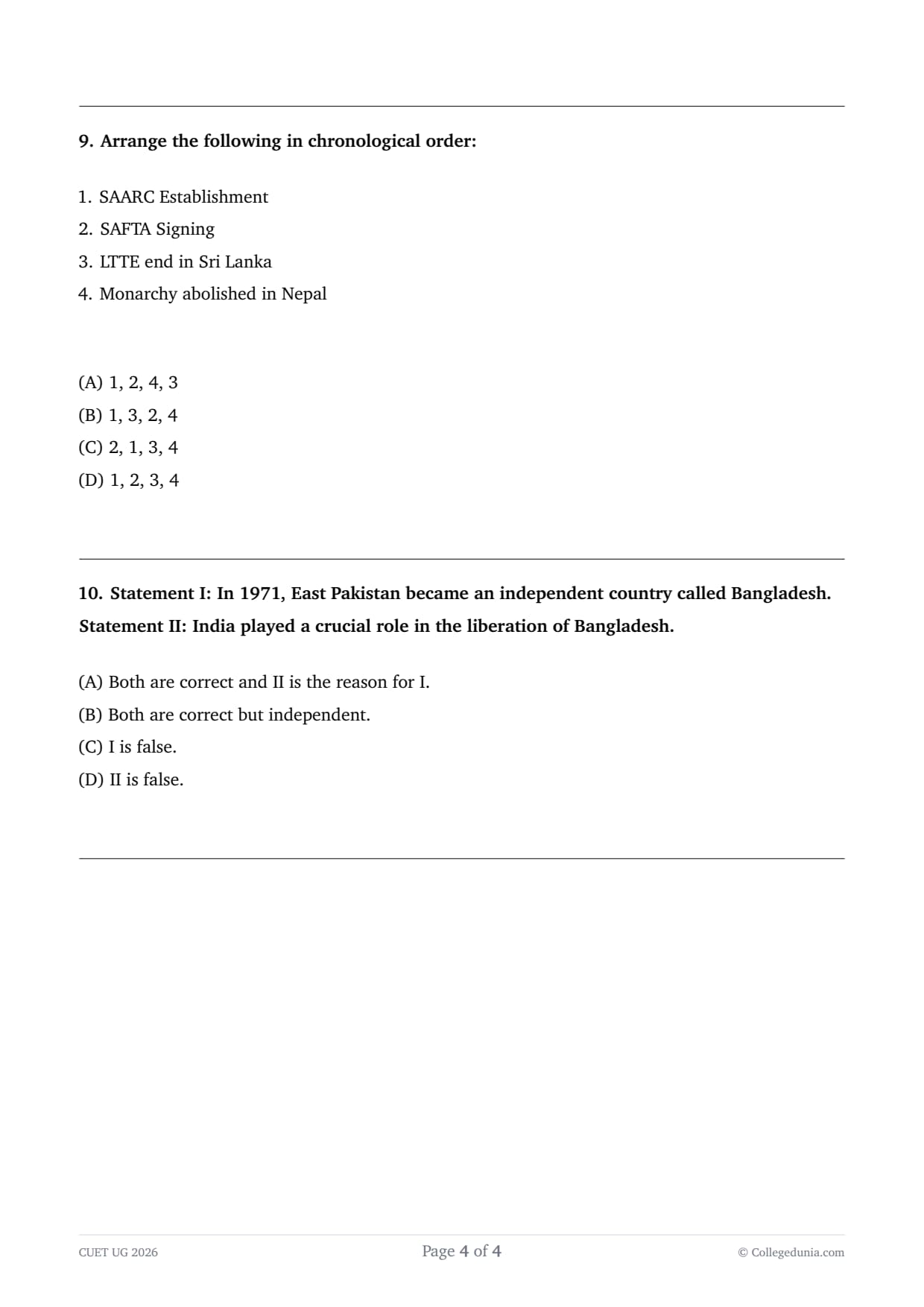
Question 9:

Arrange the following in chronological order:

1. SAARC Establishment

2. SAFTA Signing

3. LTTE end in Sri Lanka

4. Monarchy abolished in Nepal

  • (A) 1, 2, 4, 3
  • (B) 1, 3, 2, 4
  • (C) 2, 1, 3, 4
  • (D) 1, 2, 3, 4
Correct Answer: (A) 1, 2, 4, 3
View Solution

Step 1: Concept
Chronological order means arranging events according to the sequence in which they occurred in history.

Step 2: Meaning
We identify the year of each event and then place them from earliest to latest.

Step 3: Analysis

SAARC was established in 1985.
SAFTA was signed in 2004.
The monarchy in Nepal was abolished in 2008.
The LTTE was defeated in Sri Lanka in 2009.

Thus, the correct chronological sequence is:
1985 \(\rightarrow\) 2004 \(\rightarrow\) 2008 \(\rightarrow\) 2009.

Step 4: Conclusion: Therefore, the correct order is 1, 2, 4, 3.


Final Answer: (A) Quick Tip: Remember the timeline: SAARC (1985) came first, SAFTA (2004) followed, Nepal monarchy ended in 2008, and LTTE ended in 2009.


Question 10:

Statement I: In 1971, East Pakistan became an independent country called Bangladesh.
Statement II: India played a crucial role in the liberation of Bangladesh.

  • (A) Both are correct and II is the reason for I.
  • (B) Both are correct but independent.
  • (C) I is false.
  • (D) II is false.
Correct Answer: (A) Both are correct and II is the reason for I.
View Solution

Step 1: Concept
This examines the creation of Bangladesh and the regional geopolitical dynamics involved.

Step 2: Meaning
It assesses the cause-and-effect relationship between India's intervention and the independence of East Pakistan.

Step 3: Analysis
Statement I is historically correct; Bangladesh was formed in 1971. Statement II is also correct; Indian military and diplomatic support were decisive factors. Because India's intervention led directly to the Pakistani surrender and subsequent independence of the territory, Statement II explains why Statement I occurred.

Step 4: Conclusion
Both statements are true, and the second provides the logical reason for the first.


Final Answer: (A) Quick Tip: 1971 Indo-Pak War = Liberation of Bangladesh. India's help was the "Key" to the "Door" of independence.

CUET UG 2026 Exam Pattern

Parameter Details
Exam Name Common University Entrance Test (CUET UG) 2026
Conducting Body National Testing Agency (NTA)
Exam Mode Computer-Based Test (CBT)
Exam Duration 60 minutes per test
Total Sections 3 (Languages, Domain Subjects, General Test)
Question Type Multiple Choice Questions (MCQs)
Questions per Test 50 questions (all compulsory)
Marking Scheme +5 for correct, -1 for incorrect
Maximum Marks 250 marks per test
Maximum Subject Choices 5 subjects in total
Syllabus Base Class 12 NCERT (mainly for Domain Subjects)

CUET UG 2026 May 11 Shift 1 Exam Analysis