


CUET 2026 Mathematics Question Paper is available for download here. NTA is conducting the CUET 2026 exam from 11th May to 31st May in two shifts.
- CUET 2026 Mathematics exam consists of 50 questions for 250 marks to be attempted in 60 minutes.
- As per the marking scheme, 5 marks are awarded for each correct answer, and 1 mark is deducted for incorrect answer.
Candidates can download CUET 2026 Mathematics Question Paper with Answer Key and Solution PDF from links provided below.
CUET 2026 Mathematics Question Paper with Solution PDF
| CUET 2026 Day and Shift | Question Paper PDF | Solutions PDF |
|---|---|---|
| CUET 2026 Mathematics Question Paper May 15 Shift 1 | Download PDF | Check Solutions |
| CUET 2026 Mathematics Question Paper May 14 Shift 2 | Download PDF | Check Solutions |
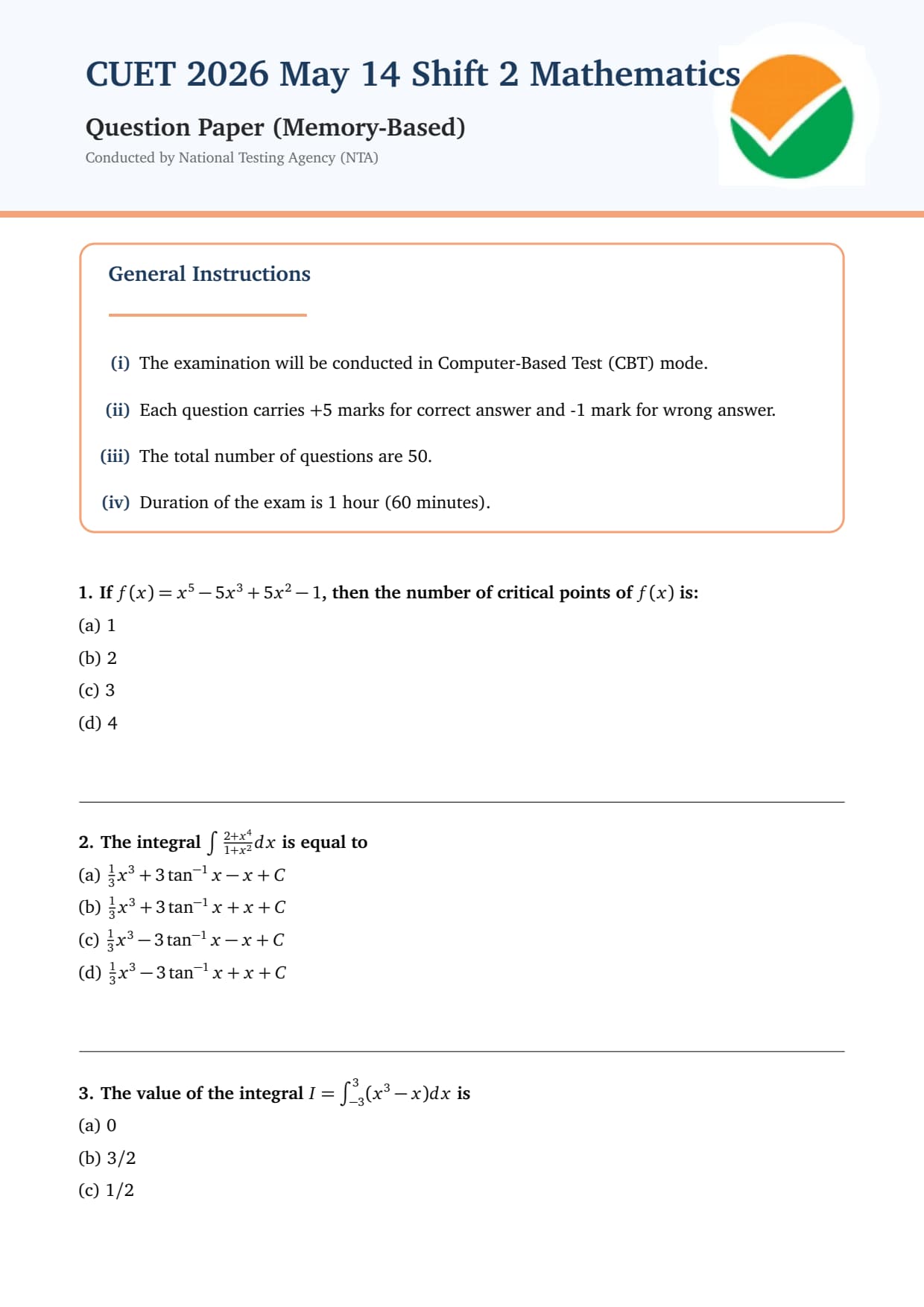


If \( f(x) = x^5 - 5x^3 + 5x^2 - 1 \), then the number of critical points of \( f(x) \) is:
View Solution
Step 1: Understanding the Question:
The question asks for the number of critical points of the given function \( f(x) \). Critical points are points where the derivative of the function is either zero or undefined. For polynomial functions, the derivative is always defined, so we look for points where \( f'(x) = 0 \).
Step 2: Key Formula or Approach:
1. Find the first derivative of the function, \( f'(x) \).
2. Set \( f'(x) = 0 \) and solve for \( x \). The number of distinct real roots will be the number of critical points.
Step 3: Detailed Explanation:
Given function: \( f(x) = x^5 - 5x^3 + 5x^2 - 1 \).
Differentiate \( f(x) \) with respect to \( x \):
\[ f'(x) = \frac{d}{dx}(x^5 - 5x^3 + 5x^2 - 1) \]
\[ f'(x) = 5x^4 - 15x^2 + 10x \]
To find the critical points, set \( f'(x) = 0 \):
\[ 5x^4 - 15x^2 + 10x = 0 \]
Factor out \( 5x \):
\[ 5x(x^3 - 3x + 2) = 0 \]
One critical point is \( x = 0 \).
Now, we need to find the roots of the cubic equation \( x^3 - 3x + 2 = 0 \).
By inspection, try integer values that divide 2 (\(\pm 1, \pm 2\)):
- If \( x = 1 \): \( (1)^3 - 3(1) + 2 = 1 - 3 + 2 = 0 \). So, \( x = 1 \) is a root. This means \((x-1)\) is a factor.
- Since \( x = 1 \) is a root, \((x-1)\) is a factor. We can perform polynomial division or synthetic division.
Using synthetic division with root 1:
1 | 1 \quad 0 \quad -3 \quad 2
\quad \quad \quad 1 \quad 1 \quad -2
-----------------------
\quad 1 \quad 1 \quad -2 \quad 0
The quotient is \( x^2 + x - 2 \).
So, \( x^3 - 3x + 2 = (x-1)(x^2 + x - 2) = 0 \).
Now, factor the quadratic term:
\( x^2 + x - 2 = (x+2)(x-1) \).
So, \( x^3 - 3x + 2 = (x-1)(x+2)(x-1) = (x-1)^2(x+2) = 0 \).
The roots of \( x^3 - 3x + 2 = 0 \) are \( x = 1 \) (a repeated root) and \( x = -2 \).
Combining all roots from \( f'(x) = 0 \):
The distinct real roots are \( x = 0, x = 1, \) and \( x = -2 \).
Thus, there are 3 distinct critical points.
Step 4: Final Answer:
The number of critical points of \( f(x) \) is 3.
Quick Tip: To find critical points of a polynomial:
1. Calculate the first derivative.
2. Factor the derivative completely.
3. Identify all distinct real roots. Each distinct real root corresponds to a critical point. Don't count repeated roots multiple times as distinct critical points.
The integral \( \int \frac{2+x^4}{1+x^2} dx \) is equal to
View Solution
Step 1: Understanding the Question:
The question asks to evaluate an indefinite integral of a rational function. The degree of the numerator is higher than the degree of the denominator, so algebraic manipulation or polynomial long division is required before integration.
Step 2: Key Formula or Approach:
1. Perform algebraic manipulation to simplify the integrand:
\[ \frac{x^4+2}{x^2+1} = \frac{x^4-1+3}{x^2+1} \]
2. Use the algebraic identity \(a^2 - b^2 = (a-b)(a+b)\) for \(x^4-1 = (x^2-1)(x^2+1)\).
3. Apply standard integral formulas:
\[ \int x^n dx = \frac{x^{n+1}}{n+1} + C \quad (for n \neq -1) \]
\[ \int \frac{1}{1+x^2} dx = \tan^{-1}x + C \]
Step 3: Detailed Explanation:
Given integral: \( I = \int \frac{2+x^4}{1+x^2} dx \)
First, manipulate the numerator to simplify the fraction:
\[ I = \int \frac{x^4 - 1 + 3}{x^2 + 1} dx \]
Split the fraction into two terms:
\[ I = \int \left( \frac{x^4 - 1}{x^2 + 1} + \frac{3}{x^2 + 1} \right) dx \]
Factor the numerator of the first term using the difference of squares: \( x^4 - 1 = (x^2 - 1)(x^2 + 1) \).
\[ I = \int \left( \frac{(x^2 - 1)(x^2 + 1)}{x^2 + 1} + \frac{3}{x^2 + 1} \right) dx \]
Simplify the first term:
\[ I = \int \left( (x^2 - 1) + \frac{3}{x^2 + 1} \right) dx \]
Now, integrate each term separately:
\[ I = \int x^2 dx - \int 1 dx + 3 \int \frac{1}{x^2 + 1} dx \]
Apply the standard integral formulas:
\[ I = \frac{x^{2+1}}{2+1} - x + 3 \tan^{-1}x + C \]
\[ I = \frac{x^3}{3} - x + 3 \tan^{-1}x + C \]
This result matches option (a).
Step 4: Final Answer:
The integral is equal to \(\frac{1}{3}x^3 + 3 \tan^{-1}x - x + C\).
Quick Tip: When integrating rational functions where the numerator's degree is greater than or equal to the denominator's degree, always perform algebraic division (or manipulation) first. This breaks the complex fraction into simpler terms (a polynomial and a proper rational fraction) that are easier to integrate.
The value of the integral \( I = \int_{-3}^3 (x^3 - x) dx \) is
View Solution
Step 1: Understanding the Question:
The question asks to evaluate a definite integral over a symmetric interval (from -3 to 3).
Step 2: Key Formula or Approach:
For a definite integral over a symmetric interval \([-a, a]\):
1. If \( f(x) \) is an odd function (\( f(-x) = -f(x) \)), then \( \int_{-a}^a f(x) dx = 0 \).
2. If \( f(x) \) is an even function (\( f(-x) = f(x) \)), then \( \int_{-a}^a f(x) dx = 2 \int_0^a f(x) dx \).
Step 3: Detailed Explanation:
Given integral: \( I = \int_{-3}^3 (x^3 - x) dx \)
Let \( f(x) = x^3 - x \).
First, check if \( f(x) \) is an odd or even function:
Substitute \(-x\) for \(x\):
\[ f(-x) = (-x)^3 - (-x) \]
\[ f(-x) = -x^3 + x \]
Factor out -1:
\[ f(-x) = -(x^3 - x) \]
Since \( f(-x) = -f(x) \), the function \( f(x) = x^3 - x \) is an odd function.
Because the integral is over a symmetric interval \([-3, 3]\) and the integrand is an odd function, the value of the integral is 0.
Alternatively, directly integrate:
\[ \int (x^3 - x) dx = \frac{x^4}{4} - \frac{x^2}{2} + C \]
Evaluate the definite integral:
\[ \left[ \frac{x^4}{4} - \frac{x^2}{2} \right]_{-3}^3 = \left( \frac{3^4}{4} - \frac{3^2}{2} \right) - \left( \frac{(-3)^4}{4} - \frac{(-3)^2}{2} \right) \]
\[ = \left( \frac{81}{4} - \frac{9}{2} \right) - \left( \frac{81}{4} - \frac{9}{2} \right) \]
\[ = 0 \]
Step 4: Final Answer:
The value of the integral is 0.
Quick Tip: Always check for odd/even symmetry when integrating over symmetric intervals \([-a, a]\). This often simplifies the problem significantly. The integral of an odd function over a symmetric interval is always zero.
The integral \( \int e^x \left(\tan^{-1}x + \frac{1}{1+x^2}\right) dx \) is equal to
View Solution
Step 1: Understanding the Question:
The question asks to evaluate an indefinite integral that has the form \( \int e^x (f(x) + f'(x)) dx \).
Step 2: Key Formula or Approach:
The standard integral formula for this form is:
\[ \int e^x (f(x) + f'(x)) dx = e^x f(x) + C \]
Step 3: Detailed Explanation:
Given integral: \( I = \int e^x \left(\tan^{-1}x + \frac{1}{1+x^2}\right) dx \)
Identify \( f(x) \) and \( f'(x) \):
Let \( f(x) = \tan^{-1}x \).
Then, the derivative of \( f(x) \) is \( f'(x) = \frac{d}{dx}(\tan^{-1}x) = \frac{1}{1+x^2} \).
The integral is exactly in the form \( \int e^x (f(x) + f'(x)) dx \).
Applying the formula:
\[ I = e^x \tan^{-1}x + C \]
Step 4: Final Answer:
The integral is equal to \( e^x \tan^{-1}x + C \).
Quick Tip: Always look for the pattern \( \int e^x (f(x) + f'(x)) dx \) when you see an \( e^x \) multiplied by a sum of functions. Identifying \( f(x) \) and its derivative \( f'(x) \) simplifies the integral significantly.
The value of \( \int_0^2 |x - 2| dx = \)
View Solution
Step 1: Understanding the Question:
The question asks to evaluate a definite integral involving an absolute value function.
Step 2: Key Formula or Approach:
1. Define the absolute value function: \( |A| = A \) if \( A \ge 0 \), and \( |A| = -A \) if \( A < 0 \).
2. Split the integral into intervals where the expression inside the absolute value changes sign.
3. Evaluate the integral over each interval.
Alternatively, interpret the integral geometrically as the area under the curve.
Step 3: Detailed Explanation:
Given integral: \( I = \int_0^2 |x - 2| dx \)
Analyze the expression inside the absolute value, \( x - 2 \):
- For \( x \le 2 \), \( x - 2 \le 0 \). So, \( |x - 2| = -(x - 2) = 2 - x \).
The interval of integration is from 0 to 2. In this entire interval, \( x \le 2 \).
Therefore, for \( x \in [0, 2] \), \( |x - 2| \) can be replaced by \( 2 - x \).
\[ I = \int_0^2 (2 - x) dx \]
Now, integrate term by term:
\[ I = \left[ 2x - \frac{x^2}{2} \right]_0^2 \]
Evaluate at the limits:
\[ I = \left( 2(2) - \frac{2^2}{2} \right) - \left( 2(0) - \frac{0^2}{2} \right) \]
\[ I = \left( 4 - \frac{4}{2} \right) - (0 - 0) \]
\[ I = (4 - 2) - 0 \]
\[ I = 2 \]
Geometric Interpretation:
The function \( y = |x - 2| \) is a V-shaped graph with its vertex at \( x = 2 \).
For the interval \([0, 2]\), the function is \( y = 2 - x \).
This is a straight line.
- At \( x = 0 \), \( y = 2 \).
- At \( x = 2 \), \( y = 0 \).
The integral represents the area of a right-angled triangle with base 2 (from \( x=0 \) to \( x=2 \)) and height 2 (at \( x=0 \)).
Area = \(\frac{1}{2} \times base \times height = \frac{1}{2} \times 2 \times 2 = 2\).
Step 4: Final Answer:
The value of the integral is 2.
Quick Tip: For definite integrals involving absolute value functions over simple intervals, drawing a quick sketch of the graph and calculating the area geometrically (e.g., as triangles or rectangles) can be much faster and less error-prone than algebraic integration.
If \( X + Y = \begin{pmatrix} 5 & 3
0 & 7 \end{pmatrix} \) and \( X - Y = \begin{pmatrix} 7 & 1
2 & 3 \end{pmatrix} \). Then X and Y are
1 & 5 \end{pmatrix} \text{ and } Y = \begin{pmatrix} -1 & -1
-1 & 2 \end{pmatrix} \)
View Solution
Step 1: Understanding the Question:
The question provides two matrix equations involving two unknown matrices X and Y. We need to solve for these matrices.
Step 2: Key Formula or Approach:
This is analogous to solving a system of linear equations for scalar variables. We can use addition and subtraction of matrix equations.
Given:
1. \( X + Y = A = \begin{pmatrix} 5 & 3
0 & 7 \end{pmatrix} \)
2. \( X - Y = B = \begin{pmatrix} 7 & 1
2 & 3 \end{pmatrix} \)
Step 3: Detailed Explanation:
Solve for X:
Add Equation 1 and Equation 2:
\( (X + Y) + (X - Y) = A + B \)
\( 2X = \begin{pmatrix} 5 & 3
0 & 7 \end{pmatrix} + \begin{pmatrix} 7 & 1
2 & 3 \end{pmatrix} \)
Perform matrix addition (add corresponding elements):
\( 2X = \begin{pmatrix} 5+7 & 3+1
0+2 & 7+3 \end{pmatrix} = \begin{pmatrix} 12 & 4
2 & 10 \end{pmatrix} \)
Now, divide by 2 (multiply by 1/2):
\( X = \frac{1}{2} \begin{pmatrix} 12 & 4
2 & 10 \end{pmatrix} = \begin{pmatrix} 6 & 2
1 & 5 \end{pmatrix} \)
Solve for Y:
Substitute the value of X back into Equation 1:
\( X + Y = A \)
\( \begin{pmatrix} 6 & 2
1 & 5 \end{pmatrix} + Y = \begin{pmatrix} 5 & 3
0 & 7 \end{pmatrix} \)
Subtract X from both sides:
\( Y = \begin{pmatrix} 5 & 3
0 & 7 \end{pmatrix} - \begin{pmatrix} 6 & 2
1 & 5 \end{pmatrix} \)
Perform matrix subtraction:
\( Y = \begin{pmatrix} 5-6 & 3-2
0-1 & 7-5 \end{pmatrix} = \begin{pmatrix} -1 & 1
-1 & 2 \end{pmatrix} \)
Step 4: Final Answer:
\( X = \begin{pmatrix} 6 & 2
1 & 5 \end{pmatrix} and Y = \begin{pmatrix} -1 & 1
-1 & 2 \end{pmatrix} \). This corresponds to option (a).
Quick Tip: Treat matrix equations like scalar equations for addition/subtraction. Add or subtract equations to isolate one variable, then back-substitute. Always perform element-wise addition/subtraction carefully. Double-check your result against options to catch any simple arithmetic errors.
A certain type of fish has a 4/5 probability of surviving in a pond, while another fish has a 2/5 probability of survival. What is the probability that exactly one of them survives?
View Solution
Step 1: Understanding the Question:
The problem asks for the probability that exactly one of two independent events (fish survival) occurs.
Step 2: Key Formula or Approach:
Let \(P(A)\) be the probability that the first fish survives and \(P(B)\) be the probability that the second fish survives.
The probability that exactly one of them survives is:
\(P(exactly one survives) = P(A survives and B dies) + P(A dies and B survives)\).
Since the events are independent:
\(P(exactly one survives) = P(A) \times P(B') + P(A') \times P(B)\).
Where \(P(A')\) is the probability that A dies, and \(P(B')\) is the probability that B dies.
\(P(X') = 1 - P(X)\).
Step 3: Detailed Explanation:
Given:
- Probability of first fish surviving, \(P(A) = 4/5\).
- Probability of second fish surviving, \(P(B) = 2/5\).
First, calculate the probabilities of them dying:
- Probability of first fish dying, \(P(A') = 1 - P(A) = 1 - 4/5 = 1/5\).
- Probability of second fish dying, \(P(B') = 1 - P(B) = 1 - 2/5 = 3/5\).
Now, calculate the probability that exactly one of them survives:
\[ P(exactly one survives) = P(A)P(B') + P(A')P(B) \]
\[ = \left(\frac{4}{5}\right) \times \left(\frac{3}{5}\right) + \left(\frac{1}{5}\right) \times \left(\frac{2}{5}\right) \]
\[ = \frac{12}{25} + \frac{2}{25} \]
\[ = \frac{12 + 2}{25} = \frac{14}{25} \]
Step 4: Final Answer:
The probability that exactly one of them survives is 14/25.
Quick Tip: For "exactly one of two independent events" problems, break it down into two mutually exclusive scenarios: (Event A happens AND Event B does NOT happen) OR (Event A does NOT happen AND Event B happens). Then sum the probabilities of these two scenarios.
A card is picked at random from a pack of 52 playing cards. Given that the picked card is a king, the probability of this card to be a card of spade is:
View Solution
Step 1: Understanding the Question:
The problem asks for a conditional probability: the probability that a card is a spade, given that it is a king.
Step 2: Key Formula or Approach:
Use the formula for conditional probability:
\[ P(A|B) = \frac{P(A \cap B)}{P(B)} \]
Where:
- \( A \) is the event that the card is a spade.
- \( B \) is the event that the card is a king.
Alternatively, a more intuitive approach for conditional probability when the sample space is reduced:
\[ P(A|B) = \frac{Number of outcomes in (A and B)}{Number of outcomes in B} \]
Step 3: Detailed Explanation:
A standard deck of 52 playing cards consists of 4 suits (Spades, Hearts, Diamonds, Clubs), and each suit has 13 cards (A, 2, ..., 10, J, Q, K).
1. Identify the reduced sample space (Event B):
The condition is "the picked card is a king".
There are 4 kings in a deck (King of Spades, King of Hearts, King of Diamonds, King of Clubs).
So, the total number of kings = 4.
2. Identify the favorable outcome within the reduced sample space (Event A and B):
The event A is "the card is a spade".
Among the 4 kings, there is exactly one King of Spades.
So, the number of kings that are also spades = 1.
3. Calculate the conditional probability:
\[ P(Spade | King) = \frac{Number of (Spade and King)}{Number of Kings} = \frac{1}{4} \]
Step 4: Final Answer:
The probability is 1/4.
Quick Tip: For conditional probability problems, always clearly define and reduce your sample space first based on the "given" condition. Then, count the favorable outcomes within this reduced sample space. This simplifies complex problems.
If \(\vec{a}\) and \(\vec{b}\) are unit vectors, then the angle between \(\vec{a}\) and \(\vec{b}\) for \( \sqrt{3}\vec{a} - \vec{b} \) to be a unit vector is given by :
View Solution
Step 1: Understanding the Question:
The problem involves two unit vectors \(\vec{a}\) and \(\vec{b}\). We are given that a linear combination of these vectors, \( \sqrt{3}\vec{a} - \vec{b} \), is also a unit vector. We need to find the angle between \(\vec{a}\) and \(\vec{b}\).
Step 2: Key Formula or Approach:
1. If \(\vec{v}\) is a unit vector, then \( |\vec{v}|^2 = 1 \).
2. For any vector \(\vec{v}\), \( |\vec{v}|^2 = \vec{v} \cdot \vec{v} \).
3. The dot product of two vectors \(\vec{a} \cdot \vec{b} = |\vec{a}| |\vec{b}| \cos\theta \).
4. Since \(\vec{a}\) and \(\vec{b}\) are unit vectors, \( |\vec{a}| = 1 \) and \( |\vec{b}| = 1 \).
Step 3: Detailed Explanation:
Let \(\vec{v} = \sqrt{3}\vec{a} - \vec{b}\).
Since \(\vec{v}\) is a unit vector, \( |\vec{v}|^2 = 1 \).
\[ |\sqrt{3}\vec{a} - \vec{b}|^2 = 1 \]
Expand the square of the magnitude using the dot product property:
\[ (\sqrt{3}\vec{a} - \vec{b}) \cdot (\sqrt{3}\vec{a} - \vec{b}) = 1 \]
\[ (\sqrt{3}\vec{a}) \cdot (\sqrt{3}\vec{a}) - 2(\sqrt{3}\vec{a} \cdot \vec{b}) + \vec{b} \cdot \vec{b} = 1 \]
\[ (\sqrt{3})^2 |\vec{a}|^2 - 2\sqrt{3} (\vec{a} \cdot \vec{b}) + |\vec{b}|^2 = 1 \]
Since \(\vec{a}\) and \(\vec{b}\) are unit vectors, \( |\vec{a}|^2 = 1 \) and \( |\vec{b}|^2 = 1 \).
\[ 3(1) - 2\sqrt{3} (\vec{a} \cdot \vec{b}) + 1 = 1 \]
\[ 4 - 2\sqrt{3} (\vec{a} \cdot \vec{b}) = 1 \]
\[ 3 = 2\sqrt{3} (\vec{a} \cdot \vec{b}) \]
Now, substitute \(\vec{a} \cdot \vec{b} = |\vec{a}| |\vec{b}| \cos\theta = (1)(1)\cos\theta = \cos\theta \):
\[ 3 = 2\sqrt{3} \cos\theta \]
Solve for \(\cos\theta\):
\[ \cos\theta = \frac{3}{2\sqrt{3}} = \frac{3\sqrt{3}}{2 \times 3} = \frac{\sqrt{3}}{2} \]
The angle \(\theta\) whose cosine is \( \frac{\sqrt{3}}{2} \) is \( 30^{\circ} \) or \( \pi/6 \) radians.
Step 4: Final Answer:
The angle between \(\vec{a}\) and \(\vec{b}\) is \(\pi/6\). This corresponds to option (a).
Quick Tip: When dealing with unit vectors and magnitudes, always square the vector equation to convert magnitudes into dot products. This leverages the properties \( |\vec{v}|^2 = \vec{v} \cdot \vec{v} \) and \( \vec{a} \cdot \vec{b} = |\vec{a}| |\vec{b}| \cos\theta \) for unit vectors.
Consider the function \( f(x) = -2x^3 - 9x^2 - 12x + 5 \). Then, which of the following is/are correct?
(a) \( f(x) \) decreasing in \((0, \infty)\) and increasing in \((-\infty, 0)\)
(b) \( f(x) \) increasing in \((-\infty, 1) \cup (2, \infty)\) and decreasing in \((1, 2)\)
(c) \( f(x) \) increasing in \((0, \infty)\) and decreasing in \((-\infty, 0)\)
(d) \( f(x) \) is increasing in \((-2, -1)\) and decreasing in \((-\infty, -2) \cup (-1, \infty)\)
View Solution
Step 1: Understanding the Question:
The question asks to determine the intervals where the given function \( f(x) \) is increasing or decreasing. This involves analyzing the sign of the first derivative of the function.
Step 2: Key Formula or Approach:
1. Find the first derivative of the function, \( f'(x) \).
2. Find the critical points by setting \( f'(x) = 0 \).
3. Test the sign of \( f'(x) \) in intervals determined by the critical points.
- If \( f'(x) > 0 \), the function is increasing.
- If \( f'(x) < 0 \), the function is decreasing.
Step 3: Detailed Explanation:
Given function: \( f(x) = -2x^3 - 9x^2 - 12x + 5 \).
Differentiate \( f(x) \) with respect to \( x \):
\[ f'(x) = \frac{d}{dx}(-2x^3 - 9x^2 - 12x + 5) \]
\[ f'(x) = -6x^2 - 18x - 12 \]
To find critical points, set \( f'(x) = 0 \):
\[ -6x^2 - 18x - 12 = 0 \]
Divide by -6:
\[ x^2 + 3x + 2 = 0 \]
Factor the quadratic equation:
\[ (x+1)(x+2) = 0 \]
The critical points are \( x = -1 \) and \( x = -2 \).
These critical points divide the number line into three intervals: \((-\infty, -2)\), \((-2, -1)\), and \((-1, \infty)\).
Now, test the sign of \( f'(x) = -6(x+1)(x+2) \) in each interval:
1. Interval \((-\infty, -2)\): Choose a test value, e.g., \( x = -3 \).
\( f'(-3) = -6(-3+1)(-3+2) = -6(-2)(-1) = -12 \).
Since \( f'(x) < 0 \), \( f(x) \) is decreasing in \((-\infty, -2)\).
2. Interval \((-2, -1)\): Choose a test value, e.g., \( x = -1.5 \).
\( f'(-1.5) = -6(-1.5+1)(-1.5+2) = -6(-0.5)(0.5) = -6(-0.25) = 1.5 \).
Since \( f'(x) > 0 \), \( f(x) \) is increasing in \((-2, -1)\).
3. Interval \((-1, \infty)\): Choose a test value, e.g., \( x = 0 \).
\( f'(0) = -6(0+1)(0+2) = -6(1)(2) = -12 \).
Since \( f'(x) < 0 \), \( f(x) \) is decreasing in \((-1, \infty)\).
Combining the results:
\( f(x) \) is increasing in \((-2, -1)\).
\( f(x) \) is decreasing in \((-\infty, -2) \cup (-1, \infty)\).
This matches option (d).
Step 4: Final Answer:
The function \( f(x) \) is increasing in \((-2, -1)\) and decreasing in \((-\infty, -2) \cup (-1, \infty)\).
Quick Tip: To determine intervals of increasing/decreasing, the sign of the first derivative \( f'(x) \) is crucial. Always factor \( f'(x) \) to easily analyze its sign across intervals defined by its roots. Use test points within each interval to determine the sign.
CUET UG 2026 Exam Pattern
| Parameter | Details |
|---|---|
| Exam Name | Common University Entrance Test (CUET UG) 2026 |
| Conducting Body | National Testing Agency (NTA) |
| Exam Mode | Computer-Based Test (CBT) |
| Exam Duration | 60 minutes per test |
| Total Sections | 3 (Languages, Domain Subjects, General Test) |
| Question Type | Multiple Choice Questions (MCQs) |
| Questions per Test | 50 questions (all compulsory) |
| Marking Scheme | +5 for correct, -1 for incorrect |
| Maximum Marks | 250 marks per test |
| Maximum Subject Choices | 5 subjects in total |
| Syllabus Base | Class 12 NCERT (mainly for Domain Subjects) |



Comments