


CUET 2026 June 7 Shift 2 Business Studies Question Paper is available for download here. NTA conducted the CUET 2026 exam from 11th May to 31st May and 6th June and 7th June.
- CUET 2026 Business Studies exam consists of 50 questions for 250 marks to be attempted in 60 minutes.
- As per the marking scheme, 5 marks are awarded for each correct answer, and 1 mark is deducted for incorrect answer.
Candidates can download CUET 2026 June 7 Shift 2 Business Studies Question Paper with Answer Key and Solution PDF from links provided below.
Related Links:
- CUET 2026 June 7 Shift 2 Business Studies Answer Key
- CUET UG 2026 Business Studies Marks vs Expected Percentile and Colleges
CUET 2026 Business Studies June 7 Shift 2 Question Paper with Solution PDF
| CUET June 7 Shift 2 Business Studies Question Paper 2026 | Download PDF | Check Solutions |

Which level of management is responsible for implementing the policies and plans formulated by top-level management?
View Solution
Concept:
Management is generally divided into three levels:
Top-level Management
Middle-level Management
Lower-level (Operational) Management
Each level has specific responsibilities and functions within the organization.
Step 1: Understand the role of top-level management.
Top-level management consists of executives such as the Managing Director, Chief Executive Officer (CEO), and Board of Directors.
Their primary functions are:
Formulating organizational policies
Setting objectives
Making strategic decisions
Planning for the future
Step 2: Understand the role of middle-level management.
Middle-level managers act as a link between top management and operational employees.
Their functions include:
Implementing policies framed by top management
Coordinating departmental activities
Supervising lower-level managers
Ensuring that organizational plans are executed effectively
Step 3: Apply the concept to the given question.
The question asks which level of management implements the policies and plans formulated by top-level management.
This responsibility belongs to middle-level management because they translate broad policies into practical actions.
\[ \boxed{Middle-level Management} \]
Hence, the correct answer is:
\[ \boxed{Option (B)} \] Quick Tip: Remember: Top Management \(\rightarrow\) Policy Formulation Middle Management \(\rightarrow\) Policy Implementation Lower Management \(\rightarrow\) Direct Supervision of Workers
Which principle of Henry Fayol suggests that there should be one head and one plan for a group of activities having the same objective?
View Solution
Concept:
Henry Fayol proposed fourteen principles of management to improve organizational efficiency.
One of these principles is Unity of Direction.
Step 1: Understand the meaning of Unity of Direction.
Unity of Direction means:
\[ One Head + One Plan \]
for a group of activities having the same objective.
All employees working toward a common goal should follow one coordinated plan under one manager.
Step 2: Differentiate it from Unity of Command.
Students often confuse Unity of Direction with Unity of Command.
Unity of Command means:
\[ One Employee \rightarrow One Boss \]
Unity of Direction means:
\[ One Objective \rightarrow One Plan + One Head \]
Step 3: Apply the concept.
Since the question specifically mentions:
One head
One plan
Same objective
the principle being referred to is Unity of Direction.
\[ \boxed{Unity of Direction} \]
Hence, the correct answer is:
\[ \boxed{Option (B)} \] Quick Tip: Unity of Command = One Employee, One Boss. Unity of Direction = One Objective, One Plan, One Head.
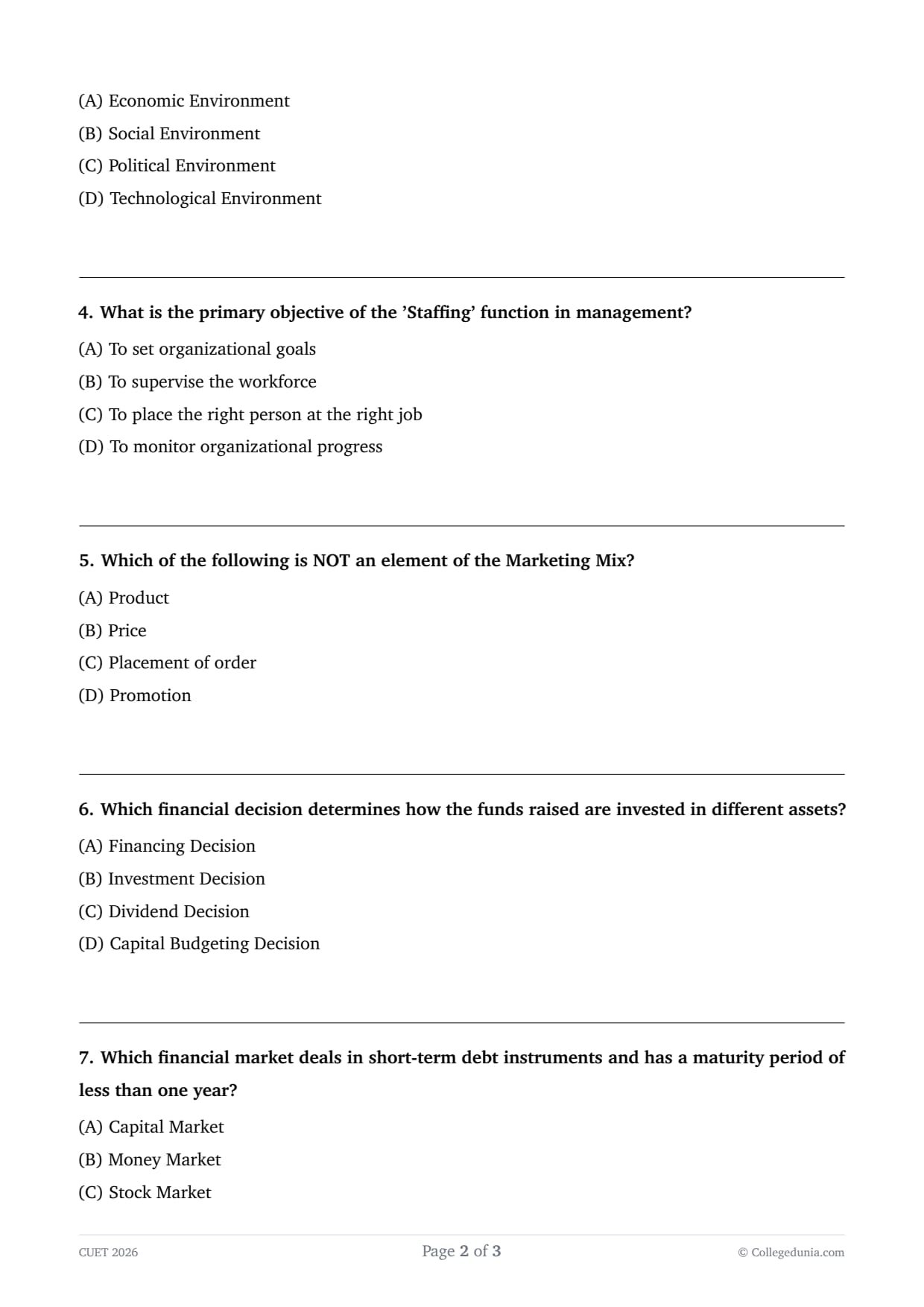
Which component of the business environment refers to the values, customs, and beliefs of a society?
View Solution
Concept:
Business organizations operate within an environment that consists of several external factors influencing business decisions.
One important component is the Social Environment.
Step 1: Understand the meaning of social environment.
The social environment includes:
Customs
Traditions
Values
Beliefs
Lifestyle
Education level
Demographic characteristics
These factors influence consumer behavior and business decisions.
Step 2: Understand its importance.
Business firms must understand social trends because consumer preferences are strongly influenced by society.
For example:
Growing health awareness increases demand for healthy food.
Environmental awareness increases demand for eco-friendly products.
Changing lifestyles create demand for modern technology.
Step 3: Apply the concept.
Since the question refers to values, customs, and beliefs of society, it clearly indicates the Social Environment.
\[ \boxed{Social Environment} \]
Hence, the correct answer is:
\[ \boxed{Option (B)} \] Quick Tip: Values, customs, traditions, culture and beliefs are all components of the Social Environment.
What is the primary objective of the 'Staffing' function in management?
View Solution
Concept:
Staffing is an important managerial function concerned with acquiring, developing and maintaining human resources required by an organization.
It ensures that competent employees occupy suitable positions.
Step 1: Understand the meaning of staffing.
Staffing involves:
Manpower planning
Recruitment
Selection
Training
Placement
Promotion
Performance appraisal
Step 2: Identify the main objective.
The ultimate aim of staffing is to ensure that every position is occupied by a suitable employee possessing the required qualifications and skills.
This idea is popularly expressed as:
\[ Right Person at the Right Job \]
Step 3: Apply the concept.
Since staffing focuses on selecting and placing suitable employees in appropriate positions, its primary objective is:
\[ \boxed{To place the right person at the right job} \]
Hence, the correct answer is:
\[ \boxed{Option (C)} \] Quick Tip: Staffing = Manpower Planning + Recruitment + Selection + Training + Placement. Main Objective: \[ Right Person at Right Job \]
Which of the following is NOT an element of the Marketing Mix?
View Solution
Concept:
Marketing Mix refers to the set of marketing tools used by a company to achieve its marketing objectives.
The traditional Marketing Mix is known as the 4 Ps.
Step 1: Recall the four elements of Marketing Mix.
The 4 Ps are:
Product
Price
Place
Promotion
Step 2: Understand each element.
Product:
The goods or services offered to customers.
Price:
The amount charged for the product.
Place:
Distribution channels through which products reach customers.
Promotion:
Activities used to inform and persuade customers.
Step 3: Apply the concept.
"Placement of order" is not one of the elements of the Marketing Mix.
Therefore:
\[ \boxed{Placement of Order} \]
is the correct answer.
\[ \boxed{Option (C)} \] Quick Tip: Marketing Mix = 4 Ps \[ Product \] \[ Price \] \[ Place \] \[ Promotion \]
Which financial decision determines how the funds raised are invested in different assets?
View Solution
Concept:
Financial management involves taking important decisions regarding procurement, utilization and distribution of funds.
The three major financial decisions are:
Investment Decision
Financing Decision
Dividend Decision
Among these, the Investment Decision determines where and how the available funds should be invested.
Step 1: Understand the meaning of Investment Decision.
Investment Decision refers to the decision regarding allocation of funds among different assets and projects.
Management has to decide:
Which assets should be purchased.
Which projects should be undertaken.
How much money should be invested.
Whether an investment will generate sufficient returns.
Step 2: Understand its importance.
Investment decisions are often called the most important financial decisions because they directly affect:
Future profitability
Growth of the business
Earning capacity
Risk level of the firm
Wrong investment decisions may result in losses and inefficient use of funds.
Step 3: Relate the concept to the given question.
The question asks which financial decision determines how the funds raised are invested in various assets.
This function is performed by the Investment Decision.
\[ \boxed{Investment Decision} \]
Therefore, the correct answer is:
\[ \boxed{Option (B)} \] Quick Tip: Remember: Investment Decision = Where to invest funds? Financing Decision = How to raise funds? Dividend Decision = How much profit to distribute?
Which financial market deals in short-term debt instruments and has a maturity period of less than one year?
View Solution
Concept:
Financial markets facilitate the transfer of funds between investors and borrowers.
They are broadly classified into:
Money Market
Capital Market
The classification is based mainly on the maturity period of financial instruments.
Step 1: Understand the Money Market.
The Money Market deals in short-term funds and financial instruments having a maturity period of less than one year.
Examples include:
Treasury Bills
Commercial Paper
Call Money
Certificates of Deposit
Commercial Bills
Step 2: Understand the Capital Market.
The Capital Market deals in medium-term and long-term securities.
Examples include:
Equity Shares
Preference Shares
Debentures
Bonds
These generally have a maturity period exceeding one year.
Step 3: Apply the concept.
The question specifically mentions:
Short-term debt instruments
Maturity less than one year
These characteristics belong to the Money Market.
\[ \boxed{Money Market} \]
Hence, the correct answer is:
\[ \boxed{Option (B)} \] Quick Tip: Money Market: \[ Maturity < 1 year \] Capital Market: \[ Maturity > 1 year \]
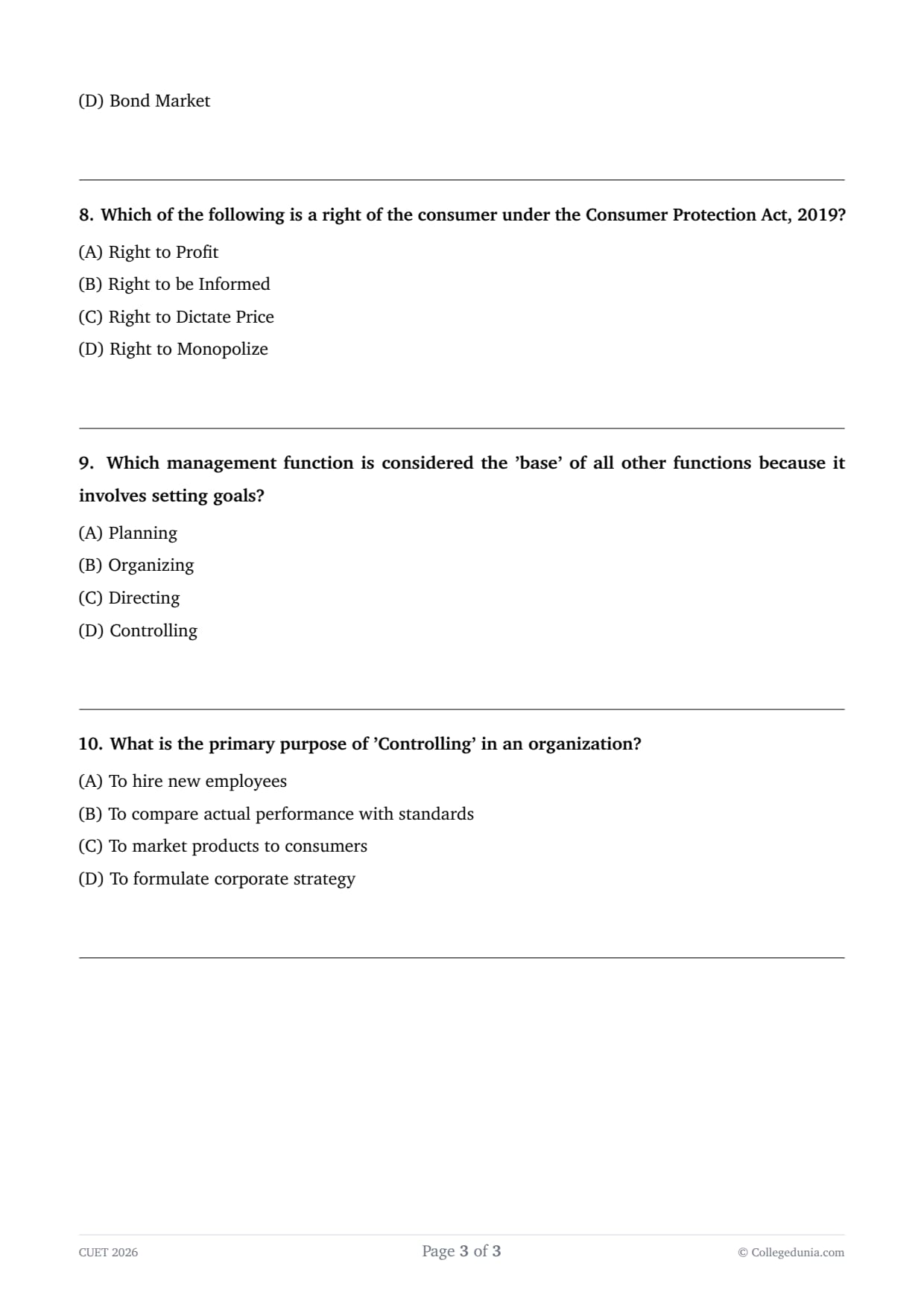
Which of the following is a right of the consumer under the Consumer Protection Act, 2019?
View Solution
Concept:
The Consumer Protection Act, 2019 protects consumers against unfair trade practices and exploitation.
The Act grants several important rights to consumers.
Step 1: Understand the rights available to consumers.
Major consumer rights include:
Right to Safety
Right to be Informed
Right to Choose
Right to be Heard
Right to Seek Redressal
Right to Consumer Education
Step 2: Understand the Right to be Informed.
Consumers must receive complete and accurate information regarding:
Quality
Quantity
Purity
Standard
Price
Ingredients
Manufacturing and expiry dates
This enables consumers to make informed purchasing decisions.
Step 3: Apply the concept.
Among the options provided, only "Right to be Informed" is an officially recognized consumer right.
\[ \boxed{Right to be Informed} \]
Hence, the correct answer is:
\[ \boxed{Option (B)} \] Quick Tip: Consumer Rights: Safety Information Choice Hearing Redressal Education
Which management function is considered the 'base' of all other functions because it involves setting goals?
View Solution
Concept:
Management consists of several interrelated functions:
Planning
Organizing
Staffing
Directing
Controlling
Among these, Planning is regarded as the primary and foundational function.
Step 1: Understand the meaning of planning.
Planning means deciding in advance:
What is to be done.
How it is to be done.
When it is to be done.
Who will do it.
It provides direction to organizational activities.
Step 2: Understand why planning is called the base.
Every other managerial function depends upon planning.
For example:
Organizing arranges resources to achieve planned goals.
Staffing provides manpower for planned activities.
Directing guides employees toward planned objectives.
Controlling compares actual performance with planned standards.
Thus planning serves as the foundation of all managerial functions.
Step 3: Apply the concept.
Since planning establishes organizational objectives and future actions, it is considered the base of all management functions.
\[ \boxed{Planning} \]
Therefore, the correct answer is:
\[ \boxed{Option (A)} \] Quick Tip: Management Functions: Planning \(\rightarrow\) Organizing \(\rightarrow\) Staffing \(\rightarrow\) Directing \(\rightarrow\) Controlling Planning comes first and forms the foundation of all others.
What is the primary purpose of 'Controlling' in an organization?
View Solution
Concept:
Controlling is the managerial function that ensures organizational activities are proceeding according to plan.
It helps management identify deviations and take corrective actions whenever necessary.
Step 1: Understand the meaning of controlling.
Controlling involves:
Setting performance standards
Measuring actual performance
Comparing actual performance with standards
Taking corrective action
Step 2: Understand its importance.
Without controlling:
Managers cannot know whether goals are being achieved.
Errors may remain undetected.
Resources may be wasted.
Organizational efficiency may decline.
Controlling ensures that plans are effectively implemented.
Step 3: Identify the primary purpose.
The central activity of controlling is the comparison between actual results and predetermined standards.
If differences are found, corrective measures are taken.
Therefore:
\[ \boxed{Actual Performance \leftrightarrow Standards} \]
is the essence of controlling.
Step 4: Write the conclusion.
The primary purpose of controlling is:
\[ \boxed{To compare actual performance with standards} \]
Hence, the correct answer is:
\[ \boxed{Option (B)} \] Quick Tip: Controlling Process: \[ Set Standards \] \[ Measure Performance \] \[ Compare \] \[ Correct Deviations \]
CUET UG 2026 Exam Pattern
| Parameter | Details |
|---|---|
| Exam Name | Common University Entrance Test (CUET UG) 2026 |
| Conducting Body | National Testing Agency (NTA) |
| Exam Mode | Computer-Based Test (CBT) |
| Exam Duration | 60 minutes per test |
| Total Sections | 3 (Languages, Domain Subjects, General Test) |
| Question Type | Multiple Choice Questions (MCQs) |
| Questions per Test | 50 questions (all compulsory) |
| Marking Scheme | +5 for correct, -1 for incorrect |
| Maximum Marks | 250 marks per test |
| Maximum Subject Choices | 5 subjects in total |
| Syllabus Base | Class 12 NCERT (mainly for Domain Subjects) |



Comments