


CUET 2026 June 6 Shift 1 Physics Question Paper is available for download here. NTA is conducting the CUET 2026 exam from 11th May to 31st May and June 6 to June 7.
- CUET 2026 Physics exam consists of 50 questions for 250 marks to be attempted in 60 minutes.
- As per the marking scheme, 5 marks are awarded for each correct answer, and 1 mark is deducted for incorrect answer.
Candidates can download CUET 2026 June 6 Shift 1 Physics Question Paper with Answer Key and Solution PDF from links provided below.
Related Links:
CUET 2026 Physics June 6 Shift 1 Question Paper with Solution PDF
| CUET 6 June Shift 1 Physics Question Paper 2026 | Download PDF | Check Solutions |
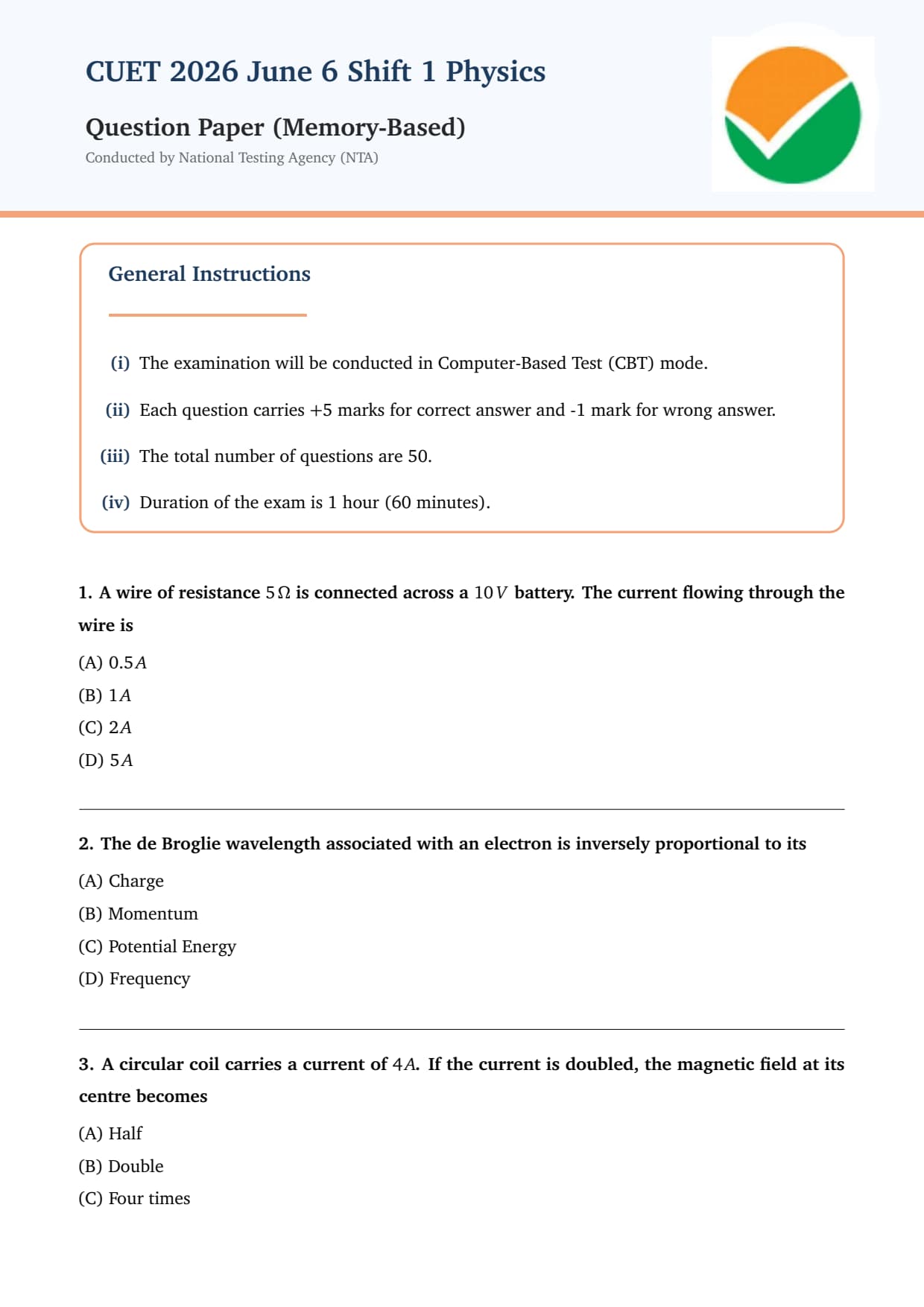
A wire of resistance \(5\,\Omega\) is connected across a \(10\,V\) battery. The current flowing through the wire is
View Solution
Concept:
According to Ohm's Law,
\[ V=IR \]
where
\[ V=Potential Difference, \quad I=Current, \quad R=Resistance \]
Step 1: Write the given values.
\[ V=10\,V \]
\[ R=5\,\Omega \]
Step 2: Use Ohm's law to calculate current.
\[ I=\frac{V}{R} \]
\[ I=\frac{10}{5} \]
\[ I=2\,A \]
Therefore,
\[ \boxed{I=2\,A} \]
\[ \boxed{Answer = (C)} \] Quick Tip: For numerical questions from Current Electricity, first check whether Ohm's law can be directly applied.
The de Broglie wavelength associated with an electron is inversely proportional to its
View Solution
Concept:
According to de Broglie's hypothesis,
\[ \lambda=\frac{h}{p} \]
where
\[ \lambda=de Broglie wavelength \]
\[ h=Planck's constant \]
\[ p=momentum \]
Step 1: Observe the relation.
\[ \lambda=\frac{h}{p} \]
Since \(h\) is constant,
\[ \lambda\propto \frac{1}{p} \]
Step 2: Identify the correct option.
The wavelength is inversely proportional to momentum.
Therefore,
\[ \boxed{\lambda\propto \frac{1}{p}} \]
\[ \boxed{Answer = (B)} \] Quick Tip: Higher momentum means shorter wavelength.
A circular coil carries a current of \(4\,A\). If the current is doubled, the magnetic field at its centre becomes
View Solution
Concept:
The magnetic field at the centre of a circular coil is
\[ B=\frac{\mu_0 I}{2R} \]
Step 1: Observe the proportionality.
\[ B\propto I \]
Step 2: Double the current.
If
\[ I\rightarrow 2I \]
then
\[ B\rightarrow 2B \]
Hence the magnetic field also doubles.
Therefore,
\[ \boxed{Magnetic Field = Double} \]
\[ \boxed{Answer = (B)} \] Quick Tip: Magnetic field at the centre of a coil is directly proportional to current.
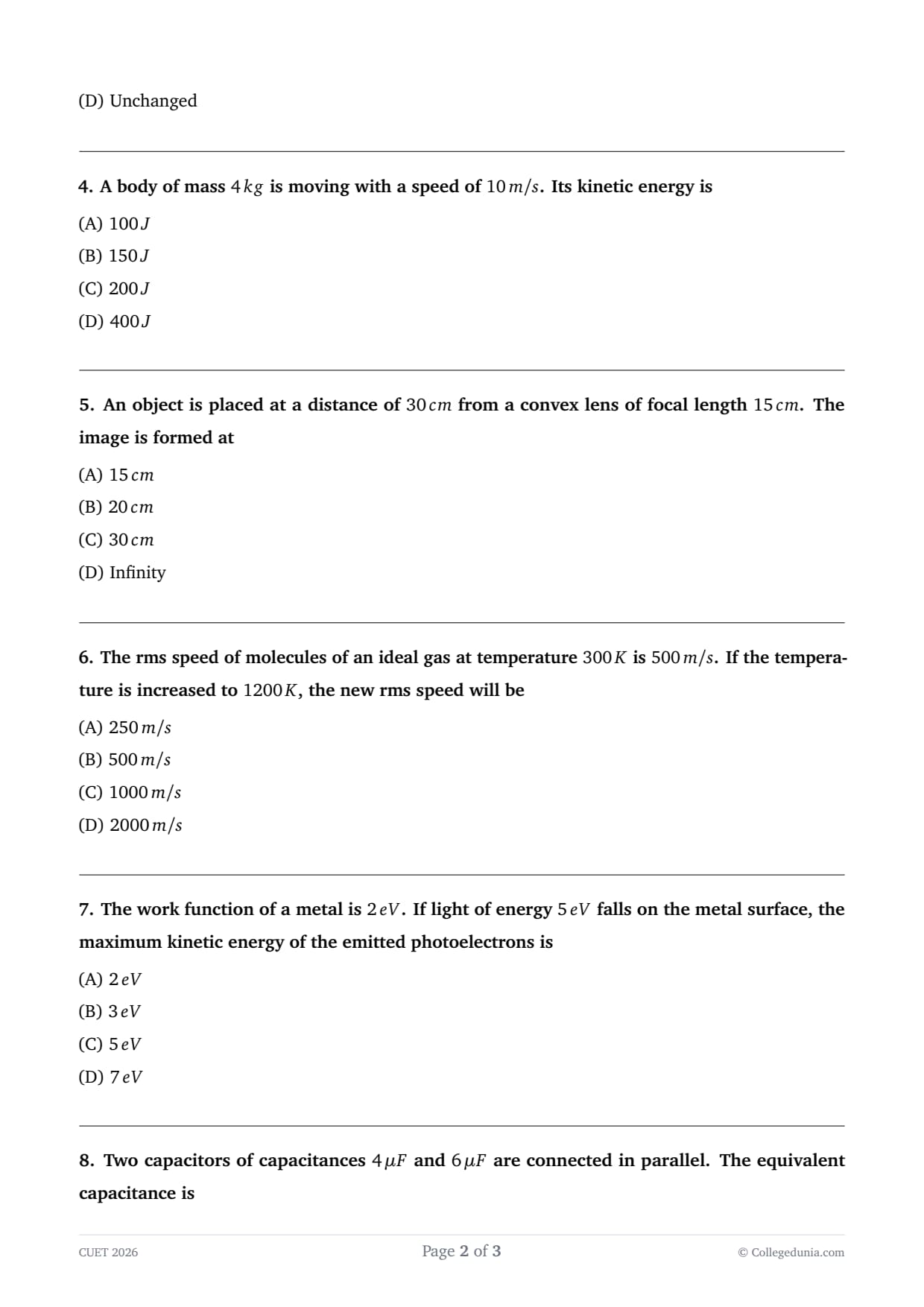
A body of mass \(4\,kg\) is moving with a speed of \(10\,m/s\). Its kinetic energy is
View Solution
Concept:
Kinetic Energy is given by
\[ KE=\frac12 mv^2 \]
Step 1: Substitute the given values.
\[ KE=\frac12 \times 4 \times 10^2 \]
\[ KE=2\times100 \]
\[ KE=200\,J \]
Therefore,
\[ \boxed{KE=200\,J} \]
\[ \boxed{Answer = (C)} \] Quick Tip: Kinetic energy depends on the square of velocity. Doubling velocity makes kinetic energy four times.
An object is placed at a distance of \(30\,cm\) from a convex lens of focal length \(15\,cm\). The image is formed at
View Solution
Concept:
Lens Formula:
\[ \frac1f=\frac1v-\frac1u \]
Step 1: Write the given values.
\[ f=+15\,cm \]
\[ u=-30\,cm \]
Step 2: Apply lens formula.
\[ \frac1{15} = \frac1v+\frac1{30} \]
\[ \frac1v = \frac1{15}-\frac1{30} \]
\[ = \frac2{30}-\frac1{30} \]
\[ = \frac1{30} \]
\[ v=30\,cm \]
Therefore,
\[ \boxed{v=30\,cm} \]
\[ \boxed{Answer = (C)} \] Quick Tip: An object placed at \(2F\) of a convex lens forms its image at \(2F\) on the other side.
The rms speed of molecules of an ideal gas at temperature \(300\,K\) is \(500\,m/s\). If the temperature is increased to \(1200\,K\), the new rms speed will be
View Solution
Concept:
The rms speed of gas molecules is given by
\[ v_{rms}=\sqrt{\frac{3RT}{M}} \]
Therefore,
\[ v_{rms}\propto \sqrt{T} \]
Step 1: Write the relation between initial and final rms speeds.
\[ \frac{v_2}{v_1} = \sqrt{\frac{T_2}{T_1}} \]
Step 2: Substitute the given values.
\[ \frac{v_2}{500} = \sqrt{\frac{1200}{300}} \]
\[ \frac{v_2}{500} = \sqrt{4} \]
\[ \frac{v_2}{500} = 2 \]
\[ v_2=1000\,m/s \]
Therefore,
\[ \boxed{v_2=1000\,m/s} \]
\[ \boxed{Answer = (C)} \] Quick Tip: The rms speed is directly proportional to the square root of absolute temperature.
The work function of a metal is \(2\,eV\). If light of energy \(5\,eV\) falls on the metal surface, the maximum kinetic energy of the emitted photoelectrons is
View Solution
Concept:
According to Einstein's photoelectric equation,
\[ K_{max}=h\nu-\phi \]
where
\[ K_{max}=Maximum Kinetic Energy \]
\[ h\nu=Energy of incident photon \]
\[ \phi=Work Function \]
Step 1: Write the given values.
\[ h\nu=5\,eV \]
\[ \phi=2\,eV \]
Step 2: Apply Einstein's equation.
\[ K_{max}=5-2 \]
\[ K_{max}=3\,eV \]
Therefore,
\[ \boxed{K_{max}=3\,eV} \]
\[ \boxed{Answer = (B)} \] Quick Tip: Photoelectric emission occurs only when photon energy exceeds the work function.
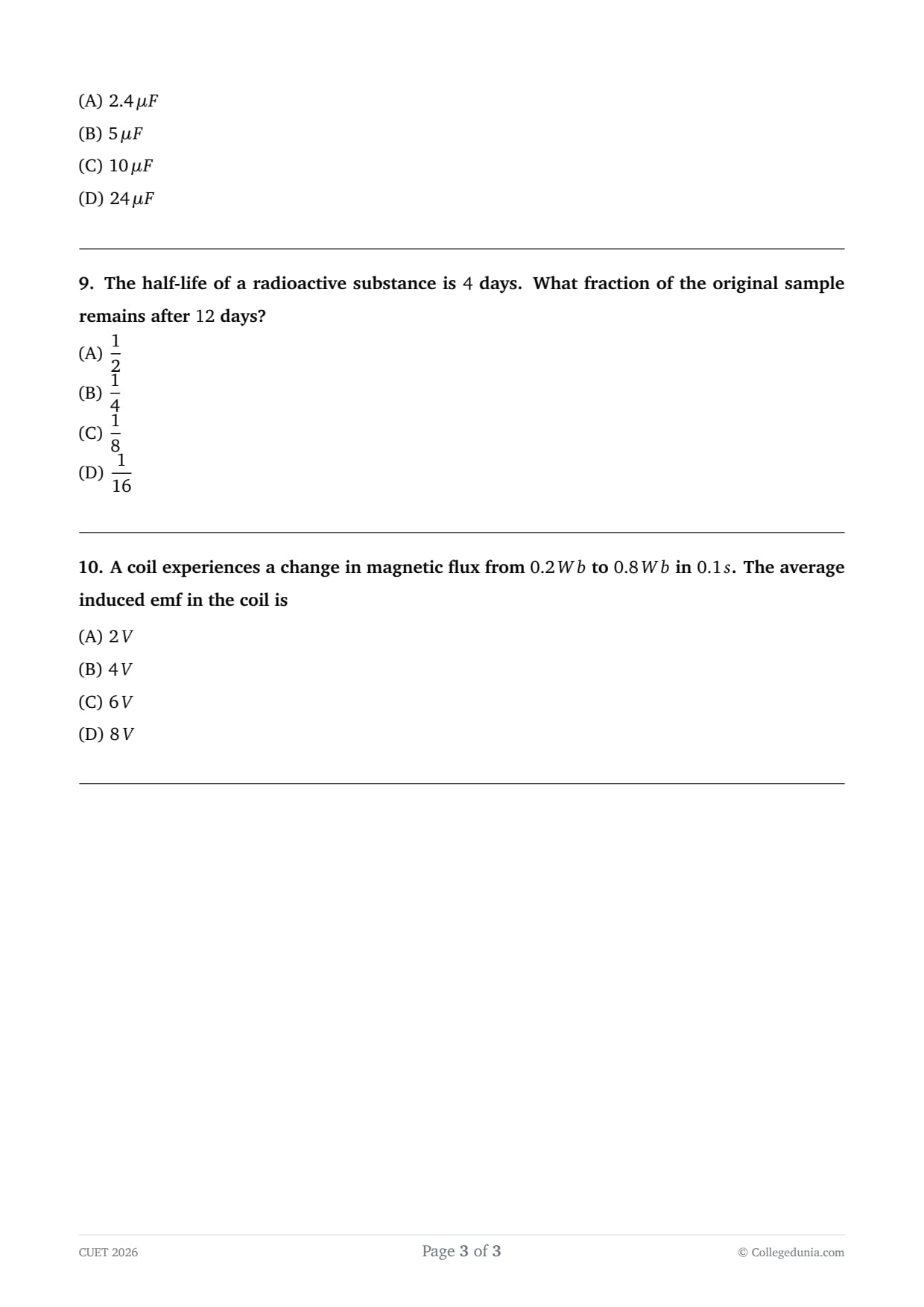
Two capacitors of capacitances \(4\,\mu F\) and \(6\,\mu F\) are connected in parallel. The equivalent capacitance is
View Solution
Concept:
For capacitors connected in parallel,
\[ C_{eq}=C_1+C_2 \]
Step 1: Write the given values.
\[ C_1=4\,\mu F \]
\[ C_2=6\,\mu F \]
Step 2: Calculate equivalent capacitance.
\[ C_{eq}=4+6 \]
\[ C_{eq}=10\,\mu F \]
Therefore,
\[ \boxed{C_{eq}=10\,\mu F} \]
\[ \boxed{Answer = (C)} \] Quick Tip: Capacitances add directly in parallel and decrease in series combination.
The half-life of a radioactive substance is \(4\) days. What fraction of the original sample remains after \(12\) days?
View Solution
Concept:
Radioactive decay law:
\[ N=N_0\left(\frac12\right)^n \]
where
\[ n=\frac{t}{T_{1/2}} \]
Step 1: Calculate the number of half-lives elapsed.
\[ n=\frac{12}{4} \]
\[ n=3 \]
Step 2: Find the remaining fraction.
\[ \frac{N}{N_0} = \left(\frac12\right)^3 \]
\[ = \frac18 \]
Therefore,
\[ \boxed{\frac{N}{N_0}=\frac18} \]
\[ \boxed{Answer = (C)} \] Quick Tip: After every half-life, the amount of radioactive substance becomes half of its previous value.
A coil experiences a change in magnetic flux from \(0.2\,Wb\) to \(0.8\,Wb\) in \(0.1\,s\). The average induced emf in the coil is
View Solution
Concept:
According to Faraday's Law,
\[ e= \left| \frac{\Delta\phi}{\Delta t} \right| \]
where
\[ \Delta\phi=Change in Magnetic Flux \]
\[ \Delta t=Time Interval \]
Step 1: Calculate the change in magnetic flux.
\[ \Delta\phi = 0.8-0.2 \]
\[ \Delta\phi=0.6\,Wb \]
Step 2: Apply Faraday's law.
\[ e = \frac{0.6}{0.1} \]
\[ e=6\,V \]
Therefore,
\[ \boxed{e=6\,V} \]
\[ \boxed{Answer = (C)} \] Quick Tip: Induced emf depends on the rate of change of magnetic flux, not on the flux alone.
CUET UG 2026 Exam Pattern
| Parameter | Details |
|---|---|
| Exam Name | Common University Entrance Test (CUET UG) 2026 |
| Conducting Body | National Testing Agency (NTA) |
| Exam Mode | Computer-Based Test (CBT) |
| Exam Duration | 60 minutes per test |
| Total Sections | 3 (Languages, Domain Subjects, General Test) |
| Question Type | Multiple Choice Questions (MCQs) |
| Questions per Test | 50 questions (all compulsory) |
| Marking Scheme | +5 for correct, -1 for incorrect |
| Maximum Marks | 250 marks per test |
| Maximum Subject Choices | 5 subjects in total |
| Syllabus Base | Class 12 NCERT (mainly for Domain Subjects) |



Comments