


CUET 2026 June 6 Shift 1 Economics Question Paper is available for download here. NTA conducted the CUET 2026 exam from 11th May to 31st May.
- CUET 2026 Economics exam consists of 50 questions for 250 marks to be attempted in 60 minutes.
- As per the marking scheme, 5 marks are awarded for each correct answer, and 1 mark is deducted for incorrect answer.
Candidates can download CUET 2026 June 6 Shift 1 Economics Question Paper with Answer Key and Solution PDF from links provided below.
Related Links:
- CUET 2026 June 6 Shift 1 Economics Answer Key
- CUET UG 2026 Economics Marks vs Expected Percentile and Colleges
CUET 2026 Economics June 6 Shift 1 Question Paper with Solution PDF
| CUET June 6 Shift 1 Economics Question Paper 2026 | Download PDF | Check Solutions |
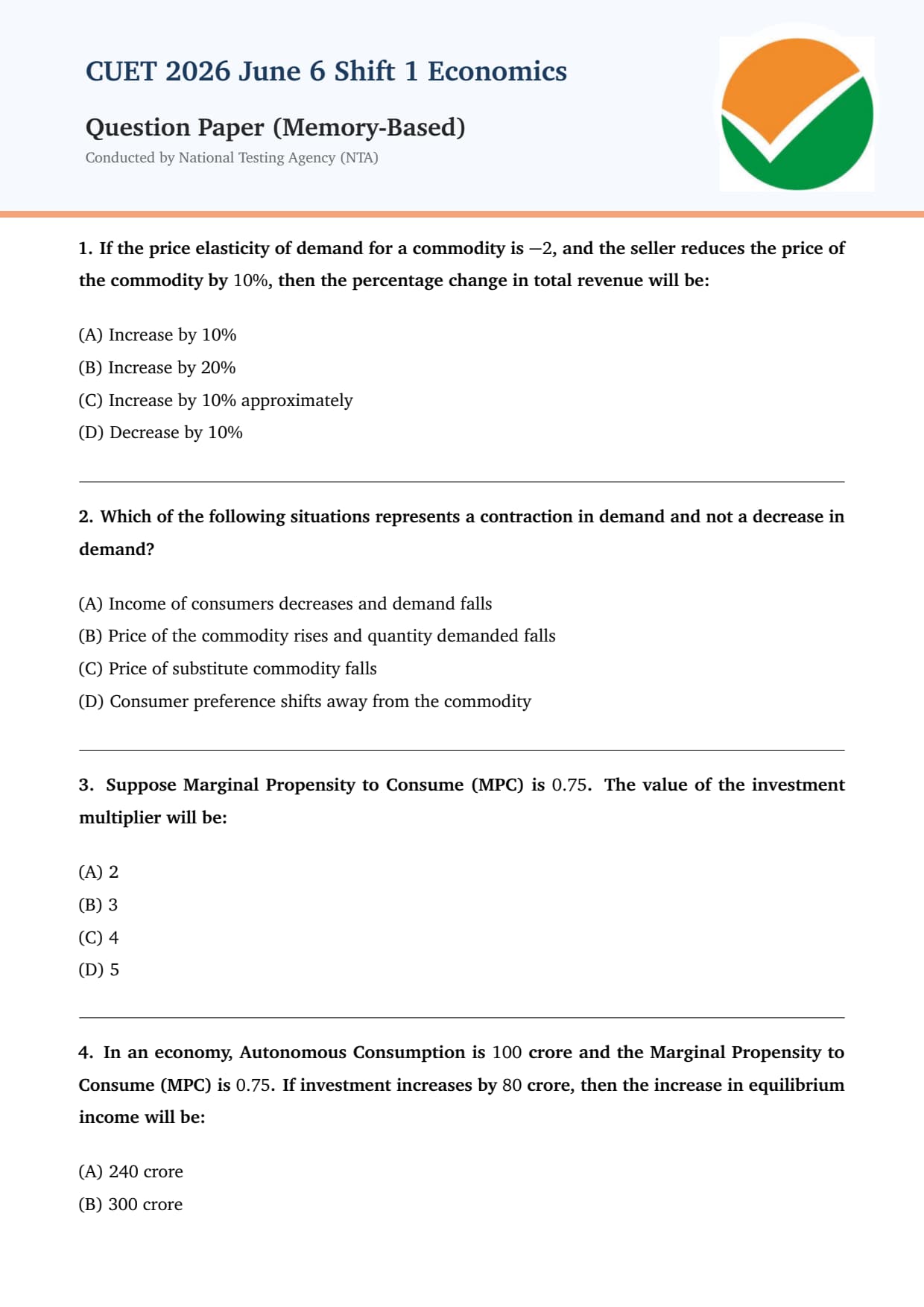


If the price elasticity of demand for a commodity is \(-2\), and the seller reduces the price of the commodity by \(10%\), then the percentage change in total revenue will be:
View Solution
Concept:
Price Elasticity of Demand measures the responsiveness of quantity demanded to a change in price.
\[ E_d=\frac{%\Delta Q_d}{%\Delta P} \]
When demand is elastic \((|E_d|>1)\), a fall in price causes proportionately larger increase in quantity demanded, leading to an increase in total revenue.
Step 1: Use the elasticity formula.
Given:
\[ E_d=-2 \]
Price falls by:
\[ 10% \]
Therefore,
\[ %\Delta Q_d=E_d \times %\Delta P \]
\[ =(-2)\times(-10%) \]
\[ =20% \]
Thus quantity demanded increases by \(20%\).
Step 2: Assume initial values for easy calculation.
Let:
\[ P=100,\quad Q=100 \]
Initial Revenue:
\[ TR=100\times100=10000 \]
Step 3: Calculate new revenue.
New Price:
\[ 90 \]
New Quantity:
\[ 120 \]
New Revenue:
\[ TR=90\times120 \]
\[ =10800 \]
Step 4: Calculate percentage change in revenue.
\[ %\Delta TR=\frac{10800-10000}{10000}\times100 \]
\[ =8% \]
Approximately, revenue rises by around \(10%\).
Hence option (C) is the closest answer. Quick Tip: If demand is elastic \((E_d>1)\), price and total revenue move in opposite directions.
Which of the following situations represents a contraction in demand and not a decrease in demand?
View Solution
Concept:
Students often confuse contraction in demand with decrease in demand.
Contraction in demand occurs due to a rise in the commodity's own price.
Decrease in demand occurs due to changes in factors other than price.
Step 1: Analyze Option (A).
Income falls.
Demand curve shifts left.
This is decrease in demand.
Step 2: Analyze Option (B).
Price rises.
Movement occurs upward along the same demand curve.
This is contraction in demand.
Step 3: Analyze Option (C).
Price of substitute falls.
Consumers switch products.
Demand decreases.
Step 4: Analyze Option (D).
Preference changes negatively.
Demand decreases.
Thus only Option (B) represents contraction in demand.
Hence Option (B) is correct. Quick Tip: Price change causes movement on the same demand curve. Non-price factors shift the entire demand curve.
Suppose Marginal Propensity to Consume (MPC) is \(0.75\). The value of the investment multiplier will be:
View Solution
Concept:
The investment multiplier explains how a change in investment causes a multiple change in national income.
Formula:
\[ K=\frac{1}{1-MPC} \]
where
\[ K=Multiplier \]
\[ MPC=Marginal Propensity to Consume \]
Step 1: Substitute the value of MPC.
Given:
\[ MPC=0.75 \]
\[ K=\frac{1}{1-0.75} \]
\[ K=\frac{1}{0.25} \]
\[ K=4 \]
Step 2: Economic Interpretation.
This means that every additional ₹1 invested in the economy generates ₹4 increase in national income.
For example:
\[ \Delta I=100 \]
then
\[ \Delta Y=400 \]
Step 3: Select the correct option.
\[ K=4 \]
Hence Option (C) is correct. Quick Tip: The higher the MPC, the larger the multiplier. If MPC approaches 1, the multiplier becomes very large.
In an economy, Autonomous Consumption is \(100\) crore and the Marginal Propensity to Consume (MPC) is \(0.75\). If investment increases by \(80\) crore, then the increase in equilibrium income will be:
View Solution
Concept:
According to Keynesian Income Determination Theory, a change in autonomous expenditure causes a multiplied change in equilibrium income. The size of this multiplied effect is measured through the Investment Multiplier.
The multiplier is given by:
\[ k=\frac{1}{1-MPC} \]
and
\[ \Delta Y=k\times \Delta I \]
where:
\(k\) = Investment Multiplier
\(MPC\) = Marginal Propensity to Consume
\(\Delta I\) = Change in Investment
\(\Delta Y\) = Change in Equilibrium Income
Step 1: Calculate the value of Multiplier.
Given:
\[ MPC=0.75 \]
Therefore,
\[ k=\frac{1}{1-0.75} \]
\[ k=\frac{1}{0.25} \]
\[ k=4 \]
This means every additional rupee of investment generates four rupees of income in the economy.
Step 2: Calculate change in equilibrium income.
Increase in investment:
\[ \Delta I=80 crore \]
Applying multiplier formula:
\[ \Delta Y=k\times \Delta I \]
\[ \Delta Y=4\times80 \]
\[ \Delta Y=320 crore \]
Step 3: Interpret the result.
An increase of \(80\) crore in investment initiates multiple rounds of spending and income generation. As a result, the final increase in national income becomes four times the initial increase in investment.
Hence,
\[ \boxed{\Delta Y=320 crore} \]
Therefore, option (C) is correct. Quick Tip: For CUET questions on multiplier: \[ k=\frac{1}{1-MPC} \] \[ \Delta Y=k\Delta I \] Higher MPC \(\Rightarrow\) Higher Multiplier \(\Rightarrow\) Larger increase in National Income.
A consumer spends his entire income on goods \(X\) and \(Y\). The price of \(X\) is \(₹20\) per unit and the price of \(Y\) is \(₹10\) per unit. If his income is \(₹400\), which of the following combinations lies on his budget line?
View Solution
Concept:
A budget line represents all possible combinations of two goods that can be purchased with a given income at given prices.
The budget equation is:
\[ P_X X + P_Y Y=M \]
where:
\(P_X\) = Price of Good \(X\)
\(P_Y\) = Price of Good \(Y\)
\(M\) = Income
Any combination satisfying the equation lies exactly on the budget line.
Step 1: Write the budget equation.
Given:
\[ P_X=20 \]
\[ P_Y=10 \]
\[ M=400 \]
Therefore,
\[ 20X+10Y=400 \]
Dividing by \(10\),
\[ 2X+Y=40 \]
Step 2: Check Option A.
\[ 2(5)+25=35 \]
\[ 35\neq40 \]
Hence, not on the budget line.
Step 3: Check Option B.
\[ 2(10)+20=40 \]
\[ 40=40 \]
Hence, this combination lies exactly on the budget line.
Step 4: Verify remaining options.
Option C:
\[ 2(15)+5=35 \]
Not equal to \(40\).
Option D:
\[ 2(8)+18=34 \]
Not equal to \(40\).
Only Option B satisfies the budget equation.
Therefore,
\[ \boxed{X=10,\;Y=20} \]
lies on the budget line. Quick Tip: To quickly identify a point on a budget line, substitute the values directly into: \[ P_X X + P_Y Y=M \] If LHS = RHS, the point lies on the budget line.
The Reserve Bank of India purchases government securities worth \(₹5,000\) crore from the open market. Assuming Cash Reserve Ratio remains unchanged, the immediate effect of this operation will be:
View Solution
Concept:
Open Market Operations (OMO) are an important quantitative monetary policy instrument used by the Reserve Bank of India to regulate money supply and liquidity in the economy.
The RBI can:
Purchase government securities.
Sell government securities.
When RBI purchases securities, it injects money into the banking system.
When RBI sells securities, it withdraws money from the banking system.
Step 1: Understand the given situation.
RBI purchases government securities worth:
\[ ₹5,000 crore \]
The sellers of these securities receive money from RBI.
Thus,
\[ Money flows from RBI to the public/banks \]
Step 2: Analyze impact on banking system.
As money enters banks:
Bank reserves increase.
Lending capacity increases.
Credit creation increases.
Market liquidity increases.
Step 3: Analyze effect on money supply.
Higher reserves allow banks to create additional deposits through the process of credit creation.
Therefore,
\[ Money Supply \uparrow \]
and
\[ Liquidity \uparrow \]
Step 4: Evaluate options.
Option A: Opposite effect.
Option B: Correct.
Option C: CRR is unchanged.
Option D: Deposits tend to increase rather than decrease.
Hence the correct answer is:
\[ \boxed{Increase in liquidity and money supply} \] Quick Tip: Remember: RBI buys securities \(\Rightarrow\) Money enters economy \(\Rightarrow\) Liquidity increases. RBI sells securities \(\Rightarrow\) Money leaves economy \(\Rightarrow\) Liquidity decreases.
The following information relates to an economy (in ₹ crore):
\[ \begin{aligned} &Private Final Consumption Expenditure = 8,000 \\
&Government Final Consumption Expenditure = 2,000 \\
&Gross Domestic Capital Formation = 3,000 \\
&Net Exports = -500 \end{aligned} \]
Calculate the GDP at Market Price using the Expenditure Method.
View Solution
Concept:
Under the Expenditure Method, Gross Domestic Product at Market Price is calculated as the sum of expenditure incurred on final goods and services produced within the domestic territory during an accounting year.
The formula is:
\[ GDP_{MP}=C+I+G+(X-M) \]
where:
\(C\) = Private Final Consumption Expenditure
\(I\) = Gross Domestic Capital Formation
\(G\) = Government Final Consumption Expenditure
\(X-M\) = Net Exports
This method measures aggregate demand in the economy.
Step 1: Write the given values.
\[ C=8000 \]
\[ I=3000 \]
\[ G=2000 \]
\[ (X-M)=-500 \]
Step 2: Substitute into the GDP formula.
\[ GDP_{MP}=8000+3000+2000+(-500) \]
\[ GDP_{MP}=13000-500 \]
\[ GDP_{MP}=12500 \]
Step 3: Economic interpretation.
The economy generated total final expenditure worth ₹13,000 crore, but because imports exceeded exports by ₹500 crore, net exports became negative.
Therefore,
\[ GDP_{MP}=₹12,500 crore \]
Hence, option (B) is correct. Quick Tip: Always remember: \[ GDP_{MP}=C+I+G+(X-M) \] If imports exceed exports, Net Exports become negative and reduce GDP.
In a perfectly competitive market, a firm's Total Revenue and Total Cost functions are:
\[ TR = 120Q \]
\[ TC = 200 + 40Q + Q^2 \]
The profit-maximizing output level is:
View Solution
Concept:
A competitive firm maximizes profit at the output level where:
\[ MR = MC \]
and
\[ MC is rising \]
Since firms in perfect competition are price takers:
\[ MR = AR = Price \]
Step 1: Find Marginal Revenue.
Given:
\[ TR=120Q \]
Differentiate with respect to \(Q\):
\[ MR=\frac{d(TR)}{dQ} \]
\[ MR=120 \]
Step 2: Find Marginal Cost.
Given:
\[ TC=200+40Q+Q^2 \]
Differentiate:
\[ MC=\frac{d(TC)}{dQ} \]
\[ MC=40+2Q \]
Step 3: Apply profit maximization condition.
\[ MR=MC \]
\[ 120=40+2Q \]
\[ 80=2Q \]
\[ Q=40 \]
Step 4: Verify second condition.
\[ MC=40+2Q \]
Since coefficient of \(Q\) is positive, MC is rising.
Therefore the condition for profit maximization is satisfied.
Hence,
\[ \boxed{Q=40} \]
Thus option (C) is correct. Quick Tip: For Perfect Competition: \[ MR = AR = Price \] Profit maximization occurs at: \[ MR = MC \] with a rising MC curve.
The price elasticity of demand for a commodity is \(-1.5\). If its price increases by \(10%\), then the approximate percentage change in quantity demanded will be:
View Solution
Concept:
Price Elasticity of Demand measures the responsiveness of quantity demanded to a change in price.
The formula is:
\[ E_d= \frac{%\Delta Q}{%\Delta P} \]
For most goods, elasticity is negative because price and quantity demanded move in opposite directions.
Step 1: Write the given information.
\[ E_d=-1.5 \]
\[ %\Delta P=+10% \]
Step 2: Apply elasticity formula.
\[ -1.5= \frac{%\Delta Q}{10} \]
Multiplying both sides by \(10\):
\[ %\Delta Q=-15% \]
Step 3: Interpret the sign.
The negative sign indicates an inverse relationship.
Hence quantity demanded falls by \(15%\).
Therefore,
Decrease by 15%
Option (C) is correct. Quick Tip: For quick CUET calculations: \[ %\Delta Q = E_d \times %\Delta P \] Always interpret the sign carefully. A negative sign indicates a fall in quantity demanded when price rises.
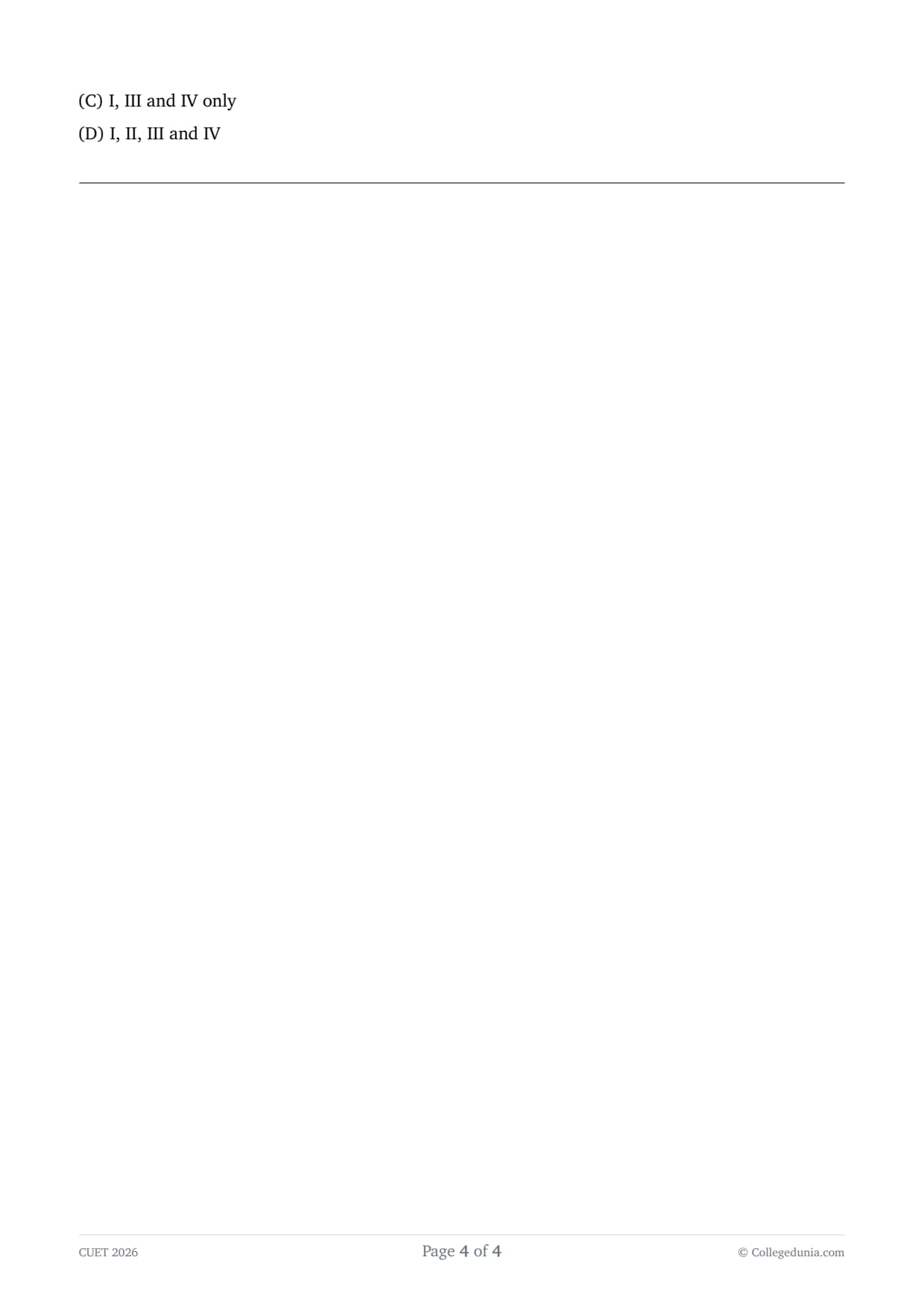
Read the following statements carefully:
I. Every increase in investment necessarily increases Aggregate Demand.
II. Ex-ante savings are always equal to Ex-post savings.
III. Ex-ante investment and Ex-ante savings may differ.
IV. Equilibrium income is determined at the point where Aggregate Demand equals Aggregate Supply.
Choose the correct answer.
View Solution
Concept:
Macroeconomic equilibrium involves interactions among aggregate demand, aggregate supply, savings, and investment.
A clear distinction must be made between:
Ex-ante (planned)
Ex-post (actual)
values.
Step 1: Examine Statement I.
Investment is a component of Aggregate Demand.
\[ AD=C+I+G+(X-M) \]
An increase in investment directly increases Aggregate Demand.
Hence Statement I is correct.
Step 2: Examine Statement II.
Actual savings and actual investment are always equal in national income accounting.
Therefore Ex-post savings are always equal to Ex-post investment.
Hence Statement II is correct.
Step 3: Examine Statement III.
Planned savings and planned investment are determined independently.
Therefore:
\[ S_{ex-ante} \neq I_{ex-ante} \]
in general.
Hence Statement III is correct.
Step 4: Examine Statement IV.
National income equilibrium occurs when:
\[ AD=AS \]
At this point firms have no incentive to change output.
Hence Statement IV is correct.
Step 5: Final conclusion.
All four statements are correct.
Therefore the correct answer is:
\[ \boxed{I, II, III and IV} \]
Option (D) is correct. Quick Tip: Remember: \[ Ex-post Savings=Ex-post Investment \] always. However, \[ Ex-ante Savings \neq Ex-ante Investment \] in general.
CUET UG 2026 Exam Pattern
| Parameter | Details |
|---|---|
| Exam Name | Common University Entrance Test (CUET UG) 2026 |
| Conducting Body | National Testing Agency (NTA) |
| Exam Mode | Computer-Based Test (CBT) |
| Exam Duration | 60 minutes per test |
| Total Sections | 3 (Languages, Domain Subjects, General Test) |
| Question Type | Multiple Choice Questions (MCQs) |
| Questions per Test | 50 questions (all compulsory) |
| Marking Scheme | +5 for correct, -1 for incorrect |
| Maximum Marks | 250 marks per test |
| Maximum Subject Choices | 5 subjects in total |
| Syllabus Base | Class 12 NCERT (mainly for Domain Subjects) |



Comments