


CUET 2026 June 6 Shift 1 Business Studies Question Paper is available for download here. NTA is conducting the CUET 2026 exam from 11th May to 31st May and 6th June and 7th June.
- CUET 2026 Business Studies exam consists of 50 questions for 250 marks to be attempted in 60 minutes.
- As per the marking scheme, 5 marks are awarded for each correct answer, and 1 mark is deducted for incorrect answer.
Candidates can download CUET 2026 June 6 Shift 1 Business Studies Question Paper with Answer Key and Solution PDF from links provided below.
Related Links:
- CUET 2026 June 6 Shift 1 Business Studies Answer Key
- CUET UG 2026 Business Studies Marks vs Expected Percentile and Colleges
CUET 2026 Business Studies June 6 Shift 1 Question Paper with Solution PDF
| CUET June 6 Shift 1 Business Studies Question Paper 2026 | Download PDF | Check Solutions |
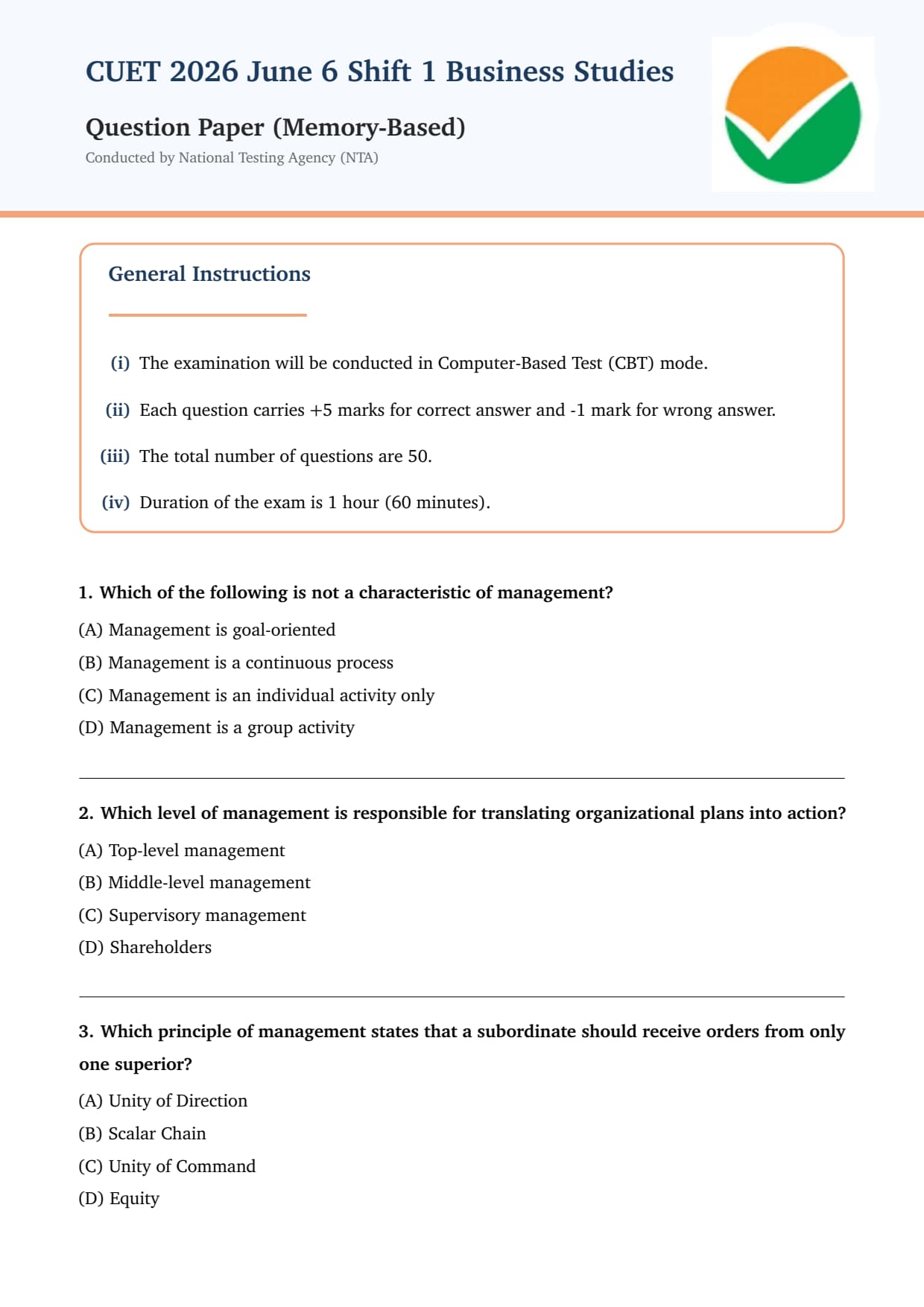


Which of the following is not a characteristic of management?
View Solution
Concept:
Management refers to the process of planning, organizing, staffing, directing and controlling the efforts of organizational members to achieve predetermined goals efficiently and effectively.
Step 1: Recall the characteristics of management.
The major characteristics of management are:
Goal-oriented process
Pervasive in nature
Continuous process
Group activity
Dynamic function
Intangible force
Step 2: Analyze the given options.
Options (A), (B), and (D) are characteristics of management.
However, management is not an individual activity. It involves coordinating the efforts of a group of people.
Therefore,
\[ \boxed{Management is not an individual activity only} \]
\[ \boxed{Answer = (C)} \] Quick Tip: Management always involves getting work done through and with people. Hence, it is a group activity.
Which level of management is responsible for translating organizational plans into action?
View Solution
Concept:
Organizations generally have three levels of management:
Top-level Management
Middle-level Management
Supervisory/Operational Management
Step 1: Understand the role of top-level management.
Top-level managers formulate policies and long-term objectives.
Step 2: Understand the role of middle-level management.
Middle-level managers interpret policies framed by top management and ensure their implementation through lower-level managers.
Step 3: Identify the correct answer.
Since middle-level managers convert plans into operational activities,
\[ \boxed{Middle-level management} \]
\[ \boxed{Answer = (B)} \] Quick Tip: Top level decides "What to do", middle level decides "How to do", and lower level ensures "Doing the work".
Which principle of management states that a subordinate should receive orders from only one superior?
View Solution
Concept:
Henri Fayol proposed 14 principles of management.
Step 1: Understand Unity of Command.
The principle of Unity of Command states that an employee should receive instructions from only one superior.
This avoids:
Confusion
Conflict
Dual reporting
Lack of accountability
Step 2: Differentiate from Unity of Direction.
Unity of Direction means one head and one plan for activities having the same objective.
Step 3: Select the correct principle.
\[ \boxed{Unity of Command} \]
\[ \boxed{Answer = (C)} \] Quick Tip: Remember: Unity of Command = One Boss Unity of Direction = One Plan
Which of the following is a financial incentive provided to employees?
View Solution
Concept:
Incentives motivate employees to perform better.
They are broadly classified into:
Financial Incentives
Non-Financial Incentives
Step 1: Identify financial incentives.
Examples include:
Bonus
Profit Sharing
Commission
Productivity-linked wage incentives
Step 2: Identify non-financial incentives.
Examples include:
Promotion
Recognition
Job Security
Participation in decision making
Step 3: Choose the correct option.
Among the given options, only Bonus is a financial incentive.
\[ \boxed{Bonus} \]
\[ \boxed{Answer = (C)} \] Quick Tip: Financial incentives are directly measurable in monetary terms.
Planning provides directions for action and reduces uncertainty. This highlights which importance of planning?
View Solution
Concept:
Planning is deciding in advance what to do, how to do, when to do and who will do it.
Step 1: Understand the role of planning.
Planning enables managers to anticipate future events and prepare strategies accordingly.
Step 2: Analyze the statement.
The statement mentions:
Provides direction
Anticipates future conditions
Minimizes uncertainty
These directly indicate that planning reduces uncertainty.
Step 3: Select the correct option.
\[ \boxed{Reduces the Risk of Uncertainty} \]
\[ \boxed{Answer = (C)} \] Quick Tip: Planning cannot eliminate uncertainty completely, but it can significantly reduce its impact.
Which type of plan is formulated for activities that occur repeatedly over a long period of time?
View Solution
Concept:
Plans are broadly classified into:
Standing Plans
Single-use Plans
Step 1: Understand Standing Plans.
Standing plans are prepared for activities that occur repeatedly in an organization.
Examples:
Policies
Procedures
Methods
Rules
These plans remain in use for a long period and guide routine decisions.
Step 2: Understand Single-use Plans.
Single-use plans are developed for one specific objective and cease to exist after achieving that objective.
Examples:
Budgets
Programmes
Projects
Step 3: Identify the correct option.
Since the question refers to activities that occur repeatedly,
\[ \boxed{Standing Plan} \]
\[ \boxed{Answer = (D)} \] Quick Tip: Repeated Activity = Standing Plan One-Time Activity = Single-use Plan
The process of assigning duties, grouping tasks and establishing authority relationships among employees is known as
View Solution
Concept:
Organising is the process of identifying and grouping work, assigning duties and establishing authority-responsibility relationships.
Step 1: Understand the meaning of organising.
Organising involves:
Identification of activities
Departmentalisation
Assignment of duties
Establishment of reporting relationships
Step 2: Differentiate from other functions.
Staffing = Recruitment and selection of employees
Directing = Guiding and motivating employees
Controlling = Comparing actual performance with standards
Step 3: Select the correct answer.
The activity described in the question is organising.
\[ \boxed{Organising} \]
\[ \boxed{Answer = (B)} \] Quick Tip: Organising creates a structure that defines who will do what and who will report to whom.
Which of the following is the first step in the staffing process?
View Solution
Concept:
Staffing refers to the managerial function of filling and maintaining positions in the organizational structure.
Step 1: Recall the staffing process.
The major steps are:
Estimating Manpower Requirements
Recruitment
Selection
Placement and Orientation
Training and Development
Performance Appraisal
Step 2: Identify the first step.
Before recruiting employees, managers must determine:
Number of employees required
Type of employees required
Skills required
This is known as estimating manpower requirements.
Therefore,
\[ \boxed{Estimating Manpower Requirements} \]
\[ \boxed{Answer = (D)} \] Quick Tip: No recruitment can begin unless manpower requirements are first estimated.
The element of directing that seeks to influence the behaviour of employees to achieve organizational objectives is called
View Solution
Concept:
Motivation is the process of stimulating people to take desired actions to achieve organizational goals.
Step 1: Understand motivation.
Motivation creates willingness among employees to perform their tasks efficiently.
It helps in:
Improving performance
Increasing productivity
Enhancing morale
Achieving organizational objectives
Step 2: Differentiate from other elements.
Communication = Exchange of information
Supervision = Monitoring subordinates
Delegation = Transfer of authority
Step 3: Identify the correct option.
The element that influences employee behaviour is motivation.
\[ \boxed{Motivation} \]
\[ \boxed{Answer = (C)} \] Quick Tip: Motivation answers the question: "Why will employees work enthusiastically?"
In the controlling process, comparing actual performance with predetermined standards is known as
View Solution
Concept:
Controlling is the process of ensuring that actual performance conforms to planned performance.
Step 1: Recall the steps in controlling.
Setting Performance Standards
Measurement of Actual Performance
Comparison of Actual Performance with Standards
Analysis of Deviations
Taking Corrective Action
Step 2: Understand comparison and deviation analysis.
After actual performance is measured, it is compared with standards.
The difference between the two is called deviation.
Managers then analyze the causes and extent of these deviations.
Step 3: Identify the correct answer.
The process associated with comparing actual performance and identifying differences is analysis of deviations.
\[ \boxed{Analysis of Deviations} \]
\[ \boxed{Answer = (C)} \] Quick Tip: Controlling is effective only when deviations are identified and corrective actions are taken promptly.
CUET UG 2026 Exam Pattern
| Parameter | Details |
|---|---|
| Exam Name | Common University Entrance Test (CUET UG) 2026 |
| Conducting Body | National Testing Agency (NTA) |
| Exam Mode | Computer-Based Test (CBT) |
| Exam Duration | 60 minutes per test |
| Total Sections | 3 (Languages, Domain Subjects, General Test) |
| Question Type | Multiple Choice Questions (MCQs) |
| Questions per Test | 50 questions (all compulsory) |
| Marking Scheme | +5 for correct, -1 for incorrect |
| Maximum Marks | 250 marks per test |
| Maximum Subject Choices | 5 subjects in total |
| Syllabus Base | Class 12 NCERT (mainly for Domain Subjects) |



Comments