


CUET 2026 June 6 Shift 1 Biology Question Paper is available for download here. NTA is conducting the CUET 2026 exam from 11th May to 31st May and June 6 to June 7.
- CUET 2026 Biology exam consists of 50 questions for 250 marks to be attempted in 60 minutes.
- As per the marking scheme, 5 marks are awarded for each correct answer, and 1 mark is deducted for incorrect answer.
Candidates can download CUET 2026 June 6 Shift 1 Biology Question Paper with Answer Key and Solution PDF from links provided below.
Related Links:
CUET 2026 Biology June 6 Shift 1 Question Paper with Solution PDF
| CUET 6 June Shift 1 Biology Question Paper 2026 | Download PDF | Check Solutions |


Match List - I with List - II. Choose the correct answer from the options given below:
List I List II
P. Ribosome (i) Translation
Q. Histone (ii) Nucleosome
R. DNA polymerase (iii) Replication
S. RNA polymerase (iv) Transcription
View Solution
Concept:
Molecular biology processes are based on central dogma where DNA replication, transcription and translation are carried out by specific enzymes and structures.
Step 1: Identify function of ribosome.
Ribosome is the site of protein synthesis where mRNA is translated into amino acid sequence, hence it performs translation.
Step 2: Identify histone function.
Histones are basic proteins around which DNA is wrapped forming nucleosomes, which are structural units of chromatin.
Step 3: Identify DNA polymerase function.
DNA polymerase is responsible for DNA replication during cell division.
Step 4: Identify RNA polymerase function.
RNA polymerase synthesizes RNA from DNA template during transcription.
\[ P-(iii),\ Q-(iv),\ R-(i),\ S-(ii) \] Quick Tip: Ribosome = Translation, DNA polymerase = Replication, RNA polymerase = Transcription, Histone = Nucleosome formation.
Identify the statements true for RNA.
(i) RNA acts as a genetic material for some viruses.
(ii) RNA also functions as an adapter molecule.
(iii) RNA has hexose sugar as its backbone.
(iv) RNA also acts as catalyst in some cases.
View Solution
Concept:
RNA (Ribonucleic Acid) is a versatile biomolecule that plays multiple roles in living organisms. It is involved in genetic information transfer, protein synthesis, and regulation of biological reactions. Unlike DNA, RNA is usually single-stranded and contains ribose sugar.
Step 1: Evaluate statement (i).
RNA acts as genetic material in certain viruses such as retroviruses (e.g., HIV). In these organisms, RNA carries hereditary information instead of DNA. Therefore, statement (i) is correct.
Step 2: Evaluate statement (ii).
During translation, transfer RNA (tRNA) functions as an adapter molecule. It carries specific amino acids to the ribosome and matches anticodons with codons on mRNA. Hence, statement (ii) is correct.
Step 3: Evaluate statement (iii).
RNA contains ribose sugar, which is a pentose sugar, not hexose. Hexose sugars contain six carbon atoms and are not part of RNA structure. Hence, statement (iii) is incorrect.
Step 4: Evaluate statement (iv).
Certain RNA molecules called ribozymes exhibit catalytic activity and function like enzymes. For example, rRNA in ribosomes has catalytic roles in peptide bond formation. Hence, statement (iv) is correct.
Final Conclusion:
Statements (i), (ii), and (iv) are correct.
Quick Tip: RNA is unique because it can store information, act as an adapter, and also function as a catalyst.
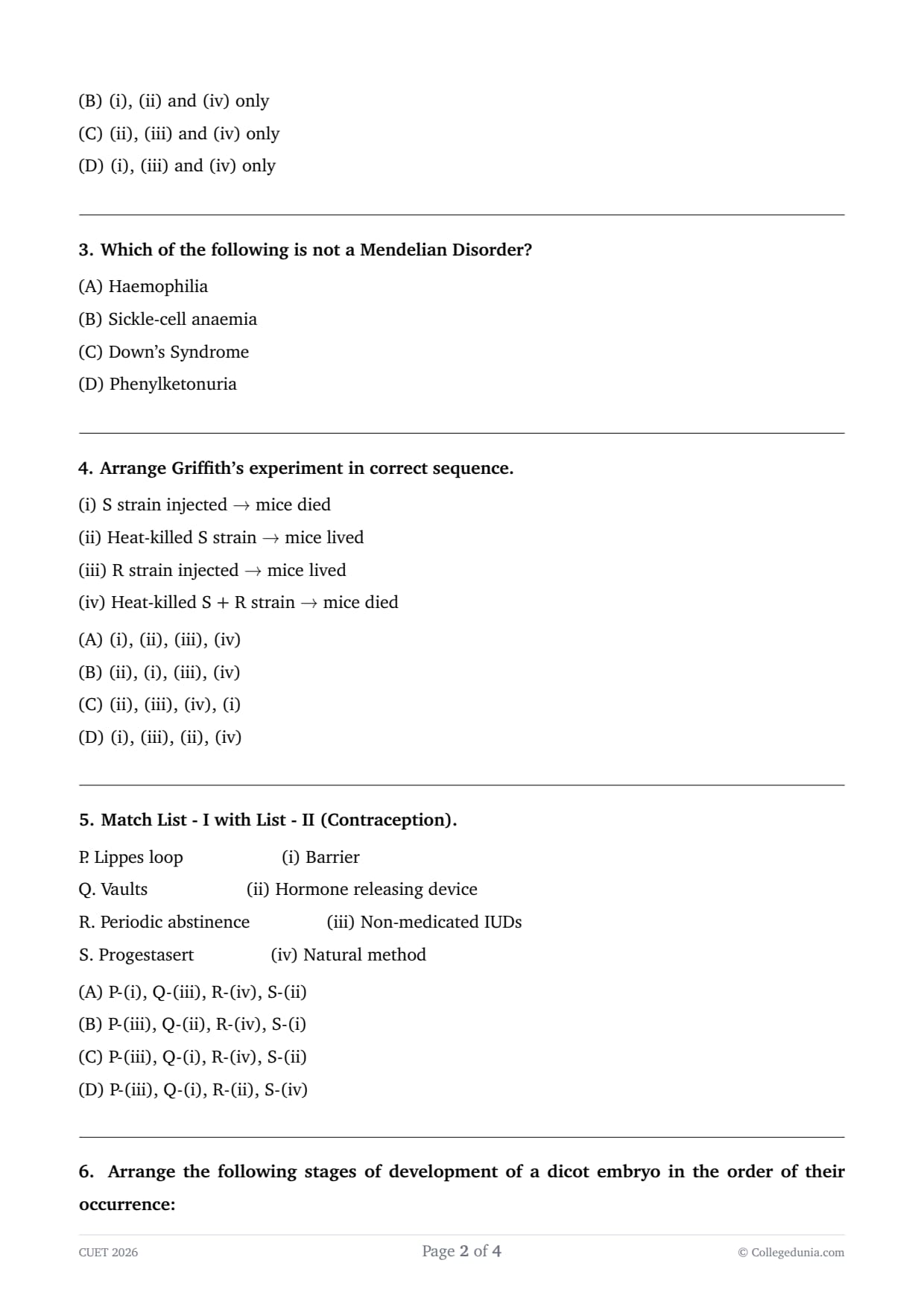
Which of the following is not a Mendelian Disorder?
View Solution
Concept:
Mendelian disorders arise due to mutations in a single gene and follow Mendel’s laws of inheritance. They may be autosomal dominant, autosomal recessive, or sex-linked disorders.
Step 1: Analyze haemophilia.
Haemophilia is a sex-linked recessive disorder caused by mutation in genes responsible for blood clotting factors. It follows Mendelian inheritance, so it is a Mendelian disorder.
Step 2: Analyze sickle-cell anaemia.
This disorder is caused by a point mutation in the beta-globin gene, leading to abnormal hemoglobin structure. It is autosomal recessive and therefore Mendelian.
Step 3: Analyze phenylketonuria.
Phenylketonuria is caused by mutation in a gene encoding phenylalanine hydroxylase enzyme. It follows autosomal recessive inheritance and is Mendelian.
Step 4: Analyze Down’s syndrome.
Down’s syndrome is caused by trisomy of chromosome 21, which is a chromosomal abnormality due to nondisjunction. It is not caused by a single gene mutation, hence not Mendelian.
Final Conclusion:
Down’s syndrome is not a Mendelian disorder. Quick Tip: Mendelian disorders involve single gene mutations, while Down’s syndrome is a chromosomal disorder.
Arrange Griffith’s experiment in correct sequence.
(i) S strain injected → mice died
(ii) Heat-killed S strain → mice lived
(iii) R strain injected → mice lived
(iv) Heat-killed S + R strain → mice died
View Solution
Concept:
Griffith’s experiment (1928) demonstrated bacterial transformation in Streptococcus pneumoniae. He used two strains: virulent S strain (smooth, capsule present) and non-virulent R strain (rough, no capsule).
Step 1: Study R strain behavior.
R strain lacks a polysaccharide capsule, so it is easily destroyed by host immune system. Therefore, mice injected with R strain survive.
Step 2: Study S strain behavior.
S strain has a protective capsule making it virulent. It causes pneumonia and kills mice.
Step 3: Heat-killed S strain experiment.
Heating kills S bacteria, removing virulence, so mice survive.
Step 4: Mixture experiment (key discovery).
When heat-killed S strain is mixed with live R strain, genetic material from dead S strain transforms R strain into virulent form, leading to death of mice. This proves transformation.
Final Conclusion:
Correct sequence is (i), (iii), (ii), (iv). Quick Tip: Griffith proved that genetic material can transfer between bacteria through transformation.
Match List - I with List - II (Contraception).
P. Lippes loop (iii) Non-medicated IUDs
Q. Vaults (i) Barrier
R. Periodic abstinence (iv) Natural method
S. Progestasert (ii) Hormone releasing device
View Solution
Concept:
Contraceptive methods are classified into natural, barrier, intrauterine devices (IUDs), and hormonal methods. Each method works through a different biological mechanism to prevent fertilization or implantation.
Step 1: Understand Lippes loop.
Lippes loop is a non-medicated intrauterine device that prevents implantation by creating a foreign body reaction in the uterus.
Step 2: Understand Vaults.
Vaults are barrier contraceptive devices that physically prevent sperm from entering the female reproductive tract.
Step 3: Understand periodic abstinence.
This is a natural method where intercourse is avoided during the fertile period of the menstrual cycle to prevent fertilization.
Step 4: Understand Progestasert.
Progestasert is a hormone-releasing IUD that releases progesterone to prevent ovulation and implantation.
Final Conclusion:
Correct matching is P-(iii), Q-(i), R-(iv), S-(ii). Quick Tip: Contraceptives are classified as natural, barrier, IUD, and hormonal methods based on mechanism.
Arrange the following stages of development of a dicot embryo in the order of their occurrence:
(i) Formation of heart shaped embryo
(ii) Formation of typical dicot embryo
(iii) Formation of zygote
(iv) Formation of globular embryo
View Solution
Concept:
Embryogenesis in angiosperms is a highly coordinated developmental process that begins after fertilization and results in the formation of a mature embryo capable of developing into a complete plant. In dicot plants, this process follows a fixed morphological sequence involving distinct structural stages. Each stage reflects increasing cellular differentiation, polarity establishment, and organ formation.
The development is not random but follows a genetically programmed sequence controlled by differential gene expression, hormone regulation (especially auxins and cytokinins), and cell division patterns.
Step 1: Using fertilization to define the starting point of embryogenesis.
The process begins when the male gamete fuses with the egg cell inside the embryo sac, forming a diploid zygote. This zygote is a single cell but contains the complete genetic blueprint required for the development of a multicellular organism. It marks the transition from gametophytic to sporophytic generation.
The zygote undergoes repeated mitotic divisions and establishes polarity (apical-basal axis), which is essential for later differentiation.
Step 2: Using early mitotic divisions to explain globular embryo formation.
After several rounds of cell division, the zygote develops into a globular embryo. This stage is characterized by a spherical structure with rapidly dividing cells.
At this stage:
- Basic tissue differentiation begins
- Primary meristematic regions start to appear
- Cell fate begins to be determined
However, organ differentiation is still absent, making this a fundamental early embryonic stage.
Step 3: Using cotyledon initiation to explain heart-shaped embryo stage.
In dicot plants, the formation of two cotyledon primordia is a key developmental event. As these cotyledons begin to grow laterally, the embryo takes on a heart-shaped appearance.
This stage is biologically significant because:
- It marks the first visible organ differentiation
- Embryonic polarity becomes clearly established
- Shoot and root axis formation becomes more defined
This is a transitional stage between undifferentiated and fully differentiated embryo.
Step 4: Using maturation process to explain formation of typical dicot embryo.
The final stage involves extensive differentiation leading to the formation of a fully developed dicot embryo. The embryo now consists of:
- Two cotyledons
- Plumule (future shoot system)
- Radicle (future root system)
At this stage, the embryo becomes metabolically prepared for dormancy or germination depending on environmental conditions.
Final Conceptual Understanding:
Embryogenesis is a stepwise developmental cascade:
zygote → globular → heart-shaped → mature dicot embryo.
Each stage builds upon the previous one through controlled gene expression and hormonal regulation. Quick Tip: Embryo development is irreversible and strictly sequential; skipping stages is biologically impossible.
Ribozyme is:
View Solution
Concept:
The discovery of ribozymes revolutionized molecular biology because it challenged the long-standing “protein-only enzyme hypothesis.” Ribozymes are RNA molecules capable of catalyzing biochemical reactions without the involvement of proteins. This showed that RNA can act both as genetic material and as a catalyst, supporting the RNA world hypothesis of early life evolution.
Step 1: Using ribosome structure to understand catalytic RNA location.
Ribosomes are ribonucleoprotein complexes composed of rRNA and proteins. However, experimental evidence shows that proteins are not directly responsible for peptide bond formation. Instead, rRNA carries out the catalytic function.
In prokaryotic ribosomes:
- 30S small subunit → decoding
- 50S large subunit → catalysis
Step 2: Using peptidyl transferase activity as evidence of ribozyme function.
The key reaction in translation is peptide bond formation between amino acids. This reaction is catalyzed by the peptidyl transferase center, which is composed entirely of rRNA. Therefore, ribosomal RNA acts as an enzyme.
This proves that RNA is not only informational but also functional.
Step 3: Using identification of 23S rRNA as the catalytic component.
In prokaryotes, the 23S rRNA located in the 50S ribosomal subunit performs the peptidyl transferase activity. This makes it the best and classical example of a ribozyme.
Other rRNAs like 16S or 5.8S are structural or functional in decoding but not catalytic.
Final Understanding:
Ribozymes represent a fundamental shift in biology, showing that RNA can function as both information carrier and catalyst. Quick Tip: The ribosome is essentially a ribozyme-based enzyme complex, not a protein enzyme system.
Match List - I with List - II.
P. Polyembryony (iii) Orange
Q. Parthenocarpy (iv) Banana
R. False Fruit (i) Apple
S. Embryo Sac (ii) Female gametophyte
View Solution
Concept:
Plant reproductive strategies include a wide range of adaptations that ensure successful reproduction and survival. These include modifications in seed development, fruit formation, and embryonic development. Polyembryony, parthenocarpy, and false fruit formation are important evolutionary adaptations observed in angiosperms.
Step 1: Using concept of polyembryony in citrus plants.
Polyembryony refers to the presence of multiple embryos within a single seed. This occurs due to the development of additional embryos from nucellar tissue or cleavage of the zygote.
In citrus fruits such as orange, this phenomenon ensures higher chances of seedling survival and genetic stability. Hence orange is a classical example.
Step 2: Using parthenocarpy mechanism in fruit development.
Parthenocarpy refers to fruit development without fertilization. Since fertilization does not occur, seeds are absent, resulting in seedless fruits.
Banana is a well-known example of parthenocarpy. This trait is agriculturally important because it increases fruit quality and commercial value.
Step 3: Using false fruit formation concept.
False fruits are those in which edible parts develop from floral structures other than the ovary, such as thalamus or receptacle.
In apple, the fleshy edible portion is largely derived from the thalamus, making it a false fruit.
Step 4: Using embryo sac structure as female gametophyte.
The embryo sac is the haploid female gametophyte of angiosperms. It contains egg apparatus, central cell, and antipodals, and is the site of fertilization.
Final Understanding:
Each term represents a distinct reproductive adaptation in flowering plants. Quick Tip: Angiosperm reproduction involves both fertilization-based and fertilization-independent processes.
Select correct statements regarding menstrual cycle in human female:
(i) First menstruation begins at puberty and is called menopause.
(ii) Ovulation occurs around day 14 when progesterone is maximum.
(iii) In absence of fertilisation, corpus luteum degenerates causing menstruation.
(iv) Menstrual cycle ceases around 50 years of age.
View Solution
Concept:
The menstrual cycle is a complex, cyclic physiological process in human females regulated by a precise hormonal interplay between the hypothalamus, pituitary gland, ovaries, and uterus. It is designed to prepare the female reproductive system for possible pregnancy every month. The cycle typically lasts about 28 days and is divided into follicular phase, ovulation, luteal phase, and menstrual phase. Each phase is controlled by hormones such as FSH, LH, estrogen, and progesterone.
Understanding the correctness of each statement requires knowledge of both hormonal regulation and reproductive biology.
Step 1: Using the definition of menarche and menopause.
Statement (i) is incorrect because the first menstruation at puberty is called menarche, not menopause. Menopause refers to the permanent cessation of menstrual cycles at later age, usually around 45–50 years. Thus, the terminology used in statement (i) is biologically wrong.
Step 2: Using hormonal regulation of ovulation and progesterone levels.
Statement (ii) is incorrect because ovulation does occur around day 14 in a typical 28-day cycle, but progesterone is not at its maximum at this time. Progesterone levels rise after ovulation during the luteal phase due to corpus luteum activity. At ovulation, LH surge is maximum, not progesterone.
Step 3: Using corpus luteum degeneration mechanism.
Statement (iii) is correct. If fertilization does not occur, the corpus luteum (formed after ovulation) degenerates. This leads to a sudden drop in progesterone and estrogen levels, causing breakdown of the endometrial lining and resulting in menstruation. This is a key physiological mechanism of the menstrual cycle.
Step 4: Using reproductive aging and menopause concept.
Statement (iv) is correct. The menstrual cycle ceases permanently around 45–50 years of age due to depletion of ovarian follicles and reduced hormone production. This stage is called menopause and marks the end of reproductive life.
Final Understanding:
Only statements (iii) and (iv) correctly describe the physiological events of the menstrual cycle. Quick Tip: Menstrual cycle is controlled by hormone feedback loops involving FSH, LH, estrogen, and progesterone.
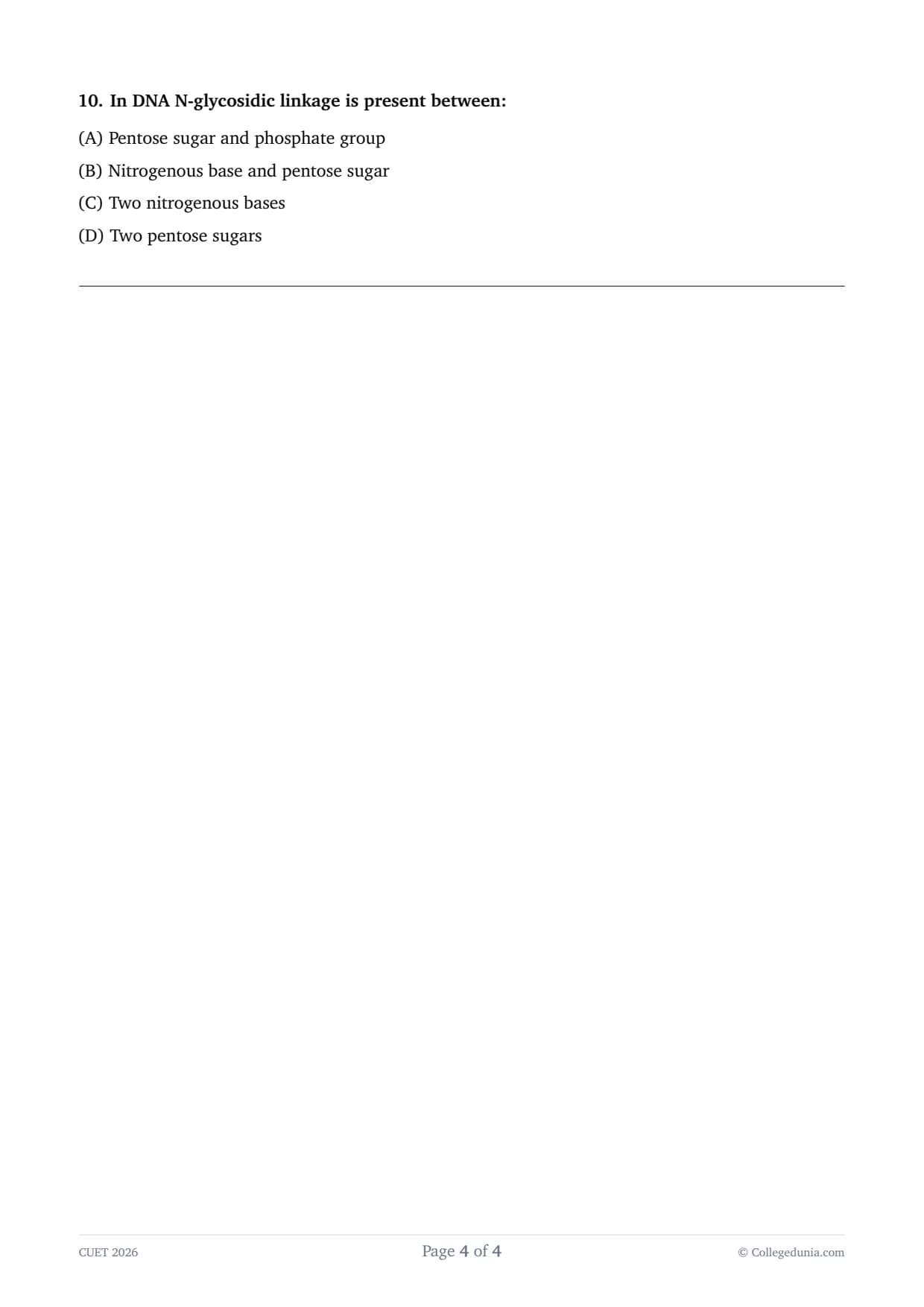
In DNA N-glycosidic linkage is present between:
View Solution
Concept:
DNA is a polymer made up of repeating units called nucleotides. Each nucleotide consists of three essential components: a nitrogenous base (purine or pyrimidine), a pentose sugar (deoxyribose), and a phosphate group. The stability and structure of DNA depend on specific covalent and non-covalent bonds that link these components together.
Among these bonds, the N-glycosidic bond plays a crucial role in forming the fundamental nucleotide structure.
Step 1: Using nucleotide structural composition in DNA.
A nucleotide is formed when a nitrogenous base attaches to a pentose sugar. In DNA, the sugar is deoxyribose, and bases include adenine, guanine, cytosine, and thymine. This base-sugar unit forms the nucleoside before phosphate attachment.
Step 2: Using definition of N-glycosidic bond formation.
The N-glycosidic bond is a covalent linkage formed between the nitrogen atom of the nitrogenous base (N9 in purines and N1 in pyrimidines) and the 1' carbon atom of the pentose sugar. This bond is essential for forming nucleosides.
Step 3: Using differentiation of DNA bonding systems.
DNA structure is stabilized by three major types of bonds:
- N-glycosidic bond (base + sugar)
- Phosphodiester bond (sugar + phosphate backbone)
- Hydrogen bonds (between complementary bases)
Thus, each bond has a distinct structural role.
Final Understanding:
The N-glycosidic bond specifically connects nitrogenous base with pentose sugar, forming the foundation of nucleotide structure. Quick Tip: Base + sugar forms nucleoside via N-glycosidic bond; adding phosphate forms nucleotide.
CUET UG 2026 Exam Pattern
| Parameter | Details |
|---|---|
| Exam Name | Common University Entrance Test (CUET UG) 2026 |
| Conducting Body | National Testing Agency (NTA) |
| Exam Mode | Computer-Based Test (CBT) |
| Exam Duration | 60 minutes per test |
| Total Sections | 3 (Languages, Domain Subjects, General Test) |
| Question Type | Multiple Choice Questions (MCQs) |
| Questions per Test | 50 questions (all compulsory) |
| Marking Scheme | +5 for correct, -1 for incorrect |
| Maximum Marks | 250 marks per test |
| Maximum Subject Choices | 5 subjects in total |
| Syllabus Base | Class 12 NCERT (mainly for Domain Subjects) |



Comments