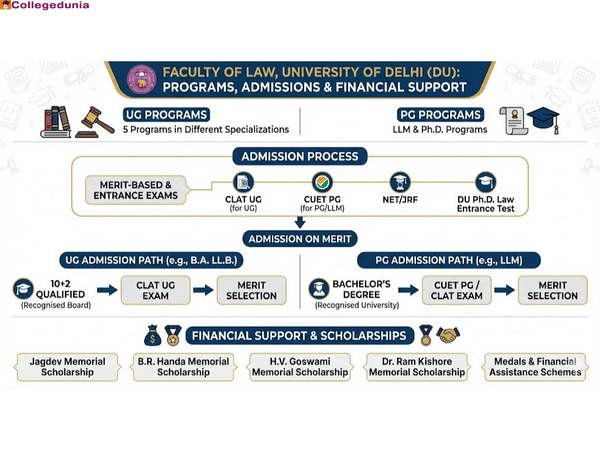
Faculty of Law, DU offers UG and PG programs. The College offers 5 programs in different specialisations. Admission to the UG and PG programs is done on the basis of merit, followed by the CLAT UG /CUET PG/NET/JRF/DU Ph.D. Law Entrance Test.
- Admission to the UG course is done on the basis of merit. Candidates need to qualify 10+2 from a recognised Board, followed by qualifying for the CLAT exam.
- Admission to PG courses like LLM is done on the basis of Merit. Candidates need a Bachelor's degree from a recognised University, followed by qualifying for the CUET PG/ CLAT exam.
- Faculty of Law, DU offers a range of Scholarships, medals, and financial assistance schemes to support students enrolled in LL.B., LL.M., and Ph.D. programmes. Popular awards include the Jagdev Memorial Scholarship, B.R. Handa Memorial Scholarship, H.V. Goswami Memorial Scholarship, and Dr. Ram Kishore Memorial Scholarship, among others.
![faculty of law, du admissions]()
Faculty Of Law, DU Important Dates 2026
The Important dates of the Faculty of Law, DU, for various courses are mentioned below.
Faculty of Law, DU CLAT Important Dates 2026
Faculty of Law, DU has released important CLAT dates as mentioned below.
| Counselling Event |
Date |
| First Allotment List (Round 1) |
Jan 7, 2026 |
| Confirmation Fee Payment & Admission (Round 1) |
Jan 7 – Jan 15, 2026 |
| Second Allotment List (Round 2) |
Jan 22, 2026 |
| Confirmation Fee Payment & Admission (Round 2) |
Jan 22 – Jan 29, 2026 |
| Third Allotment List (Round 3) |
Feb 5, 2026 |
| Confirmation Fee Payment & Admission (Round 3) |
Feb 5 – Feb 12, 2026 |
| Deadline for University Fee (Rounds 1–3 Freeze) |
Apr 24, 2026 |
| Fourth Allotment List (Round 4) |
May 2, 2026 |
| Confirmation Fee Payment & Admission (Round 4) |
May 2 – May 8, 2026 |
| Fifth & Final Allotment List (Round 5) |
May 15, 2026 |
| Confirmation Fee Payment & Admission (Final Round) |
May 15 – May 20, 2026 |
| Deadline for University Fee (Rounds 4 & 5 Freeze) |
May 30, 2026 |
Faculty of Law, DU CUET PG Important Dates 2026
Faculty of Law, DU has released Important CUET PG Dates as mentioned below.
| Event |
Date (2026) |
| Last Date of Registration |
January 14, 2026 |
| Application Correction Window |
January 18 – 20 January 2026 |
| CUET PG 2026 Exam |
March 2026 |
| Result Declaration |
May 2026 |
| Counselling / Admission Process |
May 2026 |
Faculty of Law, DU DULLB Important Dates 2026
Once a candidates clears the CUET LLB 2026 exam and results are published, Delhi University (DU) will begin its admission process via the CSAS (PG) portal. Faculty of Law, DU has released DU LLB Tentative dates as mentioned below.
| Admission Activity |
Approx. Timeline (2026) |
| DU LLB 2026 Application (CSAS PG) Opens |
Third week of May 2026 |
| CSAS PG Portal Closes (Last Date to Apply) |
Second week of June 2026 |
| Application Correction Window (DU LLB) |
Second week of June 2026 |
| First Seat Allocation List (CSAS PG) |
Third week of June 2026 |
| Accept Seat & Document Verification (Round 1) |
Third week of June 2026 |
| Second Seat Allocation List |
Fourth week of June 2026 |
| Accept Seat & Document Verification (Round 2) |
Fourth week of June 2026 |
| Third Round & Allocation (If Applicable) |
Second week of July 2026 |
| Last Date for Fee Payment/Final Admissions |
Third week of July 2026 |
Faculty of Law, DU Admissions 2026
Faculty of Law, DU offers LLB, LLM, BA LLB (Hons.) and BBA LLB (Hons.). Candidates need to pass their 10+2 with a minimum 50% from a recognised Board, followed by qualifying for the CLAT exam to get admission into UG courses. For getting admission into PG courses, candidates Bachelors degree from a recognised University followed by qualifying CUET PG. The details for Faculty of Law, DU Admissions are mentioned below:
| Course (Duration) |
Eligibility Criteria |
Selection Criteria |
| L.L.B |
Bachelors with 50% |
CUET PG/ CLAT |
| BALLB {Hons.} |
10+2 with 50% |
CLAT |
| BBA LLB {Hons.} |
10+2 with 50% |
CLAT |
| [L.L.M.] |
LLB |
CUET PG |
| PhD |
LL.M with 55% |
NET/JRF/DU Ph.D. Law Entrance Test and Synopsis |
FAQs on Faculty of Law, DU Admissions
Ques. Is CLAT the only criterion for law admissions in Faculty of Law, DU?
Ans. Yes, for the 5-year integrated law courses, admissions are conducted through merit in CLAT.
Ques. Can candidates apply for admission if he/ she is already studying at DU?
Ans. If he/ she is already enrolled in another DU course and want to join the Faculty of Law, then they should clarify their status with the DU Admission Branch, as some forms ask whether they are a current DU student, and that may affect their application options.
Faculty of Law, DU Admission Process 2026
The Faculty of Law, University of Delhi, offers LLB, LLM, BA LLB (Hons.) and BBA LLB (Hons.) programmes. For UG law courses, candidates must have passed 10+2 with at least 50% marks from a recognised board and must qualify for the CLAT exam. Admission to PG law courses (LLM) requires a Bachelor’s degree from a recognised university, along with a valid CUET PG score. Faculty of Law, DU, Admission Process has been mentioned below.
Step 1: Visit the official Delhi University admission portal.
Step 2: Register as a new user and verify your email ID.
Step 3: Log in and complete the online application form.
Step 4: Select the preferred course(s) as per eligibility.
Step 5: Apply separately for the relevant entrance exam.
Step 6: Upload the required documents.
Step 7: Pay the application fee online (INR 100 for General/OBC, INR 50 for SC/ST).
Step 8: Submit the application form.
Step 9: Report for admission with original documents for verification.
Faculty of Law, DU Documents Required 2026
- Class 10 & 12 mark sheets (for UG courses)
- Bachelor’s degree mark sheets and certificate (for LLM)
- Entrance exam scorecard (CLAT / CUET PG)
- Valid photo ID proof
- Passport-size photographs
- Category/reservation certificate (if applicable)
- Migration certificate (if applicable)
- Original documents and photocopies for verification
FAQs on Faculty of Law, DU Admission Process
Ques. Is there any offline process involved in Faculty of Law, DU Admissions?
Ans. Yes. After seat allotment, candidates must report in person for document verification and fee payment to confirm their admission.
Ques. Where can candidates check official updates and notifications for the Faculty of Law, DU?
Ans. All official admission updates are published on the Delhi University admission website and the Faculty of Law, DU official website.
CLAT 2026
What is the CLAT Exam 2026?
The CLAT 2026 is a national-level entrance examination, which is conducted every year for admission into UG (5-Year LLB) and PG (LLM) programs, which are offered by 24 NLUs in India.
- Around 1 lakh candidates appear every year for 3,000 to 3,500 NLU Seats.
- By CLAT, a career door will be opened for corporate law, litigation, judiciary, civil services, legal policy and global law firms.
- A Single Counselling will be followed for seat allotment as per AIR and category reservation.
- The Consortium of NLUs has released the CLAT 2026 Answer Key on 16th December 2025. The CLAT UG 2026 Exam was conducted on 7th December 2025, across 156 Exam centres in 25 States, 93 cities, and 4 Union Territories.
- A Total of 92,344 candidates applied for the examination, from which 75,009 candidates registered for the Undergraduate (UG) program and 17,335 candidates for the PG program.
- This Year, there is an increase of more than 17% in applications for the CLAT Exam; there was a total turnout of 96.83% of Undergraduate applicants.
- By CLAT 2026, around 3,500+ seats will be offered in 24 Participating NLUs, in which the top 5 will close the rank between the top 200 and 500, as per the previous year's trends.
CLAT Counselling Schedule 2026
CLAT Counselling Process has already started. The authorities have released instructions on CLAT counselling, which can be checked here.
| Schedule |
Particulars |
| January 7, 2026, at 10 am |
Publication of the first allotment list (first round begins) |
| January 7, 2026 (10 am) to January 15, 2026 (1 pm) |
Payment of the confirmation fee and admission by NLUs for the first allotment list |
| January 22, 2026, at 10 am |
Publication of the second allotment list (second round begins) |
| January 22, 2026 (10 am) to January 29, 2026 (1 pm) |
Payment of the confirmation fee and admission by NLUs for the second allotment list |
| February 5, 2026, at 10 am |
Publication of the third allotment list (third round begins) |
| February 5, 2026 (10 am) to February 12, 2026 (1 pm) |
Payment of the confirmation fee and admission by NLUs for the third allotment list |
| April 24, 2026, by 5 pm |
Payment of university fees by candidates who chose the Freeze option in the first three rounds |
| May 2, 2026, at 10 am |
Publication of the fourth allotment list (fourth round begins) |
| May 2, 2026 (10 am) to May 8, 2026 (1 pm) |
Payment of the confirmation fee and admission for the fourth allotment list |
| May 15, 2026, at 10 am |
Publication of the fifth and final allotment list (fifth round begins) |
| May 15, 2026 (10 am) to May 20, 2026 (1 pm) |
Payment of the confirmation fee and admission for the fifth allotment list |
| As notified by the respective NLUs |
Payment of university fees by candidates who chose the Freeze option in the fourth and fifth rounds |
CLAT 2026 Score Calculation Process: How Your Marks Are Calculated
The CLAT Exam will follow a negative marking system, with each correct answer being 1 mark and -0.25 marks for every incorrect answer.
As in CLAT, only a single raw scoring model is used; the final answer key can be directly determined using AIR Rank without a normalisation process.
- In the CLAT Exam, your accuracy will matter more than the number of attempts; if you guess too many, your score can be reduced because of negative marking.
- There is no partial marking, with all questions being single-choice objective questions.
CLAT Score Calculation: Marking Scheme 2026
| Particulars |
Details |
Impact on Score |
| Total Questions |
120 (MCQs) |
Determines max raw score |
| Marks for Each Correct Answer |
+1 |
Increases overall score |
| Penalty for Each Wrong Answer |
–0.25 |
Negative impact: reduces marks |
| Marks for Unanswered Questions |
0 |
No change in total score |
| Score Range |
0 to 120 (raw marks) |
Used directly for the AIR ranking |
| Normalization |
Not Applicable |
Raw marks = Final marks |
| Tie-Breaking Parameters |
Legal Reasoning score → Older age → Computerised lottery |
Used when the marks are the same |
CLAT Result & Counselling 2026
The CLAT 2026 Result can be released anytime in the last week of December 2025. You should follow a proper process for the result download.
The merit list will be published, and centralised counselling for proper seat allotment.
| Stage |
What Happens |
What You Need To Do |
| Result Declaration |
Scorecard released with AIR & category rank |
Download scorecard & analyse rank vs expected |
| Registration for Counselling |
Consortium opens counselling portal |
Pay the counselling fee & register |
| Choice Filling & Locking |
Select and arrange in preference order |
Carefully prioritise colleges based on cutoff trends |
| Seat Allotment Rounds (Round 1/2/3 etc.) |
Seats allotted as per rank, category & preference |
Accept seat / apply for upgrade/exit option |
| Document Upload & Verification |
Verification done online |
Upload the required docs within the deadline |
| Fee Payment |
Final seat confirmation |
Pay the admission fee |
CLAT Counselling Schedule 2026
The counselling process will consist of multiple rounds. The CLAT Counselling schedule are:
| Schedule |
Particulars |
| January 7, 2026, at 10 am |
Publication of the first allotment list (first round begins) |
| January 7, 2026 (10 am) to January 15, 2026 (1 pm) |
Payment of the confirmation fee and admission by the first allotment list |
| January 22, 2026, at 10 am |
Publication of the second allotment list (second round begins) |
| January 22, 2026 (10 am) to January 29, 2026 (1 pm) |
Payment of the confirmation fee and admission for the second allotment list |
| February 5, 2026, at 10 am |
Publication of the third allotment list (third round begins) |
| February 5, 2026 (10 am) to February 12, 2026 (1 pm) |
Payment of the confirmation fee and admission for the third allotment list |
| April 24, 2026, by 5 pm |
Payment of university fees by candidates who chose the Freeze option in the first three rounds |
| May 2, 2026, at 10 am |
Publication of the fourth allotment list (fourth round begins) |
| May 2, 2026 (10 am) to May 8, 2026 (1 pm) |
Payment of the confirmation fee and admission for the fourth allotment list |
| May 15, 2026, at 10 am |
Publication of the fifth and final allotment list (fifth round begins) |
| May 15, 2026 (10 am) to May 20, 2026 (1 pm) |
Payment of the confirmation fee and admission for the fifth allotment list |
Documents Required for CLAT Counselling 2026
Candidates are requested to keep a soft/scanned copy of the following documents ready for upload:
- Grade 10 statement of marks*
- CLAT 2025 Admit Card*
- Grade 12 Statement of Marks*
- Character Certificate/Conduct Certificate from the Educational Institution last attended
- Transfer/Migration Certificate from the Educational Institution last attended
- Caste Certificate (SC, ST, OBC, etc.) if applied and allotted under the Reserved category of seats*
- PwD/SAP Certificate, if applied and allotted under the PwD category*
- Domicile/Residence Certificate, if applied and allotted under the domicile/resident category seat*
- Any other supporting documents to claim your seat for the category you have applied (e.g., Wards of Serving/Retired Defence Personnel, EWS certificate, Sons/daughters of Ex-servicemen/Defence service personnel, etc.)*
FAQs on Faculty of Law, DU CLAT
Ques. Can candidates withdraw from CLAT counselling after accepting a seat?
Ans. Yes, candidates can withdraw within the specified deadline, subject to the refund rules set by the Consortium.
Ques. How many rounds of CLAT counselling are conducted?
Ans. CLAT counselling is usually conducted in multiple rounds until all seats are filled.
Key Takeaways from the Video:
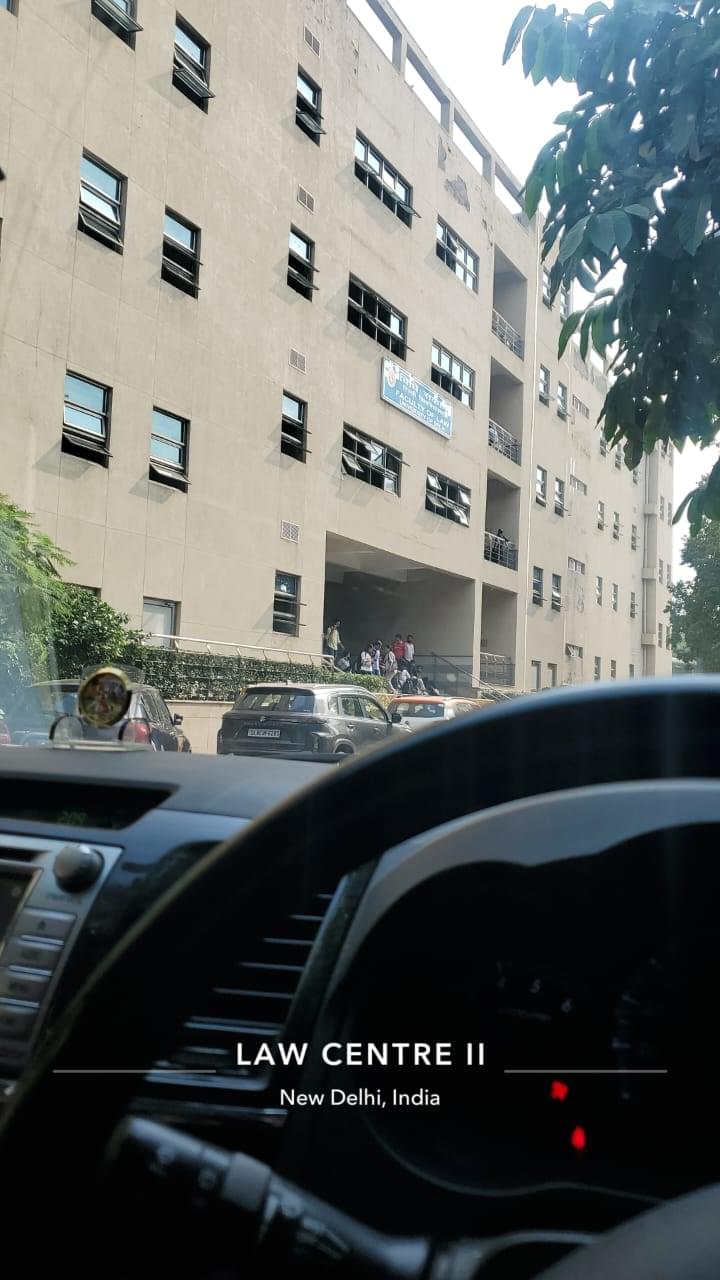
- The law campus is part of North Campus, University of Delhi, with multiple centres under the Faculty of Law — Campus Law Centre (CLC), Law Centre-I, and Law Centre-II.
- The campus buildings are spacious with organised pathways and green surroundings.
- A large, well-stocked law library with over 1.5 lakh books and many journals is a central highlight.
- The Campus tour Video depicts a busy, student-centric environment with groups of law students moving around or studying in lawns and in common areas.
Faculty of Law, DU Cutoff 2026
Faculty of Law, DU has not released the Cutoff 2026. However Candidates can take admission in L.L.B programs at the Faculty of Law, Delhi University based on the CUET score. L.L.B is the top choice for students appearing in CUET. Faculty of Law, DU Cutoff for the General Category is listed below.
| Program |
Entrance Test Used |
Cut-off (General) |
| 5-Year BA LL.B. (Hons.) |
CLAT 2025 |
88.50 (Round 1) |
| 5-Year BBA LL.B. (Hons.) |
CLAT 2025 |
87.00 (Round 1) |
| 3-Year LL.B. |
CUET PG 2025 |
200–205 (Tentative) |
| LL.M. |
CUET PG LLM 2025 |
208 |
| Ph.D. in Law |
Ph.D. Entrance / Interview / NET |
No numeric cutoff (eligibility + selection performance) |
FAQs on Faculty of Law, DU Cutoff
Ques. If Candidates miss out on the first round, can they still get admission in the Faculty of Law, DU?
Ans. Yes! The Faculty of Law, DU, publishes multiple rounds of cut-offs, including second round and spot rounds, so candidates with slightly lower CLAT/CUET scores can still be considered in later rounds, depending on seat availability.
Ques. Do Class 12 marks or graduation scores affect the Faculty of Law, DU cut-offs?
Ans. For 5-year integrated Law admissions via CLAT, Class 12 marks are for eligibility only. They do not directly affect the CLAT cut-off merit list. For CUET PG programmes (3-yr LLB/LLM), final eligibility and counselling rules depend on DU’s PG admissions guidelines.
Faculty of Law, DU Scholarships 2026
Faculty of Law, DU offers Scholarships to its meritorious and deserving candidates. Faculty of Law, DU scholarships have been mentioned in the Tabular form below.
| Scholarship Name |
Funding / Source |
Eligible Students |
Purpose / Basis |
| Jagdev Memorial Scholarship |
Endowment (Law Centre Alumni/Private fund) |
Law students (EWS) |
Merit / category-based support (approx. INR 14,000/yr) |
| B.R. Handa Memorial Scholarship |
Campus Law Centre Alumni Association |
Law students (CLC) |
Merit (Campus-specific award) |
| H.V. Goswami Memorial Scholarship |
Campus Law Centre Alumni Association |
Law students (CLC) |
Merit (Campus award) |
| Dr. Ram Kishore Memorial Scholarship |
Endowment by Senior Advocate Shri Brijbans Kishore |
LL.B. students |
Merit-cum-means award (monthly stipend under rules) |
| Nain Sukh Gauba & Devi Huti Gauba Memorial Scholarship |
Endowment Fund |
Law students |
Endowment-funded award (monthly stipend per rules) |
| Vijay Kumar Chadha Memorial Scholarship |
Endowment |
Law students |
Donor-established merit fund |
| C. Rai Barrister of Sialkot Memorial Scholarship |
Endowment |
Law students |
Funded award for law students |
| Justice Sunanda Bhandare Fellowship (Constitutional Law) |
Endowment |
Law students |
Funded fellowship in law |
| Sohan Lal Sethi Memorial Scholarship |
Donor endowment |
Law students |
Merit-based (INR 25,000 prize) |
FAQs on Faculty of Law, DU Scholarships
Ques. Are these scholarships only for LL.B. students of the Faculty of Law, DU?
Ans. No! Scholarships are available to students across all law programmes, including LL.B. (3-year), LL.M. (postgraduate) and PhD scholars. There are awards for academic excellence, endowment scholarships, and national/University-level financial aid.
Ques. Can financially needy students get assistance studying or applying in the Faculty of Law, DU?
Ans. Yes! The Faculty prospectus mentions that financial assistance may be given to deserving and needy students out of the Vice-Chancellor’s Student Funds as per University of Delhi rules.
Conclusion
- Applications for DU law programs are processed online through the DU Admission website and law faculty portals during the admission window.
- Faculty of Law, DU PhD admissions include an entrance test like UGC NET, followed by an interview. Sometimes, equivalent qualifications can sometimes exempt candidates from the admission test and move them directly to an interview stage.
- DU follows reservation policies for SC/ST/OBC-NCL/EWS/PwBD candidates as per government norms in both admissions and mark requirements.
Faculty Of Law, DU Admissions FAQs
Ques. What is CLAT, and how does it help in getting admission to Faculty of Law, DU?
Ans. CLAT (Common Law Admission Test) is a national-level entrance exam conducted by the Consortium of National Law Universities for admission to 5-year integrated law programs such as BA LL.B. and BBA LL.B. CLAT scores are accepted not only by National Law Universities (NLUs) but also by several prestigious institutions, including the Faculty of Law, University of Delhi (DU) for its undergraduate law programs. CLAT assesses a candidate’s aptitude in English language, current affairs, legal reasoning, logical reasoning, and quantitative techniques. The exam focuses on comprehension-based questions that test analytical and problem-solving skills rather than rote learning.
Ques. What is the PhD in Law program offered by the Faculty of Law, DU?
Ans. The PhD in Law at the Faculty of Law, University of Delhi is a research-oriented doctoral program designed for candidates interested in advanced legal research, academic teaching, policy formulation, and high-level legal scholarship. The program allows scholars to conduct in-depth research in specialised areas of law under the guidance of experienced faculty members. Admission is conducted through a PhD entrance test followed by an interview/viva-voce. Shortlisted candidates are assessed on research aptitude, subject knowledge, and the proposed research area.
Ques. What is the Duration and the Career Proposals for the PhD program at Faculty of Law, DU?
Ans. The minimum duration is three years, and the maximum duration is six years, in accordance with UGC regulations. It is mandatory to submit a research proposal outlining the research problem, objectives, methodology, and relevance of the study. Graduates can pursue careers in academia, legal research, policy think tanks, judiciary support roles, international organisations, and advanced legal consultancy.









.png?h=78&w=78&mode=stretch)

.png?h=78&w=78&mode=stretch)

















.png?h=72&w=72&mode=stretch)
.png?h=72&w=72&mode=stretch)


 (4).jpeg?h=72&w=72&mode=stretch)





Comments