




NEET Chemistry chapter wise weightage 2026 accounts for 25% of the whole NEET paper. Class 12 Chemistry almost 60% and Class 11 contributes 40% weightage to the NEET Chemistry question paper.
NEET chemistry covers organic, inorganic, and physical areas, each contributing significantly to overall scores with roughly equal weightage.
- Physical chemistry carries around 32% weightage
- Organic chemistry has 35-37% weightage
- Inorganic chemistry carries 30-34% weightage
Organic chemistry chapters like aldehydes, ketones, and carboxylic acids account for 9%, hydrocarbons account for 7%, and inorganic fundamentals are also equally important.
Inorganic chemistry chapters, chemical bonding has 7% weightage, p block and d & f block share 6% weightage, and coordination compounds have a consistent 5% weightage over the years.
In physical chemistry, thermodynamics has 5% weightage, electrochemistry and kinetics equally have 5% weightage, and equilibrium accounts for 6%.
Note: NEET 2026 Syllabus is not yet published, but it is expected that the syllabus will remain the same as that of NEET 2025
Related Articles
Key Summary
- NEET Chemistry carries 25 percent of the weightage in NEET.
- The NEET Chemistry chapter wise weightage is almost equally divided among organic, inorganic, and physical chemistry.
- Physical chemistry carries around 32-34% weightage
- Organic chemistry has 35-36% weightage
- Inorganic chemistry carries 30-34% weightage
- Aldehydes, Hydrocarbons, Bonding, P block, and thermodynamics are high-yielding chapters.
- Coordination compounds, biomolecules, and kinetics have an average weightage.
- Solution, redox, and structure of atoms, though they carry lower weight, but still essential.
NEET Chemistry Chapter Wise Weightage 2026 (Expected)
- NEET Chemistry chapter wise weightage is almost equally split across Organic, Inorganic, and Physical Chemistry.
- Organic Chemistry: 35-36% weightage
- Inorganic Chemistry:35-36% weightage
- Physical Chemistry:32-34% weightage
- Aldehydes, Ketones, and Carboxylic Acids have the highest weightage, ~9% in Chemistry.
- Over 70% Inorganic Chemistry questions are directly asked from the Class 11 & 12 NCERT Chemistry textbook.
- Thermodynamics, Electrochemistry, Equilibrium, and Kinetics together form about 20-22% of Chemistry.
- Class 12 Chemistry chapters alone contribute about 55-60% of Chemistry marks.
- Class 11 covers 40-45% of total Chemistry marks.
| Organic Chemistry | % | Inorganic Chemistry | % | Physical Chemistry | % |
|---|---|---|---|---|---|
| Basic Principles and Techniques | 5% | Classification of Elements & Periodicity | 2% | Basic concepts | 3-4% |
| Hydrocarbons | 6-7% | Hydrogen | 2% | Structure of Atoms | 3-4% |
| Haloalkanes & Haloarenes | 4% | S-block Element(Alkali & Alkaline) | 3% | States of Matter(Gaseous+Liquid) | 2-3% |
| Alcohols, Phenols & Ethers | 4% | p-Block elements(Group13,14,15,16,17,18) | 6% | Thermodynamics | 5% |
| Aldehydes, Ketones & Carboxylic Acids | 9% | d-Block Elements | 4% | Equilibrium(Chemical+Ionic) | 6% |
| Amines | 5% | f-Block Elements | 2% | Redox Reaction | 3% |
| Biomolecules | 4% | Coordination compounds | 5% | Solid State | 2-3% |
| Polymers | 2% | Chemical Bonding & Molecular Structure | 7% | Solutions | 4% |
| Chemistry in everyday life | 2% | Metallurgy | 2% | Electrochemistry | 5% |
| Practical organic/IUPAC/Mechanisms | 2% | Environmental Chemistry | 2% | Chemical Kinetics | 5% |
| Qualitative Analysis | 2% | Surface Chemistry | 2% | ||
| Nuclear Chemistry/Radioactivity | ~1% |
Read More:
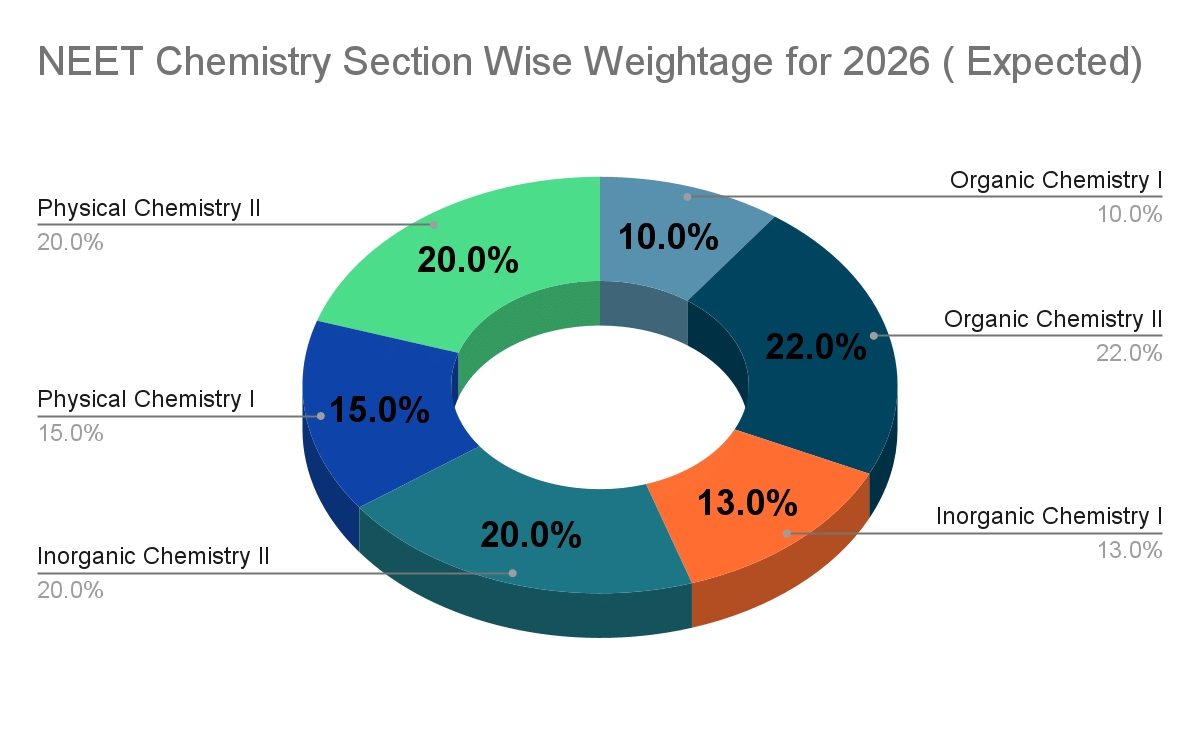
NEET Chemistry SyllabusNEET Chemistry Section Wise Weightage for 2026 ( Expected)
| Organic Chemistry I (Class 11) | 9-10% |
|---|---|
| Organic Chemistry II (Class 12) | 22-24% |
| Inorganic Chemistry I (Class 11) | 13-14% |
| Inorganic Chemistry II (Class 12) | 20-21% |
| Physical Chemistry I (Class 11) | 15-16% |
| Physical Chemistry II (Class 12) | 19-20% |
NEET Chemistry Chapter Wise Weightage: Weightage Comparison ( 2025 to 2020)
- Class 12 dominates chemistry every year, contributing 55 to 60% of total questions every year.
- Organic chemistry Class 12 is the heaviest block, consistently carrying 20 to 24% weightage.
- Physical chemistry is evenly distributed, with classes 11 and 12 together with 35 percent.
- Inorganic chemistry class 11 has the smallest but stable share of 12 to 14%.
| Sections | 2020 | 2021 | 2022 | 2023 | 2024 | 2025 |
|---|---|---|---|---|---|---|
| Organic Chemistry I (Class 11) | 8% | 9% | 10% | 11% | 10% | 9% |
| Organic Chemistry II (Class 12) | 22% | 20% | 19% | 21% | 23% | 24% |
| Inorganic Chemistry I (Class 11) | 13% | 14% | 15% | 13% | 12% | 13% |
| Inorganic Chemistry II (Class 12) | 20% | 19% | 18% | 20% | 21% | 21% |
| Physical Chemistry I (Class 11) | 15% | 16% | 17% | 16% | 15% | 15% |
| Physical Chemistry II (Class 12) | 22% | 22% | 21% | 19% | 19% | 20% |

NEET Chemistry Chapter Wise Weightage Past 5 Years: Number of Questions asked for Each Chapter
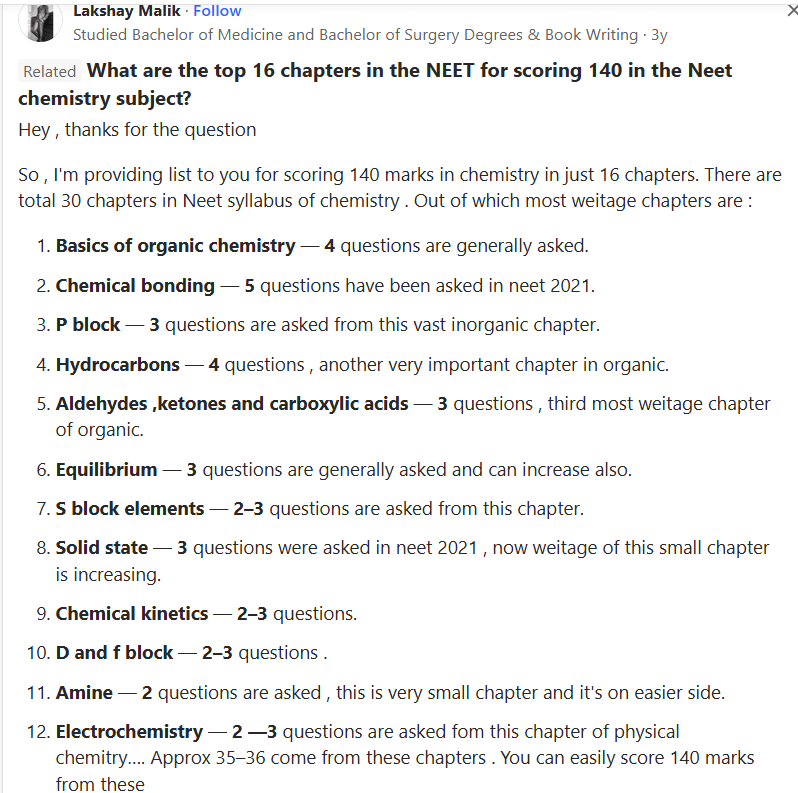
- Carbonyl compounds are among the most repeated topics, contributing two to four questions every year.
- Hydrocarbons consistently appear with three to four questions annually, making it one of the most reliable Class 11 organic chapters for NEET
- Chemical bonding and molecular structure from inorganic chemistry are highly important, showing up with 2-5 questions every year
- Physical chemistry core topics like equilibrium thermodynamics, electrochemistry, and chemical kinetics together account for 20% the chemistry section, with 6-8 questions
- Coordination compounds and P block elements from the class 12inorganic chemistry remain strong, high-weightage areas with 2-5 questions every year
| Chemistry Chapters | 2025 | 2024 | 2023 | 2022 | 2021 | 2020 |
|---|---|---|---|---|---|---|
| Coordination compounds | 5Qs | 2Qs | ~2Qs | 2Qs | ~2Qs | |
| Hydrocarbons | 4Qs | 3Qs | 3Qs | ~3Qs | 4Qs | ~3Qs |
| Chemical bonding and molecular structure | 3Qs | 2Qs | ~2Qs | 5Qs | ~3Qs | |
| Aldehydes, Ketones, and Carboxylic Acids | 3Qs | 3Qs | 4Qs | ~2Qs | 3Qs | ~2-3Qs |
| Equilibrium | 2Qs | 2Qs | ~2Qs | 1Q | ~2-3Qs | |
| Thermodynamics | 3Qs | 2Qs | 1Qs | ~2Qs | 1Q | ~2Qs |
| Electrochemistry | 2Qs | 3Qs | ~1-2Qs | 2Qs | ~2Qs | |
| Chemical kinetics | 3Qs | 2Qs | ~2Qs | 2Qs | ~2Qs | |
| p-block elements | 3Qs | 2Qs | 2Qs | ~1-2Qs | 2Qs | ~2Qs |
| Solutions | 3Qs | 2Qs | 1Qs | ~2Qs | 2Qs | ~2Qs |
| Atomic structure | 1Qs | 2Qs | ~1-2Qs | 1Q | ~2Qs | |
| Alcohols, Phenols & Ethers | 2Qs | 2Qs | ~2Qs | 1Q | ~1-2Qs | |
| Amides | 1Qs | 2Qs | ~1Q | 2Qs | ~1-2Qs | |
| Basic principles of organic chemistry | 1Qs | 2Qs | ~2Qs | 1Q | ~1Q |
NEET Chemistry Chapter Wise Weightage: Quora Discussion
NEET Chemistry Chapter Wise Weightage: Books For NEET 2026 Chemistry Preparation
NCERT Textbooks (Essential)
| Class | Book Title | Reason for Recommendation |
|---|---|---|
| Class 11 | NCERT Chemistry Class 11 | Clear explanations of fundamental concepts and basic problems. |
| Class 12 | NCERT Chemistry Class 12 | Detailed coverage of advanced topics with high NEET relevance. |
Physical Chemistry
| Book Title | Author | Why Recommended |
|---|---|---|
| Physical Chemistry | O.P. Tandon | Comprehensive for theoretical clarity and numerical practice. |
| Physical Chemistry for NEET | P. Bahadur | Focuses on problem-solving and conceptual clarity with exercises. |
| Numerical Chemistry | R.C. Mukherjee | Ideal for practicing numerical problems with varying difficulty. |
Organic Chemistry
| Book Title | Author | Why Recommended |
|---|---|---|
| Organic Chemistry | Morrison and Boyd | Excellent for understanding reaction mechanisms and theory. |
| Organic Chemistry for NEET | O.P. Tandon | NEET-specific with detailed explanations and solved questions. |
| Organic Chemistry | Paula Y. Bruice | Great for understanding complex reaction mechanisms. |
Inorganic Chemistry
| Book Title | Author | Why Recommended |
|---|---|---|
| Concise Inorganic Chemistry | J.D. Lee | Comprehensive theory and logical presentation of Inorganic topics. |
| Inorganic Chemistry for NEET | O.P. Tandon | NEET-oriented with easy-to-memorize explanations. |
NEET-Specific Chemistry Guides
| Book Title | Publisher/Author | Why Recommended |
|---|---|---|
| MTG NEET Chemistry Guide | MTG Publications | Covers NCERT-based theory, previous year questions, and mock tests. |
| Objective Chemistry for NEET | Dinesh Publications | Chapter-wise questions with NEET-specific focus. |
| NEET Chemistry 40 Days | Arihant Experts | Ideal for last-minute revision with quick tips and practice sets. |
Also Read
Deleted Syllabus of NEET 2026 ChemistryNEET Chemistry Chapter Wise Weightage FAQs
NEET Chemistry Chapter Wise Weightage FAQs
Ques. Which chapter has more weightage in NEET Chemistry?
Ans. Considering the past five NEET papers, 36% of chemistry questions come from physical chemistry, followed by 34% from organic chemistry, and 30% from inorganic chemistry.
- General organic chemistry, coordination, chemical bonding, and thermodynamics are some high-return chapters.
- Physical chemistry:
- Mole concept - 3 to 4 questions
- Thermodynamics - 3 to 4 questions
- Organic chemistry:
- Hydrocarbons, General organic chemistry, Alcohols and Amines - 6 to 8 questions combined
- Inorganic chemistry:
- Coordination compounds and chemical bonding - 4 to 5 questions each
Ques. What is the 80-20 rule in NEET?
Ans. 80-20 rule in NEET means 80% of NEET questions come from 20% of the chapters.
- In Chemistry, 80% of the questions come from chemical bonding, general organic chemistry, coordination, thermodynamics, electrochemistry, and hydrocarbons.
- In Biology, Human Physiology, Genetics, Plant Physiology, Ecology, and Cell Biology, questions occupy 80% of NEET Biology questions.
- In Physics, Laws of Motion, Modern Physics, Current Electricity, Magnetism, and Optics occupy 80% of the Physics section.
Ques. How to score 650+ in NEET 2025?
Ans.
- Know the in-and-out of NCERT. 85-90% of the Biology questions and 65% of the Chemistry questions come from NCERT.
- Solve the last 15 years of NEET/AIPMT papers.
- Take 50 to 60 full mock tests.
- Solve chapter-wise questions from the most repeated chapters.
Ques. Which is the toughest chapter of Chemistry for NEET?
Ans.
- In Inorganic chemistry, Coordination compounds and d-block are memory-intensive and comparatively difficult.
- In Organic chemistry, General organic chemistry and named reactions are often confusing.
- In Physical chemistry, Electrochemistry and Ionic equilibrium are vast.
- Electrochemistry is rated as the toughest by 41% aspirants.
- Questions from Thermodynamics and Electrochemistry can even appear in JEE style.
Ques. What are the Top 5 toughest NEET papers ever?
Ans.
- NEET 2022: Physical chemistry dominated. Chemistry had numerically heavy questions.
- NEET 2021: Questions from Biology, assertion-reason, and diagrams were confusing.
- NEET 2020: The Physics section was tough, and the paper was very lengthy.
- NEET 2018: Twisted questions in the Biology section and a lengthy Chemistry section.
- NEET 2016: Physics had unexpectedly JEE-level questions.
Ques. Which is the easiest subject in NEET?
Ans.
- Biology is considered easier and has high-score potential in NEET.
- Biology covers 50% of the paper with 90 questions.
- Questions are often direct, memory-based, and diagram-based.
Ques. Which is the most scoring subject in NEET?
Ans.
- Biology is the most scoring subject with a maximum of 360 marks.
- As the questions mostly come from NCERT, it is easier to score 280 to 320 in Biology alone.
- Inorganic chemistry is the next most scoring subject.
- Physical chemistry can also fetch easy 15 to 20 direct formula questions.
- Biology is the deciding subject for 600+.
- While Physics is comparatively tougher, it is a rank-determining subject.



Comments