




Once the NEET 2026 exam concludes on May 3, 2026, many students will be wondering how to predict your NEET 2026 score using memory-based questions.
To do this, compare your responses with expert-released memory-based answer keys and calculate your score using the official NEET marking scheme.
- Memory-based questions and answers are prepared based on the student's reaction immediately after the exam. You need to note that they are not official.
- NTA will release your NEET OMR response sheet and NEET answer key a few days after the exam, so that you can predict again your NEET 2026 score.
- NEET 2026 is scheduled for May 3, 2026; memory-based question papers will be available after 2-3 hours of the exam.
- NEET uses a +4/–1 marking scheme, which means for every correct answer, the candidate will get +4 marks and every wrong answer deducts 1 mark; unanswered questions carry zero penalty.
Related Links:
- NEET Answer Key 2026: Check Code-Wise PDF, Release Date, Result & Response Sheet
- Check NEET 2026 expected cutoff for OBC SC ST candidates
- Check Minimum Marks in NEET 2026 for BHMS Government College
Key Summary
- Memory-based question papers are available within 1-3 hours of the NEET 2026 exam.
- You need to count correct answers × 4, subtract wrong answers × 1, and ignore unanswered; the total is your estimated raw score out of 720.
- A score of 550+ (General) or 420+ (SC/ST/OBC) is typically needed for government MBBS admission under state quota; 620+ for AIQ General category.
- Memory-based papers carry 5-10% recall error, so always wait for the official NTA answer key (expected within 10 -15 days of exam) before taking admission decisions.
- Challenging the answer key is possible online at the NTA portal within the specified objection window, as a valid challenge can increase your score significantly.
How to Predict Your NEET 2026 Score Using Memory-Based Questions: Step-by-Step
How to predict your NEET 2026 score using memory-based questions involves a structured 5-step process that begins immediately after you exit the exam hall.
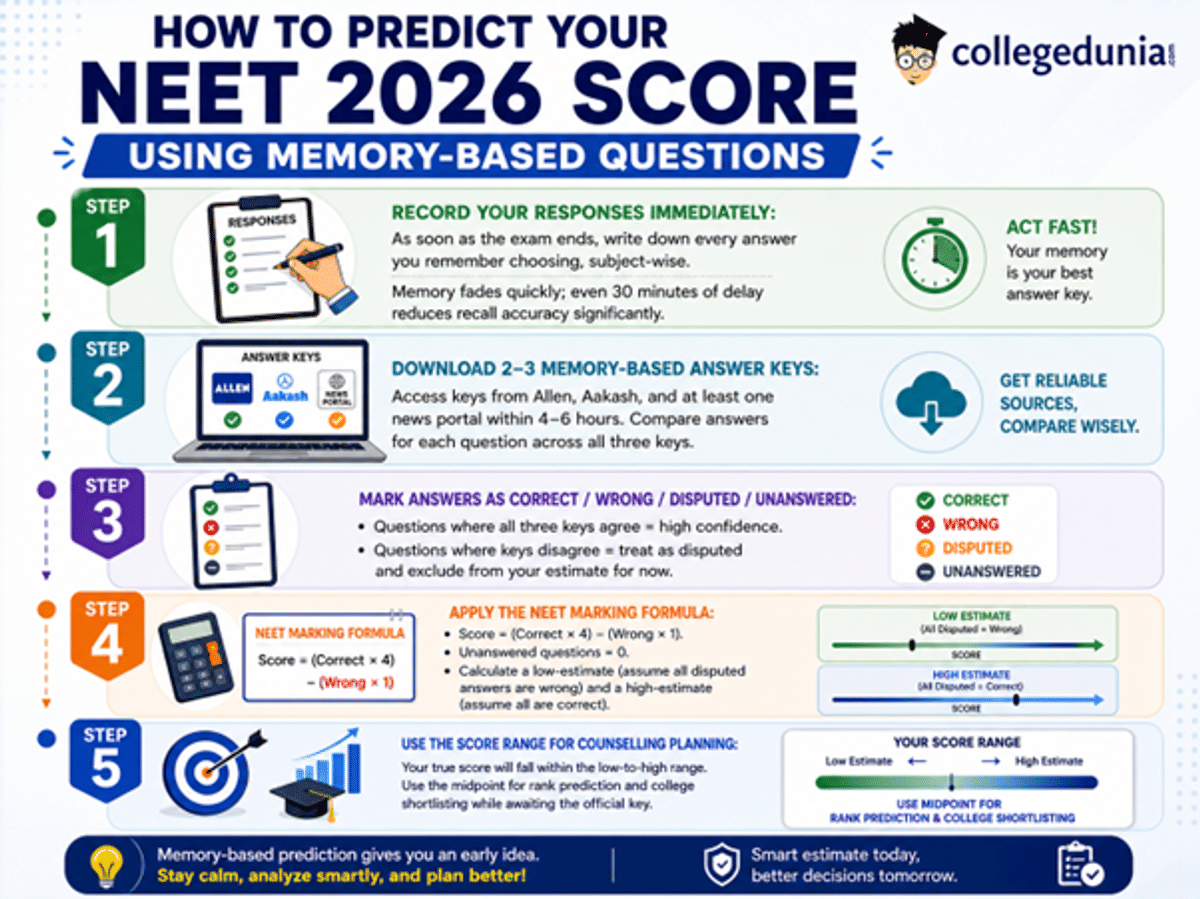
- Step 1- Record your responses immediately: As soon as the exam ends, write down every answer you remember choosing, subject-wise. Memory fades quickly; even 30 minutes of delay reduces recall accuracy significantly.
- Step 2- Download 2-3 memory-based answer keys: Access keys from Allen, Aakash, and at least one news portal within 4-6 hours. Compare answers for each question across all three keys.
- Step 3- Mark answers as Correct / Wrong / Disputed / Unanswered: Questions where all three keys agree = high confidence. Questions where keys disagree = treat as disputed and exclude from your estimate for now.
- Step 4- Apply the NEET marking formula: Score = (Correct × 4) − (Wrong × 1). Unanswered questions = 0. Calculate a low-estimate (assume all disputed answers are wrong) and a high-estimate (assume all are correct).
- Step 5- Use the score range for counselling planning: Your true score will fall within the low-to-high range. Use the midpoint for rank prediction and college shortlisting while awaiting the official key.
Also Read:
Ques. How accurate is self-recall for predicting NEET 2026 scores?
Ans. Self-recall accuracy varies by candidate; most students can reliably recall 70 – 80% of their answers, especially for Biology and straightforward Physics/Chemistry questions. Diagram-based and lengthy questions have lower recall accuracy, so treat those as uncertain and account for them in your score range rather than assuming correctness.
Ques. Should I trust one memory-based key or multiple for score prediction?
Ans. Always use multiple memory-based keys- a minimum of three from different sources. Where all keys agree, treat the answer as high-confidence. Where keys disagree, flag the question as disputed and estimate your score with and without those marks to build a realistic score range rather than a single number.
NEET 2026 Marking Scheme and Score Calculation Formula
The NEET 2026 marking scheme remains unchanged from previous years, with the paper carrying a total of 720 marks divided across Physics, Chemistry, and Biology (Botany + Zoology).
Score Calculation Formula:
- For every correct answer: +4 marks
- For every incorrect answer: −1 mark
- For unanswered / marked for review: 0 marks
- Formula: Estimated Score = (Correct Answers × 4) − (Wrong Answers × 1)
| Correct Answers | Wrong Answers | Unanswered | Estimated Score |
|---|---|---|---|
| 170 | 5 | 5 | 675 |
| 160 | 10 | 10 | 630 |
| 150 | 15 | 15 | 585 |
| 140 | 20 | 20 | 540 |
| 125 | 25 | 30 | 475 |
| 110 | 30 | 40 | 410 |
Check:
Ques. What is the maximum score in NEET 2026 and how is it calculated?
Ans. The maximum possible score in NEET 2026 is 720 marks, which can be achieved by answering all 180 attempted questions correctly with zero wrong answers. The formula is straightforward: 180 correct × 4 = 720. In practice, even top-ranked candidates rarely score above 710 – 715 due to one or two incorrect or unanswered questions.
Ques. Does attempting more Section B questions improve my NEET 2026 score?
Ans. In Section B, only 10 answers are evaluated, even if you attempt all 15. NTA evaluates the first 10 responses in order. Attempting questions you are uncertain about in Section B can reduce your score due to negative marking, so it is safer to attempt only those 10 where you are confident, rather than guessing to fill all 15.

NEET 2026 Score vs Rank: What Does Your Predicted Score Mean?
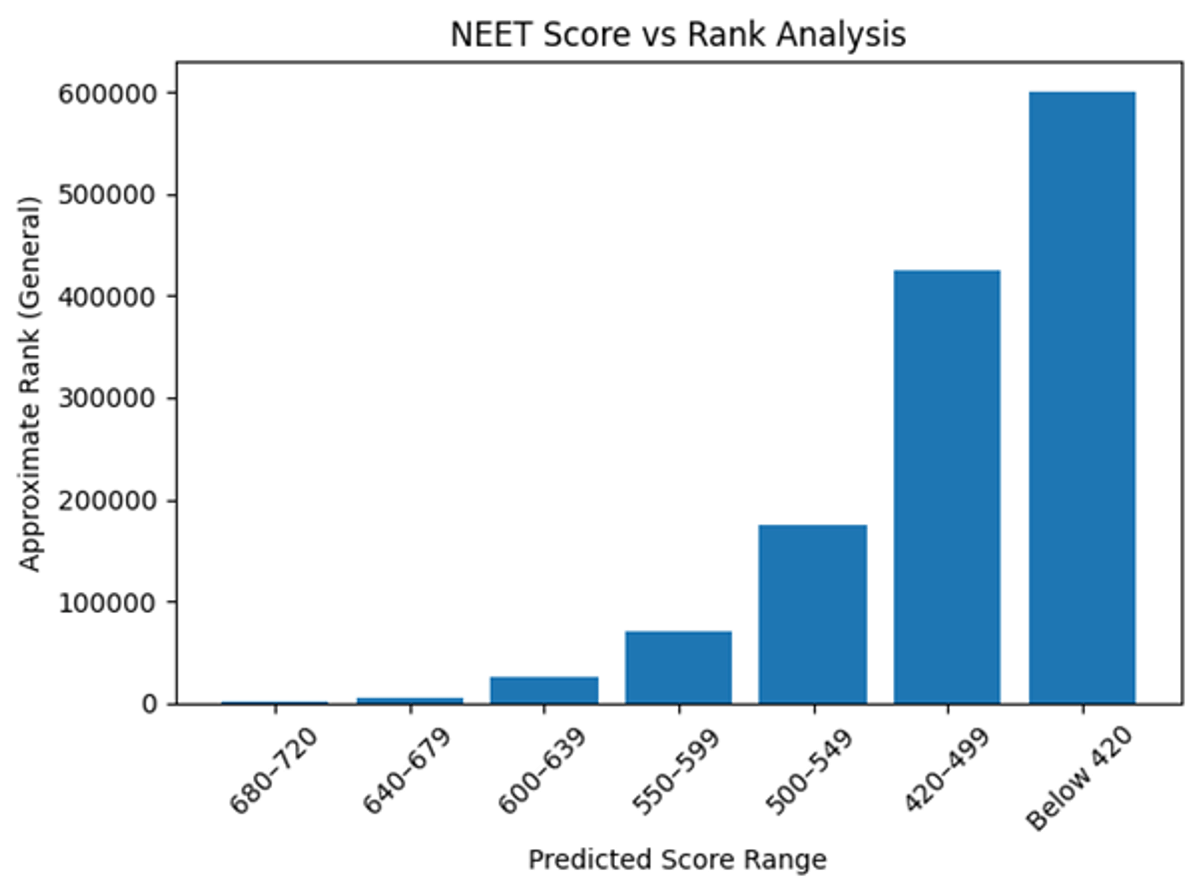
Once you predict your NEET 2026 score using memory-based questions, the next critical step is converting that score into an approximate rank because admission to MBBS courses is rank-based, not score-based.
A score of 600 may translate to a rank anywhere between 20,000 – 40,000, depending on how difficult the paper was, how many candidates appeared, and the overall score distribution that year.
| Predicted Score Range | Approximate Rank (General) | Expected Admission Prospect |
|---|---|---|
| 680 – 720 | Top 1 – 1,000 | Top government MBBS colleges (AIQ) |
| 640 – 679 | 1,000 – 10,000 | Good government MBBS (AIQ + State) |
| 600 – 639 | 10,000 – 40,000 | State quota government MBBS (high competition states) |
| 550 – 599 | 40,000 – 1,00,000 | State quota government MBBS (mid-tier states) |
| 500 – 549 | 1,00,000 – 2,50,000 | State quota / Private MBBS (low competition states) |
| 420 – 499 | 2,50,000 – 6,00,000 | Private MBBS / SC-ST state quota in some states |
| Below 420 | Below 6,00,000 | BDS / AYUSH / Deemed colleges |
Also Check:
Note: Rank estimates are approximate and based on NEET 2025 data. Actual NEET 2026 ranks depend on the number of candidates appearing and the overall score distribution.
Ques. How do I convert my NEET 2026 predicted score to an approximate rank?
Ans. Use NTA's historical marks-vs-rank data from NEET 2024 and 2025 as a reference, then adjust for expected difficulty. Most coaching institutes and college predictor tools (like the Collegedunia Rank Predictor) use this data to provide instant provisional rank estimates based on your entered score.
Ques. If two candidates score the same in NEET 2026, who gets the better rank?
Ans. NTA uses a tie-breaking formula: first preference to the candidate with higher Biology marks, then higher Chemistry marks, then fewer wrong answers overall, and finally age (older candidate preferred). If still tied, both receive the same rank. This tie-breaker can matter significantly when predicting rank from memory-based scores in competitive score bands.
How to Challenge the NEET 2026 Answer Key After Score Prediction
After you predict your NEET 2026 score using memory-based questions and the official answer key is released, candidates have the right to raise objections against any answer that they believe is incorrect.
NTA opens an online answer key challenge window, typically 2-3 days after releasing the provisional key.
- ₹200 per question challenged, but the fee is non-refundable even if the objection is upheld by NTA's expert committee.
- In NEET 2024, valid challenges on 2- 3 questions resulted in grace marks being awarded to thousands of candidates, directly shifting ranks by 10,000 – 50,000 positions for affected aspirants.
| Stage | Action | Expected Timeline (NEET 2026) |
|---|---|---|
| Exam Conducted | NEET 2026 exam day | May 4, 2026 |
| Memory-Based Keys Released | Coaching institutes publish recall-based keys | May 4 – 5, 2026 |
| Provisional Answer Key Released | NTA publishes official provisional key | ~May 14 – 18, 2026 |
| Answer Key Challenge Window | Candidates raise objections at ntaneet.nic.in | ~May 18 – 21, 2026 |
| Final Answer Key Released | NTA publishes post-challenge revised key | ~May 25 – June 5, 2026 |
| NEET 2026 Result Declared | Scorecard and rank available on NTA portal | ~June 10 – 14, 2026 |
Also Check:
Ques. How do I object the NEET 2026 answer key?
Ans. Visit ntaneet.nic.in during the challenge window, log in with your application number and date of birth, select the question you wish to challenge, upload supporting evidence (NCERT page, textbook reference), and pay ₹200 per question. Challenges are reviewed by a subject expert panel and accepted if evidence is conclusive.
Ques. Is it worth challenging a NEET 2026 answer key based on memory-based paper discrepancies?
Ans. Yes, if multiple reputed coaching institute keys (Allen, Aakash, Resonance) all show a different answer than NTA's provisional key. This multi-source disagreement is strong evidence for a legitimate challenge. Isolated discrepancies from a single source are less reliable; always verify against NCERT before paying the challenge fee.



Comments