



NEET 2023 Botany Question Paper with Solutions PDF G6 is available for download. NEET 2023 G6 Botany Question Paper comprises 50 MCQs out of which only 45 are to be attempted. NEET 2023 question G6 Botany is divided into 2 sections- A (35 questions) and B (15 questions).
You can download NEET 2023 Botany question paper with answer key and solutions PDF for G6 using the links given below.
NEET 2023 Botany Question Paper with Solutions PDF G6
| NEET 2023 Botany G6 Question Paper with Answer Key PDF | Download PDF | Check Solutions |

Given below are two statements : One is labelled as Assertion A and the other is
labelled as Reason R :
Assertion A : The first stage of gametophyte in the life cycle of moss is protonema stage.
Reason R : Protonema develops directly from spores produced in capsule.
In the light of the above statements, choose the most appropriate answer from the options given below :
View Solution
Step 1: Understanding the Question:
The question asks us to evaluate two statements about the life cycle of moss. Assertion (A) describes the first stage of the gametophyte, and Reason (R) describes the origin of this stage. We need to determine if both statements are true and if the reason correctly explains the assertion.
Step 2: Detailed Explanation:
Analyzing Assertion A: The life cycle of a moss includes two distinct stages in its gametophyte phase. The first stage is the protonema, which develops directly from a spore. This is a creeping, green, branched, and frequently filamentous stage. The second stage is the leafy stage, which develops from the secondary protonema as a lateral bud. Therefore, Assertion A, which states that the protonema is the first stage of the gametophyte, is correct.
Analyzing Reason R: The moss life cycle involves an alternation of generations. The sporophyte, which includes the capsule, produces spores through meiosis. When these spores germinate, they develop into the protonema. Thus, the protonema develops directly from spores produced in the capsule. Therefore, Reason R is also correct.
Relating A and R: Reason R states that the protonema develops from spores. This directly explains why the protonema is the first stage (Assertion A) of the gametophyte life cycle, as it's the structure that emerges from the germinating spore, initiating the gametophytic generation. Hence, R is the correct explanation for A.
Step 3: Final Answer:
Both Assertion A and Reason R are correct statements, and Reason R provides the correct explanation for Assertion A. Therefore, option (B) is the most appropriate answer.
Quick Tip: In Assertion-Reason questions, first check the validity of each statement independently. If both are true, then check if the reason logically explains the assertion. Visualizing the life cycle of moss can be very helpful.
Cellulose does not form blue colour with Iodine because
View Solution
Step 1: Understanding the Question:
The question asks for the reason why cellulose does not give a positive iodine test (blue colour), which is a characteristic test for starch.
Step 2: Detailed Explanation:
The iodine test is specific for the presence of starch. Starch consists of two components: amylose and amylopectin. Amylose is a linear polymer of \(\alpha\)-glucose units that forms a helical secondary structure. This helical structure allows it to trap iodine molecules (\(I_2\)) inside its coil, forming a starch-iodine complex that appears blue-black.
Cellulose, on the other hand, is a linear polymer of \(\beta\)-glucose units linked by \(\beta\)-1,4 glycosidic bonds. This structural difference prevents cellulose from forming a helical structure. Instead, cellulose molecules are straight chains that aggregate into parallel bundles called microfibrils, held together by hydrogen bonds. Because cellulose does not have the complex helical structure of amylose, it cannot trap iodine molecules within its structure. Therefore, it does not produce a blue colour with iodine.
Let's evaluate the options:
(A) Cellulose is a very stable polymer and does not break down upon reaction with iodine.
(B) Cellulose is a polysaccharide, not a disaccharide.
(C) It is not a helical molecule in the way starch is. Its chains are linear.
(D) This is the correct explanation. The lack of a helical structure means there is no space to hold iodine molecules to form the colored complex.
Step 3: Final Answer:
Cellulose does not form a blue color with iodine because its linear structure does not form helices capable of trapping iodine molecules. Thus, option (D) is the correct answer.
Quick Tip: Remember the structural differences between major polysaccharides: Starch (helical, \(\alpha\)-glucose, storage), Glycogen (branched, \(\alpha\)-glucose, storage), and Cellulose (linear, \(\beta\)-glucose, structural). The helical structure of starch is key to the iodine test.
Which micronutrient is required for splitting of water molecule during photosynthesis?
View Solution
Step 1: Understanding the Question:
The question asks to identify the micronutrient essential for the photolysis, or splitting, of water molecules during the light-dependent reactions of photosynthesis.
Step 2: Detailed Explanation:
The splitting of water molecules (\(2H_2O \rightarrow 4H^+ + O_2 + 4e^-\)) occurs in Photosystem II (PS II) and is known as photolysis. This process is crucial as it releases electrons to replace those lost by PS II, produces protons (\(H^+\)) that contribute to the proton gradient for ATP synthesis, and releases oxygen as a byproduct.
This reaction is catalyzed by the Oxygen Evolving Complex (OEC), which is associated with PS II. The OEC contains a cluster of four manganese ions (Mn) and one calcium ion (Ca). Manganese ions are essential cofactors that undergo changes in their oxidation states, facilitating the extraction of electrons from water molecules.
Let's check the roles of other options:
(A) Copper (Cu) is a component of plastocyanin, an electron carrier between cytochrome b6f complex and PS I.
(C) Molybdenum (Mo) is a component of enzymes like nitrate reductase and nitrogenase, crucial for nitrogen metabolism.
(D) Magnesium (Mg) is the central atom in the chlorophyll molecule, essential for absorbing light energy, but not directly involved in splitting water.
Step 3: Final Answer:
Manganese (Mn) is the essential micronutrient required for the activity of the Oxygen Evolving Complex, which carries out the splitting of water. Therefore, option (B) is the correct answer.
Quick Tip: Memorize the specific roles of essential micronutrients in plant physiology. For photosynthesis, remember: Mg in chlorophyll, Mn and Cl for water splitting, and Cu in plastocyanin.
Expressed Sequence Tags (ESTs) refers to
View Solution
Step 1: Understanding the Question:
The question asks for the definition of Expressed Sequence Tags (ESTs).
Step 2: Detailed Explanation:
ESTs are short, unedited, single-pass sequence reads derived from cDNA (complementary DNA) libraries. Here's the process and what it implies:
1. Messenger RNA (mRNA) is extracted from cells. mRNA is present only for genes that are actively being transcribed (expressed).
2. The enzyme reverse transcriptase is used to create a single-stranded cDNA copy of the mRNA.
3. This cDNA is then sequenced. The resulting short sequence is an EST.
Because ESTs are generated from mRNA, they represent portions of genes that are being expressed as RNA at a particular time in a particular tissue. They provide a quick way to identify transcribed genes and are useful in gene discovery and gene sequence determination.
Let's evaluate the options:
(A) They are not limited to "certain important" genes but represent a random sample of all expressed genes.
(B) This is the most accurate description. They represent all genes that are being transcribed into RNA (specifically mRNA).
(C) While many expressed RNAs are translated into proteins, ESTs are derived from RNA, not proteins. Not all RNAs are translated (e.g., non-coding RNAs).
(D) They only represent expressed genes, not unexpressed genes (which are not transcribed into mRNA).
Step 3: Final Answer:
ESTs are sequences derived from mRNA, so they represent the set of all genes expressed as RNA in a cell. Therefore, option (B) is the correct answer.
Quick Tip: Remember the source of a molecular biology tool to understand its function. ESTs come from mRNA, so they are directly related to gene expression at the transcription level.
The thickness of ozone in a column of air in the atmosphere is measured in terms of :
View Solution
Step 1: Understanding the Question:
The question asks for the unit of measurement for the thickness of the atmospheric ozone layer.
Step 2: Detailed Explanation:
The concentration of ozone in the stratosphere is measured in Dobson Units (DU). One Dobson Unit is defined as the thickness (in units of 10 µm or 0.01 mm) of the layer of pure ozone that would be formed if all the ozone molecules in a vertical column of the atmosphere were brought to standard temperature (0°C) and pressure (1 atm).
For example, 300 DU of ozone would form a 3 mm thick layer of pure ozone at standard conditions.
Let's examine the other units:
(A) Kilobase (kb) is a unit of length for DNA or RNA molecules, equal to 1000 base pairs.
(C) Decibels (dB) are units used to measure the intensity of a sound or the power level of an electrical signal.
(D) Decameter (dam) is a unit of length equal to 10 meters.
Step 3: Final Answer:
The standard unit for measuring the thickness of the ozone layer is the Dobson unit. Therefore, option (B) is the correct answer.
Quick Tip: Associate specific units with the quantities they measure. Decibels for sound, Dobson Units for ozone, and base pairs/kilobases for nucleic acid length are common examples in science.
Given below are two statements: One is labelled as Assertion A and the other is
labelled as Reason R :
Assertion A: ATP is used at two steps in glycolysis.
Reason R: First ATP is used in converting glucose into glucose-6-phosphate and second
ATP is used in conversion of fructose-6-phosphate into fructose-1-6-diphosphate.
In the light of the above statements, choose the correct answer from the options given below :
View Solution
Step 1: Understanding the Question:
The question presents an Assertion and a Reason related to the use of ATP in the glycolysis pathway. We need to evaluate the correctness of both statements and their relationship.
Step 2: Detailed Explanation:
Analyzing Assertion A: Glycolysis is the metabolic pathway that converts glucose into pyruvate. The initial phase of glycolysis is known as the preparatory or investment phase, where energy in the form of ATP is consumed. Indeed, two molecules of ATP are invested in this phase. Therefore, Assertion A is correct.
Analyzing Reason R: The two steps where ATP is consumed are:
1. Step 1: The phosphorylation of glucose to form glucose-6-phosphate, catalyzed by the enzyme hexokinase.
\[ Glucose + ATP \xrightarrow{Hexokinase} Glucose-6-phosphate + ADP \]
2. Step 3: The phosphorylation of fructose-6-phosphate to form fructose-1,6-bisphosphate, catalyzed by the enzyme phosphofructokinase-1.
\[ Fructose-6-phosphate + ATP \xrightarrow{Phosphofructokinase} Fructose-1,6-bisphosphate + ADP \]
Reason R correctly identifies these two specific steps. Therefore, Reason R is also correct.
Relating A and R: Reason R details the exact two steps where ATP is utilized, which directly substantiates and explains Assertion A's claim that ATP is used at two steps. Thus, R is the correct explanation for A.
Step 3: Final Answer:
Both Assertion A and Reason R are true, and Reason R correctly explains Assertion A. Therefore, option (B) is the correct answer.
Quick Tip: For metabolic pathways like glycolysis, it's essential to remember the key steps, especially those involving energy investment (ATP use) and energy payoff (ATP and NADH production). Drawing out the pathway can be a great study aid.
Upon exposure to UV radiation, DNA stained with ethidium bromide will show
View Solution
Step 1: Understanding the Question:
The question asks about the appearance of DNA when it is stained with ethidium bromide and then exposed to ultraviolet (UV) light. This is a standard procedure in molecular biology for visualizing DNA.
Step 2: Detailed Explanation:
Ethidium bromide (EtBr) is a fluorescent dye commonly used in gel electrophoresis to visualize nucleic acids (DNA or RNA). EtBr works by intercalating, or inserting itself, between the stacked base pairs of the DNA double helix.
When free in solution, EtBr fluoresces weakly. However, when it is intercalated into DNA, its fluorescence is enhanced significantly. This complex of DNA-EtBr absorbs UV radiation at around 300-360 nm and emits light in the visible spectrum at around 590 nm. This emitted light appears as a bright orange or sometimes reddish-orange color. This allows for the easy detection of DNA bands in an agarose gel under a UV transilluminator.
Step 3: Final Answer:
DNA stained with ethidium bromide fluoresces with a bright orange colour when exposed to UV radiation. Therefore, option (A) is the correct answer.
Quick Tip: Remember the colors associated with common biological stains. Ethidium Bromide + DNA + UV light = Bright Orange. This is a fundamental technique in molecular biology and frequently asked in exams.
Among 'The Evil Quartet', which one is considered the most important cause driving extinction of species?
View Solution
Step 1: Understanding the Question:
The question asks to identify the primary cause of species extinction from the four major causes collectively known as 'The Evil Quartet'.
Step 2: Detailed Explanation:
'The Evil Quartet' is a term used to describe the four main causes of biodiversity loss:
1. Habitat Loss and Fragmentation: This is the clearing of forests, filling of wetlands, and conversion of natural habitats for human activities like agriculture, urbanization, and mining. It is widely considered the most significant driver of extinction because it directly removes the physical environment that species need to survive, breed, and feed.
2. Over-exploitation: This refers to harvesting species from the wild at rates faster than natural populations can recover. Examples include overfishing, overhunting, and excessive logging.
3. Alien Species Invasions: The introduction of non-native species into an ecosystem can disrupt the local food web, outcompete native species for resources, and introduce diseases, leading to the decline and extinction of native species.
4. Co-extinctions: This is the secondary extinction of a species as a direct result of the extinction of another species with which it had a vital relationship (e.g., a parasite losing its host, or a plant losing its specific pollinator).
While all four are significant threats, habitat loss and fragmentation affects the largest number of species globally and is the leading cause of endangerment for terrestrial animals and plants.
Step 3: Final Answer:
Among the four major causes of biodiversity loss, habitat loss and fragmentation is considered the most important driver of species extinction. Therefore, option (B) is the correct answer.
Quick Tip: When asked about the "most important" or "primary" cause of biodiversity loss, habitat destruction is almost always the correct answer. It's the foundational threat that impacts the widest range of species.
Which of the following stages of meiosis involves division of centromere?
View Solution
Step 1: Understanding the Question:
The question asks to identify the specific stage of meiosis during which the centromere, the structure holding sister chromatids together, divides.
Step 2: Detailed Explanation:
Let's review the key events of the meiotic stages:
Meiosis I (Reductional Division): The primary goal is to separate homologous chromosomes.
Metaphase I: Homologous chromosome pairs (bivalents) align at the metaphase plate. The centromeres do not divide.
Anaphase I: Homologous chromosomes move to opposite poles. Sister chromatids remain attached at their centromeres.
Meiosis II (Equational Division): The goal is to separate sister chromatids. This phase is very similar to mitosis.
Metaphase II: Individual chromosomes (each with two sister chromatids) align at the metaphase plate.
Anaphase II: The centromeres holding the sister chromatids together finally divide. The now-separated sister chromatids (referred to as individual chromosomes) are pulled to opposite poles.
Telophase I and II: These are the final stages where nuclei re-form. No centromere division occurs here.
From this breakdown, it is clear that the division of the centromere occurs during Anaphase II.
Step 3: Final Answer:
The division of the centromere, which allows sister chromatids to separate, is the defining event of Anaphase II. Therefore, option (D) is the correct answer.
Quick Tip: A key distinction between Meiosis I and Meiosis II is the behavior of centromeres. In Anaphase I, homologous chromosomes separate but centromeres do not divide. In Anaphase II, centromeres divide and sister chromatids separate.
Which hormone promotes internode/petiole elongation in deep water rice?
View Solution
Step 1: Understanding the Question:
The question asks to identify the plant hormone responsible for the rapid elongation of internodes or petioles in deep-water rice plants, which is an adaptation to flooding.
Step 2: Detailed Explanation:
Deep-water rice grows in areas that are prone to flooding. To survive, the plant must be able to rapidly elongate its stems (internodes) or leaf stalks (petioles) to keep its leaves above the water surface for photosynthesis.
This rapid growth is primarily triggered by the plant hormone ethylene. When the plant is submerged, the gaseous ethylene gets trapped in the plant tissues, leading to its accumulation. This high concentration of ethylene stimulates cell division and elongation in the internodes, causing the plant to grow taller quickly. Ethylene also increases the sensitivity of the cells to another hormone, gibberellin (like GA\(_3\)), which also promotes stem elongation. However, ethylene is the key trigger in this specific submergence response.
Let's look at the other options:
(A) 2, 4-D is a synthetic auxin, often used as a herbicide.
(B) GA\(_3\) (Gibberellic acid) does promote stem elongation in general (e.g., bolting), but ethylene is the primary signal for this specific response in deep-water rice.
(C) Kinetin is a cytokinin, which primarily promotes cell division and is generally antagonistic to apical dominance.
Step 3: Final Answer:
Ethylene is the hormone that accumulates in submerged parts of deep-water rice and promotes rapid internode/petiole elongation. Therefore, option (D) is the correct answer.
Quick Tip: Associate ethylene with plant responses to stress, such as flooding (deep-water rice elongation), as well as its more common roles in fruit ripening and senescence.
Frequency of recombination between gene pairs on same chromosome as a measure of the distance between genes to map their position on chromosome, was used for the first time by
View Solution
Step 1: Understanding the Question:
The question asks to identify the scientist who first used the frequency of genetic recombination to create a map of gene positions on a chromosome.
Step 2: Detailed Explanation:
Thomas Hunt Morgan: Working with \textit{Drosophila melanogaster (fruit flies), Morgan's lab established the concepts of genetic linkage (genes on the same chromosome tend to be inherited together) and recombination (crossing over can break linkages). He showed that the closer two genes are on a chromosome, the less likely they are to be separated by recombination.
Alfred Sturtevant: While an undergraduate student in Morgan's lab, Sturtevant had a crucial insight in 1913. He reasoned that the frequency of recombination between linked genes could be used as a measure of the physical distance separating them on the chromosome. He used recombination data to construct the very first genetic map, showing the linear arrangement of genes on a chromosome. He proposed that 1% recombination frequency is equal to one map unit or one centimorgan (cM).
Sutton and Boveri: They independently proposed the Chromosomal Theory of Inheritance (around 1902-1903), which states that genes are located on chromosomes. They did not work on gene mapping.
Henking: In 1891, he discovered the X chromosome, referring to it as the 'X body', but he did not know its role in sex determination.
Therefore, it was Alfred Sturtevant who first utilized recombination frequencies for gene mapping.
Step 3: Final Answer:
Alfred Sturtevant was the first to use recombination frequency as a measure of the distance between genes to create a genetic map. Therefore, option (D) is the correct answer.
Quick Tip: Associate key genetic discoveries with the correct scientists: Morgan (linkage), Sturtevant (gene mapping), Sutton and Boveri (chromosomal theory), and Mendel (principles of inheritance). Sturtevant was Morgan's student.
How many ATP and NADPH\(_2\) are required for the synthesis of one molecule of Glucose during Calvin cycle?
View Solution
Step 1: Understanding the Question:
The question asks for the total number of ATP and NADPH molecules required to produce one molecule of glucose (\(C_6H_{12}O_6\)) through the Calvin cycle. (Note: NADPH\(_2\) is an older notation for NADPH).
Step 2: Key Formula or Approach:
We need to determine the requirements for one turn of the Calvin cycle (fixing one \(CO_2\)) and then multiply by the number of turns needed for one glucose molecule.
A glucose molecule has 6 carbon atoms, so it requires 6 turns of the Calvin cycle to fix 6 molecules of \(CO_2\).
Step 3: Detailed Explanation:
Let's analyze the energy requirements for one turn of the Calvin cycle:
Carboxylation: Fixation of one \(CO_2\) molecule. No ATP or NADPH is used.
Reduction: The product of carboxylation (a 3-carbon compound) is reduced. This step uses 2 ATP and 2 NADPH per \(CO_2\) molecule fixed.
Regeneration: The initial \(CO_2\) acceptor molecule (RuBP) is regenerated. This step uses 1 ATP per \(CO_2\) molecule fixed.
So, for each \(CO_2\) molecule fixed (one turn of the cycle):
Total ATP required = 2 ATP (reduction) + 1 ATP (regeneration) = 3 ATP
Total NADPH required = 2 NADPH
To synthesize one molecule of glucose (\(C_6H_{12}O_6\)), we need to fix 6 molecules of \(CO_2\). Therefore, we need 6 turns of the Calvin cycle.
Total requirements for one glucose molecule:
Total ATP = \(6 turns \times 3 ATP/turn = \textbf{18 ATP}\)
Total NADPH = \(6 turns \times 2 NADPH/turn = \textbf{12 NADPH}\)
Step 4: Final Answer:
The synthesis of one molecule of glucose requires 18 ATP and 12 NADPH. Therefore, option (C) is the correct answer.
Quick Tip: Remember the "3-2-1" rule for the Calvin cycle: for every \textbf{1} \(CO_2\) fixed, \textbf{3} ATP and \textbf{2} NADPH are used. To make glucose (\(C_6\)), just multiply by 6.
What is the role of RNA polymerase III in the process of transcription in Eukaryotes?
View Solution
Step 1: Understanding the Question:
The question asks for the specific function of RNA polymerase III in eukaryotic transcription. Eukaryotes have multiple RNA polymerases, each with a specialized role.
Step 2: Detailed Explanation:
In eukaryotic cells, there are three main types of nuclear RNA polymerases, each responsible for transcribing different classes of genes:
RNA Polymerase I: Located in the nucleolus, it is responsible for transcribing the genes for most ribosomal RNAs (rRNAs). Specifically, it synthesizes the precursor for the 18S, 5.8S, and 28S rRNAs.
RNA Polymerase II: Located in the nucleoplasm, it transcribes all protein-coding genes into precursors of messenger RNA (pre-mRNA). It also synthesizes most small nuclear RNAs (snRNAs) and microRNAs (miRNAs).
RNA Polymerase III: Located in the nucleoplasm, it is responsible for transcribing the genes for transfer RNAs (tRNAs), the 5S rRNA (a component of the large ribosomal subunit), and some other small RNAs, including some snRNAs (like U6 snRNA).
Based on this, RNA Polymerase III's primary role is the transcription of tRNA, 5S rRNA, and some snRNAs.
Let's evaluate the options:
(A) It transcribes more than just snRNAs.
(B) This is the role of RNA Polymerase I.
(C) This accurately describes the main functions of RNA Polymerase III.
(D) This is the role of RNA Polymerase II.
Step 3: Final Answer:
The role of RNA Polymerase III is the transcription of tRNA, 5S rRNA, and some snRNAs. Therefore, option (C) is the correct answer.
Quick Tip: Use a mnemonic to remember the roles of eukaryotic RNA polymerases: Pol \textbf{I} for \textbf{r}RNA, Pol \textbf{II} for \textbf{m}RNA, and Pol \textbf{III} for \textbf{t}RNA. (Remembering that Pol I, II, and III have additional roles, but this covers the main ones). The order is R-M-T, corresponding to 1-2-3.
Family Fabaceae differs from Solanaceae and Liliaceae. With respect to the stamens, pick out the characteristics specific to family Fabaceae but not found in Solanaceae or Liliaceae.
View Solution
Step 1: Understanding the Question:
The question asks for a characteristic of the stamens (androecium) that is specific to the family Fabaceae when compared to Solanaceae and Liliaceae.
Step 2: Detailed Explanation:
Let's compare the stamen characteristics of the three families:
Fabaceae (Pea family): The androecium typically consists of ten stamens. A very common and characteristic feature is the diadelphous condition, where the filaments of nine stamens are fused to form a tube, and the tenth stamen is free. This is represented as (9)+1. The anthers are dithecous (having two lobes).
Solanaceae (Potato family): Typically has five stamens. They are epipetalous, meaning the filaments are attached to the petals. The anthers are dithecous. The stamens are not fused into bundles (not monadelphous, diadelphous, or polyadelphous).
Liliaceae (Lily family): Typically has six stamens, arranged in two whorls of three. They are often epiphyllous (or epitepalous), meaning the filaments are attached to the tepals (undifferentiated petals and sepals). The anthers are dithecous.
Now let's evaluate the options based on what is specific to Fabaceae:
(A) Epiphyllous condition is characteristic of Liliaceae.
(B) The diadelphous condition is a hallmark of many species in the Fabaceae family and is not found in Solanaceae or Liliaceae. Dithecous anthers are common to all three, but the combination with diadelphous is specific.
(C) Polyadelphous (stamens fused into multiple bundles) is found in families like Rutaceae (e.g., Citrus). Epipetalous is found in Solanaceae.
(D) Monoadelphous (all filaments fused into one tube) is found in Malvaceae (e.g., China rose). Monothecous anthers (one lobe) are also a feature of Malvaceae.
Step 3: Final Answer:
The diadelphous condition of stamens is a specific characteristic of the family Fabaceae that distinguishes it from Solanaceae and Liliaceae. Therefore, option (B) is the correct answer.
Quick Tip: For plant family questions, focus on the key diagnostic features of the floral parts: androecium (stamen fusion - adelphy, attachment - epipetalous/epiphyllous) and gynoecium (placentation, ovary position). The (9)+1 diadelphous condition is a classic identifier for Fabaceae.
The process of appearance of recombination nodules occurs at which sub stage of prophase I in meiosis?
View Solution
Step 1: Understanding the Question:
The question asks to identify the specific sub-stage of Prophase I of meiosis where recombination nodules appear. Recombination nodules are the sites where genetic crossing over occurs.
Step 2: Detailed Explanation:
Prophase I of meiosis is a long and complex phase divided into five sub-stages:
Leptotene: Chromosomes start to condense and become visible.
Zygotene: Synapsis begins, which is the pairing of homologous chromosomes to form bivalents. The synaptonemal complex starts to form.
Pachytene: Synapsis is complete. The paired homologous chromosomes (bivalents) are clearly visible. This is the stage where crossing over occurs. Large protein complexes called recombination nodules appear at intervals on the synaptonemal complex. These nodules contain the enzymes required to cut and rejoin the DNA of homologous chromatids, leading to genetic exchange.
Diplotene: The synaptonemal complex dissolves, and the homologous chromosomes start to separate from each other, but they remain attached at the sites of crossing over. These X-shaped points of attachment are called chiasmata.
Diakinesis: Chromosomes become fully condensed. The chiasmata terminalize (move towards the ends of the chromatids), and the nuclear envelope breaks down, preparing for Metaphase I.
From the description, the appearance of recombination nodules and the actual process of crossing over are characteristic events of the pachytene stage.
Step 3: Final Answer:
Recombination nodules, the sites of crossing over, appear during the pachytene sub-stage of Prophase I. Therefore, option (C) is the correct answer.
Quick Tip: Use the mnemonic "Lazy Zebras Pick Dandelions Daily" to remember the order of Prophase I stages: Leptotene, Zygotene, Pachytene, Diplotene, Diakinesis. Associate a key event with each: Zygotene (Synapsis), Pachytene (Crossing over/Recombination nodules), Diplotene (Chiasmata visible).
In the equation GPP R = NPP GPP is Gross Primary Productivity NPP is Net Primary Productivity R here is
View Solution
Step 1: Understanding the Question:
The question asks to identify what 'R' represents in the ecological equation GPP - R = NPP.
Step 2: Key Formula or Approach:
The equation relates three key measures of ecosystem productivity: \[ NPP = GPP - R \]
Where:
- GPP (Gross Primary Productivity): The total rate at which solar energy is captured by producers (like plants) during photosynthesis to create organic matter.
- NPP (Net Primary Productivity): The rate at which producers create biomass that is available to the next trophic level (consumers). It is the energy stored as biomass after accounting for metabolic needs.
- R: The portion of GPP that producers use for their own life processes, primarily cellular respiration.
Step 3: Detailed Explanation:
Plants, like all living organisms, must respire to get energy for their metabolic activities (growth, maintenance, reproduction). This process consumes some of the organic matter (glucose) they produce through photosynthesis. This consumption of energy for self-maintenance is known as respiratory loss.
Therefore, the net amount of energy stored as biomass (NPP) is the gross amount produced (GPP) minus the amount lost through respiration (R).
So, R stands for Respiratory loss.
Step 4: Final Answer:
Based on the definition of net and gross primary productivity, R in the equation GPP - R = NPP represents the energy lost by the producers through respiration.
Quick Tip: Think of GPP as the 'gross salary' of an ecosystem. 'R' is the 'tax' or 'living expenses' (energy used for respiration). 'NPP' is the 'net or take-home salary' (energy available for growth and for other organisms).
The reaction centre in PS II has an absorption maxima at
View Solution
Step 1: Understanding the Question:
The question asks for the specific wavelength of light at which the reaction center of Photosystem II (PS II) shows maximum absorption.
Step 2: Detailed Explanation:
In higher plants and algae, photosynthesis is driven by two photosystems: Photosystem I (PS I) and Photosystem II (PS II).
Each photosystem consists of a light-harvesting complex (antenna molecules) and a reaction center.
The reaction center is a special pair of chlorophyll 'a' molecules that gets excited and initiates the electron transport chain.
- The reaction center of Photosystem II (PS II) is called P680 because it absorbs light most effectively at a wavelength of 680 nm.
- The reaction center of Photosystem I (PS I) is called P700 because it absorbs light most effectively at a wavelength of 700 nm.
The question specifically asks about PS II.
Step 3: Final Answer:
The reaction center in PS II has an absorption maximum at 680 nm.
Quick Tip: A simple way to remember is that PS II (the second one named) comes first in the electron flow and has a smaller wavelength number (P680), while PS I (the first one named) comes second in the flow and has a larger wavelength number (P700).
Unequivocal proof that DNA is the genetic material was first proposed by
View Solution
Step 1: Understanding the Question:
The question asks to identify the scientist(s) who provided the definitive, or "unequivocal," experimental proof that DNA, and not protein, is the molecule of heredity.
Step 2: Detailed Explanation:
Let's review the contributions of the scientists listed:
- Frederick Griffith (1928): His experiment with Streptococcus pneumoniae demonstrated the "transforming principle," showing that some substance could be transferred from dead virulent bacteria to live non-virulent bacteria, making them virulent. However, he did not identify what this substance was.
- Avery, Macleoid, and McCarthy (1944): They further investigated Griffith's transforming principle. Through a series of experiments using enzymes to destroy different macromolecules (proteases, RNases, DNases), they showed that only the destruction of DNA prevented transformation. This provided strong biochemical evidence that DNA was the genetic material, but many scientists remained skeptical, still favoring proteins.
- Alfred Hershey and Martha Chase (1952): They conducted the "blender experiment" using bacteriophages (viruses that infect bacteria). They labeled the viral DNA with radioactive phosphorus (\(^{32\)P) and the viral protein coat with radioactive sulfur (\(^{35}\)S). They found that only the \(^{32}\)P (DNA) entered the bacterial host cell to direct the synthesis of new viruses. This provided the clear, unequivocal proof that DNA is the genetic material.
- Wilkins and Franklin: Their work involved X-ray diffraction of DNA, which was critical for Watson and Crick to deduce the double-helix structure of DNA. Their work was about structure, not function as the primary genetic material.
Step 3: Final Answer:
The Hershey-Chase experiment provided the first widely accepted and unequivocal proof that DNA is the genetic material.
Quick Tip: Remember the timeline of discovery: Griffith showed something was transferred. Avery et al. showed it was likely DNA. Hershey and Chase proved it was DNA with their definitive experiment using radioactive tracers.
Spraying of which of the following phytohormone on juvenile conifers helps in hastening the maturity period, that leads to early seed production?
View Solution
Step 1: Understanding the Question:
The question asks which plant hormone (phytohormone) can be used to speed up the maturation process in young conifer trees to make them produce seeds earlier than they would naturally.
Step 2: Detailed Explanation:
Let's analyze the functions of the given hormones:
- Abscisic Acid (ABA): Primarily a growth-inhibiting hormone, involved in stress responses, dormancy, and abscission (shedding of leaves, fruits). It does not promote early maturity.
- Indole-3-butyric Acid (IBA): An auxin, primarily used to promote root formation in plant cuttings. It is involved in cell elongation and apical dominance but not in hastening maturity.
- Gibberellic Acid (GA): A growth-promoting hormone with many functions, including stimulating stem elongation (bolting), breaking seed dormancy, and promoting flowering. In forestry, spraying juvenile conifers with GAs is a standard practice to overcome juvenility and induce early cone and seed production. This is highly valuable for breeding programs.
- Zeatin: A type of cytokinin, primarily involved in promoting cell division (cytokinesis), overcoming apical dominance, and delaying senescence. It does not hasten the maturity period.
Step 3: Final Answer:
Spraying with Gibberellic Acid is the correct method to hasten maturity and promote early seed production in juvenile conifers.
Quick Tip: Associate Gibberellins with "speeding up" processes in plants: speeding up malting, speeding up growth (bolting), and speeding up the transition from a juvenile to a mature, reproductive state.
What is the function of tassels in the corn cob?
View Solution
Step 1: Understanding the Question:
The question asks about the function of structures associated with the corn cob, which it refers to as "tassels". This question contains a common terminological error that needs clarification to arrive at the correct answer based on the given options.
Step 2: Detailed Explanation:
In the corn plant (\textit{Zea mays), the male and female flowers are separate.
- Tassel: This is the male inflorescence located at the very top of the plant. Its function is to produce and disperse pollen grains (Option D).
- Cob (or Ear): This is the female inflorescence, located in the leaf axils. It develops into the fruit containing the kernels (seeds).
- Silks: These are the long, thread-like styles and stigmas that emerge from the tip of the cob. Each silk is connected to an ovule. The function of the feathery silks is to trap the airborne pollen grains (Option C) released from the tassel.
The question "What is the function of tassels in the corn cob?" is anatomically incorrect because tassels are not part of the cob. However, given the options, the question is almost certainly referring to the silks of the cob but has mislabeled them as tassels. The function of the silks is to trap pollen grains.
Step 3: Final Answer:
Assuming the question incorrectly uses the word "tassels" to mean the "silks" on the corn cob, their function is to trap pollen grains. Option (C) describes the function of the silks. Option (D) describes the function of the actual tassels, which are not on the cob. Given the context of the options, (C) is the intended answer.
Quick Tip: Be prepared for poorly phrased questions in exams. Understand the correct terminology: Tassel = Male part at the top, disperses pollen. Silk = Female part on the cob, traps pollen. Use the options to deduce the question's intent.
During the purification process for recombinant DNA technology, addition of chilled ethanol precipitates out
View Solution
Step 1: Understanding the Question:
The question concerns a specific step in the purification of DNA, particularly in the context of recombinant DNA technology. It asks which molecule is precipitated when chilled ethanol is added.
Step 2: Detailed Explanation:
The isolation of DNA from a cell is a fundamental procedure in molecular biology. The typical steps are:
1. Lysis: Breaking open the cells to release their contents, including DNA.
2. Purification: Removing other macromolecules like proteins, RNA, and lipids. This is often done using enzymes (e.g., protease for proteins, RNase for RNA) and other chemical treatments.
3. Precipitation: After purification, the DNA is in an aqueous solution. DNA is not soluble in alcohol (like ethanol or isopropanol). When chilled ethanol is added to the aqueous solution, the DNA molecules clump together and precipitate out of the solution, forming a visible mass of fine, white threads. This allows for the easy collection of purified DNA.
Other molecules like RNA can also precipitate with ethanol but are usually removed beforehand. Histones (proteins) would have been removed during the purification step.
Step 3: Final Answer:
The addition of chilled ethanol to the purified cell lysate causes the DNA to precipitate.
Quick Tip: Remember the principle: "Like dissolves like." DNA is a polar molecule and dissolves in polar water. Ethanol is less polar than water. Adding ethanol reduces the solubility of DNA, causing it to precipitate. The cold temperature further reduces solubility.
In angiosperm, the haploid, diploid and triploid structures of a fertilized embryo sac sequentially are :
View Solution
Step 1: Understanding the Question:
The question asks to identify a set of three structures from a fertilized angiosperm embryo sac that are, in order, haploid (n), diploid (2n), and triploid (3n).
Step 2: Detailed Explanation:
Let's determine the ploidy level of key structures in an embryo sac after fertilization:
- Haploid (n): The synergids and antipodal cells are part of the female gametophyte. They are haploid. Although they degenerate after fertilization, they are present at the time of fertilization.
- Diploid (2n): The zygote is formed from the fusion of one haploid male gamete (n) with the haploid egg cell (n). Thus, the zygote is diploid (2n).
- Triploid (3n): The Primary Endosperm Nucleus (PEN) is formed by the process of triple fusion, where the second haploid male gamete (n) fuses with the diploid central cell (which contains two polar nuclei, n + n). Thus, the PEN is triploid (3n).
Now we check the options for the sequence: haploid (n), diploid (2n), triploid (3n).
- (A) Synergids (n), antipodals (n), Polar nuclei (n+n, not 3n and not a post-fertilization structure in this form). Incorrect.
- (B) Synergids (n), Primary endosperm nucleus (3n), zygote (2n). The order is n, 3n, 2n. Incorrect.
- (C) Antipodals (n), synergids (n), primary endosperm nucleus (3n). The order starts with two haploid structures. Incorrect.
- (D) Synergids (n), Zygote (2n), Primary endosperm nucleus (3n). This matches the required sequence of n, 2n, 3n.
Step 3: Final Answer:
The correct sequential order of haploid, diploid, and triploid structures is Synergids, Zygote, and Primary endosperm nucleus.
Quick Tip: Memorize the outcomes of double fertilization: 1. Syngamy: male gamete (n) + egg (n) \(\rightarrow\) Zygote (2n) 2. Triple Fusion: male gamete (n) + central cell (n+n) \(\rightarrow\) PEN (3n) Any other cell in the embryo sac (synergids, antipodals) is haploid (n).
Large, colourful, fragrant flowers with nectar are seen in :
View Solution
Step 1: Understanding the Question:
The question describes a flower with specific traits (large, colorful, fragrant, nectar-producing) and asks to identify the most likely mode of pollination.
Step 2: Detailed Explanation:
The characteristics of flowers are adaptations to attract specific pollinating agents. This is known as a pollination syndrome.
- Large and colourful flowers: These are visual attractants for pollinators.
- Fragrance: This is an olfactory (smell) attractant.
- Nectar: This serves as a food reward for the pollinator.
Let's analyze the options:
- (A) Wind pollinated plants (Anemophily): Flowers are typically small, inconspicuous, not colorful, and lack fragrance and nectar because they don't need to attract animals.
- (B) Insect pollinated plants (Entomophily): Insects, particularly bees and butterflies, are attracted by bright colors (like blue, yellow, UV patterns), sweet fragrances, and nectar rewards. The described flower fits this syndrome perfectly.
- (C) Bird pollinated plants (Ornithophily): Flowers are often large and brightly colored (especially red or orange), produce copious amounts of nectar, but are typically odorless, as birds have a poor sense of smell.
- (D) Bat pollinated plants (Chiropterophily): Flowers are typically large, pale or white, open at night, and emit a strong, musty, or fermented fruit-like odor. They also produce a lot of nectar.
The combination of being colourful, fragrant, and having nectar is a classic adaptation for attracting insects.
Step 3: Final Answer:
The described floral characteristics are typical of insect-pollinated plants.
Quick Tip: To solve pollination questions, create a mental checklist for each pollinator type. For insects, the key features are: colorful + fragrant + nectar. For birds: colorful (often red) + lots of nectar + no scent. For wind: dull + no nectar/scent + lots of light pollen.
In tissue culture experiments, leaf mesophyll cells are put in a culture medium to form callus. This phenomenon may be called as :
View Solution
Step 1: Understanding the Question:
The question asks for the biological term for the process where specialized (differentiated) cells, like leaf mesophyll cells, are induced to divide and form an undifferentiated mass of cells (callus) in a laboratory setting.
Step 2: Detailed Explanation:
Let's define the terms:
- Differentiation: The process by which a less specialized cell becomes a more specialized cell type. For example, a meristematic cell becomes a mesophyll cell.
- Dedifferentiation: The process by which cells that have already differentiated and lost their ability to divide, regain the capacity for cell division under certain conditions. The formation of a callus from a differentiated plant part (explant) like a leaf mesophyll cell is the classic example. The specialized cell reverts to an undifferentiated, meristematic state.
- Redifferentiation: The process where dedifferentiated cells (like those in a callus) then differentiate again to form specialized cells and tissues, ultimately forming a whole plantlet.
- Senescence: The process of aging in tissues and organs.
- Development: The overall process of change that an organism goes through during its life cycle, including growth, differentiation, and maturation.
The phenomenon described in the question, where mature mesophyll cells form a callus, is precisely the definition of dedifferentiation.
Step 3: Final Answer:
The formation of callus from differentiated leaf mesophyll cells is called dedifferentiation.
Quick Tip: Remember the three 'D's of plant tissue culture in order: A differentiated explant undergoes \textbf{Dedifferentiation} to form a callus, which then undergoes \textbf{Redifferentiation} to form a new plant.
Given below are two statements :
Statement I: The forces generated by transpiration can lift a xylem-sized column of water over 130 meters height.
Statement II: Transpiration cools leaf surfaces sometimes 10 to 15 degrees, by evaporative cooling.
In the light of the above statements, choose the most appropriate answer from the options given below :
View Solution
Step 1: Understanding the Question:
The task is to evaluate the correctness of two separate statements related to the process of transpiration in plants.
Step 2: Detailed Explanation:
Analysis of Statement I:
This statement refers to the Cohesion-Tension theory of water transport in plants. The main driving force for pulling water up the xylem is the transpiration pull generated at the leaf surface. This pull creates a negative pressure or tension in the xylem. The properties of water — cohesion (attraction between water molecules) and adhesion (attraction between water and xylem walls) — allow this tension to be transmitted down the entire water column. The tensile strength of a continuous water column in the narrow xylem vessels is remarkably high, capable of supporting a column of water much taller than the tallest trees on Earth (like redwoods, which can exceed 115 meters). Therefore, the statement that these forces can lift water over 130 meters is considered scientifically correct.
Analysis of Statement II:
Transpiration is the evaporation of water from the plant's surface, primarily from the leaves. Evaporation is a physical process that requires energy, known as the latent heat of vaporization. This energy is taken from the leaf tissue itself. By removing heat energy, evaporation has a significant cooling effect. This process of evaporative cooling can lower the temperature of the leaf surface by 10 to 15 degrees Celsius compared to the surrounding air, which is crucial for preventing heat damage to enzymes and metabolic processes, especially under intense sunlight. This statement is also correct.
Step 3: Final Answer:
Both Statement I and Statement II are factually correct statements describing two important aspects of transpiration.
Quick Tip: Remember the two main roles of transpiration: (1) It's the engine that pulls the water column up the plant (Cohesion-Tension theory). (2) It acts as the plant's air conditioner through evaporative cooling. Both statements describe these key functions.
The historic Convention on Biological Diversity, 'The Earth Summit' was held in Rio de Janeiro in the year :
View Solution
Step 1: Understanding the Question:
The question asks for the year when the 'Earth Summit', which led to the Convention on Biological Diversity, was held in Rio de Janeiro.
Step 2: Detailed Explanation:
The United Nations Conference on Environment and Development (UNCED), popularly known as the Earth Summit or the Rio Summit, was a landmark international conference held in Rio de Janeiro, Brazil. The summit took place in 1992.
It was historic because it resulted in several major international agreements on environmental issues. One of the most significant outcomes was the Convention on Biological Diversity (CBD), which was opened for signature at the summit. Other key outcomes included Agenda 21 and the Framework Convention on Climate Change (UNFCCC).
- The year 2002 corresponds to the World Summit on Sustainable Development (Rio+10) held in Johannesburg.
- The other years listed are not associated with this specific event.
Step 3: Final Answer:
The Earth Summit in Rio de Janeiro was held in the year 1992.
Quick Tip: The 1992 Rio Earth Summit is a foundational date in environmental policy. Link "Rio," "Earth Summit," and "1992" together in your memory. It's a very common question in exams covering environmental issues and biodiversity.
In gene gun method used to introduce alien DNA into host cells, microparticles of __________ metal are used.
View Solution
Step 1: Understanding the Question:
The question asks about the type of metal microparticles used in the gene gun method for genetic transformation.
Step 2: Detailed Explanation:
The gene gun method, also known as biolistics or microprojectile bombardment, is a physical method for introducing foreign DNA into cells.
In this technique:
1. The desired foreign DNA is coated onto microscopic particles.
2. These particles must be dense enough to penetrate the cell wall and membrane without causing excessive damage to the cell.
3. They must also be chemically inert so they do not react with the DNA or the cell's internal environment.
4. The metals that fit these criteria and are commonly used are tungsten and gold.
5. These DNA-coated microparticles are then accelerated to high velocity by a "gene gun" and shot into the target cells or tissues.
Step 3: Final Answer:
Therefore, microparticles of tungsten or gold are used in the gene gun method.
Quick Tip: Remember the term "biolistics," which is a combination of "biological" and "ballistics." This helps recall that the method involves shooting DNA-coated particles (like tiny bullets) into cells. Gold and Tungsten are used because they are heavy and non-reactive.
Movement and accumulation of ions across a membrane against their concentration gradient can be explained by
View Solution
Step 1: Understanding the Question:
The question asks to identify the transport mechanism responsible for moving ions across a membrane "against their concentration gradient."
Step 2: Detailed Explanation:
Let's define the key terms:
- Concentration Gradient: The difference in the concentration of a substance between two areas. Molecules naturally tend to move from an area of high concentration to an area of low concentration (i.e., down the gradient).
- Against the concentration gradient: This means moving a substance from an area of low concentration to an area of high concentration. This is like pushing something uphill and requires energy.
Now let's review the transport options:
- Passive Transport: The movement of substances down the concentration gradient, without the use of cellular energy. Simple diffusion is a type of passive transport.
- Facilitated Diffusion: A type of passive transport where substances move down the concentration gradient with the help of membrane proteins (channels or carriers). It does not require energy.
- Osmosis: The specific movement of water across a semipermeable membrane from a region of high water potential to low water potential. It is a type of passive transport.
- Active Transport: The movement of substances against their concentration gradient. This process requires carrier proteins and the expenditure of cellular energy, typically in the form of ATP.
Step 3: Final Answer:
The movement of ions against a concentration gradient is the definition of Active Transport.
Quick Tip: Associate "against the gradient" with requiring energy, just like walking uphill. The word "active" in Active Transport implies the use of energy. Passive transport (including facilitated diffusion and osmosis) is "downhill" and requires no energy.
Axile placentation is observed in
View Solution
Step 1: Understanding the Question:
The question asks to identify the group of plants that all exhibit axile placentation. Placentation refers to the arrangement of ovules within the ovary.
Step 2: Detailed Explanation:
Axile Placentation: In this type, the placenta is axial and the ovules are attached to it in a multilocular (multi-chambered) ovary. Imagine an orange cut in cross-section; the seeds are attached to the central column.
Let's analyze the placentation types for the plants in each option:
- China rose (Hibiscus): Has axile placentation.
- Petunia: Has axile placentation.
- Lemon (Citrus): Has axile placentation.
- Mustard: Has parietal placentation.
- Cucumber: Has parietal placentation.
- Primrose: Has free-central placentation.
- Beans and Lupin (Legumes): Have marginal placentation.
- Tomato: Has axile placentation.
- Dianthus: Has free-central placentation.
- Pea (Legume): Has marginal placentation.
Now, let's evaluate the options:
- (A) China rose, Petunia and Lemon: All three show axile placentation. This option is correct.
- (B) Mustard, Cucumber and Primrose: A mix of parietal and free-central placentation. Incorrect.
- (C) China rose, Beans and Lupin: A mix of axile and marginal placentation. Incorrect.
- (D) Tomato, Dianthus and Pea: A mix of axile, free-central, and marginal placentation. Incorrect.
Step 3: Final Answer:
The correct combination of plants all showing axile placentation is China rose, Petunia, and Lemon.
Quick Tip: For placentation, memorize key examples for each type. For Axile placentation, remember the common examples: Tomato, China rose, and Lemon (Citrus). "ACT" - Axile in China rose and Tomato.
Identify the correct statements :
A. Detrivores perform fragmentation.
B. The humus is further degraded by some microbes during mineralization.
C. Water soluble inorganic nutrients go down into the soil and get precipitated by a process called leaching.
D. The detritus food chain begins with living organisms.
E. Earthworms break down detritus into smaller particles by a process called catabolism.
Choose the correct answer from the options given below :
View Solution
Step 1: Understanding the Question:
The question asks to identify the set of correct statements regarding the process of decomposition in an ecosystem.
Step 2: Detailed Explanation of Each Statement:
- A. Detrivores perform fragmentation. This is correct. Detritivores, such as earthworms, physically break down large pieces of detritus (dead organic matter) into smaller particles. This process is called fragmentation and it increases the surface area for microbial action.
- B. The humus is further degraded by some microbes during mineralization. This is correct. Humus is a dark, amorphous, and stable form of organic matter. It degrades very slowly, but microbes eventually break it down, releasing inorganic nutrients back into the soil. This release of inorganic nutrients from humus is called mineralization.
- C. Water soluble inorganic nutrients go down into the soil and get precipitated by a process called leaching. This is correct. Leaching is the process where water percolating through the soil carries dissolved, water-soluble nutrients downward through the soil profile. These nutrients can then become unavailable to plants if they are precipitated as salts in deeper soil layers.
- D. The detritus food chain begins with living organisms. This is incorrect. The detritus food chain (DFC) begins with dead organic matter (detritus). It is the grazing food chain (GFC) that begins with living organisms (producers like plants).
- E. Earthworms break down detritus into smaller particles by a process called catabolism. This is incorrect. The process by which earthworms break down detritus into smaller particles is called fragmentation. Catabolism refers to the chemical breakdown of complex organic molecules into simpler inorganic substances by the action of bacterial and fungal enzymes.
Step 3: Final Answer:
The correct statements are A, B, and C. Therefore, the correct option is (B).
Quick Tip: Remember the five key steps of decomposition in order: Fragmentation (physical breakdown), Leaching (nutrient loss to lower soil), Catabolism (enzymatic breakdown), Humification (humus formation), and Mineralization (release of inorganic nutrients). Distinguish between fragmentation (physical) and catabolism (chemical/enzymatic).
Among eukaryotes, replication of DNA takes place in
View Solution
Step 1: Understanding the Question:
The question asks to identify the specific phase of the eukaryotic cell cycle during which DNA replication occurs.
Step 2: Detailed Explanation:
The eukaryotic cell cycle is divided into two main stages: Interphase and M phase (Mitotic phase).
Interphase is the period of growth and preparation for cell division. It is further subdivided into three phases:
- G\(_1\) phase (Gap 1): This is the first growth phase where the cell increases in size and synthesizes proteins and RNA. The cell is metabolically active, but DNA does not replicate.
- S phase (Synthesis phase): This is the phase where DNA replication takes place. Each chromosome is duplicated, resulting in two sister chromatids. The amount of DNA in the cell doubles (from 2C to 4C), but the chromosome number remains the same.
- G\(_2\) phase (Gap 2): This is the second growth phase. The cell continues to grow and synthesize proteins, preparing for mitosis.
M phase is the phase of actual cell division, which includes mitosis (nuclear division) and cytokinesis (cytoplasmic division). No DNA replication occurs here.
Step 3: Final Answer:
Based on the phases of the cell cycle, DNA replication specifically occurs during the S phase.
Quick Tip: The letter 'S' in S phase stands for 'Synthesis'. This makes it easy to remember that this is the phase where new DNA is synthesized.
Given below are two statements :
Statement I: Endarch and exarch are the terms often used for describing the position of secondary xylem in the plant body.
Statement II: Exarch condition is the most common feature of the root system.
In the light of the above statements, choose the correct answer from the options given below:
View Solution
Step 1: Understanding the Question:
The question requires an evaluation of two statements regarding the terms 'endarch' and 'exarch' in plant anatomy.
Step 2: Detailed Explanation:
Analysis of Statement I:
The terms 'endarch' and 'exarch' describe the pattern of development of primary xylem, not secondary xylem.
- Endarch: The protoxylem (the first formed primary xylem) is located towards the center (pith), and the metaxylem (later formed primary xylem) is located towards the periphery. This is characteristic of stems.
- Exarch: The protoxylem is located towards the periphery, and the metaxylem is located towards the center. This is characteristic of roots.
Secondary xylem, formed by the vascular cambium, does not have this protoxylem-metaxylem distinction. Therefore, Statement I is incorrect.
Analysis of Statement II:
This statement claims that the exarch condition is the most common feature of the root system. As explained above, the arrangement of primary xylem in roots is indeed exarch. This arrangement allows the root to grow deeper into the soil without damaging the younger, developing xylem tissues. Therefore, Statement II is true.
Step 3: Final Answer:
Since Statement I is incorrect and Statement II is true, the correct option is (A).
Quick Tip: Use a mnemonic to remember the difference: \textbf{EX}arch is for \textbf{EX}ternal (protoxylem on the outside), found in roots. \textbf{EN}darch is for \textbf{EN}ternal (protoxylem on the inside), found in stems. Remember these terms apply only to \textbf{primary} tissues.
The phenomenon of pleiotropism refers to
View Solution
Step 1: Understanding the Question:
The question asks for the definition of the genetic term "pleiotropism" (or pleiotropy).
Step 2: Detailed Explanation:
Let's analyze the genetic phenomena described in the options:
- Pleiotropy: This occurs when a single gene influences two or more seemingly unrelated phenotypic traits. For example, the gene that causes phenylketonuria (PKU) in humans can lead to mental retardation, reduced hair pigmentation, and skin pigmentation. This matches option (D).
- Polygenic Inheritance: This is the opposite of pleiotropy. It's when a single trait (like human height or skin color) is controlled by multiple genes. This matches the description in option (A).
- Multiple Alleles: This refers to a situation where a single gene has more than two alleles in a population (e.g., the ABO blood group gene). Option (B) partially and incorrectly describes this.
- Option (C) describes a simple Mendelian dihybrid cross scenario, not a specific named phenomenon.
Step 3: Final Answer:
Pleiotropism is correctly defined as a single gene affecting multiple phenotypic expressions.
Quick Tip: To remember, think of "pleio-" as meaning "many" and "-tropy" as "effects" or "ways." So, pleiotropy means one gene has many effects. This is the opposite of polygenic ("many genes") inheritance, where many genes have one effect (a single trait).
Identify the pair of heterosporous pteridophytes among the following :
View Solution
Step 1: Understanding the Question:
The question asks to identify a pair of pteridophytes where both members are heterosporous.
Step 2: Detailed Explanation:
Pteridophytes can be classified based on the types of spores they produce:
- Homosporous: They produce only one type of spore, which grows into a bisexual (monoecious) gametophyte. Most pteridophytes are homosporous.
- Heterosporous: They produce two distinct types of spores: smaller microspores (male) and larger megaspores (female). Microspores develop into male gametophytes, and megaspores develop into female gametophytes. This condition is an important evolutionary step towards the seed habit.
Let's classify the given genera:
- Equisetum (Horsetail): Homosporous
- \textit{Lycopodium (Club moss): Homosporous
- \textit{Psilotum (Whisk fern): Homosporous
- \textit{Selaginella (Spike moss): Heterosporous
- \textit{Salvinia (Water fern): Heterosporous
Now, let's evaluate the options:
- (A) \textit{Equisetum (homosporous) and \textit{Salvinia (heterosporous). Incorrect.
- (B) \textit{Lycopodium (homosporous) and \textit{Selaginella (heterosporous). Incorrect.
- (C) \textit{Selaginella (heterosporous) and \textit{Salvinia (heterosporous). Both are heterosporous. Correct.
- (D) \textit{Psilotum (homosporous) and \textit{Salvinia (heterosporous). Incorrect.
Step 3: Final Answer:
The pair of pteridophytes where both are heterosporous is \textit{Selaginella and \textit{Salvinia.
Quick Tip: For exams, it's crucial to memorize the key examples of heterosporous pteridophytes. The main ones to remember are \textit{Selaginella, Salvinia, Marsilea, and Azolla. If a plant from this list appears, it's heterosporous. Most others, like Dryopteris, Pteris, Lycopodium, and Equisetum, are homosporous.
Given below are two statements: One is labelled as Assertion A and the other is labelled as Reason R :
Assertion A: Late wood has fewer xylary elements with narrow vessels.
Reason R: Cambium is less active in winters.
In the light of the above statements, choose the correct answer from the options given below:
View Solution
Step 1: Understanding the Question:
This is an Assertion-Reason question. We need to evaluate if both statements are true and if the Reason correctly explains the Assertion. The topic is the formation of annual rings in wood due to seasonal variations in cambial activity.
Step 2: Analyzing Assertion A:
"Late wood has fewer xylary elements with narrow vessels."
Late wood, also known as autumn wood, is the secondary xylem formed during the later part of the growing season (autumn/winter). During this period, environmental conditions are less favorable for growth. As a result, the wood produced has fewer tracheary elements (vessels and tracheids), the vessels are much narrower, and the wood is denser. So, Assertion A is true.
Step 3: Analyzing Reason R:
"Cambium is less active in winters."
The vascular cambium is responsible for secondary growth. Its activity is regulated by physiological and environmental factors, including temperature and hormones. In temperate climates, the cambium is highly active in the spring but becomes less active as winter approaches. This reduced activity is a direct response to the unfavorable conditions of winter. So, Reason R is true.
Step 4: Linking Assertion and Reason:
The reason for the structural difference between early wood and late wood is the change in cambial activity. The low activity of the cambium in winter (Reason R) leads directly to the production of fewer and narrower xylary elements (Assertion A). Therefore, Reason R is the correct explanation for Assertion A.
Step 5: Final Answer:
Both Assertion A and Reason R are true, and R provides the correct explanation for A.
Quick Tip: Think of the seasons' effect on a tree's 'plumbing'. Spring (high activity) = needs big pipes (wide vessels of early wood) for lots of water. Winter (low activity) = needs small, strong pipes (narrow vessels of late wood) as water transport is minimal. The difference in activity (Reason) explains the difference in structure (Assertion).
Identify the correct statements :
A. Lenticels are the lens-shaped openings permitting the exchange of gases.
B. Bark formed early in the season is called hard bark.
C. Bark is a technical term that refers to all tissues exterior to vascular cambium.
D. Bark refers to periderm and secondary phloem.
E. Phellogen is single-layered in thickness.
Choose the correct answer from the options given below :
View Solution
Step 1: Understanding the Question:
The question requires us to evaluate five statements related to the anatomy of a plant stem, specifically about bark and associated structures, and identify the correct ones.
Step 2: Detailed Explanation of Each Statement:
- A. Lenticels are the lens-shaped openings permitting the exchange of gases. This is correct. Lenticels are porous regions in the periderm that allow for the direct exchange of gases between the internal tissues of the stem and the atmosphere.
- B. Bark formed early in the season is called hard bark. This is incorrect. Bark formed early in the season, when cambial activity is high, is known as 'soft bark'. Bark formed late in the season is called 'hard bark'.
- C. Bark is a technical term that refers to all tissues exterior to vascular cambium. This is incorrect. While "bark" is often used broadly to mean all tissues outside the vascular cambium, it is considered a \textit{non-technical term. Statement D gives a more precise, technical composition. The use of "technical term" makes this statement inaccurate.
- D. Bark refers to periderm and secondary phloem. This is correct. Technically, bark is composed of two main regions: the outer bark (periderm) and the inner bark (secondary phloem). This is the accepted anatomical definition.
- E. Phellogen is single-layered in thickness. This is incorrect. Phellogen, or cork cambium, is a meristematic tissue. It is typically a few layers of cells thick, not just a single layer.
Step 3: Final Answer:
Based on the analysis, only statements A and D are correct. Therefore, the correct option is (C).
Quick Tip: Remember the components of bark: Bark = Inner Bark + Outer Bark. Inner Bark = Secondary Phloem. Outer Bark = Periderm. Periderm = Phellogen (cork cambium) + Phellem (cork) + Phelloderm (secondary cortex). This detailed breakdown helps clarify definitions.
Match List I with List II :
List I & List II
A. M Phase & I. Proteins are synthesized
B. G\(_2\) Phase & II. Inactive phase
C. Quiescent stage & III. Interval between mitosis and initiation of DNA replication
D. G\(_1\) Phase & IV. Equational division
Choose the correct answer from the options given below :
View Solution
Step 1: Understanding the Question:
The question asks to match the phases of the cell cycle (List I) with their corresponding events or descriptions (List II).
Step 2: Matching Each Item:
- A. M Phase: This is the mitotic phase where the cell divides. Mitosis is known as an equational division because the chromosome number in the daughter cells is the same as in the parent cell. Thus, A matches IV.
- B. G\(_2\) Phase: This is the gap 2 phase, which occurs after DNA synthesis and before mitosis. During this phase, the cell continues to grow and proteins are synthesized (e.g., tubulin for spindle fibers) in preparation for division. Thus, B matches I.
- C. Quiescent stage (G\(_0\)): This is a phase where cells exit the cell cycle and stop dividing. They are metabolically active but do not proliferate. It is considered an inactive phase with respect to the cell cycle. Thus, C matches II.
- D. G\(_1\) Phase: This is the gap 1 phase, which is the interval between the end of the previous mitosis (M phase) and the initiation of DNA replication (S phase). Thus, D matches III.
Step 3: Compiling the Correct Match:
The correct matches are: A \(\rightarrow\) IV, B \(\rightarrow\) I, C \(\rightarrow\) II, D \(\rightarrow\) III. This combination corresponds to option (D).
Quick Tip: Visualize the cell cycle diagram: M \(\rightarrow\) G\(_1\) \(\rightarrow\) S \(\rightarrow\) G\(_2\) \(\rightarrow\) M. G\(_1\) is the "interval" before S. S is "synthesis". G\(_2\) is preparation for M. M is "mitosis/division". G\(_0\) is an exit ramp from G\(_1\). This mental map makes matching questions straightforward.
Given below are two statements: One is labelled as Assertion A and the other is labelled as Reason R :
Assertion A: In gymnosperms the pollen grains are released from the microsporangium and carried by air currents.
Reason R: Air currents carry the pollen grains to the mouth of the archegonia where the male gametes are discharged and pollen tube is not formed.
In the light of the above statements, choose the correct answer from the options given below :
View Solution
Step 1: Understanding the Question:
This is an Assertion-Reason question about pollination and fertilization in gymnosperms. We need to evaluate the truthfulness of both statements and the relationship between them.
Step 2: Analyzing Assertion A:
"In gymnosperms the pollen grains are released from the microsporangium and carried by air currents."
This statement describes anemophily (wind pollination), which is the characteristic mode of pollination in most gymnosperms (e.g., pines, cycads). Pollen grains are produced in microsporangia (pollen sacs) and are light and often winged, adapted for dispersal by wind. So, Assertion A is true.
Step 3: Analyzing Reason R:
"Air currents carry the pollen grains to the mouth of the archegonia where the male gametes are discharged and pollen tube is not formed."
This statement has multiple parts. The first part, that air currents carry pollen to the female structure (ovule containing the archegonia), is correct. However, the last part, "pollen tube is not formed," is definitively false. A key feature of seed plants (both gymnosperms and angiosperms) is siphonogamy, the formation of a pollen tube. After landing near the micropyle of the ovule, the pollen grain germinates and grows a pollen tube, which delivers the non-motile male gametes to the egg cell within the archegonium for fertilization.
Step 4: Final Answer:
Since Assertion A is true and Reason R is false, the correct option is (D).
Quick Tip: Remember that the pollen tube is a major evolutionary innovation that made seed plants independent of water for fertilization. Both gymnosperms and angiosperms form pollen tubes. The absence of a pollen tube is characteristic of more primitive groups like bryophytes and pteridophytes, which still require water for motile sperm to swim to the egg.
Match List I with List II :
List I & List II
A. Iron & I. Synthesis of auxin
B. Zinc & II. Component of nitrate reductase
C. Boron & III. Activator of catalase
D. Molybdenum & IV. Cell elongation and differentiation
Choose the correct answer from the options given below :
View Solution
Step 1: Understanding the Question:
The question requires matching micronutrients (List I) with their specific functions or roles in plants (List II).
Step 2: Matching Each Item:
- A. Iron (Fe): Iron is a crucial component of electron-carrying proteins like cytochromes and is essential for chlorophyll synthesis. It also serves as an activator for the enzyme catalase, which breaks down hydrogen peroxide. Thus, A matches III.
- B. Zinc (Zn): Zinc is a cofactor for many enzymes, especially carboxylases. Its most frequently tested role is its requirement for the synthesis of auxin (specifically, Indole-3-acetic acid or IAA) from the amino acid tryptophan. Thus, B matches I.
- C. Boron (B): Boron is involved in a wide range of functions, including calcium uptake, pollen germination, and membrane function. Critically, it plays a role in cell elongation and cell differentiation. Thus, C matches IV.
- D. Molybdenum (Mo): Molybdenum is a component of key enzymes involved in nitrogen metabolism, namely nitrate reductase (which converts nitrate to nitrite) and nitrogenase (for nitrogen fixation). Thus, D matches II.
Step 3: Compiling the Correct Match:
The correct matches are: A \(\rightarrow\) III, B \(\rightarrow\) I, C \(\rightarrow\) IV, D \(\rightarrow\) II. This combination corresponds to option (D).
Quick Tip: For mineral nutrition questions, focus on the most specific and unique roles of each element. For example: - Molybdenum \(\rightarrow\) Nitrogen enzymes (Nitrate reductase, Nitrogenase) - Zinc \(\rightarrow\) Auxin synthesis - Boron \(\rightarrow\) Pollen germination, Cell differentiation - Iron \(\rightarrow\) Catalase activation, Cytochromes Memorizing these key associations is very effective.
Which of the following combinations is required for chemiosmosis?
View Solution
Step 1: Understanding the Question:
The question asks for the essential components necessary for the process of chemiosmosis, which is the mechanism for ATP synthesis in both photosynthesis and cellular respiration.
Step 2: Detailed Explanation:
Chemiosmosis, as proposed by Peter Mitchell, requires four key components to function:
1. A membrane: An intact membrane (like the inner mitochondrial membrane or the thylakoid membrane) is required to establish a separate compartment and maintain a concentration gradient.
2. A proton pump: This pump, which is part of the electron transport chain, actively transports protons (H\(^+\) ions) across the membrane, moving them from a low concentration area to a high concentration area.
3. A proton gradient: The pumping of protons creates a high concentration of H\(^+\) on one side of the membrane. This difference in concentration and charge across the membrane is the proton gradient, or proton-motive force, which stores potential energy.
4. ATP synthase: This is an enzyme complex embedded in the membrane. It has a channel that allows protons to flow back down their electrochemical gradient. The energy released by this flow is used by the enzyme to catalyze the synthesis of ATP from ADP and inorganic phosphate (P\(_i\)).
Let's evaluate the options based on these requirements:
- Option (A) is incorrect because it mentions an "electron gradient" instead of a proton gradient and "NADP synthase" instead of ATP synthase.
- Option (B) correctly lists all four essential components: a membrane, a proton pump, a proton gradient, and ATP synthase.
- Option (C) is incorrect because it lists "NADP synthase" instead of ATP synthase.
- Option (D) is incorrect because it omits the crucial membrane and mentions an "electron gradient."
Step 3: Final Answer:
The correct combination of components required for chemiosmosis is a membrane, a proton pump, a proton gradient, and ATP synthase.
Quick Tip: Think of chemiosmosis like a hydroelectric dam. The \textbf{membrane} is the dam wall. The \textbf{proton pump} is the mechanism that fills the reservoir with water (protons). The \textbf{proton gradient} is the stored water at a high level. The \textbf{ATP synthase} is the turbine that generates electricity (ATP) as the water flows through it.
Main steps in the formation of Recombinant DNA are given below. Arrange these steps in a correct sequence.
A. Insertion of recombinant DNA into the host cell.
B. Cutting of DNA at specific location by restriction enzyme.
C. Isolation of desired DNA fragment.
D. Amplification of gene of interest using PCR.
Choose the correct answer from the options given below :
View Solution
Step 1: Understanding the Question:
The question asks to arrange the given steps of recombinant DNA technology in the correct chronological order.
Step 2: Detailed Explanation of the Sequence:
The process of creating a genetically modified organism involves several key steps that must be performed in a specific order:
1. Cutting of DNA at specific location by restriction enzyme (B): First, both the source DNA (containing the gene of interest) and the vector DNA (e.g., a plasmid) are cut with the same restriction enzyme. This creates compatible "sticky ends".
2. Isolation of desired DNA fragment (C): After cutting the source DNA, the specific fragment containing the gene of interest must be separated and isolated from the other fragments, usually by gel electrophoresis.
3. Amplification of gene of interest using PCR (D): To get a sufficient quantity of the gene for the next steps, the isolated fragment is amplified using the Polymerase Chain Reaction (PCR). This creates millions of copies of the gene.
4. Ligation (not listed): The amplified gene of interest is then joined with the cut vector DNA using the enzyme DNA ligase to form the recombinant DNA molecule.
5. Insertion of recombinant DNA into the host cell (A): Finally, the recombinant DNA is introduced into a suitable host organism (like bacteria or yeast) in a process called transformation.
Therefore, the correct sequence of the given steps is B \(\rightarrow\) C \(\rightarrow\) D \(\rightarrow\) A.
Step 3: Final Answer:
The correct sequence for the formation of recombinant DNA is: Cutting of DNA, Isolation of the fragment, Amplification of the gene, and finally Insertion into the host.
Quick Tip: Remember the acronym "C-I-A-L-I": Cut (with restriction enzymes), Isolate (the gene), Amplify (with PCR), Ligate (into a vector), Insert (into a host). The steps in the question follow this general logic.
Which one of the following statements is NOT correct?
View Solution
Step 1: Understanding the Question:
The question asks to identify the statement that is factually incorrect regarding water pollution and its ecological consequences.
Step 2: Detailed Explanation of Each Statement:
- (A) This statement describes biomagnification, the process by which certain toxins (like heavy metals or pesticides) become more concentrated in organisms at higher trophic levels. This is a well-documented and correct phenomenon.
- (B) This statement correctly describes the effect of sewage pollution. The decomposition of organic matter by aerobic bacteria consumes dissolved oxygen in the water. High levels of pollution lead to a high Biochemical Oxygen Demand (BOD), which can deplete oxygen levels and cause mass death of fish and other aquatic life. This statement is correct.
- (C) This statement is incorrect. Algal blooms are caused by an excess of nutrients (eutrophication), not directly by organic matter. These blooms drastically \textit{degrade water quality. They block sunlight to submerged plants, and when the algae die, their decomposition by bacteria consumes vast amounts of oxygen, leading to hypoxic (low oxygen) conditions that kill fish and severely damage fisheries.
- (D) This statement is correct. Water hyacinth (\textit{Eichhornia crassipes) is an invasive aquatic plant that thrives in nutrient-rich (eutrophic) water. Its rapid growth covers the water surface, blocking light and oxygen exchange, which disrupts the entire aquatic ecosystem.
Step 3: Final Answer:
The statement that algal blooms improve water quality and promote fisheries is fundamentally incorrect.
Quick Tip: Associate algal blooms and eutrophication with negative consequences: low oxygen, fish kills, and poor water quality. Any statement claiming they are beneficial is almost certainly incorrect.
Which of the following statements are correct about Klinefelter's Syndrome?
A. This disorder was first described by Langdon Down (1866).
B. Such an individual has overall masculine development. However, the feminine development is also expressed.
C. The affected individual is short statured.
D. Physical, psychomotor and mental development is retarded.
E. Such individuals are sterile.
Choose the correct answer from the options given below :
View Solution
Step 1: Understanding the Question:
The question asks to identify the correct statements describing the characteristics of Klinefelter's Syndrome from a given list.
Step 2: Detailed Explanation of Each Statement:
- A. This disorder was first described by Langdon Down (1866). This is false. Langdon Down described Down's Syndrome. Klinefelter's Syndrome was first described by Harry Klinefelter in 1942.
- B. Such an individual has overall masculine development. However, the feminine development is also expressed. This is true. Individuals with Klinefelter's Syndrome have an XXY karyotype. The Y chromosome determines the male sex, so they have an overall masculine phenotype. However, the extra X chromosome leads to the expression of some feminine characteristics, such as gynaecomastia (development of breasts) and a more rounded body shape.
- C. The affected individual is short statured. This is false. A characteristic feature of Klinefelter's Syndrome is being taller than average, with disproportionately long limbs. Short stature is associated with Turner's Syndrome (XO).
- D. Physical, psychomotor and mental development is retarded. This is false. While some individuals may have learning difficulties or delayed speech development, severe mental retardation is not a typical feature of Klinefelter's Syndrome. This characteristic is more strongly associated with Down's Syndrome.
- E. Such individuals are sterile. This is true. The presence of an extra X chromosome disrupts the normal development of the testes, which are small and do not produce sperm, leading to infertility.
Step 3: Final Answer:
The only correct statements from the list are B and E.
Quick Tip: To differentiate between common chromosomal disorders, remember key features: - \textbf{Klinefelter's (XXY):} Sterile, tall male with some female traits. - \textbf{Turner's (XO):} Sterile, short female. - \textbf{Down's (Trisomy 21):} Short stature, characteristic facial features, mental development issues.
Match List I with List II :
List I & List II
(Interaction) & (Species A and B)
A. Mutualism & I. +(A), O(B)
B. Commensalism & II. -(A), O(B)
C. Amensalism & III. +(A), -(B)
D. Parasitism & IV. +(A), +(B)
Choose the correct answer from the options given below :
View Solution
Step 1: Understanding the Question:
The question asks to match different types of ecological population interactions with their symbolic representation, where '+' indicates a benefit, '-' indicates harm, and '0' indicates no effect.
Step 2: Matching Each Interaction:
- A. Mutualism: An interaction where both species benefit from their association. The correct representation is (+, +). This matches IV.
- B. Commensalism: An interaction where one species benefits, and the other is neither harmed nor benefited (unaffected). The correct representation is (+, 0). This matches I.
- C. Amensalism: An interaction where one species is harmed, and the other is unaffected. The correct representation is (-, 0). This matches II.
- D. Parasitism: An interaction where one species (the parasite) benefits at the expense of the other species (the host), which is harmed. The correct representation is (+, -). This matches III.
Step 3: Compiling the Correct Match:
The correct set of matches is A \(\rightarrow\) IV, B \(\rightarrow\) I, C \(\rightarrow\) II, and D \(\rightarrow\) III. This combination corresponds to option (C).
Quick Tip: Memorize the signs for each interaction: - Mutualism: (+,+) Both win. - Competition: (-,-) Both lose. - Predation/Parasitism: (+,-) One wins, one loses. - Commensalism: (+,0) One wins, one is neutral. - Amensalism: (-,0) One loses, one is neutral.
Given below are two statements: One is labelled as Assertion A and the other is labelled as Reason R:
Assertion A: A flower is defined as modified shoot wherein the shoot apical meristem changes to floral meristem.
Reason R: Internode of the shoot gets condensed to produce different floral appendages laterally at successive nodes instead of leaves.
In the light of the above statements, choose the correct answer from the options given below :
View Solution
Step 1: Understanding the Question:
This Assertion-Reason question asks us to evaluate two statements about the morphological nature of a flower and determine if the reason correctly explains the assertion.
Step 2: Analyzing Assertion A:
The assertion states that a flower is a modified shoot where the shoot apical meristem transforms into a floral meristem. This is the fundamental botanical definition of a flower. The vegetative apex ceases to grow indefinitely and differentiates to produce floral parts. Thus, Assertion A is true.
Step 3: Analyzing Reason R:
The reason describes how this modification occurs: the internodes of the shoot axis condense, and the nodes bear floral appendages (like sepals, petals, etc.) instead of vegetative leaves. This condensation of the axis (receptacle) brings the floral whorls close together. This is a correct description of the structural changes that occur when a shoot becomes a flower. Thus, Reason R is true.
Step 4: Linking Assertion and Reason:
The Reason explains the specific modifications that justify calling a flower a "modified shoot." The condensation of internodes and the production of floral appendages instead of leaves are the key aspects of this modification. Therefore, the Reason correctly explains the Assertion.
Step 5: Final Answer:
Both Assertion A and Reason R are true, and Reason R is the correct explanation for Assertion A.
Quick Tip: To solve Assertion-Reason questions, use the "because" test. Read the Assertion, then insert "because," then read the Reason. "A flower is a modified shoot BECAUSE the internodes condense and produce floral appendages." This logical connection confirms that the reason explains the assertion.
How many different proteins does the ribosome consist of?
View Solution
Step 1: Understanding the Question:
The question asks for the approximate number of different proteins that make up a ribosome. The question does not specify whether it is a prokaryotic or eukaryotic ribosome.
Step 2: Detailed Explanation:
Ribosomes are complex molecular machines composed of ribosomal RNA (rRNA) and ribosomal proteins.
- Prokaryotic ribosomes (70S) consist of a 50S subunit (with ~34 proteins) and a 30S subunit (with ~21 proteins), totaling about 55 different proteins.
- Eukaryotic ribosomes (80S) consist of a 60S subunit (with ~49 proteins) and a 40S subunit (with ~33 proteins), totaling about 82 different proteins.
Given the options:
- (A) 20 refers to the number of common amino acids.
- (B) 80 is very close to the number of proteins in a eukaryotic ribosome (~82) and is also the Svedberg unit for the entire eukaryotic ribosome. It is the most plausible answer.
- (C) 60 is the Svedberg unit for the large eukaryotic subunit.
- (D) 40 is the Svedberg unit for the small eukaryotic subunit.
In the context of general biology questions, "ribosome" often refers to the eukaryotic ribosome, and 80 is the standard approximate number provided in many textbooks.
Step 3: Final Answer:
A ribosome consists of approximately 80 different proteins.
Quick Tip: In multiple-choice questions about ribosomes, the numbers 40, 60, and 80 often refer to the Svedberg units (S) of the eukaryotic small subunit, large subunit, and total ribosome, respectively. The number 80 also serves as a good approximation for the total number of proteins in a eukaryotic ribosome.
Match List I with List II :
List I & List II
A. Cohesion & I. More attraction in liquid phase
B. Adhesion & II. Mutual attraction among water molecules
C. Surface tension & III. Water loss in liquid phase
D. Guttation & IV. Attraction towards polar surfaces
Choose the correct answer from the options given below :
View Solution
Step 1: Understanding the Question:
The question requires matching physical properties of water and a related plant phenomenon (List I) with their correct descriptions (List II).
Step 2: Matching Each Item:
- A. Cohesion: This is the property of like molecules sticking together. For water, it is the mutual attraction among water molecules due to hydrogen bonding. This matches II.
- B. Adhesion: This is the property of different molecules clinging to each other. In plants, it refers to the attraction of water towards polar surfaces, such as the walls of xylem vessels. This matches IV.
- C. Surface tension: This is a special property resulting from cohesion. Water molecules at the surface are pulled inwards, creating a "skin". This happens because there is more attraction between water molecules in the liquid phase than between water and the air above it. This matches I.
- D. Guttation: This is a physiological process in plants where water is exuded from the tips of leaves as droplets. It is a form of water loss in the liquid phase, driven by root pressure. This matches III.
Step 3: Compiling the Correct Match:
The correct set of matches is: A \(\rightarrow\) II, B \(\rightarrow\) IV, C \(\rightarrow\) I, and D \(\rightarrow\) III. This combination corresponds to option (B).
Quick Tip: Remember the difference: \textbf{Co}hesion = attraction between \textbf{co}-workers (same type, i.e., water-water). \textbf{Ad}hesion = attraction like an \textbf{ad}hesive tape (different types, i.e., water-surface). Surface tension is a consequence of cohesion. Guttation is 'gut'sy water loss as liquid.
Match List I with List II:
List I & List II
A. Oxidative decarboxylation & I. Citrate synthase
B. Glycolysis & II. Pyruvate dehydrogenase
C. Oxidative phosphorylation & III. Electron transport system
D. Tricarboxylic acid cycle & IV. EMP pathway
Choose the correct answer from the options given below :
View Solution
Step 1: Understanding the Question:
The question asks to match the stages or processes of cellular respiration (List I) with their associated enzyme, pathway name, or location (List II).
Step 2: Matching Each Item:
- A. Oxidative decarboxylation: This refers to the link reaction where pyruvate is converted to acetyl-CoA. This reaction is catalyzed by the Pyruvate dehydrogenase enzyme complex. This matches II.
- B. Glycolysis: The metabolic pathway that converts glucose into pyruvate. It is also known as the Embden-Meyerhof-Parnas pathway, or EMP pathway. This matches IV.
- C. Oxidative phosphorylation: The process of generating ATP using the energy from the chemiosmotic gradient established by the Electron transport system (ETS). This matches III.
- D. Tricarboxylic acid cycle (TCA Cycle): Also known as the Krebs cycle. The first step of this cycle is the condensation of acetyl-CoA with oxaloacetate to form citric acid, a reaction catalyzed by Citrate synthase. This matches I.
Step 3: Compiling the Correct Match:
The correct matches are: A \(\rightarrow\) II, B \(\rightarrow\) IV, C \(\rightarrow\) III, and D \(\rightarrow\) I. This corresponds to option (A).
Quick Tip: Associate key terms: Glycolysis = EMP pathway. TCA Cycle = Krebs Cycle / Citric Acid Cycle (starts with Citrate Synthase). Oxidative Decarboxylation = Link Reaction (Pyruvate Dehydrogenase). Oxidative Phosphorylation = ETS + Chemiosmosis.
Malonate inhibits the growth of pathogenic bacteria by inhibiting the activity of
View Solution
Step 1: Understanding the Question:
The question asks to identify the enzyme that is inhibited by malonate. Note: The question spells it "Melonate," which is a common typo for malonate.
Step 2: Detailed Explanation:
Malonate is a classic example of a competitive inhibitor. Its structure is very similar to succinate, the natural substrate for the enzyme succinic dehydrogenase.
- Enzyme: Succinic dehydrogenase is a key enzyme in the Krebs cycle (Tricarboxylic acid cycle).
- Reaction: It catalyzes the oxidation of succinate to fumarate.
- Inhibition Mechanism: Because malonate is structurally similar to succinate, it can bind to the active site of the succinic dehydrogenase enzyme. However, the enzyme cannot act on malonate. By occupying the active site, malonate prevents the actual substrate (succinate) from binding, thereby inhibiting the enzyme's activity and blocking the Krebs cycle. This will inhibit cellular respiration and thus inhibit the growth of bacteria.
Step 3: Final Answer:
Malonate inhibits the enzyme succinic dehydrogenase.
Quick Tip: Remember the "S-M-S" connection: \textbf{S}uccinate is the substrate for \textbf{S}uccinic dehydrogenase, and it is competitively inhibited by \textbf{M}alonate. The structural similarity is the key to competitive inhibition.
Given below are two statements :
Statement I: Gause's 'Competitive Exclusion Principle' states that two closely related species competing for the same resources cannot co-exist indefinitely and competitively inferior one will be eliminated eventually.
Statement II: In general, carnivores are more adversely affected by competition than herbivores.
In the light of the above statements, choose the correct answer from the options given below:
View Solution
Step 1: Understanding the Question:
The question requires an evaluation of two independent statements related to ecological competition.
Step 2: Analyzing Statement I:
"Gause's 'Competitive Exclusion Principle' states that two closely related species competing for the same resources cannot co-exist indefinitely and competitively inferior one will be eliminated eventually."
This is the precise and correct definition of the Competitive Exclusion Principle, which is a fundamental concept in ecology derived from Gause's experiments with \textit{Paramecium. Therefore, Statement I is correct.
Step 3: Analyzing Statement II:
"In general, carnivores are more adversely affected by competition than herbivores."
This statement is a broad generalization that is considered false. Competition can be intense at any trophic level. While carnivores do compete strongly, herbivores often face intense competition as well, especially when their populations reach the carrying capacity of their environment. For example, competition for limited grass or seeds among herbivores can be just as, or even more, severe than competition for prey among carnivores. Ecological principles suggest that the intensity of competition depends on the degree of resource limitation and niche overlap, not simply the trophic level. Thus, making a sweeping statement that one group is "more adversely affected" is not accurate.
Step 4: Final Answer:
Based on the analysis, Statement I is a correct definition of a key ecological principle, while Statement II is an inaccurate generalization. Therefore, Statement I is correct and Statement II is false.
Quick Tip: Be cautious with broad generalizations in biology. Statements using words like "always," "never," or making sweeping comparisons (like "more than") are often the incorrect options in an exam. Fundamental definitions, like Gause's Principle, are usually stated correctly.
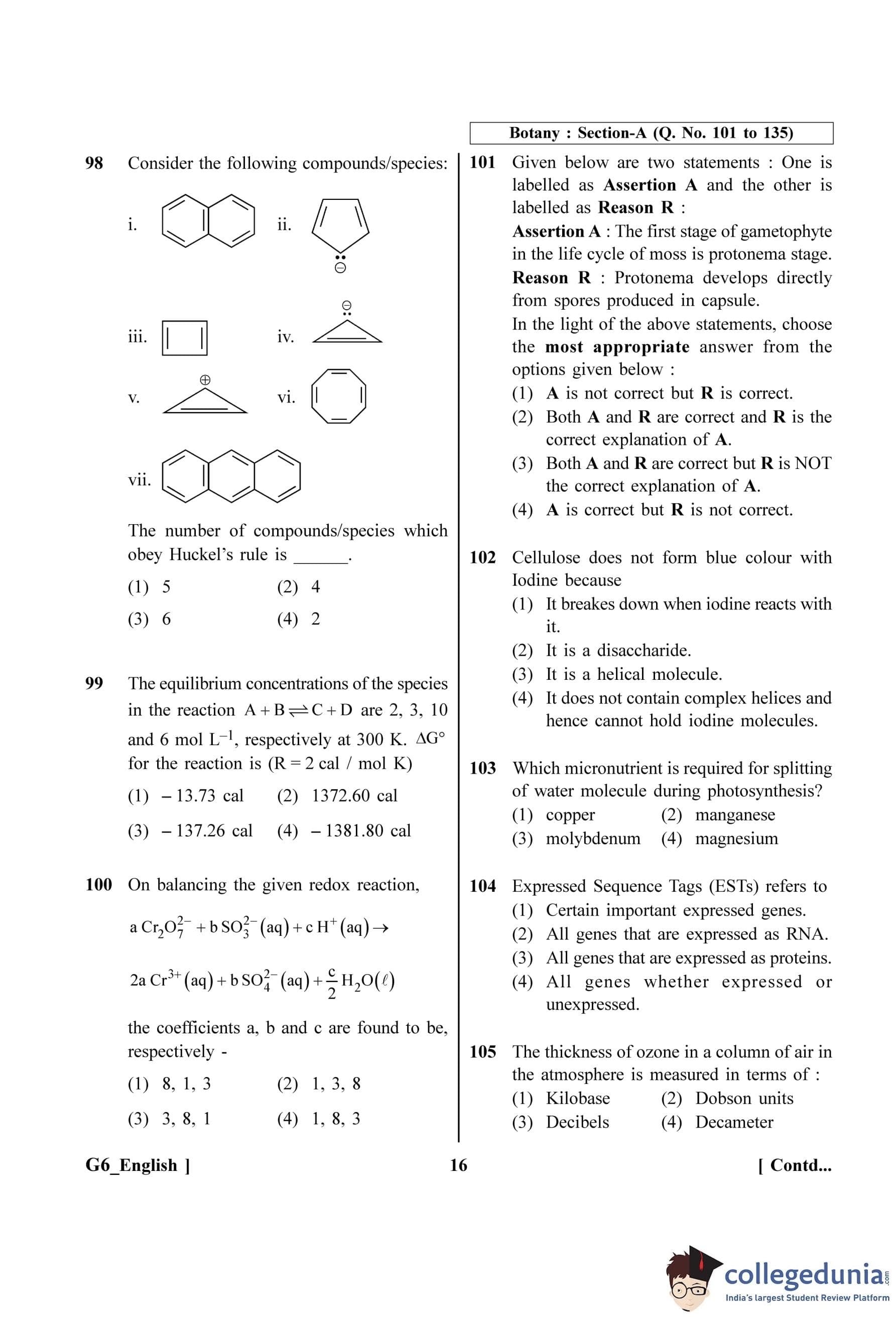
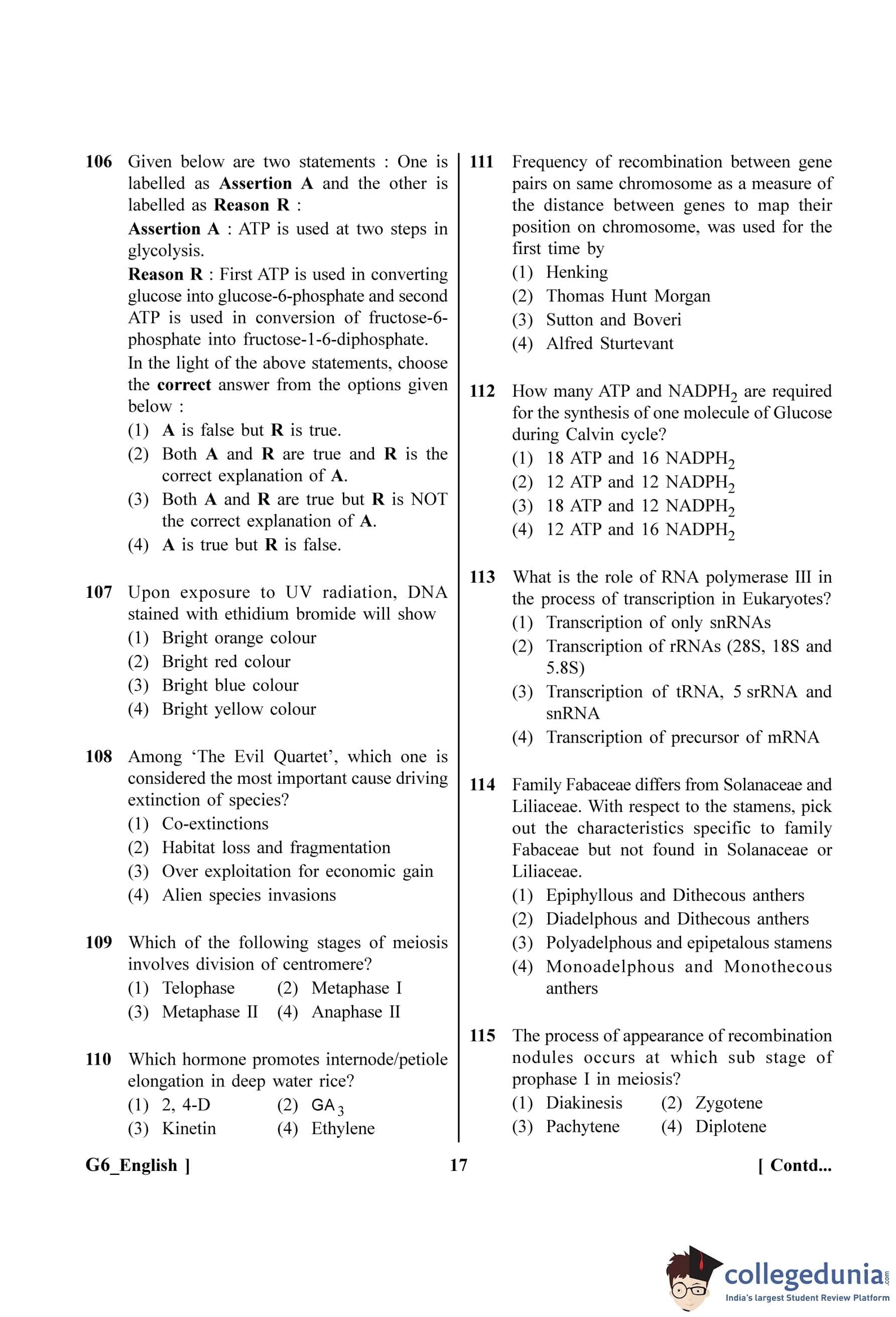
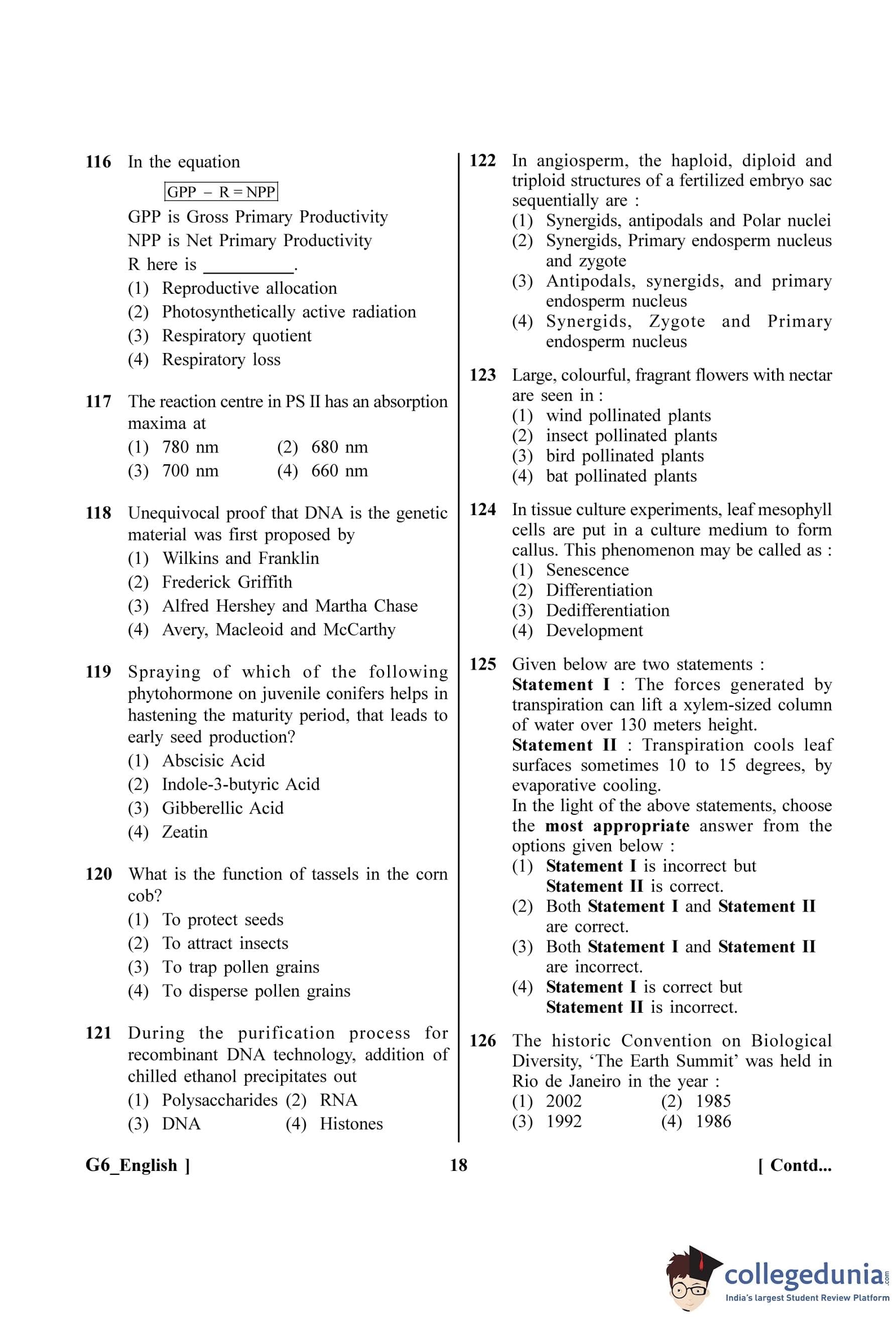
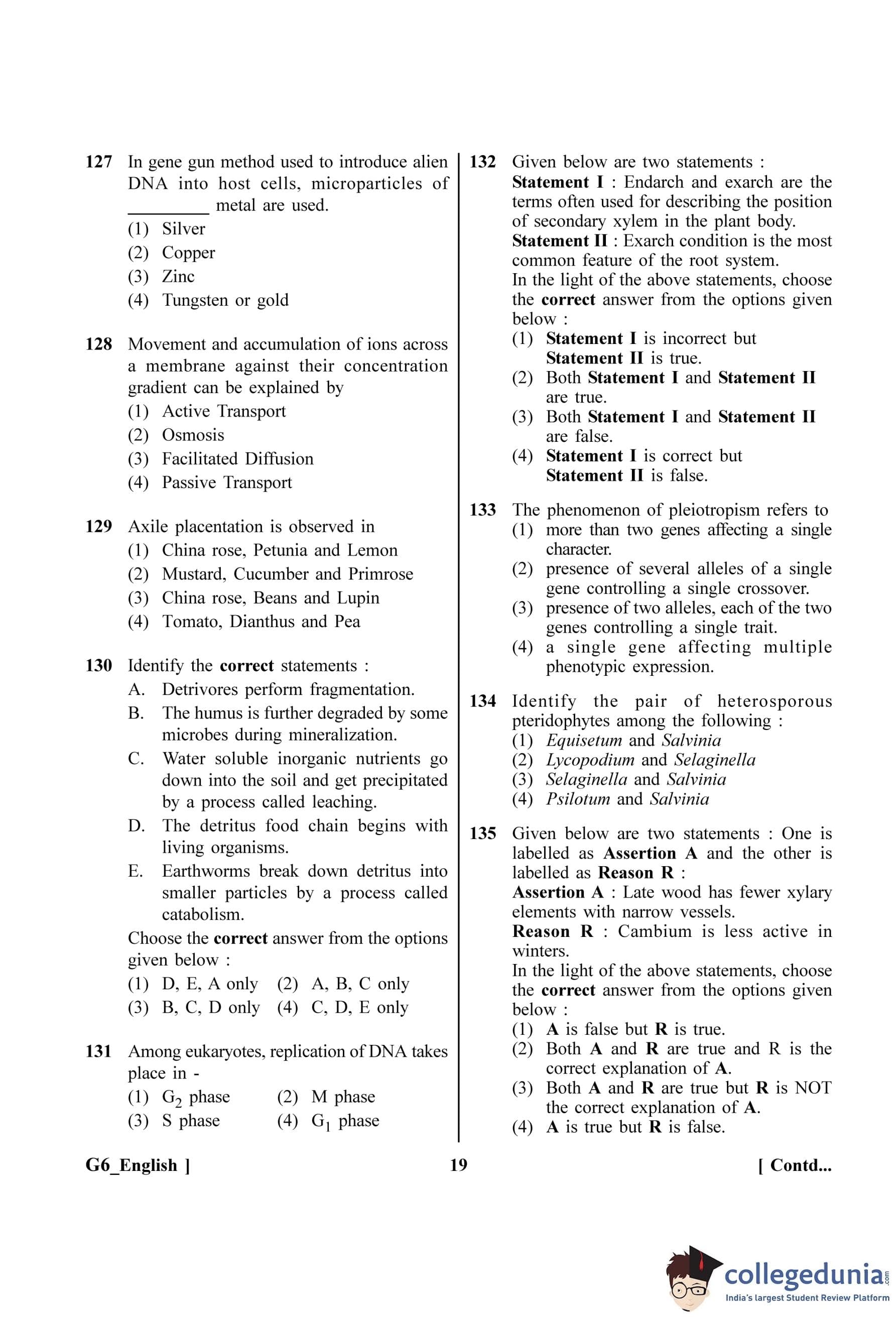
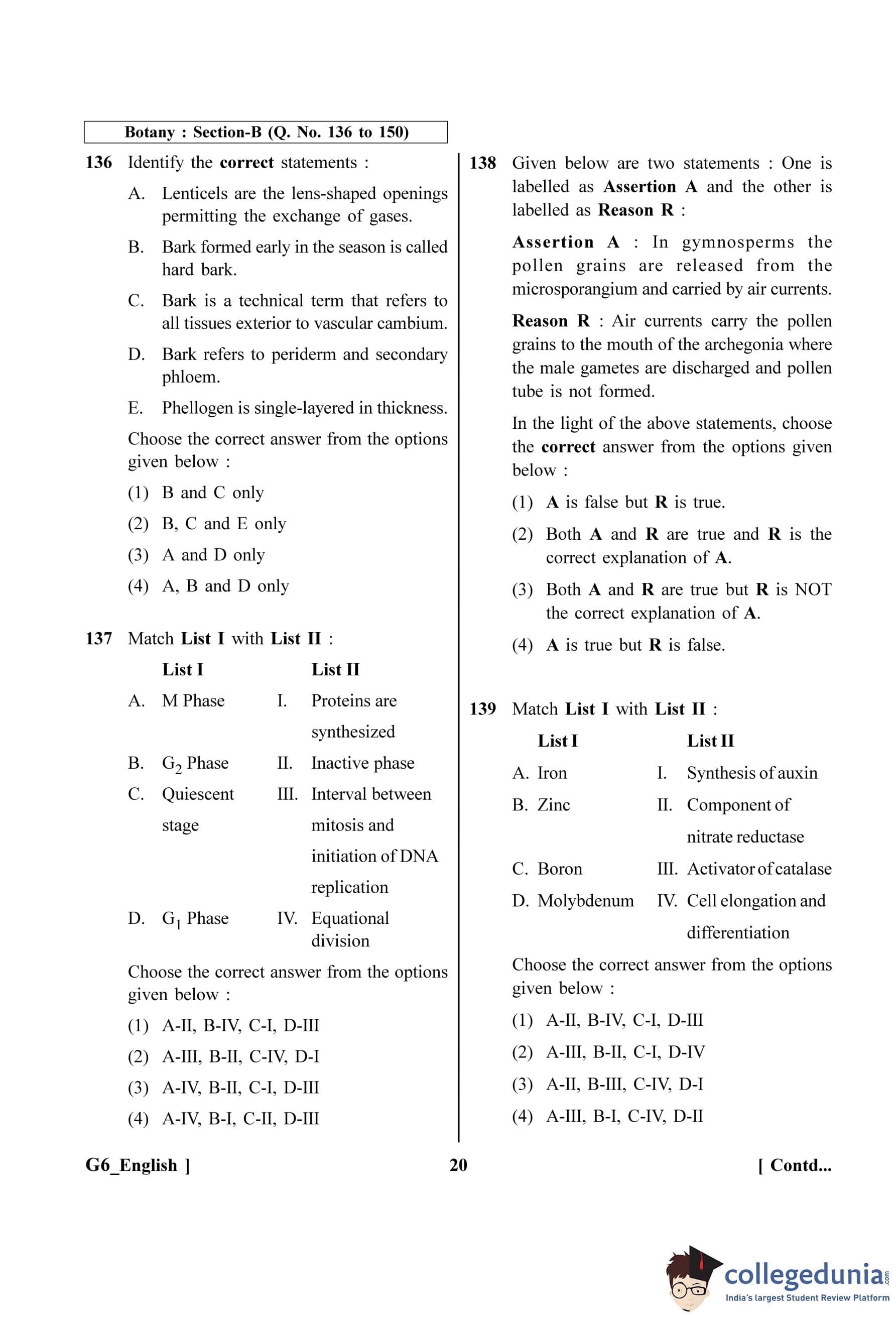
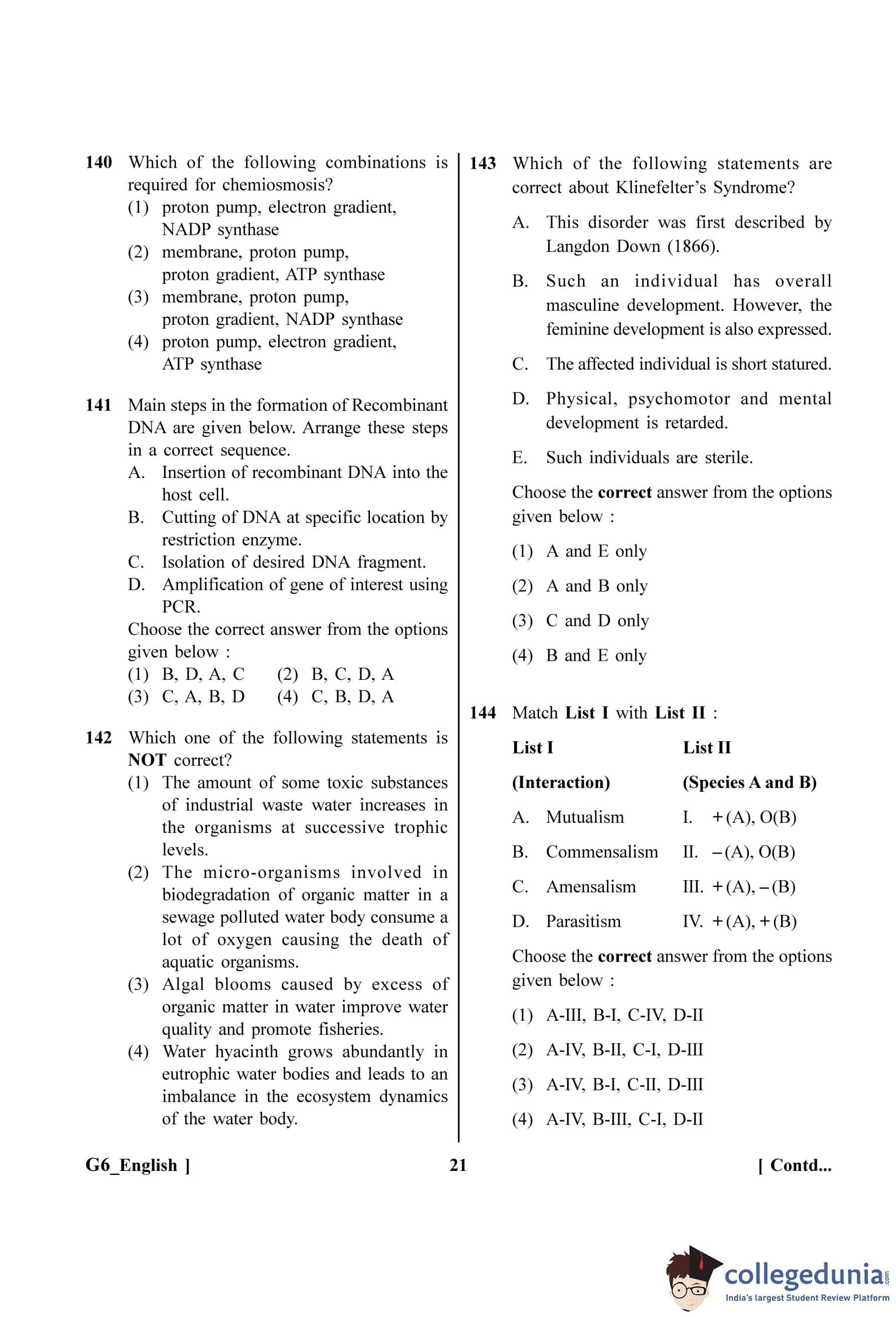
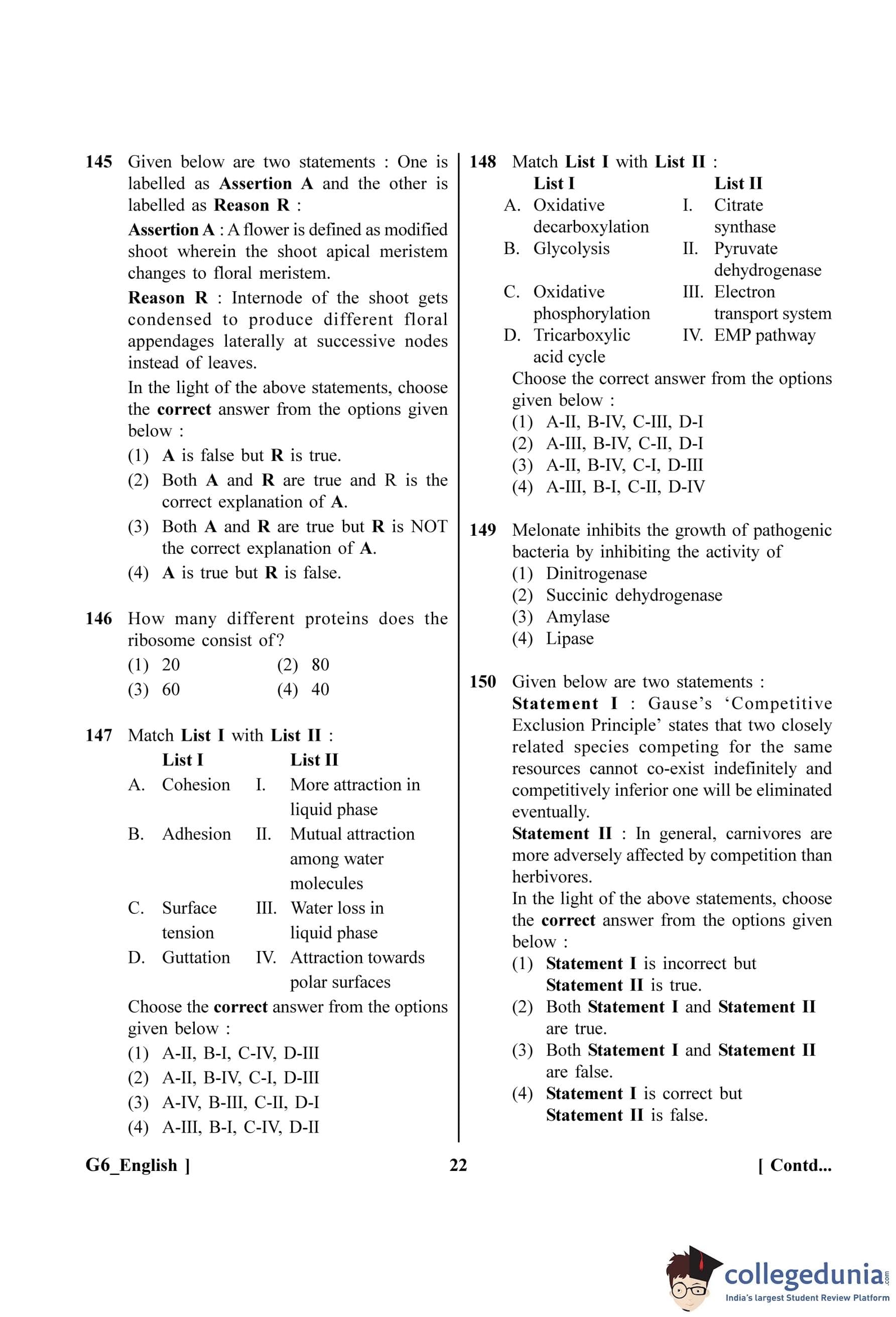
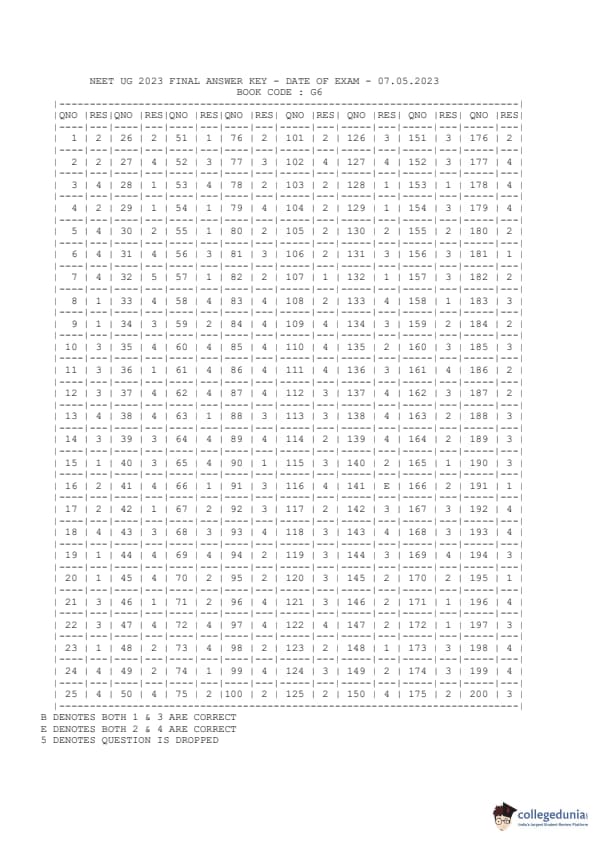
NEET Previous Year Question Papers with Answer Keys
| NEET 2022 Question Papers | NEET 2021 Question Papers | NEET 2020 Question Papers |
| NEET 2019 Question Papers | NEET 2018 Question Papers | NEET 2017 Question Papers |



Comments