


Content Writer-SME
Herbivores and Carnivores are two classes of animals based on their nutritional needs and eating patterns. As certain plants and animals are unable to make their own food, they must rely on food from other plants and animals. Every animal has its own eating habits and nutritional needs. Despite the fact that they are both herbivores and carnivores belong to the same Animal Kingdom, they have a number of variations.
| Table of Content |
Herbivores
[Click Here for Sample Questions]
Herbivores are animals that eat fruits, plants, and plant products as their primary source of nutrition. They have unique characteristics, like large and flat teeth, that enable them to feed on plants. Such characteristics enable them to effortlessly smash the plants.
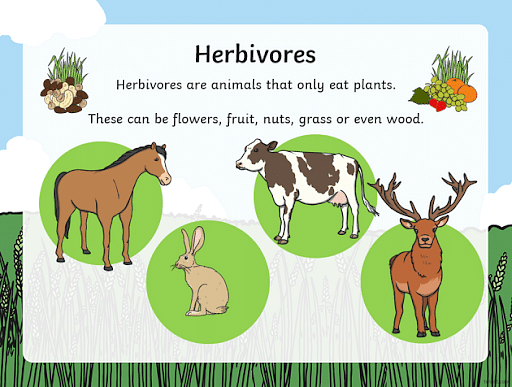
Herbivore
Herbivores have the ability to bring their food to the surface. As a result, the majority of the nutrients in the food are absorbed. They have the ability to detoxify vitamin A in the liver. Carbohydrate digesting enzymes are present in their saliva. Their gut is extremely lengthy.
Herbivores include cows, buffaloes, goats, and deer, to name a few. The mouths of butterflies and hummingbirds are fashioned like straws. This aids them in obtaining nectar.
Characteristics of Herbivorous Animals
[Click Here for Sample Questions]
Herbivorous animals come in a range of forms; some eat a wide variety of plants, while others eat only one type of plant.

Anatomy of Cow (Herbivore)
- Fruit-eating animals are known as frugivores. Fruit bats and flying foxes are examples of frugivores.
- Animals that eat leaves are among the followers. Giraffes, koalas, pandas, caterpillars, and other animals are examples.
- Herbivorous animals that eat wood are known as xylophages. Termites, for example.
- Herbivores that eat nectar are known as nectivores. Butterflies, for example.
- Herbivorous creatures that eat seeds are known as granivores. They're also thought to be seed-eating herbivores. Pigeons, for example.
Carnivores
[Click Here for Sample Questions]
Carnivores are animals that feed on the flesh of other animals. Sharp claws and teeth assist these creatures to seize their prey and tear through their prey's skin, among other adaptations. However, unlike herbivores, they lack some unique characteristics.
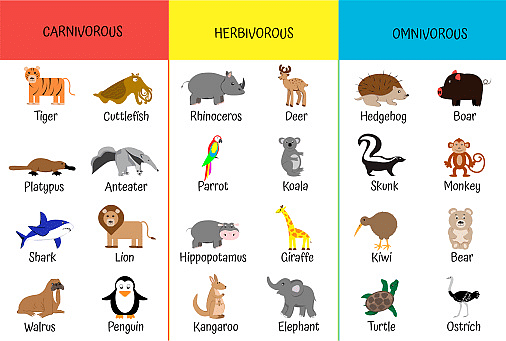
Carnivores and Herbivores
Carnivores' livers are unable to metabolise vitamin A. They don't have carbohydrate digesting enzymes in their saliva. In comparison to herbivores, the gut is likewise somewhat short.
Carnivores include animals such as tigers, lions, and wolves. Their bodies are tough, and their jaws are capable of crushing bones. Carnivorous animals are also divided into groups depending on their feeding patterns and the species they eat.
Characteristics of Carnivorous Animals
[Click Here for Sample Questions]
Various facts about carnivorous creatures are included. These creatures are described as follows based on these facts:
- Red pandas and raccoons, for example, are carnivores who eat very little meat. Carnivorous animals are not all dedicated meat-eaters.
- The only way these animals can move their jaws is up and down. They are unable to move their jaws to the side.
- All carnivores descend from the same ancestor.
- They have a basic and well-organized digestive system.
- Social carnivorous animals include dogs, wolves, and lions, to name a few.
Difference Between Herbivores and Carnivores
[Click Here for Sample Questions]
The main differences between Herbivores and Carnivores are given below:
| Herbivores | Carnivores |
|---|---|
| Plants or plant-based materials are almost solely the major dietary source for herbivores. | Meat, which is produced from other animals, is the principal food source for carnivores. |
| The stomachs of most herbivores have many chambers. In comparison to carnivores, they also have a longer digestive tract. Ruminants are animals that have several stomach chambers. | Carnivores have a more easier digestive system than herbivores. They also have a shorter digestive tract and only one stomach chamber. |
| Herbivores have teeth that are specialized exclusively for eating plant stuff. Cows, for example, have big, flat teeth capable of chewing up plant matter. | Carnivores, on the other hand, have teeth that are designed for hunting and eating flesh. Lions, for example, have sharp incisors and big, pointed canines. Even their molars are capable of shearing meat. |
| Herbivores have particularly adapted skulls and teeth to pulverize tough plants. Herbivores have amylase in their saliva to help break down carbohydrates and coarse fiber found in plant materials. | Carnivores have skulls that can bite with a lot of force. Carnivores' saliva does not include amylase. They must rely on their pancreas to break down carbohydrates instead. |
| Herbivores can be classified into four groups based on the sort of plant material they consume. Granivores (seed-eaters), folivores (leaf eaters), frugivores (fruit eaters), and nectar feeders (nectarivore) | Obligate carnivores and facultative carnivores are the two types of carnivores. Obligate carnivores must eat only meat, but facultative carnivores can eat both meat and non-animal food. |
| Folivores - Sloths and Koalas Granivores - Capybara, grey squirrel Frugivores - Kakapo, Grey parrot, white cockatoo Nectarivore - hummingbirds | Obligate carnivores - Lions, tigers Facultative carnivores - Dogs |
Things to Remember
- Animals that eat plants or plant products are referred to as herbivores. Plants provide them with their food.
- Herbivores have wide, flat teeth that make it easier for them to eat and shatter plants.
- Carnivores are animals that eat other animals' meat.
- Carnivores are in good shape and are quite active. Their bodies are strong.
- The jaws of carnivores are designed to crush and shatter bones
Sample Questions
Ques. Why are herbivores referred to as ruminants? (3 Marks)
Ans. Herbivores are unable to break down cellulose because they lack the necessary enzymes. As a result, they have a shared gut ecology with bacteria like methanogens in the rumen, a specific compartment of their stomach. This bacterium aids in the partial digestion of cellulose and the formation of cud. Herbivorous animals eat this cud again, which is then digested in their long intestines. All of this is done in order to effectively digest the cellulose. As a result, they are known as ruminants.
Ques. Is it possible for plants to be carnivorous? (2 Marks)
Ans. Plants that eat flesh do exist. Venus flytraps, for example, have enzymes that help them digest flesh. They use aromatic scents to attract insects and small birds, then slowly digest them.
Ques. What are the characteristics of a carnivore? (5 Marks)
Ans. Following are the characteristics of carnivorous animals:
- Carnivores have unique dentition that allows them to hunt and kill prey. Baleen whales, for example, are predators because they use their baleen plates as filter-feeding systems to hunt krill. Similarly, most carnivorous mammals kill with sharp canines. In order to inject venom into their prey, venomous reptiles employ fangs that work like hypodermic needles.
- Long sticky tongues are used by some carnivorous creatures like chameleons and a few species of frogs to catch prey.
- Carnivores must pursue down and exhaust their prey, hence they are usually quick.
- Spiders and other arthropods destroy their prey with poison.
- Vitamin A cannot be detoxified in the liver by carnivores.
- Carnivorous animals have a short gut.
Ques. What are herbivores? (2 Marks)
Ans. An herbivore is an animal that eats largely plants. Herbivores range in size from the tiniest insects like aphids to massive elephants. Herbivores are an important part of the food chain, which describes which organisms eat which other organisms in nature.
Ques. What are the basic features of herbivores? (5 Marks)
Ans. Herbivorous animals have the following characteristics:
- Herbivores are creatures that eat plants and plant-based foods and are physically and physiologically functioning.
- Herbivores' digestive systems typically contain mutually balanced microorganisms that aid in the breakdown of plant-based foods and the emission of methane.
- The majority of herbivores have a regurgitating mechanism and chew their meal twice to digest cellulose.
- To digest the cellulose, herbivores have a gut that is around 10 times their body size.
- Herbivores have a unique set of teeth that allow them to effectively chew their food. To crush their food, they normally have powerful and flat molars.
Ques. Is it possible for herbivores to evolve into carnivores? (2 Marks)
Ans. In such a scenario, yes. If a herbivorous species is unable to find food, it may transition to an omnivorous diet, and eventually to full-fledged carnivorous behaviour. However, there are a number of potential hurdles in the way of this evolution, some of which could be fatal to the species.
Ques. Why do carnivores not need vegetables? (3 Marks)
Ans. The digestive systems of carnivores are shorter than those of herbivores. Food passes through the digestive system more quickly because their small intestine is shorter. Because plant cell walls are predominantly formed of cellulose which higher animal digestive enzymes cannot digest or disrupt, it takes longer to digest and requires a longer digestive system to allow for the breakdown and re-absorption of nutrients. As a result, even the nutritional contents of plant cells are not fully digestible.



Comments