




CUET PG 2027, the Common University Entrance Test for Postgraduate, is a national-level entrance exam that is taken for admission into postgraduate programmes in India. CUET PG is conducted by the National Testing Agency (NTA).
NTA has released the CUET 2027 exam dates on its examination calendar:
- CUET PG 2027 is scheduled to be conducted from March 1 to 5, March 8 to 12, March 20, and March 24 to 25, 2027
- March 30 and 31 dates are kept as buffer dates.

Source: NTA Exam Calendar PDF
Candidates need a recognised bachelor’s degree, while final-year students can apply provisionally; universities may have additional requirements.
- Candidates can select up to 4 subject test papers, depending on their chosen PG programmes.
- The exam consists of 75 domain-specific MCQs, carrying 300 marks, with a duration of 90 minutes.
- Each correct answer earns +4 marks, while an incorrect answer carries a -1 mark penalty and unanswered questions receive 0 marks.
- CUET PG syllabus focuses on undergraduate-level domain knowledge, with paper codes divided across Science, Humanities, Commerce, Management, and Languages.
- NTA does not conduct a common counselling process; participating universities independently conduct counselling and prepare their merit lists based on CUET PG scores.
Related Links:
- CUET PG 2027 Registration- Apply Link, Fees, Last Date to Apply and Application Guide
- CUET PG Syllabus 2027: Subject-Wise Syllabus PDF, Important Topics, Exam Pattern, and Books
Key Summary
- CUET PG 2027 does not have a general aptitude section; the paper consists entirely of 75 domain-specific MCQs worth 300 marks, unlike NTA CUET UG, which retains a General Test section.
- CUET PG exam date for the 2027 cycle is tentatively expected between mid to end of March 2027, with CUET PG result and scorecard release expected by end of April to early May 2027.
- CUET PG score is accepted by over 200 universities across India, including JNU, DU, BHU, JMI, and TISS, each running independent counselling and merit lists after the CUET official website declares results.
CUET PG 2027: Important Dates
The NTA has announced the CUET PG 2027 exam dates in its official exam calendar PDF. The CUET PG exam will be conducted from March 1 to 5, March 8 to 12, March 20, and March 24 to 25,2027, with March 30 and 31 kept as buffer dates.
CUET PG 2027 Exam Schedule
| Event | Date |
|---|---|
| CUET PG 2027 | March 1–5, 2027 |
| CUET PG 2027 | March 8–12, 2027 |
| CUET PG 2027 | March 20, 2027 |
| CUET PG 2027 | March 24–25, 2027 |
| Buffer Dates | March 30–31, 2027 |
- Registration must be completed online via the CUET official website.
- The computer-based test takes place across multiple dates and shifts depending on the selected domain subjects.
- After CUET PG result declaration, participating universities handle admissions independently.
| Stage / Event | Tentative Timeline (2027) | 2026 Dates |
|---|---|---|
| Official Notification & Brochure Release | Mid-December 2026 | 14 December 2025 |
| Online Application & Registration Starts | Mid-December 2026 | 14 December 2025 |
| Last Date for Form Submission & Fee Payment | Last week of January 2027 | 14 January 2026 (extended to 23 Jan) |
| Application Form Correction Window | Late January 2027 | 18–20 January 2026 |
| Advance Exam City Intimation Slip Release | Last week of February 2027 | Late February – early March 2026 |
| Admit Card Release | First week of March 2027 | From 3 March 2026 onwards |
| CUET PG Exam Date | March 1–5, March 8–12, March 20, and March 24–25, 2027 (Confirmed) | 6–27 March 2026 |
| Provisional Answer Key & Response Sheet | First week of April 2027 | 11 April 2026 |
| Answer Key Objection Window | Mid-April 2027 | 11–14 April 2026 |
| Final Answer Key & CUET PG Result Date | End of April to Early May 2027 | 24 April 2026 |
| University Counselling & Merit Lists | May to July 2027 | May–July/August 2026 |
Ques. When is the CUET PG exam date for 2027?
Ans. The CUET PG 2027 exam is scheduled to be conducted from March 1 to 5, March 8 to 12, March 20, and March 24 to 25, 2027, as per the NTA examination calendar. March 30 and 31, 2027, have been kept as buffer dates.
Related Link: CUET PG Exam Dates 2027: Subject-Wise Schedule, Dates & Shift Timings
What is CUET PG Exam?
CUET PG serves as a centralized test that participating universities use for postgraduate admissions instead of running separate entrance exams of their own.
- NTA CUET PG covers domain-specific subjects across Humanities, Sciences, Commerce, Management, Law, and Languages.
- Candidates can choose up to 4 test papers based on the programmes they want to apply for.
Subjects under the CUET PG syllabus are classified into unique question paper codes across major groups:
- SCQP (Science courses),
- HUQP (Humanities and Social Sciences),
- COQP (Commerce, Management, and General papers), and
- LAQP (Languages and Linguistics).
| Particular | Details for CUET PG 2027 |
|---|---|
| Conducting Body | National Testing Agency (NTA) |
| Exam Name | Common University Entrance Test for Postgraduate (CUET PG) |
| Subjects Covered | Domain-specific subjects across Humanities, Sciences, Commerce, Management, Law, and Languages (up to 4 papers) |
| Exam Level | National-level postgraduate entrance exam |
| Exam Mode | Computer-Based Test (CBT / Online) |
| Total Questions | 75 questions (all domain-specific MCQs) |
| Total Marks | 300 marks |
| Marking Scheme | +4 for each correct answer; -1 for each incorrect answer |
| Passing Score | No fixed passing score; admission depends on cut-offs and merit lists released by individual universities |
| Basic Eligibility | Bachelor's degree (or equivalent) in a relevant discipline, or appearing in the final year of graduation |
| Age Limit | No upper age limit set by NTA (individual universities may set their own) |
| Application Mode | Online only |
| CUET Official Website | exams.nta.nic.in/cuet-pg |
Ques. What is the CUET PG full form?
Ans. The CUET PG full form is Common University Entrance Test for Postgraduate, a national-level exam conducted by the NTA for admission into postgraduate programmes across participating universities.
Also Check:
CUET PG Exam Eligibility Criteria 2027
To be eligible for the CUET PG 2027 exam, candidates must fulfill the basic guidelines set by the NTA.
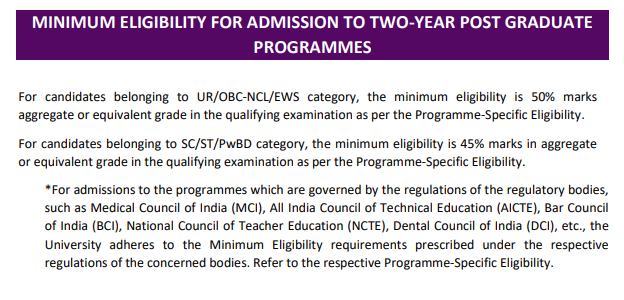
- Basic Eligibility: Candidates need a recognised bachelor’s degree or equivalent. Final-year students can also apply provisionally.
- University-Specific Rules: NTA generally does not set minimum marks or an upper age limit
- However, individual universities may have additional eligibility requirements for specific PG programmes.
| Eligibility Parameter | Criteria |
|---|---|
| Educational Qualification |
|
| Minimum Graduation Marks |
|
| Age Limit |
|
| Nationality |
|
| Course-Specific Eligibility |
|
Source: CUET PG Information Bulletin 2026
Also Check:
CUET PG Application Process 2027
The CUET PG 2027 application process is conducted completely online through the CUET official website. The process involves a sequential series of steps, from initial registration to final fee payment.
| Step | Application Stage | Key Actions |
|---|---|---|
| Step 1 | Online Registration |
|
| Step 2 | Fill Application Form |
|
| Step 3 | Select University & Test Papers |
|
| Step 4 | Upload Documents |
|
| Step 5 | Pay Application Fee |
|
CUET PG 2027 Application Fee
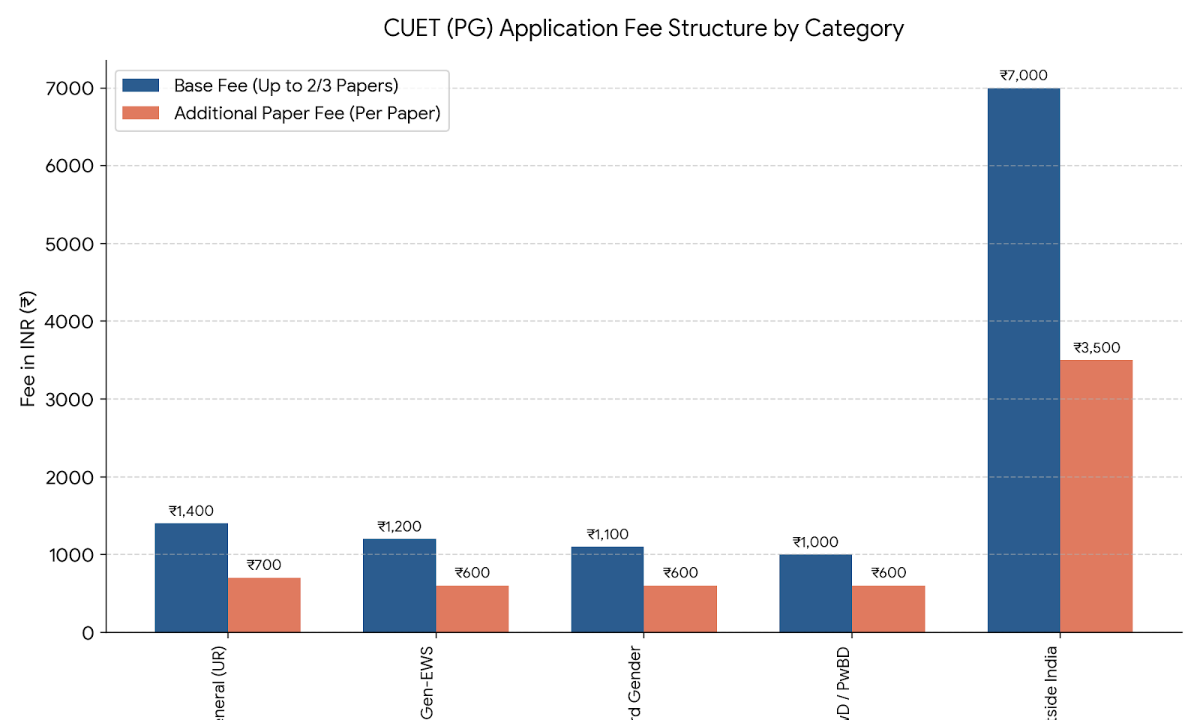
The CUET PG 2027 application fee depends on the candidate's category and the number of test papers chosen. The base fee covers up to two test papers, with an additional fee per paper for up to 4 papers.
- Payment can only be made online using Credit Card, Debit Card, Net Banking, or UPI via the CUET official website.
- GST and standard bank processing fees may be added dynamically at checkout, and once paid, the application fee is non-refundable and non-transferable.
| Category | Base Application Fee (Up to 2 Test Papers) | Fee for Additional Papers (Per Extra Paper) |
|---|---|---|
| General (UR) | ₹1,400 | ₹700 |
| OBC-NCL / General-EWS | ₹1,200 | ₹600 |
| SC / ST / Third Gender | ₹1,100 | ₹600 |
| PwD / PwBD | ₹1,000 | ₹600 |
| Outside India (International) | ₹7,000 (covers up to 3 papers) | ₹3,500 |
Also Check:
- CUET PG English Syllabus 2027: Download PDF, Exam Pattern, Books, Tips
- CUET PG Physics Syllabus 2027: Download PDF, Books, Question Paper
- CUET PG Mathematics Syllabus 2027: Subject-Wise Topics, Topic-Wise Weightage and PDF Download
Documents Required for CUET PG Registration 2027
To ensure smooth CUET PG 2027 registration without last-minute errors, candidates should gather and organize documents in advance.
- Photo & Signature: Upload a recent photograph and clear signature in the prescribed JPG/JPEG format and file-size limits.
- Category Certificates: SC/ST/OBC-NCL/Gen-EWS and PwBD candidates must upload the relevant certificates in the prescribed PDF format and size limits.
| Document | Specifications & Format | File Size Limit |
|---|---|---|
| Passport-Sized Photograph | Recent colour or black-and-white photo, plain white background, full face visible without mask or sunglasses (spectacles allowed) | 10 KB – 200 KB (JPG/JPEG) |
| Candidate's Signature | Signed with black ink pen on clean white paper, scanned clearly | 4 KB – 30 KB (JPG/JPEG) |
| Category Certificate (if applicable) | Required for SC, ST, OBC-NCL, or Gen-EWS categories | 50 KB – 300 KB (PDF) |
| PwBD Certificate (if applicable) | Required for Persons with Benchmark Disabilities to claim reservation/scribe facilities | 50 KB – 300 KB (PDF) |
Candidates do not need to upload the following but must enter exact details from them during the application process:
- Valid Photo ID Proof: Registration number of a government-issued ID (Aadhaar Card, PAN Card, Voter ID, Passport, Driving License, or Ration Card)
- Educational Certificates: Class 10th & 12th Marksheets and Graduation Marksheet/Degree Certificate for aggregate marks, percentages, roll numbers, and passing years
- Active Contact Information: A valid personal Email ID and active Mobile Number, since the NTA sends OTPs, application updates, and CUET PG result details exclusively to these channels
Also Check:
CUET PG Year-wise Question Paper Download
| CUET PG Year-wise Question Paper Download | |
|---|---|
| CUET PG Question Paper 2025 | CUET PG 2024 Question Paper |
| CUET PG 2023 Question Paper | CUET PG 2022 Question Paper |
CUET PG Exam Pattern 2027
The CUET PG 2027 paper consists purely of 75 domain knowledge questions. The general section (English, General Awareness, and Mathematical Ability) has been removed, unlike NTA CUET UG, which still retains a General Test section.
- Marking Scheme: Each correct answer carries +4 marks
- An incorrect answer results in a -1 mark penalty
- Unanswered questions receive 0 marks.
| Parameter | Details |
|---|---|
| Mode of Examination | Computer-Based Test (CBT / Online) |
| Type of Questions | Multiple Choice Questions (MCQs) with 4 options |
| Total Number of Questions | 75 Questions (all domain-specific) |
| Maximum Marks | 300 Marks |
| Exam Duration | 90 Minutes (1.5 Hours) |
| Medium of Paper | Bilingual (English & Hindi) by default, except specific language and linguistic papers |
Also Check:
CUET PG Syllabus 2027
The CUET PG syllabus for each subject is strictly based on the undergraduate (Bachelor's degree) curriculum for that specific domain.
Since the exam consists entirely of 75 domain-specific MCQs, the CUET PG exam syllabus focuses purely on core subject concepts rather than a general test.
CUET PG Syllabus for Science Stream
| PG Programme | Paper Code | Major Topics |
|---|---|---|
| M.Sc. Physics | SCQP24 | Mathematical Methods; Mechanics & General Properties; Oscillations, Waves & Optics; Electricity & Magnetism; Kinetic Theory & Thermodynamics; Modern Physics & Quantum Mechanics |
| M.Sc. Chemistry | SCQP08 | Physical Chemistry; Organic Chemistry; Inorganic Chemistry |
| M.Sc. Mathematics | SCQP19 | Algebra; Real & Complex Analysis; Differential Equations; Vector Calculus & Geometry |
| M.Sc. Life Sciences / Biotechnology | SCQP17 / SCQP03 | Cell Biology & Genetics; Biochemistry & Molecular Biology; Microbiology & Immunology; Plant & Animal Sciences |
CUET PG Syllabus for Commerce, Management & Law
| PG Programme | Paper Code | Major Topics |
|---|---|---|
| MBA | COQP12 | Quantitative Ability; Data Interpretation & Logical Reasoning; Verbal Ability & Reading Comprehension |
| M.Com. / Commerce | COQP07 | Financial & Cost Accounting; Business Organisation & Management; Economics; Business Laws & Statistics |
| LL.M. / Law | COQP14 | Constitutional Law; Jurisprudence; Law of Contracts & Torts; Criminal Law & Consumer Protection |
CUET PG Syllabus for Humanities & Social Sciences
| PG Programme | Paper Code | Major Topics |
|---|---|---|
| M.A. Economics | COQP10 | Micro & Macroeconomics; Statistical & Mathematical Methods; Indian Economy & Development |
| M.A. English | LAQP01 | History of English Literature; Literary Genres; Literary Criticism & Theory; Linguistics & Grammar |
| M.A. Political Science | HUQP18 | Political Theory & Thought; Comparative Politics & International Relations; Indian Government & Politics |
Ques. Is there a CUET PG general test syllabus like CUET UG?
Ans. No, there is no separate CUET PG general test syllabus; the general section covering English, General Awareness, and Mathematical Ability has been removed, and CUET PG 2027 now consists entirely of 75 domain-specific questions per chosen subject.
Also Check the Detailed Syllabus for:
| Subject Code | Subject Name |
|---|---|
| SCQP07 | Botany (SCQP07) |
| SCQP08 | Chemistry (SCQP08) |
| SCQP09 | Computer Science and Information Technology (SCQP09) |
| SCQP17 | Life Sciences (SCQP17) |
| SCQP24 | Physics (SCQP24) |
| SCQP27 | Statistics (SCQP27) |
| SCQP28 | Zoology (SCQP28) |
| MTQP05 | Electronics, Communication and Information Engineering (MTQP05) |
| MTQP07 | Mechanical Engineering (MTQP07) |
| MTQP10 | Electrical, Power and Energy Engineering (MTQP10) |
| LAQP01 | English |
| LAQP02 | Hindi |
| HUQP09 | History |
| HUQP18 | Political Science |
| HUQP26 | Geography |
| COQP03 | B.Ed. |
| COQP04 | B.Ed. Humanities and Social Science |
| COQP05 | B.Ed. Languages |
| COQP06 | B.Ed. Science |
| COQP07 | B.Ed. Mathematics |
| COQP14 | Law (LLM) |
CUET PG 2026 Question Paper with Solution PDF – Available
| CUET PG 2026 Question Paper | Question Paper PDF | Solution PDF |
|---|---|---|
| CUET PG 2026 Botany Question Paper | Download PDF | Check Solutions |
| CUET PG 2026 B.Ed. Languages Question Paper | Download PDF | Check Solutions |
| CUET PG 2026 Horticulture Question Paper | Download PDF | Check Solutions |
| CUET PG 2026 Geophysics Question Paper | Download PDF | Check Solutions |
| CUET PG 2026 Civil & Structural Engineering Question Paper | Download PDF | Check Solutions |
| CUET PG 2026 LLM Question Paper | Download PDF | Check Solutions |
| CUET PG 2026 Food Engineering Question Paper | Download PDF | Check Solutions |
| CUET PG 2026 Microbiology Question Paper | Download PDF | Check Solutions |
| CUET PG 2026 Electronics & Communication Engineering Question Paper | Download PDF | Check Solutions |
| CUET PG 2026 Economics Question Paper | Download PDF | Check Solutions |
| CUET PG 2026 Computer Science Question Paper | Download PDF | Check Solutions |
| CUET PG 2026 Chemistry Question Paper | Download PDF | Check Solutions |
| CUET PG 2026 Commerce Question Paper | Download PDF | Check Solutions |
| CUET PG 2026 Punjabi Question Paper | Download PDF | Check Solutions |
| CUET PG 2026 Political Science Question Paper | Download PDF | Check Solutions |
| CUET PG 2026 B.Ed Question Paper | Download PDF | Check Solutions |
| CUET PG Yoga Question Paper 2026 | Download PDF | Check Solutions |
| CUET PG Sports Question Paper 2026 | Download PDF | Check Solutions |
| CUET PG Sanskrit Question Paper 2026 | Download PDF | Check Solutions |
| CUET PG Textile Design Question Paper 2026 | Download PDF | Check Solutions |
| CUET PG 2026 Applied Geography / Geoinformatics Question Paper | Download PDF | Check Solutions |
| CUET PG 2026 Statistics Question Paper | Download PDF | Check Solutions |
| CUET PG 2026 B.Ed. Mathematics Question Paper | Download PDF | Check Solutions |
| CUET PG 2026 French Question Paper | Download PDF | Check Solutions |
| CUET PG 2026 Data Science Question Paper | Download PDF | Check Solutions |
| CUET PG 2026 Home Science Question Paper | Download PDF | Check Solutions |
| CUET PG 2026 M.A. Education | Download PDF | Check Solution |
| CUET PG 2026 Forensic Science | Download PDF | Check Solution |
| CUET PG 2026 Disaster Studies | Download PDF | Check Solution |
| CUET PG 2026 Fine Arts | Download PDF | Check Solution |
| CUET PG 2026 Political Science | Download PDF | Check Solution |
| CUET PG 2026 Master of Physiotherapy | Download PDF | Check Solution |
| CUET PG 2026 Computer Science | Download PDF | Check Solution |
| CUET PG 2026 Chemistry | Download PDF | Check Solution |
| CUET PG 2026 Commerce | Download PDF | Check Solution |
| CUET PG 2026 Sahitya (Hindi) | Download PDF | Check Solution |
| CUET PG 2026 B.Ed. Humanities | Download PDF | Check Solution |
| CUET PG 2026 Economics | Download PDF | Check Solution |
| CUET PG 2026 English | Download PDF | Check Solution |
| CUET PG 2026 Library & Information Science | Download PDF | Check Solution |
| CUET PG 2026 History | Download PDF | Check Solution |
| CUET PG 2026 Bioinformatics | Download PDF | Check Solution |
| CUET PG 2026 Nanoelectronics | Download PDF | Check Solution |
| CUET PG 2026 Life Science | Download PDF | Check Solution |
| CUET PG 2026 Architecture & Planning | Download PDF | Check Solutions |
| CUET PG 2026 Mathematics / Applied Math / Electronics | Download PDF | Check Solutions |
| CUET PG 2026 Theatre | Download PDF | Check Solutions |
| CUET PG 2026 Public Health | Download PDF | Check Solutions |
| CUET PG 2026 Sociology | Download PDF | Check Solutions |
| CUET PG 2026 Mechanical Engineering | Download PDF | Check Solutions |
| CUET PG 2026 Russian | Download PDF | Check Solutions |
| CUET PG 2026 Mass Communication | Download PDF | Check Solutions |
CUET PG Exam Preparation Tips 2027
A focused preparation strategy can help candidates cover the syllabus effectively while improving speed, accuracy, and question-solving skills.
- Follow the Syllabus: Use the exact NTA paper code, cover high-yield units first
- Study concepts from standard bachelor’s-level textbooks.
- Practise & Analyse: Solve PYQs and timed mocks regularly; manage the +4/-1 marking scheme
- Analyse recurring question trends to improve accuracy and speed.
| Preparation Area | What to Do |
|---|---|
| Download the Exact Syllabus | Download the NTA CUET PG syllabus for the specific subject paper code, such as SCQP24 for Physics or COQP12 for MBA |
| Use Bachelor's Books | Map the syllabus topics to standard undergraduate textbooks and use them for conceptual preparation |
| Identify High-Yield Units | Separate topics already known well from those needing more conceptual preparation |
| Manage Time | Practise solving 75 questions in 90 minutes, giving about 1.2 minutes per question |
| Handle Negative Marking | With +4 for correct and -1 for wrong answers, avoid blind guessing and use option elimination |
| Practise Skimming | Skip lengthy questions during the first pass and return to them in the second pass |
| Solve Previous Year Questions | Practise CUET PG papers from 2024, 2025 and 2026 to understand NTA's question style and difficulty |
| Track Question Trends | Analyse PYQs to identify units and topics that are repeatedly tested |
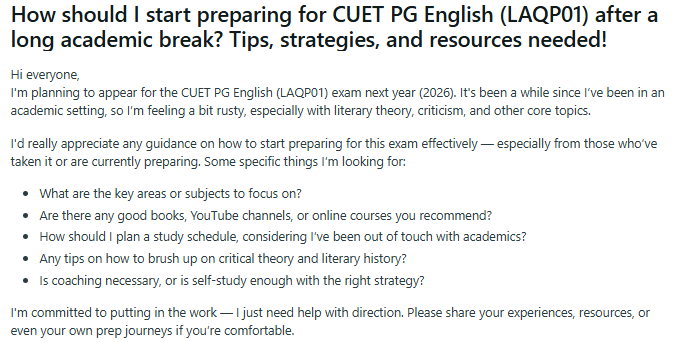
As per students on Reddit, below are some effective tips for MA English to employ in your CUET PG preparation:
- Prioritize literary theory, criticism, Indian literature, and the history of English literature.
- Don't skip current affairs and general knowledge related to literature, as this area carries significant weight.
- Study Peter Barry for literary theory and criticism, and thoroughly review M.H. Abrams for literary terms, as questions are often directly drawn from it.
- For Indian literature, supplement standard sources like A.K. Mehrotra with material covering Sanskrit literature.
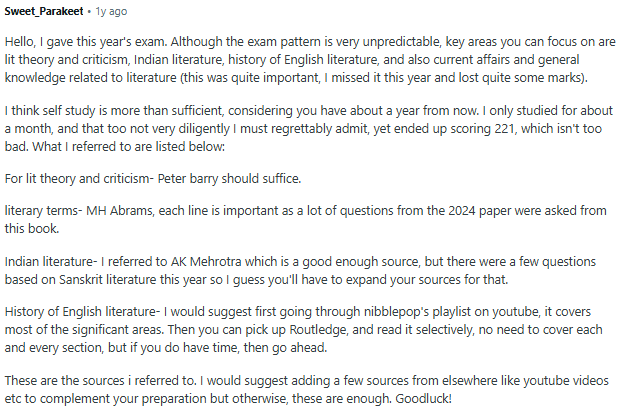
Source: Reddit
Check out the Handwritten Notes:
CUET PG Admit Card 2027
The CUET PG 2027 admit card will be issued exclusively online by the NTA. Physical hall tickets are not sent by post. Candidates must log in to the CUET official website to download and print the document.
Make sure to carefully cross-verify the following information as soon as you download the document:
- Candidate’s Name, Roll Number, and Application Number.
- Exact Exam Date, Shift Timing, and Reporting Time.
- Name & Address of the Allotted Exam Centre.
- Chosen subject paper name and its respective code (e.g., SCQP24, COQP12).
- NTA Exam-Day Instructions and a Self-Declaration (Undertaking) Form regarding health and travel rules.
Also Check:
CUET PG Result and Scorecard 2027
The CUET PG 2027 result and scorecard will be compiled and officially declared by the NTA. The digital CUET PG scorecard is a document used for university counselling. It displays:
- Candidate Credentials: Full Name, Roll Number, Application Number, Parents' Names, Category, Gender, and Date of Birth
- Subject Specifics: The unique subject paper code attempted (e.g., COQP12 for MBA, SCQP24 for Physics)
- Performance Metrics: Raw marks obtained out of 300, alongside the relative NTA Score/Percentile (calculated up to 7 decimal places to minimize tie-breaking errors)
- Visual Identifiers: Uploaded photograph and digital signature
The NTA evaluates and reports absolute raw marks as the final base metric for ranking. If subjects are completed smoothly in a single shift, candidates are graded strictly on their exact absolute performance.
Ques. When is the CUET PG result date expected for 2027?
Ans. The CUET PG result date for 2027 is tentatively expected between end of April and early May 2027, in line with the final answer key release for that cycle.
Also Check:
CUET PG Exam Cutoff 2027
The NTA does not release a centralized rank list or common merit cut-off for CUET PG admissions. Once candidates receive their CUET PG scorecard, they must visit the independent portals of their chosen universities (such as Delhi University, JNU, or BHU).
- Each institution opens its own counselling window, evaluates the scores submitted by its applicants
- They also publishes separate merit selection lists based on its specific seat quotas.
- Unlike exams like JEE or NEET, the NTA only provides a scorecard containing raw marks (and percentile scores if the exam was conducted in multiple shifts).
University-Specific Ranks: When applying to individual universities using the CUET PG score, each university creates its own internal merit list.
A candidate might rank #5 on the Delhi University merit list for M.A. English, but rank #2 on the BHU merit list for the exact same course. This depends entirely on who else applied to that specific university.
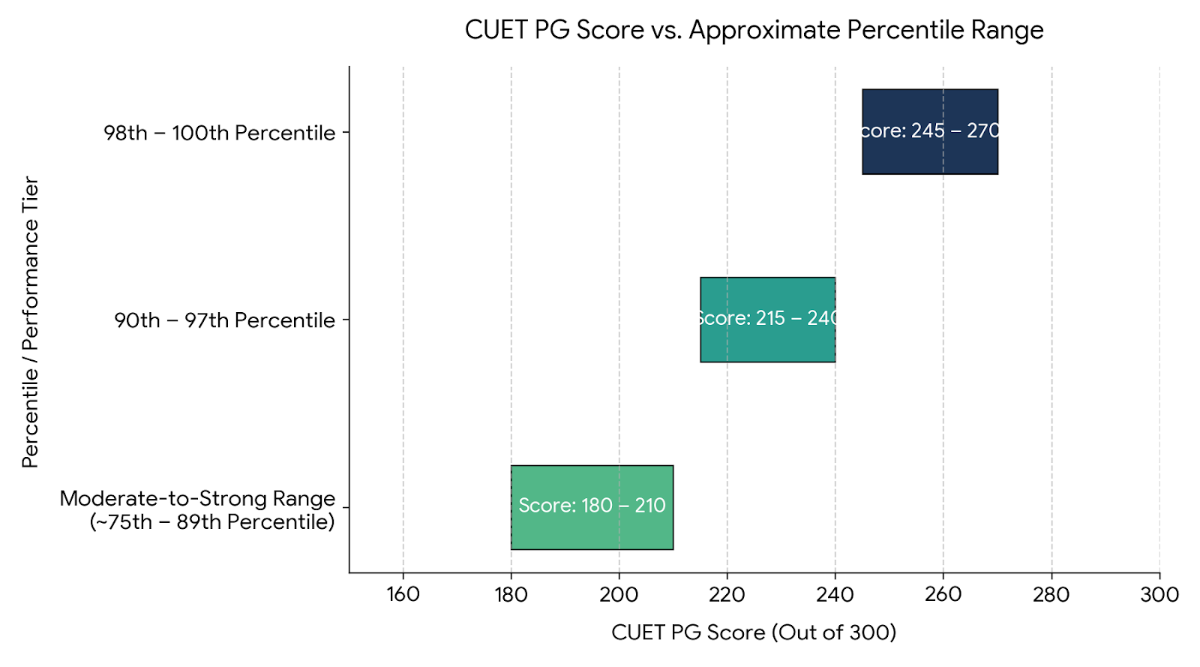
| CUET PG Score Range (Out of 300) | Approximate Percentile | Admission Prospects |
|---|---|---|
| 245 – 270+ | 98th – 100th Percentile |
|
| 215 – 240 | 90th – 97th Percentile |
|
| 180 – 210 | Moderate-to-strong range |
|
Also Check:
CUET PG 2027: Counselling and Admission
There is no centralized online portal that automatically assigns a college seat based on the CUET PG score. Instead, each participating university conducts its own independent counselling and admission rounds, including DU PG registration through its CSAS PG portal.
- Accept Early Allocation: Accept the allotted seat to remain eligible for further counselling rounds.
- Upgrade Option: Candidates who accept a seat can choose the Upgrade option in the next round.
- Rejection Impact: Rejecting or ignoring an allotted seat may remove the candidate from subsequent rounds of that university.
- Spot Admissions: Vacant seats may be filled through Spot Admissions, giving candidates another opportunity to secure admission.
| Step | Counselling Stage | Key Actions |
|---|---|---|
| Step 1 | Institutional Registration |
|
| Step 2 | Course & College Preference Filling |
|
| Step 3 | Merit List Declaration & Seat Allocation |
|
| Step 4 | Document Verification & Fee Payment |
|
Also Check:
Top Universities Accepting CUET PG Score
The CUET PG cut-offs vary across universities, courses, and candidate categories.
- Top Universities: Leading CUET PG participating universities include several highly ranked institutions, making admission competitive.
- Category-Wise Cut-offs: OBC-NCL/EWS candidates may have cut-offs around 15–25 marks lower, while SC/ST cut-offs can be around 40–60 marks lower than the General category.
| Institution | Key / Famous PG Streams | Safe Target Score (General Category / Out of 300) |
|---|---|---|
| Jawaharlal Nehru University (JNU), Delhi | M.A. Economics, Political Science, International Relations, MCA | 230 – 260+ (85th–98th percentile) |
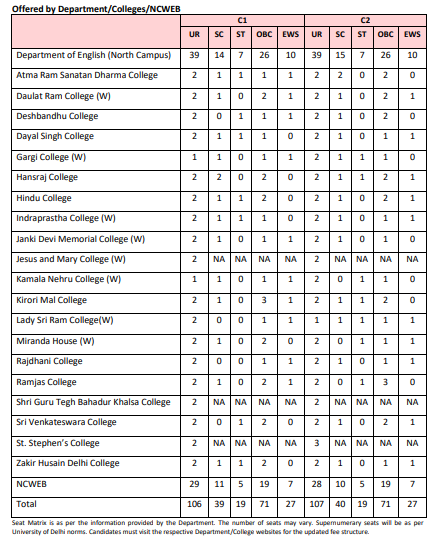
| University of Delhi (DU) | M.Sc. Chemistry/Physics M.A. English, M.Com, LL.M. | 210 – 245+ (North Campus colleges require the highest scores) |
| Banaras Hindu University (BHU), Varanasi | M.Sc. Botany/Zoology, M.A. Humanities, MBA | 190 – 235+ (Sciences generally require higher benchmarks than Humanities) |
| Jamia Millia Islamia (JMI), Delhi | M.A. History, Media/Mass Comm, Education courses | 200 – 230+ |
| Tata Institute of Social Sciences (TISS), Mumbai | M.A. HRM, Public Policy, Social Work | 240 – 260+ (HRM is exceptionally competitive) |
| University of Hyderabad (UoH) | M.Sc. Life Sciences, Biotechnology, M.A. Economics | 180 – 215+ |
| Pondicherry University | M.Sc. Marine Biology, Operational Research, Management | 160 – 190+ |
| Central University of Punjab / Rajasthan | Data Science, Cyber Security, Core Sciences | 150 – 180+ |
CUET PG 2027 FAQs
Ques. What is CUET PG, and what is the CUET PG full form?
Ans. CUET PG full form is Common University Entrance Test for Postgraduate. It is a national-level entrance exam conducted by the NTA for admission into postgraduate programmes across participating Indian universities.
Ques. How is CUET PG different from NTA CUET UG?
Ans. NTA CUET PG consists entirely of 75 domain-specific MCQs with no general test section, while NTA CUET UG includes languages, domain subjects, and a separate General Test covering aptitude and general knowledge.
Ques. Where can candidates check CUET PG exam syllabus and CUET PG general test syllabus details?
Ans. The CUET PG exam syllabus for each paper code is published on the CUET official website; there is no separate CUET PG general test syllabus, since the general section has been discontinued for postgraduate admissions.
Ques. How is DU PG registration linked to the CUET PG score?
Ans. After CUET PG results are declared, candidates must separately complete DU PG registration on Delhi University's CSAS PG portal, upload their CUET PG scorecard and documents, and participate in DU's independent merit-list rounds.
Ques. How long is a CUET PG scorecard valid?
Ans. A CUET PG scorecard is generally used for admission in the same academic session it is issued for, since each university conducts its own counselling cycle immediately after the CUET PG results are declared.



Comments
Found 199 Comments
With 65 marks in CUET PG for M.Sc. Botany under the SC category, your chances in top government universities are low, but you may still get admission in lower cut-off central or state universities. Participate in counseling, consider multiple options, and keep backup colleges ready to improve your chances.
With 96 marks in CUET for Biochemistry, top central universities like University of Delhi or Banaras Hindu University may be difficult. You can target state or private universities like Lovely Professional University or Amity University where admission chances are higher depending on cut-offs and availability.
With 96 marks in Common University Entrance Test for MCA, chances in top universities are low. You may target private or state universities like Amity University, Chandigarh University, or lesser competitive central universities depending on cutoffs, category, and counselling rounds.
With a 100/300 in CUET PG for English and PwD (85%), chances at the University of Delhi are low for top colleges, as cutoffs are higher. However, you may still get admission to less competitive colleges or later rounds depending on seat availability and category reservation.
Eligibility for M.Sc. Food Technology in government institutes like Banaras Hindu University and Central Food Technological Research Institute requires a B.Sc. degree in Food Science, Food Technology, Microbiology, Biochemistry, Nutrition, or related science subjects. If your Clinical and Nutritional Dietetics vocational UG includes core science subjects, you may be eligible; however, eligibility depends on each institute’s specific criteria.
To download 5 years of previous year question papers for MPT (CUET-PG) officially, go to the National Testing Agency (NTA) website at nta.ac.in and open the “Downloads/Question Papers” section. Select CUET-PG, choose the year and MPT subject code, and download the PDFs. This gives you past papers directly from the exam authority.
To officially download CUET PG sample/previous year papers, visit the National Testing Agency (NTA) CUET-PG official portal at cuet.nta.nic.in or exams.nta.ac.in/CUET-PG, then go to the “Downloads” section and choose your exam year, paper type, and subject to get the PDF files. These are the authentic question papers released by NTA for practice
The official question bank for CUET UG General Test (LAQP01) can be downloaded from the National Testing Agency’s CUET portal. Visit cuet.samarth.ac.in, open the ‘Question Papers / Mock Tests’ or ‘Sample Papers’ section, select CUET UG, choose subject, language, and download the PDF for authentic practice and exam-oriented preparation material officially.
You can check here for the CUET PG Question Paper (Available): Check the Previous Year Question Paper with Solution PDF
You can check here for the CUET PG Question Paper. To download CUET PG previous year question papers (PYQs) officially, go to the NTA official website (nta.ac.in or exams.ntaonline.in) and look for the “Downloads/Question Papers” section. There you can select CUET PG, choose the year and subject, and download the official PDFs. Solve these to understand the exam pattern and questions asked in previous years.
Here are some Indian universities that accept CUET PG scores for M.Sc/M.A. Economics admission in 2026: B.R. Ambedkar School of Economics University (Bengaluru), Banaras Hindu University (BHU), Jawaharlal Nehru University (JNU), University of Hyderabad, Central University of Andhra Pradesh, Central University of Gujarat, Central University of Haryana, Central University of Himachal Pradesh, Central University of Jammu, and Sikkim University. Many central universities across India also offer Economics through CUET PG.
You can check here for the CUET PG 2025 Question Paper (Available): Check the Previous Year Question Paper with Solution PDF. You can download CUET?PG last year's question papers or practice sets for History of Art and Painting from the official NTA CUET PG website. Visit cuet.nta.nic.in, go to Downloads, and select your subject. Practicing these papers helps understand exam patterns, question types, and improves preparation effectively for postgraduate admissions.
To pursue an M.Sc. in Medical Imaging Technology, candidates need to clear a relevant entrance exam or university-specific test. Most institutes accept scores from national-level exams like AIIMS PG, JIPMER PG, or state-level PG entrance tests. Some private universities conduct their own M.Sc. Medical Imaging Technology entrance exams for admission.
You can check here for the CUET PG B.Ed. Question Paper (Available): Download Previous Years’ Question Papers PDF with Solutions
To download all CUET PG Humanities & Social Sciences previous year question papers:
You can download the CUET PG sample and previous year question papers from the National Testing Agency (NTA) website. Visit the CUET PG section at the official NTA exam portal (exams.nta.ac.in/CUET-PG) and go to the Downloads/Question Papers section to select the year, paper code, and subject to get the PDF. These PDFs are released by the exam authority for practice and pattern understanding.
You can check here for the CUET PG Question Paper (Available): Check the Previous Year Question Paper with Solution PDF
You can check here for the CUET PG 2025 Question Paper (Available): Check the Previous Year Question Paper with Solution PDF
MBA, or Master of Business Administration, is a postgraduate program focusing on business management, leadership, and entrepreneurship. The course covers subjects like finance, marketing, human resources, and operations. It equips students with strategic, analytical, and managerial skills for careers in corporate, startups, and government sectors. Duration is two years.
For Chemistry postgraduate admission at BITS Pilani, candidates apply through the BITS Higher Degree (HD) Admission Test, often referred to as a PGCET-type entrance. The test evaluates core Chemistry subjects at the undergraduate level. Admission is offered to the M.Sc. Chemistry and related programs are based on test scores, academic record, and counselling. Eligibility requires a relevant bachelor’s degree with minimum qualifying marks. The application process is online, and the exam is conducted once a year.