




The CUET PG Exam pattern 2027 is expected to follow the previous year's CUET PG exam pattern published by the National Testing Agency (NTA).
The CUET PG 2027 exam pattern is not officially notified yet. So, you can download the expected CUET PG exam pattern 2027 PDF, prepared based on previous years' patterns, for preparation.
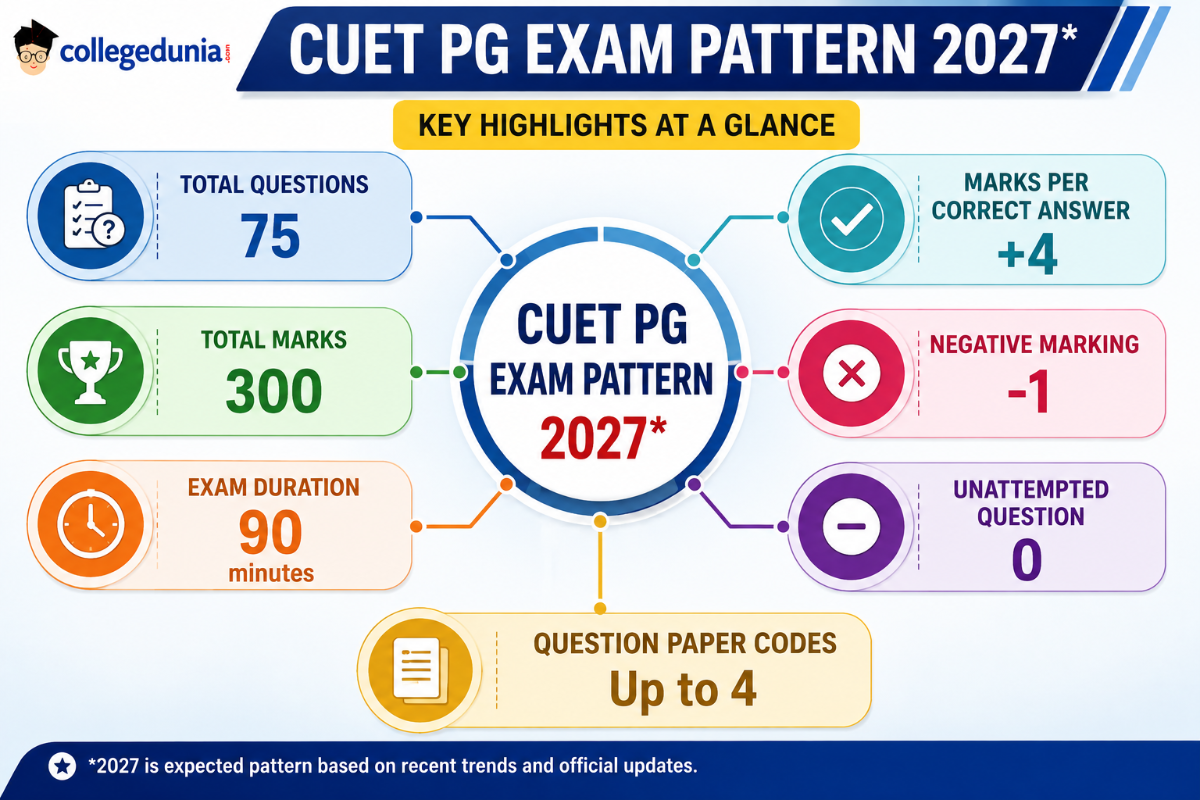
The CUET PG 2027 exam is a computer-based format consisting of 75 multiple-choice questions to be completed in 90 minutes.
- Each question carries 4 marks, with a maximum of 300 marks, while 1 mark is deducted for every incorrect answer and there is no negative marking for left-blank questions.
- Candidates can select up to four question paper codes, depending on the programmes and universities they are applying to.
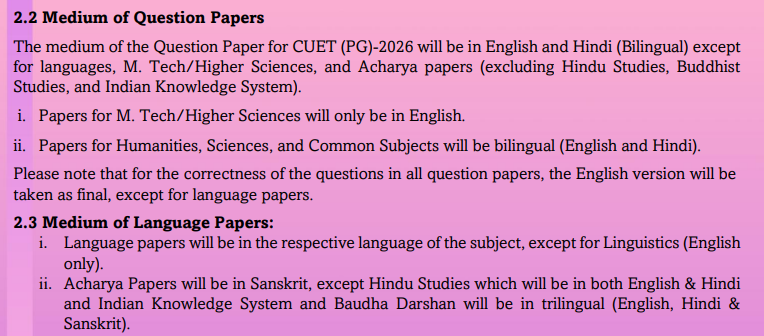
- The CUET PG 2027 question paper medium will be bilingual across all the streams except for specific language papers, M.Tech, and specialised Acharya courses.
Note: You can check official notifications and updates as they are released on the NTA CUET PG Website
Related Links:

CUET PG Exam Pattern 2027: Latest Update
| Particular | CUET PG 2027 Expected Pattern |
|---|---|
| Conducting Body | National Testing Agency (NTA) |
| Exam Mode | Computer-Based Test (CBT) |
| Question Type | Multiple Choice Questions (MCQs) |
| Total Questions | 75 |
| Total Marks | 300 |
| Exam Duration | 90 minutes |
| Marks per Correct Answer | +4 |
| Negative Marking | -1 |
| Unattempted Question | 0 |
| Question Paper Codes | Up to 4 |
| Paper Structure | Domain-specific / subject-specific |
| Medium | Depends on the paper; English & Hindi for applicable papers |
Note: The 75-question, 90-minute and 300-mark structure is confirmed in the latest NTA bulletin
CUET PG Exam Pattern 2027: Previous Year Comparison
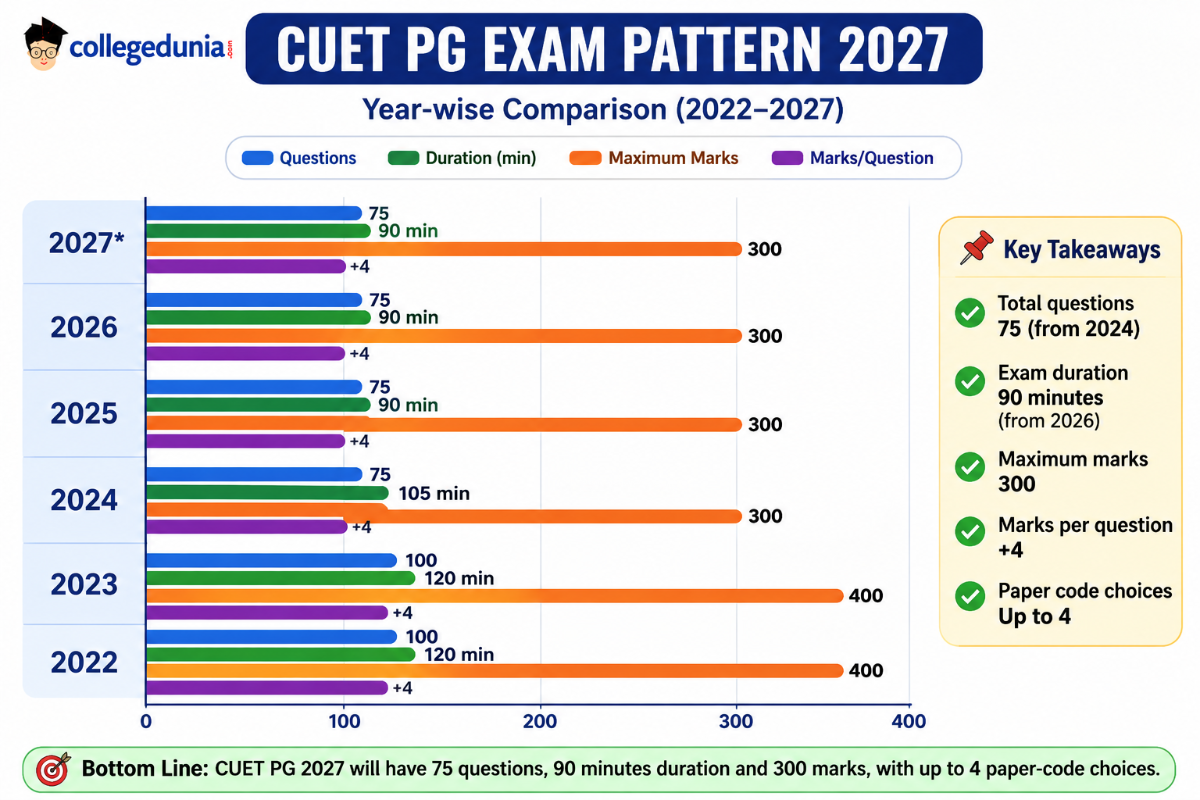
The CUET PG exam pattern has become shorter and more focused over the years. Earlier, candidates had 120 minutes to answer 100 questions.
The current pattern has 75 questions to be attempted in 90 minutes. The maximum marks have also been reduced from 400 to 300.
Another major change is the number of paper codes candidates can select. Earlier, candidates could choose up to 20 paper codes, while the latest pattern allows up to four.
For CUET PG 2027, students should check the paper code required for their target course and university before starting preparation. This will help them choose the right syllabus and avoid preparing for an unnecessary paper.
| Year | Questions | Duration | Maximum Marks | Marks/Question | Paper-Code Choices |
|---|---|---|---|---|---|
| 2027* | 75 | 90 min | 300 | +4 | Up to 4 |
| 2026 | 75 | 90 min | 300 | +4 | Up to 4 |
| 2025 | 75 | 90 min | 300 | +4 | Up to 4 |
| 2024 | 75 | 105 min | 300 | +4 | Up to 4 |
| 2023 | 100 | 120 min | 400 | +4 | Up to 20 |
| 2022 | 100 | 120 min | 400 | +4 | Up to 20 |
Note: *2027 is expected based on the latest available pattern and will be confirmed by NTA.
Ques. How many questions are there in CUET PG 2027?
Ans. CUET PG 2027 is expected to have 75 multiple-choice questions (MCQs) in each question paper, based on the latest available NTA pattern. The final 2027 pattern will be confirmed by NTA.
Ques. What is the CUET PG 2027 exam pattern?
Ans. The CUET PG 2027 exam is expected to be a computer-based test with 75 MCQs, 300 total marks and 90 minutes of CUET PG 2027 exam duration for each paper. The questions asked depend on the selected QP Code and subject.
CUET PG Exam Pattern 2027: CUET PG Total Marks Per Subject
The CUET PG 2027 total marks for each subject in CUET PG is 300 marks. Every test paper consists of 75 multiple-choice questions (MCQs), with each correct answer carrying 4 marks and 1 mark deducted for every incorrect response.
Exam Structure Details
- CUET PG 2027 Total Questions: 75 domain-specific questions (all mandatory to attempt)
- Total Marks: 300 marks per subject paper
- Correct Answer: +4 marks
- Incorrect Answer: –1 mark (negative marking)
- Unattempted Question: 0 marks
- Exam Duration: 90 minutes (1 hour 30 minutes)
CUET PG Exam Pattern 2027: How Much Time Do You Get Per Question?
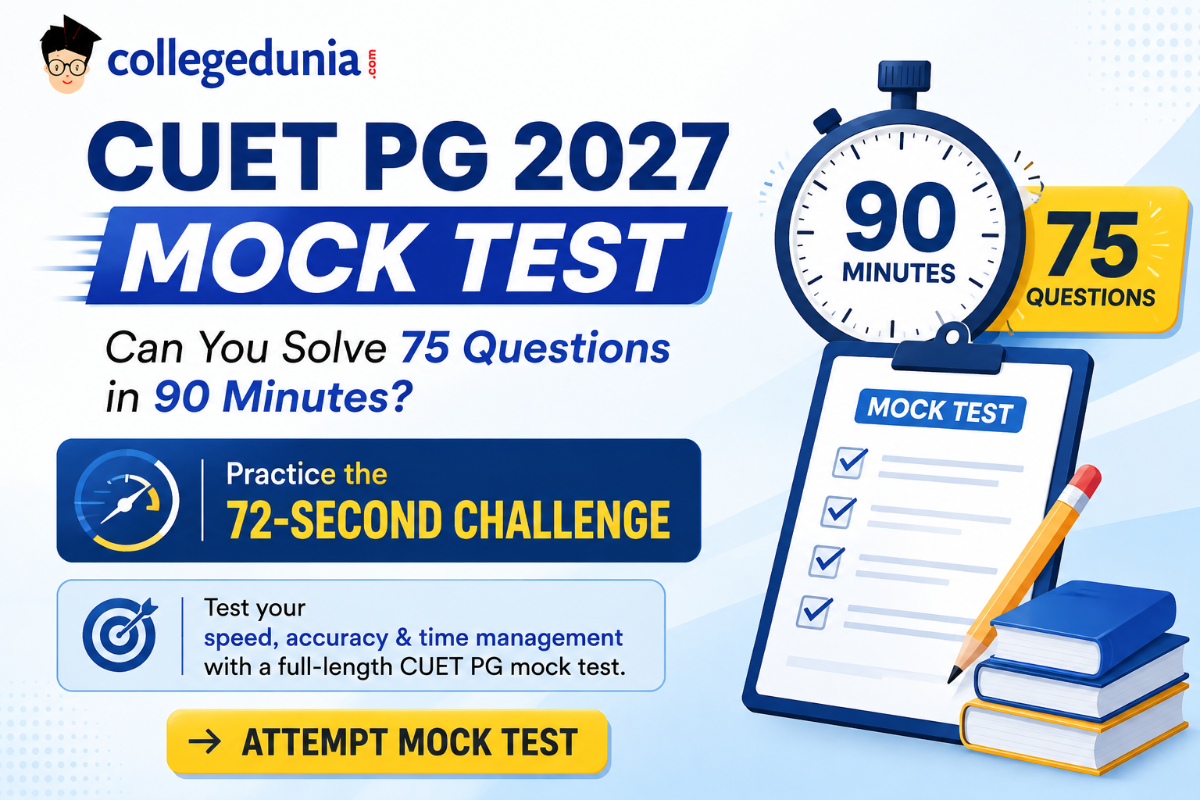
As per the CUET PG exam pattern, you will get 90 minutes for 75 questions. This means you have an average of 1.2 minutes, or 72 seconds, per question.
| Metric | CUET PG 2027 |
|---|---|
| Total time | 90 minutes |
| Total questions | 75 |
| Average time per question | 1.2 minutes |
| Average time per question | 72 seconds |
| Marks per question | 4 |
However, 72 seconds is only an average. You do not need to spend the same amount of time on every question.
A better strategy is to divide the paper into three rounds:
- Round 1: Answer easy and familiar questions first.
- Round 2: Attempt questions that need more time or calculation.
- Round 3: Review doubtful questions and check for careless mistakes.
This will help you to save time on easy questions and spend more time on tough questions. It is especially useful for domain-based papers where question difficulty can vary.
Ques. Is there negative marking in CUET PG 2027?
Ans. Yes. Based on the latest pattern, candidates get +4 marks for every correct answer and -1 mark for every incorrect answer. An unattempted question carries 0 marks.
Ques. How many marks is CUET PG 2027?
Ans. Each CUET PG question paper is expected to carry 300 marks, with 75 questions worth 4 marks each.
Ques. How much time is given for CUET PG 2027?
Ans. Candidates are expected to get 90 minutes (1 hour 30 minutes) to answer 75 questions. This gives an average of 72 seconds per question.
CUET PG Exam Pattern 2027: Marking Scheme
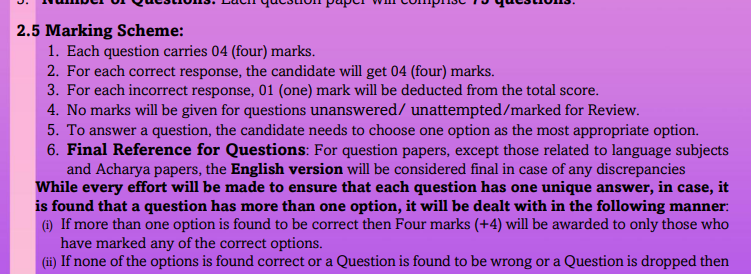
The CUET PG 2027 marking scheme is expected to remain the same, which is +4 marks for every correct answer and -1 mark for every incorrect answer.
| Response | Marks |
|---|---|
| Correct Answer | +4 |
| Incorrect Answer | -1 |
| Unattempted | 0 |
Why Does Negative Marking Matter?
Consider two students:
| Student A | Student B | |
|---|---|---|
| Questions attempted | 70 | 60 |
| Correct | 55 | 52 |
| Incorrect | 15 | 8 |
| Score | 205 | 200 |
Student A attempted more questions, but the additional incorrect answers reduced the final score.
The takeaway: In CUET PG, more attempt count does not automatically mean a higher score. Students should aim for high accuracy with controlled attempts.
CUET PG Exam Pattern 2027: Stream-wise Paper Structure
- The CUET PG exam paper pattern is not the same for every course.
- While each paper has 75 questions, the type of questions depends on the selected paper code.
- Domain papers mainly test subject knowledge, while common aptitude papers include areas such as language, reasoning, quantitative ability and general awareness.
- The NTA syllabus documents also confirm that the 75-question format is used for individual papers.
You need to understand here that 75 questions does not mean 75 questions of the same difficulty or type.
For example, a student appearing for a Science or Humanities paper needs strong subject knowledge, while a candidate taking a General or Management paper must prepare across multiple aptitude areas.
- Domain-heavy papers: Science, Humanities, M.Tech and other subject papers focus mainly on core knowledge.
- Common papers: These require preparation across multiple areas such as language, reasoning, mathematics or general awareness.
- Language papers: Preparation is specific to the selected language and its literature or language skills.
- Education papers: Candidates may need to cover education-related concepts along with areas specified in the respective syllabus.
- Same question count, different preparation: Every paper may have 75 questions, but the syllabus and difficulty can vary significantly.
| Paper/Stream | Questions | What is Tested? | Examples of Subjects/Paper Areas |
|---|---|---|---|
| Common – Education | 75 MCQs | Teaching Aptitude, GK related to education, Mathematics, Science & Environment, Social Sciences, Arts, Music, Yoga, Theatre & Sports | B.Ed., B.Ed.-M.Ed. Integrated, B.Ed. (HI), B.Ed. (ID), B.Ed. (VI) |
| Science | 75 MCQs | Domain Knowledge | Agriculture, Biology, Chemistry, Computer Science, Environmental Science, Food Science, Geology, Life Science, Mathematics, Physics, Statistics, Zoology |
| Humanities | 75 MCQs | Domain Knowledge | History, Geography, Anthropology, Fine Arts, Archaeology, Home Science, Performing Arts, etc. |
| M.Tech/Higher Sciences | 75 MCQs | Technical/Domain Knowledge | Civil, Mechanical, Electrical, Electronics, Computer Science, AI, Data Science, VLSI, Biotechnology, etc. |
| Literature | 75 MCQs | Language & Literature-specific knowledge | English, Hindi, Sanskrit, Arabic, Bengali, French, German, Japanese, Malayalam, Marathi, Tamil, Telugu, Urdu, etc. |
| Acharya | 75 MCQs | Acharya/Domain Knowledge | Veda, Vedanta, Nyaya, Mimansa, Jyotisha, Dharma Shastra, Sanskrit-related subjects |
| Common – Management/Aptitude | 75 MCQs | Language Comprehension, Verbal Ability, Quantitative Ability, Data Interpretation, Logical Reasoning | MBA, Marketing & Finance Management, Tourism, Business Analytics, Sales & Marketing |
| Common – General | 75 MCQs | Language Comprehension, Verbal Ability, GK, Computer Basics, Logical Reasoning | General, LLB, Library Science, Defence Studies, Women Studies, Physical Education, Hospitality, etc. |
| Other Domain Papers | 75 MCQs | Domain Knowledge | Economics, Commerce, LLM, M.Ed., Education, Mass Communication, Public Health, Sports, Yoga, Hospital Management, etc. |
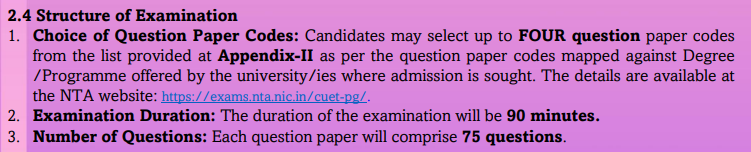
Source: CUET PG 2026 Information Brochure
Ques. How many paper codes can I choose in CUET PG 2027?
Ans. Candidates should check the latest NTA application rules for 2027. In the latest available CUET PG structure, candidates can select up to four Question Paper (QP) Codes, depending on the programmes and universities they are targeting. NTA also advises candidates to select the appropriate test paper code based on the eligibility and programme requirements of the university
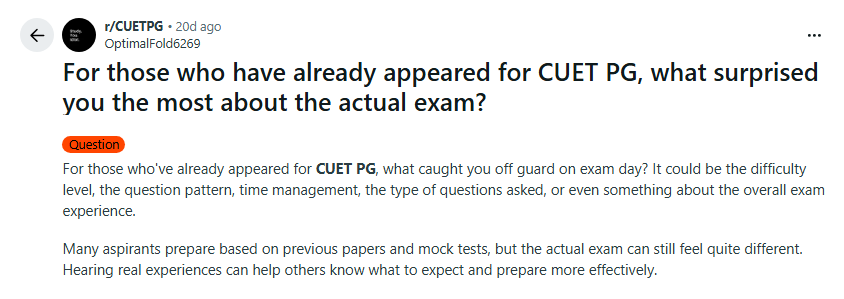
CUET PG Exam Pattern 2027: Reddit Discussion
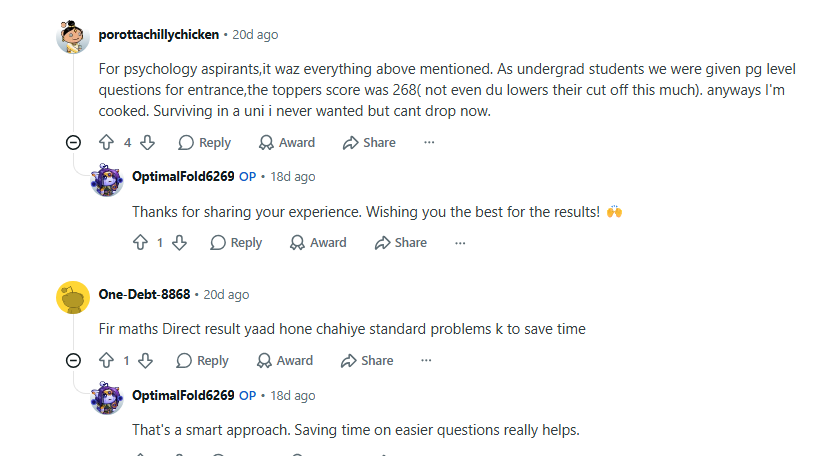
Recent student discussions on Reddit’s r/CUETPG suggest that the actual CUET PG paper can feel different from previous papers and mock tests. One Psychology aspirant said the paper included PG-level questions, while also mentioning difficulty and time-management challenges.
Source: Reddit
A Maths aspirant, meanwhile, suggested focusing on standard problems first to save time during the exam. These experiences underline the importance of preparing beyond mocks, strengthening concepts and practising questions under a strict time limit.
Source: Reddit
CUET PG Exam Pattern 2027: QP Code Categories along with Subject Codes
- CUET PG offers multiple paper-code categories based on the course and subject, including Common, Science, Humanities, Languages, M.Tech/Higher Sciences and Acharya.
- The QP Code is important because CUET PG uses different question papers for different postgraduate courses.
- Candidates must choose the paper code that matches their target programme and check the university’s eligibility criteria.
- For CUET PG 2027, do not choose a QP code based only on the subject name.
- First check the required QP code for your preferred course and university, then select the appropriate paper.
| Category | QP Code Range | What It Covers |
|---|---|---|
| Common | COQP01–COQP22 |
|
| Science | SCQP01–SCQP30 |
|
| Humanities | HUQP01–HUQP26 |
|
| Languages | LAQP01–LAQP41 |
|
| M.Tech/Higher Sciences | MTQP01–MTQP12 |
|
| Acharya | ACQP01–ACQP26 |
|
Ques. Are all 75 questions compulsory in CUET PG 2027?
Ans. The latest pattern is based on 75 questions per paper, so candidates should prepare to attempt the complete 75-question paper within the 90-minute duration. The exact 2027 instructions will be confirmed by NTA.
Ques. Is the CUET PG 2027 syllabus the same for all subjects?
Ans. No. CUET PG does not have one common syllabus for every candidate. The syllabus and question content depend on the selected QP Code. NTA publishes separate syllabi for the different test papers.
CUET PG 2027 Exam Pattern: Paper-wise Question Approach
- The CUET PG 2027 exam pattern is expected to have 75 MCQs, but the type of questions candidates face depends on the selected paper.
- Science, Humanities, Literature, M.Tech/Higher Sciences, Acharya and Common papers test different areas.
- Students should therefore understand the question approach for their CUET PG paper before starting preparation.
| Paper Type | What the Paper Tests | How to Approach the Questions |
|---|---|---|
| Science | Core domain concepts | Focus on concepts, applications, formulas and PYQs |
| Humanities | Subject concepts and factual knowledge | Focus on concepts, important facts and PYQs |
| Literature | Language, literature and subject-specific knowledge | Revise texts, authors, literary concepts and PYQs |
| M.Tech/Higher Sciences | Technical concepts and applications | Focus on core concepts, numerical problems and applications |
| Acharya | Paper-specific Sanskrit/domain knowledge | Focus on prescribed texts, concepts and previous questions |
| Common/Aptitude | Language, Quantitative Ability, DI, GK and Logical Reasoning | Practise speed, accuracy and timed questions |
| Other Domain Papers | Course-specific domain knowledge | Follow the paper-specific syllabus and practise PYQs |
CUET PG Exam Pattern 2027: Question Paper Medium
- The CUET PG 2027 exam medium is expected to depend on the selected question paper.
- For many papers, the question paper is available in English and Hindi, while language-specific papers are conducted in the respective language.
- Do not assume that every CUET PG paper will have the same language option. The medium can vary according to the selected QP Code.
- Candidates preparing for language, M.Tech or Acharya papers should specifically check the medium mentioned for their paper.
The final medium for CUET PG 2027 will be confirmed by NTA in the official Information Bulletin.
| Paper Category | Expected Medium | What Candidates Should Know |
|---|---|---|
| Common Papers | English & Hindi for applicable papers | Candidates should check the medium specified for their particular QP Code |
| Science Papers | English & Hindi for applicable papers | Check the paper-specific instructions before the exam |
| Humanities Papers | English & Hindi for applicable papers | Medium may depend on the individual paper |
| Language Papers | Respective language | English, Hindi, Sanskrit, Odia and other language papers follow their specific language requirements |
| M.Tech/Higher Sciences | Paper-specific | Candidates should check the medium prescribed for the selected technical paper |
| Acharya Papers | Paper-specific | Some papers have Sanskrit/Hindi/English combinations depending on the subject |
Note: The Acharya category has more specific language rules. For example, NTA lists Baudha Darshan/Buddhist Studies as trilingual (Hindi/Sanskrit/English), while Hindu Studies is bilingual (Hindi/English) and Indian Knowledge System is trilingual (Hindi/Sanskrit/English)
CUET PG 2027 Paper Difficulty: What Should Students Expect?
- The time pressure is the same across papers: 75 questions in 90 minutes means only 1.2 minutes or 72 seconds per question on average.
- The difficulty comes from the type of questions, not the number of questions. M.Tech and Science papers can demand calculations or applications, while Humanities and Literature papers can require faster recall of concepts, facts and texts.
- With +4 for a correct answer and -1 for an incorrect answer, students need both speed and accuracy. Four correct answers add 16 marks, but four wrong answers can cost 4 marks.
| If Your Paper Is... | Give More Time To... |
|---|---|
| Science | Concept-based MCQs, formulas, applications and PYQs |
| Humanities | Important facts, concepts and repeated PYQ themes |
| Literature | Authors, works, literary terms and text-based questions |
| M.Tech/Higher Sciences | Numerical problems, technical concepts and applications |
| Common/Aptitude | Timed Quant, Reasoning, DI and Language practice |
| Acharya | Prescribed texts, terminology and domain-specific PYQs |
CollgeDunia takeaway: Don't judge your preparation by the number of questions you can solve at home. For CUET PG, track questions attempted, accuracy and time taken in every mock. Your target should be to solve the easy questions quickly enough to create time for the questions that require deeper thinking.
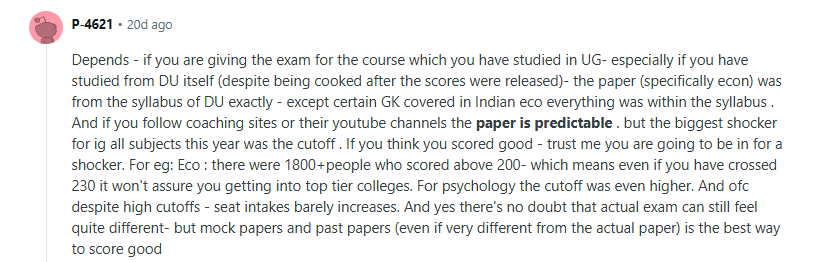
A recent Reddit discussion suggests that the CUET PG paper can remain largely syllabus-based, especially for candidates who have studied the subject at UG level. However, the bigger challenge may be high cutoffs and limited seats, with students reporting strong competition even at 200+ scores.
The discussion also highlights the importance of mock tests and previous-year papers to build speed and prepare for variations in the actual exam.
Source: Reddit
CUET PG Exam Pattern 2027 FAQs
Ques. What is the exam pattern for the CUET 2027 exam?
Ans. The CUET PG 2027 exam pattern is expected to have 75 MCQs for 300 marks, with a duration of 90 minutes. Each correct answer carries 4 marks, while 1 mark is deducted for an incorrect answer. The final 2027 pattern will be confirmed by NTA in its official Information Bulletin.
Ques. Is CUET tougher than JEE?
Ans. CUET and JEE test different skills, so their difficulty cannot be compared directly. JEE Main focuses on Physics, Chemistry and Mathematics for engineering admissions, while CUET PG tests the domain or paper selected by the candidate. For CUET PG, the difficulty also varies by QP Code and subject.
Ques. How much CUET PG score is required for DU?
Ans. There is no single CUET PG score that guarantees admission to DU. The required score varies by programme, category, competition and admission year. Candidates should check the DU admission requirements and previous-year cut-off trends for their specific postgraduate programme rather than targeting one common score.
Ques. Can we select all universities in CUET PG?
Ans. No. Candidates cannot simply select all participating universities through CUET PG. The QP Code must match the programme and university requirements, and candidates must separately follow the admission or counselling process prescribed by the university. NTA's latest CUET PG structure allows candidates to select up to four QP Codes, based on the programmes they are targeting.
Ques. Which is better for PG, JNU or DU?
Ans. Both JNU and DU are strong options for postgraduate study, but the better choice depends on the course, faculty, research opportunities, campus environment and career goals. Candidates should compare the specific PG programme, not just the university name.



Comments