



MA English is a 2-year postgraduate (PG) programme that focuses on English literature, literary criticism, language and cultural studies.
- MA English Colleges in India – There are 1500+ MA English colleges in India, including both private and public institutions.
- Admission – Admission through CUET PG, university-level entrance exams, merit lists based on graduation marks, counselling or institution-specific selection.
- Eligibility Criteria – Students with a recognised bachelor’s degree, preferably in English or a related discipline, can apply. Minimum marks generally range from 45% to 55%, depending on the university.
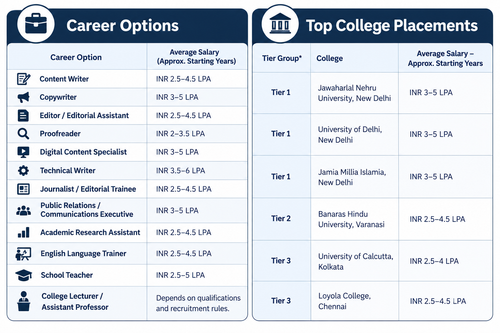
- Course Scope – Graduates can work in content writing, editing, publishing, journalism, teaching, public relations and corporate communication, or pursue research and higher studies such as a PhD.
Course Highlight
| Top Colleges | Total Course Fees | Specialisation Areas | Average Starting Salary |
|---|---|---|---|
| Lady Shri Ram College for Women, New Delhi, Hindu College, New Delhi, Miranda House, New Delhi | INR 544 to INR 15.47 Lakh | British Literature, Indian Writing in English, American Literature, Literary Theory, Comparative Literature | Approx. INR 2.5–5 LPA |
Quick Facts
- Duration: 2 years, generally divided into 4 semesters
- Eligibility: A bachelor's degree from a recognised university. English may be required as a subject or at the graduation level by some institutions. Minimum marks commonly range from 45% to 55%, but requirements vary.
- Entrance Exam: CUET PG and university-specific entrance examinations, some colleges use undergraduate marks.
- Selection: Entrance score, merit list, interview where applicable, counselling or university admission portal, document verification
- Government Institution Fee Range: INR 544 (Loganatha Narayanasamy Government College, Ponneri) to INR 3.07 Lakh (IIT Madras)
- Private Institution Fee Range: INR 1 K (V.V. Vanniaperumal College for Women, Virudhunagar) - INR 15.47 Lakh (Ashoka University, Sonepat)
- Admission Season: Applications commonly open between December and June, depending on the institution. Entrance tests, results and counselling generally follow during the first half or middle of the year.
Top Entrance Exams

Three Myths Busted
- Myth: Only BA English graduates can apply for MA English.
- Fact: Many universities accept graduates from other disciplines, but some require English as a subject or specify a relevant undergraduate degree.
- Myth: An MA English degree leads only to teaching jobs.
- Fact: Graduates can also work in publishing, editing, journalism, corporate communications, content writing and research.
- Myth: Every MA English college requires an entrance examination.
- Fact: Some institutions use entrance scores, while others offer admission through academic merit or a combination of selection methods.
Ques. Can BA graduates from other streams apply for MA English?
Ans. Yes, at universities that accept graduates from any discipline. However, some institutions require English at the graduation level or a relevant undergraduate degree.
Ques. Can Science and Commerce students pursue MA English?
Ans. Yes, if they hold a qualifying bachelor's degree and meet the institution's subject and marks requirements. A BA English degree is not compulsory at every university.
Ques. Which colleges offer MA English at a relatively low fee?
Ans. Public universities and government colleges may have comparatively low tuition fees such as Jawaharlal Nehru University, Banaras Hindu University, the University of Calcutta and other public institutions.
Ques. What is the average starting salary after MA English?
Ans. Many entry-level content, editorial and communications roles offer approximately INR 2.5–5 LPA. Technical writing and specialised communications roles may pay more. Actual salaries depend on skills, location and employer.
Ques. Does MA English provide campus placements?
Ans. Some universities and colleges provide placement support, but course-specific placement availability varies. Many graduates find opportunities through external applications, internships, competitive examinations and professional networks.
Types of Admission Routes in India

MA English Admission Process
- Qualifying Examination: A bachelor's degree from a recognised university. The degree may be in English or another discipline, depending on the institution.
- Eligible Streams: Arts, Humanities, Commerce, Science and other undergraduate disciplines may be accepted where the university permits them.
- Minimum Marks: Many institutions specify approximately 45%–55% in graduation, but some require a particular subject or a different minimum. Reserved-category relaxations depend on applicable rules.
- Entrance Registration: Apply for CUET PG or the relevant university entrance examination if required. Check the accepted test paper and programme eligibility before submitting the form.
- Entrance Result: Download the scorecard and follow the university's separate application, preference-filling or counselling instructions.
- Interview: Not compulsory across all institutions. Attend one only if it forms part of the published selection process.
- Counselling/Application: Complete the university application or counselling registration. Enter programme and college preferences where required.
- Document Verification: Keep the graduation marksheets, degree or provisional certificate, Class 10 and 12 certificates, identity proof, photograph, signature and applicable category or disability certificates ready.
- Seat Confirmation: Accept the allotted seat, complete verification and pay the prescribed admission fee within the notified deadline.
Ques. Can I pursue a PhD after MA English?
Ans. Yes. Eligible graduates can apply for a PhD in English or related research areas. Admission may require an entrance examination, interview, research proposal or other criteria set by the university.
Ques. Is MA English useful for government jobs?
Ans. Yes, graduates can apply for government jobs for which they meet the prescribed eligibility requirements. These may include relevant teaching recruitment, administrative examinations, translation posts and other graduate-level vacancies. Some positions require additional qualifications or examinations.
Top MA English Colleges in India

Scholarships
- Merit-based scholarships: Universities and colleges may offer fee concessions to students with strong academic records. Check the current scholarship policy and renewal conditions.
- Need-based scholarships and freeships: Eligible students from low-income households may receive financial assistance or partial/full tuition-fee concessions.
- Government scholarships: Students may check the National Scholarship Portal (NSP) and applicable state scholarship portals for postgraduate schemes.
- Category-based scholarships: SC, ST, OBC, EBC, minority and other eligible categories may qualify for specific government or state schemes, subject to scheme rules.
- Entrance-score scholarships: Some private universities offer scholarships based on entrance scores or academic performance. These are institution-specific.
- Sports scholarships: Certain institutions assist eligible sportspersons. Availability, performance criteria and scholarship amounts vary.
- Institution-specific scholarships: Jamia Millia Islamia and other universities have institutional student-support provisions.
Placement After MA English
Top Recruiters
| Sector | Major Recruiters |
|---|---|
| Publishing and Editorial | Penguin Random House India, HarperCollins Publishers India, SAGE Publications, Oxford University Press India, Hachette India |
| Digital Content and Media | The Times of India Group, HT Media, India Today Group, The Hindu Group, Network18 |
| IT and Technical Communication | TCS, Infosys, Wipro, Accenture, Cognizant |
| Advertising and Communications | Ogilvy India, Dentsu India, Publicis Groupe India, GroupM, Weber Shandwick India |
| Education and EdTech | British Council India, Teach For India, upGrad, BYJU'S, Physics Wallah |
Higher Education Options
| Course | Duration |
|---|---|
| PhD in English / Literary Studies | 3–6 years, subject to applicable regulations and university rules |
| B.Ed. | 2 years; eligibility depends on the institution and applicable teacher-education rules. |
| Postgraduate Diploma in Journalism or Mass Communication | 1–2 years, depending on the programme |
| Postgraduate Diploma in Translation | 6 months–2 years, depending on the institution |
| Certificate or Diploma in Technical Writing / Professional Communication | A few months to 1 year or more, depending on the provider |
| MA/MSc in Linguistics or a related interdisciplinary field | 2 years; eligibility varies by university |
FAQs
Ques. Can I become an English professor after MA English?
Ans. MA English is an important academic qualification, but it does not automatically qualify for a permanent college teaching post. Candidates generally need to meet the applicable UGC eligibility and recruitment requirements, including NET/SET or a qualifying PhD route where permitted.
Ques. What is the difference between BA English and MA English?
Ans. BA English is an undergraduate degree generally pursued after Class 12. MA English is a postgraduate degree pursued after graduation. MA English usually involves more advanced literary analysis, theory, research and specialised study.
Ques. Which MA English specialisation is suitable for a career in publishing?
Ans. British Literature, Indian Writing in English and Literary Theory can support literary and editorial careers. Practical skills in editing, proofreading, digital publishing and content management are also useful. The exact specialisation offered depends on the university.



Comments