




The Best Physics Books for JEE Advanced combine concept builders, one practice series, and one advanced problem book. Cengage and D.C. Pandey are useful for practising question formats, including single-correct, multiple-correct and numerical-answer questions.
Pathfinder, Irodov and Krotov should generally be attempted after developing a strong conceptual foundation and completing regular practice modules. Beginners should prioritize concepts, while experienced aspirants can focus on advanced applications.
- H.C. Verma’s Concepts of Physics Vol. 1 and 2 are suitable for building conceptual clarity, physical intuition and fundamental problem-solving skills for JEE Advanced.
- Halliday, Resnick & Walker’s Fundamentals of Physics offers detailed theoretical explanations and diagrams, particularly for mechanics and electromagnetism.
- Cengage Physics by B.M. Sharma provides structured theory, solved examples and extensive chapter-wise exercises, making it useful for self-study.
- D.C. Pandey’s Understanding Physics offers graded exercises that progress from introductory applications to advanced objective questions.
- Physics Galaxy by Ashish Arora emphasizes derivations, visual explanations and conceptual illustrations to strengthen mathematical understanding.
- I.E. Irodov’s Problems in General Physics is suited to advanced problem-solving practice, particularly in mechanics, thermodynamics and electrodynamics.
Related Links:
- JEE Advanced Syllabus 2027: Subject-Wise Topics, Chapter-Wise Weightage and PDF Download
- Download JEE Advanced 2026 Question Paper with Solutions: Access JEE Advanced Previous Year Papers (2007-2025) in PDF Format
- JEE Advanced 2027 Preparation Tips: Timetable, Section-Wise Tips & Best Books
Key Summary
- H.C. Verma is a strong starting point for building conceptual clarity in JEE Advanced Physics.
- Cengage, D.C. Pandey, and Physics Galaxy offer structured theory, solved examples, and graded problem-solving practice.
- I.E. Irodov, Pathfinder, and Krotov are useful for challenging, multi-concept problems after mastering the fundamentals.
- Three to four well-chosen resources, combined with coaching modules and previous years’ questions, are generally more practical than studying multiple overlapping books.
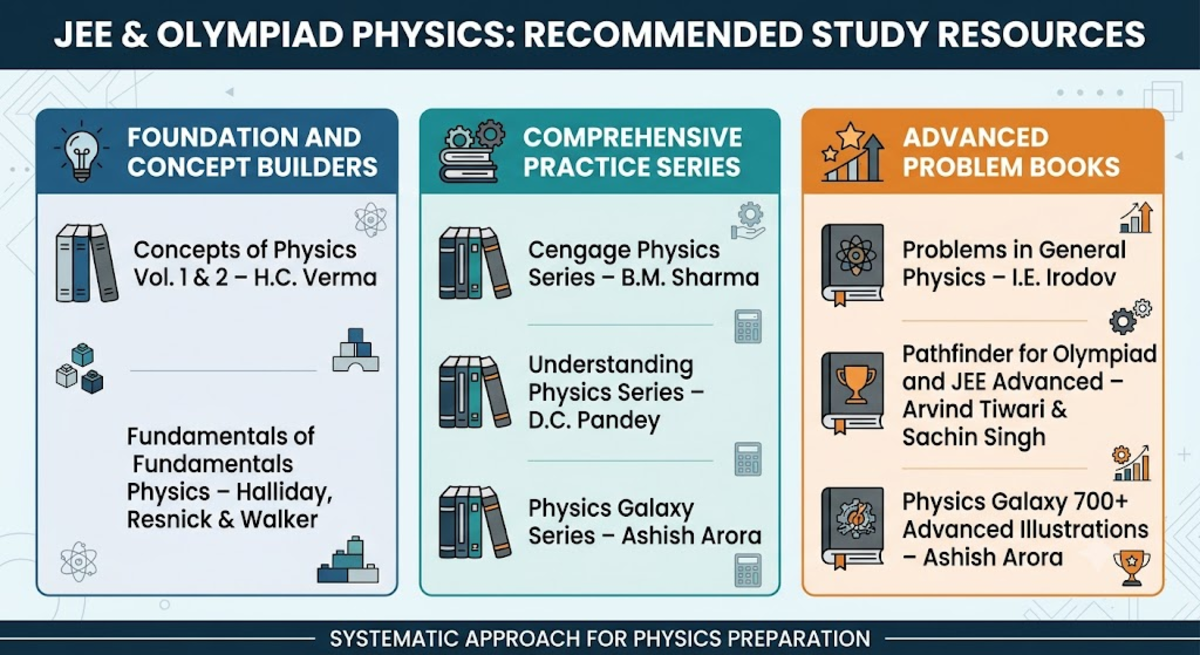
Best Physics Books for JEE Advanced: Author-Wise Comparison
The best Physics textbooks for JEE Advanced differ in focus, difficulty and start time. Compare authors before choosing your JEE Advanced Physics reference books.
- H.C. Verma and Halliday, Resnick & Walker help strengthen conceptual understanding, theoretical clarity, and physical intuition before attempting advanced problems.
- Cengage, D.C. Pandey and Physics Galaxy offer structured theory, solved examples and graded practice questions for systematic JEE Advanced preparation.
- I.E. Irodov, Pathfinder and Physics Galaxy 700+ Advanced Illustrations focus on numerical problems, multi-concept applications and higher-level analytical thinking.
| Category | Book / Author | Why Choose It |
|---|---|---|
| Foundation and Concept Builders | Concepts of Physics Vol. 1 & 2 – H.C. Verma | Builds fundamentals through clear explanations, short-answer questions and graded exercises. |
| Fundamentals of Physics – Halliday, Resnick & Walker | Offers in-depth explanations of core topics. | |
| Comprehensive Practice Series | Cengage Physics Series – B.M. Sharma | Suitable for self-study, with structured explanations, solved examples and practice questions. |
| Understanding Physics Series – D.C. Pandey | Progresses from basic concepts to advanced-level practice through graded exercises. | |
| Physics Galaxy Series – Ashish Arora | Explains formulas and their applications through detailed derivations and illustrative examples. | |
| Advanced Problem Books | Problems in General Physics – I.E. Irodov | Develops analytical and mathematical problem-solving skills once concepts are clear. |
| Pathfinder for Olympiad and JEE Advanced – Arvind Tiwari & Sachin Singh | Offers demanding problems for students seeking to strengthen higher-level analytical skills. | |
| Physics Galaxy 700+ Advanced Illustrations – Ashish Arora | Helps practise problems combining concepts from multiple chapters. |
As per Reddit discussions, below are the best books for JEE Advanced Physics preparation:
- For Mechanics: The recommended book is DC Pandey.
- For Thermodynamics & Thermal Physics: The recommended book is Physics Galaxy by Ashish Arora.
- Electricity & Magnetism: The recommended book is DC Pandey.
- Optics: The recommended book is DC Pandey.
- Modern Physics: The recommended book is Physics Galaxy by Ashish Arora.
- Parting Advice: Pay close attention to Modern Physics, as it is considered one of the easiest scoring sections in JEE Advanced.
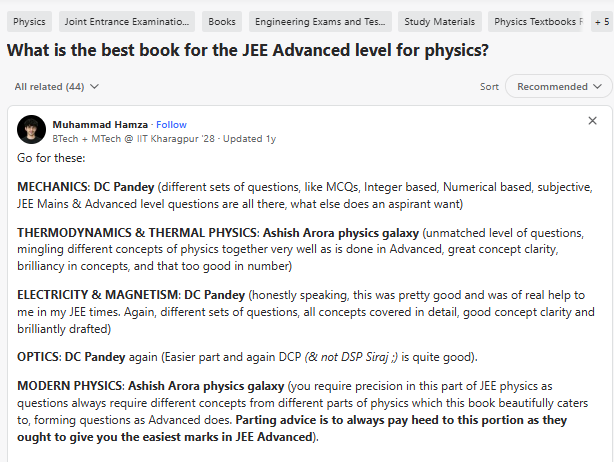
Source: Quora
Check Out:
Best Physics Books for JEE Advanced Theory and Concepts
The best books for JEE Advanced Physics concepts explain why a formula works, where it fails and how to derive it.
- B.M. Sharma (Cengage): Breaks topics into small sub-concepts, each followed by a "Concept Application" loop. It is the best standalone theory set for self-study.
- Ashish Arora (Physics Galaxy): Explains the calculus behind every law, including each integration and boundary condition. Pairs with his video lectures.
- H.C. Verma (Concepts of Physics): Brief but dense theory. The "Questions for Short Answer" fix misconceptions before numericals.
- Fundamentals of Physics by Halliday: Narrative explanations with rich diagrams for Classical Mechanics and Electromagnetism. Use it if coaching notes feel dry.
| Book / Author | Theoretical Style |
|---|---|
| Cengage Physics – B.M. Sharma | Structured, detailed, and application-oriented |
| Physics Galaxy – Ashish Arora | Derivation-heavy and visualization-focused |
| Concepts of Physics Vol. 1 & 2 – H.C. Verma | Concise, intuitive, and analogy-based |
| Fundamentals of Physics – Halliday, Resnick & Walker | Detailed, narrative-driven, and diagram-rich |
Check Out: Best Books for JEE Advanced 2027: Mathematics, Physics, and Chemistry, Topic-wise Weightage and Tips
Best Physics Books for JEE Advanced Problem-Solving Practice
The best books for JEE Advanced Physics practice cover Single Correct, Multiple Correct, Comprehension, Matrix Match and Integer types. The best Physics problem-solving books for JEE Advanced move from formula substitution to multi-concept problems.
- Use Cengage or D.C. Pandey for structured, chapter-wise practice, and move to advanced problem books after mastering the fundamentals.
- Solve single-correct, multiple-correct, comprehension, matrix-match and numerical-answer questions to prepare for JEE Advanced's varied problem types.
- Identify conceptual gaps and revisit incorrect questions instead of trying to complete every book.
| Book / Author | Key Features | Why Choose It? |
|---|---|---|
| Cengage Physics Series – B.M. Sharma | Solved examples followed by extensive chapter-wise exercises |
|
| Understanding Physics – D.C. Pandey | Divides practice into introductory and advanced levels |
|
| Problems in General Physics – I.E. Irodov | Emphasizes fundamental physical principles and multi-variable analysis |
|
| Physics Galaxy 700+ Advanced Illustrations – Ashish Arora | Step-by-step physical reasoning and mathematical explanations |
|
| Aptitude Test Problems in Physics – S.S. Krotov | Emphasizes physical intuition, logical reasoning and problem setup |
|
Preparation Tip: Complete your primary textbook or coaching modules before moving to I.E. Irodov, Krotov or advanced illustration collections. Prioritize accuracy and understanding over solving every question in every book.
Check Out:
Toughest Physics Books for JEE Advanced
The toughest JEE Advanced Physics books focus on complex, non-routine problems rather than straightforward formula-based questions.
- Pathfinder (Tiwari & Singh) is considered one of the toughest physics books for JEE Advanced. Its problems fuse three or four sub-topics, such as fluid dynamics, electrostatics, and thermal expansion.
- From Irodov, study Mechanics, Thermodynamics, and Electrodynamics. Skip Optics and Quantum Physics, which lean towards university level.
- Krotov suits Multiple Correct questions. Use Savchenko sparingly, as it goes beyond the JEE syllabus. Pinsky suits Kinematics, Mechanics and Wave Motion.
- Jearl Walker – The Flying Circus of Physics builds intuition through real-world paradoxes. It is not for numerical drill.
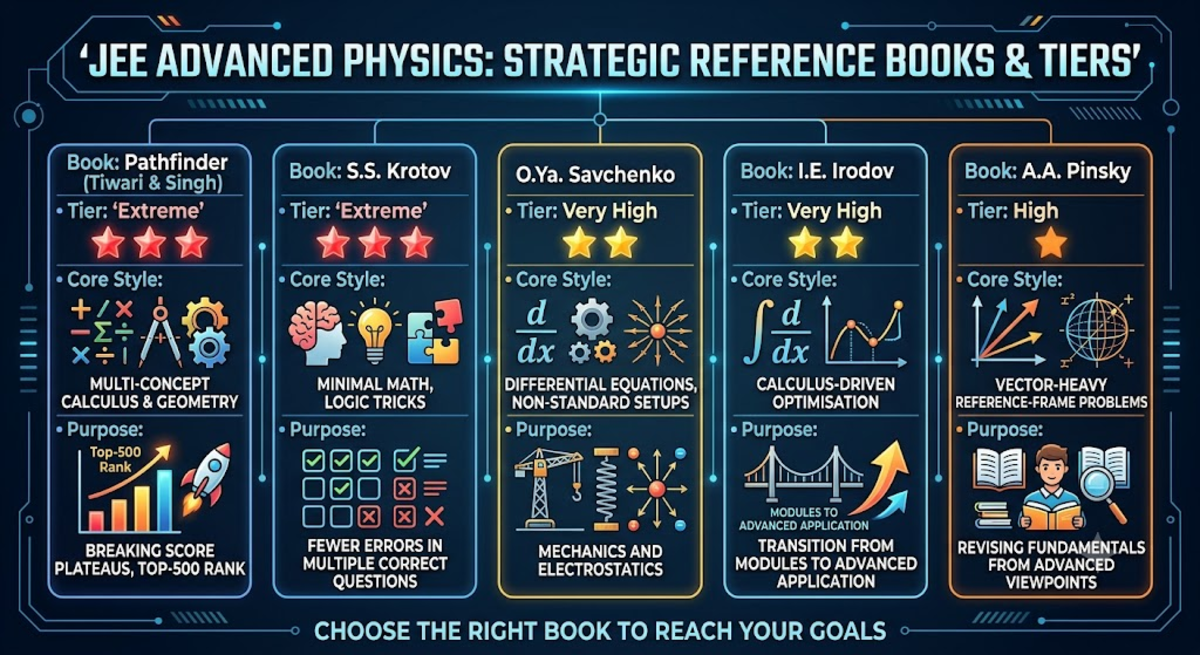
| Book | Tier | Core Style | Purpose for JEE Advanced |
|---|---|---|---|
| Pathfinder (Tiwari & Singh) | Extreme | Multi-concept calculus and geometry | Breaking score plateaus, Top-500 rank |
| S.S. Krotov | Extreme | Minimal math, logic tricks | Fewer errors in Multiple Correct questions |
| O.Ya. Savchenko | Very High | Differential equations, non-standard setups | Mechanics and Electrostatics |
| I.E. Irodov | Very High | Calculus-driven optimisation | Transition from modules to advanced application |
| A.A. Pinsky | High | Vector-heavy reference-frame problems | Revising fundamentals from advanced viewpoints |
Also Check:
How to Choose Physics Books for JEE Advanced Preparation
Choose Physics JEE Advanced books by preparation phase and learning style. The Best Physics Books for JEE Advanced work only when matched to where you are.
- Build concepts first: Understand fundamental principles before attempting difficult numerical problems.
- Stick to one primary practice series: Complete its theory, solved examples and exercises before switching resources.
- Use advanced books selectively: Attempt Irodov or Pathfinder after developing a strong conceptual foundation and completing your regular practice.
| Step | Recommended Books / Approach |
|---|---|
| 1. Identify your preparation phase |
|
| 2. Match your learning style |
|
| 3. Follow the Rule of Three |
|
This video by the channel “Kalpit Veerwal JEE” evaluates advanced physics resources for JEE Advanced aspirants, weighing the effectiveness of Irodov and Krotov against international competition materials. This guide clarifies which complex textbooks are truly relevant for exam preparation and which ones risk steering learners away from the core curriculum.
How Many Physics Books Are Required for JEE Advanced?
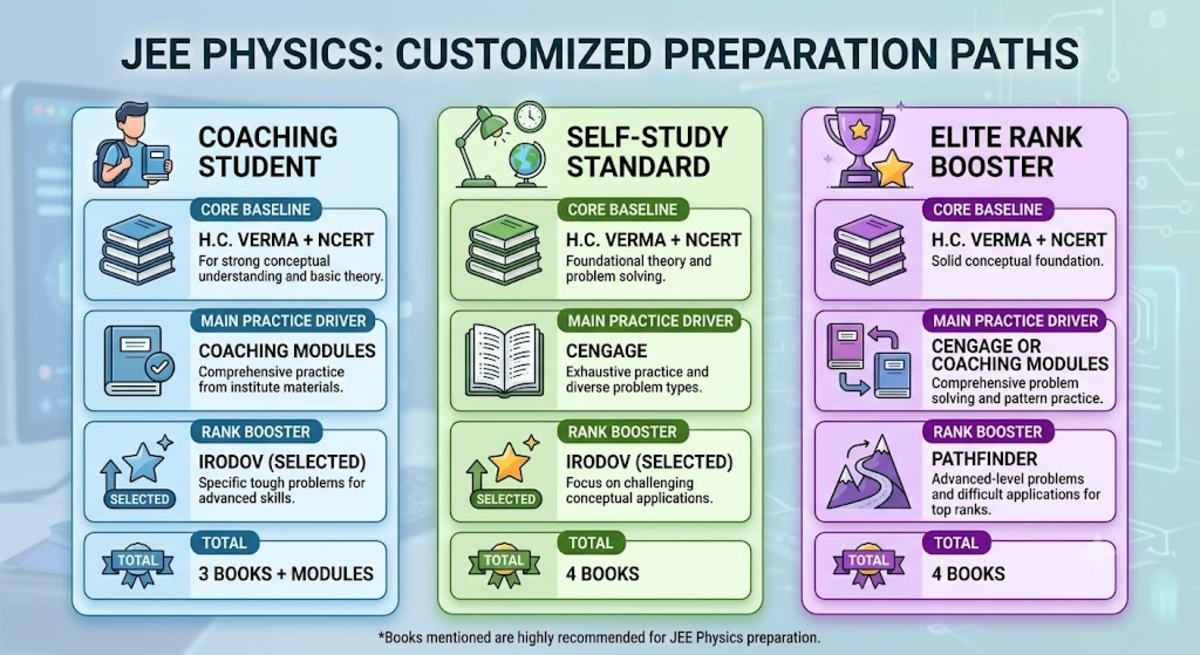
Ideally, limit your JEE Advanced Physics preparation to 3–4 books to avoid overlapping content and focus on consistent practice. Too many books lead to incomplete chapters. Books stack idea:
- Coaching Students: Use H.C. Verma and NCERT for fundamentals, coaching modules for practice, and selected Irodov problems for advanced preparation.
- Self-Study Students: Combine H.C. Verma and NCERT with Cengage for structured theory and practice, followed by selected Irodov problems.
- Top-Rank Aspirants: Build concepts with H.C. Verma and NCERT, practise through Cengage or coaching modules, and use Pathfinder for challenging problems.
| Preparation Style | Core Baseline | Main Practice Driver | Rank Booster | Total |
|---|---|---|---|---|
| Coaching Student | H.C. Verma + NCERT | Coaching modules | Irodov (selected) | 3 books + modules |
| Self-Study Standard | H.C. Verma + NCERT | Cengage | Irodov (selected) | 4 books |
| Elite Rank Booster | H.C. Verma + NCERT | Cengage or coaching modules | Pathfinder | 4 books |
Are JEE Main Physics Books Enough for JEE Advanced?
JEE Main preparation books are not enough for the Best Physics Books for JEE Advanced level of preparation.
- JEE Main tests one formula from one chapter. JEE Advanced combines chapters, such as Electromagnetic Induction with a spring-mounted ring (Electrodynamics + SHM).
- JEE Advanced has Multiple Correct questions with negative marking, Comprehension Paragraphs and Matrix Match. Main-level books do not train for these.
- H.C. Verma for short-answer questions, and NCERT for Modern Physics, Optical Instruments and Surface Tension.
FAQs on the Best Physics Books for JEE Advanced
Ques. Which book is best for JEE Advanced?
Ans. H.C. Verma is the best starting book. Add Cengage (B.M. Sharma) or D.C. Pandey for practice and Irodov for advanced problems.
Ques. Which book is best for JEE Advanced Physics?
Ans. Concepts of Physics by H.C. Verma is best for concepts, and Cengage Physics is best for JEE Advanced practice.
Ques. What is the best book for IIT JEE Physics?
Ans. H.C. Verma for concepts, one practice series for the full syllabus, and Irodov for advanced problems form the best stack for IIT JEE.
Ques. How many Physics books are needed for JEE Advanced?
Ans. Three to four books are enough, including H.C. Verma, NCERT, one practice series and one advanced workbook.
Ques. Is Irodov necessary for JEE Advanced?
Ans. No. Use Irodov selectively, focusing on Mechanics, Thermodynamics and Electrodynamics, after completing 70% of the syllabus.
Ques. Is Fundamentals of Physics by Halliday good for JEE Advanced?
Ans. Yes, it is useful for visual theory in Mechanics and Electromagnetism, but it is not a practice book.
Ques. What is the toughest Physics book for JEE Advanced?
Ans. Pathfinder by Tiwari & Singh, followed by Krotov and Irodov.
Ques. How to crack JEE Advanced Physics?
Ans. Build concepts first, solve 15–20 years of PYQs, keep an error log and take full mocks in the final month.



Comments