




The JEE Advanced Seat Matrix 2026 will be released by the Joint Seat Allocation Authority (JoSAA) at josaa.nic.in. They are published after the JEE Advanced 2026 result is declared on June 1, 2026.
The JEE Advanced seat matrix offers 17,760–18,160 B.Tech and dual-degree seats available in the 23 IITs across all programs, categories, and gender pools.
- IIT Kharagpur has the highest seat count (1,899), followed by IIT BHU Varanasi (1,589), IIT Bombay (1,368), and IIT Roorkee (1,353).
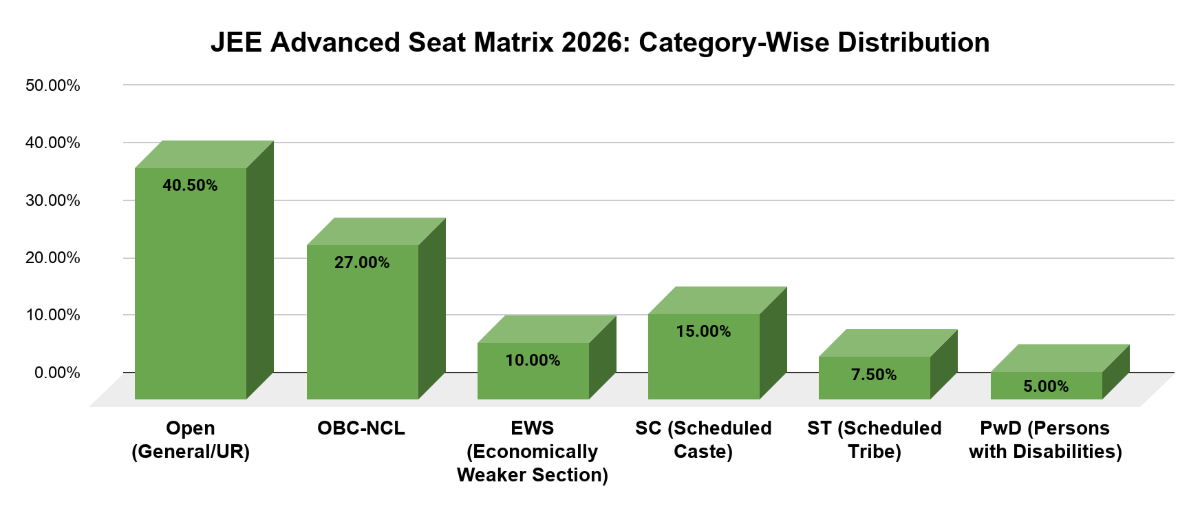
- Seats are reserved as follows: OBC-NCL 27%, SC 15%, ST 7.5%, EWS 10% — leaving about 40.5% as Open (General) seats. PwD reservation is 5% horizontal within each category.
- Female supernumerary seats (up to 20% extra) are added above the base seat count at IITs, they do not reduce seats for male students.
- Computer Science Engineering (CSE) at top IITs is the most competitive branch — IIT Bombay CSE had a General category closing rank of around 67 in 2024.
| Direct Link to JEE Advanced Seat Matrix 2026 (JoSAA) |
Also Check:
- JEE Advanced Cutoff 2026 | JoSAA Counselling 2026 | JEE Advanced Marks vs Rank 2026
- JEE Advanced Marks vs Rank 2026: Check Category-wise marks vs rank, minimum marks required & cutoff
Key Summary – JEE Advanced Seat Matrix 2026
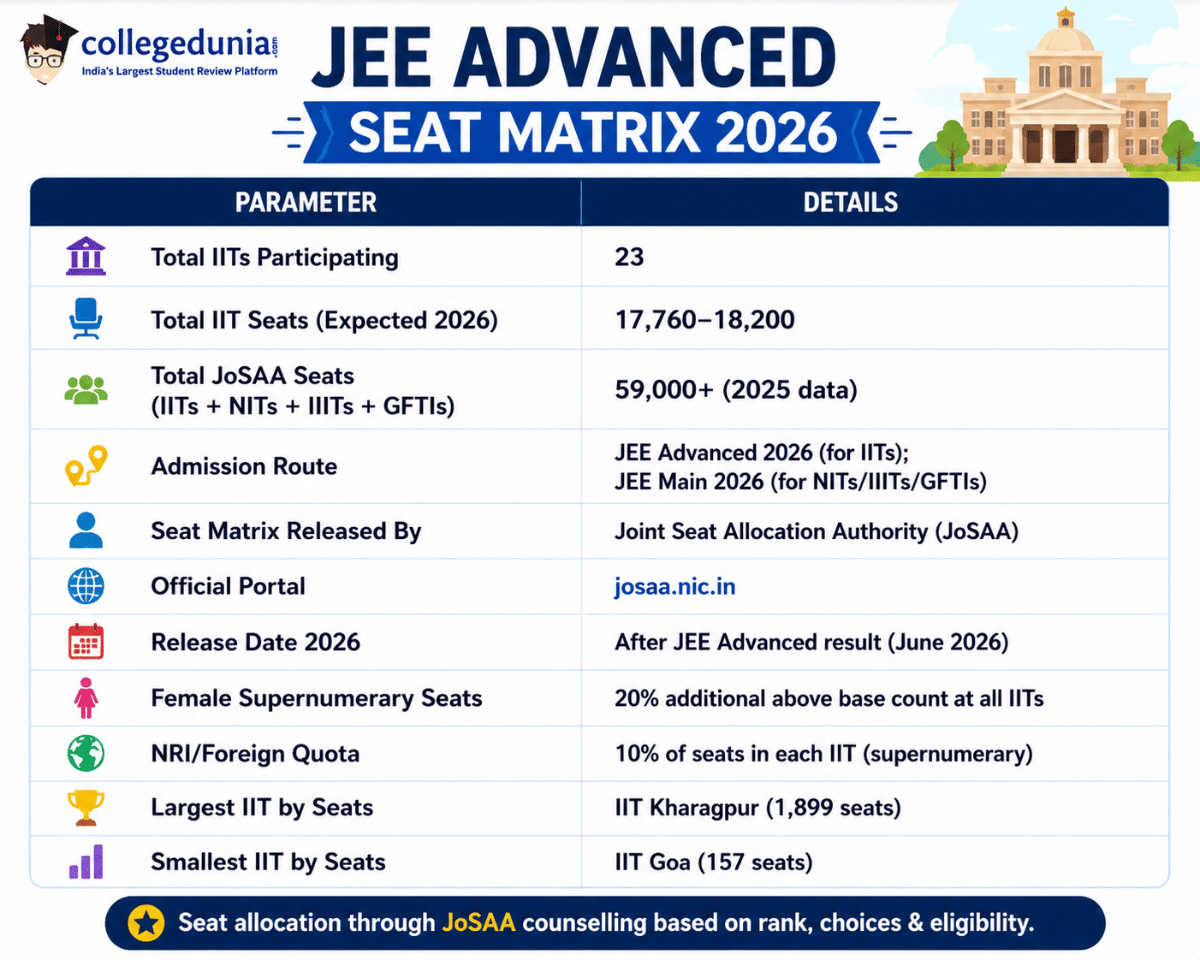
- Seat matrix released by: Joint Seat Allocation Authority (JoSAA)
- Official portal: josaa.nic.in
- Expected total IIT seats: 17,760–18,200 (based on 2025 data)
- Number of IITs: 23
- Release date: After JEE Advanced result — June 2026
- Largest IIT by seats: IIT Kharagpur (1,899 seats in 2025)
- Reservation: OBC-NCL 27%, SC 15%, ST 7.5%, EWS 10%, Open 40.5%
What is the JEE Advanced Seat Matrix 2026?
The JEE Advanced seat matrix 2026 covers approximately 17,760–18,200 seats across 23 IITs in India. These seats are filled exclusively through JEE Advanced qualification.
The JEE Advanced 2026 seat matrix covers the following programme types at IITs:
- 4-year B.Tech programs, the most common type, available at all 23 IITs
- 5-year Dual Degree (B.Tech + M.Tech), available at most older IITs
- 5-year Integrated M.Tech, available at select IITs
- 5-year B.Arch, available at IIT Kharagpur, IIT Roorkee, and IIT (BHU) Varanasi (requires AAT)
- 4-year B.S. programs, available at IIT Bombay, IIT Delhi, and a few others
Related Links:
JEE Advanced Seat Matrix 2026: Category-Wise Distribution
All IITs follow the reservation policy set by the Government of India. The JEE Advanced 2026 category-wise seats are distributed as follows across all 23 IITs.
- PwD (Persons with Disability) reservation is horizontal — it applies within each category, not as a separate pool.
- So 5% of Open seats go to Open-PwD, 5% of OBC-NCL seats go to OBC-NCL-PwD, and so on.
- Female supernumerary seats are additional to the base count and do not reduce seats in any category.
| Category | Reservation Percentage | Approximate Seats (out of 17,760) | Type |
|---|---|---|---|
| Open (General/UR) | 40.5% | 7,193 | Vertical reservation |
| OBC-NCL | 27% | 4,795 | Vertical reservation |
| EWS (Economically Weaker Section) | 10% | 1,776 | Vertical reservation |
| SC (Scheduled Caste) | 15% | 2,664 | Vertical reservation |
| ST (Scheduled Tribe) | 7.5% | 1,332 | Vertical reservation |
| PwD (Persons with Disabilities) | 5% | 5% of seats within each category above | Horizontal reservation |
Related Links:
JEE Advanced Seat Matrix 2026: Institute-Wise Seats in IITs
The table below shows the expected institute-wise seat count for JEE Advanced 2026 based on 2025 official JoSAA data. The number of seats may change slightly in 2026 as IITs add new programs, expand capacity, or reorganise existing ones.
| IIT | Total Seats (2025) | Trend for 2026 |
|---|---|---|
| IIT Kharagpur | 1,899 | Stable/slight increase |
| IIT (BHU) Varanasi | 1,589 | Stable |
| IIT Dhanbad (ISM) | 1,125 | Stable |
| IIT Bombay | 1,368 | Stable/new B.S. additions |
| IIT Roorkee | 1,353 | Stable |
| IIT Kanpur | 1,210 | Stable |
| IIT Delhi | 1,209 | Slight increase (new B.S. Chemistry 2025) |
| IIT Madras | 1,133 | Stable / Data Science & AI seats added |
| IIT Guwahati | 922 | Slight increase |
| IIT Hyderabad | 570 | Stable |
| IIT Patna | 547 | Stable |
| IIT Bhubaneswar | 481 | Stable |
| IIT Jodhpur | 490 | Slight increase |
| IIT Ropar | 370 | Stable |
| IIT Mandi | 329 | Stable |
| IIT Indore | 360 | Stable |
| IIT Gandhinagar | 250 | New IC Design programme added in 2025 |
| IIT Tirupati | 250 | Stable |
| IIT Palakkad | 200 | Stable |
| IIT Bhilai | 200 | Increase likely (46 seats added in 2025) |
| IIT Jammu | 240 | Stable |
| IIT Dharwad | 187 | Increase (ECE and Data Science added 2025) |
| IIT Goa | 157 | Stable |
| Total (All 23 IITs) | 18,160 (2025) | Expected 18,200–18,500 for 2026 |
Related Links:
JEE Advanced Seat Matrix of Top 5 IITs: Branch-wise Seats
The top 5 IITs by preference — IIT Bombay, IIT Delhi, IIT Madras, IIT Kanpur, and IIT Kharagpur — are the most competitive. Here is an approximate branch-wise seat breakdown for these IITs.
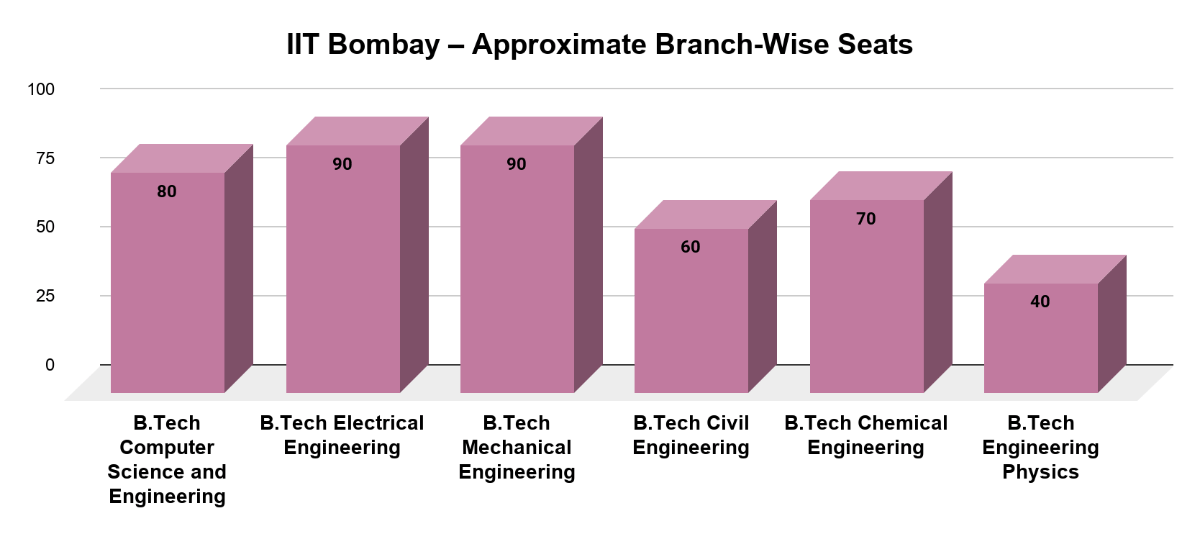
IIT Bombay – Approximate Branch-Wise Seats (2025)
| Program | Total Seats (Approx.) | General (Open) | OBC-NCL | SC | ST | EWS |
|---|---|---|---|---|---|---|
| B.Tech Computer Science and Engineering | 80 | 32 | 22 | 12 | 6 | 8 |
| B.Tech Electrical Engineering | 90 | 36 | 24 | 14 | 7 | 9 |
| B.Tech Mechanical Engineering | 90 | 36 | 24 | 14 | 7 | 9 |
| B.Tech Civil Engineering | 60 | 24 | 16 | 9 | 5 | 6 |
| B.Tech Chemical Engineering | 70 | 28 | 19 | 11 | 5 | 7 |
| B.Tech Engineering Physics | 40 | 16 | 11 | 6 | 3 | 4 |
| All Other programs | 838 | Distributed as per reservation norms | ||||
| IIT Bombay Total | 1,368 | — | ||||
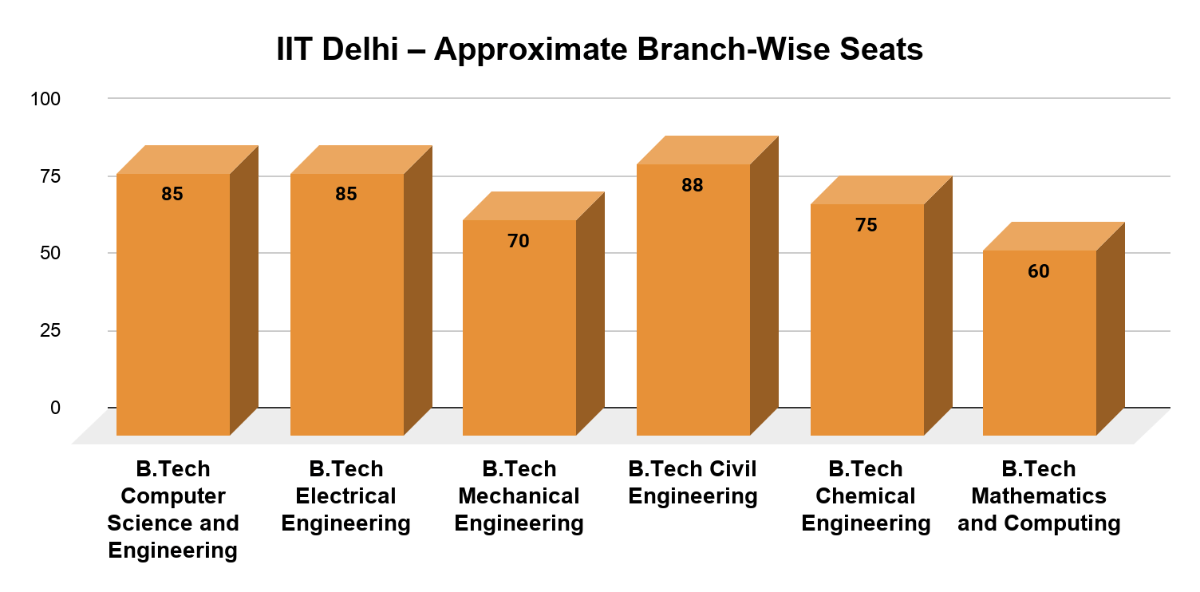
IIT Delhi – Approximate Branch-Wise Seats (2025)
| Programme | Total Seats (Approx.) |
|---|---|
| B.Tech Computer Science and Engineering | 85 |
| B.Tech Electrical Engineering | 85 |
| B.Tech Mechanical Engineering | 70 |
| B.Tech Civil Engineering | 88 |
| B.Tech Chemical Engineering | 75 |
| B.Tech Mathematics and Computing | 60 |
| All Other programs | 746 |
| IIT Delhi Total | 1,209 |
Also Read:
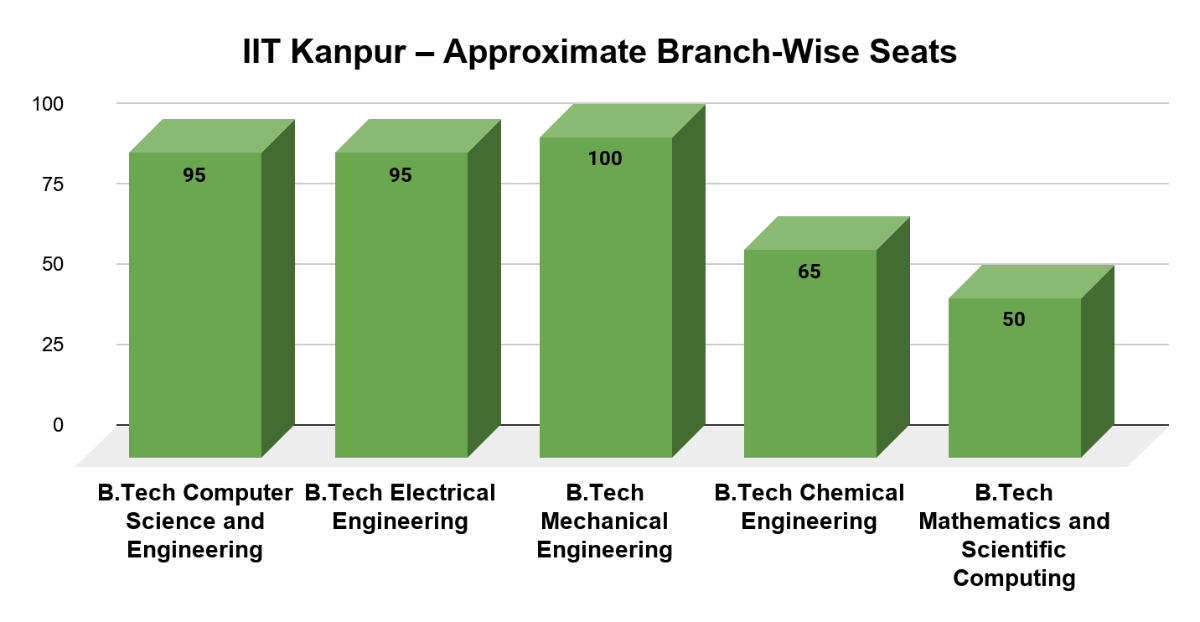
IIT Kanpur – Approximate Branch-Wise Seats (2025)
| Program | Total Seats (Approx.) |
|---|---|
| B.Tech Computer Science and Engineering | 95 |
| B.Tech Electrical Engineering | 95 |
| B.Tech Mechanical Engineering | 100 |
| B.Tech Chemical Engineering | 65 |
| B.Tech Mathematics and Scientific Computing | 50 |
| All Other programs | 805 |
| IIT Kanpur Total | 1,210 |
Related Links:
JEE Advanced Seat Matrix 2026: Course-Wise Breakdown
The course-wise seat distribution shows how seats are spread across engineering branches in IITs.
- The total CSE seats across all 23 IITs in 2024 were approximately 1,928, for which around 2 lakh students appeared in JEE Advanced 2026.
- This means roughly 100 students compete for each CSE seat at IITs.
| Branch / Course | Approx. Total Seats Across All 23 IITs (2025) | Demand Level |
|---|---|---|
| Computer Science Engineering (CSE) | 1,928 | Extremely High |
| Electrical Engineering (EE / EEE) | 2,100+ | Very High |
| Mechanical Engineering (ME) | 2,200+ | High |
| Civil Engineering (CE) | 1,800+ | Moderate |
| Chemical Engineering (CHE) | 1,200+ | Moderate |
| Electronics and Communication (ECE) | 800+ | Very High |
| Engineering Physics | 400+ | High (niche) |
| Mathematics and Computing / Scientific Computing | 500+ | Very High |
| Aerospace / Aeronautical Engineering | 400+ | High |
| Metallurgical / Materials Engineering | 700+ | Lower |
| Mining / Mineral Engineering | 500+ | Lower |
| B.Arch (at IIT KGP, IIT Roorkee, IIT BHU) | 150 | Moderate (AAT needed) |
| New / Interdisciplinary Branches (AI, DS, IC Design, etc.) | 1,500+ | Very High (growing) |
Related Links:
Female Supernumerary Seats in IITs 2026
Female supernumerary seats mean female students have more seats available than what appears in the base seat matrix. These seats are not carved out of existing seats — they are extra seats that do not reduce the number of seats available to male students.
| Parameter | Details |
|---|---|
| Female Supernumerary Seats | Up to 20% of the base sanctioned strength of each programme |
| Who Can Apply | Female students who qualify JEE Advanced and meet all eligibility criteria |
| Category Rules | Female supernumerary seats follow the same category reservation (Open/OBC/SC/ST/EWS) |
| Impact on Cutoff | Female closing ranks are typically higher (lower AIR number) than corresponding male seats in the same category and branch |
| Available At | All 23 IITs across all programs |
Related Links:
NRI and Foreign National Seats in IITs 2026
- IITs offer a separate quota of seats for NRI (Non-Resident Indian), OCI (Overseas Citizen of India), PIO (Persons of Indian Origin), and Foreign National students.
- In 2024, 7 foreign nationals qualified JEE Advanced and 179 Overseas Citizens of India (OCI) also cleared the exam.
| Parameter | Details |
|---|---|
| NRI/OCI/PIO Quota | Up to 10% of sanctioned seats in each programme at each IIT |
| Foreign National Quota | Separate seats; filled through DASA (Direct Admission of Students Abroad) or bilateral agreements |
| JEE Advanced Requirement | NRI/OCI/PIO students must qualify JEE Advanced to be eligible. Foreign nationals may apply through DASA using SAT scores. |
| Unfilled NRI Seats | If NRI quota seats remain vacant, they are converted to regular Indian seats and allotted to eligible Indian students through JoSAA counselling |
| Counselling Route | NRI/OCI/PIO: JoSAA counselling with JEE Advanced rank; Foreign nationals: DASA portal (dasanit.org) |
JEE Advanced Seat Matrix: Previous Year Trend
IIT seat count has been growing steadily over the years. The table below shows the year-wise total IIT seat count from 2021 to 2025, helping you understand the expansion trend for 2026.
| Year | Conducting IIT | Total IIT Seats | Year-on-Year Change |
|---|---|---|---|
| 2026 | IIT Roorkee | 18,200–18,500 (Expected) | +200–400 (minor increase expected) |
| 2025 | IIT Kanpur | 18,160 | +116 seats (+IIT Bhilai +46, IIT Delhi +30, etc.) |
| 2024 | IIT Madras | 17,740 | +1,000+ over 2023 |
| 2023 | IIT Guwahati | 16,598 | Moderate increase |
| 2022 | IIT Kharagpur | 16,000 | Increase after COVID disruption years |
| 2021 | IIT Kharagpur | 15,500 | Base level |
The total number of IIT seats has grown by approximately 17% over the last 5 years — from around 15,500 in 2021 to 18,160 in 2025. This growth is driven by expansion at newer IITs (Bhilai, Dharwad, Goa, Jammu, Palakkad, Tirupati) and addition of new programs (AI, Data Science, Design, Integrated Circuits) at older IITs. For 2026, a minor increase of around 200–400 seats is expected.
Related Links:
JEE Advanced Seat Matrix 2026: FAQs
Ques. How many total seats are available through JEE Advanced 2026?
Ans. JEE Advanced 2026 is expected to offer approximately 17,760–18,200 seats across 23 IITs. The official seat matrix will be released on josaa.nic.in after the JEE Advanced 2026 result on June 1, 2026.
Ques. Which IIT has the most seats?
Ans. IIT Kharagpur has the highest seat count among all IITs with approximately 1,899 seats in 2025, making it the largest IIT by intake. It is followed by IIT BHU Varanasi (1,589), IIT Bombay (1,368), and IIT Roorkee (1,353).
Ques. Which IIT has the fewest seats?
Ans. IIT Goa has the fewest seats among the 23 IITs with approximately 157 seats in 2025. Other newer IITs like IIT Dharwad (187), IIT Palakkad (200), and IIT Bhilai (200) also have relatively small intakes but are expanding every year.
Ques. How many CSE seats are available across all IITs?
Ans. The total CSE seats across all 23 IITs in 2024 was approximately 1,928. IIT Bombay CSE has around 80 seats, IIT Delhi CSE has around 85 seats, and IIT Kanpur CSE has around 95 seats. CSE is the most competitive branch due to very high demand and limited supply.
Ques. What is the reservation breakdown for IIT seats?
Ans. IIT seats are reserved as follows: Open (General) 40.5%, OBC-NCL 27%, EWS 10%, SC 15%, ST 7.5%. PwD reservation is horizontal at 5% within each category. Female supernumerary seats (up to 20% extra) are additional and do not cut into any category's seats.
Ques. When will the JEE Advanced 2026 seat matrix be released?
Ans. The official JEE Advanced 2026 seat matrix will be released by JoSAA at josaa.nic.in after the JEE Advanced result on June 1, 2026. Counselling registration begins June 2, 2026, and the seat matrix is typically published at the same time.
Ques. Are female supernumerary seats separate from the regular seat count?
Ans. Yes. Female supernumerary seats are additional seats above the base count — they do not reduce seats for male students. IITs offer up to 20% extra seats exclusively for female students to improve gender diversity. These seats are distributed across all categories (Open, OBC, SC, ST, EWS).
Ques. Can NRI students get IIT seats through JEE Advanced 2026?
Ans. Yes. NRI, OCI, and PIO students who qualify JEE Advanced 2026 are eligible for up to 10% supernumerary NRI quota seats at each IIT through JoSAA counselling. Foreign nationals who have not written JEE Advanced can apply through DASA (dasanit.org) using SAT scores.
Ques. How does the seat matrix affect JEE Advanced cutoff?
Ans. Fewer seats in a branch leads to a lower closing rank and a tighter cutoff. For example, IIT Bombay CSE with 32 Open seats closes around AIR 67 — while a branch with 150+ Open seats at the same IIT may close at AIR 800+. When planning your JoSAA choices, always check the seat count alongside previous year cutoffs.
Ques. Do new IITs have lower cutoffs despite fewer seats?
Ans. Generally yes. Newer IITs (established post-2008) like IIT Goa, IIT Bhilai, IIT Dharwad, and IIT Palakkad have lower demand relative to their seat count — so closing ranks are typically much higher (looser) than older IITs. If you aim for CSE at a newer IIT, your closing rank in 2025 ranged between around 4,000–8,000 in the General category depending on the specific IIT.
Ques. Will IIT seats increase in 2026 compared to 2025?
Ans. Yes, a minor increase is expected. In 2025, total IIT seats grew by 116 compared to 2024. For 2026, newer IITs are likely to add more seats and new programs (especially in AI, Data Science, and interdisciplinary engineering), while some older IITs may also expand specific branches. The official count will be confirmed in the JoSAA 2026 seat matrix.



Comments