




The JEE Advanced paper 2 has been concluded at 5:30 PM. Based on the early students’ reactions, Paper 2 was moderate in overall difficulty.
- Physics: The physics section was tough. There were multi-concept questions on topics such as Mechanics, Electrodynamics, Modern Physics, Thermodynamics, and Optics.
- Chemistry: The chemistry section was moderate, with organic chemistry focused on reaction mechanisms and named reactions. Numericals were asked in Physical Chemistry.
- Mathematics: The maths section was easy but had lengthy calculations. Questions were asked from Calculus, Algebra, Coordinate Geometry, Probability, and Vectors & 3D Geometry.
In Paper 1, the overall difficulty was moderate, with Physics being tough and Chemistry and Maths being easy and doable. The paper included many lengthy and concept-based questions that required strong accuracy and problem-solving skills.
Time management was crucial in both papers as questions involved multiple calculations and a deep understanding of concepts.
The IIT Roorkee conducted the JEE Advanced 2026 paper 1 and paper 2 on 17 May 2026 in 2 shifts. Paper 1 from 9:00 AM to 12:00 PM and Paper 2 from 2:30 PM to 5:30 PM in CBT mode, and both papers were compulsory.
Related Links:
- JEE Advanced Question Paper with Solutions: Access Previous Year Papers
- JEE Advanced Marks vs Rank 2026: Check Category-wise marks vs rank, minimum marks required & cutoff
- JEE Advanced 2026 Answer Key: Release Date, Response Sheet, and How to Challenge
JEE Advanced 2026 Question Paper with Solutions PDF
| JEE Advanced 2026 Paper 1 Question Paper | Download PDF | Check Solutions |
| JEE Advanced 2026 Paper 2 Question Paper | Download PDF | Check Solutions |
JEE Advanced Paper 2 Analysis (Out)
The JEE Advanced paper 1 was moderate in overall difficulty. Some students said that Paper 2 was tougher than 2025. The portion of class 12th was more in the exam compared to class 11. The concepts and patterns were also repeated from previous years.
Physics
- The Physics section was tough in Paper 2. There were lengthy calculations in this section. The questions had multiple concepts.
- The questions were asked on topics such as Ray optics, Electrostatics, Magnetic field, Galvanometer, Capacitance, fluid, Thermodynamics, Kinematics, and Experimental Physics, etc.
Chemistry
- The Chemistry section of paper 2 was moderate and tricky. There was a higher weightage for organic chemistry.
- Questions were also asked of the POC. Modern chemistry weightage was negligible, with only 1 question.
Mathematics
- The Maths section was easy due to easy concepts, but was lengthy due to multiple statements.
- The section included lengthy calculations and a deep understanding of concepts.
- Questions were asked on topics such as Integration, conic sections, Vector 3D, probability, AOD, Parabola, Limits, and Matrices.
JEE Advanced Paper 1 Analysis (Out)
The JEE Advanced paper 1 was moderate in overall difficulty, with the Physics section being on the tougher side. The chemistry section was easy and doable. The Mathematics section was easier compared to previous years.
Physics
- The Physics section was difficult with a strong focus on conceptual clarity, multi-concept numericals, and application-based problems.
- Mechanics, Electrodynamics, and Modern Physics had higher weightage, while questions from Optics and Thermodynamics were moderate in number.
- Integer-type and matrix match questions were lengthy and calculation-intensive, making time management challenging for many students.
Chemistry
- Chemistry was easy, with Physical Chemistry involving numerical calculations, Organic Chemistry focusing on reaction mechanisms, and Inorganic Chemistry testing the factual understanding of the students.
- Questions were asked on topics such as Coordination Compounds, Electrochemistry, Chemical Bonding, and Organic Named Reactions.
- The section included assertion-reason and multi-statement questions.
Mathematics
- Mathematics was easier compared to previous years for most students. The section included lengthy calculations and advanced problem-solving.
- Calculus, Coordinate Geometry, Algebra, and Vectors & 3D Geometry carried higher weightage in the paper.
- Match the following, and integer-answer questions required deep conceptual understanding and strong accuracy.
JEE Advanced 2026 Paper Analysis (Expected)
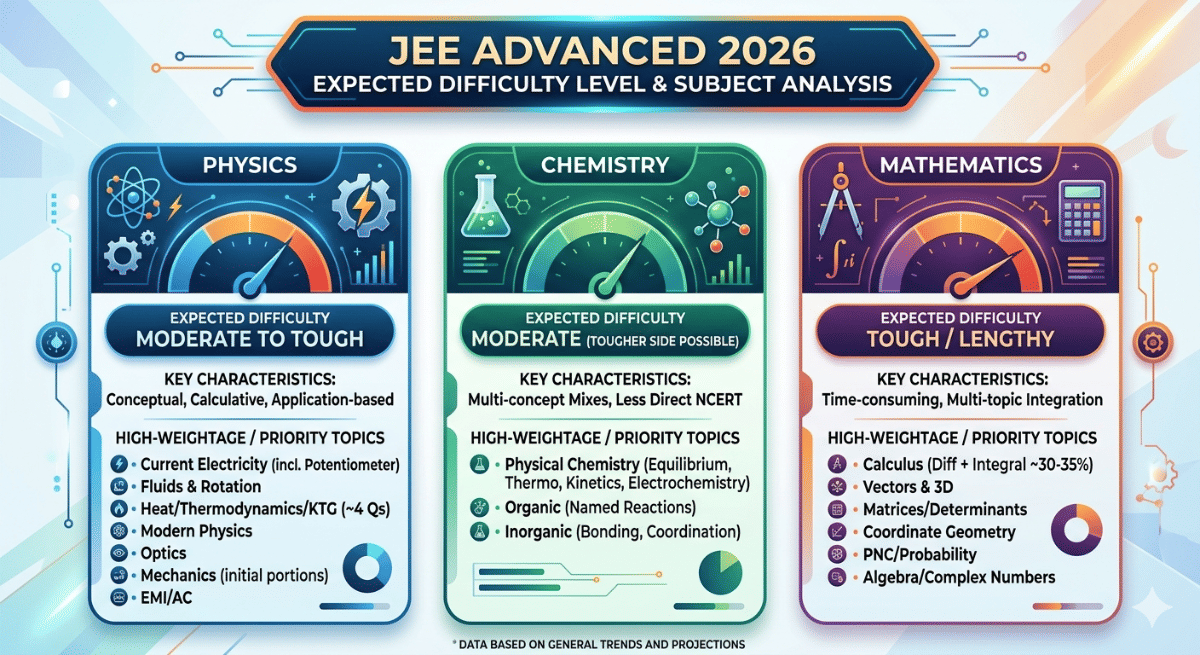
As per the experts (Matrix Academy and PW), the overall difficulty is predicted as Moderate to Tough. The paper is expected to be conceptually challenging with multi-concept integration, similar to or slightly tougher than recent years (e.g., 2025 or 2022 trends).
- Paper 1: Relatively balanced/moderate.
- Paper 2: Slightly tougher (more comprehension/numerical-heavy, plus afternoon fatigue).
| Subject | Expected Difficulty | Key Characteristics | High-Weightage / Priority Topics |
|---|---|---|---|
| Physics | Moderate to Tough | Conceptual, calculative, application-based | Current Electricity (high probability, incl. potentiometer), Fluids & Rotation, Heat/Thermodynamics/KTG (~4 Qs), Modern Physics, Optics, Mechanics (initial portions), EMI/AC |
| Chemistry | Moderate (Tougher side possible) | Multi-concept mixes, less direct NCERT | Physical Chemistry (Equilibrium, Thermo, Kinetics, Electrochemistry — high), Organic (named reactions), Inorganic (bonding, coordination) |
| Mathematics | Tough / Lengthy | Time-consuming, multi-topic integration | Calculus (Diff + Integral ~30-35%), Vectors & 3D, Matrices/Determinants, Coordinate Geometry, PNC/Probability, Algebra/Complex Numbers |
JEE Advanced 2026 Paper 1 Exam Analysis
Paper 1 is expected to be moderate difficulty. Balanced but with time pressure in lengthy questions. Good for students strong in concepts and time management.
Electrodynamics & Mechanics likely high weightage. Low recent-weightage topics (e.g., Current Electricity, Fluids, Rotation) expected to appear strongly. Chemistry offers scoring opportunities if NCERT + reaction mechanisms are strong. Maths will differentiate ranks.
| Subject | Expected Difficulty | Key Characteristics & Insights | High-Weightage / Important Topics | Good Attempts (out of ~16-18 Qs per subject) |
|---|---|---|---|---|
| Physics | Moderate to Difficult (Lengthy) | Multi-concept, calculation-heavy, application-based | Mechanics, Electrodynamics (Current Electricity high probability, including potentiometer), Optics, Modern Physics, Thermodynamics/KTG, SHM & Waves | 12–15 |
| Chemistry | Easy to Moderate | Scoring section; mix of direct & applied concepts | Organic (GOC, Amines, Alcohols, Named Reactions), Inorganic (Chemical Bonding, Coordination Compounds), Physical (Equilibrium, Electrochemistry) | 14–16+ |
| Mathematics | Difficult (Time-Consuming) | Lengthy calculations, multi-topic integration | Calculus (Differential + Integral), Algebra (Matrices, Complex), Coordinate Geometry, Vectors & 3D | 10–13 |
| Overall | Moderate | ~25-30% easy questions; focus on accuracy | — | 36–45 questions |
JEE Advanced 2026 Paper 2 Exam Analysis
Paper 2 is expected to be moderate to slightly higher difficulty than Paper 1. More comprehension/paragraph-based questions, potentially increasing time pressure and complexity.
Similar topic trends as Paper 1 but with potentially more application/comprehension twists. Maths remains the biggest challenge. Chemistry continues as the scoring section. Overall, Paper 2 may test endurance more.
Subject-wise Breakdown (Expected)
| Subject | Expected Difficulty | Key Characteristics & Insights | High-Weightage / Important Topics | Good Attempts (out of ~16-18 Qs per subject) |
|---|---|---|---|---|
| Physics | Moderate | Conceptual + numerical; paragraph sets possible | Electrodynamics, Modern Physics, Optics, Mechanics, Thermodynamics | 12–15 |
| Chemistry | Moderate | Balanced; named reactions & bonding key | Organic (Named Reactions, Amines), Inorganic (Coordination, Periodic Table), Physical (Thermo, Electrochemistry, Equilibrium) | 13–16 |
| Mathematics | Moderate to Difficult | Tough problems, integration of concepts | Calculus, Algebra, Coordinate Geometry, Probability, Vectors & 3D | 10–13 |
| Overall | Moderate (Tougher side) | Comprehension-heavy; better time management needed | — | 35–44 questions |
Also Check:
JEE Advanced 2026 Good Attempts & Safe Scores (Expected)
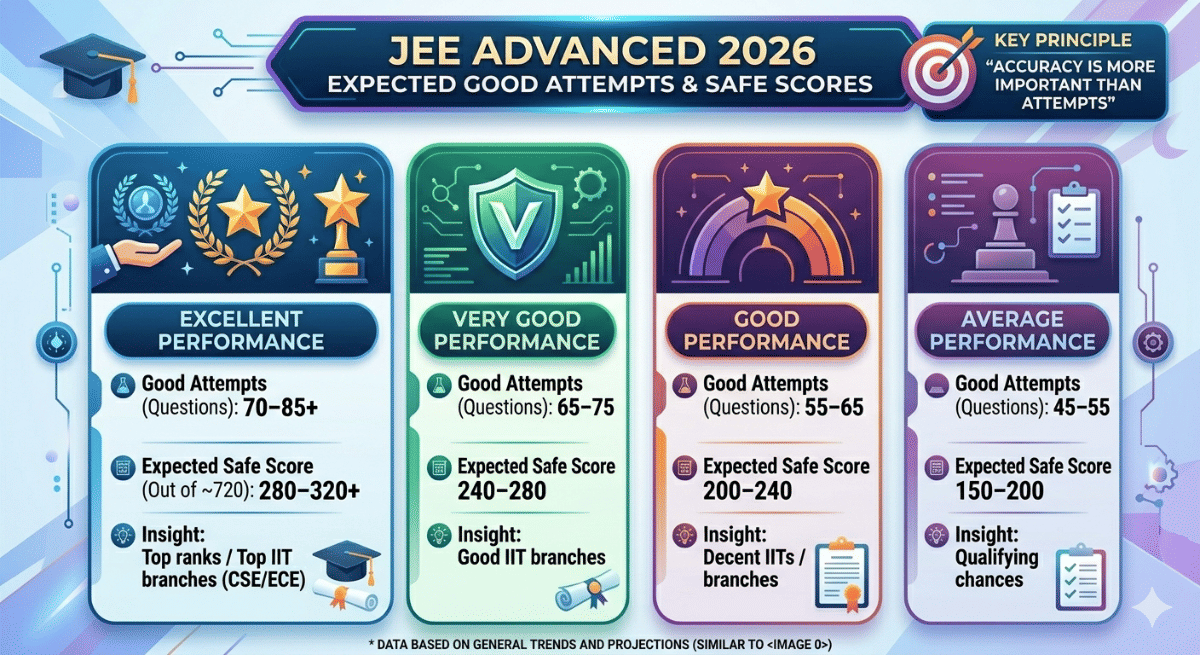
The JEE Advanced 2026 expected score analysis suggests that accuracy will be more important than attempts.
- Students scoring 280–320+ marks with 70–85 attempts can target top ranks and premium branches at IITs, while 240–280 marks can secure good IIT branches.
- Scores between 200–240 marks may lead to decent IIT options, and 150–200 marks mainly indicate qualifying chances.
| Performance Level | Good Attempts (Total Questions) | Expected Safe Score (Out of ~720) | Insight |
|---|---|---|---|
| Excellent | 70–85+ | 280–320+ | Top ranks / Top IIT branches (CSE/ECE) |
| Very Good | 65–75 | 240–280 | Good IIT branches |
| Good | 55–65 | 200–240 | Decent IITs / branches |
| Average | 45–55 | 150–200 | Qualifying chances |
JEE Advanced Question Paper 2025 with Solution PDF
| Paper Name | Question Paper Link | Solutions Link |
|---|---|---|
| JEE Advanced 2025 Paper 1 Question Paper | Download PDF | Check Solutions |
| JEE Advanced 2025 Paper 2 Question Paper | Download PDF | Check Solutions |
JEE Advanced Question Paper 2024 with Solution PDF
| Paper Name | Question Paper Link | Solutions Link |
|---|---|---|
| JEE Adv 2024 Paper 1 Question Paper PDF | Download PDF | Check Solution |
| JEE Adv 2024 Paper 2 Question Paper PDF | Download PDF | Check Solution |
Check:
JEE Advanced 2025 Paper Analysis
JEE Advanced 2025 was moderately difficult overall, with Paper 2 slightly tougher than Paper 1.
- In Paper 1, Mathematics was the most challenging, Physics was moderate, and Chemistry was the easiest and most scoring section.
- In Paper 2, Physics emerged as the toughest subject, while Mathematics was moderate and Chemistry remained easy to moderate.
- With 180 marks and 48 questions in each paper, the exam emphasized accuracy, time management, and smart question selection.
| Particulars | Paper 1 Exam Analysis | Paper 2 Exam Analysis |
|---|---|---|
| Overall Difficulty | Moderate | Moderate to Difficult |
| Maths Difficulty | Comparatively Difficult but Manageable | Moderate |
| Physics Difficulty | Moderate | Difficult |
| Chemistry Difficulty | Easy | Easy to Moderate |
| Total Marks | 180 | 180 |
| Total Questions | 48 | 48 |
JEE Advanced 2024 Paper Analysis
JEE Advanced 2024 was moderately difficult, with Mathematics emerging as the toughest and most time-consuming section in both papers. Physics was conceptual and lengthy, while Chemistry remained the easiest and most scoring subject. The exam favored students with strong accuracy, speed, and strategic question selection.
| Particulars | Paper 1 Exam Analysis | Paper 2 Exam Analysis |
|---|---|---|
| Overall Difficulty | Moderate | Moderate |
| Maths Difficulty | Difficult | Difficult |
| Physics Difficulty | Moderate to Difficult | Moderate to Difficult |
| Chemistry Difficulty | Moderate | Moderate |
| Total Marks | 180 | 180 |
| Total Questions | 51 | 51 |
| Subject-wise Questions | Physics- 17Chemistry- 17Mathematics- 17 | Physics- 17Chemistry- 17Mathematics- 17 |
| Types of Question | MAMCQS, SAQS, Integer Type Questions, Matrix Match | MAMCQS, SAQS, Integer Type Questions, Paragraph-based Questions |
JEE Advanced 2023 Paper Analysis
| Parameter | Paper 1 | Paper 2 |
|---|---|---|
| Overall Difficulty | Moderate to Difficult | More Difficult than Paper 1 |
| Mathematics | Moderate to Difficult | Difficult |
| Physics | Moderate | Moderate to Difficult |
| Chemistry | Moderate | Moderate |
| Most Difficult Subject | Mathematics | Mathematics |
| Most Scoring Subject | Chemistry | Chemistry |
| Key Challenge | Balanced difficulty, lengthy questions | Higher difficulty and time pressure |
JEE Advanced 2022 Paper Analysis
| Parameter | Paper 1 | Paper 2 |
|---|---|---|
| Overall Difficulty | Moderate to Difficult | Moderate |
| Mathematics | Difficult & Time-consuming | Time-consuming |
| Physics | Moderate | Moderate, Time-consuming |
| Chemistry | Moderate | Easiest section |
| Most Difficult Subject | Mathematics | Mathematics & Physics |
| Most Scoring Subject | Chemistry | Chemistry |
| Key Topics Highlighted | Maths: 3D Geometry, Functions, Matrices, Ellipse, Vectors, Probability | Chemistry: Electrochemistry, Mole Concept, Surface Chemistry, Thermodynamics, Organic Chemistry |
| Key Challenge | Lengthy Mathematics | Time management in Maths & Physics |
JEE Advanced 2021 Paper Analysis
| Parameter | Paper 1 | Paper 2 |
|---|---|---|
| Overall Difficulty | Moderate | Moderate |
| Mathematics | Moderate, time-consuming | Moderate but lengthy |
| Physics | Difficult to Moderate | Toughest section |
| Chemistry | Easy to Moderate | Comparatively easier |
| Most Difficult Subject | Physics | Physics |
| Most Scoring Subject | Chemistry | Chemistry |
| Time-Consuming Sections | Physics & Mathematics | Mathematics |
| High-Weightage Topics | Physics: Gravitation, Rotation, Waves, Mechanics Chemistry: Organic Chemistry, Atomic Structure, Chemical Bonding Maths: Calculus, Integration, Geometry | Physics: Mechanics, Thermodynamics, Gravitation Chemistry: Organic Chemistry, Aldehydes, P-block, Atomic Structure Maths: Calculus, Geometry |
JEE Advanced Paper Difficulty Level Year Wise
| Year | Overall Difficulty | Physics | Chemistry | Mathematics | Key Observation |
|---|---|---|---|---|---|
| 2025 | Moderate-Difficult | Hard | Easy-Moderate | Hard | Maths most difficult section |
| 2024 | Easy-Moderate | Moderate | Easy | Moderate | Easier than 2022–23 |
| 2023 | Hard | Moderate-Hard | Moderate | Hard | Lengthy but balanced |
| 2022 | Very Hard | Hard | Hard | Very Hard | Lowest cutoff among recent years |
| 2021 | Hard | Hard | Moderate | Hard | Tough multi-correct questions |
| 2020 | Moderate-Hard | Hard | Moderate | Hard | Conceptual jump after COVID delay |
| 2019 | Moderate | Moderate | Easy-Moderate | Moderate | Relatively easier year |
| 2018 | Moderate-Hard | Moderate | Moderate | Hard | Maths time-consuming |
| 2017 | Moderate-Hard | Very Hard | Moderate | Hard | Physics unusually difficult |
| 2016 | Hard | Hard | Moderate | Hard | Numerical-heavy |
| 2015 | Hard | Moderate | Hard | Hard | Lengthy calculations |
| 2014 | Very Hard | Hard | Hard | Very Hard | Considered one of toughest papers ever |
| 2013 | Moderate-Hard | Moderate | Moderate | Hard | First "Advanced" format; balanced but tricky |
JEE Advanced 2026 Paper Analysis FAQs
Ques. Is the JEE Advanced 2026 tough?
Ans. Yes, JEE Advanced 2026 is expected to be a tough and highly competitive exam, based on trends from previous years.
- JEE Advanced is widely considered one of the most challenging undergraduate engineering entrance exams in India.
- it tests not only conceptual understanding but also problem-solving speed, analytical thinking, and exam temperament.
Ques. What is the safe score for JEE Advanced 2026?
Ans. A safe score in JEE Advanced 2026 depends on your target IIT and branch, but based on recent trends, 160–180 marks out of 360 can be considered a good safe range for top IIT opportunities.
| Target | Safe Score Range |
|---|---|
| Qualifying Cutoff | 85–100 marks |
| Rank under 10,000 | 110–130 marks |
| Rank under 5,000 | 140–160 marks |
| Top IITs (IIT Bombay, Delhi, Madras) | 180–220+ marks |
| Top 1,000 Rank | 230–260+ marks |
Ques. What rank is 70 marks in JEE Advanced?
Ans. Based on recent JEE Advanced score vs rank trends, 70 marks will place you in the 18,000-25,000 rank, which is lower qualifying or borderline rank range.
Ques. Is Jee Advanced Paper 2 hard?
Ans. Yes, JEE Advanced Paper 2 is often considered harder than Paper 1, especially because of increased mental fatigue and slightly trickier question framing.
- 2025: Paper 2 was rated moderate to difficult, mainly due to tougher Physics
- 2024: Similar difficulty, but more lengthy
- 2023: Paper 2 was tougher than Paper 1
| Reason | Explanation |
|---|---|
| Exam Fatigue | Students are already mentally exhausted after Paper 1 |
| Tricky Questions | Paper 2 often has more unconventional questions |
| Time Pressure | Long calculations feel tougher in the second session |
| Physics Difficulty | Physics tends to feel harder in many years |



Comments