




JEE Advanced Chapter-Wise Weightage gives the topic-wise marks distribution for Physics, Chemistry, and Mathematics. JEE Advanced is a country-level test for entry to IITs and the best engineering colleges, which is accessible only to JEE Main qualifiers.
Each subject is equally weighted to 33.33%, promoting the understanding of concepts and the development of problem-solving skills.
- Mathematics and Physics together cover about 65–70% of the JEE Advanced paper, with key topics such as Calculus, Coordinate Geometry, Algebra, Mechanics, Electrodynamics, and Thermodynamics, accounting for nearly 40–45 questions worth 240 marks.
- Chemistry contributes the remaining 30–35%, focusing on Physical (Thermodynamics, Equilibrium), Inorganic (P-Block, Coordination Compounds), and Organic Chemistry (Alcohols, Aldehydes, and Amines), with around 18–20 questions carrying 120 marks.
The official JEE Advanced Syllabus PDF is available to download from the link below:
Also Read: Do PYQs Repeat in JEE Advanced?

Key Summary
- In this article, we covered the JEE Advanced Chapter-Wise Weightage 2026, including important topics, marks distribution, and previous years’ questions.
- The JEE Advanced 2026 syllabus includes both class 11 and 12 concepts. The distribution of questions is equally for Physics, Chemistry, and Mathematics (33.33% each).
- Mathematics chapters that get the most weightage are Calculus, Algebra, 3D Geometry, Trigonometry, and Probability. These topics make up the majority of the 54–60 questions.
- Physics topics are Mechanics, Electricity & Magnetism, Wave Optics, and Modern Physics, which cover most of the 54–60 questions.
- Chemistry major chapters are Thermodynamics, Chemical Kinetics, P-Block & S-Block Elements, and Coordination Compounds, which contribute most of the questions.
- What is the JEE Advanced 2026 Chapter-Wise Weightage?
- JEE Advanced Chapter-Wise Weightage 2026
- JEE Advanced 2026 Subject-Wise Weightage
- JEE Advanced 2026 Exam Pattern
- JEE Advanced 2026: Important Chapters
5.1 JEE Advanced 2026 Mathematics - Important Chapters
5.2 JEE Advanced 2026 Physics-Important Chapters
5.3 JEE Advanced 2026 Chemistry - Important Chapters
- JEE Advanced 2026 Syllabus
- JEE Advanced 2026 – Chapters & Weightage by Pathshala by Nova
- JEE Advanced Previous Years’ Papers
- FAQs
What is the JEE Advanced 2026 Chapter-Wise Weightage?
JEE Advanced 2026 covers Class 11 and 12 concepts from CBSE and other national boards. All subjects carry roughly equal weight (~33% each), testing conceptual understanding, problem-solving, and application skills.
- Mathematics: Calculus (15–17%), Algebra (14–16%), Coordinate Geometry (12–14%), Trigonometry (6–8%), Probability & Statistics (7–9%), Vectors & 3D Geometry (9–11%)
- Physics: Mechanics (15–17%), Electricity & Magnetism (12–14%), Optics (8–10%), Thermodynamics & Heat (10–12%), Modern Physics (10–12%), Waves & Oscillations (8–10%)
- Chemistry: Physical Chemistry – Thermodynamics, Equilibrium, Kinetics (14–16%), Organic Chemistry – Reaction Mechanisms, Biomolecules (14–16%), Inorganic Chemistry – p-, s-, d-, f-Block Elements (12–14%)
| Aspect | Details |
|---|---|
| Exam Name | Joint Entrance Examination (JEE) Advanced 2026 |
| Conducting Body | IITs (rotating among IITs each year) |
| Mode of Exam | Online – Computer-Based Test (CBT) |
| Exam Duration | 3 hours per paper (2 papers, Paper 1 and Paper 2) |
| Total Marks | 372 marks (Paper 1 – 186, Paper 2 – 186) |
| Total Questions | Paper 1 & Paper 2 – 54 questions each |
| Subjects Covered | Physics, Chemistry, Mathematics |

Also Read: Best Books for JEE Advanced
JEE Advanced Chapter-Wise Weightage 2026
The JEE Advanced chapter-wise weightage distribution for mathematics, physics, and chemistry is listed as follows:
JEE Advanced Mathematics Chapter-Wise Weightage
The table outlines the JEE Advanced chapter-wise weightage for classes 11 and 12 for 2026, in which:
- Class 12 chapters dominate with ~60% of total weightage, while Class 11 contributes ~40%.
- High-weight chapters include Calculus, Coordinate Geometry, and Algebra.
| Class 11 Chapters | Weightage (%) | Class 12 Chapters | Weightage (%) |
|---|---|---|---|
| Sets, Relations & Functions | 4% | Calculus (Differentiation & Integration) | 15% |
| Quadratic Equations & Expressions | 5% | Vectors & 3D Geometry | 10% |
| Complex Numbers | 6% | Probability & Statistics | 7% |
| Sequence & Series | 5% | Matrices & Determinants | 6% |
| Permutations & Combinations | 5% | Differential Equations | 6% |
| Binomial Theorem | 4% | Application of Derivatives | 5% |
| Coordinate Geometry (2D) | 6% | Linear Programming | 5% |
| Trigonometry | 5% | Vectors (Advanced) | 5% |

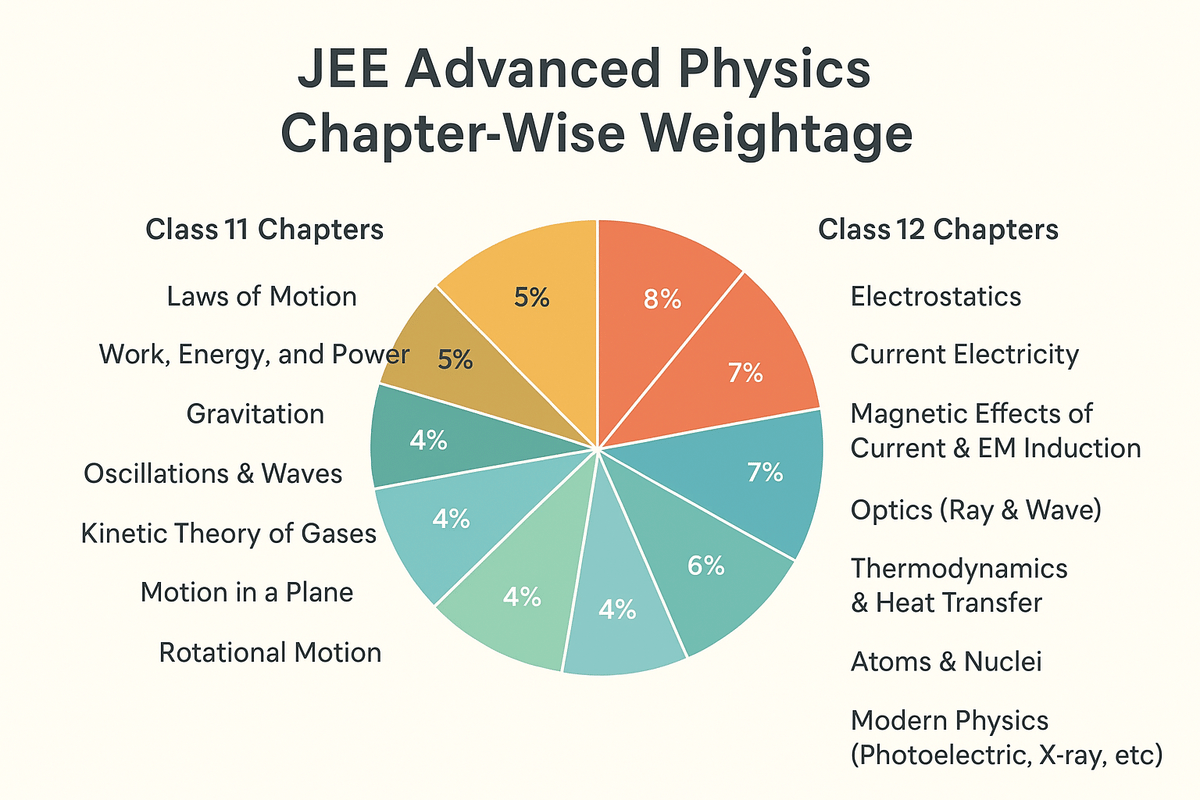
JEE Advanced Physics Chapter-Wise Weightage
The table outlines the JEE Advanced chapter-wise weightage for physics of classes 11 and 12 for 2026, in which:
- Class 12 chapters carry a major share (~65%), while Class 11 contributes ~35%.
- High-weight topics include Mechanics, Electrostatics, and Modern Physics.
| Class 11 Chapters | Weightage (%) | Class 12 Chapters | Weightage (%) |
|---|---|---|---|
| Laws of Motion | 5% | Electrostatics | 8% |
| Work, Energy, and Power | 5% | Current Electricity | 7% |
| Gravitation | 4% | Magnetic Effects of Current & EM Induction | 7% |
| Oscillations & Waves | 4% | Optics (Ray & Wave) | 6% |
| Kinetic Theory of Gases | 3% | Thermodynamics & Heat Transfer | 6% |
| Motion in a Plane | 3% | Atoms & Nuclei | 6% |
| Rotational Motion | 4% | Modern Physics (Photoelectric, X-ray, etc.) | 7% |
JEE Advanced Chemistry Chapter-Wise Weightage
The table outlines the JEE Advanced chapter-wise weightage for chemistry of classes 11 and 12 for 2026, in which:
- Physical, Inorganic, and Organic Chemistry each contribute ~33% of the total weightage.
- High-weight chapters include Chemical Bonding, Thermodynamics, and Coordination Compounds.
| Class 11 Chapters | Weightage (%) | Class 12 Chapters | Weightage (%) |
|---|---|---|---|
| Atomic Structure & Chemical Bonding | 5% | Solid State & Surface Chemistry | 6% |
| Thermodynamics & Thermochemistry | 5% | Electrochemistry | 6% |
| Equilibrium (Chemical & Ionic) | 5% | Chemical Kinetics | 5% |
| Hydrocarbons & Organic Basics | 5% | Aldehydes, Ketones, Carboxylic Acids | 6% |
| Hydrogen, s-Block, p-Block | 4% | Nitrogen & Halogens | 5% |
| Metallurgy & Periodicity | 4% | Coordination Compounds | 7% |
| Environmental Chemistry & Misc. | 3% | Biomolecules & Polymers | 4% |

Ques. What is the syllabus distribution for JEE Advanced 2026?
Ans. The JEE Advanced 2026 exam follows the syllabus pattern:
| S.No. | Syllabus Distribution |
|---|---|
| 1 | Questions are based on both Class 11 and Class 12 syllabus (roughly 50:50 distribution, varying slightly by subject) |
| 2 | The syllabus is based on CBSE and other national-level board curricula |
| 3 | The exam tests conceptual understanding, problem-solving, and application-based questions |
Ques. Why is chapter-wise weightage important for JEE Advanced exam preparation?
Ans. The chapter-wise weightage is important for JEE Advanced because:
| S.No. | Details |
|---|---|
| 1 | It helps focus on high-weightage and scoring chapters |
| 2 | Enables the prioritization of the study schedule effectively |
| 3 | Improves time management during preparation and revision |
| 4 | Helps in allocating effort to topics that can maximize rank and percentile |
Ques. What is the general approach to Chemistry in JEE Advanced?
Ans. JEE Advanced Chemistry questions focus on:
| S.No. | Details |
|---|---|
| 1 | Strong conceptual understanding of reaction mechanisms |
| 2 | Numerical problems from Physical Chemistry |
| 3 | Organic chemistry reaction series, naming, and synthesis |
| 4 | Emphasis on NCERT and reference books for accuracy and depth |
JEE Advanced 2026 Subject-Wise Weightage
The weightage is a reflection of the topics taught in Class 11 and Class 12 of CBSE and other national boards.
- The examination is very balanced as it tests the conceptual understanding and problem-solving skills for all three subjects.
- The three subjects, Mathematics, Physics, and Chemistry, are almost equally weighted, with each subject contributing approximately 33% to the total.
| Subject | Weightage (Marks) |
|---|---|
| Mathematics | 120 marks |
| Physics | 120 marks |
| Chemistry | 120 marks |

Also Read:JEE Advanced Total Marks
Ques. What are the high-weightage chapters in JEE Advanced 2026?
Ans. The high-weightage chapters in JEE Advanced 2026 focus on topics that are frequently tested across previous years:
| S.No. | Details |
|---|---|
| 1 | Mathematics: Calculus, Algebra, Coordinate Geometry, Probability & Vectors |
| 2 | Physics: Mechanics, Electrodynamics, Modern Physics, Thermodynamics |
| 3 | Chemistry: Physical Chemistry numericals, Organic reaction mechanisms, Inorganic NCERT-based concepts |
| 4 | Prioritizing these chapters helps maximize scoring potential |
Ques. How will JEE Advanced 2026 be conducted?
Ans. JEE Advanced 2026 will be conducted as per the standard format:
| S.No. | Details |
|---|---|
| 1 | Online Computer-Based Test (CBT) |
| 2 | Two papers: Paper 1 and Paper 2, each 3 hours |
| 3 | Multiple-choice, numerical answer type, and match-the-following questions |
| 4 | Both papers are compulsory and test conceptual and problem-solving skills |
JEE Advanced 2026 Exam Pattern
- The JEE Advanced 2026 exam is designed to test analytical thinking, reasoning ability, and deep conceptual knowledge.
- The paper is a mix of multiple-choice questions, numerical answer type, and match-the-following type questions.
| Aspect | Details |
|---|---|
| Mode of Exam | Computer-Based Test (CBT) |
| Duration | 3 hours per paper (Paper 1 & Paper 2) |
| Total Marks | 360 marks (180 per paper) |
| Number of Questions | 54–60 questions per paper (varies) |
| Marking Scheme | MCQs: +3 for correct, -1 for wrong; Numerical & matrix: +3, no negative marking |
| Sections | Paper 1 & Paper 2: Physics, Chemistry, Mathematics |
| Negative Marking | Yes, for MCQs only |
Also Read:
Ques. Is the State of Matter deleted for JEE Advanced 2026?
Ans. As per the latest syllabus update:
- The “State of Matter” chapter is not included in the JEE Advanced 2026 syllabus, so students should focus on other high-weightage chapters in Physical Chemistry.
- NCERT-based topics remain the primary source for Chemistry, and chapters with recurring questions in past exams should be prioritized.
JEE Advanced 2026: Important Chapters
High-weightage chapters are essential to get the highest scores in JEE Advanced.
- Practically all concepts of both 11th and 12th will be included in the JEE Advanced syllabus, and the distribution of the subjects will be almost equal.
- In addition, the students will improve their accuracy, problem-solving speed, and overall performance by giving preference to important chapters.
JEE Advanced 2026 Mathematics - Important Chapters
Mathematics in JEE Advanced emphasizes conceptual clarity, problem-solving, and analytical skills.
- Calculus, algebra, and probability are high-weight chapters.
- Prioritizing these topics improves efficiency and scoring potential.
| S.No. | Topic |
|---|---|
| 1 | Calculus |
| 2 | Algebra (Matrices & Determinants) |
| 3 | Probability & Statistics |
| 4 | Coordinate Geometry / 3D Geometry |
| 5 | Differential Equations |
| 6 | Application of Derivatives |
| 7 | Limits & Continuity |
| 8 | Trigonometry |
JEE Advanced 2026 Physics-Important Chapters
Physics requires both conceptual understanding and numerical problem-solving.
- Mechanics, modern physics, and thermodynamics consistently appear in JEE Advanced exams, carrying significant weightage.
| S.No. | Topic |
|---|---|
| 1 | Mechanics (Kinematics & Dynamics) |
| 2 | Rotational Motion |
| 3 | Oscillations & Waves |
| 4 | Current Electricity |
| 5 | Electromagnetic Induction |
| 6 | Optics |
| 7 | Atoms & Nuclei |
| 8 | Thermodynamics |
JEE Advanced 2026 Chemistry - Important Chapters
Chemistry in JEE Advanced includes Physical, Organic, and Inorganic sections.
- High-weightage topics include Thermodynamics, Coordination Chemistry, and reaction mechanisms.
- Combining numerical and theoretical practice is key.
| S.No. | Topic |
|---|---|
| 1 | Thermodynamics |
| 2 | p-Block Elements |
| 3 | d-Block & f-Block Elements |
| 4 | Coordination Compounds |
| 5 | Chemical Kinetics |
| 6 | Electrochemistry |
| 7 | Polymers & Biomolecules |
| 8 | Organic Reactions & Mechanisms |
Also Read: JEE Advanced Mock Test
Ques. Which chapter is most important for JEE?
Ans. The following chapters are considered the most important for JEE as they have high weightage and conceptual significance :
| Coordinate Geometry |
|---|
| Calculus |
| Electrostatics |
| Current Electricity |
| Chemical Bonding |
| Thermodynamics |
Ques. Can I leave Trigonometry for JEE?
Ans. It is not recommended to leave Trigonometry for JEE because:
- It forms the foundation for topics such as calculus, Coordinate Geometry, and Complex Numbers.
- Even if a few direct questions are asked, their applications appear in many problems.
- A strong understanding of Trigonometry improves overall mathematical accuracy and speed.
Ques. Which is the hardest chapter in JEE Advanced?
Ans. The hardest chapters in JEE Advanced are generally those requiring deep conceptual clarity and advanced problem-solving:
| Rotational Motion |
|---|
| Electromagnetic Induction |
| Organic Reaction Mechanisms |
JEE Advanced 2026 Syllabus
The JEE Advanced syllabus for chemistry, physics, and mathematics is shown in the table below.
JEE Advanced 2026 – Chapters & Weightage by Pathshala by Nova
The mentor from Pathshala by Nova, an IIT Bombay alumnus, provides a complete breakdown of JEE Advanced 2026 chapter-wise weightage for Physics, Chemistry, and Mathematics.
1. Based on previous-year papers and the latest IIT syllabus trends, the video highlights how marks are distributed across key topics.
2. Explains which chapters carry the highest weightage, which are concept-based, and how to build depth and accuracy for securing top AIR ranks.
3. Includes a smart 6-month preparation plan covering time management, JEE Main + Advanced balance, and topic prioritization.
4. Guides students on how to analyze PYQs, use mind maps for quick revision, and strengthen conceptual understanding.
5. Perfect for aspirants targeting IIT Bombay, Delhi, or Madras, aiming to secure a top 1000 rank in JEE Advanced 2026.
JEE Advanced Previous Years’ Papers
Aspirants must go through the previous years’ papers to understand the JEE Advanced Exam Pattern and JEE Advanced Syllabus.
| JEE Advanced Year | JEE Advanced Paper | Download Question Paper PDF |
|---|---|---|
| JEE Advanced 2025 | Paper 1 | Download PDF |
| Paper 2 | Download PDF | |
| JEE Advanced 2024 | Paper 1 | Download PDF |
| Paper 2 | Download PDF | |
| JEE Advanced 2023 | Paper 1 | Download PDF |
| Paper 2 | Download PDF | |
| JEE Advanced 2022 | Paper 1 | Download PDF |
| Paper 2 | Download PDF |
FAQs
Ques. Was JEE Advanced 2025 tough?
Ans. JEE Advanced 2025 was moderately tough and tested conceptual understanding:
- JEE Advanced 2025 was moderately tough and tested students’ conceptual understanding.
- Mathematics had lengthy problem-solving questions, Physics focused on application-based problems, Chemistry emphasized reaction mechanisms, and time management was crucial due to tricky questions.
Ques. What is the weightage for JEE Advanced 2026?
Ans. The weightage for JEE Advanced 2026 is almost evenly distributed across the three main subjects:
| Subject | Weightage (%) |
|---|---|
| Mathematics | ~33% |
| Physics | ~33% |
| Chemistry | ~33% |
Ques. What is the safe score for JEE Advanced 2026?
Ans. Safe score depends on category and desired IITs:
- A score above 180 is considered very competitive for top IITs.
| Category | Safe Score Range | Percentile Equivalent |
|---|---|---|
| General | 180–200+ | 99+ |
| OBC/EWS | 160–180+ | 95–98 |
| SC/ST | 130–150+ | 90+ |
Ques. What is the pattern of JEE Advanced 2026?
Ans. JEE Advanced 2026 consists of two papers. Each paper includes questions from Physics, Chemistry, and Mathematics. The total marks and number of questions vary by paper and year.
| Paper | Subjects | Type of Questions | Total Marks | Duration |
|---|---|---|---|---|
| Paper 1 | Physics, Chemistry, Mathematics | MCQs + Numerical + Match the Following | 180–200 | 3 hrs |
| Paper 2 | Physics, Chemistry, Mathematics | MCQs + Numerical + Match the Following | 180–200 | 3 hrs |
Ques. Is JEE Advanced 2026 only 200 marks?
Ans. No, the total marks for each paper usually range from 180 to 200. The distribution varies each year and across papers:
- Mathematics: ~60–70 marks per paper
- Physics: ~60–70 marks per paper
- Chemistry: ~60–70 marks per paper



Comments