




The JEE Advanced exam pattern 2027 follows a two paper structure with Paper 1 and Paper 2 of three hours each. Both papers are compulsory and each includes Physics, Chemistry and Mathematics. The JEE Advanced 2027 exam will be conducted in Computer Based Test (CBT) mode in both English and Hindi.
- Each paper will cover Physics, Chemistry and Mathematics with 60 marks per subject, taking the JEE Advanced total marks to 360 across both papers.
- JEE Advanced 2027 high weightage chapters include Mechanics, Calculus, Coordinate Geometry, Chemical Bonding, Organic Chemistry and Modern Physics.
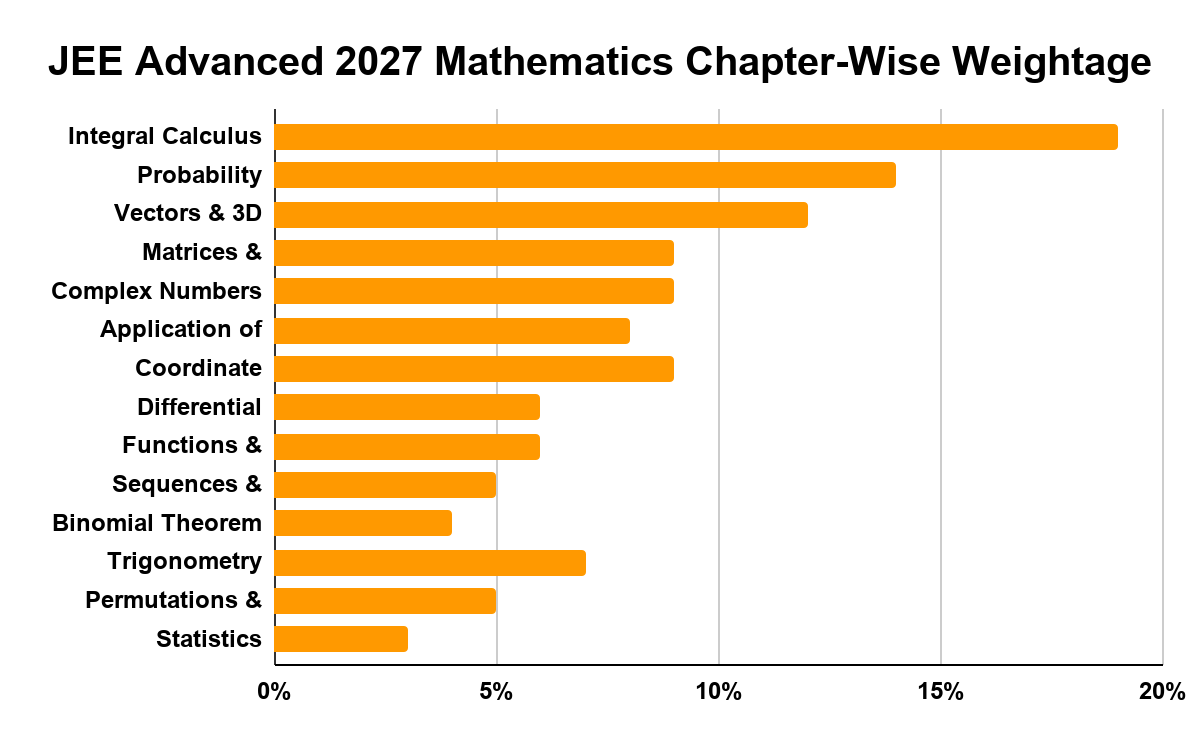
- In Mathematics, Integral Calculus (Definite + Indefinite) (15–19%) and Probability (12–14%) have the highest weightage.
- In JEE Advanced 2027 Physics, Mechanics and Electrostatics (30-35%) & Capacitance (10-12%) have high weightage.
- In JEE Advanced 2027 Chemistry, Organic Chemistry (especially reaction mechanisms) and Chemical Bonding remain the high-scoring areas.
- JEE Advanced 2027 question types include MCQs, multiple correct, numerical answer, integer type, matching and paragraph based questions.
- The JEE Advanced Marking Scheme 2027 follows +3 for correct and −1 for incorrect single correct MCQs while MSQs carry +4 for all correct options.
- MSQs award +3, +2 or +1 for partial answers while NAT questions carry +4 for correct answers with no negative marking based on the 2026 JEE Advanced paper.
- The JEE Advanced exam pattern carries around 51 questions per paper or 17 per subject based on 2024 and 2026.
- JEE Advanced 2027 will be organised by IIT Delhi under the JAB rotation system, though official confirmation is still awaited.
Related Links:
- JEE Advanced Exam Syllabus 2027: Subject-Wise Topics, Chapter Wise Weightage and PDF Download
- JEE Advanced Exam Paper Analysis: Paper 1&2 Difficulty Level, Students’ Reaction, and Good Attempts
- JEE Advanced Exam Mock Test: Online Chapter-wise Mock Test, Download Free PDF
Key Summary
- JEE Advanced has kept the 360 mark structure since 2021 despite changes in the total number of questions across different years.
- The number of questions reduced to 96 in 2025 from 114 in 2021, after the number of questions was increased to 102 in 2026 in the JEE Advanced exam.
- JEE Advanced Paper 2 had 54 questions in 2026 compared with 48 questions in Paper 1 creating a six question difference between the papers.
- In the JEE Advanced exam there were two types of partial marking in Multiple Choice Questions with five questions per subject in Paper 2.
JEE Advanced Exam Pattern 2027: Overview
JEE Advanced Exam Pattern 2027 is expected to be released on the official website jeeadv.ac.in along with the information brochure.
IIT Delhi is will conduct the exam 2027 and will provide the final details of the JEE Advanced 2027 exam pattern.
| Particulars | Details |
|---|---|
| Exam Name | JEE Advanced 2027 |
| Conducting Body | IIT Delhi (expected, under the zonal IIT rotation) |
| Exam Mode | Computer-Based Test (CBT) |
| Medium | English and Hindi |
| Number of Papers | 2 (Paper 1 and Paper 2) |
| Duration | 3 hours per paper (4 hours for eligible PwD candidates) |
| Total Duration | 6 hours (same day) |
| Typical Timings |
|
| Subjects | Physics, Chemistry, and Mathematics (in both papers) |
| Question Types |
|
| Total Marks (typical) |
|
| Marking Scheme | Full marks, partial marks (for multi-correct), zero, and negative marking |
| Negative Marking |
|
| Sections per Paper | 3 (Physics, Chemistry, Mathematics) |
Also Check:
- JEE Advanced Preparation: Section-wise Tips and Best Books
- JEE Advanced Chemistry Preparation: Study Material, Tips and Best Books
Ques. What is the JEE Advanced Exam Pattern 2027?
Ans. The JEE Advanced Exam Pattern 2027 consist of two compulsory computer-based papers covering Physics, Chemistry and Mathematics, with a total of 360 marks and a mix of MCQ, MSQ, numerical and matching-type questions, closely following the 2026 structure.
Candidates can also watch “JEE Advanced New Pattern” by Yash Mishra for an explanation of the proposed changes to the JEE Advanced examination. The video discusses the adaptive testing concept, the proposed pilot test, how difficulty could adjust based on responses, and what the possible change could mean for JEE Advanced 2027 and 2028 aspirants.
Also Check:
JEE Advanced Exam Pattern: Past Year Trends
As per the previous JEE Advanced Exam Pattern, the total marks have not changed from 360 since 2021.
- JEE Advanced had 102–114 questions across both papers from 2020 to 2026, with 51–57 questions per paper.
- The exam carried 360 marks from 2021 to 2026, while the 2020 paper had 396 marks, showing that the total marks can vary.
- The number of questions changed across years despite the 180-mark-per-paper format remaining consistent from 2021 to 2026.
| Year | Organising IIT | Total Questions (Both Papers) | Total Marks (Both Papers) | Questions per Paper | Marks per Paper |
|---|---|---|---|---|---|
| 2020 | IIT Delhi | 108 | 396 | 54 / 54 | 198 / 198 |
| 2021 | IIT Kharagpur | 114 | 360 | 57 / 57 | 180 / 180 |
| 2022 | IIT Bombay | 108 | 360 | 54 / 54 | 180 / 180 |
| 2023 | IIT Guwahati | 102 | 360 | 51 / 51 | 180 / 180 |
| 2024 | IIT Madras | 102 | 360 | 51 / 51 | 180 / 180 |
| 2025 | IIT Kanpur | 108 | 360 | 54 / 54 | 180 / 180 |
| 2026 | IIT Roorkee | 102 | 360 | 51 / 51 | 180 / 180 |
Also Check:
- JEE Advanced Exam Syllabus 2027: Topic-wise PDF, Subject-wise Topics and Chapter-wise Weightage
- JEE Advanced Exam Syllabus 2027: Subject-Wise Topics, Chapter-Wise Weightage and PDF Download
Ques. Which year was JEE Advanced toughest?
Ans. JEE Advanced 2022 is widely regarded as one of the toughest recent papers with Mathematics being particularly difficult and lengthy. 2014 and 2016 are also frequently listed among the toughest JEE Advanced papers.
JEE Advanced Exam Pattern 2027 Question Types
JEE Advanced Exam Pattern 2027 Question Types include Multiple Correct MCQs where candidates must select all the correct options from the given choices.
- Multiple Correct MCQs require candidates to identify every correct option, making complete option selection important for scoring.
- The organizing IIT does not officially lock the layout ahead of time. The specific allocation of marks and negative penalties is explicitly revealed to candidates as the exam timer starts.
- For Multi-Correct MCQs, you only receive partial credit if you don’t mark all correct options. For example, if options A, B, and C are correct, choosing just A and B yields +2 marks; choosing A, B, and D yields -2 marks.
| Question Type | Format | Typical Marking Scheme |
|---|---|---|
| Single Correct MCQ |
|
|
| Multiple Correct MCQ (MSQ) |
|
|
| Numerical Value Type (NVT) |
|
|
| Integer Type |
|
|
| Match the List / Matrix Match |
|
|
| Paragraph / Stem-based |
|
|
Also Check:
- JEE Advanced Exam Syllabus 2027: Subject-Wise Topics, Topic-Wise Weightage and PDF Download
- JEE Advanced Exam Chapter-Wise Weightage: Important Topics, Mark Distribution & Previous Year Question Analysis
Ques. What are the different types of questions in the JEE Advanced exam?
Ans. JEE Advanced includes different question formats such as Multiple Choice Questions, Multiple Select Questions and Numerical Answer Type questions. The exact marking scheme can vary across sections and papers.
JEE Advanced Marking Scheme 2027 for Paper 1
JEE Advanced Marking Scheme 2027 for Paper 1 includes a penalty for Multiple Correct MCQs when an incorrect option is selected.
- A −2 mark deduction applies to Multiple Correct questions when a wrong option is marked along with the correct ones.
- Numerical Answer Type questions in Paper 1 had no negative marking in both 2025 and 2026.
- NAT questions therefore remained a lower risk scoring area in the recent Paper 1 marking pattern.
- Match-the-List questions appeared in Paper 1 across the last three years with +3 or +4 marks for correct matching and −1 mark for an incorrect response.
| Section | Question Type | No. of Questions | Full Marks | Partial Marks | Incorrect Marks | Unattempted |
|---|---|---|---|---|---|---|
| 1 | Single Correct MCQ | 4 | +3 | N/A | –1 | 0 |
| 2 | Multiple Correct MCQ (MSQ) | 3–4 | +4 | +3 / +2 / +1 | –2 | 0 |
| 3 | Numerical Value Type (NVT) | 4–6 | +4 | N/A | 0 | 0 |
| 4 | Match the List / Matrix Match | 3–4 | +3 or +4 | Sometimes | –1 | 0 |
JEE Advanced Marking Scheme 2027 for Paper 2
JEE Advanced Marking Scheme 2027 for Paper 2 had five Multiple Correct questions per subject in 2026, one more than Paper 1.
- The higher number of Multiple Correct questions increased the share of questions requiring careful option selection in Paper 2.
- Paragraph and stem-based questions appeared mainly in Paper 2 over the last three years and generally carried fewer marks per question.
| Section | Question Type | No. of Questions | Full Marks | Partial Marks | Incorrect Marks | Unattempted |
|---|---|---|---|---|---|---|
| 1 | Single Correct MCQ | 4 | +3 | N/A | –1 | 0 |
| 2 | Multiple Correct MCQ (MSQ) | 4–5 | +4 | +3 / +2 / +1 | –2 | 0 |
| 3 | Numerical Value Type (NVT) | 5–6 | +4 | N/A | 0 | 0 |
| 4 | Paragraph / Stem-based | 3–4 | +2 or +4 | Rare | 0 or –1 | 0 |
Does JEE Advanced Have Negative Marking?
Yes, JEE Advanced has negative marking. In Single Correct MCQs 1 mark is deducted for a wrong answer and MSQs can deduct up to 2 marks per wrong option selected.
- Candidates are advised against guessing and should attempt a question only when reasonably confident of the answer.
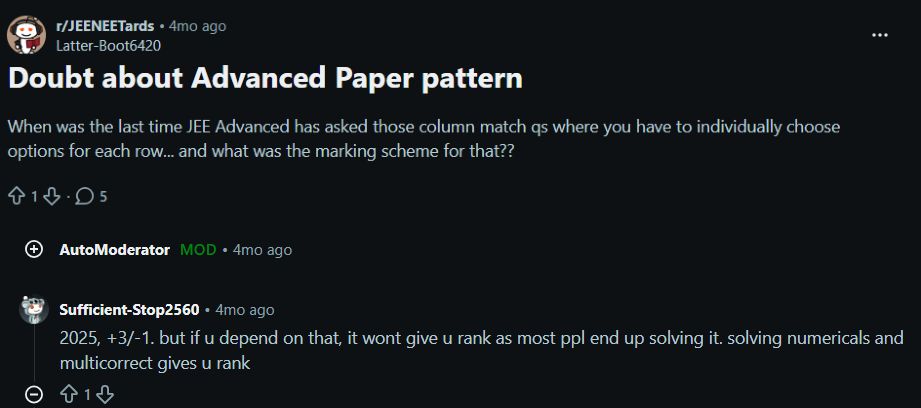
According to a Reddit discussion, candidates asked about the JEE Advanced column-match question format and its recent marking scheme.
The discussion noted that 2025 used a +3/-1 marking pattern, while also suggesting that Numerical Answer Type and multi-correct questions can be more important for improving rank.
Source: Reddit
Also Check:
JEE Advanced Exam Pattern 2027: Subject-Wise Weightage and Important Topics
Candidates can check the Subject-wise weightage and important topics for the JEE Advanced 2027 exam below:
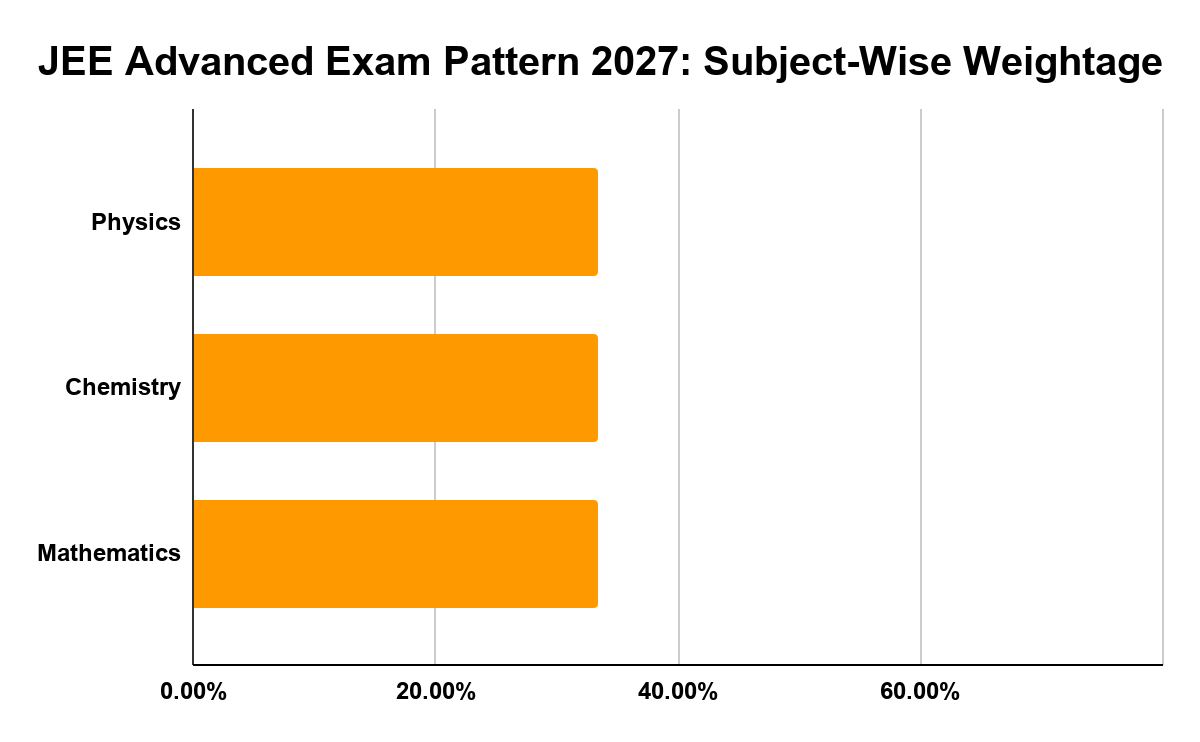
- Physics, Chemistry, and Mathematics each carry 120 marks across both papers, accounting for approximately 33.33% of the total marks per subject.
- Candidates should prepare all three subjects rather than rely on one high-scoring subject, as each contributes equally to the overall JEE Advanced score.
| Subjects | Marks (Paper 1 & Paper 2) | Total Marks | Overall Weightage |
|---|---|---|---|
| Physics | 60 + 60 | 120 | 33.33% |
| Chemistry | 60 + 60 | 120 | 33.33% |
| Mathematics | 60 + 60 | 120 | 33.33% |
JEE Advanced 2027 Mathematics Chapter-Wise Weightage
Mathematics carries approximately 120 marks in the JEE Advanced exam based on previous year data. Class 12 topics have higher weightage than Class 11 topics which account for 65-70% in the JEE Advanced exam.
- In JEE Advanced 2027 Mathematics, Calculus (especially integral Calculus) and probability will be the highest scoring areas.
- Candidates should focus on high weightage chapters first while ensuring coverage of the complete syllabus due to the unpredictable nature of JEE Advanced.
| Chapter / Topic | Approx. Weightage | Expected Questions |
|---|---|---|
| Integral Calculus (Definite + Indefinite) | 15–19% | 5–6 |
| Probability | 12–14% | 4–5 |
| Vectors & 3D Geometry | 10–12% | 3–4 |
| Matrices & Determinants | 7–9% | 2–3 |
| Complex Numbers | 6–9% | 2–3 |
| Application of Derivatives / Limits | 6–8% | 2–3 |
| Coordinate Geometry (Conics) | 7–9% | 2–3 |
| Differential Equations | 4–6% | 1–2 |
| Functions & Relations | 4–6% | 1–2 |
| Sequences & Series | 3–5% | 1–2 |
| Binomial Theorem | 3–4% | 1 |
| Trigonometry (including Inverse) | 4–7% | 1–2 |
| Permutations & Combinations | 3–5% | 1 |
| Statistics | 2–3% | 0–1 |
JEE Advanced 2027 Physics Chapter-Wise Weightage
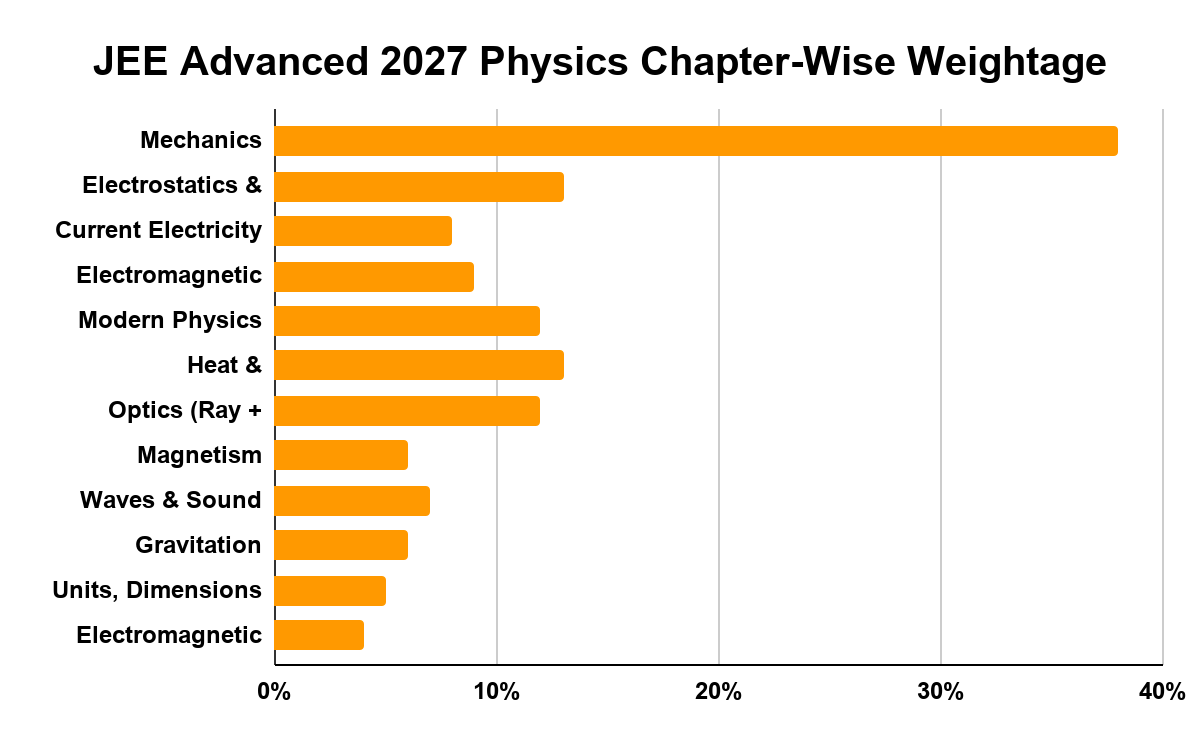
Physics carries approximately 120 marks in the JEE Advanced exam based on previous year data. Class 11 Mechanics alone has the largest share of marks in the JEE Advanced exam.
- In JEE Advanced 2027 Physics, Mechanics and Electrostatics & Capacitance have high weightage.
- Mechanics leads with an estimated 30–38% weightage and 10–13 questions, followed by Electrostatics and Capacitance, Heat and Thermodynamics, and Modern Physics.
- Prioritise high-weightage chapters, but also revise Optics, Magnetism, Gravitation, and Units and Dimensions, as smaller topics can contribute additional marks.
| Chapter / Topic | Approx. Weightage | Expected Questions |
|---|---|---|
| Mechanics (Rotational Motion, COM, Work-Energy, SHM, Fluids) | 30–38% | 10–13 |
| Electrostatics & Capacitance | 10–13% | 3–4 |
| Current Electricity | 6–8% | 2–3 |
| Electromagnetic Induction & AC | 6–9% | 2–3 |
| Modern Physics (Photoelectric, Nuclear, Atoms) | 10–12% | 3–4 |
| Heat & Thermodynamics | 10–13% | 3–4 |
| Optics (Ray + Wave) | 8–12% | 2–4 |
| Magnetism | 4–6% | 1–2 |
| Waves & Sound | 4–7% | 1–2 |
| Gravitation | 4–6% | 1–2 |
| Units, Dimensions & Errors | 3–5% | 1–2 |
| Electromagnetic Waves | 2–4% | 0–1 |
JEE Advanced 2027 Chemistry Chapter-Wise Weightage
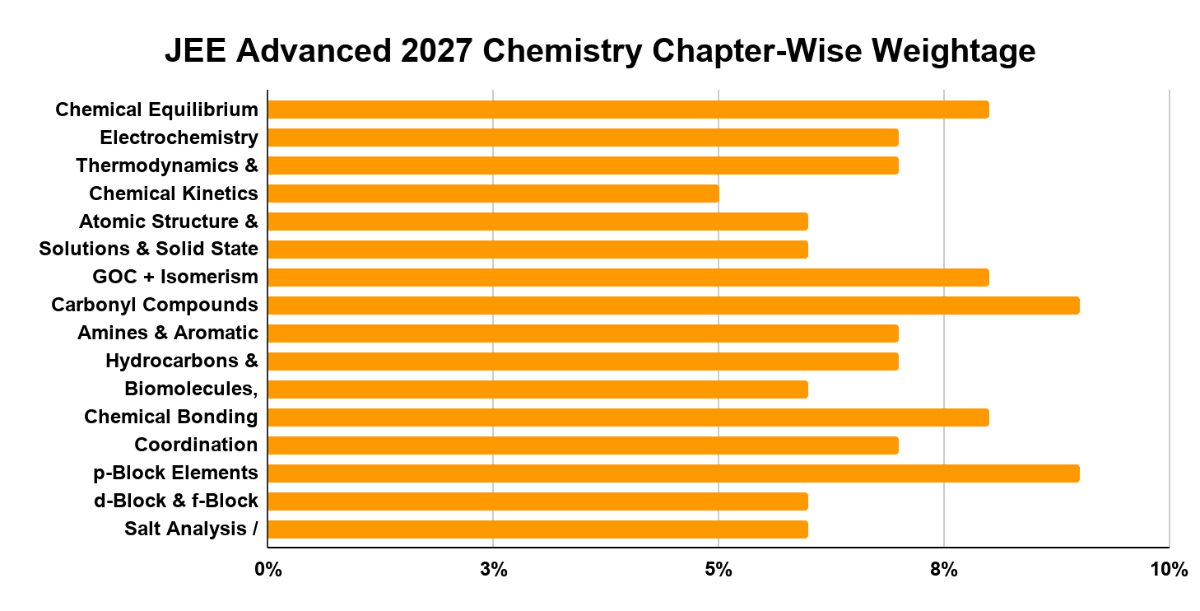
Chemistry carries approximately 120 marks in the JEE Advanced exam based on previous year data. In the JEE Advanced exam, the questions from the three branches of Chemistry which are Physical, Organic and Inorganic are well balanced.
- In JEE Advanced 2027 Chemistry, Organic Chemistry (especially reaction mechanisms) and Chemical Bonding remain the high scoring areas.
- Candidates are recommended to study the entire JEE Advanced Chemistry syllabus since it combines all the concepts in Chemistry through different chapters.
| Branch | Chapter / Topic | Approx. Weightage | Expected Questions |
|---|---|---|---|
| Physical | Chemical Equilibrium (Ionic + Chemical) | 6–8% | 2 |
| Electrochemistry | 6–7% | 2 | |
| Thermodynamics & Thermochemistry | 5–7% | 1–2 | |
| Chemical Kinetics | 3–5% | 1 | |
| Atomic Structure & Mole Concept | 4–6% | 1–2 | |
| Solutions & Solid State | 4–6% | 1–2 | |
| Organic | GOC + Isomerism | 6–8% | 2 |
| Carbonyl Compounds (Aldehydes, Ketones, Acids) | 7–9% | 2–3 | |
| Amines & Aromatic Compounds | 5–7% | 1–2 | |
| Hydrocarbons & Haloalkanes | 5–7% | 1–2 | |
| Biomolecules, Polymers & POC | 4–6% | 1–2 | |
| Inorganic | Chemical Bonding | 6–8% | 2 |
| Coordination Compounds | 5–7% | 2 | |
| p-Block Elements | 7–9% | 2–3 | |
| d-Block & f-Block | 4–6% | 1–2 | |
| Salt Analysis / Qualitative Analysis | 4–6% | 1–2 |
JEE Advanced Question Papers:
Ques. Does the JEE Advanced pattern change in 2027?
Ans. No change has been announced for JEE Advanced 2027 yet. The 2026 pattern remained consistent with previous years, so candidates can follow the latest pattern until IIT Bombay releases the 2027 brochure.
JEE Advanced Exam Pattern 2027: Timing, Duration and Language
JEE Advanced Exam Pattern 2027 Timing is will be 9 AM and 2:30 PM schedule for Paper 1 and Paper 2 as per previous year trends.
- Both papers are conducted on the same Sunday with Paper 1 in the morning and Paper 2 in the afternoon.
- PwD candidates receive one hour of compensatory time for each paper under the stated examination arrangement.
- The question paper is available in English and Hindi and candidates can switch between the two languages during the examination.
| Particulars | Details |
|---|---|
| Exam Date | Expected in mid-May 2027 (Sunday) |
| Number of Papers | 2 (Paper 1 and Paper 2) |
| Paper 1 Timing | 09:00 AM – 12:00 PM (IST) |
| Paper 2 Timing | 02:30 PM – 05:30 PM (IST) |
| Duration per Paper | 3 hours |
| Duration for PwD Candidates | 4 hours per paper |
| Total Exam Duration | 6 hours (same day) |
| Medium / Language | English and Hindi |
| Mode | Computer-Based Test (CBT) |
Also Check:
- JEE Advanced Exam 2024 AAT Question Paper with Answer Key PDF
- JEE Advanced Exam 2024 PCM May 26 Paper 2 Question Paper Pdf - Check Solutions with Answer Key Pdf
Ques. Is the JEE Advanced Paper of 6 hours?
Ans. Yes, JEE Advanced has two papers of 3 hours each, making 6 hours of total exam time. However, the papers are conducted in two separate shifts, with a break between them.
JEE Advanced Exam Pattern vs JEE Main Exam Pattern 2027
JEE Advanced Exam Pattern and JEE Main Exam Pattern differ in the number of attempts with JEE Main offering two sessions each year.
- JEE Advanced allows only one attempt in a year with a maximum of two consecutive attempts.
- Multiple Correct questions in JEE Advanced can use partial marking unlike the fixed +4/−1 scheme stated for JEE Main.
- JEE Advanced can include a −2 penalty in certain Multiple Correct questions which makes its marking pattern different from JEE Main.
- The JEE Advanced exam pattern can change each year while the JEE Main pattern has followed the 75 question, 300 mark structure since 2025.
| Particulars | JEE Main 2027 | JEE Advanced 2027 |
|---|---|---|
| Conducting Body | National Testing Agency (NTA) | IIT Delhi (Expected) |
| Mode | Computer-Based Test (CBT) | Computer-Based Test (CBT) |
| Number of Papers | 1 (for B.E./B.Tech) | 2 (Paper 1 + Paper 2) |
| Duration | 3 hours | 3 hours per paper (Total 6 hours) |
| Total Questions | 75 (25 per subject) | Varies |
| Total Marks | 300 | ≈ 360 |
| Subjects | Physics, Chemistry, Mathematics | Physics, Chemistry, Mathematics |
| Question Types | Single Correct MCQ + Numerical Value | Single Correct, Multiple Correct, Numerical, Integer, Match the List, Paragraph |
| Marking Scheme | +4 correct, –1 incorrect (fixed) | Full / Partial / Zero / Negative (varies by type) |
| Partial Marking | No | Yes (for Multiple Correct questions) |
| Language | 13 languages | English and Hindi only |
| Frequency | Twice a year (January & April) | Once a year |
| Pattern Fixed? | Yes (almost fixed every year) | No (changes every year) |
Also Check:
- JEE Advanced 2023 Question Paper 1 (Available): Download Question Paper and Answer Key PDFs
- JEE Advanced 2023 AAT Question Paper PDF (Available)
Ques. Is JEE Advanced tougher than JEE Main?
Ans. Yes. JEE Advanced is generally considered tougher than JEE Main because it has more complex, application-based questions and varied marking schemes. The exam also tests deeper understanding of Physics, Chemistry and Mathematics.
JEE Advanced Exam Previous Years’ Papers
| Year | Paper | PDF Link |
|---|---|---|
| JEE Advanced 2025 | Paper 1 | Download PDF |
| Paper 2 | Download PDF | |
| JEE Advanced 2024 | Paper 1 | Download PDF |
| Paper 2 | Download PDF | |
| JEE Advanced 2023 | Paper 1 | Download PDF |
| Paper 2 | Download PDF | |
| JEE Advanced 2022 | Paper 1 | Download PDF |
| Paper 2 | Download PDF |
JEE Advanced Exam Pattern 2027: Frequently Asked Questions (FAQs)
Ques. Which IIT will conduct JEE Advanced 2027?
Ans. IIT Delhi is expected to be the organising institute for JEE Advanced 2027, based on the JAB's round-robin rotation, though the official notification is still awaited.
Ques. What rank is 70 marks in JEE Advanced?
Ans. 70 marks can generally result in a rank in the tens of thousands, but the exact rank depends heavily on the paper difficulty and year. For comparison, 109 marks corresponded to CRL Rank 25,946 in JEE Advanced 2024.
Ques. Will JEE Advanced 2027 be tough?
Ans. The difficulty of JEE Advanced 2027 cannot be predicted officially. The paper may range from moderate to difficult, with the difficulty level varying across Physics, Chemistry and Mathematics. Candidates should prepare for a challenging paper rather than rely on predictions.
Ques. Is IIT tougher than CA?
Ans. Both are highly competitive but difficult in different ways. JEE Advanced requires strong problem-solving in Physics, Chemistry and Mathematics, while CA involves extensive study of accounting, taxation, law and other subjects, so one cannot be directly considered tougher than the other.
Ques. How many papers are there in JEE Advanced 2027?
Ans. JEE Advanced 2027 will have two compulsory papers, Paper 1 and Paper 2, both conducted on the same day in different shifts. Skipping either paper makes a candidate ineligible for the rank list.



Comments